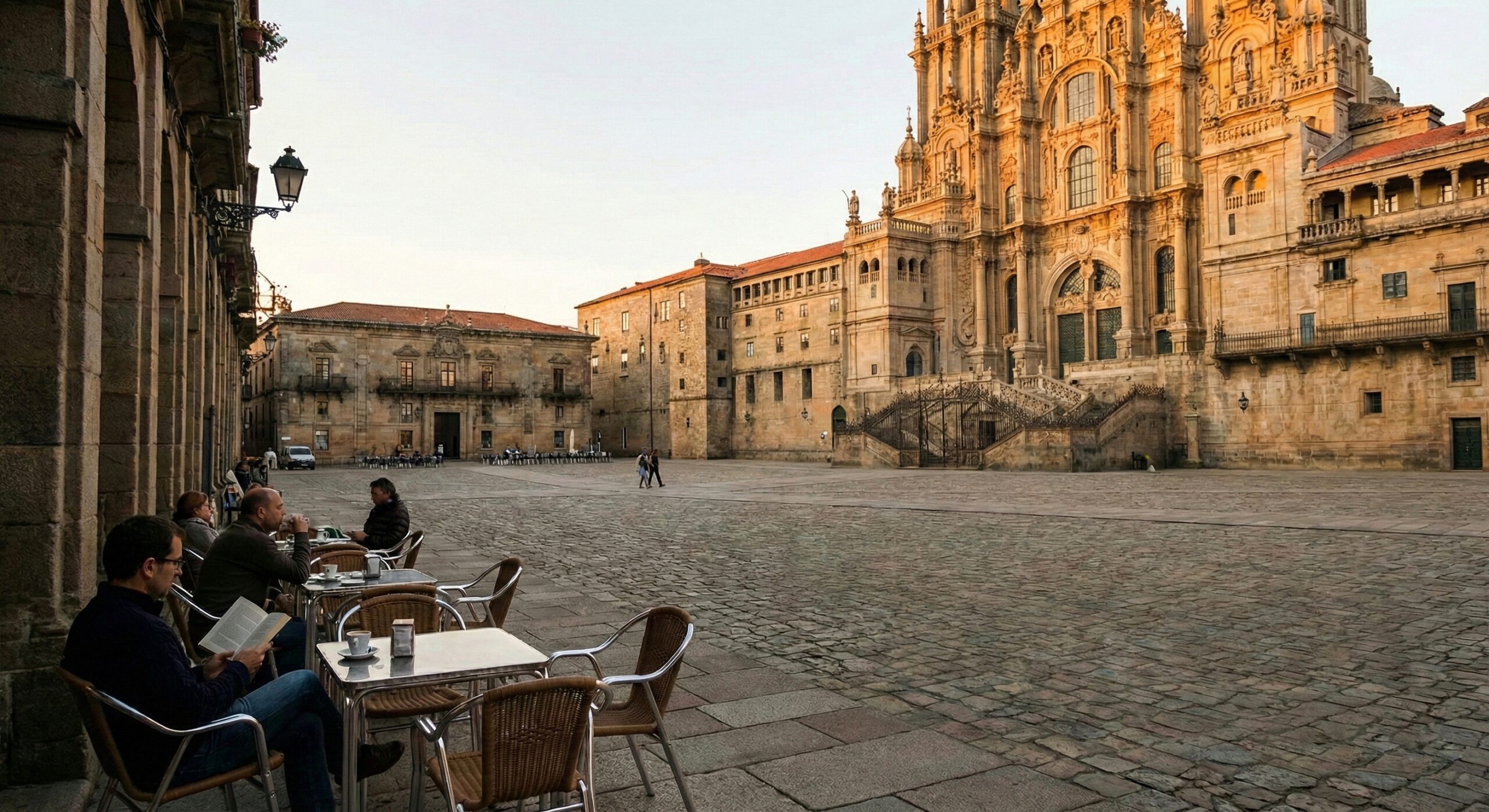
The echo of eternity: A spiritual guide through Santiago
The continuation of the pilgrimage in the heart of the city
After days or weeks of walking, you have arrived. You have carried the shell, trusted the yellow arrows and perhaps sacrificed blisters, rain and exhaustion. Once you arrive in Santiago, the question often arises: “And now?” For the spiritual pilgrim, the city is not a destination, but a sacred space in which the experiences of the journey are allowed to settle.
Here you can find out how you can use these 2 to 3 days to encounter God, the apostle and yourself in silence and liturgy.
Day 1: The encounter with the apostle
The entry through the Holy Door (Porta Santa)
If you arrive in a Holy Year (Xacobeo) – i.e. if July 25 falls on a Sunday – the central spiritual act is the passage through the Porta Santa on the Praza da Quintana. It symbolizes the transition from the old to the new, forgiveness and a new beginning. But the Quintana is also a place of contemplation outside of the Holy Years. Stop for a moment and reflect: What am I leaving behind? What am I taking with me into this sacred precinct?
The rites of the cathedral: more than tradition
The Cathedral of Santiago is not a museum, but a living reliquary. There are three classic acts that you should perform with care:
- The descent into the crypt: the bones of St. James and his disciples Athanasius and Theodore rest in a silver urn under the main altar. It is a place of absolute silence in the midst of the hustle and bustle. Don’t look for pomp here, but for a connection to the apostolic tradition. A short prayer here will connect you with millions of pilgrims who have visited the same place for over a thousand years.
- The “Abrazo” – the embrace of the saint: Climb the narrow staircase behind the high altar to embrace the life-size statue of St. James from behind. There is deep symbolism in this gesture: it is thanks for protection on the way and trust in spiritual guidance. Whisper your intentions or thanks for your arrival to him.
- The pilgrims’ mass and the Botafumeiro: The daily pilgrims’ mass at 12:00 noon (and often also in the evening) is the liturgical fixture. When the names of the pilgrims who have arrived and their countries of origin are read out, you can feel the universality of the Church(Catholica). When the botafumeiro, the huge censer, swings through the transept, it is not just a spectacle. The rising smoke symbolizes the prayers of the pilgrims ascending to God. Breathe in the scent deeply – it is the “smell of the Camino”.
Capilla de la Corticela: The community of pilgrims
In a corner of the cathedral, almost hidden away, is the La Corticela chapel. Originally an independent church from the 9th century, it was later integrated into the cathedral building. It is considered the “parish of pilgrims and strangers”. There is a completely different, more intimate atmosphere here than at the magnificent main altar. It is the perfect place for a personal prayer of thanksgiving away from the crowds of tourists.
Day 2: Monastic silence and the liturgy of the hours
On your second day, we invite you to leave the hustle and bustle of the souvenir stores and explore the spiritual map of the city.
San Pelayo de Antealtares: The prayer of the nuns
Directly opposite the cathedral, separated only by the Praza da Quintana, is the convent of the Benedictine nuns.
- Spiritual tip: Visit the nuns’ vespers (evening prayers). When their voices ring out from behind the choir screen, time seems to stand still. The Gregorian chants and the simplicity of the room offer a deep contrast to the baroque gold of the cathedral. Here you can find the inner peace to organize your diary notes or simply just be.
San Fiz de Solovio: where it all began
This small church near the market is often overlooked. But it stands in one of the most sacred places in the city. The hermit Paio (Pelagius) lived here in the 9th century, who saw the lights above the field that led to the discovery of the tomb of the apostles(Campus Stellae – Field of Stars). The church is often open for silent worship. It is the place of “vision” – ask yourself here: What light has led me on my path?
The International Pilgrimage Center (Centro de Acogida al Peregrino)
Don’t just pick up your Compostela, take advantage of the spiritual offerings on the upper floor. There are chapels for different language groups and priests who are available for confession or spiritual discussions. Many pilgrims report that only a clarifying conversation about the experiences of the last few weeks clears the way inwardly for their return home.
Day 3: The path inwards and looking ahead
San Francisco de Santiago: Franciscan humility
The San Francisco monastery is just a few steps from the north exit of the cathedral. Legend has it that St. Francis of Assisi himself came here as a pilgrim in 1214.
- Impulse: Franciscan spirituality emphasizes simplicity and love of creation – core values of pilgrimage. Visit the museum in the cloister and linger in the garden. It’s a good place to think about how you can integrate the simplicity of the Camino (a rucksack, a pair of shoes, the bare essentials) into your everyday life at home.
Santa María del Sar: The bent columns
Just outside the center is the collegiate church of Santa María del Sar. It is famous for its dramatically leaning pillars, which almost collapse due to the unstable ground, but have held up for centuries.
- Spirituality of fragility: This church is a wonderful parable for human life and faith. We all have “bumps in the road”, we are fragile and often insecure, but we are held – by God’s grace and community. A visit here is an exercise in humility.
Monte do Gozo: the mountain of joy
If you have the strength, walk the last 4-5 kilometers of the path back to Monte do Gozo. There you will find the monument of the two pilgrims pointing to the towers of the cathedral.
- Ritual: Sit on the grass and look out over the city. Reflect on the moment of your first sighting. The Camino is a metaphor for life after death: arduous walking, trials and finally the arrival in the “heavenly city”. Bless the way you have come and bless the city that has welcomed you.
Practical companions for spirituality
- The pilgrim’s prayer: Carry the classic pilgrim’s prayer with you (many churches offer small cards). It often begins with the words: “Apostle James, friend of the Lord…”
- Candle offering: Lighting a candle (often electric today, but the gesture counts) is a physical expression of your prayer for those who have stayed at home or who can no longer go on pilgrimage.
- Quiet times: The cathedral is often very full between 12:00 and 14:00. The early morning hours (from 7:00 a.m.) or the time shortly before closing (9:00 p.m.) offer the most atmosphere for an undisturbed conversation with God.
Santiago is a place where heaven touches the earth. Take these 2-3 days to not only rest your body, but also your soul. The most important part of your pilgrimage is not the journey you make, but the person you return home as.