It is the least glamorous topic of the trip, but one of the most important:
Where and how do I do my business?
On the Way of St. James, the answer is a mixture of strategic planning, Spanish café culture and strict “leave no trace” ethics. But above all, it is a clue:
Try not to do it in nature!
1 The power of numbers: why we need to be careful
Over 500,000 people now make the pilgrimage to Santiago de Compostela every year. If everyone leaves a handkerchief by the wayside even once, the Camino will turn into a sea of “white flowers” in no time at all. Discipline is required to keep the path clean for everyone.
2. the golden rule: use the bars
On the main routes, you will often pass a bar every 5 to 10 km. This is the safest and most hygienic option. And that’s how long you’ll last in 98% of cases.
Etiquette: Don’t walk past the counter to the loo without saying a word. It’s good manners to say hello first and ideally order a snack (a café solo, a water or a tortilla).
The language bridge (How to ask politely):
If you are unsure, use these sentences:
“Hola, ¿puedo usar el baño, por favor?” (Hello, may I use the bathroom, please?) – The polite classic.
“¿Dónde está el baño?” (Where is the toilet?) – If you need to go quickly.
“¿Tienen baño?” (Do you have a toilet?) – If it is not obvious from the outside whether there is a toilet.
3. the “emergency scenario”: off into the bushes
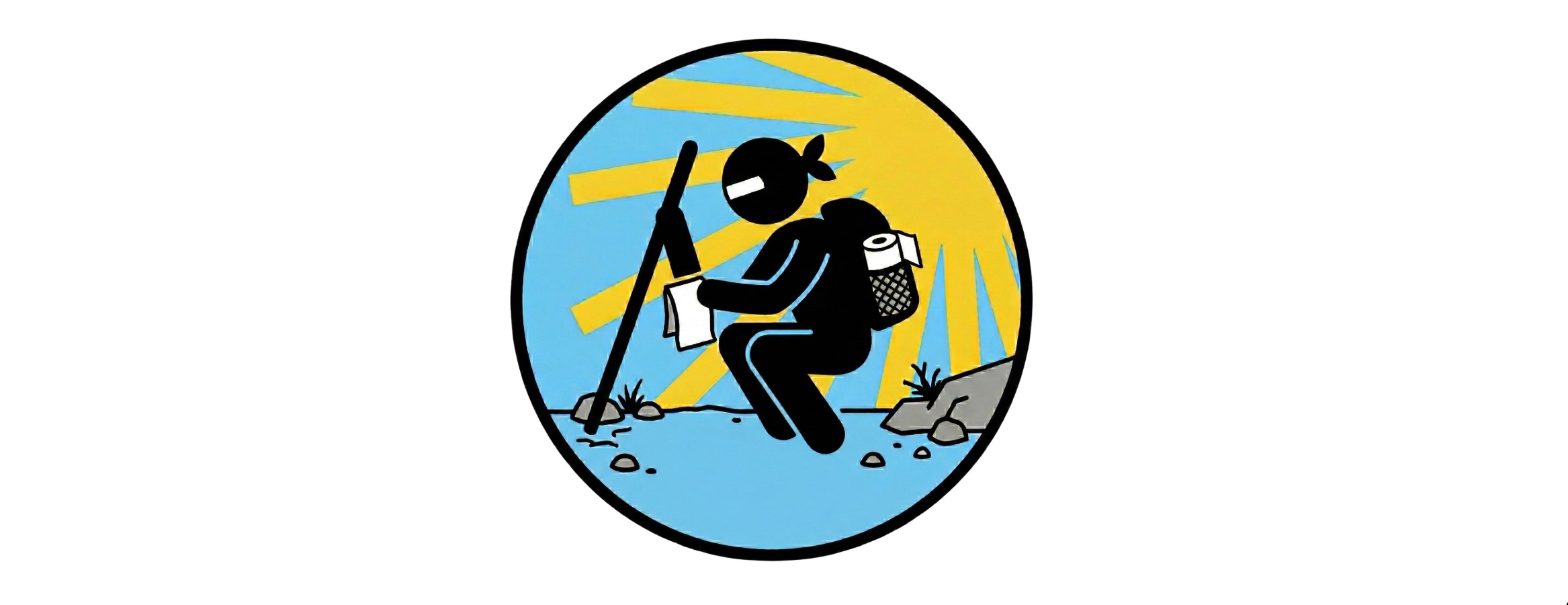
If you absolutely can’t make it to the next village, but only then, follow the “cat hole” principle:
Keep your distance: Walk at least 60 meters (about 80 paces) away from the path, water sources or sleeping areas.
Dig: Use a stone or your stick to dig a hole about 15 cm deep.
The toilet paper taboo: never leave paper or wet wipes lying around! They decompose much more slowly than you think.
The solution: Put used paper in a ziplock bag and dispose of it in the nearest garbage can. It’s best to have two bags, one to hold your business and then another to double seal the first bag really securely.
4. your “toilet survival” kit
What belongs in your daypack so that you are never surprised:
Your own emergency roll: Never rely on there still being toilet paper in the bar.
Disinfectant gel: A must, as soap is often in short supply in public toilets.
Ziplock bags: For the hygienic removal of waste. Bags for dog waste also work.
Wash your hands: Hygiene is the best protection against the infamous “pilgrim’s stomach”.
5. small phrasebook for emergencies
| German | Spanish | Pronunciation (approx.) |
| Where is the toilet? | ¿Dónde está el baño? | Don-de es-ta el ban-jo? |
| May I use the toilet? | ¿Puedo usar el baño? | Pue-do u-sar el ban-jo? |
| Toilet paper | Papel higiénico | Pa-pel i-chi-e-ni-ko |
| It is occupied. | Está ocupado. | Es-ta o-ku-pa-do |
| Thank you! | ¡Gracias! | Gra-zi-as |
Conclusion
We are guests in nature and in the small villages of Spain. With over 500,000 pilgrims, “Leave No Trace” is not a suggestion, but a duty. Respect the land by leaving nothing behind but your footprints.