A very personal pilgrimage report
My wife Birgit (58) and I (65) quickly decided that we would walk the Portuguese Way of St. James from the port city of Porto in Portugal to the legendary pilgrimage city of Santiago de Compostela in Spain.
To the spiritual city of Galicia where the mortal remains of St. James the Apostle are kept in the local cathedral. We want to experience for ourselves what has driven millions of people since the 9th century, when the tomb of the apostle was discovered. Walk a part of the path that is shrouded in myth and adventure.
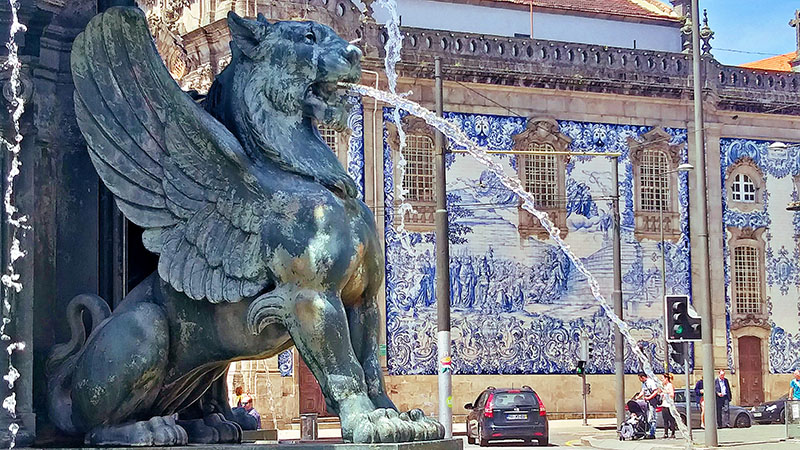
After spending a day exploring the beautiful city of Porto, also known for its many tiled facades (azulejos), we finally set off. Well prepared, we set off on the 280-kilometre-long coastal path “caminho portugues” on 06.05.2019.
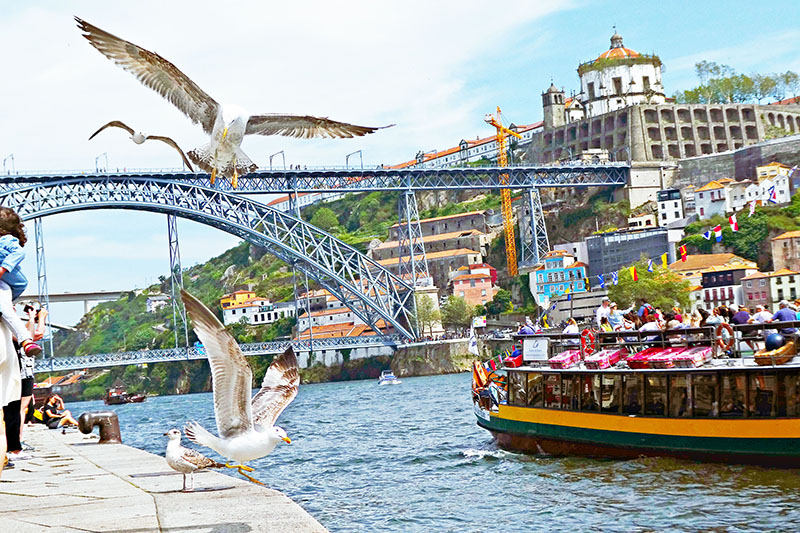
We divided the overall route into 13 stages, so on average we had to cover around 20 kilometers a day. That should be manageable on the rather flat route profile. The accommodation was booked in advance and that was a good thing.
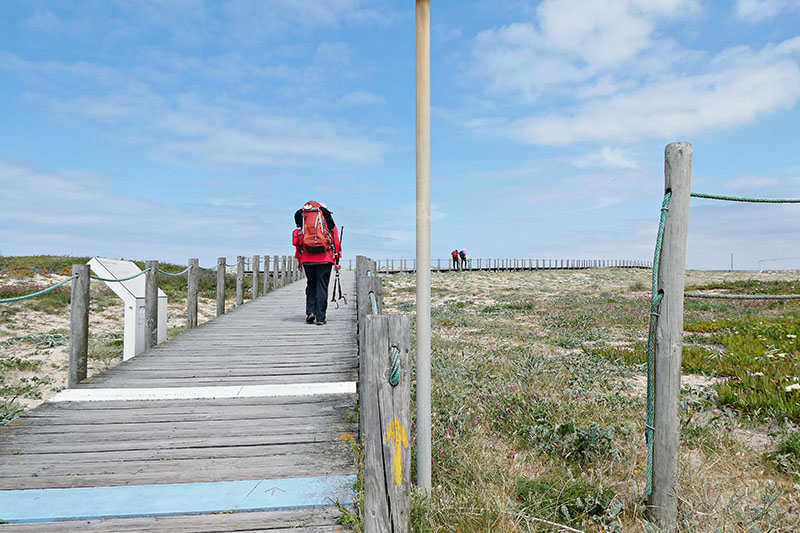
Many pilgrims were already on the road in May, which meant that some of the accommodation on the increasingly popular coastal route was fully booked. One pilgrim told us that he had to walk another 8 kilometers to find accommodation for the night.
From now on, our backpacks are our constant companions. For the first two days, I berate it as an annoying 10-kilo weight on my back. From the third day onwards, I no longer feel it and from the fourth day onwards, I even miss it when I take it off. Luckily, the hiking boots are comfortable and well broken in; put them on and no longer feel your feet, that’s how it should be. None of us had blisters on our feet. And to say it up front, no, there was no marital quarrel, on the contrary, we walked harmoniously at the same pace and enjoyed the many new impressions. It was a shared pilgrimage with all our senses.
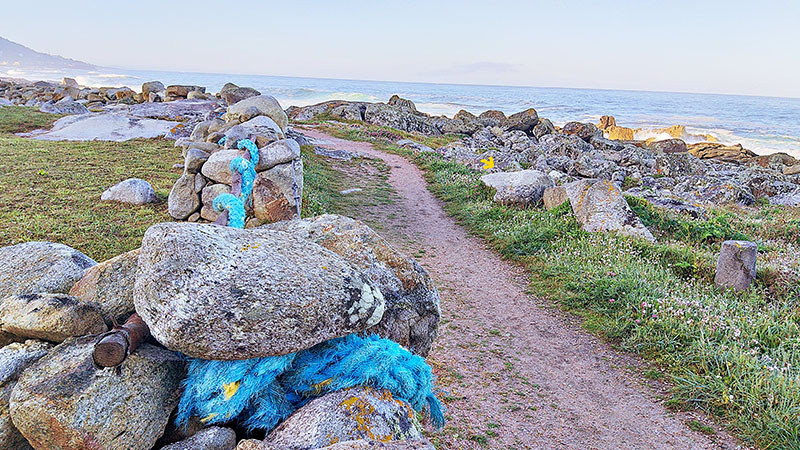
In the truest sense of the word. We saw, heard, smelled and tasted lots of new things.
The first five stages in Portugal run along the Atlantic coast. The mighty sound of the sea and the unmistakable cries of the seagulls are always on the left.
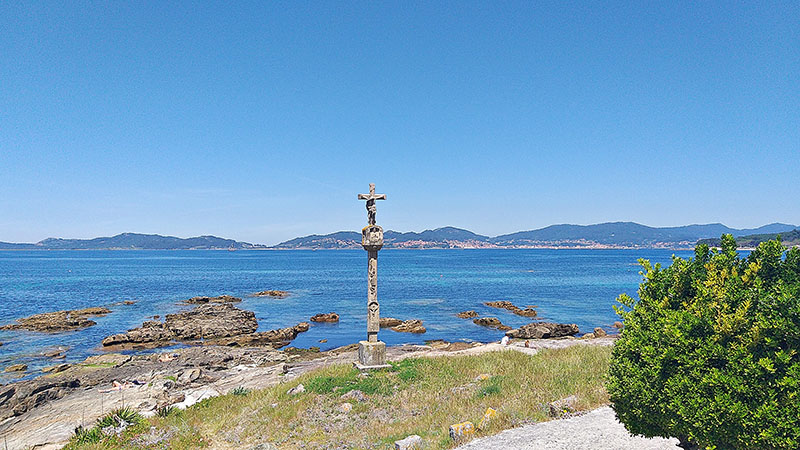
In warm but windy weather, we cycle for miles, often alone, quietly and relaxed along well-maintained wooden boardwalks, through secluded dunes and bays that invite us to stop and take a breather, past idyllic beaches and small, dreamy villages. From time to time there are small rain showers, which we don’t mind.
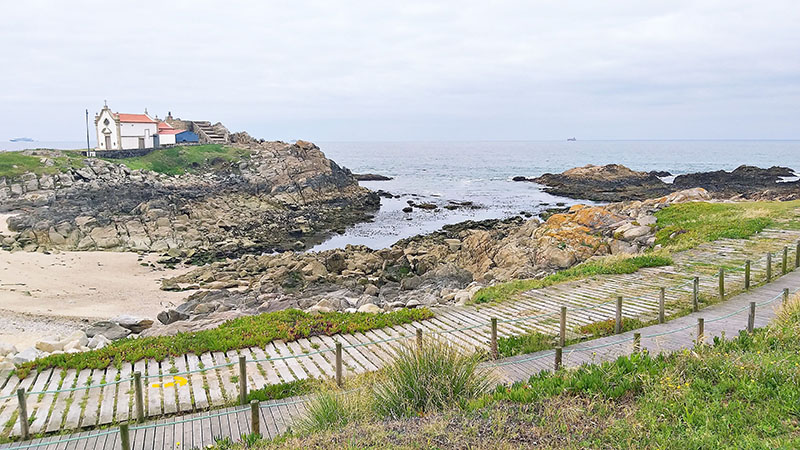
Every now and then we meet other pilgrims and we shout the obligatory pilgrim’s greeting “buen camino” to each other. With some of them you get into a longer conversation and you walk part of the way together. We meet some of them again and again on the stages and everyone is happy to see each other again.
My wife loves the callas flowers that grow wild almost everywhere and the strelitzia. She also loves the fresh fish that we enjoy here every evening.
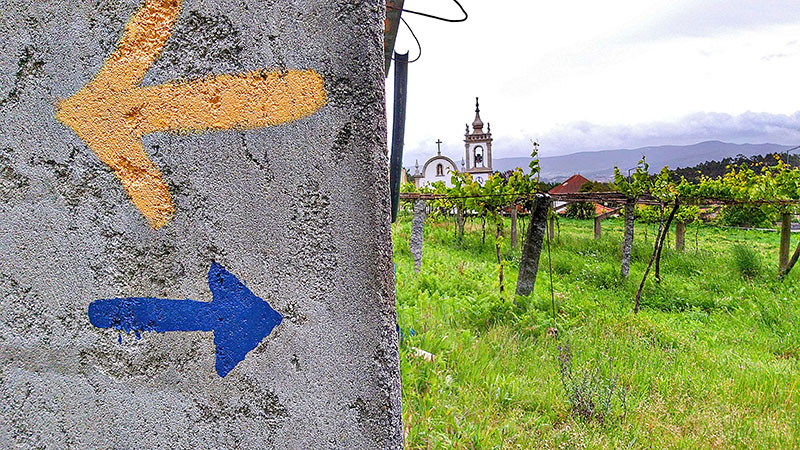
We are guided by the reliable yellow arrows that mark the Way of St. James. Unfortunately, the coastal path in Portugal is not yet fully completed, so that we are repeatedly led inland along less attractive paths. But it always leads back to the sea.
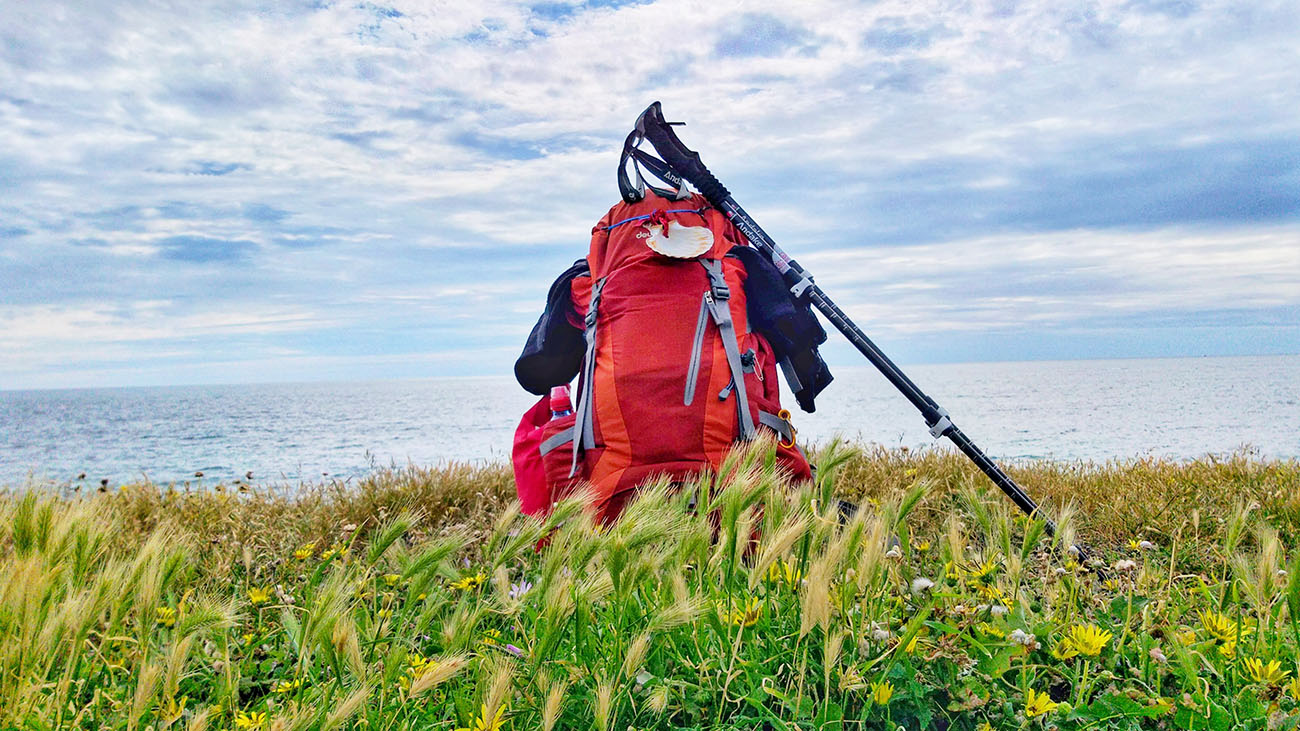
Especially here in Portugal, we are approached in a friendly manner by many people, some of whom have worked in Germany, mostly in the port of Hamburg, and speak some German. They admire our plans and wish us a Portuguese “bom caminho” or “bom dia”. Others have walked the Way of St. James themselves and are happy to give us insider tips on where to stop for a break. Always look for the cafés that are also used by locals. A good tip, as we also noticed from the reasonable prices. We were welcome everywhere. Recognized as pilgrims – after all, we carry the scallop shell as a pilgrim symbol on our rucksacks – people pay us great tribute and seek out conversation.
A praising “thumbs up” is often enough. Many drivers honk their horns in appreciation.
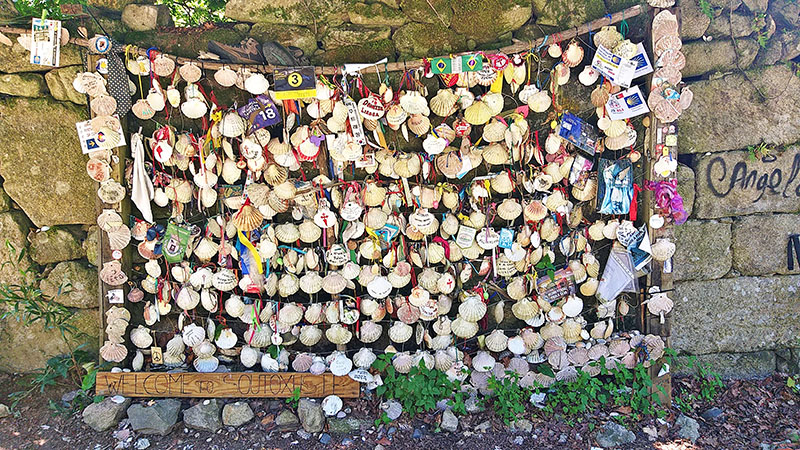
We experienced an unforgettable and very emotional encounter on the third stage. We visit the small church of St. Michael behind the village of Esposende. It’s part of our ritual to visit churches, to come down for a moment, reflect, light a candle and, admittedly, also to cool off a little, as it was a very warm 29 degrees that day.
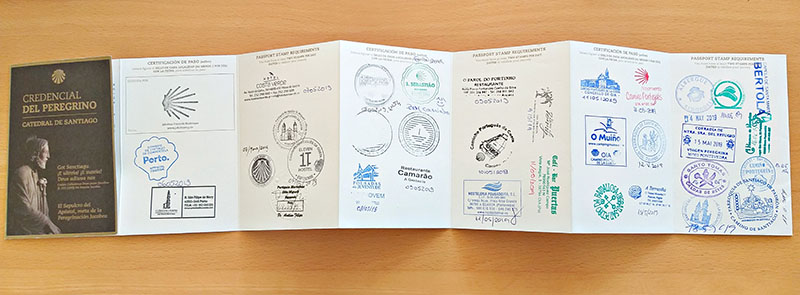
You will often also receive a pilgrim’s stamp in the churches for our pilgrim’s booklet. The daily stamps are used to document the route you have walked with the date so that you can later receive the pilgrim’s certificate, the Compostela, in Santiago de Compostela.
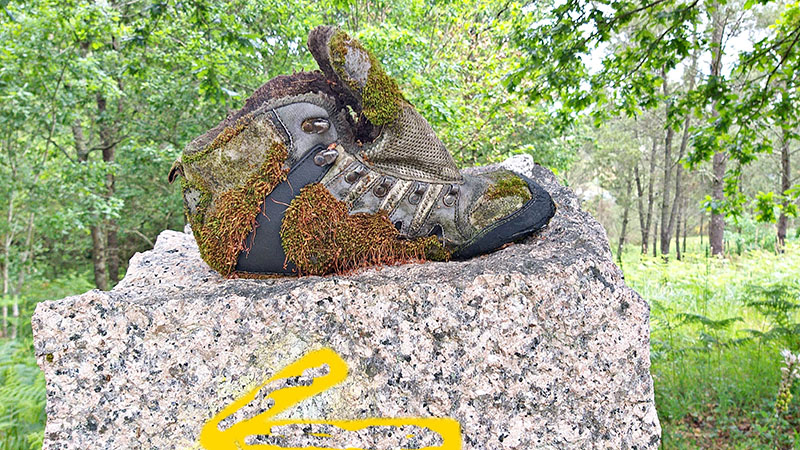
Unfortunately, the church is closed and we are about to leave disappointed when an elderly man appears. We recognize the priest from his clothes. He unlocks the church and waves us in. He explains the church to us in Portuguese staccato
We don’t understand a word. Then he invites us into the sacristy. With a rare embossed stamp and his signature, he makes us and our pilgrim’s booklet happy.
He then places his hands over our heads and gives us his personal pilgrim’s blessing. We then pray the “Our Father” together. He in Portuguese and we in German. We are deeply moved. I am not ashamed of my tears. As we walk on in silence, still completely impressed, the priest comes running after us and hands us a piece of paper with a German prayer and a wooden figure of Jesus. We say a heartfelt goodbye.
We didn’t talk much more on this stage.
On the fifth stage, we reach the border with Spain, which runs through the middle of the Rio Mino, where it is customary to cross by ferry, but unfortunately we miss it by 5 minutes. A motorized fishing boat then takes us across for 5 euros in a fast and wet ride.
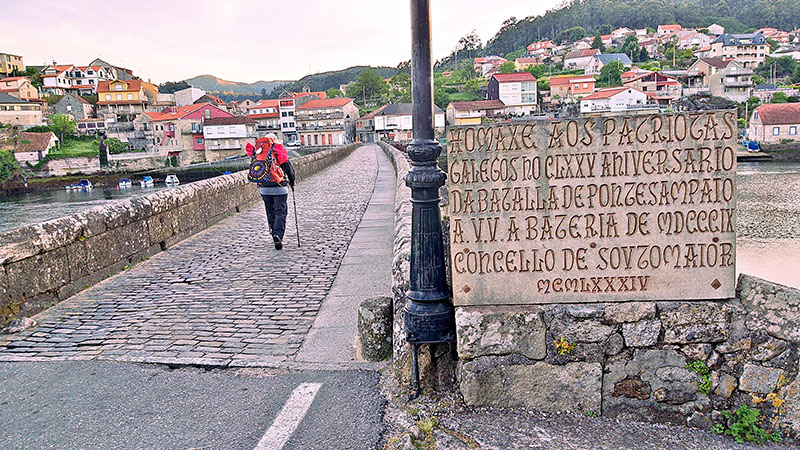
So now 8 stages in Spain. Now it’s “buen camino and buen dia” again and the clock is set forward another hour.
Galicia welcomes us with a heavy downpour at a warm 18 degrees and for the first time we really climb uphill to Monte Santa Tegra and a well-preserved Celtic village. The first four stages then take us up and down the stony paths that were built by the Romans and Celts, along the somewhat rugged and rough Atlantic coast accompanied by a strong breeze.
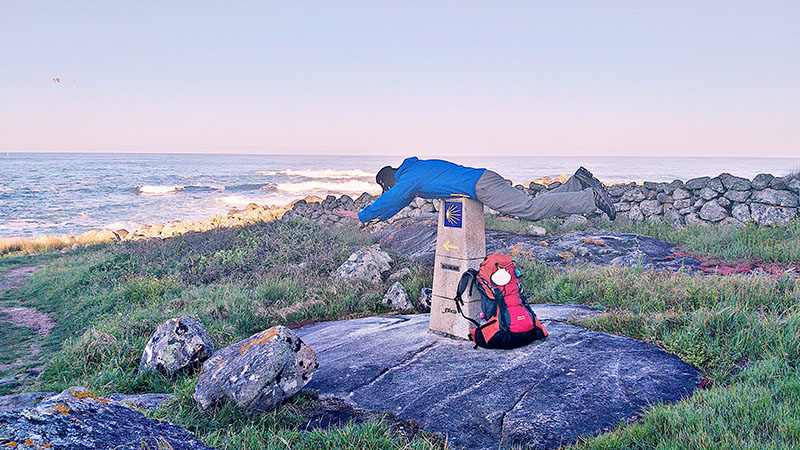
The yellow arrows are supplemented by the typical and unmistakable kilometer markers, which not only show us the way to our destination, but also indicate the remaining kilometers to Santiago de Compostela.
Lighthouses, old monasteries and crumbling castle ruins alternate with small fishing villages, dreamy bays and lively harbors.
On the tenth stage, we reach the historic town of Pontevedra, the capital of the Portuguese coastal route. The local church “La Peregrina” has the shape of a scallop shell and a visit is a must for every pilgrim.
The Galician landscape becomes more varied, with lush meadows, fields and small rivers.
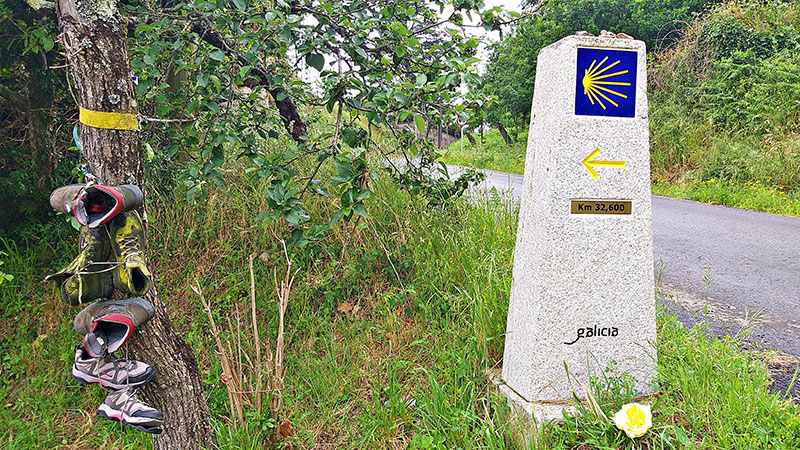
The route through an aromatic eucalyptus forest is impressive, we breathe in and out the ethereal air deeply and feel pleasantly refreshed.
A very special nature experience.
Lush lemon and orange trees delight my wife just as much as the countless
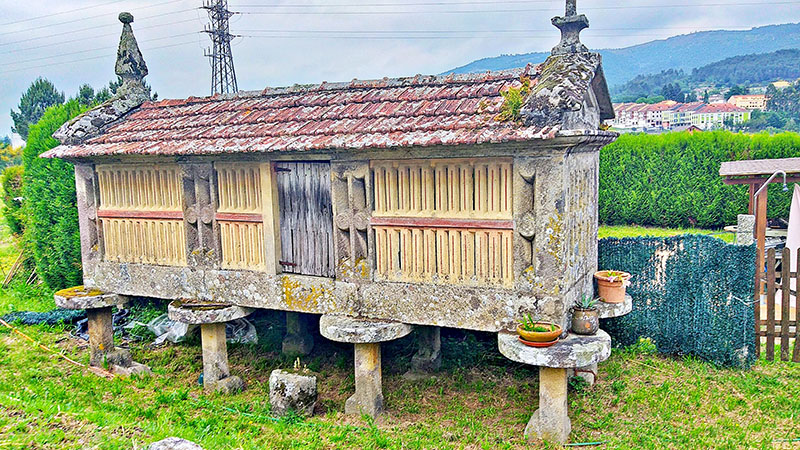
Horreos, these distinctive granaries for fruit and maize built of stone or wood on pillars.
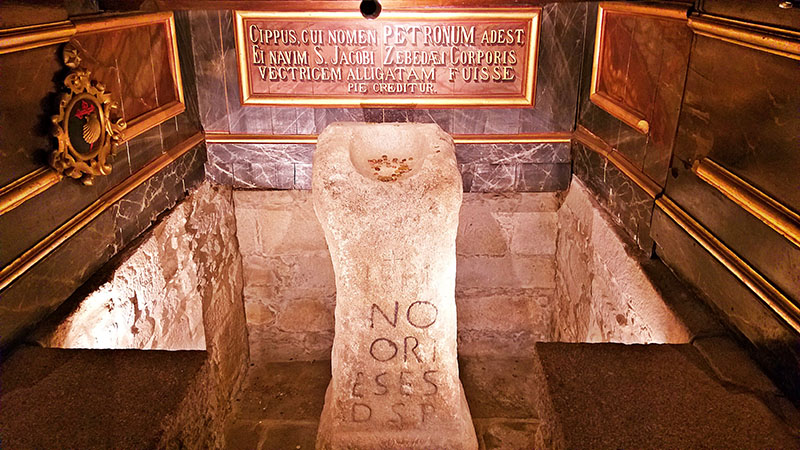
On the penultimate stage, we reach Padron, where, according to tradition, the boat with the body of the apostle St. James docked on a stone. We visit the impressive Church of St. James and can also see the mighty stone behind the altar where the boat is said to have docked.
On the market square, we meet a 57-year-old Dutchman who looks like a well-groomed pilgrim. He tells us that he left home at 17, led an eventful life at sea for 20 years and has now been living on the streets for 20 years. He cannot and does not want to imagine a different life. We invite him to dinner and get to know a likeable person who seems to be at peace with his life.
The last stage to Santiago de Compostela is approaching. Anticipation, but also sadness that the journey is now coming to an end, arises when the kilometer marker suddenly shows only 10 kilometers to the finish.
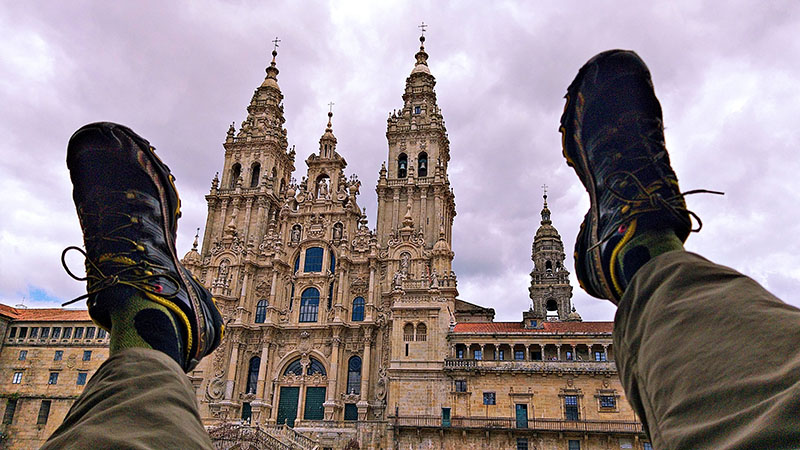
Finally, we stand in awe on the large forecourt of the imposing cathedral of Santiago de Compostela. Incredible scenes take place. Dances of joy are performed, strangers hug each other, tears flow, the ground is kissed, people sing and laugh and, of course, photographs are taken.
We are also very moved and overwhelmed, sit in silence in the square for a very long time, want to arrive inwardly and simply let the atmosphere take effect on us.
Much later, we visit the cathedral (which is currently being renovated inside), embrace the statue of St. James and proudly receive our pilgrimage certificate.
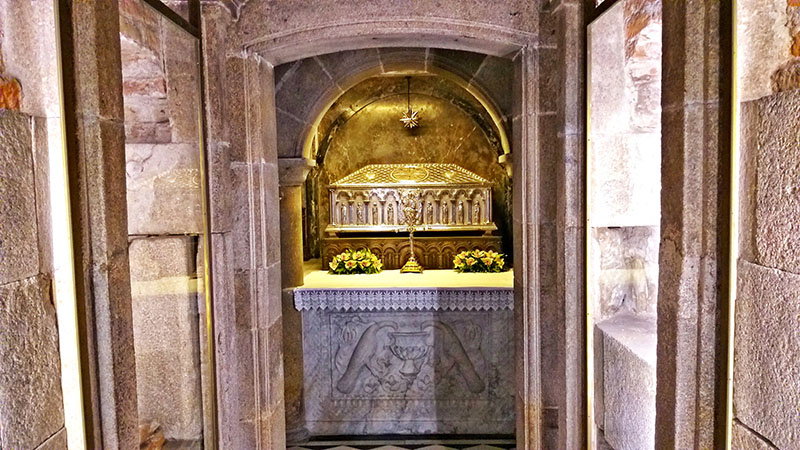
We had an impressive and lasting experience.
We got to know lots of interesting people from all over the world and had some nice encounters.
There was the ever-smiling Japanese couple, who took small steps along the Way of St. James rather than making a pilgrimage.
There was the young Czech woman who was connected to her boyfriend in Prague online via cell phone and was constantly filming and reporting to him; he was tracking her location via GPS.
There was the Irishman who thanked us warmly for the brief conversation and described us as real Germans, saying that we were not from the East and not from Bavaria.
There were the two somewhat “lost” ladies from Lake Constance, who kept getting lost but still managed to reach their destination.
There was the Spaniard who led us across the city to our accommodation and told us about his four tours on the Way of St. James.
And there was the singing nun in the church who, when asked about her great voice, replied: “The voice was given to me by God for you!”
No, we have not reached our physical limits and have arrived in good health.
We have not met God personally (or have we?), but we have met his diverse, wonderful creatures and impressive works.
And we are very grateful for that. Buen Camino.
Karl Hofstätter
Our tour
- Day 1: Flight from Frankfurt to Porto
- Day 2: Sightseeing Porto
- Day 3 (23 km): First stage from Porto-Matosinhos to Povoa de Varzim
- Day 4 (22 km): Second stage from Povoa de Varzim to Esposende
- Day 5 (24 km): Third stage from Esposende to Viana do Castelo
- Day 6 (25 km): Fourth stage from Viana do Castelo to Vila Praia de Ancora
- Day 7 (22 km): Fifth stage from Vila Praia de Ancora to A Guarda/Spain
- Day 8 (20 km): Sixth stage from A Guarda to Viladesuso
- Day 9 (20 km): Seventh stage from Viladesuso to Baiona
- Day 10 (25 km): Eighth stage from Baiona to Vigo
- Day 11 (22 km): Ninth stage from Vigo to Arcade
- Day 12 (16 km): Tenth stage from Arcade to Pontevedra
- Day 13 (21 km): Eleventh stage from Pontevedra to Caldas de Reis
- Day 14 (28 km): Twelfth stage from Caldas de Reis to Padron
- Day 15 (22 km): Thirteenth stage from Padron to Santiago des Compostela
- Day 16: Sightseeing tour Santiago de Compostela
- Day 17: Return flight from Santiago de Compostela to Frankfurt