

Southern Route – From Huelva to Zafra
The Camino del Sur runs 183.1 kilometers from the port of Huelva to Zafra in Extremadura, where it joins the Vía de la Plata. Along the way you pass the mining landscape of Minas de Riotinto with its rust-red river, the castle town of Aracena up in the Sierra, and three villages called "de León" because for centuries they belonged to the Order of Santiago. Eight stages, ↗ 2,524 meters of climbing, a high point of 782 meters just past Fuentes de León, and nearly always the trail to yourself.
- 01At a Glance
- 02Overview
- 03Other Names
- 04Who It's Ideal For—and Who It's Not So Ideal For
- 05Route & Landscape
- 06Stages, Terrain, and Difficulty
- 07Three Villages Called "de León"—and None of Them in León
- 08Highlights Along the Way
- 09A River from Mars and the Englishmen's Soccer
- 10How Pilgrims Find Their Way onto This Path
- 11Continue the pilgrimage?
- 12Preparation & Practical Information
- 13What the journey will cost you
- 14Getting Here
At a Glance
- Start / Finish: Huelva / Zafra, junction with the Vía de la Plata (km 183.1)
- Length: 183.1 km
- Duration: 8 stages, averaging just under 23 km; 9 days with a stop in Campofrío
- Elevation: ↗ 2,524 m / ↘ 2,048 m
- Highest point: 782 m at km 135.3, just past Fuentes de León
- Landscape: the Campiña with olives and grain, stone pines and eucalyptus around Valverde, open-pit mines and a red river at Riotinto, the chestnut and holm-oak forests of the Sierra de Aracena, and finally the dehesas of Extremadura
- Operator / Waymarking: Asociación de Amigos del Camino de Santiago de Huelva; yellow arrows, fully waymarked since 2004, with fifty shell-marked waystones added in 2008
- Traces of St. James: castles and commanderies of the Order of Santiago in Segura de León, Fuentes de León, and Valencia del Ventoso, the Cross of St. James on many town coats of arms, a venerated Santiago figure in Campofrío, and the Hospital de Santiago of 1437 in Zafra
- Accommodation: pilgrim hostels in Cañaveral de León, Valencia del Ventoso, and Zafra; otherwise hostales, guesthouses, and rural houses
- Connecting routes: Vía de la Plata from Zafra via Mérida and Salamanca to Santiago
- Best time: October to April, most pleasant March to May and October to November; in summer the route is too hot
Overview
The Camino del Sur is the route that climbs from Spain's far southwestern corner up to the Vía de la Plata. It starts in Huelva, where the Odiel and the Tinto meet, a city founded as Phoenician Onoba in the 9th century BC, and ends in Zafra, the Renaissance town of the Dukes of Feria. In between lie 183.1 kilometers that take you through the province of Huelva from bottom to top: first flat farmland, then mining country, then the Sierra, then the pastures of Extremadura. Gronze's route guide calls it a beautiful way, "todavía poco conocido entre los peregrinos" (still little known among pilgrims)—and that's still true today.
It's also more honest than many Caminos about its history. Xacopedia, the St. James encyclopedia from Santiago, dates its beginnings to the 15th century and mentions pilgrims from the Canary Islands and the Americas who arrived through the port—but on Huelva itself it states soberly: "Sin antecedentes jacobeos investigados" (no researched Jacobean antecedents). What there is in abundance, though, are traces of the Order of Santiago, which settled the Sierra after 1248. So this route without documented medieval pilgrims runs through villages that belonged to the Apostle for centuries. The St. James association of Huelva waymarked it for the Holy Year of 2004.
Other Names
In Spanish the route is called the Camino del Sur, or in full Camino de Santiago del Sur or Camino del Sur de Huelva a Zafra; Xacopedia writes Camino-Sur. Some sources classify it as a feeder route to the Vía de la Plata or the Camino Mozárabe, which is only true insofar as it joins the Silver Way in Zafra. In German you'll see Südweg (Southern Way) or Jakobsweg von Huelva nach Zafra. It has nothing to do with the Camino del Sureste from Alicante.
Who It's Ideal For—and Who It's Not So Ideal For
Ideal if you want to walk the Vía de la Plata but would rather not start in flat Seville: from Huelva you get mining history, Sierra, and dehesa in eight days and then find yourself on the main route in Zafra. Also ideal if you're looking for silence. On many days you won't meet a single other pilgrim, and in the bars people will ask where on earth you're headed.
Honestly, though, it's not for you if you expect a dense network of hostels: there are pilgrim hostels only in Cañaveral de León, Valencia del Ventoso, and Zafra; otherwise you sleep in hostales and guesthouses, and in Campofrío or Segura de León the choice is slim. Not for you without a few words of Spanish, because outside Huelva, Aracena, and Zafra English won't get you far. And not for you in high summer: there's little shade between Huelva and Riotinto, and Gronze explicitly recommends the route from October to April.
Route & Landscape
Huelva to Minas de Riotinto (km 0–71.4): From Huelva you head north through the Campiña, an open plain of grain, olives, and vineyards. Trigueros (km 19.1) lies about 700 meters off the route, as does the hamlet of Puerto Blanco (km 43.4) with its pilgrim welcome. Around Valverde del Camino (km 46.1) the land gets hillier, and stone pines and eucalyptus take over from the fields; the town was the workshop base of the Buitrón mining railway, which carried ore to the coast from 1870 to 1969. Via El Pozuelo (km 57.1) and El Campillo (km 68.1) you reach the mining district of Minas de Riotinto (km 71.4) with its open pits, spoil heaps, and red river.
Riotinto to Zafra (km 71.4–183.1): Past Riotinto the route climbs via Campofrío (km 81.8) into the Sierra de Aracena y Picos de Aroche: chestnuts, cork and holm oaks, stream valleys, and white villages. Aracena (km 100.7) sits beneath its castle at 678 meters. Then you head west through quiet wooded valleys to Cañaveral de León (km 127.6), beyond which you cross from Andalusia into Extremadura. After Fuentes de León (km 134.5) you reach the high point at 782 meters, then the route descends via Segura de León (km 142.5), the hermitage of Nuestra Señora del Valle (km 158.9), and Valencia del Ventoso (km 161.2) into the wide dehesas. Via Medina de las Torres (km 173.6) you arrive in Zafra (km 183.1).
Stages, Terrain, and Difficulty
We show the route in 8 stages; the distances come from the Camino Ninja map, calibrated exactly to 183.1 km, and may differ from guidebooks by a few hundred meters. Gronze splits the route into 9 days with an extra night in Campofrío: that turns the long fourth stage into a short day of 10.4 and a medium one of 18.9 kilometers.
- Huelva → Trigueros (19.1 km) — a flat opener through the Campiña on farm tracks and back roads, barely any shade; Trigueros lies about 700 meters off the route.
- Trigueros → Valverde del Camino (27.0 km) — long and gently rising, stone pines and eucalyptus; the only stop in between is the pilgrim welcome in Puerto Blanco, a good 700 meters off the trail.
- Valverde del Camino → Minas de Riotinto (25.3 km) — hillier, via El Pozuelo and El Campillo into the mining district.
- Minas de Riotinto → Aracena (29.3 km) — the queen stage: past mine pits and reservoirs to Campofrío, then the climb into the Sierra; if you want it shorter, split it in Campofrío.
- Aracena → Cañaveral de León (26.9 km) — chestnut and oak forest, stream valleys, lonely paths; carry water for the whole day.
- Cañaveral de León → Segura de León (14.9 km) — short, but with the high point: over the border into Extremadura and up through Fuentes de León to 782 meters.
- Segura de León → Valencia del Ventoso (18.7 km) — mostly downhill through the dehesa, past the hermitage of Nuestra Señora del Valle.
- Valencia del Ventoso → Zafra (21.9 km) — open pastureland via Medina de las Torres, arriving at the Vía de la Plata.
Nothing here is technically difficult; the surface is farm and forest tracks, trails in the Sierra, and stretches on back roads. What wears you out are the long distances between Trigueros and Aracena, the heat on the plain, and the stream crossings in the Sierra, which can get tricky after heavy rain. The climbing is unevenly spread: up to Riotinto you rise almost imperceptibly to just over 400 meters, and the Sierra brings most of the ups and downs.
Three Villages Called "de León"—and None of Them in León
Cañaveral de León, Fuentes de León, Segura de León: reading the stage list, you might think the route takes a detour to northern Spain. But the name refers not to a kingdom but to a province of a military order. The Order of Santiago divided its holdings into a province of Castile and a province of León, and this Sierra belonged to León. In 1247 and 1248 Christian troops took Fuentes de León and handed it to the Order; in 1274 Grand Master Pelay Pérez Correa granted the council of Segura de León its settlement charter. Segura became the seat of the Encomienda Mayor de León, the grand commandery—a rank to which big names were appointed as Comendadores Mayores. The castle the Order built above the town still stands today.
The youngest of the three villages is Cañaveral. King Philip II separated it from Fuentes de León on December 30, 1588, and made it a town in its own right; the census of 1594 lists it in the Order of Santiago's province of León. Then came the administrative reform of 1833, which assigned Cañaveral to the province of Huelva. Ever since, one village called "de León" has been in Andalusia and its neighbor with the same name tag seven kilometers away in Extremadura—and between them you walk across a border the Order never drew.
For the route, this means the traces of St. James on the Camino del Sur aren't pilgrim traces but traces of lordship. You'll find the Cross of St. James, the red sword with fleur-de-lis ends, on town coats of arms, above doorways, and on castle walls; in Valencia del Ventoso the Casa de la Encomienda even appears on the municipal coat of arms. In Segura de León, allow an hour for the climb up to the castle and ask at the town hall about opening times; in mid-September the town celebrates the Capeas, with around 150 young bulls running through the streets.
Highlights Along the Way
- Huelva (km 0) — a port city since Phoenician times, hit hard by the Lisbon earthquake in 1755, granted city status in 1876; this is where Recreativo de Huelva, Spain's oldest soccer club, was founded in 1889.
- Valverde del Camino (km 46.1) — the town with "Camino" in its name, called that since the late 15th century, probably after an old Roman road; shoe and boot making is still one of its main trades.
- Minas de Riotinto (km 71.4) — mining museum in the former hospital, the Corta Atalaya open pit, Bella Vista, the Victorian quarter of the British engineers, and the heritage railway with Spain's oldest working steam locomotives.
- Río Tinto (near km 71) — the river with a pH of 2 to 2.5, red with dissolved iron; its chemistry has been compared to rocks on Mars.
- Aracena (km 100.7) — 13th-century castle over Moorish remains, enclosing the Templar church of Nuestra Señora del Mayor Dolor with its star-ribbed vaults; beneath the castle hill lies the Gruta de las Maravillas with 2,130 meters of passages, Spain's first show cave.
- Fuentes de León (km 134.5) — an Order town with a parish church from the mid-15th century and a Franciscan convent from 1603; the caves at the edge of town have been a natural monument since 2001.
- Segura de León (km 142.5) — castle and seat of the Order of Santiago's grand commandery, still preserved today.
- Zafra (km 183.1) — Alcázar of the Dukes of Feria, begun in 1437 and now a parador; Plaza Grande and Plaza Chica with the merchants' old measuring rod; Hospital de Santiago from the same year; the Feria de San Miguel since 1453.
A River from Mars and the Englishmen's Soccer
Riotinto is where this route changes character, and it has earned it. Mining here goes back to around 3000 BC, under the Tartessians, the Phoenicians, and the Romans, who worked the district until the late 2nd century. The mines were rediscovered in 1556, reactivated by the Spanish state in 1724, and in 1873 the First Spanish Republic sold them for 94 million pesetas to a British consortium led by Hugh Matheson and the Rothschilds. By 1875 the Rio Tinto Company had built a railway down to Huelva and its own loading pier there; in the end it owned a network of 360 kilometers of track.
With the English came soccer. British employees of the company were playing in the area from 1873, and on December 18, 1889, together with the Scottish doctor William Alexander Mackay, they founded Recreativo in Huelva, a month before Sevilla FC; to this day the club is known as "Decano" (the Dean) and "Mineros" (the Miners). The dark side belongs here too: on February 4, 1888, the "Año de los tiros" (Year of the Shots), soldiers opened fire in the square of Riotinto on people protesting working conditions and toxic smoke from ore roasting; estimates range from 100 to more than 200 dead. In 1954 the British sold to Spanish capital, mining wound down from 1986 to 2001, and since 2016 copper has been mined again. The museum, the Corta Atalaya, and the heritage railway are run by the Parque Minero; if you take only one half-day off, take it here.
How Pilgrims Find Their Way onto This Path
Most arrive in Huelva by train or bus and start the route right at the port; there's no other Camino that ends in Huelva. If you're coming from Seville, you have a choice: the Camino del Sur as a detour through the Sierra, or starting directly on the Vía de la Plata in Seville—the two routes meet in Zafra.
Some walk the Camino del Sur as a standalone week, without continuing, and take the train back from Zafra. Honestly, that's not a bad idea: the Sierra de Aracena is the most beautiful part of the route, and Zafra deserves an evening of its own.
Continue the pilgrimage?
Yes, and a long way: in Zafra you join the Vía de la Plata, which runs from Seville via Mérida, Cáceres, Salamanca, and Zamora to Santiago. Xacopedia counts around 817 kilometers from Zafra to Santiago, so a good five more weeks. From Zafra on, the route gets busier, the network of pilgrim hostels denser, and within a few days you reach Mérida with its Roman theater.
If you want the Compostela, you'll have to keep walking, because the certificate is only issued for the last 100 kilometers before Santiago. On its own, the Camino del Sur is a pilgrimage with stamps but no certificate.
Preparation & Practical Information
Pilgrim passport and app. As on all Spanish routes, you need a pilgrim passport (credencial) to stay in the hostels and to receive the Compostela at the end—on the Camino del Sur you collect your first stamps, but you only get the Compostela itself in Santiago after the Vía de la Plata. It's best to order it online in advance so it reaches you in time for the start of your trip. Because accommodation is thin on the ground, planning pays off twice over; the easiest way is right in the Camino Ninja App, where you put together your stages and plan suitable places to stay along the way.
Accommodation. You'll find pilgrim hostels in Cañaveral de León at the edge of the village, in Valencia del Ventoso opposite the castle, and two in Zafra, one of them in the former Franciscan convent, which has taken in pilgrims since 2013. In Huelva there's the Inturjoven youth hostel and the Casa Diocesana, in Puerto Blanco a private pilgrim welcome with breakfast, and otherwise hostales, guesthouses, and rural houses. In Campofrío, Segura de León, and Trigueros, call a day ahead.
Season and water. This is a winter route: from October to April it's pleasant, and in March and April the dehesa is in bloom. From June on it gets very hot in the Campiña and around Riotinto, and there's often no water between towns. The Sierra is wetter than the rest of Andalusia; pack a rain jacket and good shoes for wet stream crossings.
What the journey will cost you
Gronze lists, for Huelva, the Inturjoven hostel from 22.50 € and the Casa Diocesana for 20 to 32 €; for Trigueros, the Hostal Ciudad de Trigueros with a pilgrim rate of 30 €; in Puerto Blanco 15 € in the dorm with breakfast; in Aracena the Pensión Casa Manolo from 20 €; in Cañaveral de León the pilgrim hostel for 10 €; in Segura de León a rural house for 30 € per person; and in Zafra the Vincent van Gogh hostel for 15 € and the Convento San Francisco for 18 to 28 € (as of October 2026). According to its price list, the Parque Minero in Riotinto charges between 10 and 32 €, depending on the combination.
Budget 40 to 55 € a day with a guesthouse, breakfast at the bar, and the menu of the day, and 30 to 35 € on hostel days. Honestly, that makes the Camino del Sur more expensive than the Vía de la Plata from Zafra, because you're missing the hostels—but in return you have a room to yourself most evenings.
Getting Here
To the start. You can reach Huelva on Renfe trains from Seville in about an hour and a half, arriving at the new station opened in 2018; long-distance buses run from Seville and Madrid. The nearest major airport is Seville.
From the finish. Zafra has been on the Mérida–Seville railway since 1885 and on the line to Huelva since 1889, which runs almost parallel to your route; trains go to Mérida, Seville, and Madrid. If you continue on the Vía de la Plata, you won't need a return trip.
- Train: renfe.com — trains Seville–Huelva and from Zafra
- Bus: damas-sa.es — buses in the province of Huelva
- Riotinto: parquemineroderiotinto.es — museum, Corta Atalaya, and heritage railway

Get your pilgrim credential and shell
Everything you need for the Southern Route – From Huelva to Zafra, shipped to your door.
Visit Camino Shop
Other Caminos
 Appenzeller Weg
Appenzeller Weg
52.6 km from Rankweil across the Rhine to St. Peterzell: St. James Chapel (1464), 163 Years of the Wedding Trail, connection to the Via Jacobi. Stages, costs, how to get there.
Read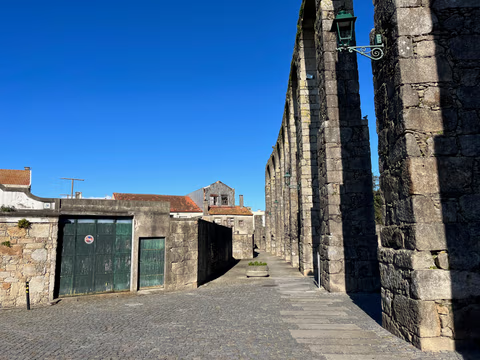
Aqueduct Trail – A path running along the Vila do Conde Aqueduct
From the Coastal Trail to the Camino Central: 12.9 km along the aqueduct from Vila do Conde to São Pedro de Rates. Route, stage, hostels, costs—explained honestly.
Read
Augsburg Way of St. James
The Augsburg Way of St. James runs 231.7 km in 11 stages from Oettingen in the Ries via Donauwörth, Augsburg, Bad Wörishofen and Ottobeuren to Ermengerst in the Allgäu — the Fuggerei, the Jakobervorstadt, a pilgrim of 1446 and Mozart's organ duel. Stages, hostels, costs.
Read

