

Camino Jasnogórska
69.2 kilometres, three days, three St. James churches: from the Black Madonna of Jasna Góra in Częstochowa to the basilica of Piekary Śląskie, the second great Marian shrine of Upper Silesia. Flat, wooded, along the watershed between the Oder and the Vistula — and at kilometre 56 in Sączów, where certified relics of the apostle have lain since 1779, directly connected to the Via Regia.
At a glance
- Start / finish: Częstochowa, Jasna Góra monastery / Piekary Śląskie, basilica of the Assumption and St. Bartholomew
- Length: 69.2 km
- Duration: 3 days
- Elevation: ↗ 348 m / ↘ 304 m
- Highest point: 347 m; lowest point 249 m
- Stages: 3 (Camino Ninja division; the operator reckons two to three days)
- Direction: north → south, through the Silesian Voivodeship
- Waymarking: yellow scallop on blue and yellow arrows
- St. James churches: three — Częstochowa, Lubsza, Sączów
- Connection north: in Częstochowa the continuation of the Camino Warszawska; junction with the Camino Częstochowska
- Connection south: at Sączów (km 56) onto the Via Regia Polska; the last 12 km to Piekary shared
- Best time: May to September; note the men's pilgrimage in late May and the women's pilgrimage in early August in Piekary
Overview
The Camino Jasnogórska is the shortest Way of St. James in Poland that can seriously be called one — and one of the most St.-James-dense in Europe. You walk out of Jasna Góra, Poland's greatest Marian shrine, through the south exit, pass the St. James church of Częstochowa a few minutes later, dive beyond Konopiska into the forests that shape this trail, and at the end of the first day reach Lubsza with its stone church of St. James from the 14th or 15th century. The second day follows the watershed between the Oder and the Vistula — imperceptibly, because nothing rises here — to Sączów, where the third St. James church stands, relics of the apostle lie and the Via Regia crosses the trail. The third day is a long morning: twelve kilometres through the Upper Silesian conurbation to the neo-Romanesque basilica of Piekary Śląskie.
What carries the trail is this combination: 69 kilometres, three St. James churches, two national shrines at the ends. And a destination that still belongs to Upper Silesia today — in Piekary a Kraków archbishop named Karol Wojtyła preached year after year from 1965 to 1978 before tens of thousands of miners and steelworkers. Frankly, the landscape in between is no postcard: pine forest, watershed, an airport within earshot, industry in plain terms at the end. But as a first Camino to try out, as a long weekend or as a search for the apostle's traces in Poland, it is hard to beat.
Other names
In Polish the trail is called Jasnogórska Droga św. Jakuba, in short Droga Jasnogórska. In German you meet it as the Jasna-Góra-Jakobsweg; no established English name exists. Beware of confusion: the Camino Częstochowska also starts at the same monastery, but leads west to St. Anne's Mountain. If you ask in Częstochowa for "the Way of St. James", you have to say which one you mean — and if you want to walk both, you will find the combination below under Carrying on.
Two figures to place. The operator gives 68 kilometres, GPS measurements give 69.1 to 69.6 kilometres, our route measures 69.2 kilometres. And the operator divides the trail into two sections — Częstochowa–Lubsza and Lubsza–Sączów — plus the final stretch shared with the Via Regia; the three-stage division here is our recommendation, not an official staging. Important on the third day: the waypoint Blachownia just before Piekary is a district in the conurbation, not the town of the same name near Częstochowa, which lies on the Camino Częstochowska.
Ideal for — and not so much for
This trail is ideal if you have a long weekend and still want to walk a complete Way of St. James — arrive Friday, three stages, return Sunday evening or Monday. Ideal if searching for the apostle's traces interests you: in 69 kilometres there are three St. James churches, and in Sączów relics certified since 1779. Ideal as a first Camino to try before you venture onto 800 Spanish kilometres, or as a two-day bike tour — the route is explicitly laid out for it. And ideal if you use Katowice-Pyrzowice airport: it lies in the municipality of Ożarowice, right on stage 2.
Frankly, though, it is not for you if you need dramatic landscape: this is Upper Silesia, pine forest and watershed, no panorama, and the final stage passes through industrial suburbs. Not for you either if you want to check in spontaneously on stage 1 — 32 kilometres to Lubsza is ambitious for the first day, and accommodation is thin. After rain the forest sections between Konopiska and Sączów turn muddy and in places overgrown; the operator itself signposts an asphalt alternative. And outside the pilgrimage sites nobody recognises you as a pilgrim — here you are simply a hiker.
Route & landscape
The trail falls into three parts, which happen to coincide with the three days. Częstochowa and the forest: you walk out of Jasna Góra through the south exit, past the St. James church and the Sanctuary of Divine Mercy, and after a few kilometres you are out of the city. Via Konopiska with its St. Valentine church and the Pająk reservoir, a local recreation spot, you dive into the forests that make up most of the trail; via Okrąglik and Babienica you reach Lubsza. The watershed: the second day is the quietest. Via Kolonia Przysieki, Ożarowice and Tąpkowice the trail follows the watershed between the Warta and Oder on one side and the Vistula on the other — you don't notice it, but along the way you change Poland's river system. To your right lies the airport; now and then a plane climbs above you. At Sączów you arrive at kilometre 56: junction with the Via Regia, St. James church, pilgrim hostel.
The conurbation: the third day is twelve kilometres via Wymysłów and the district of Blachownia, which both trails walk together — here the landscape turns industrial, this is Upper Silesia unfiltered. Then suddenly the neo-Romanesque basilica of Piekary Śląskie stands before you, with the Paradise Square, five chapels and the twelve stone apostles along the church wall, and behind it the extensive calvary on Cerekwica hill.
Stages, terrain & difficulty
The operator reckons two to three days for experienced pilgrims and divides into two sections plus the shared final stretch. We split the 69.2 kilometres into three stages, calibrated to the exact length of our route. Day 1 at 32 kilometres is the hard day; if you want it gentler, split at Konopiska or Babienica and make four stages of it. Day 3 is more a long morning than a stage — handy, because you can be on the train by the afternoon.
- Częstochowa (Jasna Góra) – Konopiska – Okrąglik – Babienica – Lubsza (32.1 km) — St. James church Częstochowa, St. Valentine church, Pająk reservoir, then forest to the St. James church of Lubsza.
- Lubsza – Kolonia Przysieki – Ożarowice – Tąpkowice – Sączów (24.9 km) — Oder/Vistula watershed, Pyrzowice airport in view, finish at the third St. James church with hostel.
- Sączów – Wymysłów – Blachownia – Piekary Śląskie (12.2 km) — together with the Via Regia through the conurbation to the basilica.
Difficulty: very easy — that is the operator's own rating. The total height difference on the trail is under a hundred metres. Surface: mostly forest tracks and sandy paths, with field tracks and village passages in between; asphalt roughly a quarter to a third, concentrated on the last day. Important after rain: the forest section between the Pająk reservoir and Hutki can become hard to pass, the operator signposts an asphalt alternative, and user reports mention overgrown passages as far as Sączów — where vegetation grows over the path, the markers disappear too. Waterproof shoes, tick protection and water for thirty kilometres on the first day.
A seal from Jerusalem
There is hardly a Way of St. James in Europe with so much St. James on so little distance. Right after the start in Częstochowa stands the first St. James church. At the end of the first day in Lubsza the second: a stone building from the 14th, at the latest 15th century, whose oldest part sits in the foundation of the bell tower, with Baroque altars and a baptismal chapel from the 18th century — here, in the first half of the 19th century, taught Józef Lompa, one of the pioneers of Polish letters in Upper Silesia. And at kilometre 56 in Sączów the third: a parish consecrated in 1224 by Bishop Iwo Odrowąż and thus among the oldest in the region; the present brick church of 1872 holds a Mannerist high altar from the 17th century with an image of Mary venerated as miraculous.
The real treasure of Sączów is small. In the church lies a silver reliquary, protected on both sides by crystal and sealed with red silk thread. With it belongs a document dated 19 June 1779, issued by Georgius de Lascaris, Patriarch of Jerusalem, certifying the bones as relics of the apostle James and permitting their public veneration in churches, oratories and chapels; the document was later translated and examined by Fr Polikarp Nowak OFM. Frankly, a document of 1779 attests the ecclesiastical certification, not the historical authenticity of the bones — but it attests that the cult of St. James here is no invention of the 21st century, but was institutionally anchored by the 18th century at the latest. Since 2013 a pilgrim hostel has stood beside the church, the only documented one on this route. A trail that leads from patron saint to patron saint and on which the apostle is said to be bodily present needs no constructed St. James connection.
Highlights along the way
- Jasna Góra, Częstochowa — Pauline monastery with the Black Madonna, Poland's national shrine; get your first stamp here.
- St. James church, Częstochowa — the first of the three St. James churches on this trail, a few minutes after the start; shortly after, the Sanctuary of Divine Mercy.
- Konopiska and Pająk reservoir — St. Valentine church and recreation lake; after that the forest begins.
- Lubsza — church of St. James the Greater, stone, 14th/15th century, rebuilt 1930; oldest part in the foundation of the bell tower, Baroque altars, baptismal chapel from the 18th century; where Józef Lompa taught.
- Sączów — parish since 1224 (consecrated by Iwo Odrowąż), present church 1872, Mannerist high altar from the 17th century; relics of the apostle James, certified on 19 June 1779 by the Patriarch of Jerusalem; pilgrim hostel since 2013; junction of the Via Regia and the Szlak Tysiąclecia.
- Oder/Vistula watershed — stage 2 follows the divide between Poland's two great river systems.
- Basilica of Piekary Śląskie — initiated by parish priest Jan Ficek, architect Daniel Groetschel, neo-Romanesque, consecrated on 22 August 1849; copy of the miraculous image from the 17th century (the original was taken to Opole during the Great Northern War and stayed there); coronation in 1925 before some 250,000 people with crowns blessed by Pius XI; basilica minor since 1962; visit of Mother Teresa in 1986.
- Paradise Square (Rajski Plac) — five chapels and the stone figures of the twelve apostles along the church wall, plus the calvary on Cerekwica hill.
- The men's pilgrimage of Piekary — since 1947 on the last weekend in May, tens of thousands of participants; Karol Wojtyła preached here from 1965 to 1978; in 1983, as Pope, he confirmed the title "Mother of Justice and Social Love".
How pilgrims reach this trail
Most come via the Camino Warszawska, the Warsaw Way of St. James, which ends in Częstochowa — the Camino Jasnogórska is one of its two continuations, the southern one. Others travel directly to Częstochowa and walk the trail as a standalone short Camino. And a third group comes from the Via Regia Polska: if you are walking west from Kraków, you can turn off at Sączów and walk up to Częstochowa in two days — the trail is conceived southwards, but is just as walkable in this direction.
In Częstochowa itself three trails meet: the Camino Warszawska arriving, the Camino Jasnogórska to Piekary and the Camino Częstochowska to Góra Świętej Anny. If you have a good week, you link Jasnogórska and Częstochowska — first three days to Piekary, back by train, then five days to St. Anne's Mountain — and visit three Upper Silesian pilgrimage sites on one trip.
Carrying on?
Absolutely — the connection is already part of the route. At kilometre 56 in Sączów the Camino Jasnogórska meets the Via Regia, and the last twelve kilometres to Piekary Śląskie both trails cover together. So you can stop in Piekary — or carry on along the Via Regia Polska: west via Toszek and Góra Świętej Anny to Opole, Wrocław and Zgorzelec on the Neisse, more than 900 kilometres in total in 38 proposed stages; or east via Sławków with its St. James church and Kraków to the Ukrainian border at Korczowa.
At the Neisse the Via Regia in Germany takes over, the Ecumenical Pilgrims' Way from Görlitz via Leipzig and Erfurt to Vacha. Heading west, via Wrocław you also reach the Camino Dolnośląska and the Camino Sudecka. From Sączów Santiago is still far — but the trail does not break off.
Preparation & practicalities
The best time is May to September; April and October are feasible but wet. Two dates you should know: the men's pilgrimage in late May and the women's pilgrimage in early August in Piekary Śląskie — on those weekends the town is full and every bed taken; either you plan for it deliberately, or you avoid it. There is no hostel network, but one real fixed point: the pilgrim hostel in Sączów at the St. James church, since 2013 — phone ahead. Plus parish houses (plebania) in Konopiska, Lubsza and Sączów for a donation, agroturystyka around Babienica, Ożarowice and Tąpkowice, hotels in Częstochowa, Ożarowice, Piekary Śląskie, Bytom and Tarnowskie Góry. Because the route is so short, the base-camp model also works: a hotel in Częstochowa or Bytom, leave your luggage there, walk with a daypack and commute by train and bus. The easiest way to plan your stages and lodgings is directly in the Camino Ninja app.
You get the pilgrim credential from the operating association at camino.net.pl; European credentials are accepted. Stamps are available at Jasna Góra, in Lubsza, in Sączów and in the basilica of Piekary. The waymarking — yellow scallop on blue plus yellow arrows — is the standard of the Polish network; GPX, KML and a PDF guide are free at camino.net.pl, and the "Camino w Polsce" app has an offline map, churches and accommodation. Take it with you: where the forest grows over the path, the scallops disappear too. Language: Polish; in Częstochowa, at the airport and in the hotels of the conurbation English works, in the villages hardly. In Upper Silesia you also hear Silesian — surprisingly often intelligible to ears with some German. Three words help: nocleg (a night's lodging), pielgrzym (pilgrim), pieczątka (stamp). Take cash.
What this trail costs
Frankly, the Camino Jasnogórska is the cheapest complete Way of St. James you can walk in Europe — the figures here are market estimates for Upper Silesia, not individually quoted prices (as of September 2026, around 4.25 złoty to the euro). The pilgrim hostel in Sączów runs on donations, about 25–50 PLN (€6–12); a parish house costs 30–60 PLN (€7–14), an agroturystyka with breakfast 90–150 PLN (€21–35), a double room in a guesthouse or hotel 180–320 PLN (€42–75). Lunch in a milk bar or inn is 25–45 PLN, dinner 45–80 PLN, self-catering per day 30–50 PLN, the regional train from Bytom back to Częstochowa 20–30 PLN.
A realistic daily budget: frugal with hostel or parish house and self-catering 80–120 PLN (€19–28), mid-range with agroturystyka and one hot meal 160–230 PLN (€38–54), comfortable with hotel and restaurant 280–420 PLN (€66–99). For the three days that makes roughly €55–85 (approx. 240–370 PLN) frugal, €115–165 (approx. 500–720 PLN) mid-range and €200–305 (approx. 870–1,300 PLN) comfortable, each excluding travel. Fixed costs: pilgrim credential 15–25 PLN (€4–6) (as of September 2026). Churches, monastery and basilica cost nothing.
Getting there
To the start (Częstochowa): Częstochowa Osobowa station lies on the north–south main line with direct connections from Warsaw (about 2:15 h), Kraków (about 2:15 h), Katowice (about 1:15 h), Gdańsk and Wrocław. From the station to the monastery it is about 2 kilometres up the Aleja Najświętszej Maryi Panny. Katowice-Pyrzowice airport lies in the municipality of Ożarowice, right on stage 2 — buses run from there to Katowice and to Częstochowa. Alternatives: Kraków and Wrocław.
Along the way: Ożarowice and Tąpkowice are connected by regional bus with Tarnowskie Góry and the airport, so the trail can also be walked as two day trips from a base camp.
From the finish (Piekary Śląskie): passenger service at Piekary station is limited — take the city bus to Bytom (15–20 minutes) and from there the train to Katowice, Gliwice or straight back to Częstochowa (about 1:20–1:50 h). From Katowice there are long-distance connections to Warsaw, Kraków, Vienna, Prague and Berlin. Because start and finish are connected in under two hours, you can leave your luggage in Częstochowa.
- Polish rail: intercity.pl — Częstochowa, Bytom, Katowice
- Operator, GPX, app, credential: camino.net.pl — Droga Jasnogórska
- Relics and parish of Sączów: parafiasaczow.pl — hostel, services
- Note: pilgrimage weekends in Piekary (late May, early August) — book conurbation accommodation early
Partners
Partner for Camino Jasnogórska
Camino Ninja is cooperating with official partners. For this camino the partner is:


Get your pilgrim credential and shell
Everything you need for the Camino Jasnogórska, shipped to your door.
Visit Camino Shop
Other Caminos
 Appenzeller Weg
Appenzeller Weg
52.6 km from Rankweil across the Rhine to St. Peterzell: St. James Chapel (1464), 163 Years of the Wedding Trail, connection to the Via Jacobi. Stages, costs, how to get there.
Read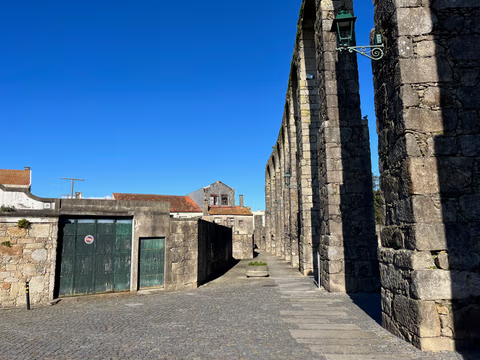
Aqueduct Trail – A path running along the Vila do Conde Aqueduct
From the Coastal Trail to the Camino Central: 12.9 km along the aqueduct from Vila do Conde to São Pedro de Rates. Route, stage, hostels, costs—explained honestly.
Read
Augsburg Way of St. James
The Augsburg Way of St. James runs 231.7 km in 11 stages from Oettingen in the Ries via Donauwörth, Augsburg, Bad Wörishofen and Ottobeuren to Ermengerst in the Allgäu — the Fuggerei, the Jakobervorstadt, a pilgrim of 1446 and Mozart's organ duel. Stages, hostels, costs.
Read

