

Königsbrück – Grumbach
The Königsbrück – Grumbach variant links the Via Regia with the Saxon Way of St James over 52.0 kilometres, leaving Dresden off to one side. It runs through the heathland north of the state capital, past Moritzburg Castle, across the Elbe by ferry and via Wilsdruff with its Romanesque St James's Church to Grumbach, where the Frankenstraße carries on towards Freiberg and Hof. Four short stages or two sporty days.
- 01At a Glance
- 02Overview
- 03Other Names
- 04Who It's Ideal For—and Who It's Not So Ideal For
- 05Route & Landscape
- 06Stages, Terrain, and Difficulty
- 07Skip Dresden, and you'll need a ferry
- 08Highlights Along the Way
- 09How Pilgrims Find Their Way onto This Path
- 10Continue the pilgrimage?
- 11Preparation & Practical Information
- 12What the journey will cost you
- 13Getting Here
At a Glance
- Start / Finish: Königsbrück, on the Via Regia / Grumbach near Wilsdruff, on the Saxon Way of St James
- Length: 52.0 km
- Duration: 4 stages, avg. 13 km; for the sporty, 2 days with an overnight stop in Moritzburg
- Elevation: ↗ 369 m / ↘ 254 m
- Highest point: 284 m at km 51.9 just before Grumbach; lowest point 101 m on the Elbe at km 38.5
- Landscape: pine heaths north of Dresden, the Moritzburg pond country, the Elbe meadows near Coswig, and finally the rolling hills of the Wilsdruff area
- Waymarking: yellow shell on a blue background, as on the main route
- Pilgrim passport: the association's pilgrim passport for a €5 donation (as of October 2026)
- Traces of St. James: St James's Church (Jakobikirche) in Wilsdruff, c. 1150, with the Benno Bell from around 1250
- Accommodation: no pilgrim hostel along the route; guesthouses and inns in Königsbrück, Moritzburg and Coswig, pilgrim hostel in the Fördergersdorf parsonage 5.7 km beyond Grumbach
- Connecting routes: Via Regia in Königsbrück, Heiliger Weg from Meissen at km 42.9, Saxon Way of St James in Grumbach
Overview
This variant is for people who, caught between two Caminos, would rather not choose the big city. If you're coming from Lusatia on the Via Regia and want to head south onto the Frankenstraße, you'd really have to go back to Bautzen or straight through Dresden. Instead, there is a waymarked shortcut through the countryside: from Königsbrück, where the Via Regia passes by, in an arc west around Dresden to Grumbach, where the main route continues towards Freiberg.
Over 52.0 kilometres you get a surprising amount of Saxony for it: the quiet pine heaths near Laußnitz and Ottendorf-Okrilla, the Baroque hunting lodge of Moritzburg in the middle of its ponds, an Elbe ferry instead of a bridge and, at the end, Wilsdruff with a village church that is older than the town. There's hardly any climbing and no difficult sections at all. What you do get is a line worth remembering: skip Dresden, and you'll need a ferry.
Other Names
The association lists the route as the Variante Königsbrück – Coswig – Grumbach, naming the place where you cross the Elbe. On the Camino Ninja map it's simply called Königsbrück – Grumbach. It has no pilgrim name of its own, and it doesn't need one: it's part of the Saxon Way of St James, just not the main route.
Who It's Ideal For—and Who It's Not So Ideal For
The variant is ideal if you're walking the Via Regia and want to switch to the Saxon Way of St James without spending a day trudging through Dresden's suburbs. It's also ideal as a weekend pilgrimage: start and finish are close to Dresden, the stages are short, and with Moritzburg and the Elbe ferry every stage has a highlight of its own. And it's ideal for beginners, because hardly any climb is more than a few dozen metres.
To be honest, though, it's not for you if you're looking for a pilgrim bed in a parish hall: there's no pilgrim hostel along the route, so you'll sleep in guesthouses and inns. Nor is it for you if you don't want to miss the great churches of the main route – the Frauenkirche, the Hofkirche and the memorial to Dresden's destroyed St James's Church lie on the other route. And if the Elbe ferry isn't running, a short crossing turns into a detour of around eight kilometres.
Route & Landscape
Königsbrück to Moritzburg (km 0–25.3): The route starts in Königsbrück on the edge of the Königsbrück Heath, where it branches off the Via Regia, and runs south via Laußnitz (km 2.6) through pine forest and sandy soils. Ottendorf-Okrilla (km 11.5) lies about 0.7 km off the trail; after that you continue via Medingen (km 15.1) and Bärnsdorf (km 20.6) into the Moritzburg pond country. Moritzburg Castle (km 25.3) stands on its island about 0.7 km off the route – take the little detour anyway.
Moritzburg to Grumbach (km 25.3–52.0): Via Auer (km 29.5) you head down to Coswig (km 36.3) and cross the Elbe by ferry to Gauernitz; at 101 metres, the Elbe is the lowest point of the route. After that the trail climbs via Constappel (km 39.7) into the hills, with Klipphausen staying about a kilometre to the west. At km 42.9 the Heiliger Weg from Meissen joins from the north. Via Wilsdruff (km 47.7) and its St James's Church you reach Grumbach (km 51.2) and, just beyond it, the highest point at 284 metres, where you meet the main route.
Stages, Terrain, and Difficulty
We show the route in four stages with distances from the Camino Ninja map, calibrated to exactly 52.0 km; the elevation per stage is calculated from the point heights on the map. The association splits it slightly differently (10.4 · 15.0 · 11.5 · 15.1 km) because it measures from different points in the towns. Technically everything is easy: forest tracks, farm tracks, a few sections on minor roads. If you like two longer days, just stay overnight in Moritzburg.
- Königsbrück → Ottendorf-Okrilla (11.5 km) — through the pine heaths via Laußnitz, flat, ↗ 55 m / ↘ 54 m
- Ottendorf-Okrilla → Moritzburg (13.8 km) — via Medingen and Bärnsdorf into the pond landscape, ↗ 75 m / ↘ 77 m
- Moritzburg → Coswig (11.0 km) — via Auer down into the Elbe valley, ↗ 47 m / ↘ 105 m
- Coswig → Grumbach (15.7 km) — Elbe ferry to Gauernitz, Constappel, Wilsdruff with St James's Church, ↗ 192 m / ↘ 18 m
Skip Dresden, and you'll need a ferry
Do the maths: from Bautzen to Grumbach it's 87.3 kilometres on the main route through Dresden. Via the Via Regia to Königsbrück and then on this variant it's around 99.6 – a good twelve kilometres more. In return, you swap a whole city day for heath, ponds and vineyards. And at exactly one spot you pay a price for this swap that pilgrims have known for centuries: between Coswig and Gauernitz there's no bridge, only the ferry. If it's out of service, as in 2026 from 13 April to 26 June due to construction work, you walk along the Elbe Cycle Route over the Niederwartha bridge and back on the other side, around eight kilometres extra – or, as the association suggests, take the S-Bahn to Dresden-Mitte and continue on the main route via Wettiner Platz, where a memorial stone recalls St James's Church, destroyed in 1945.
The second reason for this route stands in Wilsdruff. St James's Church (Jakobikirche) on the edge of the old town was built around 1150 as a Romanesque aisleless church, with thick fieldstone walls and small round-arched windows, and is considered one of the oldest surviving village churches in Saxony – it was a merchants' church before the town of Wilsdruff even existed. Inside hangs the Benno Bell from around 1250, one of the oldest bells in Saxony; its incised figures probably depict St Benno of Meissen. Since 2005 the church has been an ecumenical motorway church on the A4, open daily from 8 am to 6 pm. A church of St James that carries the patron of another pilgrim route in its tower – and that route, as the Heiliger Weg to Meissen, runs right here.
Highlights Along the Way
- Königsbrück — small town on the Via Regia, on the edge of the Königsbrück Heath; this is where you switch from the east–west to the north–south route
- Moritzburg — hunting lodge of the Wettin dynasty on an island in the castle pond, remodelled in Baroque style under Augustus the Strong; backdrop of the fairy-tale film „Drei Haselnüsse für Aschenbrödel“
- Moritzburg pond country — forest, water and reeds between Bärnsdorf and Auer, the most scenic part of the route
- Coswig – Gauernitz Elbe ferry — a few minutes on the water instead of a bridge; Gauernitz Castle stands on the far bank
- St James's Church, Wilsdruff — Romanesque aisleless church from around 1150 with the Benno Bell from around 1250, today a motorway church
- Grumbach — junction with the main route; a few kilometres further on, Fördergersdorf with its pilgrim hostel and the Tharandt Forest
How Pilgrims Find Their Way onto This Path
The main feeder is the Via Regia, the Ecumenical Pilgrim Way heading west from Görlitz. It passes through Königsbrück, according to the Camino Ninja map at km 102.1 from Görlitz and 47.6 kilometres beyond Bautzen; that's where you turn off south.
From the north, the Heiliger Weg joins at km 42.9, 13.0 kilometres up from Meissen Cathedral. So if you start in Meissen, you walk it to this point and continue on this variant to Grumbach – 22.1 kilometres in total, a good day's stage.
Continue the pilgrimage?
In Grumbach you reach the Saxon Way of St James at its km 87.3. From here it's 31.1 kilometres to Freiberg and 220.8 kilometres to Hof, where the route continues into Franconia. After just 5.7 kilometres you come to Fördergersdorf with a pilgrim hostel in the parsonage; after that you head through the Tharandt Forest to Grillenburg.
If you're heading for Bohemia, stay on the main route as far as Jahnsdorf beyond Chemnitz and take the Erz-Camino there, over the crest of the Ore Mountains to Kadaň.
Preparation & Practical Information
Pilgrim passport and app. As on all Caminos, you need a pilgrim passport (credencial) to stay in pilgrim accommodation and to receive the Compostela in Santiago at the end. It's best to order it online in advance so it arrives in time for the start of your trip – the Sächsischer Jakobsweg an der Frankenstraße association issues its own. You can get stamps in churches, tourist information offices and inns if you ask. The easiest way to plan the route is directly in the Camino Ninja app, where you put your stages together and book suitable accommodation into your plan right away.
Lodging and ferry. There's no pilgrim hostel along the route; you'll find guesthouses, inns and hotels mainly in Königsbrück, Moritzburg, Coswig and Wilsdruff, and the association's accommodation directory helps with the search. Call ahead – Moritzburg gets busy on summer weekends. Before your last day, check whether the Coswig – Gauernitz Elbe ferry is running.
What the journey will cost you
Guesthouses and simple hotels in the region usually charge €45 to €70 for a single room, with Moritzburg towards the upper end (as of October 2026). From the association, the pilgrim passport costs a €5 donation, the pilgrim guidebook €17 and the accommodation directory €4. For the ferry you'll need a few euros in change. Budget €50 to €70 a day for lodging, food and the odd café or inn stop. For getting there and back, the Deutschland-Ticket at €63 a month is worth it (as of October 2026).
Getting Here
To the start. Königsbrück has a station on the line from Dresden; Dresden itself is served by long-distance trains from Berlin, Leipzig and Prague. Ottendorf-Okrilla is on the same line, so you can shorten or lengthen your first day.
From the finish. Buses run from Grumbach and Wilsdruff towards Dresden. Coswig has S-Bahn connections to Dresden and Meissen; you can reach Moritzburg by bus or by the narrow-gauge railway through the Lößnitzgrund from Radebeul.
- Rail: bahn.de — connections to Königsbrück and from Dresden, Deutschland-Ticket
- Info: saechsischer-jakobsweg.de — stages, ferry notices, pilgrim passport, accommodation directory
Partners
Partner for Königsbrück – Grumbach
Camino Ninja is cooperating with official partners. For this camino the partner is:


Get your pilgrim credential and shell
Everything you need for the Königsbrück – Grumbach, shipped to your door.
Visit Camino Shop
Other Caminos
 Appenzeller Weg
Appenzeller Weg
52.6 km from Rankweil across the Rhine to St. Peterzell: St. James Chapel (1464), 163 Years of the Wedding Trail, connection to the Via Jacobi. Stages, costs, how to get there.
Read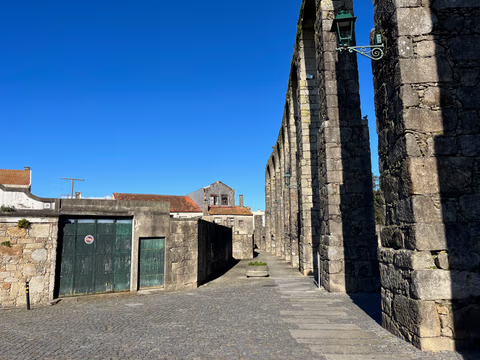
Aqueduct Trail – A path running along the Vila do Conde Aqueduct
From the Coastal Trail to the Camino Central: 12.9 km along the aqueduct from Vila do Conde to São Pedro de Rates. Route, stage, hostels, costs—explained honestly.
Read
Augsburg Way of St. James
The Augsburg Way of St. James runs 231.7 km in 11 stages from Oettingen in the Ries via Donauwörth, Augsburg, Bad Wörishofen and Ottobeuren to Ermengerst in the Allgäu — the Fuggerei, the Jakobervorstadt, a pilgrim of 1446 and Mozart's organ duel. Stages, hostels, costs.
Read

