

Camino Mozárabe Jaén
The Camino Mozárabe Jaén is the short feeder route from the provincial capital of Jaén to the Camino Mozárabe: 43.6 kilometers from the cathedral via Torredelcampo, Jamilena and Martos to Alcaudete, where it joins the main route from Almería and Granada. Two stages, ↗ 789 meters of ascent, a high point of 778 meters between Torredelcampo and Jamilena, plus a long stretch on the Vía Verde del Aceite, the bed of an old oil railway. All around you, olive trees to the horizon; above Martos, a crag with a royal legend from 1312.
- 01At a Glance
- 02Overview
- 03Other Names
- 04Who It's Ideal For—and Who It's Not So Ideal For
- 05Route & Landscape
- 06Stages, Terrain, and Difficulty
- 07The Peña de Martos and the King Who Kept His Appointment
- 08Highlights Along the Way
- 09A Sea of Olives and the Train That Carried Oil
- 10How Pilgrims Find Their Way onto This Path
- 11Continue the pilgrimage?
- 12Preparation & Practical Information
- 13What the journey will cost you
- 14Getting Here
At a Glance
- Start / Finish: Jaén Cathedral / Alcaudete, junction with the Camino Mozárabe (km 43.5)
- Length: 43.6 km
- Duration: 2 stages; at a gentler pace 3 days with an overnight in Torredelcampo
- Elevation: ↗ 789 m / ↘ 708 m
- Highest point: 778 m at km 13.5, between Torredelcampo and Jamilena
- Landscape: endless olive groves, the rolling hills of the Campiña, the castle crags of Martos and Alcaudete, a disused railway line with iron viaducts
- Operator / Waymarking: Andalusian Camino associations, in Jaén the Asociación Jacobea de Jaén; yellow arrows, and in Jaén's old town azulejo tiles with arrows
- Traces of St. James: few; a paving tile in front of the cathedral points the way, and inside the cathedral the Santo Rostro, a Veronica's veil, is venerated
- Accommodation: pilgrim lodging in the Trinitarian convent in Martos (15 €), otherwise guesthouses and hotels
- Connecting routes: Camino Mozárabe from Alcaudete toward Córdoba and Mérida, continuing there on the Vía de la Plata
- Best time: March to May and October to November; from June to September the heat makes this route a bad idea
Overview
The Camino Mozárabe Jaén isn't a long-distance trail in its own right but a run-up: two days that take you from a provincial capital onto one of Andalusia's great pilgrim routes. The Camino Mozárabe comes up from Almería via Granada and Alcalá la Real; in Alcaudete the route from Jaén joins it, and 24.8 kilometers later, in Baena, so does the one from Málaga. Starting in Jaén saves you around 275 kilometers of the main route, and after two days you're still on the same path to Córdoba, Mérida and Santiago.
What you mostly see on these 43.6 kilometers is olive trees. The municipality of Torredelcampo alone counts more than 1.3 million of them; Martos calls itself the "Cuna del olivar," the cradle of the olive grove, and holds its olive festival on December 8. In between lie stories you wouldn't expect on such a short route: a cathedral consecrated in 1660 that served as a model for churches as far away as the Americas, a military order that took over the frontier with the Kingdom of Granada in 1228, and a crag from which two brothers are said to have been thrown in a spiked cage. The king who ordered it died exactly one month later—and on this route you walk right past his verdict.
Other Names
In Spanish the route is called Camino Mozárabe de Jaén, and in guidebooks also Ramal de Jaén or Variante de Jaén; the stages are often labeled 1J and 2J. In German you'll read Mozarabischer Jakobsweg ab Jaén (Mozarabic Way of St. James from Jaén). The name "mozárabe" refers to the Christians who lived under Muslim rule in al-Andalus—it's a modern umbrella term for the routes from Andalusia to the Vía de la Plata, not a medieval name for this section.
Who It's Ideal For—and Who It's Not So Ideal For
Ideal if you want to walk the Camino Mozárabe but don't have four weeks: from Jaén you're on the main route after two days and in Córdoba within a week. Also ideal if you're looking for a weekend taster in Andalusia, since Torredelcampo and Martos have hourly buses to Jaén.
Honestly, though, it's not for you if you expect pilgrim hostels and company in the evening: apart from Martos there's no pilgrim lodging, and on some days you won't meet a soul. Not for you in summer: the route has almost no shade, and Gronze states bluntly that "varios peregrinos han fallecido por golpe de calor"—several pilgrims have died of heatstroke. And not for you if monotony gets to you: between Martos and Alcaudete there isn't a single village, just rows of olives, a railway embankment and, at the end, a steep climb.
Route & Landscape
Jaén to Martos (km 0–20.9): The route starts at Jaén Cathedral; a tile in the pavement in front of the railings points into Calle Maestra. Through the old town you pass the Palacio de Villardompardo, beneath which lie the Arab baths, and leave through the Arco de San Lorenzo. Past the Urbanización Virgen Blanca (km 1.2) the olive and almond groves begin. In Torredelcampo (km 10.1) the steepest ramp of the day awaits on the climb to the Ermita de Santa Ana, and at km 13.5 you reach the route's highest point at 778 meters. From above Jamilena (km 14.2) you can already see the castle of Martos on its crag; the final climb leads up to the Plaza de la Constitución in Martos (km 20.9).
Martos to Alcaudete (km 20.9–43.6): Leaving Martos, you pass the Trinitarian convent, ford a stream and then join the Vía Verde del Aceite, the bed of the old Linares–Puente Genil railway. A 133-meter iron viaduct carries it across the gorge of the Arroyo del Higueral, and there's a rest area at the former Vado-Jaén station. Later the route leaves the railway bed, crosses the Río Víboras on a medieval bridge and then climbs around 320 meters through olive groves. From the top you see Alcaudete below its castle; in town, at km 43.5, you meet the Camino Mozárabe.
Stages, Terrain, and Difficulty
We show the route in 2 stages, with distances from the Camino Ninja map, calibrated exactly to 43.6 km. If you'd rather take it easy, split the first stage in Torredelcampo (km 10.1) and walk it in three days; the second stage can't be split, because there's no village with accommodation between Martos and Alcaudete.
- Jaén → Martos (20.9 km) — Jaén's old town, olive-covered hills, the steep ramp in Torredelcampo, the high point at 778 m and the final climb up beneath the Peña de Martos.
- Martos → Alcaudete (22.7 km) — Vía Verde del Aceite with its viaduct, no villages and hardly any shade along the way, a medieval bridge over the Víboras and a tough climb to Alcaudete.
Technically nothing is difficult: wide dirt tracks, some stretches of asphalt, and the railway bed flat and easy underfoot. What wears you out are the short, steep ramps and, above all, the sun. Carry at least two liters of water on the second stage.
The Peña de Martos and the King Who Kept His Appointment
Above Martos rises the Peña, a limestone crag of 1,003 meters topped by the ruins of a castle. In August 1312, King Fernando IV of Castile came to Martos and sentenced two knights of the Order of Calatrava, the brothers Juan Alfonso and Pedro Alfonso de Carvajal, to death. They were accused of murdering one of the king's favorites, Juan de Benavides, in Palencia. Legend has it that on August 7 they were thrown down the Peña in a spiked iron cage. Before that, they are said to have summoned the king to appear before God's judgment within thirty days.
On September 7, 1312, Fernando IV was found dead in his bed in Jaén, aged 26. The chronicle notes laconically, "ninguno lo vieron morir"—no one saw him die. Ever since, he has been known as el Emplazado, the Summoned. The crag hasn't forgotten him, and neither has Martos: the brothers are buried in the Real Iglesia de Santa Marta, and where the cage is said to have landed stands the Cruz del Lloro, the Cross of Weeping.
In practical terms: allow time in Martos for the climb into the old town; Santa Marta lies almost on the route at the end of the stage anyway. If you still have energy, climb the Peña in the afternoon. You may already know Martos from literature: in 2012 Almudena Grandes set "El lector de Julio Verne" here, a novel about the guerrillas after the Civil War.
Highlights Along the Way
- Jaén Cathedral (km 0) — Renaissance building by Andrés de Vandelvira, consecrated in 1660, interior completed by 1724; on Spain's tentative list for World Heritage status since 2012. Every Friday a side chapel displays the Santo Rostro, a Veronica's veil probably dating from the 14th century, which came to Jaén under Bishop Nicolás de Biedma.
- Arab baths of Jaén — beneath the Palacio de Villardompardo, one of the largest surviving bath complexes from the Islamic period in Spain; above them on the hill stands Santa Catalina castle, built after the city was conquered on February 28, 1246.
- Torredelcampo (km 10.1) — Ermita de Santa Ana with panoramic views, a Visigothic necropolis; the town is considered a linguistic island with more than 2,000 words of its own.
- Jamilena (km 14.2) — just under 3,300 inhabitants, parish church built to plans by Francisco del Castillo the Younger in the 16th century; an Iron Age necropolis was found here in 1931.
- Martos (km 20.9) — Roman Tucci, under Augustus Colonia Augusta Gemella Tuccitana; taken by Fernando III in 1225 and handed to the Order of Calatrava in 1228. The Peña with its castle, Santa Marta with the Carvajal tomb, Renaissance buildings by Francisco del Castillo.
- Vía Verde del Aceite — railway built between 1882 and 1893, known as the "oil train" to the port of Málaga, closed for good in 1985; today a cycling and walking path with nine 19th-century iron viaducts.
- Alcaudete (km 43.5) — castle that al-Idrisi mentioned in 1145 as the fortress of "Algaidak," taken by Fernando III in 1240 and then given to the Order of Calatrava; on February 18, 1408, it withstood three attacks from Granada in a single day. Convent of Santa Clara from 1500 with twisted stone columns.
A Sea of Olives and the Train That Carried Oil
The stretch between Martos and Alcaudete is the part you'll remember longest, precisely because nothing happens. The Linares–Puente Genil railway was built between 1882 and 1893 to carry oil and ore from Jaén and Córdoba to the port of Málaga. Locals called it the Tren del Aceite. Regular service largely ended in 1971, and on January 1, 1985, the line closed completely. Today 55 kilometers of it through the province of Jaén have been turned into the Vía Verde del Aceite, which continues as the Vía Verde de la Subbética—112 kilometers in all.
The railway bed is flat and pleasant to walk, and the viaducts are the finest structures of the stage—but it's arrow-straight and shadeless. Cycling pilgrims often stay on the Vía Verde all the way to Baena; on foot, you'd miss the castle and the junction that way.
How Pilgrims Find Their Way onto This Path
Nobody walks to Jaén to start here: the route has no feeder of its own—it is one. Almost everyone arrives by train or bus and sets off from the cathedral. Most want to walk the Camino Mozárabe without the long section from Almería and Granada, and join the main route in Alcaudete.
Continue the pilgrimage?
Yes—on the main route. From Alcaudete the Camino Mozárabe carries on, as follows according to our map:
- Baena — after 24.8 km; this is where the Camino Mozárabe Málaga joins
- Córdoba — after around 95 km, with the Mezquita-Catedral
- Mérida — after around 337 km; there your journey continues on the Vía de la Plata to Santiago
Important for the Compostela: the certificate requires the last 100 kilometers to Santiago on foot. So the route from Jaén alone won't earn you a certificate—it's the beginning of a very long road.
Preparation & Practical Information
Pilgrim passport and app. As on all Spanish routes, you need a pilgrim passport (credencial) to stay in the hostels and receive the Compostela at the end. It's best to order it online in advance so it reaches you in time for the start of your trip. You can get stamps in churches, town halls, accommodations and bars. Because arrows are sometimes missing in the olive groves, it pays to have the track on your phone: the easiest way is right in the Camino Ninja App, where you put together your stages and plan suitable accommodation at the same time.
Accommodation. In Jaén there's the Inturjoven youth hostel about a kilometer from the cathedral, guesthouses in the old town and hotels up to the Parador in the castle. In Martos the convent of the Madres Trinitarias in the old town takes in pilgrims, dormitory 15 € (as of October 2026); there are also a few hotels. In Alcaudete there are guesthouses and the Hospedería in the historic center, but no pilgrim hostel. Call Martos the day before.
Season. Go in spring or fall. From June to September temperatures are often above 35 degrees Celsius, on many days 40 to 44. From around December the olive harvest is underway, and the tracks are full of tractors and nets.
What the journey will cost you
It isn't cheap, because guesthouses are almost the only option. The pilgrim lodging in Martos costs 15 €, a guesthouse in Jaén's old town 45 € for a single and from 53 € for a double, and in Alcaudete rooms start at around 25 €, with guesthouses at 38 to 50 € (as of October 2026). A menú del día in the villages usually costs 12 to 15 €.
Budget 45 to 65 € a day for accommodation, breakfast in a bar and a hot meal.
Getting Here
To the start. Jaén has a train station with direct trains to Madrid and a bus station with connections to Granada, Córdoba and Málaga. The nearest airports are Granada, about an hour by bus, and Málaga.
From the finish. Buses run from Alcaudete to Jaén and Córdoba, but not often; check the timetable in advance. If you have to stop early: Torredelcampo and Martos have hourly connections to Jaén.
- Train: renfe.com — trains to Jaén and from Córdoba
- Bus: alsa.es — long-distance buses to Jaén, Granada and Córdoba
- Route: caminomozarabe.es — the Córdoba Camino association on the Camino Mozárabe

Get your pilgrim credential and shell
Everything you need for the Camino Mozárabe Jaén, shipped to your door.
Visit Camino Shop
Other Caminos
 Appenzeller Weg
Appenzeller Weg
52.6 km from Rankweil across the Rhine to St. Peterzell: St. James Chapel (1464), 163 Years of the Wedding Trail, connection to the Via Jacobi. Stages, costs, how to get there.
Read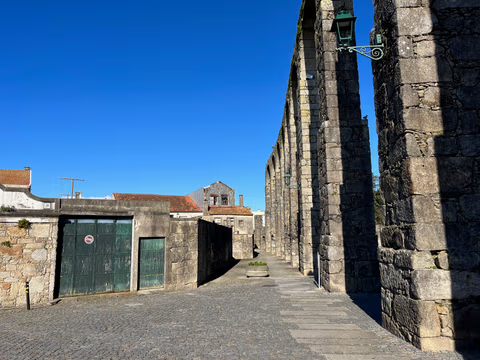
Aqueduct Trail – A path running along the Vila do Conde Aqueduct
From the Coastal Trail to the Camino Central: 12.9 km along the aqueduct from Vila do Conde to São Pedro de Rates. Route, stage, hostels, costs—explained honestly.
Read
Augsburg Way of St. James
The Augsburg Way of St. James runs 231.7 km in 11 stages from Oettingen in the Ries via Donauwörth, Augsburg, Bad Wörishofen and Ottobeuren to Ermengerst in the Allgäu — the Fuggerei, the Jakobervorstadt, a pilgrim of 1446 and Mozart's organ duel. Stages, hostels, costs.
Read

