

Via Francigena (England)
The Via Francigena (England) runs 172.1 kilometers from London on the Thames through the chalk hills of the North Downs to Canterbury and on to Dover on the English Channel. The official road to Rome only begins at the kilometer-zero stone in the south porch of Canterbury Cathedral, at kilometer 140.8; everything before that is the feeder route along the old Pilgrims' Way, the path Becket's pilgrims already took to Canterbury. Nine stages, 2,312 meters of climbing, and a high point of 208 meters in the North Downs near Wrotham. From Dover the ferry takes you to Calais, where the Via Francigena (France) takes over.
- 01At a Glance
- 02Overview
- 03Other Names
- 04Who It's Ideal For—and Who It's Not So Ideal For
- 05Route & Landscape
- 06Stages, Terrain, and Difficulty
- 07Kilometer Zero at Kilometer 140.8: Why Sigeric's List Leaves Out England
- 08Highlights Along the Way
- 09The Pilgrims' Way: Ancient, but Younger Than Its Name
- 10How Pilgrims Find Their Way onto This Path
- 11Continue the pilgrimage?
- 12Preparation & Practical Information
- 13What the journey will cost you
- 14Getting Here
At a Glance
- Start / Finish: London on the Thames / Dover on the English Channel; the official start of the Via Francigena lies in between, in Canterbury Cathedral (km 140.8)
- Length: 172.1 km, of which 140.8 km is the London–Canterbury feeder route and 31.3 km the official Via Francigena from Canterbury to Dover
- Duration: 9 stages, averaging about 19 km; 7 to 8 days if you push it
- Elevation: ↗ 2,312 m / ↘ 2,307 m
- Highest point: 208 m at km 68.6 in the North Downs near Wrotham
- Landscape: the Thames riverside and the industrial belt of East London, the green Darent valley, chalk slopes with beech woods, sheep pastures and orchards in Kent, and finally the chalk coast at Dover
- Operator / Waymarking: between Canterbury and Dover, the European Association of the Via Francigena Ways (EAVF) with its pilgrim logo; before that, the signs of the Thames Path, Darent Valley Path and North Downs Way (acorn symbol), with no continuous Francigena waymarking
- Traces of the Francigena: the kilometer-zero stone in the south porch of Canterbury Cathedral; Archbishop Sigeric, whose itinerary of 990 preserves the route; the Pilgrims' Way of the Becket pilgrimage
- Accommodation: no pilgrim hostels; B&Bs, pubs with rooms, the guesthouses of Aylesford Priory, youth hostels in Canterbury
- Connecting routes: Via Francigena (France) from Calais, Augustine Camino between Aylesford and Canterbury, Walsingham Camino from London
- Best time: May to September; in winter, muddy chalk paths and short days
- Pilgrim passport / Certificate: the Via Francigena credenziale; the Testimonium is only issued in Rome
Overview
The Via Francigena is the pilgrim road to Rome, and its English section has a quirk you'll want to read out loud: kilometer zero is at kilometer 140.8. Until Canterbury, you're walking toward the beginning. There, in the cathedral's south porch, stands the stone where the Via Francigena officially starts, because this is where Archbishop Sigeric set off for Rome in the year 990. The Camino Ninja map still puts the start in London, because that's where most pilgrims come from, and the road to Canterbury is itself one of England's oldest pilgrim routes.
This feeder route first follows the Thames and the Darent valley, then the Pilgrims' Way, a path along the southern slope of the North Downs said to have been used after 1170 by pilgrims heading to the tomb of the murdered archbishop Thomas Becket. From Canterbury it's a good 31 kilometers more to Dover. Honestly, this isn't a Camino with hostels and pilgrim menus; it's an English walking week with pubs, B&Bs and a hunt for stamps, one that ends at a ferry port and only really picks up speed on the other side of the Channel.
Other Names
In English the route is called the Via Francigena, often with England or UK section added to set it apart from the Continent; in our database it's listed as Via Francigena Britannica. The name comes from the Latin for "road of the Franks," the road through the land of the Franks to Rome, which is why in German you'll also see Frankenweg. The London–Canterbury section isn't part of the official Via Francigena; it runs on stretches of other trails: the Pilgrims' Way, the North Downs Way and, between Aylesford and Canterbury, through places the Augustine Camino also touches.
Who It's Ideal For—and Who It's Not So Ideal For
Ideal if you really want to walk the Via Francigena from the very beginning, with Canterbury as a starting line rather than a train station. Ideal, too, if you're looking for a short pilgrim week with no high mountains and no heat, good rail connections at almost every stage town, and at its heart a cathedral that has been a bishop's seat since 597.
Honestly, though, it's not for you if you're expecting 10 € pilgrim hostels: in Kent you sleep in pubs and B&Bs, and one night costs as much as half a week in Spain. Not for you if you depend on continuous waymarking; until Canterbury you switch between three different trail signs, and an offline map is a must. And not for you if you can't stand the first 30 kilometers of big city: the way out of London follows the Thames through the Docklands, industrial estates and sewage works before the green begins at Farningham.
Route & Landscape
London to Otford (km 0–56.7): From the bank of the Thames in central London you walk downstream to Greenwich (km 11.3), where the Prime Meridian crosses the route just beyond town, and on along the Thames to Erith (km 26.6). At Dartford (km 36.3) you leave the river and head up the Darent valley: Farningham (km 46.4), Eynsford (km 48.3) with its Norman castle ruin and a bridge over the ford, then Otford (km 56.7), where the archbishops of Canterbury had a palace.
Otford to Canterbury (km 56.7–140.8): This is where the Pilgrims' Way begins. It heads east as a hillside path below the chalk escarpment, via Kemsing (km 58.7) and Wrotham (km 65.4) to the high point at km 68.6, 208 meters, and down into the Medway valley to Aylesford (km 84.4). Then you climb back into the Downs: Detling (km 93.2), Thurnham (km 94.6), Hollingbourne (km 99.4), past Lenham, which lies a good kilometer off the route, to Charing (km 112.3) and via Boughton Lees (km 120.1) to Wye (km 123.8). Through the Great Stour valley and via Chartham (km 134.8) you reach Canterbury (km 140.8).
Canterbury to Dover (km 140.8–172.1): The official section leaves the city to the southeast, through wheat fields and small woods to Shepherdswell (km 157.9), then through the parkland of Waldershare to the coast. Lydden and Whitfield stay off to the side, 2.2 and 1.5 kilometers from the route; in Dover (km 172.1) you finish below the castle at the harbor.
Stages, Terrain, and Difficulty
We show the route in 9 stages; distances come from the Camino Ninja map, calibrated exactly to 172.1 km. Stage towns are places with rooms and usually a train station too, so you can shorten or bail out at any time.
- London → Erith (26.6 km) — flat along the Thames, via Greenwich and through the Docklands; urban and long.
- Erith → Eynsford (21.7 km) — via Dartford into the Darent valley, meadows and floodplains from Farningham on.
- Eynsford → Wrotham (17.1 km) — via Otford and Kemsing onto the Pilgrims' Way, first steep climb to the chalk escarpment.
- Wrotham → Aylesford (19.0 km) — over the high point (208 m) and down the slope of the Downs to the Medway and the Priory.
- Aylesford → Hollingbourne (15.0 km) — short day with a stiff climb to Detling, then a hillside path via Thurnham.
- Hollingbourne → Wye (24.4 km) — longest day in the Downs, via Charing and Boughton Lees, hardly anywhere to stop along the way.
- Wye → Canterbury (17.0 km) — through the Stour valley via Chartham, arriving at the cathedral.
- Canterbury → Shepherdswell (17.1 km) — first day on the official Via Francigena, fields and villages.
- Shepherdswell → Dover (14.2 km) — through Waldershare and over the chalk heights down to the harbor.
Technically, nothing is difficult. What wears you out are the many short, steep climbs up the chalk escarpment, which add up to more than 2,300 meters of ascent, and the ground underfoot: after rain, chalk gets as slippery as soap, and sunken lanes flood in winter. On the Pilgrims' Way you'll walk some stretches on narrow country roads with no sidewalk; between London and Dartford it's almost all asphalt.
Kilometer Zero at Kilometer 140.8: Why Sigeric's List Leaves Out England
In the year 990, Sigeric, newly elected Archbishop of Canterbury, traveled to Rome to receive the pallium, the woolen stole of his office, from Pope John XV. On the way back he had the stations written down, 80 of them, from "Urbs Roma" to the Channel. The list is now in the British Library in the manuscript Cotton Tiberius B. V and opens with the heading "Adventus archiepiscopi nostri Sigerici ad Romam" ("The journey of our archbishop Sigeric to Rome"). The last station is called Sumeran, today's Sombre near Wissant on the French coast. Then the list just stops. England doesn't appear in it at all, because the scribe assumed everyone knew the way home.
And that's the punchline of this route: the Via Francigena was reconstructed from a document that ends in France, which is why it now begins at the place Sigeric set out from. The kilometer-zero stone in the cathedral's south porch was placed by the European Association of the Via Francigena Ways; on the Continent, the anthropologist Giovanni Caselli identified the route on the ground from the late 1980s on, in 1994 the Via Francigena became a Cultural Route of the Council of Europe, and in 2004 a "Major Cultural Route." Sigeric himself had little time for glory: in 991, after the Battle of Maldon, he advised King Æthelred to pay the Vikings 10,000 pounds, which is why a 14th-century chronicle calls him "Sigeric Danegeld," and on October 28, 994, he was dead.
For Canterbury, though, Sigeric was only one chapter. On December 29, 1170, four of Henry II's knights struck down Archbishop Thomas Becket in the northwest transept; in 1173 Pope Alexander III canonized him, on July 12, 1174, the king did penance barefoot at his tomb, and in 1220 his remains were moved to the Trinity Chapel. Canterbury became the most important pilgrimage destination in Christendom after Rome, until Henry VIII had the shrine destroyed in 1538. Geoffrey Chaucer captured these pilgrims around 1387 in The Canterbury Tales: "And specially from every shires ende / Of Engelond to Caunterbury they wende, / The hooly blisful martir for to seke" ("and especially from every corner of England they make their way to Canterbury, to seek the holy, blessed martyr").
In practice, that means: set aside half a day for Canterbury. According to the cathedral, visiting as a pilgrim, for a service or to pray is always free; tourists pay admission. During the day, priests bless pilgrims who are setting out or arriving, and there's a "Pilgrim's Pass" and stamps.
Highlights Along the Way
- Greenwich (km 11.3) — the Royal Observatory of 1675 on the hill above the Thames; just past town the route crosses zero longitude, about 130 kilometers before kilometer zero of the Via Francigena.
- Eynsford (km 48.3) — ruin of one of England's early Norman stone castles; about a kilometer away, the Roman villa at Lullingstone, whose house church with a 4th-century Chi-Rho is among the oldest Christian spaces in Britain.
- Otford (km 56.7) — remains of the archbishop's palace that William Warham expanded from 1514 and that Henry VIII took over in 1537; next to it, Becket's Well.
- Kit's Coty House (near Aylesford) — burial chamber of sarsen stones, built around 4000 BC.
- Aylesford (km 84.4) — 14th-century bridge over the Medway and The Friars, the Carmelite priory of the 1240s, dissolved in 1538 and bought back by the Carmelites in 1949; since 1951 home to relics of St Simon Stock, today a pilgrimage site with a guesthouse.
- Thurnham (km 94.6) — near Thurnham's castle mound, 13th-century charters mention a "Pilgrim Road," one of the few old pieces of evidence for the Pilgrims' Way.
- Wye (km 123.8) — village with the church of St Gregory and St Martin and the college founded in 1447 by Cardinal Kempe; above the village, the Wye Crown, cut into the chalk by students in 1902.
- Canterbury (km 140.8) — cathedral founded by Augustine in 597, with the Becket Martyrdom and the kilometer-zero stone; plus St Martin's, the oldest church in England still in use, all UNESCO World Heritage since 1988.
- Dover (km 172.1) — castle with the Roman lighthouse from the early 2nd century, the church of St Mary in Castro from around the year 1000, and the tunnels from which the Dunkirk evacuation was directed in 1940.
The Pilgrims' Way: Ancient, but Younger Than Its Name
The path along the slope of the North Downs is ancient; finds date it to 600 to 450 BC. Whether Becket's pilgrims really walked here, though, is disputed. The Ordnance Survey only put the name "Pilgrims' Way" on its maps after 1871, after Edward Renouard James had published on it; the national mapping agency itself now speaks of an "enduring archaeological blunder." In 1904 Hilaire Belloc made the path popular with his book "The Old Road." On the other side of the argument: tithe maps from before 1815 that already know the name, and the "Pilgrim Road" near Thurnham in the 13th century.
What that means for you: you're walking a path that pilgrims have demonstrably walked for more than a hundred years and probably walked in the Middle Ages too. From 1972, sections of it became part of the North Downs Way, which the Archbishop of Canterbury opened at Wye in September 1978. Between Aylesford and Canterbury your route also touches the Augustine Camino, opened in 2017, which runs from Rochester to Ramsgate.
How Pilgrims Find Their Way onto This Path
London is both starting point and hub; if you're short on time, you can instead take the train to Canterbury in just under an hour and walk only the official 31.3 kilometers to Dover. In London and along the route, other English pilgrim routes meet:
- Walsingham Camino — newly laid out by Andy Bull in 2022, from London Bridge north to the Marian shrine of Walsingham
- Eleanor Cross Way — follows the crosses Edward I had built all the way to London after 1290 for his wife, Eleanor of Castile
- Augustine Camino — from Rochester via Aylesford and Canterbury to Ramsgate, usable as a cross-link
Continue the pilgrimage?
Yes, and a very long way. In Dover the ferry crosses to Calais, and that's where the Via Francigena (France) begins, a good 1,000 kilometers via Arras, Reims and Besançon to the Swiss border. Sigeric's station Sumeran lies on its first stage, to Wissant. On foot, the only way across the Channel is by ferry: the Eurotunnel doesn't take pedestrians, and not every sailing takes foot passengers, so book ahead.
After that, you carry on in the order in which Sigeric came back:
- Via Francigena (Switzerland) — from the Jura via Lausanne and the Rhône valley to the Great St. Bernard Pass
- Via Francigena (Italy) — from the pass through the Aosta Valley, the Po plain and Tuscany all the way to St. Peter's
Preparation & Practical Information
Pilgrim passport and app. As on every section of the Via Francigena, you'll need a pilgrim passport (credenziale) to collect stamps along the way and receive the Testimonium in Rome at the end. It's best to order it online in advance so it reaches you in time for the start of your trip; you'll get your first stamp at Canterbury Cathedral, and for the feeder route from London, in churches and pubs. There's no Compostela here; this is a road to Rome. Because the waymarking keeps changing until Canterbury, the Camino Ninja App with its offline map and track is your most important tool; the easiest way to plan the route is right in the app, where you put together your stages and plan suitable accommodation at the same time.
Entry requirements. Since October 2021, national ID cards are no longer enough to enter the UK; you need a passport. Since April 2025, the UK has also required EU and Swiss citizens to hold an Electronic Travel Authorisation (ETA), which you apply for online in advance.
Accommodation and season. There are no pilgrim hostels. In Canterbury you can choose between a YHA youth hostel and the independent Kipps Hostel, in Aylesford there's the Priory guesthouse, and otherwise pubs and B&Bs, which book up early in summer and on weekends. The best time is May to September, when the chalk paths are dry and the days are long.
What the journey will cost you
England is the most expensive stretch of the entire Via Francigena. A dorm bed in Canterbury costs around £25–40 (approx. 29–47 €), a double room in a pub or B&B in Kent £90–140 (approx. 110–160 €) with breakfast (as of October 2026); traveling solo, budget £70–110 (approx. 82–130 €) a day for bed, pub food and groceries. Canterbury Cathedral charges visitors £18 (approx. 21 €) from October to March and £19.50 (approx. 23 €) in summer, £21 (approx. 25 €) on July and August weekends; if you come as a pilgrim to pray, you get in free (as of October 2026). The Dover–Calais ferry for foot passengers starts at around £21 (approx. 25 €), and can cost considerably more depending on the date (as of October 2026). Honestly, a week in Kent costs you as much as three weeks in Spain.
Getting Here
To the start. You can reach London via its airports or on the Eurostar from Paris and Brussels to St Pancras. Since 2020 the Eurostar no longer stops at Ebbsfleet and Ashford, so there's no direct way from continental Europe into Kent.
From the finish and along the way. Almost every stage town has a Southeastern train station; you can reach Canterbury and Dover from St Pancras on the high-speed train in about an hour. From Dover Priory station it's a good two kilometers to the ferry terminal at the Eastern Docks.
- Rail in Kent: southeasternrailway.co.uk — trains London–Canterbury–Dover
- Ferry: poferries.com — Dover–Calais, conditions for foot passengers
- Cathedral: canterbury-cathedral.org — pilgrim welcome, blessings, opening hours

Get your pilgrim credential and shell
Everything you need for the Via Francigena (England), shipped to your door.
Visit Camino Shop
Other Caminos
 Appenzeller Weg
Appenzeller Weg
52.6 km from Rankweil across the Rhine to St. Peterzell: St. James Chapel (1464), 163 Years of the Wedding Trail, connection to the Via Jacobi. Stages, costs, how to get there.
Read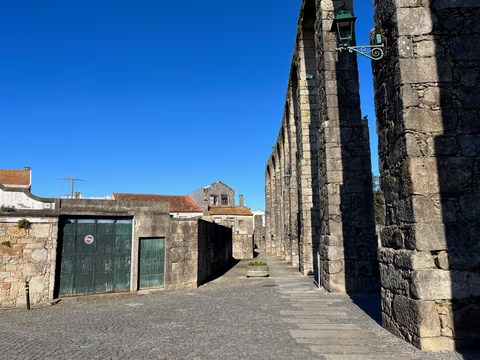
Aqueduct Trail – A path running along the Vila do Conde Aqueduct
From the Coastal Trail to the Camino Central: 12.9 km along the aqueduct from Vila do Conde to São Pedro de Rates. Route, stage, hostels, costs—explained honestly.
Read
Augsburg Way of St. James
The Augsburg Way of St. James runs 231.7 km in 11 stages from Oettingen in the Ries via Donauwörth, Augsburg, Bad Wörishofen and Ottobeuren to Ermengerst in the Allgäu — the Fuggerei, the Jakobervorstadt, a pilgrim of 1446 and Mozart's organ duel. Stages, hostels, costs.
Read

