

Epworth to Lincoln
72.7 kilometers of flat Lincolnshire from John Wesley's birthplace to Lincoln Cathedral – a young pilgrim route on very old roads.
- 01At a Glance
- 02Overview
- 03Other Names
- 04Ideal For – and Less So For
- 05Route & Landscape
- 06Stages, Terrain & Difficulty
- 07A Tombstone as Pulpit, a Church as Moving Box
- 08Highlights Along the Way
- 09How Pilgrims Reach This Route
- 10Continuing the Pilgrimage?
- 11Preparation & Practicalities
- 12What the Route Costs
- 13Getting There
At a Glance
- Start / Finish: Epworth (Isle of Axholme, North Lincolnshire) → Lincoln Cathedral
- Length: 72.7 km
- Stages: 3 (the operator walks it in 4 days)
- Duration: 3–4 days
- Difficulty: easy – flat land, one hill at Gringley, one steep final climb in Lincoln
- Operator: Lincoln Cathedral, „Journeys of Faith“ project; route published by the British Pilgrimage Trust
- Waymarking: no continuous waymarking – GPX track and pilgrim guide are essential
- Best time: April to October (when the Old Rectory in Epworth and Gainsborough Old Hall are open)
Overview
At kilometer 23.5 you see your destination. From Beacon Hill above Gringley on the Hill, the only hill on this route, the towers of Lincoln Cathedral stand on the horizon on clear days – 49 kilometers away, two days' walk across the Trent valley. Hardly any pilgrim route shows its end so early, and hardly any has such an unfair finale: after 72 kilometers of flat land, the last 420 meters run up Steep Hill, Roman paving with gradients of up to 20 percent, right beneath the cathedral that was the tallest building in the world from 1311 to 1548.
The route is young and the road is old. In 2016 a parishioner named Alan Wilson suggested at the harvest supper in the cathedral's Chapter House that pilgrim routes to Lincoln be laid out; in March 2019 the route from Epworth was walked for the first time. It starts at the rectory where John Wesley grew up, crosses the Trent at West Stockwith, passes the hall where Separatists and later Wesley preached, and reaches in Stow the church from which the bishop's seat moved to Lincoln. It does not lead to St. James – it leads to the shrine of St. Hugh. Why it can still count towards the Compostela is explained below.
Other Names
The route is simply called Epworth to Lincoln. It is one of five routes in the Journeys of Faith series built by Lincoln Cathedral – its siblings start in Louth, Boston, Navenby and Sempringham. There is no Spanish-sounding name, and that is no oversight: this route leads not to St. James but to the shrine of St. Hugh of Lincoln. If you find it somewhere as the „Lincoln Camino“, you are reading an invention of travel portals.
Ideal For – and Less So For
Ideal if you want a first multi-day pilgrimage without mountain climbs, if you like English church history – Anglo-Saxons, Vikings, Separatists and Methodists stand side by side here over 72 kilometers – or if you want to collect the kilometers you will later be missing on the Camino Inglés from A Coruña for the Compostela. Three days, one rucksack, a destination you can already see on the way: pilgrimage hardly comes more compact.
Honestly, though, it is not for you if you are looking for elevation, views and wilderness – this is marshland and arable plain. And if you expect hostels, pilgrim menus and the company of other pilgrims in the evening, you will be disappointed: there is not a single pilgrim hostel, no waymarking and usually no other pilgrims. You book pubs and B&Bs as on an ordinary walk and walk alone in between.
Route & Landscape
The route begins in Epworth in the middle of the Isle of Axholme – an island that has not been one since the Dutchman Cornelius Vermuyden drained the marshland from 1626, against the armed resistance of the farmers of Haxey. After 7.4 kilometers you reach Haxey, after 14.5 the Trent at West Stockwith, where river, Idle and Chesterfield Canal meet. From there the route climbs via Misterton to Beacon Hill at Gringley on the Hill (km 23.5) – the only hill worthy of the name, with a view across the Trent valley to Lincoln.
Then back into the plain: via Beckingham to Gainsborough (km 39.7) with its late-medieval Old Hall, then through Upton, Kexby and Willingham to Stow (km 51.4), where the largest Anglo-Saxon church in the area stands. The last third leads via Coates-by-Stow, Thorpe in the Fallows, North and South Carlton and Burton onto the limestone ridge on which Lincoln lies – and ends on Steep Hill, the Roman line of Ermine Street, directly beneath the cathedral.
Stages, Terrain & Difficulty
Technically easy: field paths, towpaths, quiet lanes, hardly any climbing – the route database holds no elevation data, other sources give around 198 meters of ascent and 71 meters as the highest point. The difficulty lies elsewhere: there is no continuous waymarking, and without a GPX track you will reliably take a wrong turn in the fields between Beckingham and Gainsborough. Wet weeks make the marsh paths heavy, in winter there is standing water. We split the route into three days; the operator walks it in four, with an extra night in Gainsborough. Kilometers from the Camino Ninja map, calibrated exactly to 72.7 km.
- Epworth → Gringley on the Hill (23.5 km) – Wesley's rectory, the Hood village of Haxey, then across the Trent at West Stockwith and up the only real hill of the route, from which on clear days you can see the cathedral.
- Gringley on the Hill → Stow (27.9 km) – The longest stage: down into the Trent valley, through Beckingham to Gainsborough and via Upton, Kexby and Willingham to the Saxon mother church of Lincolnshire.
- Stow → Lincoln (21.3 km) – Coates-by-Stow, Thorpe in the Fallows and the two Carltons, then the climb via Burton into the upper town and up Steep Hill to the cathedral.
A Tombstone as Pulpit, a Church as Moving Box
On Sunday 6 June 1742 John Wesley returned to his home village and asked the curate of St Andrew's in Epworth to let him preach. He refused – Wesley's journal notes drily: „But he did not care to accept of my assistance.“ So after the service Wesley stood on the tombstone of his father Samuel, three meters south of the chancel, and preached from there: „I stood near the east end of the church, upon my father's tombstone, and cried, 'The kingdom of heaven is not meat and drink; but righteousness, and peace, and joy in the Holy Ghost.'“ The stone still stands, listed in its own right; you can touch it. The boy whom his mother called „a brand plucked from the burning“ after the rectory fire of 1709 had been a Fellow of Lincoln College, Oxford, since 1726 – so he already carried the name of his destination in his title.
The second anchor of this route is a move. Stow Minster at kilometer 51.4 was around 975 the principal church of the Lincolnshire part of the diocese, richly endowed in 1053/54 by Leofric of Mercia and his wife Godiva; a longship is scratched into the chancel arch, the oldest known Viking graffito in England. Bishop Remigius built the nave here from 1067 to 1073 – and then moved his seat to Lincoln, where he laid the foundations of the cathedral around 1072. It was consecrated on 11 May 1092; Remigius died two days later. Whoever walks from Stow to Lincoln walks the route of that move, from the mother church to the daughter that outshone her. The destination is the shrine of St. Hugh, bishop from 1186 to 1200, canonized in 1220 as the first Carthusian ever – a place of pilgrimage that for three centuries drew almost as many pilgrims as Canterbury.
Highlights Along the Way
- Old Rectory, Epworth – the rectory rebuilt in brick after the fire of 1709, where Samuel and Susanna Wesley lived with 19 children; a museum of the Methodist Church since 1954, open April to October Tue/Wed/Thu/Sat 10:30–15:30.
- Samuel Wesley's tombstone at St Andrew's – the stone on which John Wesley preached on 6 June 1742 after being refused the pulpit.
- Haxey – scene of the Haxey Hood on 6 January, probably the oldest living tradition in England, traced back to a land grant around 1359; the Fool opens with „Hoose agen hoose, toon agen toon, if a man meets a man knock 'im down, but doan't 'ot 'im.“
- West Stockwith – canal basin at the confluence of Trent, Idle and Chesterfield Canal and one of the best places to see the Trent Aegir, a tidal bore up to five feet high, named after the Norse sea god Ægir.
- Beacon Hill, Gringley on the Hill – prehistoric hillfort from which Lincoln Cathedral is visible on clear days.
- Gainsborough Old Hall – built from 1460 by Sir Thomas Burgh, with probably the most complete medieval kitchen in England. Richard III was here in 1484, Henry VIII in 1541 with Katherine Howard, from 1596 the Separatists around John Smyth preached here – and in the 1750s John Wesley.
- Stow Minster – founded around 975, nave 1067–1073 by Remigius, the oldest Viking graffito in England on the chancel arch; open daily from 8:30, free entry.
- Steep Hill, Lincoln – 420 meters, gradients up to 20 percent, on the Roman line of Ermine Street; on the slope the Jew's House of around 1150.
- Lincoln Cathedral – foundations around 1072, consecrated on 11 May 1092; with its wooden spire 160 meters high and thus the tallest building in the world from 1311 to 1548.
- Magna Carta in Lincoln Castle – one of the four surviving original copies of 1215, together with the Charter of the Forest of 1217; Lincoln is the only place where both lie side by side.
How Pilgrims Reach This Route
No other route on our map arrives in Epworth – this one starts from nothing, in a place without a railway station. You take the train to Doncaster or Scunthorpe and board bus 399 of Hornsbys Bus & Coach, which runs via Belton to Epworth. If you only arrive at midday, a first night in Epworth is worth it: the Old Rectory is open only four days a week, and you need a morning for it.
If you build the route into a longer English pilgrimage, combine it by rail with the other English routes: the Walsingham Camino from London to Little Walsingham, the St James' Way England from Reading to Southampton, the Finchale Camino Inglés in northern England and the Via Francigena (England) from London to Dover.
Continuing the Pilgrimage?
In Lincoln the route ends – on foot, for good. No route on our map continues from here, and the four sibling routes of the series all lead to Lincoln too, not away from it. Lincoln is a destination, not a junction.
It gets interesting if you think on to Santiago. The Confraternity of Saint James writes of the short variant of the English route: „Even though the route from A Coruña is only 73 km to Santiago, you can still earn the Compostela if you have walked the remaining 27 km in your home country first and collected stamps in your credencial to prove it.“ The British Pilgrimage Trust names 25 kilometers in Britain as the threshold – with 72.7 you have clearly passed it. Two conditions: get your pilgrim passport stamped twice a day, and clear recognition beforehand with the CSJ or the Pilgrim Office in Santiago, because Epworth–Lincoln is not on the list of British routes officially recognized as having „Jacobean significance“. Then fly to A Coruña and walk the Camino Inglés from A Coruña; if you want the full distance, start in Ferrol on the Camino Inglés.
Preparation & Practicalities
The best time is April to October: then the Old Rectory in Epworth and Gainsborough Old Hall are open and the marsh paths are walkable. In winter there is standing water on the Isle of Axholme and in the Trent valley – the land lies partly below sea level, which is why it had to be drained in the first place. If you are in Haxey on 6 January you will experience the Haxey Hood, but you will hardly find a bed and certainly no dry shoes.
You do not need a pilgrim passport for a bed here, but you should carry one. The British Pilgrimage Trust's Pilgrim Passport costs £6.50 (around 7.50 euros) including UK postage and has 156 stamp fields (as of September 2026); stamps are available in churches, pubs, cafés and tourist offices, and where there is none, a signature will do. If you later want to count the kilometers towards the Compostela, you also need a Spanish credencial – the Pilgrim Office does not accept the BPT passport as a substitute – and the two-stamps-a-day rule.
There are no pilgrim hostels – you book pubs, B&Bs and hotels, and early, because between Haxey and Gainsborough the choice is thin. The route is not waymarked, so download the British Pilgrimage Trust's GPX track and plan your days beforehand rather than on the way; the easiest way is directly in the Camino Ninja app, where you put together your stages and book suitable accommodation at the same time.
What the Route Costs
The route itself costs nothing, the overnight stays do: without a hostel network you pay British B&B and pub prices, realistically £60 to £100 per night for a double room (around 70 to 115 euros) and correspondingly more alone – a daily budget of £90 to £130 (around 105 to 150 euros) including food is an honest calculation, not a list price (as of September 2026). Only Gainsborough and Lincoln have a larger choice; Epworth gets by with pubs and campsites.
Plus the admission fees (as of September 2026): Lincoln Cathedral £12.95 (around 15 euros) for adults Monday to Saturday, £10.95 on Sundays; children up to 16 and students pay nothing. For services, prayer and lighting candles entry is always free – „Entry for services and for prayer and to light candles will always be free of charge.“ So if you arrive for Evensong you go in for nothing and end the route the way the first pilgrim group ended it in 2019. Stow Minster costs nothing; for Gainsborough Old Hall (English Heritage) the website shows the day price only at the booking step, with 15 percent off online when booking by the day before.
Getting There
Epworth has no railway station – the old „Haxey and Epworth“ halt is closed. You come by train to Doncaster or Scunthorpe and take bus 399 (Hornsbys Bus & Coach) via Belton to Epworth. Doncaster lies on the East Coast Main Line and is easily reached from London King's Cross, York, Leeds and Sheffield.
Getting back is easier: Lincoln Central is served directly by LNER from London King's Cross. If you want to split the route, get off at Gainsborough Lea Road, the only station on the route – at kilometer 39.7 on the Doncaster–Lincoln line, almost exactly halfway.
- Train to Doncaster / Scunthorpe / Lincoln: LNER
- Bus 399 Doncaster/Scunthorpe – Epworth – Haxey: Hornsbys Bus & Coach, timetable
- GPX track and route description: British Pilgrimage Trust
- „Journeys of Faith“ pilgrim guides: Lincoln Cathedral

Get your pilgrim credential and shell
Everything you need for the Epworth to Lincoln, shipped to your door.
Visit Camino Shop
Other Caminos
 Appenzeller Weg
Appenzeller Weg
52.6 km from Rankweil across the Rhine to St. Peterzell: St. James Chapel (1464), 163 Years of the Wedding Trail, connection to the Via Jacobi. Stages, costs, how to get there.
Read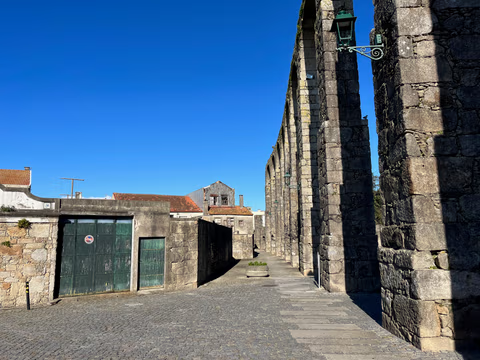
Aqueduct Trail – A path running along the Vila do Conde Aqueduct
From the Coastal Trail to the Camino Central: 12.9 km along the aqueduct from Vila do Conde to São Pedro de Rates. Route, stage, hostels, costs—explained honestly.
Read
Augsburg Way of St. James
The Augsburg Way of St. James runs 231.7 km in 11 stages from Oettingen in the Ries via Donauwörth, Augsburg, Bad Wörishofen and Ottobeuren to Ermengerst in the Allgäu — the Fuggerei, the Jakobervorstadt, a pilgrim of 1446 and Mozart's organ duel. Stages, hostels, costs.
Read

