

Lahn-Camino
The Lahn-Camino follows the Lahn in six stages and 139.0 kilometres from Wetzlar to the river's mouth at Lahnstein – with Limburg Cathedral, Arnstein Abbey and the UNESCO World Heritage town of Bad Ems along the way, and the Mosel-Camino to Trier as its continuation.
- 01At a Glance
- 02Overview
- 03Other Names
- 04Ideal For – and Less So For
- 05Route & Landscape
- 06Stages, Terrain & Difficulty
- 07Two Apostles' Tombs in One Sentence
- 08Highlights Along the Way
- 09How Pilgrims Reach This Route
- 10Continuing the Pilgrimage?
- 11Preparation & Practicalities
- 12What the Route Costs
- 13Getting There
At a Glance
- Start / Finish: Wetzlar (Hesse) → Lahnstein at the mouth of the Lahn (Rhineland-Palatinate)
- Length: 139.0 km
- Elevation: 2,851 m ascent, 2,946 m descent
- Highest point: 358 m between Misselberg and Dausenau (km 111.9)
- Stages: 6
- Duration: 6 days
- Difficulty: moderate – low mountains with many short, sharp climbs
- Waymarking: stylised yellow scallop on blue, thin in places
- Best time: April to October
Overview
This route does not end at a church but at a hospital. The Hospitalkapelle St. Jakobus in Oberlahnstein was a pilgrim hospital, documented since 24 November 1330 – „eine Urkunde über den Verkauf eines Weingartens in Kaub“, a deed on the sale of a vineyard in Kaub, mentions it for the first time – and when the chapel was restored in 1982, the grave of a Santiago pilgrim was found at its centre. He got no further. You will: across the Rhine on the opposite bank begins the Mosel-Camino to Trier, to the only apostle's tomb north of the Alps. That the two destinations belong together was already known in the Lahn valley in 1491, when a confraternity was founded in Villmar that carried both James and Matthias in its name.
139.0 kilometres, six stages, a river as the thread and a train that follows it. The Lahn valley railway accompanies the route from Wetzlar to Lahnstein almost without a gap – hardly any German Camino can be broken into day stages, abandoned and picked up again so easily. What you accept in return: 2,851 metres of ascent, because the route prefers the beech slopes above to the riverbank below, and a hostel network that consists of exactly one address. In exchange, a cathedral with seven towers, a ship tunnel of 1847, a monastery that changed confession, and a spa town where a telegram triggered a war.
Other Names
Officially it is the Lahn-Camino – so waymarked, so signposted, so printed in the pilgrim passport. You will also find it as the Jakobsweg an der Lahn or the Lahn-Jakobsweg; the operator lists it together with the Rhein-Camino under "Lahn-Camino | Rhein-Camino". Do not confuse it with the Lahnhöhenweg, which runs parallel in places but carries a black L on white. And about the start: the operator has since added a "stage 0" from Gießen to Wetzlar, around 17 kilometres. We describe the classic route Wetzlar → Lahnstein, as it was waymarked in 2001.
Ideal For – and Less So For
The Lahn-Camino is for you if you have a week, like history and have no appetite for logistics. Six days, 139 kilometres, a railway station in practically every stage town: you can leave Frankfurt in the morning, start in Wetzlar at noon and sleep in the Lahn valley that night. If you like shady beech slopes, castles above the water and churches where someone has dug a fragment of a scallop shell out of the ground, you get a lot of route here for very little travel.
Honestly, though, it is not for you if you are looking for the Spanish hostel experience. The official list of pilgrim lodgings contains exactly one address, the Laurentiuskonvent in Laufdorf on a donation basis; everything else is guesthouses, hotels, holiday flats and five youth hostels you should book ahead. Nor is the waymarking a given: one pilgrim who has walked four German Caminos calls it here „von allen vier Jakobswegen am wenigsten ausgeprägt“ – the least developed of the four – and walked with a GPS track. And if you expect flat riverside paths, think again – the route mostly stays up on the heights, and 2,851 metres of ascent over 139 kilometres do not come from nowhere.
Route & Landscape
You start at Wetzlar Cathedral, climb via Nauborn and Laufdorf onto the heights and reach Braunfels after a good 16 kilometres, with its neo-Gothic castle silhouette. Via Hirschhausen you descend to Weilburg, where the Lahn makes such a tight loop that in 1847 it was simply tunnelled under. Then it turns woody: Freienfels, Weinbach, Elkerhausen, Langhecke – the longest stretch without larger villages, but with plenty of shade. In Villmar you literally stand on 380-million-year-old reef limestone. Via Runkel with its castle ruin and Eschhofen you reach Limburg: cathedral on the rock, half-timbered old town, below it the Old Lahn Bridge of 1315.
Beyond Diez the character changes. The valley narrows, the slopes steepen, the villages shrink: Fachingen with its mineral spring, Balduinstein below the Schaumburg, Laurenburg with the ancestral castle of the House of Nassau, then down to Obernhof and up to Arnstein Abbey on its rocky spur. Via Nassau the route climbs to the highest point of the whole Camino – 358 metres between Misselberg and Dausenau – and drops to Bad Ems, a UNESCO World Heritage Site since 2021. The last kilometres via Fachbach, Miellen and Frücht are ridge walking once more, before you descend in Lahnstein to 76 metres, to where the Lahn flows into the Rhine.
Stages, Terrain & Difficulty
The operator divides the route into six stages, and we follow. The terrain is classic low mountain country: forest tracks, meadow paths, little asphalt, but constant ups and downs between valley floor and ridge. No single climb is dramatic; the sum is. The longest and most demanding stage is Diez → Obernhof through the narrow lower Lahn valley. If a stage gets too long for you, the river helps: almost every stage town has a station on the Lahn valley railway. Kilometres from the Camino Ninja map, calibrated exactly to 139.0 km.
- Wetzlar → Weilburg (28.1 km) – From the unfinished cathedral over the heights to Braunfels and down to the residence town with Germany's only navigable ship tunnel.
- Weilburg → Villmar (24.6 km) – Wooded stage via Freienfels, Weinbach and Langhecke to the marble village with its St James altar and the Unica quarry.
- Villmar → Diez (20.3 km) – Short and dense: Runkel Castle, the St James statue in Dietkirchen, Limburg Cathedral and the Old Lahn Bridge, then across into Nassau's Diez.
- Diez → Obernhof (27.7 km) – The queen stage past Fachingen, Balduinstein and Laurenburg to below Arnstein Abbey.
- Obernhof → Bad Ems (19.1 km) – Via Nassau and the highest point of the route (358 m) to Dausenau and into the UNESCO spa town.
- Bad Ems → Lahnstein (19.2 km) – Last heights via Frücht and Friedland, then the descent to the mouth of the Lahn and the Hospitalkapelle St. Jakobus.
Two Apostles' Tombs in One Sentence
Whether the Lahn was a pilgrim route in the Middle Ages cannot be proven beyond doubt – we say so up front. What can be proven is a chain of clues that points conspicuously in one direction. In the church of St. Kastor in Dausenau excavations turned up the fragment of a scallop shell, read as the remnant of a pilgrim hostel. In Oberlahnstein a St James hospital stood from 1330 at the latest, founded probably after a decree of Pope Clement V of 1312 and before the town charter of 1324; in its chapel lay a Santiago pilgrim buried. And in Villmar the record says, word for word: „Villmarer Pilger zu den Apostelgräbern in Santiago und Trier werden 1491 anlässlich der Gründung einer Jakobus-, Matthias- und Sebastiansbruderschaft erwähnt.“ – Villmar pilgrims to the apostles' tombs in Santiago and Trier are mentioned in 1491 on the founding of a confraternity of James, Matthias and Sebastian. Santiago and Trier in one sentence – that is exactly the axis the route traces today: down the Lahn, across the Rhine, up the Moselle.
Villmar supplies a second point, a stony one. The village stands on a 380-million-year-old coral reef that polishes like marble and is therefore called Lahnmarmor; there were more than a hundred quarries here, today only the Unica quarry can be entered. The stone was built into Berlin Cathedral, the Hermitage, the lobby of the Empire State Building – and into the abbey of St. Matthias in Trier, at the only apostle's tomb north of the Alps. Whoever walks the Lahn-Camino and continues on the Mosel-Camino meets at the end the rock they walked over halfway. Completion, however, is not the route's strong point: the north tower of Wetzlar Cathedral, where you start, has been waiting for its upper storey since 1336.
Highlights Along the Way
- Wetzlar Cathedral (km 0) – since 8 September 1561 a shared church for Catholics and Lutherans, with a north tower of which only the ground storey was ever built; on the tower portal St James with a pilgrim's shell.
- Braunfels Castle (km 16.4) – first mentioned in 1246 as "Castellum Bruninvels", turned into a fairy-tale backdrop from 1880, still in family ownership.
- Weilburg Ship Tunnel (km 28.1) – 195 metres through the hill, opened on 18 September 1847, the oldest still navigable ship tunnel in Germany; today canoeists pass through it.
- Unica Quarry, Villmar (km 52.7) – the only one of more than a hundred Lahn quarries you can enter; 380-million-year-old reef rock, a natural monument since 1996, next to it the Lahn Marble Museum (2016). In the church, a St James altar.
- Runkel Castle (km 57.8) – first mentioned in 1159, destroyed by imperial troops on 15 October 1634, today a walkable ruin above the Lahn bridge of 1440.
- Limburg Cathedral (km 68.8) – consecrated in 1235 by Theoderich von Wied, Archbishop of Trier, seven towers for seven sacraments, a bishop's church since 1827; beside it the Old Lahn Bridge of 1315 with the only surviving 14th-century bridge tower in Germany.
- Grafenschloss Diez (km 73.0) – keep from the 11th century, later seat of the Counts of Nassau-Diez, a youth hostel with 129 beds since 2006.
- Arnstein Abbey (km 101.0) – in 1139 Count Ludwig III turned his castle into a Premonstratensian monastery and became a monk himself; since 1 June 2019 Greek Orthodox nuns live here.
- Nassau (km 106.4) – ancestral castle of the House of Nassau, from which the royal houses of the Netherlands and Luxembourg descend; birthplace of the reformer Freiherr vom Stein (1757–1831).
- Dausenau (km 115.1) – leaning tower, cut down by around 7.50 metres in 1950, medieval town wall and the church of St. Kastor with the shell fragment.
- Bad Ems (km 119.8) – UNESCO World Heritage since 24 July 2021 as one of the "Great Spa Towns of Europe"; the Ems Dispatch originated here on 13 July 1870, and Dostoevsky took the cure for four summers.
- Hospitalkapelle St. Jakobus, Oberlahnstein (km 139.0) – the finish: a pilgrim hospital, documented since 24 November 1330, with the grave of a Santiago pilgrim at its centre; in front of it a life-size statue of St James in Verona marble.
How Pilgrims Reach This Route
Wetzlar is no random starting point but a hub: the town lies on the Elisabethpfad 1 from Frankfurt to Marburg, at its kilometre 79.5. Anyone wanting to walk in from the Rhine-Main area comes up this route and turns west in Wetzlar; from the other direction, from Marburg, the same works.
By rail, Wetzlar is a good hour from Frankfurt via the Lahn valley railway and the Main-Weser line. And if you want to put a day in front of your route, get off in Gießen and walk the official "stage 0", around 17 kilometres, to Wetzlar.
Continuing the Pilgrimage?
In Lahnstein the Lahn-Camino ends at the Hospitalkapelle St. Jakobus – and exactly there the Rhein-Camino begins: 52.5 kilometres along the right bank of the Rhine via Braubach, Kamp-Bornhofen and the Loreley to Kaub, from the same operator, with the same website and the same pilgrim passport. That is the continuation we recommend: no change of river, no train, just keep walking. In Kaub the ferry to Engelsburg takes you to the left bank, right onto the Linksrheinischer Jakobsweg, which passes Bacharach at its kilometre 208.7 and carries on to Bingen – and anyone who proves the last 100 kilometres to Kaub receives the pilgrim certificate.
The alternative lies opposite: in Koblenz-Stolzenfels the Mosel-Camino begins, leading 157.1 kilometres to Trier and St. Matthias, from where Trier – Le Puy or Trier – Vézelay continue into France. But mind the crossing: the Lahnstein–Stolzenfels ferry has not run since autumn 2010, and there is no Rhine crossing directly in Lahnstein. The Mosel-Camino operator recommends walking on along the right bank to the Horchheim railway bridge and crossing there; if you prefer it simpler, take the train from Niederlahnstein to Koblenz main station and walk about 700 metres down to the Rhine.
Preparation & Practicalities
The best time is April to October. The route runs mostly through forest, so there is plenty of shade – even so, pilgrims report real high-summer heat in August on the upper Lahn. Spring and early autumn are the most pleasant choice; in winter many stamp points and inns are closed.
For accommodation the rule is: book ahead, a week's notice is usually enough. There is no hostel network as in Spain. The official lodging list of the St. Jakobus-Gesellschaft carries a single address – the Laurentiuskonvent in Schöffengrund-Laufdorf, bed and breakfast on a donation basis – and you may use this lodging expressly only with a pilgrim passport. Otherwise you rely on the youth hostels in Wetzlar, Weilburg, Limburg, Diez and Bad Ems, on guesthouses, hotels and holiday flats.
You need a pilgrim passport (credencial) here for the pilgrim lodging, for the stamps along the way – in churches, tourist offices, inns and bakeries, special stamps in Dausenau, Miellen and Oberlahnstein – and for the Lahn-Camino certificate at the end. The St. Jakobus-Gesellschaft Rheinland-Pfalz-Saarland issues its own regional passport; it is best to order it in advance so that it reaches you in time for the start. The waymarking is thin in places, so plan with a track: the easiest way is directly in the Camino Ninja app, where you put your stages together and plan suitable accommodation at the same time.
What the Route Costs
The regional pilgrim passport of the St. Jakobus-Gesellschaft costs 5 euros including postage, the pilgrim certificate for the Lahn-Camino 3 euros; the condition is the last 100 kilometres on the route, proven by stamps – at 139.0 kilometres that means everything from Limburg (as of September 2026).
For overnight stays the Lahn-Camino sits at German, not Spanish, price levels: youth hostels and simple guesthouses in practice 30 to 60 euros a night, hotels and holiday flats above that; the one pilgrim lodging in Laufdorf runs on donations. With food you realistically reckon with 60 to 100 euros a day – considerably more than on the Camino Francés, but with no flight and no travel day (as of September 2026).
Getting There
To the start: you reach Wetzlar with regional trains via the Main-Weser line in a good hour from Frankfurt main station; from Gießen and Marburg you are there in minutes.
Along the way and from the finish: this is the real strength of this route. The Lahn valley railway accompanies the Lahn-Camino from Gießen to Koblenz – you can abandon, extend or walk any stage as a day trip. In Lahnstein trains stop at Niederlahnstein and Oberlahnstein; from Niederlahnstein it is a few minutes to Koblenz main station with long-distance connections.
- RE 25 „Lahntal-Express“: Koblenz – Limburg – Gießen, hourly, stops include Niederlahnstein, Bad Ems, Nassau, Diez, Limburg, Weilburg, Wetzlar – Deutsche Bahn
- RB 23 „Lahn-Eifel-Bahn“: Koblenz – Bad Ems – Diez – Limburg
- RB 45: Fulda – Gießen – Weilburg – Limburg (Hessische Landesbahn)
- Rhine crossing: no more Lahnstein–Stolzenfels ferry (discontinued autumn 2010) – Horchheim railway bridge or train via Koblenz main station
Partners
Partner for Lahn-Camino
Camino Ninja is cooperating with official partners. For this camino the partner is:


Get your pilgrim credential and shell
Everything you need for the Lahn-Camino, shipped to your door.
Visit Camino Shop
Other Caminos
 Appenzeller Weg
Appenzeller Weg
52.6 km from Rankweil across the Rhine to St. Peterzell: St. James Chapel (1464), 163 Years of the Wedding Trail, connection to the Via Jacobi. Stages, costs, how to get there.
Read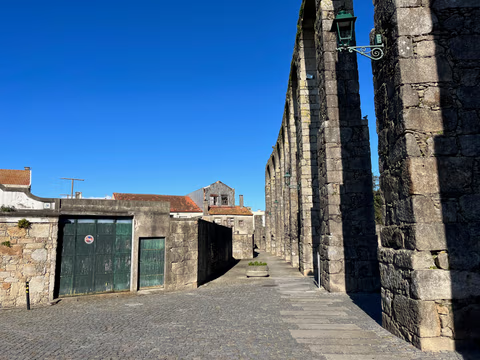
Aqueduct Trail – A path running along the Vila do Conde Aqueduct
From the Coastal Trail to the Camino Central: 12.9 km along the aqueduct from Vila do Conde to São Pedro de Rates. Route, stage, hostels, costs—explained honestly.
Read
Augsburg Way of St. James
The Augsburg Way of St. James runs 231.7 km in 11 stages from Oettingen in the Ries via Donauwörth, Augsburg, Bad Wörishofen and Ottobeuren to Ermengerst in the Allgäu — the Fuggerei, the Jakobervorstadt, a pilgrim of 1446 and Mozart's organ duel. Stages, hostels, costs.
Read

