

Beuroner Jakobsweg
The Beuroner Jakobsweg runs 105.7 kilometers from Tübingen on the Neckar to Meßkirch, via Rottenburg, Hechingen and Balingen up onto the Swabian Jura and down into the gorge of the Upper Danube to Beuron Archabbey. It is the route that gave its name to the Via Beuronensis, which a Beuron monk began waymarking in 2004 and which Santiago has recognized since 2009. Six stages, 1,830 meters of climbing, high point 951 meters on the Alb escarpment between Weilstetten and Tieringen. In Meßkirch, the Linzgauer Jakobsweg takes over toward Lake Constance.
- 01At a Glance
- 02Overview
- 03Other Names
- 04Who It's Ideal For—and Who It's Not So Ideal For
- 05Route & Landscape
- 06Stages, Terrain, and Difficulty
- 07Egypt on the Danube: How Beuron's Monks Darkened Their Own Baroque Church
- 08Highlights Along the Way
- 09How Pilgrims Find Their Way onto This Path
- 10Continue the pilgrimage?
- 11Preparation & Practical Information
- 12What the journey will cost you
- 13Getting Here
At a Glance
- Start / Finish: Tübingen on the Neckar / Meßkirch in the Linzgau
- Length: 105.7 km
- Duration: 6 stages, averaging about 18 km; fast walkers combine the first two days to Hechingen and manage it in 5
- Elevation: ↗ 1,830 m / ↘ 1,557 m
- Highest point: 951 m at km 57.7 on the Alb escarpment between Weilstetten and Tieringen
- Landscape: The Neckar valley, the rolling foothills of the Zollernalb, the steep climb up the Alb escarpment, the plateau of the Großer Heuberg, the Bära valley and the limestone cliffs of the Danube gorge
- Waymarking: yellow shell or ray bundle on a blue background, with the focal point showing the direction of travel – waymarked toward Konstanz only
- Traces of St. James: Collegiate Church of St. Jakobus in Hechingen, the pilgrim office and life-size pilgrim statue in Beuron, the Confraternity of St. James in Killer, founded in 1510, in the Hohenzollern neighborhood
- Accommodation: Inns, guesthouses and hotels in the stage towns, the guest wing of Beuron Archabbey; pilgrim hostels with dorms are almost nonexistent
- Connecting routes: Jakobsweg Rothenburg–Rottenburg (shared from Tübingen to Rottenburg), Rottenburg – Freiburg – Héricourt from Rottenburg, Linzgauer Jakobsweg from Meßkirch
- Best time: May to October; on the Alb, snow often still lingers in April or has already arrived in November
- Pilgrim passport / Certificate: Credential from the office of the Jakobspilger-Gemeinschaft in Beuron; with at least 100 documented kilometers on the Via Beuronensis, a free pilgrim certificate (as of October 2026)
Overview
The Beuroner Jakobsweg begins with a song and ends with its composer. In 1805, Tübingen's own Ludwig Uhland wrote of the chapel on the hill above Wurmlingen: „Droben stehet die Kapelle, schauet still ins Tal hinab“ (“Up there stands the chapel, gazing quietly down into the valley”), and the poem was set to music by Conradin Kreutzer, born in Meßkirch in 1780. Between the two lie 105.7 kilometers from the Neckar across the Swabian Jura into the valley of the young Danube, and at kilometer 87.8 stands the monastery that gives the trail its name.
The Archabbey of St. Martin in Beuron is no museum. Benedictines have lived here since 1863 – 32 monks at the beginning of 2023 – and they still sing Vespers in Latin. The trail itself came out of this monastery: from 2004, Brother Jakobus Kaffanke, a Benedictine at Beuron since 1983, had the Via Beuronensis waymarked with a project group; the Beuroner Jakobspilger-Gemeinschaft was founded in 2008, and in 2009 Santiago recognized the route. To be honest, though, this is no Spanish Camino in miniature: you sleep in an inn, not a dorm, and between Balingen and Nusplingen there's a climb many people wouldn't expect from a German Way of St. James.
Other Names
The trail is called the Beuroner Jakobsweg, often simply named after its network, the Via Beuronensis, Latin for “the Beuron Way.” Strictly speaking, though, the Via Beuronensis is a whole bundle of regional Ways of St. James between Tübingen, Ulm and Konstanz, and the Beuron route is its main line. The opening section from Tübingen to Hechingen is listed by the operator under its own name, Tübinger Jakobsweg. In English you'll see Beuron Way of St. James.
Who It's Ideal For—and Who It's Not So Ideal For
Ideal if you're looking for a pilgrimage week in southern Germany that feels like a real Camino: two towns on the Neckar, a castle on the horizon, a climb onto the Alb with genuine elevation gain, and on day five a monastery where you can slip into Vespers in the evening. Ideal, too, as a dress rehearsal before you take on longer routes, because almost every stage town has a train station or a bus connection and you can stop whenever you like.
Honestly, though, it's not for you if you expect pilgrim hostels and community like on the Camino Francés: you'll often walk alone all day here and pay guesthouse prices at night. Not for you if you shy away from climbs – the stage from Balingen to Nusplingen climbs from the Alb foothills to over 900 meters. And not for you if you like walking in both directions: the waymarks point only toward Konstanz, so going the other way you'll need the map in the app.
Route & Landscape
Tübingen to Balingen (km 0–47.1): From the old town of Tübingen, the trail follows the Neckar upstream to Wurmlingen (km 7.6), where the Wurmlingen Chapel crowns the Kapellenberg, and on to the episcopal town of Rottenburg am Neckar (km 11.8), Roman Sumelocenna. There the trail leaves the river and climbs via Dettingen, Bechtoldsweiler and Stein into the hill country to Hechingen (km 31.9). From here, the silhouette of Hohenzollern Castle on its conical hill keeps you company as the trail continues via Wessingen and Bisingen (km 38.2) to Balingen (km 47.1); Engstlatt lies just under a kilometer off the route.
Balingen to Meßkirch (km 47.1–105.7): Beyond Endingen and Weilstetten (km 53.0) comes the big climb: within a few kilometers you're up on the Alb escarpment, reaching 951 meters at km 57.7, and on a clear day you can see across the entire Alb foreland to the Black Forest. Up top, the trail crosses the plateau to Tieringen (km 60.1), continues via Oberdigisheim and Unterdigisheim to Nusplingen (km 69.7) and through the quiet Bära valley to Bärenthal (km 78.5). Via Gnadenweiler and Irndorf you reach the rim of the Danube valley and descend through forest to Beuron (km 87.8), where the Danube loops between white limestone cliffs. After that, the trail leaves the valley again, climbs to Buchheim (km 93.8) and runs via Altheim and Heudorf through open hill country to Meßkirch (km 105.7).
Stages, Terrain, and Difficulty
We show the trail in 6 stages, just like the Jakobspilger-Gemeinschaft, with deliberately short days; distances come from the Camino Ninja map, calibrated exactly to 105.7 km. The stage to Beuron is intentionally kept short so you have the afternoon for the monastery.
- Tübingen → Rottenburg am Neckar (11.8 km) — a flat start along the Neckar, past Wurmlingen and its chapel; early starters keep going.
- Rottenburg am Neckar → Hechingen (20.1 km) — up out of the Neckar valley via Dettingen, Bechtoldsweiler and Stein, with your first view of Hohenzollern Castle.
- Hechingen → Balingen (15.2 km) — via Wessingen and Bisingen along the foot of the Alb, easy walking.
- Balingen → Nusplingen (22.6 km) — the queen stage: the steep climb up the Alb escarpment to 951 meters, then across the plateau to Tieringen and down into the valley of the Bära.
- Nusplingen → Beuron (18.1 km) — through the Bära valley and across the plateau near Irndorf, finishing with the descent into the Danube valley to the archabbey.
- Beuron → Meßkirch (17.9 km) — up out of the valley to Buchheim and via Altheim and Heudorf into the Linzgau.
The surface is mostly forest, field and meadow paths, plus village streets and shorter paved stretches in the Neckar valley. Nothing is technically difficult, but the Alb climb beyond Weilstetten is steep and slippery when wet, and on the plateau between Tieringen and Irndorf there's nowhere to stop for food or drink for many kilometers. The trail isn't waymarked in the opposite direction; the Jakobspilger-Gemeinschaft also describes a flatter variant from Hechingen, the Hohenzollerischer Jakobsweg, which isn't shown on our map.
Egypt on the Danube: How Beuron's Monks Darkened Their Own Baroque Church
Beuron was founded by a man named Peregrin – “the pilgrim”: in the second half of the 11th century, the nobleman Peregrin von Hoßkirch endowed a house of canons, and in 1097 Pope Urban II took it under his protection. The Augustinian canons stayed until 1802, built the Baroque abbey church by the Rottweil architect Matthäus Scharpf from 1732 to 1738, and left with secularization. In 1863, the brothers Maurus and Placidus Wolter from Bonn moved in as Benedictines with the support of Princess Katharina von Hohenzollern-Sigmaringen; Beuron became an abbey in 1868 and an archabbey in 1887.
With the monks came an art found nowhere else. The sculptor Desiderius Lenz, born in nearby Haigerloch in 1832, sought his forms in early Christian, Byzantine and ancient Egyptian art. He began his first work, the St. Maurus Chapel about three kilometers downstream, on May 5, 1868; it was consecrated on September 5, 1871, with papyrus, lotus and palm ornaments on the banks of the Danube. In 1872, the new Beuron School of Art then remade the interior of the monastery's own Baroque church – the monastery itself writes today that until the middle of the 20th century it looked „völlig anders“, „eher dunkel nämlich“ (“completely different … rather dark, in fact”). When the monks had to leave Beuron during the Kulturkampf from 1875 to 1887, Lenz and his fellow monks kept painting at Monte Cassino from 1874 to 1879. By around 1910 the style was already considered outdated and many works were destroyed; in 1947 Beuron brought the Baroque splendor back into its church. The School of Art stayed where it belongs: in the Chapel of Grace, which in 1904 became the home of the 14th-century Pietà.
The other thing Beuron has passed on is something you hear rather than see. The Beuron school of chant shaped Gregorian chant across the German-speaking world, and in 1884 the first edition of the „Schott“ by the Beuron monk Anselm Schott appeared – the missal with which generations of Catholics followed the Latin Mass in German. Between 1927 and 1933, Edith Stein came here fifteen times before entering Carmel; in 2003, Brother Jakobus wrote a book about her titled „Ich betrachtete Beuron wie den Vorhof des Himmels“ (“I regarded Beuron as the forecourt of heaven”). In practical terms: plan your arrival so you're sitting in the abbey church at 6 p.m. Vespers are sung in Latin daily, Compline at 8 p.m. except on Tuesdays, and the morning office begins at 5 a.m. (as of October 2026).
Highlights Along the Way
- Tübingen (km 0) — university town on the Neckar, where Ludwig Uhland (1787–1862) was born and died; his grave in the town cemetery lies close to that of Friedrich Hölderlin.
- Wurmlingen Chapel (near km 7.6) — St. Remigius on the 474-meter Kapellenberg, according to tradition endowed around 1050 by Count Anselm of Calw, with a Romanesque crypt from the early 12th century; the building was renewed from 1680 to 1682.
- Rottenburg am Neckar (km 11.8) — as Sumelocenna, a Roman town of about 32 hectares with a 7-km aqueduct; since 1821 the seat of the diocese, with St. Martin's Cathedral; outside town, the pilgrimage church in the Weggental, rebuilt from 1682 to 1695.
- Collegiate Church of St. Jakobus in Hechingen (km 31.9) — the trail's own St. James church, built from 1780 to 1783 by Pierre Michel d'Ixnard in the Louis Seize style; also in town, the Renaissance church of St. Luzen from 1586 to 1589.
- Hohenzollern Castle (in view from km 31.9) — the neo-Gothic ancestral castle on its conical hill above Bisingen, built from 1850 to 1867 by Friedrich August Stüler; you'll see it from the trail for hours.
- Bisingen Concentration Camp Cemetery (km 38.2) — from 1944 to 1945, prisoners were forced to mine oil shale here under „Unternehmen Wüste“ (“Operation Desert”); of 4,150, at least 1,187 died. A cemetery, a history trail and an exhibition keep their memory alive.
- Balingen (km 47.1) — founded in 1255 by the Counts of Zollern, with a late Gothic town church (parish church since 1516) and the Zollern Palace.
- Alb escarpment (km 57.7) — 951 meters, the trail's highest point, with sweeping views across the Alb foreland.
- Nusplingen (km 69.7) — first recorded in 842 as Nuspilingum, with the cemetery church of St. Peter and Paul from around 1300; in the lithographic limestone outside the village, the Stuttgart Natural History Museum has recovered over 7,000 fossils from a 150-million-year-old lagoon since 1993.
- Beuron Archabbey (km 87.8) — abbey church from 1738, Chapel of Grace in the Beuron style, Lourdes grotto with a candlelight procession on the evening of August 14, pilgrim office, monastery shop; plus the covered wooden bridge over the Danube from 1801, 73 meters long, which was badly damaged by fire on the night of September 27, 2023.
- Meßkirch (km 105.7) — town charter since 1261, from 1557 the first regular four-winged Renaissance palace north of the Alps, birthplace of Kreutzer and of Martin Heidegger (1889–1976), who is buried here; the Sacred Heart Church, converted from a riding hall in 1875, is a work of the Beuron School of Art. Outside town, Campus Galli has been building a monastic town with 9th-century methods since 2013.
How Pilgrims Find Their Way onto This Path
That Swabians have long walked to Santiago is attested by the Confraternity of St. James in Killer, south of Hechingen, founded in 1510: only those who had completed „ain Walfart eintweders genn Sanct Jacob zu Compostell in Hispania, genn Rom zu St. Peter“ (“a pilgrimage either to St. James at Compostela in Spain, or to St. Peter in Rome”) or to Aachen were admitted. Today most people start in Tübingen, which is easy to reach by train. Those already on the road come from the northeast: the Jakobsweg Rothenburg–Rottenburg runs from St. James's Church in Rothenburg ob der Tauber via Tübingen to Rottenburg and shares its first 11.8 kilometers with the Beuron route. If you'd rather head west than south from there, take the Rottenburg – Freiburg – Héricourt route from Rottenburg through the Black Forest and Alsace to the Burgundian Gate.
Continue the pilgrimage?
Yes – and that's the whole point of this trail: Meßkirch isn't a destination but a handover. This is where the Linzgauer Jakobsweg begins, running 63.2 kilometers via Wald, Pfullendorf and Überlingen to Lake Constance and crossing by boat to Wallhausen before ending at Konstanz Minster. Already in Wald, nine kilometers past Meßkirch, the Hegauer Jakobsweg branches off to the west, also heading to Konstanz via Stockach and the Bodanrück.
In Konstanz, the Via Jacobi begins, Switzerland's main route via Einsiedeln and the Brünig to Geneva. From Tübingen to Geneva, the line is waymarked all the way.
Preparation & Practical Information
Pilgrim passport and app. As on all German Ways of St. James, you'll need a pilgrim passport (credencial) to stay in pilgrim accommodation and to receive the Compostela in Santiago at the end. It's best to order it in advance so it reaches you in time for the start of your trip: the Beuroner Jakobspilger-Gemeinschaft, Abteistraße 2 in Beuron, sends it out in response to an order form from via-beuronensis.de. If your passport documents at least 100 kilometers on the Via Beuronensis, they'll issue you a pilgrim certificate, free of charge in return for a donation (as of October 2026) – at 105.7 kilometers, this route alone gets you there. The easiest way to plan the trail is in the Camino Ninja App, where you can put together your stages and plan suitable accommodation at the same time.
Accommodation. The Gemeinschaft's trail stewards seek out inns and guesthouses along the route; there's no dense hostel network. In Tübingen, Rottenburg, Hechingen and Balingen you'll easily find a room; in Nusplingen and Beuron the choice is small – book a day or two ahead there, and earlier in summer and around August 14. At the archabbey you sleep in the renovated guest wing; check-in is between 2 and 5 p.m., not on Sundays or public holidays.
Season. May to October is the best time. On the Alb plateau it's several degrees cooler than in Tübingen, and the weather can turn quickly; a warm layer belongs in your pack even in summer.
What the journey will cost you
In the guest wing of Beuron Archabbey, a single room costs 92 € and a double 82 € per person, each with full board from afternoon coffee and cake through lunch the next day; for a single night only, add 10 € (as of October 2026). At inns and guesthouses along the trail, budget roughly 55 to 90 € per night with breakfast, toward the upper end in Tübingen.
With accommodation, an afternoon snack and dinner, you'll spend 80 to 120 € per day. Honestly, that's more than twice what a day in Spain costs; in return, you save on flights and travel and can take the regional express home after the monastery.
Getting Here
To the start. Tübingen Hauptbahnhof has regional connections to Stuttgart in about an hour, with long-distance trains in every direction from there; the old town is a few minutes' walk from the station. Rottenburg has had a train station since 1861, Balingen since 1874, and Hechingen and Balingen are on the Zollernalb Railway – good places to join later or bail out.
From the finish. Meßkirch no longer has a passenger station; passenger service between Mengen and Stockach ended in 1954. Buses take you to Sigmaringen and Stockach for the rail network. Beuron itself is a stop for the regional express on the Danube Valley Railway, hourly toward Sigmaringen and Ulm as well as Donaueschingen.
- Rail: bahn.de — connections to Tübingen and from Beuron or Sigmaringen
- Info: via-beuronensis.de — stages, pilgrim passport and pilgrim certificate
- Monastery: erzabtei-beuron.de — prayer times and guest wing of the archabbey
Partners
Partner for Beuroner Jakobsweg
Camino Ninja is cooperating with official partners. For this camino the partner is:


Get your pilgrim credential and shell
Everything you need for the Beuroner Jakobsweg, shipped to your door.
Visit Camino Shop
Other Caminos
 Appenzeller Weg
Appenzeller Weg
52.6 km from Rankweil across the Rhine to St. Peterzell: St. James Chapel (1464), 163 Years of the Wedding Trail, connection to the Via Jacobi. Stages, costs, how to get there.
Read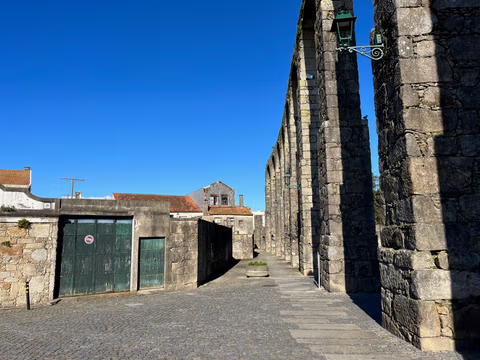
Aqueduct Trail – A path running along the Vila do Conde Aqueduct
From the Coastal Trail to the Camino Central: 12.9 km along the aqueduct from Vila do Conde to São Pedro de Rates. Route, stage, hostels, costs—explained honestly.
Read
Augsburg Way of St. James
The Augsburg Way of St. James runs 231.7 km in 11 stages from Oettingen in the Ries via Donauwörth, Augsburg, Bad Wörishofen and Ottobeuren to Ermengerst in the Allgäu — the Fuggerei, the Jakobervorstadt, a pilgrim of 1446 and Mozart's organ duel. Stages, hostels, costs.
Read

