

Dithmarscher Jakobsweg
The Dithmarscher Jakobsweg runs 118.7 kilometers from Friedrichstadt on the Eider through the marshes and cabbage country of Dithmarschen to Glückstadt on the Elbe. Along the way you pass the market square of Heide, Meldorf Cathedral, the pilgrimage village of Windbergen with its Romanesque crucifix, the St. James church of Brunsbüttel and the Kiel Canal. Seven flat stages, just 225 meters of total ascent, and a high point of 38 meters on the old edge of the geest near Sankt Michaelisdonn. In Glückstadt the route meets the Via Jutlandica and its Elbe ferry.
- 01At a Glance
- 02Overview
- 03Other Names
- 04Who It's Ideal For—and Who It's Not So Ideal For
- 05Route & Landscape
- 06Stages, Terrain, and Difficulty
- 07The Cross from the Field: 14.5 Centimeters of Bronze and a Pilgrimage on Pause
- 08Highlights Along the Way
- 09Farmers Against Kings: the Land Between the Eider and the Elbe
- 10How Pilgrims Find Their Way onto This Path
- 11Continue the pilgrimage?
- 12Preparation & Practical Information
- 13What the journey will cost you
- 14Getting Here
At a Glance
- Start / Finish: Friedrichstadt on the Eider / Glückstadt on the Elbe; the Camino Ninja map ends on the southern edge of Glückstadt, about 1.5 km from the market square
- Length: 118.7 km
- Duration: 7 stages, averaging about 17 km; with a long final day from Brunsbüttel to Glückstadt, also doable in 6
- Elevation: ↗ 225 m / ↘ 227 m
- Highest point: 38 m at km 75.5 between Sankt Michaelisdonn and Eddelak, on the Klev, the old coastline
- Landscape: marshland at and below sea level, villages on dwelling mounds, drainage ditches, cabbage fields, a narrow strip of geest near Windbergen, the Kiel Canal and the Elbe dike
- Operator / Waymarking: revived in 2013; the pilgrim center is the Lutheran parish of Windbergen-Gudendorf; yellow shell on a blue background, just like on the Via Jutlandica
- Traces of St. James: St. Jacobi church in Neuenkirchen (mentioned in 1323), St. James church in Brunsbüttel; plus the pilgrimage crucifix of Windbergen, found in 1495
- Accommodation: a few church-run pilgrim quarters, otherwise guest rooms, B&Bs and hotels in Heide, Meldorf, Brunsbüttel and Glückstadt; book ahead
- Connecting routes: Via Jutlandica from Borsfleth and Glückstadt, and via it onward to the Via Baltica at Hollenbeck
- Best time: May to September; cabbage harvest in the fall, storms and closed lodgings in winter
Overview
The Dithmarscher Jakobsweg is the west-coast branch of the Via Jutlandica, and it carries a lovely paradox in its pack: it begins and ends in two towns that were founded to compete with Hamburg. Glückstadt was laid out by the Danish king Christian IV in 1617, Friedrichstadt by his Gottorf rival Duke Frederick III in 1621. Both lured religious refugees with freedom of worship, both got canals and grid-plan streets—and both stayed small. Friedrichstadt has around 2,700 inhabitants today, barely more than in the 17th century. In between lie 118.7 kilometers of land that held its own against kings, princes and the North Sea.
For more than a century Dithmarschen was a farmers' republic without a sovereign, with 48 elected judges from 1447 on and an army that, on February 17, 1500, defeated the Danish king's forces at Hemmingstedt. You walk right through that history: from the market square in Heide, where the republic held court, to the cathedral in Meldorf, where it made its decisions. Honestly, the scenery is a theme with variations—dike, ditch, cabbage, wind. But no Camino has so little elevation and so much sky.
Other Names
In the system of northern German pilgrim routes, the trail is called Via Jutlandica West or the west-coast route of the Via Jutlandica, as distinct from the main route via Schleswig and Rendsburg and the eastern route to Lübeck. You'll also hear Dithmarscher Pilgerweg and Jakobsweg Dithmarschen. The name Dithmarschen itself is old: the land between the Eider and the Elbe was an independent farmers' state until 1559, and locals still speak of their "land," not of a district.
Who It's Ideal For—and Who It's Not So Ideal For
Ideal if you're looking for a week of quiet and want no climbing: short stages, stations on the Marschbahn railway at the start, the finish and several stage towns, and parishes that still greet pilgrims in person. Also ideal as your very first pilgrimage, for knees that don't like descents, and for anyone interested in northern German history—farmers' republic, Reformation, storm floods, canal building.
Honestly, though, it's not for you if you expect pilgrim camaraderie like in Spain: on some days you won't meet a single other pilgrim, and hostels in the Spanish sense barely exist. Not for you if you want to set off without planning—lodgings in the marsh villages are scarce, and some stage towns only have vacation rentals. And not for you if wind wears you down: in the marshes it always seems to blow in your face, and between the villages there's practically no shade.
Route & Landscape
Friedrichstadt to Meldorf (km 0–55.7): From the canal town between the Treene and the Eider, you cross the Eider and head south into the marshes. Lunden (km 10.1) and Hemme (km 17.4) sit on dwelling mounds, man-made settlement hills that are older than the dikes. Via Neuenkirchen (km 25.3) with its St. Jacobi church and Weddingstedt (km 33.8) you reach Heide (km 38.1) and its huge market square. South of town the route passes a good kilometer from Hemmingstedt, crosses the deepest marsh at Dehling (km 50.2)—here the ground lies below sea level—and continues via Epenwöhrden to Meldorf (km 55.7) and its cathedral.
Meldorf to Glückstadt (km 55.7–118.7): Beyond Meldorf the land rises a little: Windbergen (km 63.4) and Gudendorf (km 66.5) lie on the edge of the geest, Sankt Michaelisdonn (km 72.2) on the Donn, an old coastline. Here, at km 75.5 and 38 meters, is the highest point of the route; then it drops back into the marsh to Eddelak (km 79.7). In Brunsbüttel (km 90.9) the Kiel Canal begins; after that the route follows the Elbe via Büttel, Sankt Margarethen (km 101.8) and Brokdorf (km 107.9), leaves Wewelsfleth and Borsfleth just under two kilometers to one side and ends on the edge of Glückstadt (km 118.7).
Stages, Terrain, and Difficulty
We show the route in 7 stages of 11 to 21 kilometers; the distances come from the Camino Ninja map, calibrated exactly to 118.7 km. If you walk at a sportier pace, combine the last two stages into a 27.8-kilometer day from Brunsbüttel to Glückstadt. Windbergen, home of the pilgrim center, lies midway through the fourth stage and works as an overnight stop if you can find a bed there.
- Friedrichstadt → Hemme (17.4 km) — across the Eider into the marshes, through Lehe and Lunden to the Church of St. Mary on its mound.
- Hemme → Heide (20.7 km) — via Neuenkirchen with St. Jacobi and Weddingstedt to the largest undeveloped market square in Germany.
- Heide → Meldorf (17.6 km) — past Hemmingstedt, through the deepest marsh at Dehling to the cathedral of Dithmarschen.
- Meldorf → Sankt Michaelisdonn (16.5 km) — via Wolmersdorf to the pilgrimage crucifix of Windbergen and onto the edge of the geest.
- Sankt Michaelisdonn → Brunsbüttel (18.7 km) — over the high point on the Klev, down to Eddelak and on to the Kiel Canal.
- Brunsbüttel → Brokdorf (17.0 km) — across the canal and along the Elbe, via Büttel and Sankt Margarethen.
- Brokdorf → Glückstadt (10.8 km) — a short final day on the Elbe dike, across the Stör to Glückstadt.
Technically, nothing is difficult: paved farm roads, dike crests and field tracks, hardly an incline. What wears you out is the headwind, the lack of places to stop between villages and the hard surface; well-cushioned shoes matter more here than tread. On the dike: close the gates, leave the sheep in peace.
The Cross from the Field: 14.5 Centimeters of Bronze and a Pilgrimage on Pause
The spiritual heart of this route is a village of a few hundred people. In 1495 a farmer near Windbergen found a small bronze figure of the crucified Christ in his field. The find became a chapel, the chapel a place of pilgrimage, and the "Wallfahrt zum Heiligen Kreuz" (Pilgrimage to the Holy Cross) drew pilgrims from all over the North. Then came the Reformation. In Dithmarschen it had a bloody start: in December 1524, monks and drunken farmers dragged the Wittenberg preacher Heinrich von Zütphen out of Meldorf and burned him on the market square in Heide. Even so, the new faith prevailed in 1533, and the pilgrimage to Windbergen came to an end.
But the cross stayed. In 1547 the chapel became a parish church, and in 1742 the present building went up, the Kirche zum Heiligen Kreuz (Church of the Holy Cross). Above the altar the find hangs on a Baroque wooden cross: a Romanesque bronze figure about 14.5 centimeters tall, according to the regional church the oldest surviving crucifix in the territory of the former North Elbian Church. For almost five hundred years it was one altar cross among many. Then it became a pilgrim's goal again: in 2013 the Dithmarscher Jakobsweg was revived, the Windbergen-Gudendorf parish became its pilgrim center, and today Windbergen is once more what it had not been since the Reformation.
The people behind the Via Jutlandica describe the route's origins like this: "Eine in Vergessenheit geratene Route, die an der jütländischen Westküste über Ribe an die Elbe führte, wurde 2013 […] von Friedrichstadt über Meldorf, Brunsbüttel nach Glückstadt wiederbelebt." (A forgotten route that led along the west coast of Jutland via Ribe to the Elbe was revived in 2013 […] from Friedrichstadt via Meldorf and Brunsbüttel to Glückstadt.) The main line of the Nordic pilgrims ran farther east; as early as around 1159, the Icelandic abbot Nikulás Bergsson described a pilgrim route from Aalborg via Viborg and Hedeby to the Eider. In practical terms: contact the parish office in Windbergen, Kirchstraße 1, in advance if you're looking for a stamp, a conversation or a bed—the office is staffed on Monday and Thursday mornings, and there's a dedicated contact person for pilgrims.
Highlights Along the Way
- Friedrichstadt (km 0) — founded in 1621 by Duke Frederick III for Dutch Remonstrants, town charter in 1633; canals, stepped gables and the world's first explicitly Remonstrant church. Much was destroyed in the bombardment of 1850, but the Dutch look survived.
- St. Marien in Hemme (km 17.4) — Gothic brick church on a dwelling mound, documented as a parish since 1323; the picture Bible on its walls, with 121 scenes, dates from around 1650.
- St. Jacobi in Neuenkirchen (km 25.3) — dedicated to the apostle, first mentioned in 1323, burned down in 1704 and 1729 and rebuilt from the old masonry in 1730, with an organ from 1738.
- Heide market square (km 38.1) — 4.7 hectares, the largest undeveloped market square in Germany; from 1447 the seat of the Forty-Eight judges, in 1524 the site of Heinrich von Zütphen's martyrdom; on the corner, St. Jürgen, rebuilt after 1559.
- Meldorf Cathedral of St. Johannis (km 55.7) — a predecessor built between 810 and 826 as the mother church of Dithmarschen, the present brick building from 1250 to 1300, 13th-century vault paintings, a Passion altar from around 1520; the 59-meter tower came after the fire of 1866.
- Windbergen (km 63.4) — Kirche zum Heiligen Kreuz from 1742 with the Romanesque bronze crucifix, the route's pilgrim center.
- Sankt Michaelisdonn (km 72.2) — St. Michael's church from 1610 and 1611, built with money from a collection, on the old coastline; shortly afterward, the highest point of the route.
- St. Jakobus in Brunsbüttel (km 90.9) — the St. James church in the old town center, built in 1677 and rebuilt after a lightning strike in 1726; next door, the locks of the Kiel Canal from 1895, the busiest artificial seaway in the world.
- Glückstadt (km 118.7) — a planned town from 1617 with a town church from 1618 to 1623, seven streets radiating out from the market; famous for Glückstadt matjes herring.
Farmers Against Kings: the Land Between the Eider and the Elbe
On February 17, 1500, King John I of Denmark marched into Dithmarschen with some 12,000 men, among them 4,000 mercenaries of the dreaded Black Guard. Their motto is said to have been "Wahr di, Buer, de Gaar de kummt" (Beware, farmer, the Guard is coming). The roughly 6,000 farmers under Wulf Isebrand threw up an earthwork near Hemmingstedt, opened the sluices and let the army march along the narrow causeway into the flooded marsh. They turned the Guard's slogan into their own: "Wohr di, Goor, de Buur de kumt!" (Beware, Guard, the farmer is coming!) The memorial stone on the Dusenddüwelswarf south of Hemmingstedt has stood since 1900; it's a short detour from the route.
Freedom lasted another 59 years. In 1559 Denmark and the dukes conquered the land in the Last Feud, and the farmers' republic was history. The people of Dithmarschen kept up their fight against the sea: after storm floods in the 1670s, Brunsbüttel had to be moved inland, and the Christmas Flood of 1717 broke through again. More recent history has its place along the route too: in Brokdorf, on February 28, 1981, some 100,000 people demonstrated against the nuclear power plant, the largest anti-nuclear rally in West Germany up to that time. The plant went online on October 8, 1986, and was shut down on December 31, 2021.
How Pilgrims Find Their Way onto This Path
Historically, pilgrims came from the north, along the west coast of Jutland and through Ribe. Today the Dithmarscher Jakobsweg is a self-contained week-long route with easy access: Friedrichstadt has had a station on the Marschbahn line from Hamburg to Westerland since 1887, and if you're coming from Denmark or North Frisia, you can start there without a detour.
The main route of the Via Jutlandica runs farther east via Schleswig, Rendsburg and Itzehoe and only meets this route at the Elbe. If you want to combine the two, walk the Via Jutlandica from the Danish border to Schleswig and take the train from there to the west coast, or use the Dithmarscher Jakobsweg as a western variant as far as Glückstadt. You can also join midway by train in Heide, Meldorf and Sankt Michaelisdonn.
Continue the pilgrimage?
Yes—the route ends at a crossroads. At Borsfleth and Glückstadt it shares the same path as the Via Jutlandica, which crosses the Elbe by ferry from Glückstadt to Wischhafen and, after about 57 more kilometers via Stade, ends in Hollenbeck near Harsefeld. That's where your next section begins:
- Via Baltica — from Hollenbeck via Bremen to Osnabrück
- Westfälischer Jakobsweg — from Osnabrück via Münster and Dortmund to Cologne
From Cologne, the Rhineland routes lead on to the south and west. So if you're thinking all the way to Santiago, what lies ahead of you in Friedrichstadt isn't a fragment but the first section of a continuously waymarked line.
Preparation & Practical Information
Pilgrim passport and app. As on all German Caminos, you need a pilgrim passport (credencial) to stay in pilgrim lodgings and to receive your Compostela in Santiago at the end. It's best to order it online in advance so it reaches you in time for the start of your trip; the Pilgerzentrum im Norden at St. Jacobi in Hamburg asks for at least 10 days' lead time. You can get stamps in the churches along the way, at the Windbergen pilgrim center and at tourist offices. The short stages are easy to rearrange—most simply in the Camino Ninja App, where you put together your stages and plan suitable accommodation right along with them.
Lodging and season. The network is thin: in Heide, Meldorf, Brunsbüttel and Glückstadt you'll find hotels and guesthouses, while the marsh villages mostly have guest rooms that often require a minimum of two nights. Call the day before or book the whole week in advance. The best time is May to September, with long evenings; in the third week of September, Dithmarschen has celebrated the Kohltage (Cabbage Days) since 1986, when part of the roughly 90 million cabbages grown each year is harvested. Pack a windproof jacket, not just a rain jacket.
What the journey will cost you
The formalities are cheap: the pilgrim passport costs 8 € plus 3 € shipping from the Pilgerzentrum im Norden, the Elbe ferry from Glückstadt to Wischhafen is 3.40 € for foot passengers (as of October 2026), and the canal ferries in Brunsbüttel are free. Church-run pilgrim quarters are few and far between, usually by donation or for a small fee; guest rooms and B&Bs in the villages run about 45 to 80 €, hotels in Heide, Meldorf and Glückstadt 80 to 130 € (as of October 2026).
Budget 60 to 90 € a day for lodging and food. Honestly, northern Germany isn't Spain—your best way to save is the Deutschlandticket for getting there and back and for joining midway; it costs 63 € a month (as of October 2026).
Getting Here
To the start. Friedrichstadt is on the Marschbahn line from Hamburg to Westerland; from Hamburg-Altona, the regional train gets you there in about two hours, depending on the connection with a change in Heide. The route starts in the old town and heads south across the Eider.
From the finish. Glückstadt is on the same rail line; regional trains run at least hourly toward Elmshorn and Hamburg, a little over 40 minutes to Hamburg. If you're continuing, take the Elbe ferry to Wischhafen, which runs about every 30 minutes and takes around 20 minutes.
- Rail: bahn.de — Marschbahn Hamburg–Friedrichstadt and Glückstadt–Hamburg
- Ferry: frs-elbfaehre.de — Elbe ferry Glückstadt–Wischhafen, timetable and fares
- Pilgrim passport: pilger-im-norden.de — Pilgerzentrum im Norden, St. Jacobi Hamburg

Get your pilgrim credential and shell
Everything you need for the Dithmarscher Jakobsweg, shipped to your door.
Visit Camino Shop
Other Caminos
 Appenzeller Weg
Appenzeller Weg
52.6 km from Rankweil across the Rhine to St. Peterzell: St. James Chapel (1464), 163 Years of the Wedding Trail, connection to the Via Jacobi. Stages, costs, how to get there.
Read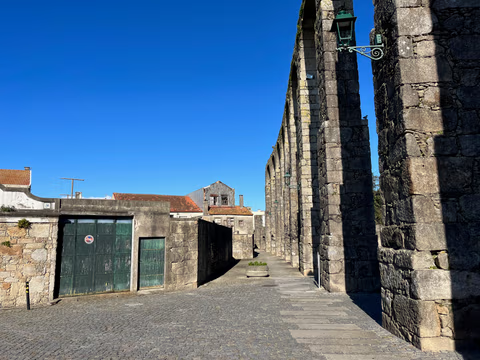
Aqueduct Trail – A path running along the Vila do Conde Aqueduct
From the Coastal Trail to the Camino Central: 12.9 km along the aqueduct from Vila do Conde to São Pedro de Rates. Route, stage, hostels, costs—explained honestly.
Read
Augsburg Way of St. James
The Augsburg Way of St. James runs 231.7 km in 11 stages from Oettingen in the Ries via Donauwörth, Augsburg, Bad Wörishofen and Ottobeuren to Ermengerst in the Allgäu — the Fuggerei, the Jakobervorstadt, a pilgrim of 1446 and Mozart's organ duel. Stages, hostels, costs.
Read

