

Camino del Ebro
The Camino del Ebro runs 466.0 kilometers from the mouth of the Ebro at Riumar in the delta upriver to Logroño, where it joins the Camino Francés. Along the way lie Tortosa with its Gothic cathedral, the vineyards of the Terra Alta, the Cistercian monastery of Rueda, the Basílica del Pilar in Zaragoza, Tudela and Roman Calahorra. The route links the place where, according to legend, Mary appeared to the Apostle James in the year 40 with the great stream of pilgrims heading for Santiago. It is flat except for one climb into the Terra Alta, long, hot in summer and lonely for long stretches.
- 01At a Glance
- 02Overview
- 03Other Names
- 04Who It's Ideal For—and Who It's Not So Ideal For
- 05Route & Landscape
- 06Stages, Terrain, and Difficulty
- 07Mary Came to the Apostle: Zaragoza's 39 Centimeters
- 08Highlights Along the Way
- 09Rice Paddies, Rail Tunnels, Trenches: The Road to Gandesa
- 10How Pilgrims Find Their Way onto This Path
- 11Continue the pilgrimage?
- 12Preparation & Practical Information
- 13What the journey will cost you
- 14Getting Here
At a Glance
- Start / Finish: Riumar at the mouth of the Ebro (delta, Catalonia) / Logroño (La Rioja), junction with the Camino Francés
- Length: 466.0 km through four regions: Catalonia, Aragon, Navarre and La Rioja
- Duration: 18 stages, averaging just under 26 km; with rest days in Tortosa and Zaragoza, about three weeks
- Elevation: ↗ 2,758 m / ↘ 2,378 m
- Highest point: 477 m at km 101.5, in the Terra Alta uplands between the Estación de Benifallet and Gandesa
- Landscape: rice paddies in the delta, orange groves, the vineyards of the Terra Alta, the Aragonese steppe, market gardens all the way into La Rioja
- Operator / Waymarking: Camino associations along the route; yellow arrows and scallop shells, on some sections also the signposts of the GR 99 (Camino Natural del Ebro), and bronze shells set into the pavement in Tudela
- Traces of St. James: the Basílica del Pilar in Zaragoza with the pillar of the Marian apparition, a reliquary bust of St. James the Pilgrim in Tortosa Cathedral, Santiago el Real in Logroño with its equestrian statue from 1737
- Accommodation: only a few true pilgrim albergues (Deltebre, Jesús, Xerta, Torres de Berrellén, Gallur, Mallén, Tudela, Alfaro, Calahorra, Alcanadre, Logroño), with pensiones and hostales in between
- Connecting routes: Camino Francés from Logroño
- Best time: March to May and September to October; July and August are very hot in the Ebro Valley
Overview
Almost every Camino ends at the sea or at a cathedral. The Camino del Ebro starts at the sea: in the delta, where the Ebro flows into the Mediterranean after some 910 kilometers. From there you walk upriver, against the current, through rice paddies at sea level – the Camino Ninja map even records points in the delta up to four meters below it – up into the vineyards of the Terra Alta, straight across the Aragonese steppe and finally through the gardens of Navarre and La Rioja to Logroño. There, after nearly three weeks almost entirely on your own, you suddenly find yourself in the thick of the Camino Francés.
This is the route of the pilgrims who came across the Mediterranean. Pilgrims from Mediterranean ports, from the Balearic Islands and from Sicily came ashore at the delta. King Peter IV of Aragon, who reigned from 1336 to 1387, had alms handed out to pilgrims bound for Rome, Jerusalem and Santiago, organized by the monastery of Poblet; payments are documented in Tortosa, Gandesa and Zaragoza. And right in the middle of the route stands the Basílica del Pilar, built over the pillar on which Mary is said to have appeared to the Apostle. Here's the line you'll want to read out loud: on this route you don't just visit the tomb of St. James – you walk past the place where, as legend has it, he got a visit himself.
Other Names
In Spanish the route is called the Camino del Ebro or, in the language of the associations, the Camino Jacobeo del Ebro; in Catalan you'll come across Camí de Sant Jaume de l'Ebre in the delta and in Tortosa. In German it goes by Ebro-Weg or Jakobsweg am Ebro. Don't confuse it with the GR 99, the Camino Natural del Ebro: this national long-distance trail follows the river from Cantabria to the delta and shares the same line in places, but it has its own signposts.
Who It's Ideal For—and Who It's Not So Ideal For
Ideal if you already know the big routes and are looking for silence: on the Camino del Ebro there are days when you won't meet a single other pilgrim. And ideal if history appeals to you more than company: Roman towns, the place where a king was chosen, a monastery with a waterwheel, the front line of 1938 – and Zaragoza.
Honestly, though, it's not for you if you want to rely on a dense network of pilgrim albergues: between Xerta and Zaragoza there's barely one over roughly 195 kilometers, and you'll often sleep in pensiones at 30 to 45 euros. Not for you if you don't cope well with heat – in summer the Ebro Valley between Caspe and Tudela is a shadeless basin, and between Chiprana and Escatrón there are a good 21 kilometers without a bar or a fountain. And not for you as your first Camino: finding beds and getting through the dry stretches takes experience.
Route & Landscape
From the delta to Tortosa (km 0–65.2): The route starts in Riumar, where the Ebro pushes out into the sea, and runs through rice paddies to Deltebre (km 15.4, about a kilometer off the line), switches to the south bank there and continues via Sant Jaume d'Enveja and El Poble Nou del Delta (km 27.6) to La Ràpita, formerly Sant Carles de la Ràpita, and via Amposta (km 47.7) to Tortosa (km 65.2).
Terra Alta and Bajo Aragón (km 65.2–157.6): Via Roquetes, Jesús and Aldover you reach Xerta (km 79.5); then the route leaves the river valley and heads into the hills along the bed of the former Val de Zafán railroad, past the Estación de Benifallet. At km 101.5 you reach the highest point at 477 meters, and at km 106.0 Gandesa at 376 meters – almost as high as Logroño, which lies 360 kilometers later at 383 meters. Via Batea (km 118.6) and Fabara (km 136.4) you cross into Aragon and arrive at the reservoir of Caspe (km 157.6).
Across the steppe to Zaragoza (km 157.6–274.4): From Caspe on, the Ebro is your companion again. Chiprana lies 700 meters off the line, followed by Escatrón (km 189.9), the Monastery of Rueda and Sástago (km 198.9), Alborge, Alforque, Velilla de Ebro (km 217.2) and Quinto (km 226.7); Gelsa stays 800 meters to the side. Via Fuentes de Ebro, El Burgo de Ebro and the Cartuja Baja you reach Zaragoza (km 274.4).
Ebro Valley into La Rioja (km 274.4–466.0): West of Zaragoza everything turns green: irrigated farmland with market gardens and poplars. Utebo and Casetas lie just off the line, then come Torres de Berrellén (km 297.1), Alagón (km 303.4), Gallur (km 324.8) and Mallén (km 334.6). Beyond Cortes, Navarre begins; Buñuel stays three kilometers off the route, and via Ribaforada and El Bocal on the Canal Imperial de Aragón you come to Tudela (km 364.2). Via Castejón and Alfaro (km 389.0) you reach La Rioja, then Calahorra (km 414.2), Alcanadre (km 433.8), Agoncillo and Varea – and Logroño.
Stages, Terrain, and Difficulty
We show the route in 18 stages; the distances come from the Camino Ninja map, calibrated exactly to 466.0 km. The stage towns follow the beds, not nice round numbers.
- Riumar → El Poble Nou del Delta (27.6 km) — flat through rice paddies, across the Ebro at Deltebre to the south bank, lots of sky and no shade.
- El Poble Nou del Delta → Amposta (20.1 km) — past the Encanyissada lagoon and via La Ràpita to the river.
- Amposta → Tortosa (17.5 km) — along the Ebro through orange groves to the old bishop's city.
- Tortosa → Xerta (14.3 km) — a short day via Roquetes, Jesús and Aldover, with time for the cathedral and the castle.
- Xerta → Gandesa (26.5 km) — the mountain stage: a Via Verde with tunnels, a climb to 477 m, about 25 km with nowhere to stop.
- Gandesa → Fabara (30.4 km) — through the vineyards of the Terra Alta via Batea into Aragon; you can split the stage in Batea.
- Fabara → Caspe (21.2 km) — almond and olive country all the way to the reservoir.
- Caspe → Escatrón (32.3 km) — long and dry; Chiprana lies beside the route, then more than 21 km of nothing.
- Escatrón → Quinto (36.8 km) — the longest stage: Rueda Monastery, Sástago, Velilla with Celsa; you can spend the night at the monastery and split the day.
- Quinto → El Burgo de Ebro (30.1 km) — steppe and irrigated land via Fuentes de Ebro.
- El Burgo de Ebro → Zaragoza (17.6 km) — via the Cartuja Baja into the city of the Pilar.
- Zaragoza → Alagón (29.0 km) — through the suburbs, via Torres de Berrellén and its 6-euro albergue.
- Alagón → Mallén (31.2 km) — Ebro villages, Gallur at the halfway point, a pilgrim albergue in Mallén.
- Mallén → Tudela (29.6 km) — into Navarre, via El Bocal on the Canal Imperial to the Mudéjar city.
- Tudela → Alfaro (24.8 km) — via Castejón into La Rioja and the town of storks.
- Alfaro → Calahorra (25.2 km) — market gardens via Rincón de Soto into Roman Calagurris.
- Calahorra → Alcanadre (19.6 km) — vineyards and hills, a short day before the finish.
- Alcanadre → Logroño (32.2 km) — via Arrúbal, Agoncillo and Varea to the capital of La Rioja.
Technically, nothing here is difficult: levees, farm tracks, the old railroad bed, asphalt in the towns. The only real climb is the one into the Terra Alta between Xerta and Gandesa, about 700 meters of ascent in a single day. For the Via Verde tunnels near Benifallet you'll need a headlamp – they're unlit. What wears you down is distance, heat and emptiness; the waymarking isn't always clear on the way out of Batea and between Caspe and Chiprana.
Mary Came to the Apostle: Zaragoza's 39 Centimeters
Legend has it that James preached in Spain with little success. On the banks of the Ebro, on the night of January 2 in the year 40, Mary is said to have appeared to him, standing on a pillar, and asked for a church to be built on that very spot. Thirteenth-century sources add angelic voices singing “Ave, María, gratia plena.” In this story Mary was still living in Jerusalem, which is why the Pilar counts as an apparition during her lifetime. The jasper pillar now stands in the Santa Capilla of the Basílica del Pilar, topped by a wooden figure just 39 centimeters tall. The church around it is 130 meters long and 67 wide, with eleven domes: you walk through one of the largest Baroque buildings in Spain to see a figure that would fit in your backpack.
Pilgrims to Santiago always saw the connection. After Alfonso I conquered Zaragoza in 1118, a Romanesque church was built, and after a fire in 1434 a new Gothic one. That same year – the first documented Holy Year of Compostela – the chronicler Diego de Espés noted: “en este propio año huvo en España gran concurso de naciones estrangeras que venían en peregrinacion para visitar el cuerpo sancto de el gloriosso apostol Santiago” – that year, many foreign peoples came to Spain to visit the holy body of the Apostle, and many of them venerated the chapel of the Pilar on their way. There were beds for them in Zaragoza: the Hospital of Santa Marta, founded in 1315, with twelve, and the Hospital of the Count of Luna, from 1358, with thirty.
The present building was begun in 1681; Ventura Rodríguez gave it the Santa Capilla and its current form, and the main dome was only finished in 1872. Goya painted the ceiling fresco of the Adoration of the Name of God in 1772 and the Regina Martyrum dome in 1782. On August 3, 1936, planes dropped three bombs on the church; none exploded, and two are on display in the basilica today. In practical terms: plan a rest day in Zaragoza and visit the Santa Capilla in the evening, when the church grows quieter.
Highlights Along the Way
- Ebro Delta (km 0–47.7) — a natural park since 1983, around 20,000 hectares of rice paddies and some 300 bird species, flamingos among them; much of the plain has only been built up by river sediment since the Middle Ages.
- Tortosa Cathedral (km 65.2) — Gothic, foundation stone laid in 1347, consecrated unfinished in 1597, with a reliquary bust of St. James the Pilgrim in the treasury; above it rises the La Suda castle.
- Mausoleum of Fabara (km 136.4) — the Roman tomb of Lucius Aemilius Lupus, a national monument since 1931.
- Caspe (km 157.6) — here, on June 24, 1412, nine arbiters, among them the preacher Vincent Ferrer, chose Ferdinand of Antequera as King of Aragon.
- Monastery of Rueda (between Escatrón and Sástago) — Cistercian from 1202, dissolved around 1837, restored by 2003, with its 16-meter-high waterwheel, the “rueda”; today a hospedería.
- Celsa near Velilla de Ebro (km 217.2) — Colonia Victrix Iulia Celsa, founded in 44 BC by Marcus Aemilius Lepidus.
- Zaragoza (km 274.4) — the Basílica del Pilar, La Seo Cathedral, the Aljafería, Caesaraugusta.
- Tudela (km 364.2) — conquered in 1119 by Alfonso the Battler; Santa María Cathedral with its Last Judgment portal, and in the cloister Christ as the Emmaus pilgrim with staff and hat.
- Alfaro (km 389.0) — Roman Graccurris; on the collegiate church of San Miguel nests one of the largest white stork colonies on a single building in Europe, and in February the town celebrates its Day of the Storks.
- Calahorra (km 414.2) — Calagurris, starved into submission by Pompey in 72 BC, home of Quintilian; the cathedral stands where Emeterius and Celedonius died around 298.
- Santiago el Real in Logroño (km 466.0) — built from 1513, with the Apostle on horseback above the south portal since 1737, and the parish pilgrim albergue right on the route.
Rice Paddies, Rail Tunnels, Trenches: The Road to Gandesa
The first hundred kilometers tell three stories layered on top of each other. The first is the delta itself: land that simply didn't exist here 2,000 years ago. The plain grew in spurts – one river mouth in the 12th to 14th centuries, the next in the 16th and 17th – so the coast the medieval sea pilgrims saw looked different from today's. When you set off in Riumar, you start on ground the river built up itself.
The second is the river as a front line: between Xerta and Gandesa lies the battlefield of the Battle of the Ebro. From July 25 to November 16, 1938, some 80,000 Republican soldiers fought 90,000 Nationalist troops here, on the slopes around Gandesa, Corbera d'Ebre and in the Serra de Pàndols. On the Republican side alone, an estimated 10,000 to 15,000 people died. Along the route you'll see memorial stones and the remains of trenches and positions.
The third is practical: between Xerta and Benifallet the route follows the old railroad with its dark tunnels, then climbs into the hills – the highest point of the whole route isn't in La Rioja but 101.5 kilometers from the sea.
How Pilgrims Find Their Way onto This Path
Historically they came by water: pilgrims from Italy, southern France, Sicily and the Balearic Islands landed at the delta or in La Ràpita and followed the river. Liturgically, setting out had long been regulated – the Missal of Vic from 1038 already contains the rite with which the bishop blessed the staff and scrip of pilgrims bound for Santiago.
Today getting started is easy, and the route isn't a feeder with junctions of its own along the way: you take the train to the coast at L'Aldea-Amposta-Tortosa and the bus into the delta. If you only want to walk the second half, start in Zaragoza, reachable by high-speed train from Madrid or Barcelona. The destination is always the same: Logroño and the Camino Francés.
Continue the pilgrimage?
In Logroño the Camino del Ebro joins the Camino Francés. Via Nájera, Burgos and León it continues to Santiago – several more weeks, this time in company. After three weeks by the river, you'll suddenly be sharing a dorm with pilgrims from all over the world.
Important for the Compostela: the Pilgrim Office requires at least the last 100 kilometers to Santiago on foot. The Ebro alone won't get you there; but the stamps from Riumar, Tortosa and Zaragoza in your pilgrim passport show where you came from.
Preparation & Practical Information
Pilgrim passport and app. As on all Spanish routes, you need a pilgrim passport (credencial) to stay in the albergues and to receive the Compostela at the end – which on the Ebro means in Santiago, after continuing along the Camino Francés. It's best to order it online ahead of time so it reaches you before your trip begins. Stage planning pays off more here than elsewhere, because distances and beds don't always line up – the easiest way is right in the Camino Ninja App, where you put your stages together and plan suitable accommodation at the same time.
Accommodation. Pilgrim albergues exist in only some of the stage towns; otherwise it's pensiones and hostales. Call the day before, especially in Escatrón, Quinto, Fabara and Mallén, where there are only one or two places to stay.
Water, heat, season. The best times are March to May and September to October. In July and August the Ebro Valley between Caspe and Tudela gets very hot, shade is scarce, and on long sections – Xerta–Gandesa, Chiprana–Escatrón, Gallur–Ribaforada – you'll go 20 kilometers or more without a bar or a fountain. Start early and carry water for the whole morning. The cierzo, the northwest wind of the Ebro Valley, usually blows right in your face as you head upriver.
What the journey will cost you
Pilgrim albergues are cheap: Torres de Berrellén 6 €, Tudela (youth hostel with breakfast) 12 €, Calahorra's Albergue San Francisco 12 €, Deltebre from 11.70 €, Jesús near Tortosa 16 €, Gallur 17 €; in Xerta a bed costs 27.90 € with breakfast. Pensiones run 27 to 40 € for a single room and 38 to 55 € for a double, and the Hostal Monasterio de Rueda in Sástago charges 36/54 €. In Zaragoza there are hostel beds from 18 €, in Logroño from 18 to 20 € (as of October 2026).
Budget 40 to 50 € a day with an albergue, a bar breakfast and the menú del día, and 55 to 65 € on pensión days. Honestly, you'll pay for a room more often than on the Francés, simply because there's no dorm.
Getting Here
To the start. By train via Barcelona or Valencia to L'Aldea-Amposta-Tortosa, then by bus or taxi to Deltebre and on to Riumar. Barcelona and Valencia have airports with direct flights from Germany, Austria and Switzerland.
From the finish. Logroño has a train station with connections to Zaragoza, Madrid and Barcelona, plus a bus station; if you're continuing your pilgrimage, simply keep walking on the Camino Francés.
- Train: renfe.com — connections to L'Aldea-Amposta-Tortosa, Zaragoza and from Logroño

Get your pilgrim credential and shell
Everything you need for the Camino del Ebro, shipped to your door.
Visit Camino Shop
Other Caminos
 Appenzeller Weg
Appenzeller Weg
52.6 km from Rankweil across the Rhine to St. Peterzell: St. James Chapel (1464), 163 Years of the Wedding Trail, connection to the Via Jacobi. Stages, costs, how to get there.
Read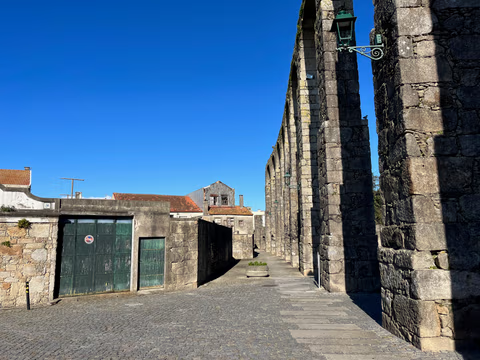
Aqueduct Trail – A path running along the Vila do Conde Aqueduct
From the Coastal Trail to the Camino Central: 12.9 km along the aqueduct from Vila do Conde to São Pedro de Rates. Route, stage, hostels, costs—explained honestly.
Read
Augsburg Way of St. James
The Augsburg Way of St. James runs 231.7 km in 11 stages from Oettingen in the Ries via Donauwörth, Augsburg, Bad Wörishofen and Ottobeuren to Ermengerst in the Allgäu — the Fuggerei, the Jakobervorstadt, a pilgrim of 1446 and Mozart's organ duel. Stages, hostels, costs.
Read

