

Via Aurelia
The Via Aurelia runs 561.4 kilometers west from Genoa along the Ligurian Riviera, crosses the border at Menton and then heads through the hinterland of the Côte d'Azur and Provence to Arles. Along the way you pass Savona, Albenga, Sanremo and Ventimiglia, and in France La Turbie with Augustus's victory monument, Vence, Fréjus, the basilica of Saint-Maximin, Aix-en-Provence and the Alpilles. The highest point is 778 meters, just before La Turbie, and the climbs add up to 8,002 meters of ascent. In Genoa the Via Postumia arrives; in Arles the Via Tolosana sets off for Toulouse and the Somport.
- 01At a Glance
- 02Overview
- 03Other Names
- 04Who It's Ideal For—and Who It's Not So Ideal For
- 05Route & Landscape
- 06Stages, Terrain, and Difficulty
- 07The Man Who Told Europe the Legend of St. James Came from Varazze
- 08Highlights Along the Way
- 09It Says Aurelia, but Augustus Built It: the Victory Monument above Monaco
- 10How Pilgrims Find Their Way onto This Path
- 11Continue the pilgrimage?
- 12Preparation & Practical Information
- 13What the journey will cost you
- 14Getting Here
At a Glance
- Start / Finish: Genoa / Arles; the map point for central Genoa lies 1.3 km off the route, and the map ends in the old town of Arles
- Length: 561.4 km, just under 180 km of it in Italy, the rest in France
- Duration: 26 stages, averaging a little over 21 km; with rest days, realistically four weeks
- Elevation: ↗ 8,002 m / ↘ 7,993 m
- Highest point: 778 m at km 189.5, on the slope above Monaco between Roquebrune-Cap-Martin and La Turbie; lowest point 1 m
- Landscape: cliffs and beach towns of the Riviera, olive terraces, limestone hills above Nice, the red porphyry of the Esterel, vineyards and oak woods in the Var, the Sainte-Victoire, the olive groves of the Alpilles
- Operator / Waymarking: in France the GR 653A, red and white with a shell, maintained by the Association PACA-Corse des Amis des Chemins de Saint-Jacques; in Liguria no continuous Camino waymarking that we could verify
- Traces of St. James: Varazze is the hometown of Jacobus de Voragine, author of the Golden Legend; near Éguilles a figure of St. James in the Saint-Alexis chapel; in Arles the start of the first route in the pilgrim's guide of the Codex Calixtinus
- Accommodation: in Italy hotels, B&Bs and the occasional parish; in France also the Chaîne d'accueil, hosts who take in pilgrims with a credencial
- Connecting routes: in Genoa the Via Postumia, from Fontvieille the Via Domitia, in Arles the Via Tolosana
- Best time: April to June and September to October; summer is hot and expensive, and in the Var forests close because of fire risk
Overview
The Via Aurelia is the route for anyone who wants to stitch Italy and France together along the Mediterranean. It starts in Genoa, where the Via Postumia arrives from Trieste, and ends in Arles, where the Via Tolosana heads off toward Spain. In between lies a stretch you know from postcards—and will barely recognize, because the route sidesteps the big names: you see Monaco from above, Nice from the hinterland, and Cannes not at all. You walk the Côte d'Azur and are surprised at the end how rarely you were on the beach.
The route takes its name from a Roman road that, strictly speaking, was called something else here. The actual Via Aurelia was built north from Rome by the censor Gaius Aurelius Cotta in 241 BC; the stretch along the Riviera and over the Maritime Alps was laid out by Augustus around 13 BC as the Via Julia Augusta. Our route follows that line almost everywhere in Liguria, but only in places in France. Honestly, the Italian half is often promenade and country road, while the French half is a proper hiking trail with climbs you would never expect from a coastline.
Other Names
In Italian the route is called Via Aurelia, in French Voie Aurélienne or simply Via Aurelia; as a hiking trail in France it carries the number GR 653A—the A stands for Aurelia, just as the D in GR 653D stands for Domitia. For the Roman road along the Riviera, the scholarly literature uses Via Julia Augusta, and for the section before it, built as far as Vado Ligure in 109 BC, Via Aemilia Scauri.
Who It's Ideal For—and Who It's Not So Ideal For
Ideal if you have already walked a major route and are looking for one where you don't constantly run into other pilgrims. Ideal if you love Roman history, art history and landscape in equal measure: Albenga, La Turbie, Fréjus and Arles all sit on the same road. Ideal, too, as an approach to the Via Tolosana.
Honestly, though, it's not for you if you expect pilgrim hostels at Spanish intervals: there aren't any here, so you sleep in hotels, guest rooms or with hosts you have to call ahead. Not for you if your budget is under 50 € a day—on the Riviera that is barely doable. And not for you if you underestimate elevation: the climb from Menton to La Turbie alone is a good 750 meters in ten kilometers.
Route & Landscape
Genoa to Menton (km 0–178.2): The route leaves Genoa heading west through Pegli and Voltri (km 17.0) and sticks to the coast: Varazze (km 34.4), Savona (km 45.7), past Vado Ligure the rocky coast to Noli (km 61.2) and Finale Ligure (km 72.2). At Albenga (km 92.8) the plain opens up, then the route crosses the hills of Alassio and Cervo to Imperia (km 125.1) and runs through the Riviera dei Fiori via Sanremo (km 149.9) to Ventimiglia (km 167.1) and over the border to Menton (km 178.2).
Menton to Arles (km 178.2–561.4): From Roquebrune-Cap-Martin the route climbs steeply to 778 meters at km 189.5 and reaches La Turbie (km 191.6; the village center lies 0.9 km off the route). Then it stays in the hinterland: Laghet (km 195.3), the Paillon valley, Aspremont (km 212.2), across the Var to Vence (km 232.3). Via Valbonne, just off the route, and Mouans-Sartoux you return to the sea at Mandelieu-la-Napoule (km 278.1) and walk through the Esterel to Saint-Raphaël and Fréjus (km 313.6). Through the Argens valley and the wine country of the Var you continue via Lorgues (km 358.4) to Saint-Maximin-la-Sainte-Baume (km 424.2), along the southern foot of the Sainte-Victoire via Puyloubier to Aix-en-Provence (km 469.5), via Éguilles to Salon-de-Provence (km 508.8) and through the Alpilles via Maussane and Fontvieille to Arles (km 561.4).
Stages, Terrain, and Difficulty
We show the route in 26 stages. The distances come from the Camino Ninja map, calibrated exactly to 561.4 km. In the Esterel and between Éguilles and Salon there is one day each with no village on the route—hence the short day out of Aix.
- Genoa → Arenzano (23.3 km) — through the western districts of Pegli, Prà and Voltri to the coast.
- Arenzano → Savona (22.4 km) — via Cogoleto and Varazze, hometown of Jacobus de Voragine.
- Savona → Finale Ligure (26.5 km) — rocky coast at Bergeggi, medieval Noli, Varigotti.
- Finale Ligure → Albenga (20.6 km) — via Pietra Ligure and Loano into the plain of Albenga.
- Albenga → Diano Marina (26.2 km) — hills above Alassio, the village of Cervo on its rock.
- Diano Marina → Arma di Taggia (24.0 km) — via Imperia and San Lorenzo; Taggia itself lies 3 km inland.
- Arma di Taggia → Bordighera (18.9 km) — via Sanremo to Ospedaletti on the old railway line, now a bike path.
- Bordighera → Menton (16.3 km) — Ventimiglia, Mortola and the border.
- Menton → Laghet (17.1 km) — the toughest day: about 760 meters of ascent up to km 189.5, then La Turbie.
- Laghet → Aspremont (16.9 km) — down into the Paillon valley and back up via Tourrette-Levens.
- Aspremont → Vence (20.1 km) — across the Var, Gattières and La Gaude.
- Vence → Valbonne (24.7 km) — Tourrettes-sur-Loup, the Loup valley, woods near Roquefort-les-Pins.
- Valbonne → Théoule-sur-Mer (26.9 km) — Mouans-Sartoux, the Siagne, Mandelieu and back to the sea.
- Théoule-sur-Mer → Saint-Raphaël (25.2 km) — through the Esterel, with no village on the route.
- Saint-Raphaël → Le Muy (29.2 km) — Fréjus, then the flat Argens valley; can be split at Puget-sur-Argens.
- Le Muy → Lorgues (20.1 km) — hills and vineyards of the Var.
- Lorgues → Carcès (24.9 km) — past Le Thoronet Abbey, 0.8 km off the route.
- Carcès → Le Val (14.0 km) — a short day through woods and via Vins-sur-Caramy.
- Le Val → Saint-Maximin-la-Sainte-Baume (26.9 km) — via Bras to the basilica of Mary Magdalene.
- Saint-Maximin-la-Sainte-Baume → Puyloubier (20.9 km) — Ollières, Pourrières, to the foot of the Sainte-Victoire.
- Puyloubier → Aix-en-Provence (24.4 km) — along the southern flank of Cézanne's mountain into town.
- Aix-en-Provence → Éguilles (10.4 km) — short, via Les Figons with its figure of St. James.
- Éguilles → Salon-de-Provence (28.9 km) — a long stage with no village; carry water.
- Salon-de-Provence → Aureille (17.1 km) — past Eyguières into the Alpilles.
- Aureille → Fontvieille (23.4 km) — olive groves, Maussane, Paradou.
- Fontvieille → Arles (12.1 km) — together with the Via Domitia to the finish.
In Liguria you walk a lot on asphalt, promenades and bike paths, often with traffic; the elevation comes from the capes the route goes over rather than around. In France the route becomes a trail—stony in the limestone above Nice and in the Esterel, sandy and shadeless in the Var. Nothing is technically difficult; what wears you out is the sum of 8,002 meters of ascent.
The Man Who Told Europe the Legend of St. James Came from Varazze
On the second day you walk through Varazze, a beach town with shipyards. Around 1230 a boy was born here who later became famous as Jacobus de Voragine, in Italian Jacopo da Varazze: Dominican friar, preacher, from 1292 archbishop of Genoa, died 1298. Around 1264 he wrote, in Latin, a collection of saints' lives, originally 182 chapters, which soon everyone knew who could read and everyone who went to church—the Legenda aurea, the Golden Legend. Most of what pilgrims know about St. James they got, without realizing it, from a man from kilometer 34.
The St. James chapter contains what would later be painted on altarpieces from the Rhine to Galicia: the ship that carries the apostle's body to Galicia without a helmsman, the pagan queen Lupa, the wild bulls that meekly let themselves be yoked to the cart, the miracle of the hanged son of a German pilgrim near Toulouse. A German manuscript existed as early as 1282, the first printed editions around 1470, one in Cologne in 1479, and in 1483 William Caxton translated the book into English. The attributes of the saints in Christian art, art historians write, are hard to understand without this work.
Jacobus died in Genoa but rests at home: his remains lie in a chapel of their own in the church of San Domenico in Varazze. If you set out from Genoa, this is your first St. James stop, before you have seen your first shell. And since Varazze apparently exports stories: in 1312 a seafarer from here, Lanzerotto Malocello, sailed to the Canary Islands—Lanzarote still bears his name.
Highlights Along the Way
- Genoa (km 0) — the old town and the Commenda di Prè, a medieval pilgrim hospice.
- Varazze (km 34.4) — birthplace of Jacobus de Voragine, his tomb in San Domenico.
- Albenga (km 92.8) — Roman Albingaunum, a self-governing commune since 1098; a 5th-century baptistery with mosaics in the vault, and in the museum amphorae from a Roman cargo ship of the 1st century BC.
- La Turbie (km 191.6) — Augustus's victory monument of 7/6 BC, high above Monaco.
- Laghet (km 195.3) — Marian shrine with hundreds of painted votive pictures from sailors and accident victims.
- Vence (km 232.3) — old town behind walls, once a bishop's seat; outside town the Rosary Chapel that Henri Matisse completed in 1951.
- Fréjus (km 313.6) — Roman Forum Iulii, amphitheater and episcopal complex with an early Christian baptistery.
- Le Thoronet Abbey (0.8 km off the route at km 367.5) — 12th-century Cistercian abbey, unadorned and famous for it.
- Saint-Maximin-la-Sainte-Baume (km 424.2) — the largest Gothic church in Provence, the tomb of Mary Magdalene in the crypt, the organ by the friar Isnard from 1773.
- Les Figons near Éguilles (km 477.6) — the Saint-Alexis chapel from the 1660s with a figure of St. James as a pilgrim.
- Salon-de-Provence (km 508.8) — Château de l'Empéri, tomb of Nostradamus, who died here in 1566.
- Arles (km 561.4) — amphitheater, Saint-Trophime, the Alyscamps, a World Heritage Site since 1981.
It Says Aurelia, but Augustus Built It: the Victory Monument above Monaco
The Roman road along this coast grew in three pieces. In 241 BC the Via Aurelia started in Rome and got as far as Pisa and Luni; in 109 BC the censor Aemilius Scaurus extended it as the Via Aemilia Scauri to Vada Sabatia, today's Vado Ligure at km 51.4. Only after the conquest of the Maritime Alps did Augustus have the Via Julia Augusta paved in 13 BC, along the coast and over the mountains to Arles. So the name Aurelia is a generalization that stuck—Italy's modern state highway SS 1 goes by the same name.
At the highest point of Augustus's road, where it crossed the Alps, the Romans erected a monument in 7/6 BC: the Trophée des Alpes in La Turbie, originally about 50 meters tall. The inscription, 17 meters long, has come down to us through Pliny the Elder. It celebrates that under Augustus's leadership "gentes Alpinae omnes quae a mari supero ad inferum pertinebant sub imperium populi Romani sunt redactae"—all the Alpine peoples reaching from the Upper to the Lower Sea were brought under the rule of the Roman people. It is probably the only town sign on the Camino that introduces itself with the number of peoples it subjugated.
The monument had a hard time afterward. In 1705 the ruin was partly blown up and then served as a quarry. Between 1920 and 1934 the architect Jules Formigé put it back up, paid for by the American patron Edward Tuck. Five Roman milestones in La Turbie are listed monuments, three more in Ventimiglia. Our highest point, 778 meters at km 189.5, lies two kilometers before the village—so you approach the victory monument from above, just like the road it was meant to celebrate.
How Pilgrims Find Their Way onto This Path
Those who arrive on foot mostly come from the east: the Via Postumia runs 1,021.7 kilometers from Trieste across northern Italy via Verona, Cremona and Piacenza to Genoa. In Genoa you simply keep walking.
Most people join in Genoa or at a Riviera town by train; the coastal line from Genoa to Ventimiglia stops in almost every stage town. Some walk only the French part from Menton, the GR 653A proper. Those who turn off the Via Postumia at Piacenza don't take the Via Aurelia but the Via Domitia over the Alps; it meets our route at Fontvieille and shares the last twelve kilometers to Arles.
Continue the pilgrimage?
Yes—all the way to Santiago. In Arles the Via Tolosana begins, the first of the four routes described in the 12th-century pilgrim's guide of the Codex Calixtinus. It runs 786.4 kilometers via Saint-Gilles, Montpellier and Toulouse to the Col du Somport; beyond it you continue on the Camino Aragonés to Puente la Reina and on the Camino Francés to Santiago.
If you stop in Arles, you have linked Genoa and the Rhône. There is no Compostela for that; you only get one in Santiago, for walking at least the last 100 kilometers.
Preparation & Practical Information
Pilgrim passport and app. As on every Camino, you need a pilgrim passport (credencial) to stay in pilgrim accommodation and, if you continue to Santiago, to receive your Compostela at the end. It is best to order it online in advance so it reaches you in good time before you set off. The Association PACA-Corse issues it for 5 € if you pick it up in person or 8 € by mail, free for members (as of October 2026). Because accommodation is sparser here than in Spain, planning pays off twice over—the easiest way is right in the Camino Ninja App, where you put your stages together and plan suitable places to stay along with them.
Sleeping. In Liguria there are hardly any pilgrim lodgings; you stay in hotels, B&Bs and occasionally in parishes or religious houses if you ask ahead. In France the Association PACA-Corse runs the Chaîne d'accueil, volunteer hosts who take in pilgrims with a credencial. Wherever you are, call at least a day ahead.
Season and wildfires. Spring and fall are ideal. In July and August the coast is crowded and expensive, and the Var and the Bouches-du-Rhône are hot; when fire risk is high, the prefectures close forest massifs such as the Esterel for days at a time. Before such stages, check the département's access traffic light, which the Association links on its website.
What the journey will cost you
The Riviera is the most expensive stretch of the route. A double room in a hotel or B&B in Liguria and between Menton and Fréjus usually costs 80 to 130 €, and a single rarely less than 60 €. In the Var and in Provence this drops to 50 to 80 € for a guest room, gîtes run around 20 to 35 €, and with the Chaîne d'accueil you give a donation. Dinner costs 20 to 35 €, a set lunch in France 15 to 20 € (as of October 2026).
Budget 60 to 90 € a day on the coast and 45 to 65 € in the hinterland if you buy some of your own groceries. Honestly, as far as Fréjus the route costs you about twice what a day on the Camino Francés does; after that things get noticeably easier.
Getting Here
To the start. You reach Genoa by train via Milan, from Germany and Switzerland via the Gotthard; ideally arrive at Genova Piazza Principe, a few steps from the old town. Joining partway is easy thanks to the coastal railway to Ventimiglia and the TER to Nice.
From the finish. Arles has trains to Marseille, Avignon and Nîmes, with TGVs from there to Paris and Lyon; the nearest airport is Marseille-Provence.
- Rail in Italy: trenitalia.com — coastal line Genoa–Ventimiglia, long-distance trains to Milan
- Rail in France: sncf-connect.com — TER on the Côte d'Azur, trains from Arles
- Route, credencial, hosts: compostelle-paca-corse.info — Association PACA-Corse, custodian of the GR 653A

Get your pilgrim credential and shell
Everything you need for the Via Aurelia, shipped to your door.
Visit Camino Shop
Other Caminos
 Appenzeller Weg
Appenzeller Weg
52.6 km from Rankweil across the Rhine to St. Peterzell: St. James Chapel (1464), 163 Years of the Wedding Trail, connection to the Via Jacobi. Stages, costs, how to get there.
Read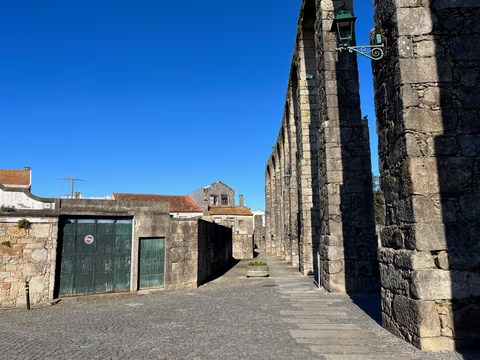
Aqueduct Trail – A path running along the Vila do Conde Aqueduct
From the Coastal Trail to the Camino Central: 12.9 km along the aqueduct from Vila do Conde to São Pedro de Rates. Route, stage, hostels, costs—explained honestly.
Read
Augsburg Way of St. James
The Augsburg Way of St. James runs 231.7 km in 11 stages from Oettingen in the Ries via Donauwörth, Augsburg, Bad Wörishofen and Ottobeuren to Ermengerst in the Allgäu — the Fuggerei, the Jakobervorstadt, a pilgrim of 1446 and Mozart's organ duel. Stages, hostels, costs.
Read

