

Via Mosana DE
Two days, one mission: the Via Mosana DE takes you from Aachen Cathedral to Liège—52 kilometers through the Marian pilgrimage site of Moresnet-Chapelle and the fruit orchards of the Herve region, until the trail drops steeply down to the Meuse River. It is the German feeder route to the Via Mosana, and it follows the old Niederstraße, the route pilgrims from northern Germany used to connect with the French trails. You’ll get your first stamp in St. Jakob—the church that, according to legend, Charlemagne founded upon his return from the Tomb of St. James.
- 01At a Glance
- 02Overview
- 03Mentioned around 1165, documented in 1215—and, according to legend, founded by Charlemagne
- 04Other Names
- 05Who It's Ideal For—and Who It's Not For
- 06Route & Landscape
- 07Stages, Terrain & Difficulty
- 08Highlights Along the Way
- 09How Pilgrims Find Their Way onto This Path
- 10Continue the pilgrimage?
- 11Preparation & Practical Information
- 12What the journey will cost you
- 13Getting Here
At a Glance
- Start / Finish: Aachen (Cathedral / St. Jakob) → Liège (Meuse)
- Length: approx. 52 km
- Stages: 2
- Duration: 2 days — a weekend
- Regions: Germany and Belgium (Wallonia) — Aachen City Forest, Herve Region, Meuse Valley
- Elevation gain: Approx. 510 m elevation gain (GPS track of the route)
- Difficulty: Easy — no mountain passes, but some paved sections and a stretch along the N3
- Waymarking: Yellow scallop shell, occasionally appearing alongside red-and-white GR markers
- Connection: in Liège on the Via Mosana Toward Namur and Vézelay
Overview
The Via Mosana DE is the German approach route to the Via Mosana — and the Weekend Way of St. James: 2 stages, about 52 Kilometers, from Aachen Cathedral uphill through the city forest, across the border to the Marian pilgrimage site Moresnet-Chapelle, then through the hedges and orchards of the County of Herve — and on the second day, a steep descent to the Meuse, across the Outremeuse Island and into Liège, where the Via Mosana branches off at Saint-Paul Cathedral. Short, well-marked, and with more history per kilometer than its length would suggest.
Because this isn't just some modern stopgap measure, but rather the Niederstraße: According to the Diocese of Aachen, pilgrims from northern Germany “mainly traveled via Cologne and Aachen (the so-called ‘Niederstraße’)” to connect with the French routes. Aachen itself was never merely a stopover—donations of relics dating from 799 turned the city into a place of pilgrimage; at times, more than 140,000 people flocked there daily to visit the shrines. You can get your first stamp at St. Jakob, just a few steps from the cathedral: around 1165 mentioned, documented 1215 — and, according to tradition, much older.
Mentioned around 1165, documented in 1215—and, according to legend, founded by Charlemagne
Medieval pilgrims stopped St. Jakob in Aachen to start a business Charlemagne's — donated, according to tradition, upon his return from the tomb of St. James. This is a legend, not a documented fact, and it should be told precisely as a legend: it made the church the premier destination for German pilgrimages to St. James, and it explains why, coming from the cathedral, people would first pray here before heading south along Niederstraße. The church is first mentioned in documents from 1165, as documented 1215; the current building is newer—the cornerstone was laid in 1877, and it was consecrated in 1886, 1944 Destroyed during the war and rebuilt by 1953; the 15th-century bells survived it all.
And then there it is, at the Aachen Jakobsplatz, perhaps the most beautiful fork in the road along the entire corridor: As far back as the Middle Ages, pilgrims decided here whether to take the detour to see the relics of St. Servatius in Maastricht—or to go straight through the Jakobstor went. This choice has resulted in two routes: the Maastricht branch is now Via Mosana, and the direct route is Via Mosana DE. At the Fish Market A stele featuring a scallop shell serves as a reminder of the tradition; the shell is even depicted on the cathedral’s baptistery, and the pilgrimage flyer soberly outlines what begins here: about 2,700 Kilometers to Santiago.
The first stop in Belgium continues in the same vein: Moresnet-Chapelle owes its reputation to a healing account by 1747, the band arrived 1823, ecclesiastical recognition 1830. And in Clermont-sur-Berwinne, the stopover town, the route takes its name from the church: Saint-Jacques-le-Majeur — travelers spend the night in the former rectory right next to it. A 52-kilometer side route featuring the legend of Charlemagne, a chapel of mercy, and the patronage of St. James: some main routes would love to have that.
Other Names
Via Mosana DE is the name of this route in our network—the “DE” honestly describes what it is: the German branch. The Belgian sponsoring association counts it among the Via Mosana 1, which officially begins “from Aachen or from Maastricht”; in our network, the Maastricht branch is known by the main name Via Mosana, and the Aachen branch is located here. The Diocese of Aachen identifies the route of the historic Niederstraße and the German information sheet published by the Deutsche St. Jakobus-Gesellschaft Aachen describes it as the first section of the “Way of St. James from Aachen to Namur.” Whatever you call it, the difference in names ends in Liège.
Who It's Ideal For—and Who It's Not For
Perfect as a weekend Camino and a trial run: Aachen is on the high-speed rail network, as is Liège—you set off from the cathedral on Saturday and are on the train home by Sunday evening. It’s also ideal as the start of the big journey: If you start in Aachen, you’ll begin at a starting point featuring the cathedral, a stamp station, and 1,200 years of pilgrimage history—and from Liège, the route continues seamlessly toward Namur, Vézelay, and Santiago. The 510 meters of elevation gain are spread out gently, and the trail markers are reliable.
To be honest, though, it’s not for you if you’re expecting two days of pure nature: there’s a stretch of shoulder along the N3, some paved sections in the Herve region, and the descent to Liège takes you through an industrial city, not a postcard-perfect landscape. And if you’re looking for traditional pilgrim hostels, you’ll find one-of-a-kind places rather than a developed infrastructure—the rectory in Clermont-sur-Berwinne is the only place to stay along the route, and you have to reserve it in advance.
Route & Landscape
The trail begins at the Aachen Cathedral, takes place in St. Jakob gets the first stamp and leaves the city, heading uphill through the Aachen City Forest. Just past the border lies Moresnet-Chapelle, the first stop in Belgium. Then the Herve Region: a plateau of hedgerows, pastures, and orchards, where an old railroad embankment with the Göhltal Viaduct offers the most beautiful route. In Clermont-sur-Berwinne — The first day ends at the stopover town and the village of Jakobsdorf, home to the Church of Saint-Jacques-le-Majeur —.
On the second day, the abandoned railroad line takes you a long way Ravel Ligne 38: Shady, dead straight, no incline—Belgium's best invention for tired legs. Then the path drops steeply toward the Meat down and across the island Outremeuse to the center of Liège. There you'll find the Abbey Church of Saint-Jacques, dating from 1016, and Saint-Paul Cathedral, where you can get your pilgrim's stamp—and that's where the Via Mosana DE joins the Via Mosana. A total of about 510 meters of ascent and 620 meters of descent: The trail ends at a lower elevation than where it begins.
Stages, Terrain & Difficulty
Two stages, as defined in the information sheet from the Deutsche St. Jakobus-Gesellschaft Aachen—one day heading up into the Herve region, one day heading down to the Meuse. Technically, there are no difficulties; just be sure to plan your lodging in Clermont-sur-Berwinne well in advance, and expect paved roads. All stage distances are rounded figures—the total length of 52 km is the definitive measurement.
- Aachen → Clermont-sur-Berwinne (approx. 24 km) — from the cathedral through St. Jakob out of the city, uphill through the Aachen City Forest, past Moresnet-Chapelle into the Herve region; a short stretch along the shoulder of the N3, but with a railroad right-of-way path and the Göhltal Viaduct to make up for it.
- Clermont-sur-Berwinne → Liège (approx. 28 km) — across the Herve Plateau, following the Ravel rail route (Ligne 38) for a long stretch, then down a steep descent to the Meuse River and across Outremeuse Island to the city center; stamp available at Saint-Paul Cathedral.
If you have more time, just keep going: From Liège, the Via Mosana in four more stages across the Condroz Plateau to Namur—together, this makes for a full week of pilgrimage from the cathedral to the citadel.
Highlights Along the Way
- Aachen Cathedral — A starting point with 1,200 years of pilgrimage history: Donations of relics beginning in 799 turned Aachen itself into a pilgrimage destination; the scallop shell is even depicted on the baptistery.
- St. Jakob — First stamp mentioned around 1165, documented in 1215; according to legend, founded by Charlemagne upon his return from the Shrine of St. James.
- Jakobsplatz and Jakobstor — the historic fork in the road: a detour via Maastricht or straight south? This choice gave rise to the two branches of the Via Mosana. At the fish market, a stele shaped like a shell commemorates the tradition.
- Moresnet-Chapelle — the first stop in Belgium: a Marian shrine that originated from a report of a healing in 1747; the chapel was built in 1823, and it received official recognition by the Church in 1830.
- Herve Region and the Göhl Valley Viaduct — Hedges, orchards, and a railroad embankment with a view: the most beautiful stretch of the first day.
- Clermont-sur-Berwinne — Jakobsdorf and its church Saint-Jacques-le-Majeur; pilgrims can stay overnight in the former rectory next door.
- Ravel Line 38 and the Arrival in Liège — First the abandoned railroad line, then the descent to the Meuse: At the end of the route, the Abbey Church of Saint-Jacques, dating from 1016, and the stamp at Saint-Paul Cathedral await.
How Pilgrims Find Their Way onto This Path
The classic feeder comes from the Rhineland: The The Way of St. James: Cologne–Aachen ends at Aachen Cathedral—and that is exactly where the Via Mosana DE begins. This isn’t a man-made route, but the old path: according to the Diocese of Aachen, pilgrims from northern Germany sought to join it “mainly via Cologne and Aachen (the so-called ‘Niederstraße’).” So if you start in Cologne, you don’t change routes in Aachen—just the name: a few hundred meters from the cathedral to St. Jakob, the first stamp, and from there the trail heads uphill out of the city.
Everyone else just gets on the train: Aachen Central Station It lies on the Cologne–Brussels high-speed rail line and is easily accessible from all over Germany; it’s about a 15-minute walk from the train station to the cathedral. Those who prefer to take the Dutch route should travel to Maastricht instead—that’s where the Via Mosana yourself.
Continue the pilgrimage?
This path does not end in Liège; it leads to the Meuse, where the Via Mosana and winds its way in four stages through the Ourthe Valley and across the Condroz Plateau to Namur, where the Sambre flows into the Meuse. From there, the route continues as Via Mosana 2 to Rocroi on the French border, and from Rocroi on, the Via Campaniensis via Reims and Troyes to Vézelay.
The journey begins in Vézelay Via Lemovicensis, which runs through Limoges to the Pyrenees, where, in Saint-Jean-Pied-de-Port, the Camino Francés takes over. The pilgrimage flyer estimates that, starting from Aachen, there will be about 2,700 kilometers to Santiago — I covered the first 52 of them in a single weekend. A start is a start.
Preparation & Practical Information
The best time is between April and October; as a two-day hike, the Via Mosana DE is suitable almost year-round, as long as the days are long enough. Expect Belgian weather—rain gear is a must, not an option. The free Information Sheet from the Deutsche St. Jakobus-Gesellschaft Aachen (published by the St. Jakob parish) describes the route and accommodations; in German, Jens M. Warnsloh’s guidebook “Via Mosana / Via Monastica” (Conrad Stein) also covers the entire corridor up to Rocroi.
Accommodations are centrally located in Clermont-sur-Berwinne in the former rectory next to St. James' Church—be sure to make a reservation in advance; it's the only place to stay along the route. In Aachen, the Elisabethkloster, among other places, accommodates pilgrims. The Pilgrim's Pass (Credencial) You can get them before you start—for example, from the Deutsche St. Jakobus-Gesellschaft or the Belgian association; you can get stamps at St. James in Aachen and at Saint-Paul Cathedral in Liège.
And even for a two-day trip, the same rule applies: Download the track to your phone. With the Camino Ninja App You're in good hands—it has the entire route stored, and you can put together your own stages and plan suitable accommodations right away.
What the journey will cost you
A weekend on a tight budget: The pilgrim hostel in Aachen costs 31 euros with breakfast (as of November 2025), the former parsonage in Clermont-sur-Berwinne cost 25 euros for a room and breakfast (As of 2020). Expect a total of about 45 to 70 euros per day — Lodging, one hot meal, and groceries along the way (estimate as of August 2026). The only other cost is the train ride: to Aachen, and back from Liège. There are bakeries and stores in Aachen, Moresnet, Clermont, and Liège—so starving is not a realistic risk on this route.
Getting Here
Aachen Central Station is located on the Cologne–Brussels high-speed rail line and is easily accessible from all over Germany; from the train station, it’s about a 15-minute walk to the cathedral and on to St. Jakob. If you’re coming from the Rhineland and have time, you’re better off walking: The The Way of St. James: Cologne–Aachen ends right here.
The return trip starts from Liège: The city is connected to the European high-speed rail network, with direct trains to Aachen and Cologne—you'll be home by Sunday evening. If you're continuing on, you don't need to book anything: From the cathedral, the Via Mosana.
- Getting to the starting point: Long-distance train to Aachen Central Station (Cologne–Brussels high-speed line), about a 15-minute walk to the cathedral. Schedules: [bahn.de](https://www.bahn.de).
- Return trip: Direct service from Liège (Liège-Guillemins) to Aachen and Cologne; schedules: [belgiantrain.be](https://www.belgiantrain.be).
- On the go: There are no train stations between Aachen and Liège—the trip is planned as a two-day stretch.
- Airports: Cologne/Bonn and Düsseldorf as the departure points, Brussels-Zaventem and Liège as the destinations.
Partners
Partner for Via Mosana DE
Camino Ninja is cooperating with official partners. For this camino the partner is:


Get your pilgrim credential and shell
Everything you need for the Via Mosana DE, shipped to your door.
Visit Camino Shop
Other Caminos
 Appenzeller Weg
Appenzeller Weg
52.6 km from Rankweil across the Rhine to St. Peterzell: St. James Chapel (1464), 163 Years of the Wedding Trail, connection to the Via Jacobi. Stages, costs, how to get there.
Read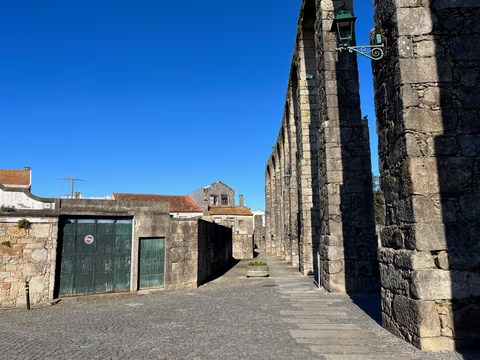
Aqueduct Trail – A path running along the Vila do Conde Aqueduct
From the Coastal Trail to the Camino Central: 12.9 km along the aqueduct from Vila do Conde to São Pedro de Rates. Route, stage, hostels, costs—explained honestly.
Read
Augsburg Way of St. James
The Augsburg Way of St. James runs 231.7 km in 11 stages from Oettingen in the Ries via Donauwörth, Augsburg, Bad Wörishofen and Ottobeuren to Ermengerst in the Allgäu — the Fuggerei, the Jakobervorstadt, a pilgrim of 1446 and Mozart's organ duel. Stages, hostels, costs.
Read

