

10 Days of Pain – Priceless! Camino Francés from León
León to Santiago in 2014: 280 km in nine walking days on the Camino Francés – with blisters, a rest day, pilgrim friend Rodolfo and lots of humour.

In July 2014 the author set off spontaneously and alone on the Camino Francés from León to Santiago de Compostela: 280 kilometres in nine walking days plus one rest day – in work boots, with inflamed blisters, but with plenty of humour and with Rodolfo, a fellow pilgrim who had started out in Switzerland.
The decision
I made my decision to go on a pilgrimage to Santiago at fairly short notice. I'd been toying with the idea of walking the Way of St James for quite a while, but I only started thinking about it seriously in June 2014. I was sitting at work and spontaneously thought: I've got 4 weeks' holiday in July, I could actually give it a go.
Back home I sat down at my laptop and started researching intensively. Since up to that point I didn't have a clue about anything, there was quite a lot to find out. First of all, the most basic questions needed answering. They were:
- When do I set off?
- How long and how far do I want to walk?
- Which route will I take?
- Where do I start?
- How do I get there?
- Where do I get a pilgrim passport?
- What gear do I need?
- How do I get back home?
I spent several days researching on my laptop until I had pretty much pieced everything together. But inwardly I still hadn't really made up my mind to actually go. So I gave my decision-making a little nudge. Since I was going to fly there and back, I pulled up the most expensive of the flights and told myself: "If I book this now, there's no turning back!" And finally, in slow motion, my index finger came down on the touchpad, making the cursor on the screen click the "Book now and pay" button. So it was official: I was going on a pilgrimage!
From then on I spent two days sorting out everything that needed doing and was ready for the big adventure.
As for "alone or in a group", it was clear to me from the start that I would go alone. My reasons were as follows:
The most trivial reason of all is probably that, off the top of my head, I don't know anyone in my circle of friends whom I could get excited about this adventure.
Besides, I'm sure that sooner or later there would be "fireworks" between us if you force yourself to walk with another person or even a group. Because in my view it's practically impossible to find someone who has the same rhythm as me!
I want to get up when I want.
I want to set off when I want.
I want to walk as fast as I want and not have to adjust to a fellow pilgrim's pace.
I want to take a break when I want.
I want to choose the daily stages the way I want.
I want my peace and quiet.
In short:
I want to do what I want!
And that's exactly what I did. I decided on the Camino Francés. I would start walking from León. For the distance of about 310 km I planned 10 walking days, plus travel there and back. That meant a daily average of more than 30 kilometres, but that seemed perfectly realistic and doable to me, especially as I'm not exactly one of the least athletic people around. I picked 13–24 July 2014 as my dates.
But wait! 13 July is the World Cup final! If Germany make it to the final, I won't be able to go to a public viewing. But since I was sure we wouldn't make it to the final again, I stuck with those dates. And as we all know, I was to be proved right! ;-)
The reason
Why am I doing this at all? I asked myself that question several times. The answer is a conglomerate of spirituality, sportiness and a thirst for adventure.
On the one hand there's the physical challenge, which I'm keen to take on. Eye to eye with my inner couch potato!
Then I also feel the need to switch off completely for once and simply think; what about, I don't really care. Just think things over in peace for once.
On top of that comes a good helping of thirst for adventure. Heading into the unknown without much planning or knowledge; I wanted that kick, and I got it.
The preparation
Bit by bit I put together everything I needed for my adventure. From the rucksack, which I borrowed from my best friend, to the pilgrim passport, right through to the shoes. For footwear I'd decided on my duty boots from work, which I'd been wearing for 10 years and which had handled longer hikes without any problems. A fatal mistake, as we'll see later. At least there was to be no shortage of medication of every kind.

The right remedy for every little ache!
Getting there (13–14 July 2014)
Here we go!
I travelled to León in two stages. First I flew from Stuttgart to Barcelona on the Sunday. Once there, I immediately went looking for a suitable venue to watch the World Cup final – which, against all expectations, Germany were playing in. First I had to discover that there was no such thing as public viewing in Barcelona; that might have had something to do with the Spanish national team crashing out in the group stage. After about an hour I found a cosy Irish pub where the match was being shown on a 2-metre screen. After a hearty dinner and a great evening of football, I went straight to bed after the match as a freshly crowned world champion.
The next day my alarm went off at 5 a.m. A taxi took me back to the airport. There a sweet little jet with a mere 34 seats was waiting. It took me to León airport, where my pilgrimage finally began. León airport, by the way, is even smaller than the one in Saarbrücken and only just deserves to be called an airport. It lies a few kilometres outside the city in a sleepy village called La Virgen del Camino. As the name gives away, the Camino runs through the village, which meant I could set off straight from the airport.
So I left the terminal building, took a deep breath and simply started walking.

Travelling in style by jet from Barcelona to León.
14 July 2014: La Virgen del Camino – Hospital de Órbigo (29 km, 6 h 04 min)
After walking from the airport into the village, the first thing I did was get my first stamp at a tourist information office. And right there I was amazed for the first time. A man was standing in front of me barefoot and greeted me with a cheerful "Buen Camino". We got chatting briefly. I learned that the man had set off on his pilgrimage from Belgium – barefoot! Absolutely crazy, if you ask me.
Then things got going for real. Where's the first arrow or a scallop shell to show me the way? After a short while I found one and took my first steps on the legendary Way that so many before me had walked.
Since it was my first day, everything I saw was spectacular and interesting. Every arrow and every shell had to be photographed. In hindsight, though, I have to say that this first stage was the "least pretty". First it went through an industrial estate, which didn't exactly exude the charm of a centuries-old pilgrim route. After that it went straight ahead for hours along a busy country road. My feet were already starting to burn considerably here. What I noticed even on the very first day, though, were all the storks! Storks everywhere. There was a nest on almost every church tower, usually with a pair of storks and their young sitting in it.
Something else I noticed was the very friendly locals along the Way of St James. You were always greeted with a friendly "Buen Camino". Some people even put tables with biscuits and water out on the pavement in front of their front door, where pilgrims could help themselves for free. This hospitality was to continue right up to the last day!
As I was plodding stubbornly straight ahead along the country road, I noticed a plant as tall as a man, growing by the hundreds along the wayside. Being very curious, I tore off a stalk and sniffed it. The plant smelled very strongly of aniseed. Is that an anise plant? No idea, because I don't know what anise plants look like. But it could also be fennel, I thought to myself. At the end of the day I asked Dr Google, who made it quite clear to me that these were fennel plants.
The entrance to Hospital de Órbigo made up for the unattractive scenery so far. The bridge with its countless arches made a lasting impression on me. I stopped for the night at the "Albergue Verde". The albergue is run by an "alternative couple"; I felt a bit like I was at Woodstock. The vegetables were home-grown, and there was praying and singing at the communal dinner. Afterwards everyone gathered on the terrace, where the evening drew to a cosy close with guitar and singing. What I now noticed in the mirror was that I'd properly fried my face and head. Unfortunately it occurred to me too late to put my hat on. Over the following days, though, I never took that fine piece off my head again.

Garden at the Albergue Verde in Hospital de Órbigo

Barefoot from Belgium to Santiago!

No hat! The sunburn wasn't long in coming!

Storks! Storks everywhere!

Entrance to Hospital de Órbigo

Topping up the electrolytes!

Dinner at the albergue. Israel, Spain, Hungary… An international crowd.

Vegetable soup as a starter

Veggie pizza and broccoli salad!

Courgette cake for dessert

Sunset at the albergue

A cosy get-together with guitar music after dinner

The first arrow in La Virgen del Camino…. let's go!

You come across pilgrim sculptures regularly here

You can't really get lost here

Kilometres straight ahead along the country road. Not particularly pretty…

Dormitory at the albergue.
15 July 2014: Hospital de Órbigo – El Ganso (30.7 km, 6 h 35 min)
Today I set off relatively late, at 8:30 a.m. Over the following days I'd long been on my way by that time.
After just a few kilometres I noticed that my feet were starting to hurt more and more. It got so bad that in Astorga I told myself: "Not one step further!" I sat down in a bar and seriously wondered how I was supposed to walk another 270 kilometres on these feet. The idea with the duty boots apparently wasn't quite as brilliant as I'd thought. A classic beginner's mistake; and that from me, a passionate know-it-all and smart alec! But I told myself that I would not give up under any circumstances. In my mind's eye I could already see the laughing faces of the folks back home, who wouldn't have thought me capable of an adventure like this anyway. So giving up was out of the question. Since I still had my running shoes in my rucksack as a spare, I changed tyres. In Formula 1 they'd say "from the hard to the soft compound".
A small addendum:
About the lovely town of Astorga, though, I'd like to mention one sensational structure. It's a railway crossing for pedestrians and cyclists. A metal tower has been built here that first zigzags up 2 levels and about 10 metres, then crosses the tracks and comes back down the same way. The route across the tracks, which would be 5 metres as the crow flies, thus actually ends up more than 100 metres long. Why do it the easy way when you can do it the complicated way?!? Apparently it's not just the Germans who are good at that, but the Spaniards too. Unfortunately I didn't take a photo of the structure; the pain in my feet made me forget.
End of addendum.
Once I was back on my way in trainers, things went much better. What was still to become clear: my feet had already taken such a beating that the coming days would turn into a real challenge.
Slowly but surely we now headed into the Montes de León, steadily climbing, slowly but surely. Along never-ending gravel tracks that didn't exactly do my feet any good.
And gradually my head started to quieten down a bit, whenever I wasn't thinking about the pain in my feet. And what do you do when you're thinking about nothing? Well, I personally now regularly caught myself singing songs in my head, or humming along quite audibly. It was a hotchpotch of songs from right across international music history. But as the saying goes… Whatever helps!
After 30 kilometres I arrived in the little village of "El Ganso", where I ended my second stage in a small but lovely albergue. There I met Rodolfo, who was to become my almost constant companion. Rodolfo was born in Italy and lives in Switzerland. As I was to discover over the next few days, I had met a very impressive man with a fabulous life story. Rodolfo set off on the Camino from his home in Switzerland and by the time he reaches Santiago he will have covered more than 2,100 kilometres! On our shared journey we had many valuable conversations that I wouldn't want to have missed.
During the night I was woken by a loud fart. That's just how it is on the Camino. Back to the basics! Who the sender was, though, I can't say.
I'd also like to mention three Italians who were staying at the same albergue. One of them was blind and was guided every step of the way by the other two: presumably all the way to Santiago. Chapeau!!!

Putting a brave face on it… The pain is almost unbearable!

The journey is the destination! Keep going straight ahead!

The early bird casts the longest shadow

Just before Astorga

Astorga's weekly market

Looks better than it tasted…

A selfie now and then never hurts!

And straight ahead again….as far as the eye can see

…

Dipping my feet in there … sadly not possible

Albergue in El Ganso… Small but lovely!

Astorga

Astorga…
16 July 2014: El Ganso – Molinaseca (35.4 km, 7 h 50 min)
That day I set off as early as 7 a.m. Because of the ongoing sweltering heat, with temperatures of nearly 40 degrees around 6 p.m., it made sense to start early and check into an albergue in good time. Rodolfo had already left at around 6 a.m.; I wasn't to see him again that day.
In the soft sand on the ground during the first few kilometres you could see that several people must be walking barefoot here. I immediately thought of the Belgian in La Virgen del Camino. But he wasn't the one leaving the footprints, as I discovered later. That's when I saw another man who was also walking barefoot on this extreme surface and in such heat. Still unimaginable to me.
The scenery on the way up to the "roof of the Camino" is glorious. Narrow paths wind through green meadows and small woods. Plus views like something out of a picture book.
Today's stage featured one of the highlights of the Camino Francés: the Cruz de Ferro. At 1,528 metres above sea level, it's the highest point of the Spanish Caminos. But I couldn't really enjoy the moment. My feet hurt so badly that you could think of practically nothing else. And that wasn't going to change over the next few days either.
In the scorching heat on the descent I realised I'd forgotten to fill up my water supplies before setting off. I had a "CamelBak" with a 2-litre capacity in my rucksack. Through a tube you could drink while walking without taking the rucksack off. I also had a water bottle around my waist, which I refilled at every opportunity; but not that day. I wouldn't say I was dehydrated, but I definitely wasn't far off. When I got to Manjarín, I went to the !real! Knight Templar who lives there. For a voluntary donation he offers water and biscuits. After practically downing about 3 litres of water in one go, I refilled my water supplies, took a handful of biscuits and continued on my way. Of course I made a donation too.
Info for anyone who passes by here at some point: if you like, you can have the Knight Templar bless you. He does it with his sword and all the bells and whistles!
After a very demanding descent I arrived in Molinaseca. For me the most beautiful place on my pilgrimage. You enter the town over a charming bridge across the Río Meruelo. A dreamlike sight!
The albergue that day was, looking back, the worst on my Camino. I still slept well, though, after tending to the blisters on my feet as best I could.

Barefoot to the Cruz de Ferro!

Molinaseca…. Simply beautiful!

Albergue in Molinaseca… not exactly recommended…

Sunrise in El Ganso…

Impressions

Impressions

Glorious view

At the Cruz de Ferro…. 1,528 metres above sea level

With the Knight Templar in Manjarín

Manjarín

The Knight Templar's "guard" dog

The tough descent …

Entrance to Molinaseca

Entrance to Molinaseca…

Molinaseca…

Molinaseca

Isotonic and tasty!

Back then it still looked halfway OK… but the blister was beyond saving…
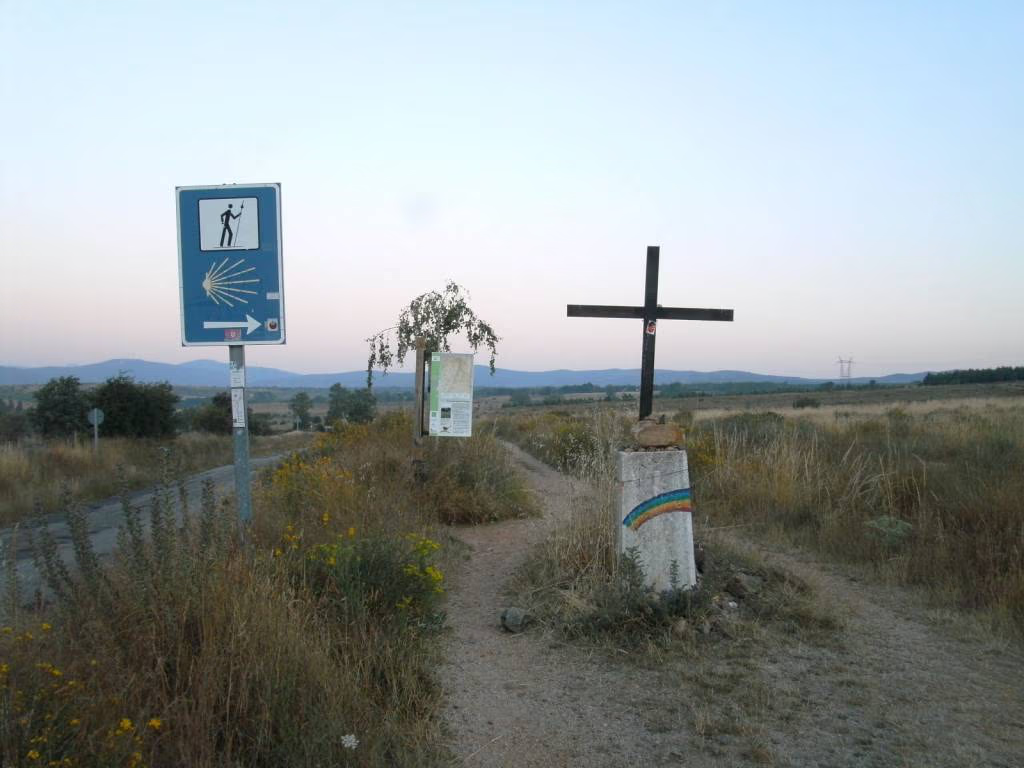
Leaving El Ganso

Rabanal del Camino

Breakfast outdoors… sadly without me.. no time… got to keep going!!!

On the climb up to the Cruz de Ferro

Impressions

Impressions

Impressions

Foncebadón
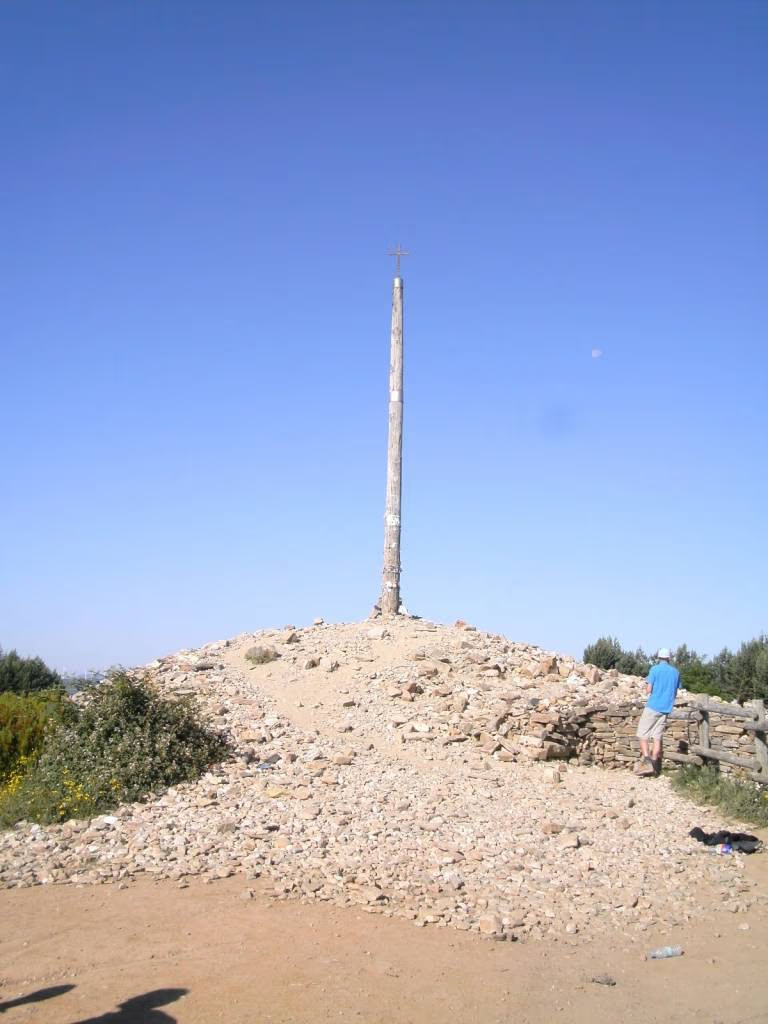
Cruz de Ferro

Selfie at dizzy heights…

Descending towards Molinaseca

Impressions
17 July 2014: Molinaseca – Pereje (40.6 km, 8 h 42 min)
Once again I started at 7 a.m. That day I managed something that's almost impossible on this route. I got lost. I'd bought a peach in a little shop. It was so hard that it took all my concentration. For fear of biting on the stone, I turned left at a roundabout instead of following the yellow arrow straight ahead. That earned me a detour of more than a kilometre. In Ponferrada I then posted a parcel at the post office and sent a total of 5 kilos of unnecessary luggage home. The postage came to more than 50 euros, and to this day the parcel has never arrived at home. A trace request has so far been unsuccessful. – very annoying!
A tarmac path led past fields where maize, courgettes and other vegetables were grown. An ingenious system of channels was used for irrigation. The water, which presumably came from a river, is led past the fields through channels. With sluice gates that are pulled upwards, each field can then be watered individually.
As a passionate hobby gardener, I personally noticed an older man who had just harvested a handcart full of courgettes. The things were at least 50 cm long and I reckon weighed several kilos each. But who wants to eat monsters like that??? When courgettes get that big, they're as hard as stone and can't really be eaten properly any more. My theory was therefore that the giants were meant for the livestock.
Afterwards, in the lovely little town of Cacabelos, as I crossed the Río Cúa, I could marvel at lots of people bathing in the cool water. My envy tended towards infinity, but I really had no time for a swim just then. Several canoeists were also enjoying the cool refreshment.
After this town came a stretch of more than 7 kilometres along a busy main road all the way to Villafranca del Bierzo. There I ordered two more bottles of "agua con gas" to take away at a bar and took them with me. By now I'd learned that drinking is the be-all and end-all here! While walking I now drink between 6 and 8 litres of water. And that's badly needed; because during the entire Camino I only had to pee once while walking… and that says a lot! 8 litres in, nothing out! All sweated out along the way.
Something else I noticed again that day: here in Spain only a few bars have sparkling water. And I love it! The more fizz, the better! Still water without bubbles is a real punishment for me! But whenever I could only get still water, I naturally had to make do and gulp it down.
After Villafranca del Bierzo the path climbed noticeably again.
My feet were burning like fire, yet that day I covered more than 40 kilometres. In the last few metres before my destination for the day, Pereje, Rodolfo caught up with me. Together we checked into the only albergue in the village of 180 souls. It was the most beautiful albergue of my journey. Rustic, built of natural stone, it felt like being in a castle in the dormitory, which held only 10 beds. The beds were top-notch, the mattresses fantastic. At 5 € a night, a dream! We went out together for something to eat. As always, it had to be the pilgrim menu. For an average of 8 € on the Camino you get a starter, a main course, a dessert, plus bread and wine, or water instead. The quality of the food was OK, and unbeatable for the price. As on the previous days, I had no appetite and wasn't hungry, but you have to eat something after all. I noticed that in every restaurant the chips were always made from fresh potatoes. No frozen stuff, really great!
Falling asleep afterwards was a bit harder than usual, as two Italian pilgrims were snoring really loudly. I'm used to quite a bit at home – I won't mention the name C. Winter here – but that was almost bordering on bodily harm.

Impressions

Pilgrim with a donkey

…in Ponferrada… Which way? Uphill, of course…

Ponferrada

Ponferrada castle

Albergue in Pereje

Dormitory at the albergue… At the back on the right, the two snoring Italians…

Taking notes over some nice cold drinks…

176 km to go

Rodolfo and me with a little starter…

My bed… Veery comfortable!

Storks again and again….

Typical main course of a pilgrim menu… Salad, meat, FRESH fries…
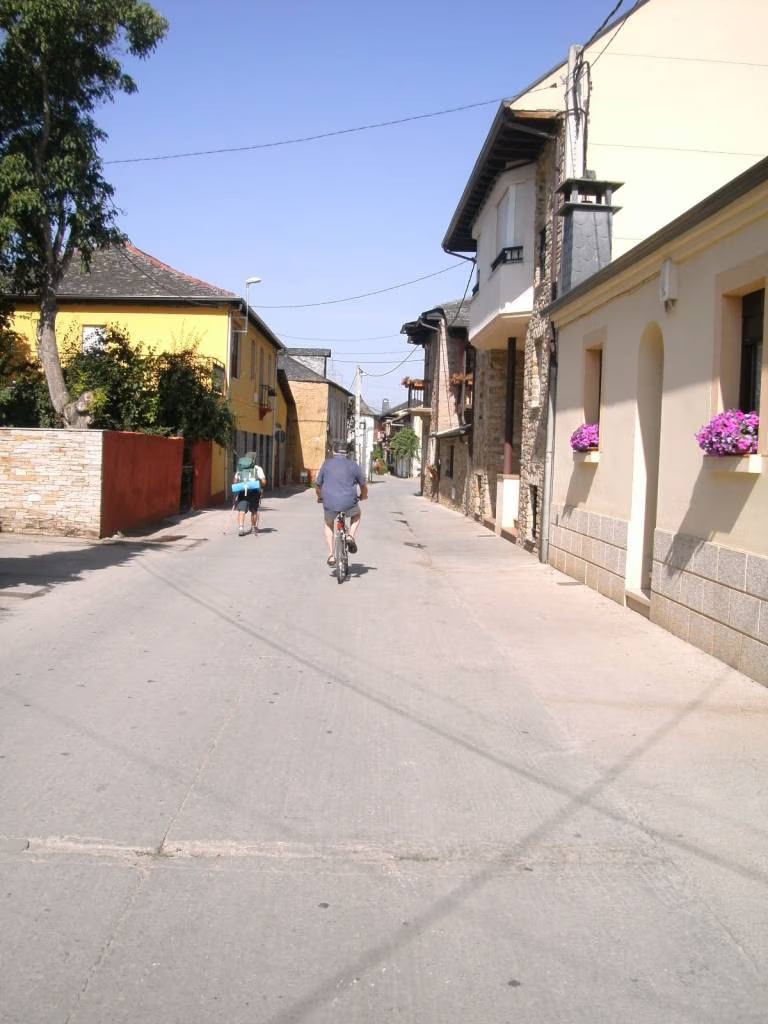
Impressions

The vegetable growers' irrigation system…

A cart full of monster courgettes… Probably as hard as stone…

Art along the Camino

The Río Cúa near Cacabelos. Envy on a scale of 1–10: 11!
18 July 2014: Pereje – Fonfría (via O Cebreiro, 37 km, 8 h 16 min)
That day I was up as early as 5:20 a.m. The culprits were the snorers I've already mentioned. Not only had they snored loudly all night, they also turned out to be very loud and inconsiderate early risers. So I set off as early as 6 a.m. Rodolfo, as every morning, had already left by then. From the very first metres the blisters did what they do best – hurt! And how! Sadly, because of that I couldn't really admire the glorious scenery. Luckily I'd taken enough photos, which at least let me take in the wonderful panorama afterwards.
Via O Cebreiro there were two steep climbs. In my view the toughest stage of my Camino! Over muddy paths and thick roots it climbs so steeply in places that you can almost only make progress on all fours. But beautiful O Cebreiro makes up for all the effort! Further on, the path goes downhill a bit, only to climb really steeply a second time. A real ordeal even for a fit pilgrim with plenty of stamina like me. After almost 37 kilometres I checked into an albergue in Fonfría. It was the biggest albergue of my journey, with over 70 beds per dormitory. The beds were very comfortable, though, and it didn't have that train-station-concourse feel I'd feared. Some of the beds were made from solid tree trunks and felt very homely and rustic. As I was sitting outside the albergue after checking in, Rodolfo came along the path. He didn't want to finish his day's walk yet, though, and after a short chat carried on. A painful blister made him stop at an albergue just one village later, as he told me afterwards.
Dinner that evening was great. The albergue had its own building across the road, where dinner was served together with all the other pilgrims in a large dining hall.
That evening, for the first time, I was properly hungry and had an appetite. And then there was green bean soup as a starter. For a confessed soup lover like me, heaven on earth. Without the slightest embarrassment I polished off 3 brimming bowls to begin with. Including the main course and dessert, I was well and truly stuffed and went to bed early.

Impressions

Glorious scenery…

Above the clouds….

Moooooooo!
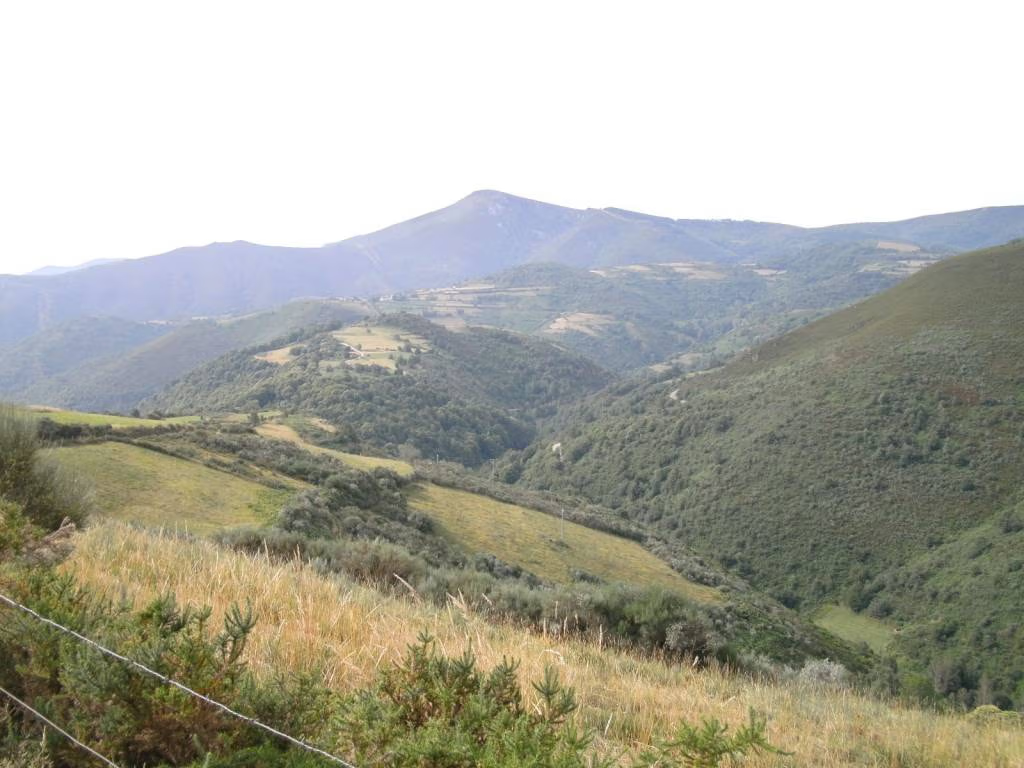
Impressions

Impressions

Impressions

Impressions

Whatcha lookin' at?!?

Keep Smiling

Dining hall in Fonfría! HUNGRY!!!!!

Dining hall…. Rustic….Lovely!

Soup!!!! And what are the others eating? :-)
19 July 2014: Fonfría – Barbadelo (34.5 km, 8 h 00 min)
This day was the first and also the last day with bad weather. The odd shower now and then, but mostly overcast and dry.
The first few kilometres went downhill the whole time and brought me to Triacastela. At the entrance to the village there's an ancient chestnut tree to admire, which is supposedly more than 800 years old. Because of unbearable pain I forgot to take the obligatory photo. In the centre I went to a pharmacy and stocked up on painkillers again. That was the only way it was even possible to walk for up to 9 hours every day. What stood out were the tiny prices for medication. A pack of 40 Ibu 600s cost a ridiculous 1.98 €! Just like in the old TV ad for "Storck Riesen", I popped the first three tablets right there in the pharmacy. And he still eats the first three straight away! ;-)
For everyone who's now smiling: here's the link to the ad:
Click here for the Storck ad!!!
After Triacastela the path splits. One route, the longer one, goes via Samos, the other via San Xil. In the little village of Perros or Vigo the routes meet again heading towards Sarria. I chose the shorter route via San Xil. It took me along very pretty forest and field paths past green meadows. There I saw a whole flock of white storks. There were at least 60 of them standing together in a meadow. If "flock" isn't the correct term for storks, please forgive me. On this stretch of the path I caught up with Rodolfo again. We walked together for the rest of the day. In Sarria we took a break and had a burger.
What we didn't yet know, but already suspected, followed over the remaining kilometres to Santiago. As almost everyone who knows a bit about the Camino is aware, you have to walk at least 100 kilometres on foot to receive the "Compostela" certificate in Santiago. Sarria lies just over the 100 km mark and is therefore a popular starting point for the so-called 4-day pilgrims.
From here on the number of pilgrims increases noticeably. Whole school classes are herded along the Camino from here, a not-so-nice side of this most famous and popular of all Caminos. Making matters worse in this case was that 25 July was just around the corner. On that day the region – especially Galicia, and above all Santiago – celebrates St James's Day in honour of the apostle. To be in Santiago in time for the date, considerably more pilgrims than usual were setting out in those very days.
Together we walked on to Barbadelo, where we checked into a guesthouse and stayed practically in luxury in small, posh 5-bed rooms. As I now had to realise, the blisters had become badly inflamed and hurt so much that I considered taking a rest day. In the last 6 days I'd already covered 207 kilometres, well above the target average of 30 km a day. So I'd more or less walked myself a rest day. But I put off the decision until the next day. At the albergue we met Xavier. He's a Spanish doctor, now a professor of public health at an American university.
The three of us went to the local restaurant for dinner. We chose the Galician national dish "pulpo" (octopus, not to be confused with squid!)
The pulpo is boiled and the tentacles cut into pieces. Olive oil, paprika and coarse sea salt are poured over the top. Tastes good, but I don't need it every day. Then it was early to bed.

American sisters and Xavier, the doctor…

It hurts "worser" than it looks!

…and storks again..!

A little snack in Sarria together with Rodolfo

Pulpo…. Perfectly edible!
20 July 2014: Rest day
I'd decided to take a break that day. In hindsight it was definitely the right decision, because I think I wasn't far off sepsis.
First I took a taxi to Portomarín, where I bought a proper ointment for my blisters at a pharmacy and dressed the wounds. In a bar right next to the church I waited for Rodolfo to arrive. He reached Portomarín some time later and sat down with me. We agreed that I'd take the taxi a few villages further on and find us a place in an albergue. That turned out to be harder than expected. Because of the many 4-day pilgrims I had no luck at the first two albergues. Only in Palas de Rei did I manage to grab the last two beds. When Rodolfo arrived, we went to a restaurant together for dinner. As a starter there were squid rings. They were so delicious that I'll probably never again touch the rubber rings sold in freezer cabinets back home. Rodolfo paid the bill, by the way! We agreed that, as a way of making it up, he'll come and visit me at home. Then I can show my generous side! The visit is still pending, but we're in touch by email and one thing is certain: the visit will happen!!! I'm really looking forward to it!
With a full belly it was off to bed.

A lavish dinner in Palas de Rei!
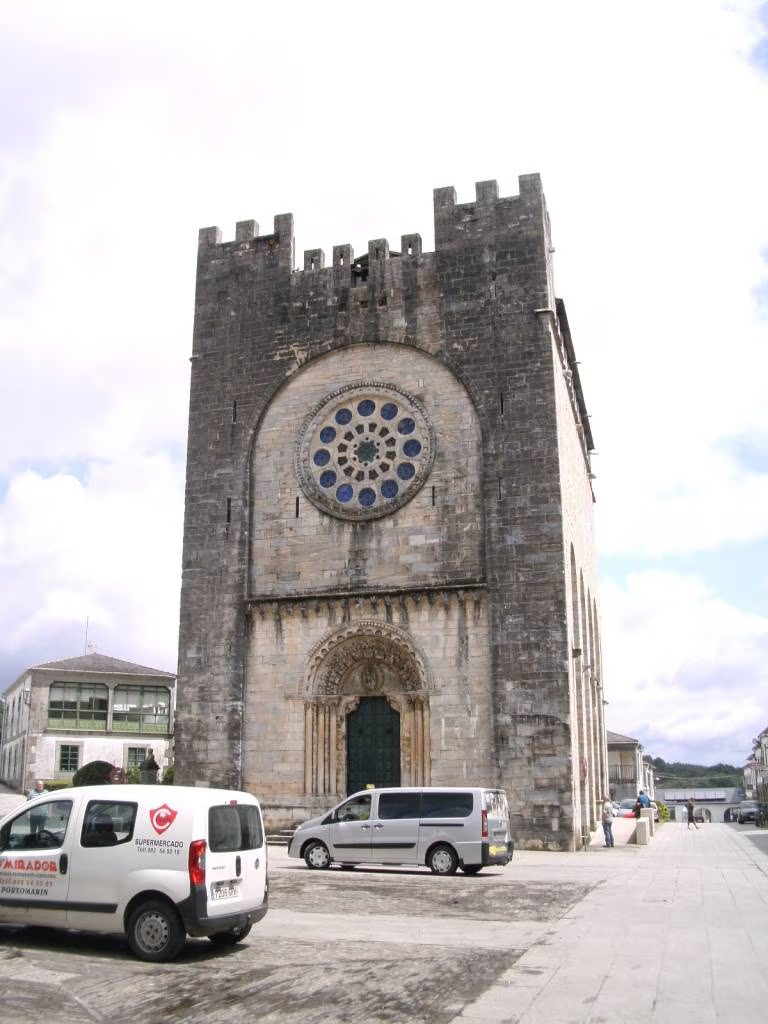
Church of Portomarín

Still lookin'?!?

Goofing around makes you happy!

Rodolfo and me at dinner.

The best squid rings I've ever eaten!

"Mixta" salad
21 July 2014: Palas de Rei – Arzúa (30.4 km, 6 h 46 min)
The break had done my feet a world of good. The pain was much more bearable. Rodolfo and I set off separately as every morning, but after a while we bumped into each other yet again. As we were walking side by side once more, an attractive Mexican woman called Claudia caught up with us. Without further ado she pressed her Nordic walking poles into my hand, explaining that "I was walking so unevenly that I needed them more than she did, this close to the finish". I gratefully accepted the gift. And as a Nordic walking sceptic I have to admit that the things really did make walking easier! Claudia then carried on alone, and Rodolfo and I kept walking side by side towards Santiago as well. The heat that day was almost unbearable, plus there were nasty descents and climbs. When I looked at my arms at one point, I thought they were covered in beads of sweat. But they weren't! It was heat rash! In the shade of a large apple tree I then slathered myself with another hefty dose of sun cream. The rash disappeared again within half an hour. Together we walked on to Arzúa. At the entrance to the town Rodolfo took a break. I looked for an albergue at the far end of the long, drawn-out town. After his break Rodolfo walked a few more kilometres. His plan was to be in Santiago as early as the next day, 22 July, so he could be out of the city again heading for Finisterre before it got completely overcrowded for the holidays. I, on the other hand, stayed in Arzúa and first settled into a cosy bar. Arzúa was really busy. The reason is that this is where the Camino Primitivo, the Camino del Norte and the Vía de la Plata also join the Camino Francés and lead on together to Santiago. The pilgrim motorway is basically widened from one lane to four. No wonder there are more pilgrims on the road.
After a nice cold beer and a tasty dinner I went to bed early once again.

Really tasty, this Estrella!

Well, you really couldn't complain about the weather…

Now it's time to get stuck into the pulpo's tentacles!

A little snack at lunchtime… Regional stew and pulpo…

You mustn't neglect your fluid balance…

Arrived in Arzúa… First, a little bite to eat!

Starter on the pilgrim menu

Main course on the pilgrim menu
22 July 2014: Arzúa – Lavacolla (29 km, 6 h 15 min)
This stretch was without major incidents. Through mighty eucalyptus forests near O Pedrouzo you head into the last 20 kilometres. At this point I started thinking again. What about, I can't quite remember. But one thought stuck with me. When you walk along a pilgrim route that's several centuries old, you start to wonder who has already walked over exactly this stone that I've just tripped over. Hape Kerkeling, for example. But how many people were there? A million? Ten million? No idea. But I'd really like to know! And another great thought experiment: how long would the queue be if all the pilgrims who have ever arrived in Santiago lined up one behind the other? The first pilgrim to St James, who according to the literature was Alfonso II "the Chaste", stands right in front of the tomb of St James, and all the other pilgrims in a queue behind him! How long would that queue be? 100 kilometres? 1,000 kilometres? I find that question really fascinating! With these thought experiments I reeled off the day's stage almost as if in a trance.
Just past Santiago airport, only about 10 kilometres from Santiago, I treated myself to something very special. A night in a hotel in Lavacolla! All on my own! No snoring, no farting, my own shower, fresh bedding; wonderful!
After a tasty dinner I went to sleep full of anticipation for the coming day.
A little anecdote about the village of Lavacolla:
It used to be the custom to wash in a small stream in this village so as to arrive in Santiago clean and not smelly. However, this custom is probably based on a misunderstanding. Apparently there was a translation error. Instead of correctly translating "Lavacolla" as "full of scree", the French monk Aymeric Picaud, author of a medieval pilgrim guide, understood "Lava coleo", which means something like "wash your genitals". Still, the washing probably never did anyone any harm. (You can read about it in the Rother hiking guide!)
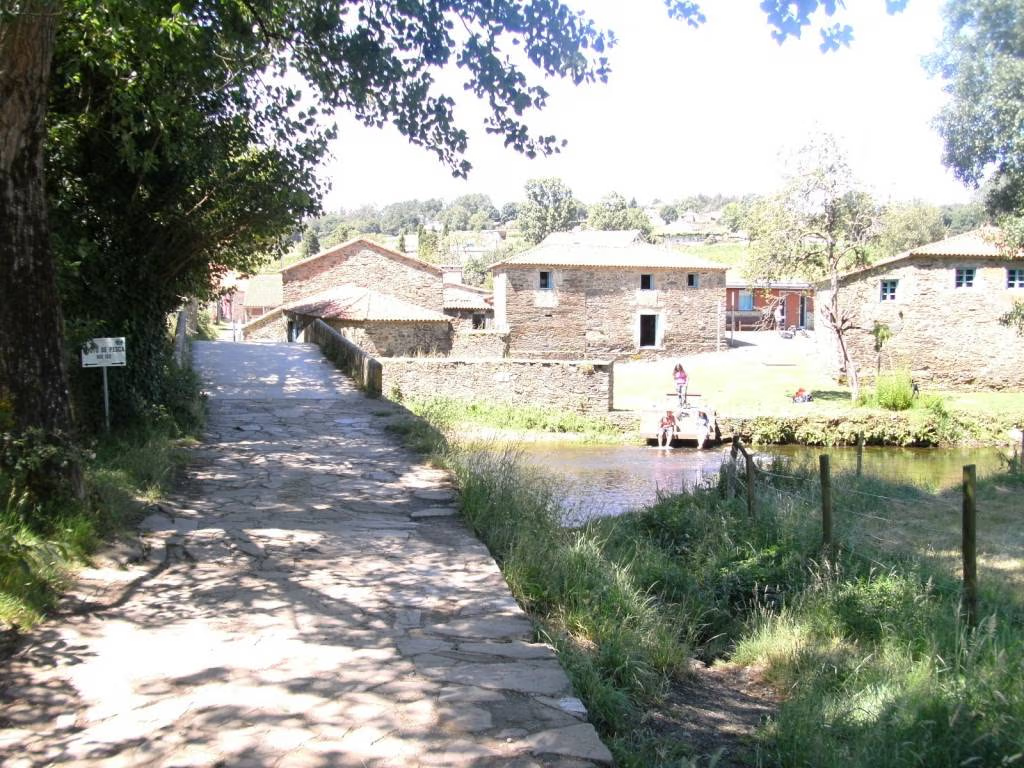
Picturesque… Wonderful!

And don't forget the selfies!

Impressions

Eucalyptus forest near O Pedrouzo

…
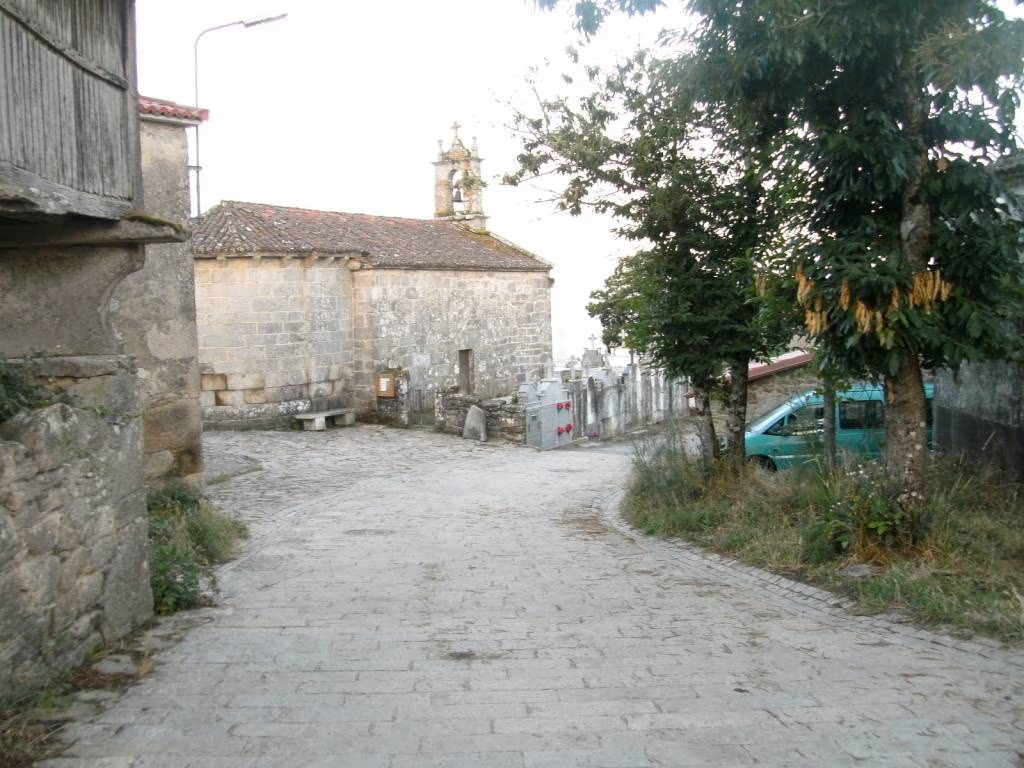
Impressions

Free with the pilgrim menu

And those fresh chips again… I love them!
23 July 2014: Lavacolla – Santiago de Compostela (13 km, 2 h 37 min)
Once again I set off on the dot of 7 a.m. After a little over an hour I reached Monte do Gozo, the "Mount of Joy". From here you can see Santiago's cathedral for the first time. After a selfie in front of the monument commemorating the Pope's visit in 1993, it was on to the final kilometres.
At 9:28 a.m. the moment had come. Through one last archway and suddenly there you are: in the square in front of the cathedral. At the kilometre-zero stone! The goal has been reached, but somehow the joy just won't come. I'd imagined the arrival being more spectacular; but still, it was done. In the end, 280 kilometres in 9 walking days. After staring motionless at the cathedral for a few minutes, I went to the Oficina del Peregrino, where my Compostela was issued. Then I met up with Rodolfo, who had already got us 2 places in an albergue. After dropping my rucksack off at the albergue, we went to the pilgrim mass at 12 noon. The highlight, of course, was the ceremony with the Botafumeiro. Before the mass began, it was announced several times in practically every major language that filming and taking photos during the service was not permitted. When it started, at least 90% of all the pilgrims had their phones and cameras in their hands, filming and taking photos. I resisted the temptation and didn't. After the mass Rodolfo and I went for something to eat. We found a restaurant where we tucked into a superb beef chop. Afterwards Rodolfo went back to the albergue, and I went into town and watched the hustle and bustle for two hours. Very interesting and a bit surreal. I still couldn't quite take in that I had arrived. In the evening Rodolfo and I stocked up at a supermarket on cold cuts, cheese, bread, pistachios, peaches and cherries, and ate at our leisure in the albergue garden. To round things off, a cigarillo courtesy of Rodolfo, and then it was off to bed. The next morning Rodolfo got up early as always and, after a short goodbye, set off for the end of the world.
After a good long lie-in until 9 a.m., I first went to the big square in front of the cathedral. Preparations for the feast of St James were in full swing there. Several TV stations were positioning their broadcast vans, and reporters were reporting live on Spanish television. After watching the hustle and bustle for a good long while, I made my way to the airport. At around 6 p.m. I landed back in Germany; the journey was over!

Not far now! The goal is almost reached…

At Monte do Gozo

Monte do Gozo

Monument commemorating the Pope's visit

Entering the city …. Only a few hundred metres to go

9:28 a.m.: I'm heeeere!

At the finish!

The cathedral! There's the thing!

At the apostle's tomb

The apostle's reliquary

Just before the pilgrim mass

My Compostela

…and the distance certificate

In front of the cathedral

In the alleys you can watch the hustle and bustle undisturbed

… with my colleagues…

The beef chop… That gives you strength! And a well-earned reward!

Dinner at the albergue with Rodolfo…
In 9 days I walked 280 kilometres and, despite the hellish pain, had a fantastic time. I can only recommend that everyone sets out on the Way at least once. No matter for what reason.
It's worth it!
Buen Camino!
The route in Camino Ninja
You'll find the Camino Francés – including the last third described here, from León to Santiago de Compostela – with stages, map and accommodation in Camino Ninja: Camino Francés.