

Camino Francés in Winter: 29 Days Through Snow and Cold
Walking the Camino Francés in January and February: daily notes on snow, closed albergues, guesthouses, prices and menus from Saint-Jean to Santiago.

From 19 January to 16 February 2014, our author walked the Camino Francés from Saint-Jean-Pied-de-Port to Santiago de Compostela – in the depths of winter, with snow in the Pyrenees, on the Meseta, at the Cruz de Ferro and before O Cebreiro. His day-by-day notes on accommodation, prices and menus will help anyone planning the Camino in the cold season.
This report is neither richly illustrated nor particularly well structured, but maybe it will help someone who wants to do the Camino in winter.
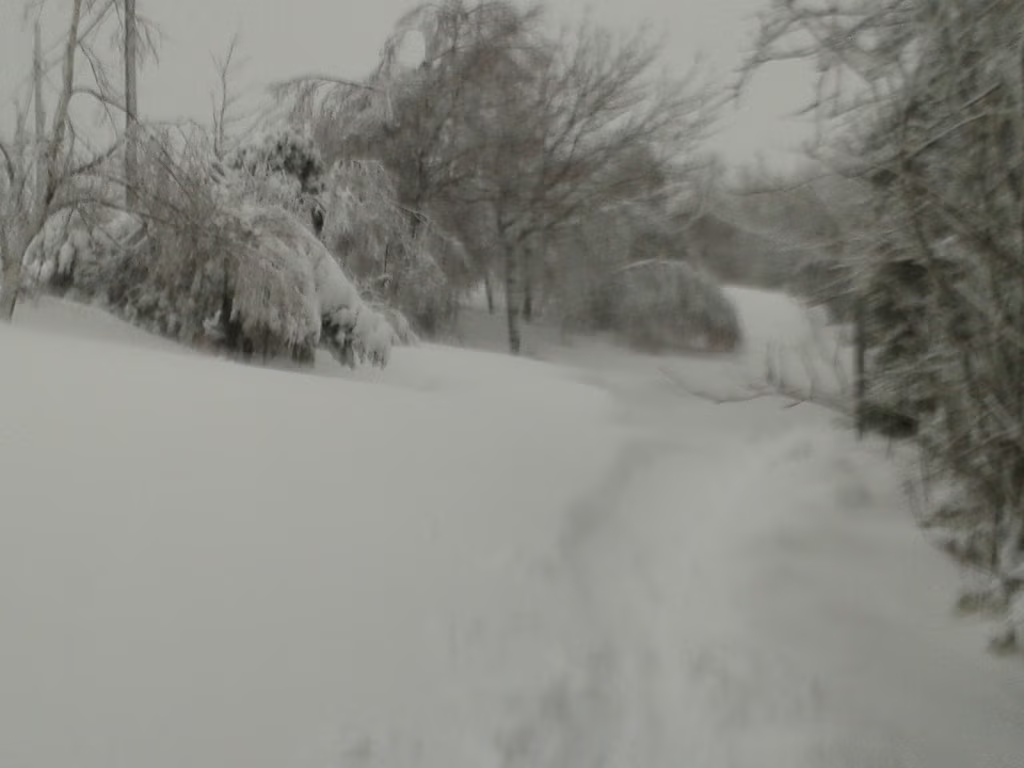
The pass near O Cebreiro
Why in winter?
The Camino Francés in winter – why? The opportunity simply came up. I would never go at any other time of year; the crowds are too much for me. Of course, opportunity has to be matched by motivation, but I’ll keep quiet about that here. In any case, I was looking more for peace and solitude than for the “pilgrim atmosphere” so often cited by the Outdoor guidebook.
Five other pilgrims started out from Saint-Jean-Pied-de-Port on the same day as me (a Sunday). There are probably fewer during the week, because once I walked a bit faster than the stage plan I got at the Accueil des Pèlerins, it became lonely.
Cold, snow and closed albergues
The weather, and the strain that comes with it, is of course different in winter. The cold was hardly a problem as long as you kept moving; long johns are important above all in cold albergues … Sometimes gloves wouldn’t have hurt, but I managed without. A warm hat (pulled down over the ears) is a must. Unfortunately (except in the rarely heated bars) you can hardly take a break of more than a few minutes, because you cool down fast. The wind usually whistles, and you rarely find a sheltered, sunny spot. Temperatures ranged from about 0 to 10 degrees, and there could be frost in the mornings. The paths can get quite deep from constant freezing and thawing and from the rain, but this doesn’t apply to the classic gravel tracks and pilgrim motorways. The pass crossings, however, were no joke because of the snow – see the daily notes below.
A lot is closed in winter: albergues, guesthouses, bars … even when it says “open all year” … that calls for a certain amount of planning, see also the tips below.
What helped me with this was the Outdoor guidebook (a few digs at it follow below) and above all the website of the Pilgerfreunde Paderborn, because it also has detailed information on guesthouses. Of course, that only worked with a smartphone. In the bars and guesthouses there was almost always free Wi-Fi, and now and then in albergues too.
I had to battle snow on 20 January in the Pyrenees, on 3 February on the Meseta, on 7 February over the Cruz de Ferro, on 10 February at the start of the climb into the mountains and on 11 February in the mountains. The snowstorm at the Cruz meant crossing on the uncleared road – a tough stage. Even tougher was the climb to O Cebreiro: 6 km in the snow with metre-high drifts on the Camino and the road.
My gear
Here is my gear in detail:
Newly bought:
- 2 pairs of lightweight Schöffel hiking trousers.
- 1 pair of Odlo long johns – over time they disintegrated under the hiking trousers; whenever I took them off, black flakes “snowed” down.
- 1 McKinley Aquamax hiking jacket – waterproof for 2 hours – with a removable fleece. For walking I mostly wore just the fleece, except in very strong wind or on downhill stages where you never reach operating temperature.
- “Functional underwear”: 3 boxer shorts and 3 T-shirts from Tchibo – money well spent.
- 2 pairs of Falke hiking socks.
- 1 light cotton sleeping bag for albergues.
- 1 Moorhead outdoor towel, absorbent and quick-drying – great stuff.
- 1 Moorhead rain cape for €5, which lasted exactly one stage (the 2nd), then one for €30 from Kohla Tirolean, which survived several outings all the way to Santiago.
Plus:
- My trusty, freshly resoled Lowa leather trekking boots on their final outing.
- 1 pair of normal socks.
- 1 light long-sleeved jumper.
- 1 wool hat.
- 1 baseball cap.
- 1 aluminium water bottle.
- Various toiletries.
- Various pharmacy items (plasters, disinfectant spray, …).
- Swiss Army knife.
Daily notes from Saint-Jean to Santiago
What follows are fairly note-style entries on the daily stages. Prices are for a single room or a double room (occasionally sharing a room with another pilgrim).
18 January: Saint-Jean-Pied-de-Port
Arrived by TGV and regional train.
A very warm welcome at the Accueil des Pèlerins, even at around 8 in the evening.
Municipal albergue clean, warm, spacious, pleasant hosts. If only all albergues had been like that …
The other freaks get up at 6 the next morning! No point staying in bed any longer. It’s still pitch dark when I’m the last to leave the albergue, and finding the way is a bit of a struggle. Here in France there are no bright yellow arrows yet.
19 January: Roncesvalles
Pension Casa Maria for €30 (single). Good food; the set lunch menu at €17 is clearly better (and pricier) than the €10 pilgrim menu in the evening.
It snowed during the night! So the next day it was trudging through the snow.
20 January: Zubiri
Pension Usoa €21 (single), laundry free. Unbeatable for the money.
The €10 menu in the bar by the sports hall on the main road (Bar Cafeteria Polideportivo) was acceptable at lunch and dinner.
21 January: Cizur Menor
Nasty walk on concrete tracks through Pamplona.
Local albergue disastrously cramped. One room gets packed with 8 pilgrims while the other rooms stay empty. Keeps me away from albergues for days.
Very modest €10 menu at the Asador Tremendo.
Note to self: big snoring dormitories at least have the advantage in winter that people can spread out a bit. Small rooms get packed mercilessly.
22 January: Estella
40 km to here, because everything along the way was closed. A bit much for the fourth stage, and I would pay for it later.
Hostal Cristina: €45 (double), heating only on and off, so a cold hole.
Note to self: a general problem with hostales: they only turn the heating on when you arrive, which often doesn’t help in a building that has gone cold, or only after hours.
Diagonally opposite, the excellent Restaurant Astarriaga – no pilgrim menu, but a good set menu.
Note to self: the pilgrim menu is often dire, while a slightly pricier set menu can be very tasty. So don’t be so stingy! Also, the quality of the vino tinto they pour seemed to decline from east to west. Or maybe after a while you just can’t stand the plonk any more.
23 January: Los Arcos
Pension Mavi: good accommodation for a hefty €45 (double). Menu in the bar that belongs to it, for the usual €10, rather modest.
24 January: Viana
Simple guesthouse for €25 (double) with a washing machine. Dinner at the Hotel Palacio de Pujadas very good.
25 January: Navarrete
Albergue El Cántaro: double room for €30 (double), which we’re given in the actually closed part of the building after asking for a private bathroom. The bathroom is separate, but we’re on our own.
Dinner at Restaurant El Molino very good: for dessert, cheese with dulce de membrillo.
The pilgrim routine sets in: breakfast (often – not always is anything open …), walking, checking in, showering, lying down, dinner, sleeping.
26 January: Nájera
Hostal Hispano €30 (single)
The pilgrim menu recommended by the Outdoor guide at Restaurant El Buen Yantar for €9 was one of the better ones.
In the evening, off to the hospital’s A&E. I don’t have to wait even 5 minutes, but it’s supposed to cost €138 for that.
Diagnosis: tendinitis (inflamed tendon) in my right foot. This simple finding earns me a discount – now it’s only €50.
Treatment: pop diclofenac, cool with ice and walk shorter stages (ha ha …).
The hospital accepts neither plastic nor cash; I have to pay the treatment costs into a bank, which proves difficult. Only their own bank, Ibercaja, takes my money – as if I were applying for a small loan – after a lengthy stay at the counter.
27 January: Santo Domingo de la Calzada
Albergue Cofradía: spacious, welcome gruff but kind. Closes at 9 – how are you supposed to eat out when nothing’s served before half past 8? That leaves only food from the backpack.
At least it’s heated round the clock.
Loneliness creeps in. Even though I went looking for it, sometimes it’s too much. And what are you really going to talk about with Koreans? They are clearly in the majority on the Camino. Walking is never lonely, but as soon as you’ve checked in …
28 January: Belorado
Pension Toni for €28 (single)
Otherwise nothing going on in the place. Pilgrim menu at Restaurant Bulevar modest.
29 January: Agés
Albergue San Rafael: extremely cramped dormitory the size of a small double room, but with 3 bunk beds, contrary to what the Outdoor guide says. Nice staff and good food. Warm.
Note to self: heating “available” doesn’t mean heating “on”, and heating “on” doesn’t mean “it’s warm inside”. Here, for once, it all worked.
Today a mystery is solved: for the last few days the same Spanish couple kept coming towards me – it had become a running gag. Today there are four of them in Agés. The four of them drive to the next stage destination, two get out, the other two drive back and walk the Camino in the right direction. In the evening the other two then bring the car back to the destination. That way they don’t have to carry any luggage, but they drive the route twice. Freaks!
30 January: Rabe de las Calzadas
After crossing Burgos (horrible …). In Burgos I see the very “oncoming” Spaniards for the last time. Today they hadn’t even set off yet, because they’d been shopping in town. On the Camino there are pilgrims and there are tourists …
Albergue Liberanos Domine: warm, food rather simple but plentiful. Slightly disconcerting to see the lady of the house always in a funky dressing gown.
Note: the albergue in Hornillos del Camino was no longer open, although it should have been (closure wasn’t planned until February).
31 January: Itero de la Vega
The (very long) stage to here was the best so far. After the climb beyond Castrojeruz, fabulous views. And the weather was great. I could hardly hold myself back.
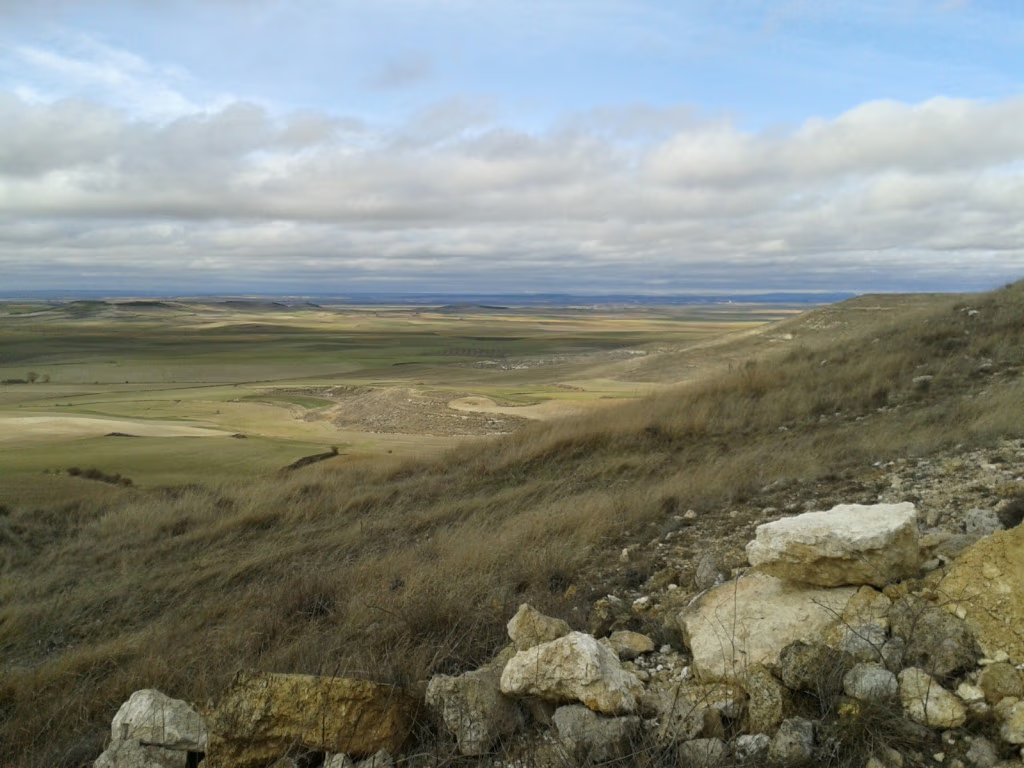
View near Castrojeruz
Albergue Fitero: cold despite heating (only until 8!), the dormitory is left open during the day to air … Food very rustic. If the landlord doesn’t open the gate at half past 7 as promised, you just have to climb over it …
1 February: Carrión de los Condes
After a gruelling headwind and a steady uphill, I head into the Albergue Espíritu Santo.
Unbelievable. Mattresses so worn out that in places chipboard had been slipped underneath. For me, pilgrim romance ends where slipped discs begin. A €2 surcharge for 3 hours of heating, which goes straight out of the window in the draughty dump. Froze all night despite 5 blankets. 2 nuns come at half past 9 for lights out! They lower the shutters “so it doesn’t get cold …” Ha! The absolute pits. Neeeever again!
Maybe one of those Outdoor testers ought to lie in a bed (and stand under a shower, see below) before writing anything about a place to stay.
The non-stop 18 kilometres the next day pass surprisingly quickly; a bar takes pity on us and is open, which of course we use for a break.
2 February: Moratinos
Hostal Moratinos: classy, but expensive. Room at €45 (double) absolutely fine, but the food: every little thing costs extra, even the bread. Wine €10! The two of us leave €85 there.
We were glad of it, though, because in the previous village the albergue “Jacques de Molay” wasn’t open yet, even though it should have been from February. They just couldn’t be bothered. And I can’t be bothered to phone ahead every day to see whether places are open. Hardly anyone answers anyway.
In the morning there are 5 cm of snow! Cool.
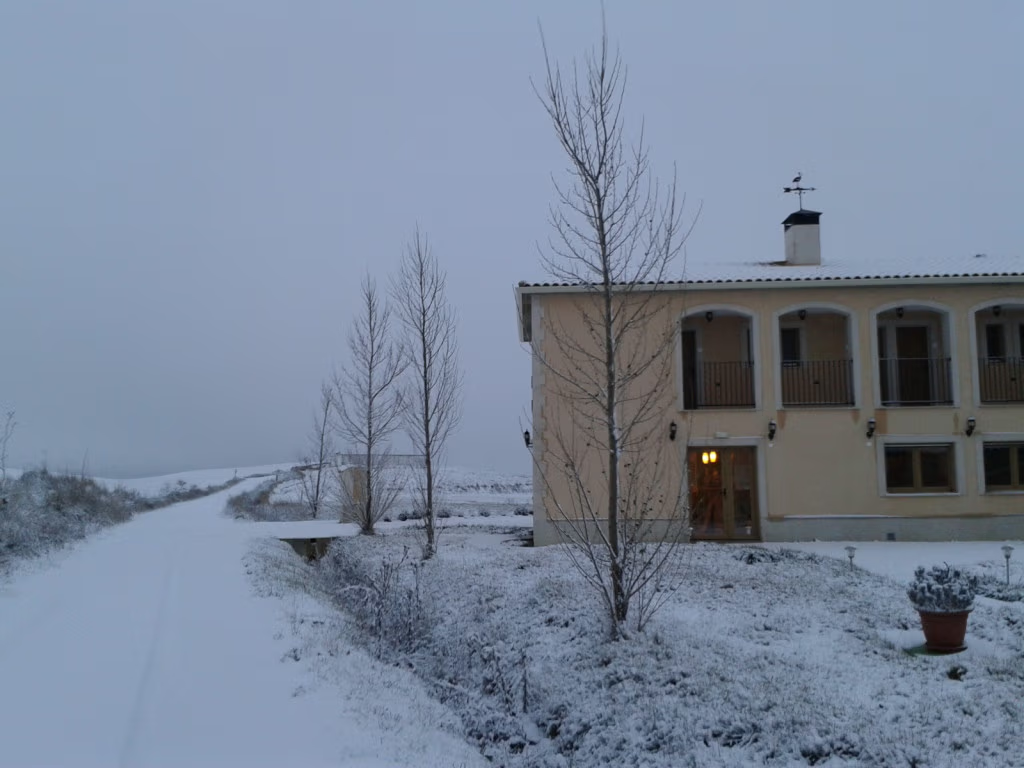
Hostal Moratinos
3 February: Calzadilla de los Hermanillos
Casa el Cura: sensational. A very beautiful house and one of the best menus on the way. The kind and funny host opens up just for me, because I beg for a guesthouse in the village bar. €35 (single), €50 for half board. Worth every euro.
4 February: Arcahueja
Albergue La Torre: it’s actually closed, but kindly opens for us. Food rather modest, breakfast already set out the evening before. Oh well. But it was nice and warm. Still, once again that albergue fussiness gets on my nerves: leave your shoes outside (how are they supposed to dry in the cold?), no backpacks in the dormitory …
Before that, in Puente de Villarente, they apparently couldn’t be bothered to open, although it was February and they should have been open.
5 February: Villar de Mazarife
Through León at top speed – who likes hiking through a city?
Albergue San Antonio de Padua: very personal and exceptional care from pilgrim veteran Carlos, who treats me to lunch when I arrive. But freezing cold despite a few hours of heating. Shower only lukewarm.
Note to self: always ask whether the heating is actually on right now. Otherwise better keep walking. Or sit by the fire with Carlos all evening. It’s remarkable how passionately he cares for the pilgrims’ well-being (within the limits of the technical possibilities …). The thanks in the guestbook almost move him to tears. Sadly, I understood far too little of what he told me in Spanish.
After León the Camino gets busier. Lots of people seem to start here.
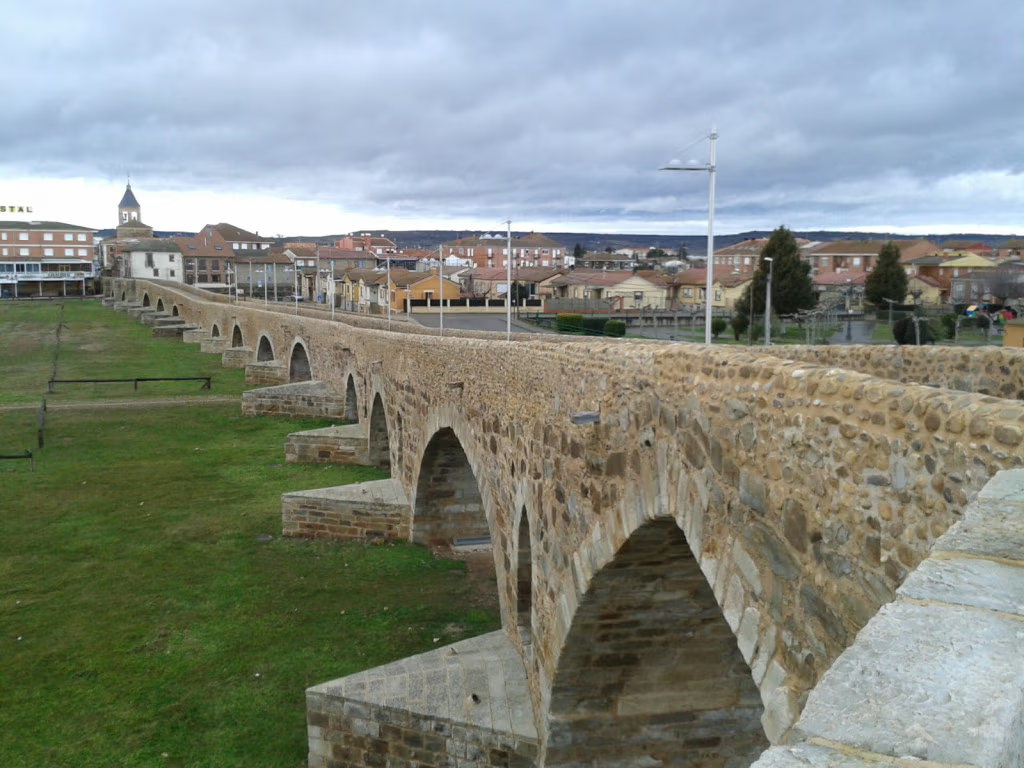
Hospital de Órbigo
6 February: Astorga
Arrival in a downpour in the little town of chocolate and fine food.
Albergue Municipal for €5, OK. Warm. But the snoring … Fed up with albergues yet again.
Very good menu for €10 at Restaurant Aizkorri, among the best on the way.
7 February: Rabanal del Camino
Hostal El Refugio for €35 (single). Food rather modest. Heating in the cold room needs time to get going. All in all rather too expensive.
Over the Cruz de Ferro on the snowed-in road in a fierce headwind. Afterwards a superb bocadillo with tortilla at La Posada del Peregrino (El Acebo) and an open fire! But not exactly cheap.

Cruz de Ferro
The stretch after that is very beautiful, both the landscape and the path itself. Finally no motorway but a proper hiking trail. And straight away the Outdoor guide – for fear of litigious, foot-sore flatlanders? – has to act as if the descent were hell. No, it’s simply an alpine path for once, and great fun.
8 February: Molinaseca
El Palacio. Great room for €35 (single) in a stylish house right by the old bridge. Warm straight away. Food (regular menu) not bad. A very good stay.

Molinaseca
9 February: Cacabelos
Hotel Villa de Cacabelos, almost mid-range for a measly €36 (single) incl. breakfast (quite untypical in Spain). Atmosphere unfortunately a bit sober, still a good choice. And finally in the dry, after heavy rain …
The posh eatery “Moncloa de San Lázaro” really does deserve its mention in the Outdoor guide; pricey by comparison, but very good cooking. On a Sunday evening nothing else decent was open anyway … The place is packed.
10 February: Ruitelán
Snow showers all day.
In Vega de Valcarce they apparently couldn’t be bothered to open a guesthouse for a single pilgrim. In Herrerías everything was shut too – including the “year-round” bars. So back to Ruitelán, to the Buddhists’ albergue. Rustic, but a friendly welcome. Excellent food! Half board for €15 – no complaints, as long as there are only two of you in the cramped 6-bed room. The other one is a Frenchman who set off from home – somewhere in Normandy; respect.
11 February: O Cebreiro
Hotel O Cebreiro: quite a setback today. I walked on the Camino instead of the road. From La Faba on I ran into deep snow. Sometimes up to my ankles, then up to my knees, and every so often I plunged up to my hips in a snowdrift. I was about to turn back when I saw the houses of Laguna de Castilla in the fog. There, in the bar, I met 3 Spaniards. I thought they knew what they were doing and carried on with them (“The snowplough will be here any minute …”), but with them I kept wading through the deep snow on the Camino (“This is the road, 100%!”). Of course no snowplough came. Wet, clammy and with no feeling in my toes, I took the first room going. €40 (single) for lukewarm heating – clearly too expensive. The food wasn’t exactly stunning either, but acceptable.

Near O Cebreiro
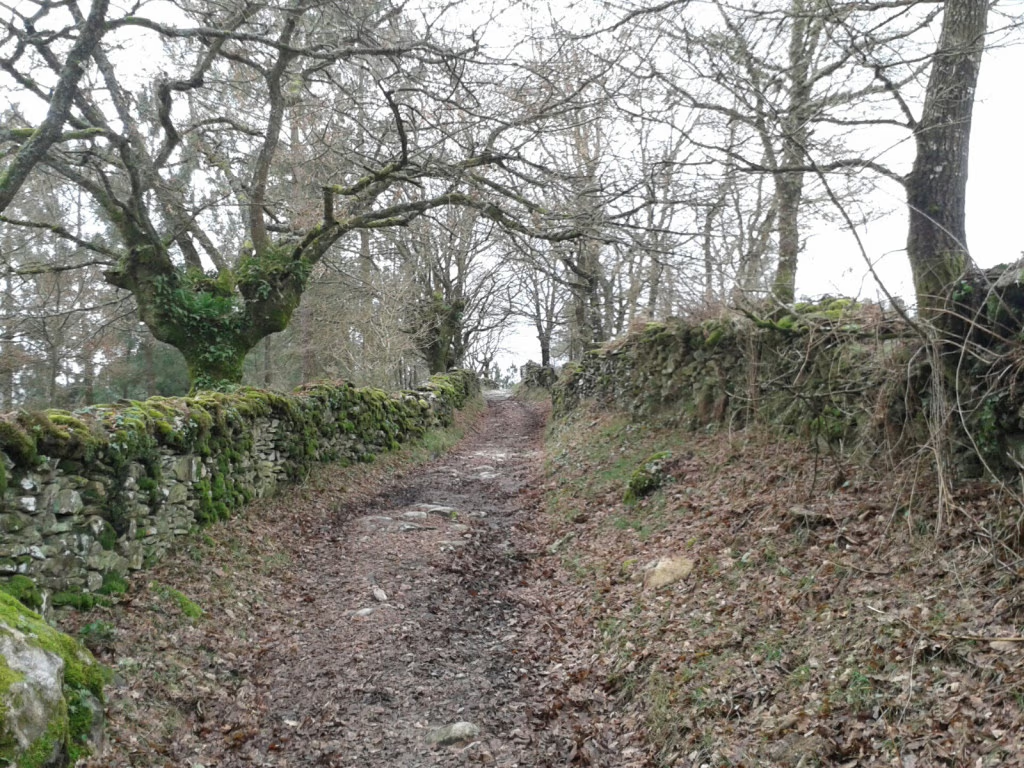
After Triacastela the beautiful Galician landscape begins – it reminds me a lot of England or Ireland. The best part of the Camino, the path included. These are more hiking trails than pilgrim motorways. However, they apparently double as drainage channels; you often walk in water or have to skirt huge puddles. From here on it also rains more often, and my shoes never get properly dry again.

Near San Xil
12 February: Calvor
After 40 km you’re even happy with a public Galician albergue – not bad for €6, but unfortunately no blankets. Not really needed, as it was warm all night. Feet in the fleece and the jacket as a cover is enough. Food from the backpack, since there’s nothing around.
The landlady, who knits almost non-stop, doesn’t seem to get many guests at this time of year and has apparently lost all sense of time and space as a result. Only at the third attempt does she manage to stamp the correct date in my pilgrim passport. At first she thought it was still January, and once we’d settled the month, we could only agree on the day with the greatest difficulty.
Somewhere …
And here’s a picture for everyone who can’t imagine how hard the wind can blow on the Camino:

13 February: Portomarín
Albergue / Pension Ultreia, €25 (single), separate bathroom, the lady of the house does your laundry for €3 – what service! Heating from 7 until early morning! Bearable! Apart from the group of 4 Spaniards who think the rest of the world needs to hear where they are at all times.
After dinner in the only open restaurant, I go outside at the same time as a Korean woman. She practically flees from me, although I make not the slightest move to make contact with her. Perhaps as a woman pilgrim travelling alone she’s been hit on often enough already. I’ve been told that this happens all too often. Not everything is good on the Camino.
14 February: Palas de Rei
A hefty €40 (single) at La Cabaña, 500 m before the town and just after the two albergues. Clearly too expensive, even if the shower did eventually get halfway hot and the fan heater starts working immediately (whereas the Spaniards otherwise only ever turn the heating on after the 2nd or 3rd complaint – or only from 7 in the evening, supposedly “automático”). At least a generous breakfast is included. And the pulpo gallego for €9 at the “not very atmospheric” restaurant (Outdoor) is more tender than the one for €16 at the posh place in Cacabelos (see above).
In the not particularly appealing town itself I just didn’t find an alternative. Seen that way, I don’t seem to have chosen the worst accommodation. It pours all afternoon; luckily I’ve already checked in.
15 February: Arzúa
Pension Arcano costs €24 (single), which I’m told is the off-season price. Absolutely fine, only I don’t get a stamp because of a supposed change of ownership!? I get one at the Paradillera Os Caqueiros next door. There, for €9, they serve up hitherto unimagined quantities.
Awake at 5 in the morning, off at 6, after leaving Arzúa through pitch-dark forest paths until it slowly gets lighter. Otherwise you can easily see the yellow arrow glowing in the dawn, but today there’s fog in the hollow by the stream, so I can’t even see where I’m putting my feet. But then, over time, glorious weather, and I decide to walk all the way to Santiago.
16 February: Santiago de Compostela
PR Mafer B&B for €27 (single) incl. breakfast, 2 nights, since I combined the last two stages. OK for the money and very close to the old town. You can hear the traffic and the bus stop in front of the house a bit.

17 February: Santiago de Compostela
The highlight: the pilgrim Mass at 12 in the cathedral. And I was lucky: despite the off-season, the “Botafumeiro”, a huge censer on a ridiculously long rope, is swung through the transept – cool show!
Dinner at Casa Paredes, recommended by the Outdoor guide, after 2 other tips turned out to be closed. €9 for the menu – unbeatable price, of course; quality-wise somewhere in the middle of all the pilgrim menus I devoured. No heating, freezing cold, maybe that’s why nobody but us was there. It’s also off the tourist strip.
18 February: Santiago de Compostela
Lunch at Bierzo Enxebre (another Outdoor tip) is better than the previous evening (€11), but doesn’t deserve sooo much praise either. Cherries in liqueur with the café solo (included in the menu). The ambience, though, is in a different league.
Night at the Parador for €155 (double) incl. breakfast. The place has style but feels a bit worn. You’re paying for the name and the location. Still, not a bad end to a pilgrimage. The breakfast buffet, including sparkling wine, left nothing to be desired.

Parador Hotel
Dinner at Maria Catana (a tip from Pension Mafer) was very good, even though it’s on the tourist strip. A bit expensive, but sometimes you have to be able to break away from the pilgrim menu.
19 February: Santiago de Compostela
Last meal at Cre Cotte (right behind the cathedral by the steps) for €11 – not bad, and with a (small portion of) pulpo at that. On my last stroll through the lanes I run into the Frenchman again. If you take 2 or 3 days, you inevitably see some of your fellow walkers again as they gradually arrive too – the town isn’t that big, after all.
Then the flight home.

The route in Camino Ninja
You’ll find the Camino Francés with stages, map and accommodation in Camino Ninja: Camino Francés.