


Partner
Amis du Chemin de Saint-Jacques des Pyrénées-Atlantiques
The St James association of the Basque Country and Béarn: it runs the pilgrim office in Saint-Jean-Pied-de-Port and hostels in Bayonne and Saint-Palais, and waymarks the Ways of St James in the Pyrénées-Atlantiques.
The Caminos on the map
Caminos of this partner
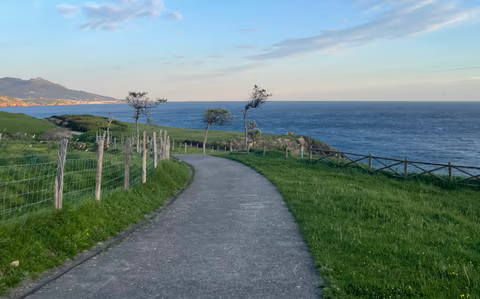 Camino del NorteThe Camino del Norte runs 898.8 kilometers from the cathedral in Bayonne along the shore of the Cantabrian Sea to Santiago de Compostela: through Irún, San Sebastián, Bilbao, Santander, Gijón and Avilés to Ribadeo, then across inland Galicia via Mondoñedo and Sobrado dos Monxes to Arzúa, where it meets the Camino Francés. 41 stages, 23,529 meters of ascent, three boat crossings, and a UNESCO World Heritage Site since 2015. Around 21,500 pilgrims reached Santiago on it in 2025 – roughly one in 25.Explore this Camino
 Via PodiensisThe Via Podiensis takes you 754.1 kilometers from Le Puy-en-Velay through the Aubrac, Conques, Cahors, and Moissac to Saint-Jean-Pied-de-Port at the foot of the Pyrenees—with 17,657 meters of elevation gain, it is the route with the highest total elevation gain in our portfolio. And it is the only Way of St. James where the route itself is a World Heritage Site: All seven UNESCO-protected sections in France, totaling 157.5 kilometers, are located along this route.Explore this Camino
 Via TuronensisThe Via Turonensis takes you 1,033.0 kilometers from the Tour Saint-Jacques in Paris to the Porte Saint-Jacques in Saint-Jean-Pied-de-Port — along the Loire, through the Romanesque landscapes of Poitou, by ferry across the Gironde, and through the pine forests of the Landes. It is the longest of the four classic routes in France and the richest in monuments, with eleven World Heritage sites—and yet it is also the least traveled: a great name with an empty path.Explore this Camino
- Via TolosanaThe Via Tolosana takes you 786.4 kilometers from Arles through Saint-Guilhem-le-Désert, Toulouse, and the Béarn region to the Col du Somport (1,632 m)—the highest point on all the routes to Santiago de Compostela—and on to Candanchú, where the ruins of the Hospital of Santa Cristina lie among the grass. Around 1135, the Codex Calixtinus lists it as the first of the four great routes and counts this very hospice among the three pillars of the world: You start at a cemetery and end at the third pillar.Explore this Camino
- Camino de BaztánThe Camino de Baztán runs 106.4 kilometers from the cathedral in Bayonne across the Pyrenees to Trinidad de Arre, where it joins the Camino Francés just before Pamplona. Past Ainhoa you cross the border into Navarre at Dantxarinea, walk through the Baztán Valley with Urdax, Amaiur and Elizondo, and climb an old Roman road to the Velate Pass, at 923 meters the highest point. Below the pass stand the remains of the Hospital of Santa María de Velate, founded around 1160; in 1325, with just four beds, it was sheltering winter pilgrims for up to twenty days. Five stages, 2,260 meters of climbing, few pilgrims and a lot of Basque.Explore this Camino
- Via LemovicensisThe Via Lemovicensis, known in France as the Voie de Vézelay, runs 918 kilometers from the Basilica of Sainte-Marie-Madeleine in Vézelay straight through the heart of France to Saint-Jean-Pied-de-Port at the foot of the Pyrenees. It is one of the four roads described in the Codex Calixtinus around 1140, and to this day it leads to the three shrines the Codex urged on pilgrims from Vézelay: Mary Magdalene in Vézelay, Leonard in Saint-Léonard-de-Noblat and Front in Périgueux. Plan on around 40 stages across the Loire, the Berry, the Limousin, the Périgord and the pine forests of the Landes, ↗ 9,355 meters, with the highest point at 662 meters near Saint-Goussaud. In Saint-Jean-Pied-de-Port, the Camino Francés begins.Explore this Camino
- Jakobsweg Saint-Jean-Pied-de-Port–IrunIn Saint-Jean-Pied-de-Port, almost everyone heads to Roncesvalles—this route goes west: about 77 kilometers in 4 stages through the French Basque Country to Irun, where the Camino del Norte begins. The Voie Nive-Bidassoa follows the Nive River, turns into the Nivelle Valley at Espelette, and crosses the Bidassoa on the final day — the border that was drawn in 1659 on an island in this very river and across which the escape helpers of the Comète Line swam at night in 1943. You’ll cross it on a bridge, with your passport in your pocket.Explore this Camino
- Voie de la NiveFrom Bayonne Cathedral to the Porte Saint-Jacques: The Voie de la Nive connects, in 3 stages and over approximately 65 kilometers (GPS track), the old pilgrim port with Saint-Jean-Pied-de-Port—along the “Chemin de Poste,” the historic postal and trade route across the Basse-Navarre plateau. Two UNESCO-listed sections of the French Ways of St. James lie at its ends, with a Commandery of the Knights Hospitaller along the way—and while tens of thousands of pilgrims arrive in Saint-Jean-Pied-de-Port each year, here you’ll walk alone for days on end.Explore this Camino
- Voie de PiemontThe Voie de Piemont takes you 606.5 kilometers from the Mediterranean Sea near Narbonne-Plage, along the foot of the Pyrenees, to Saint-Jean-Pied-de-Port—via Carcassonne, Mirepoix, Saint-Lizier, Lourdes, and Oloron-Sainte-Marie, passing seven UNESCO-designated monuments along the Way of St. James. The Codex Calixtinus makes no mention of it; its own associations call it “la cinquième grande voie française”—the alternate route that became a main route, and today one of the quietest Pilgrimage Routes to Santiago in France.Explore this Camino
Who stands behind the routes
The Amis du Chemin de Saint-Jacques des Pyrénées-Atlantiques are the St James association of the Basque Country and Béarn. Their area is where France's great Ways of St James come together: the routes from Le Puy, Tours and Vézelay meet near Ostabat and reach Saint-Jean-Pied-de-Port together, the last little town before the climb over the Pyrenees; in the south of Béarn the route from Arles crosses the mountains at the Somport. Anyone setting off from here for Santiago usually meets the association's volunteers first.
In 2019 the association received the Premio Elías Valiña from the Galician government – named after the parish priest of O Cebreiro who revived the Camino with yellow arrows in the 1980s – among other things for its work in reviving the routes. Its magazine “Le Petit Bourdon” has appeared since 2009.
The society's routes
The association explores, opens up and waymarks the Ways of St James in its département. On Camino Ninja these are nine routes, each with the section the association looks after:
- Via Podiensis – section Aire-sur-l'Adour – Ostabat
- Via Turonensis – section Sorde-l'Abbaye – Saint-Jean-Pied-de-Port
- Via Lemovicensis – section Hagetmau – Saint-Palais
- Via Tolosana – section Anoye – Morlaàs – Oloron-Sainte-Marie – Somport (locally called “Voie d'Arles”)
- Voie de Piémont – section Lourdes – Saint-Jean-Pied-de-Port (GR 78)
- Voie de la Nive – the whole route (locally called “Chemin de Poste”)
- Saint-Jean-Pied-de-Port – Irún – the whole route (locally called “Voie Nive–Bidassoa”)
- Camino del Norte – section Bayonne – Hendaye / Irún (locally called “Chemin de la Côte”)
- Camino de Baztán – section Bayonne – Spanish border
There are also routes not yet on Camino Ninja, such as the Voie d'Ossau from Arudy to the Somport, and link routes between the Basque Country and Béarn.
What the society does for pilgrims
Its best-known service is the Accueil pèlerins in the Rue de la Citadelle in Saint-Jean-Pied-de-Port: every year tens of thousands of pilgrims collect their credencial or first stamp here, along with advice on the route over the Pyrenees and addresses for the night. The association also runs the Refuge Saint-Jacques in Bayonne and the Refuge Les Franciscains in Saint-Palais, a café pèlerin in Bayonne as a meeting point, and its own project planting fruit trees for pilgrims along the way.
On its website you'll find route descriptions and maps for the Basque Country and Béarn, accommodation lists and information on the Spanish routes that continue from here.
Contact and getting involved
Everything else is on compostelle.fr. Board: bureau@compostelle.fr; pilgrim office Saint-Jean-Pied-de-Port: accueil.sjpp@compostelle.fr; Refuge Bayonne: refugebayonne@compostelle.fr; Refuge Saint-Palais: franciscains@compostelle.fr. An association at the bottleneck of the Ways of St James – this is where France says goodbye to its pilgrims.