


Partner
Asociația Prietenilor Camino de Santiago
The association behind the seven Caminos de România: founded in 2016, it researches, waymarks and promotes the pilgrim routes heading west from Iași, Giurgiu and Timișoara and issues the Romanian credencial.
The Caminos on the map
Caminos of this partner
 Camino de România 11,226.8 kilometres and 12,606 metres of ascent from Iași, the city of Eastern Europe's largest Orthodox pilgrimage, westwards: through the Catholic Csángó villages of Moldavia, over the Nemira ridge of the Eastern Carpathians into the Székely Land, through the Burzenland with Prejmer and Brașov, past the Cistercian abbey of Cârța and the St James chapel of Sebeș to Sibiu, Alba Iulia and Cluj-Napoca, through the karst of the Crișul Repede to Oradea and on to Borș, where since 2025 no border is checked any more — and no Way of St James continues. On 1 June 2019 Pope Francis blessed the first marker in Iași: „4.500 km" to Santiago. Since then the route has been waymarked kilometre by kilometre; the main axis on which all six other Romanian Caminos hang. No hostel network, bear country, GPS essential — and a route nobody has yet walked in full.Explore this Camino
 Camino de România 2372.5 kilometres from the Danube into the Carpathians: from the bridge at Giurgiu, beyond which no route waits in Bulgaria, across the plain via Comana and București, past the Brâncoveanu palaces of Mogoșoaia and Potlogi to the old capital Târgoviște, into the Subcarpathians to Câmpulung — where beneath the altar of the St James church Bărăția lies the oldest dated gravestone in Wallachia (1300) — and through the Rucăr-Bran corridor at 1,211 metres to Brașov and the Biserica Neagră with its St James in pilgrim's habit. In 1385 two German pilgrims returning from Jerusalem described exactly this route. Today volunteers waymark the Carpathian section, mostly around St James's Day; from Câmpulung it is a route, before that a corridor. 18 Camino Ninja stages, two hostels — Casa Genoveva in Câmpulung and Casa Mărioara in Șirnea —, no connection to the Santiago network.Explore this Camino
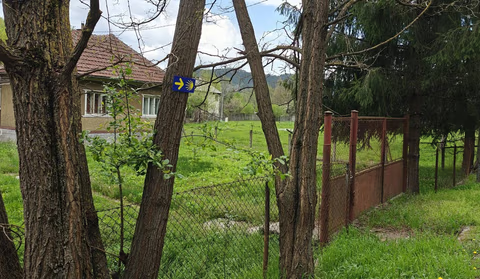 Camino de România 3310.3 kilometres of plain and hills from the 2023 Capital of Culture to the town that in the 14th century was called „the Hungarian Compostela": through the Banat Swabian colonist villages around the round village of Charlottenburg (1771), to the pilgrimage basilica of Maria Radna, whose paper icon survived the fire of 1695, via Arad, the Criș plain and the Romanesque basilica of Tămașda (1241), to Salonta and Băile Felix as far as Oradea, where King Ladislaus has lain buried since 1095. Only 3.5 metres of climb per kilometre, but heat up to 40 degrees. To be honest, the youngest route in the Romanian network: first field walk on 7 September 2025, waymarking in Bihor county approved since December 2025, launch event September 2026 — a Camino coming into being in real time. No trace of St James along the way, no connection to Hungary, no hostel network.Explore this Camino
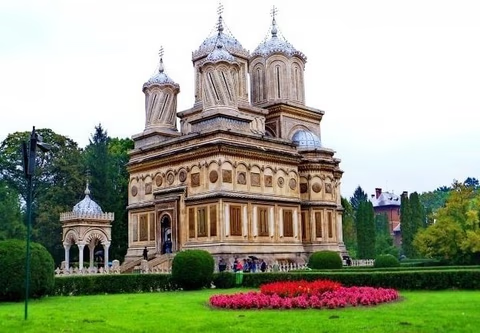 Camino de România 4215.5 kilometres from the Wallachian Plain into the Olt gorge: the Camino de România 4 leaves the Camino de România 2 in Potlogi, at the Brâncoveanu palace of 1699, and heads via Găești, Topoloveni and Pitești to Curtea de Argeș — first capital of Wallachia, princely church of 1369, relics of St Philothea, graves of five kings. Then it climbs over the ridge into the Țara Loviștei, where Perișani claims the battle of Posada (1330) for itself, and drops through the 19-kilometre Defileul Turnu Roșu to Podu Olt station near Tălmaciu, where the Camino de România 1 is waiting. 2,939 metres of ascent, highest point 1,775 m. To be honest, a route on paper: no documented waymarking, no hostel, motorway construction site in the finale, no connection to Santiago.Explore this Camino
 Camino de România 5218.4 kilometres from Moldavia into Szekler Land: the Camino de România 5 leaves the Camino de România 1 in Bacău, climbs through the hill country of the Csángó via Tescani, Moinești and Comănești into the Carpathians, crosses the ridge of the Munții Ciucului at 1,336 metres and arrives in Șumuleu Ciuc — the Marian shrine where, since a vow made on Whitsun Saturday 1567, hundreds of thousands arrive every year, and where Pope Francis said „we are pilgrims" before 100,000 pilgrims on 1 June 2019, hours before blessing the marker in Iași that reads 4,500 kilometres to Santiago. Then it follows the upper Olt via Băile Tușnad, Romania's smallest town, past the youngest volcano in the Carpathians to Valea Crișului and back onto the main axis. The association calls it „sectorul alternativ Bacău – Șumuleu Ciuc"; between March and September 2025 it was marked for the first time. To be honest: 20 kilometres of ridge without a village, bear country, no hostel, no connection to Santiago.Explore this Camino
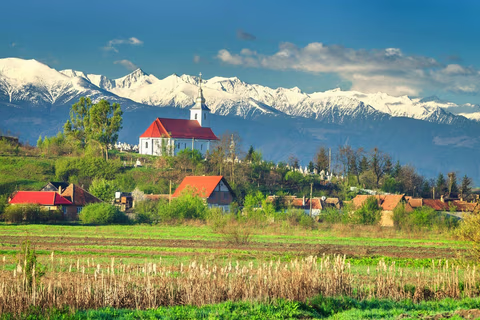 Camino de România 679.0 kilometres of Făgăraș Land, almost flat, between two images of St James: the Camino de România 6 begins in Hălchiu in front of a Saxon altar of 1528 that shows the execution of James, climbs over the northern edge of the Munții Perșani (642 m), passes the UNESCO beech forest Codrul Secular Șinca and the cave monastery of Șinca Veche, whose hermitages burned on 3 June 1761, the fortress of Făgăraș from 1310 — a political prison from 1950 to 1960 — and ends in Șoarș at the church still called the Scharoscher Jakobuskirche, although its patronage died with the Reformation. The southern variant of the Camino de România 1, which covers the same span north of the Olt via Rupea. To be honest: unmarked, no hostel, bear country on the Perșani, no connection to Santiago.Explore this Camino
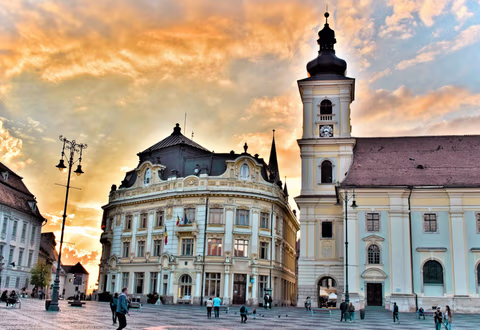 Camino de România 753.6 kilometres, the shortest of the seven Romanian Caminos — and the one with the hardest piece of St James evidence at its start: on Piața Huet in Sibiu, where the route begins, archaeologists found shell-shaped pilgrim pendants in graves of the 12th to 15th centuries, and in 1415 a Capela Sf. Iacob stood here, demolished in 1898. From there the Camino de România 7 runs south of the Camino de România 1 through the Mărginimea Sibiului, 18 shepherd villages whose transhumance has been UNESCO heritage since 2023: the fortified church of Cristian, glass icons in Sibiel, the Dacian fortress at Tilișca, Poiana Sibiului at 900 metres — then 500 metres down into Saxon Gârbova with its Gräfenburg and the basilica ruin of 1280. To be honest, a detour paid for in metres of climb: unmarked, no hostel, no connection to Santiago — but the railway keeps you company for the first half.Explore this Camino
Who stands behind the route
The Asociația Prietenilor Camino de Santiago – APCS for short, “Association of the Friends of the Camino de Santiago” – was founded in Bucharest in 2016 by people who had walked the Camino in Spain and wanted to bring that experience to Romania. Volunteers traced the medieval routes on which pilgrims from today's Romania set out for Santiago and turned them into a network of routes. Today the association has around 100 members and representatives in several regions.
Recognition came quickly: in 2022 the Romanian Ministry of Tourism accredited the Camino de România as a cultural and tourist route of national interest, in October 2023 the Council of Europe added the Romanian Camino to the Cultural Route of the Ways of St James, in November 2023 the Xunta de Galicia funded the association, and on 17 June 2024 it became a member of the Camino Europa Compostela federation. The first official waymark stands at the Palace of Culture in Iași and carries a number worth reading out loud: 4,500 kilometres to Santiago.
The association's routes
- Camino de România 1 – 1,226.8 km, Iași → Borș (Hungarian border)
- Camino de România 2 – 372.5 km, Giurgiu → Brașov
- Camino de România 3 – 310.3 km, Timișoara → Oradea
- Camino de România 4 – 215.5 km, Potlogi → Tălmaciu (Podu Olt)
- Camino de România 5 – 218.4 km, Bacău → Valea Crișului
- Camino de România 6 – 79.0 km, Hălchiu → Șoarș
- Camino de România 7 – 53.6 km, Sibiu → Gârbova
Numbers 4 to 7 are link routes between the main axes. So far only individual sections are waymarked – you need GPS on the way, most easily with the Camino Ninja app.
What the association does for pilgrims
Volunteers waymark the routes kilometre by kilometre with yellow arrows and the shell on a dark blue background – in 2025 alone near Bacău, along the Crișul Repede in Bihor County, near Tușnad and in the hills between Podu Dâmboviței and Șirnea, among others; in December 2025 Bihor County Council approved waymarking throughout the county. Since 2018 the association has issued the Romanian credencial, for RON 10 (approx. €2), to be ordered by email at office@caminoromania.org (as of September 2026). There is no list of stamp points – you get stamps in parish houses, town halls and monasteries if you ask.
The association also organises group pilgrimages – in 2025 the “Pelerinii speranței” walked from Iași to Timișoara –, St James festivals, pilgrim meet-ups such as the Camino Café in Bucharest, talks, books and media work. If you want to walk the route, write to the association; it puts you in touch with its local representatives, who help with route and accommodation.
Contact and getting involved
Website: caminodesantiago.ro (Romanian) · Email: office@caminoromania.org · Facebook: asociatiacamino. Membership costs RON 50 (approx. €10) a year, RON 25 (approx. €5) for students and pensioners (as of September 2026).