

Cycling the Camino – Part 2: Through the Meseta
Karin's photo journey by bike on the Camino Francés in 2011, part 2: from Burgos through the Meseta via León and Cruz de Ferro to Vega de Valcarce.

This is the second part of the three-part photo journey by Karin, who cycled the Camino Francés to Santiago de Compostela in September 2011. This part takes you from Burgos through the Meseta, via León and the Montes de León, to Vega de Valcarce.
- Part 1: From Saint-Jean-Pied-de-Port to Burgos
- Part 2: From Burgos to Vega de Valcarce – the part you're reading now
- Part 3: From Vega de Valcarce to Santiago de Compostela
24/09/2011: Burgos – Carrión de los Condes (85 km, 700 m of climbing)
Between Burgos and León lies the Meseta, a high plateau of 200,000 km² with sweltering heat in summer and cold winds and freezing temperatures in winter. The Meseta is barren, and trees are a rare sight. It is one of the most fascinating landscapes on the Camino. Now in September it's still hot, but bearable. I can't even imagine trudging along these dreary, kilometres-long straight stretches in summer under the blazing sun. Here I was glad to have a bike.
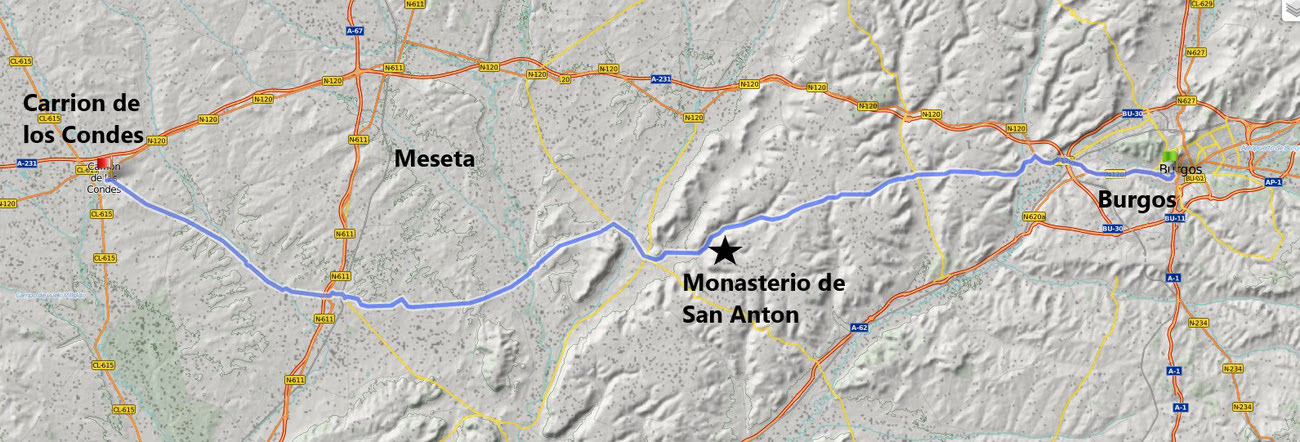
Map: © GPSies.com and OpenStreetMap contributors
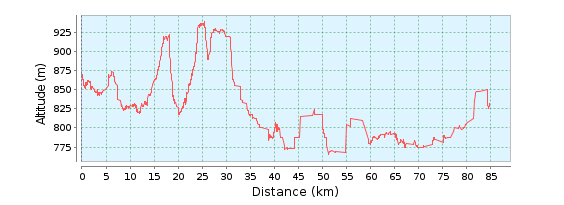
Map: © GPSies.com and OpenStreetMap contributors
Once again the night was very pleasant. The early risers were quiet, and I got up relatively early too. By about a quarter to eight I was ready to go. There was a light haze in the air and it was pleasantly fresh.
As unpleasant as the ride into Burgos had been yesterday, the ride out in the early morning hours was just as lovely. First through a park, then along a river. I quickly caught up with the pilgrims who had set off before me. I also met the two Spaniards again whom I'd been seeing on and off for two days. The city was soon behind me, and I rode under an overcast sky through green countryside.
Today's highlight was to be the Meseta, a vast plain in the Castilian highlands. After stocking up on supplies in Tardajos, I carried on along farm tracks through sparsely populated countryside. It was mostly flat, with a few short climbs and descents. Harvested grain fields with just a handful of trees still dominated the scene. In the hazy weather the area looked absolutely fascinating. In Hontanas I had to make an extra stop. I had my first puncture – at the back, of course.
Luckily it happened just before one of the few villages, so I could patch my tyre in peace in the shade of some trees. From Hontanas a beautiful avenue led to San Anton. The picturesque country road ran right through the monastery ruins of San Anton, a former house of the Antonine order. After Castrojeriz the Meseta finally began. The landscape rolled gently onwards, now and then framed by a few mountain ridges. The sky turned blue and a few cumulus clouds drifted by. On the long straight roads I was accompanied by falcons and other birds, which were out in large numbers here. Every few kilometres a small village appeared. There were only a few people to be seen, and I saw just the occasional pilgrim.
In one of the small villages I had made myself comfortable on a bench in front of the local pilgrim hostel when suddenly a whole armada of cyclists came rolling up. There must have been 30–40 of them – Germans, as it turned out. They all wore hi-vis vests and carried only light luggage. Another one of those organised soft-pilgrim tours. I found them unpleasant, and when I heard them about to cheekily ask me to join their group photo, I made sure to get away quickly. I wasn't in the mood for that kind of thing at the time. So I rode on and enjoyed the weather and the fantastic landscape. In the late afternoon I reached Carrión de los Condes and got myself assigned a bed in the hostel there. I met the two Spaniards again whom I'd seen that morning. After freshening up and looking at the beautiful, not-so-overloaded church, I ran into the two Spaniards at dinner. For once the food was really tasty today. Unfortunately they spoke not a word of German and hardly any English, so conversation was difficult. At the next table sat two Germans, with whom I could chat more easily.
After dinner many pilgrims had gathered in the hostel garden. They were listening to a guitarist playing very atmospheric music. It was a lovely end to a long day through the endless, lonely expanse of the Meseta.

At 8 in the morning, just past Burgos, I caught up with the many pilgrims again. I also saw the two Spaniards I had already seen yesterday.

Rabé de las Calzadas, just past Burgos. One of the many small villages on the Camino.

In the light haze the vast landscape looks especially impressive.

Impressions on the Camino.

Up and down through a barren, lonely landscape.
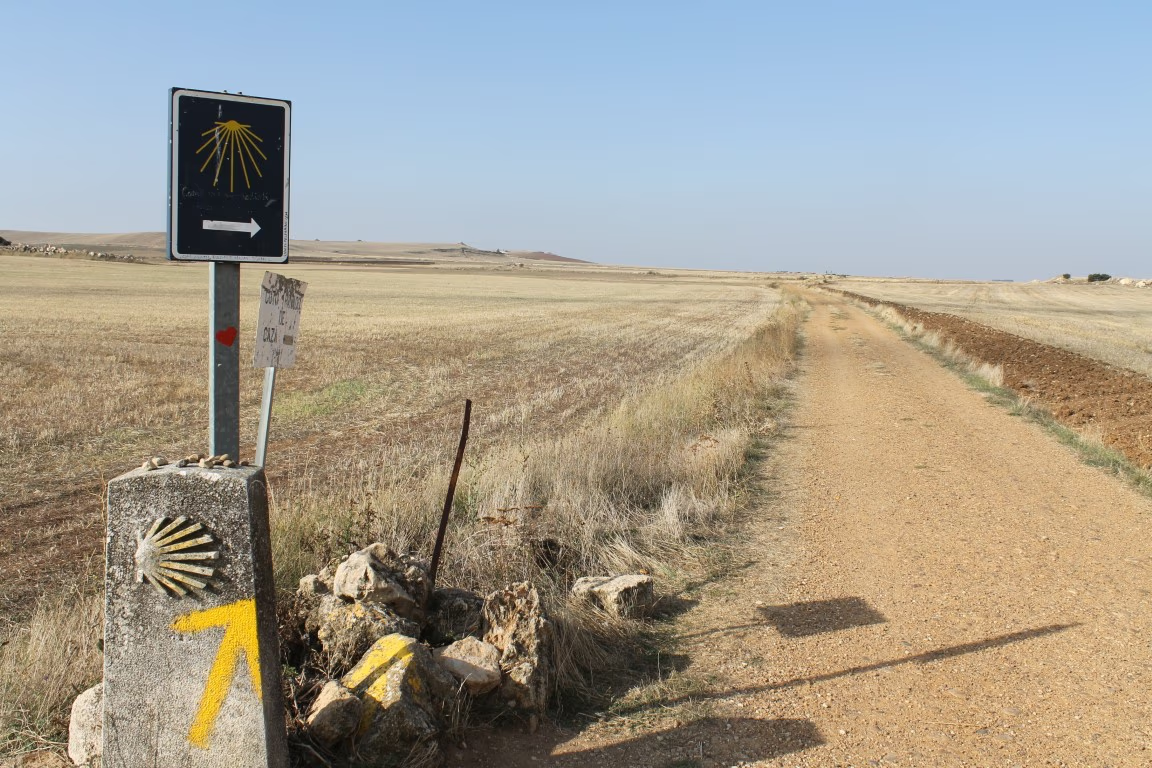
The first meseta – “high plateau” in English – came into view. By now the haze had lifted and the sun was beating down hard.
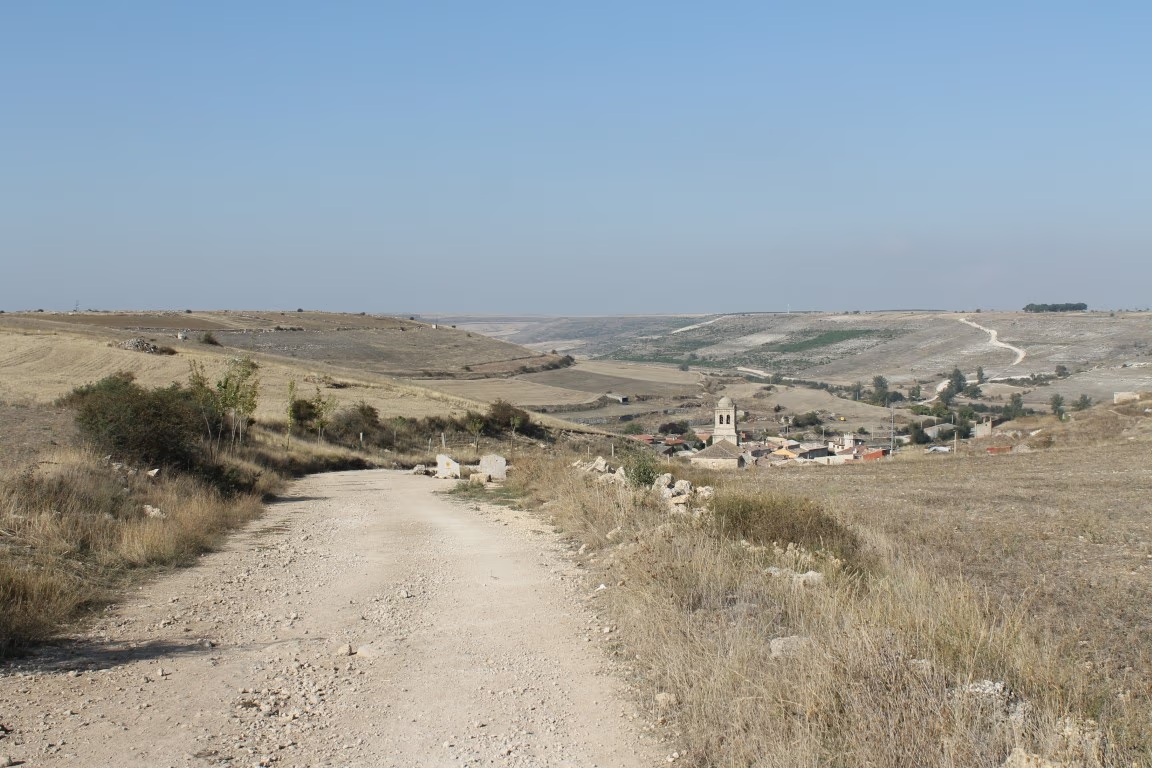
Hontanas lay somewhat lower, in an old river cutting.
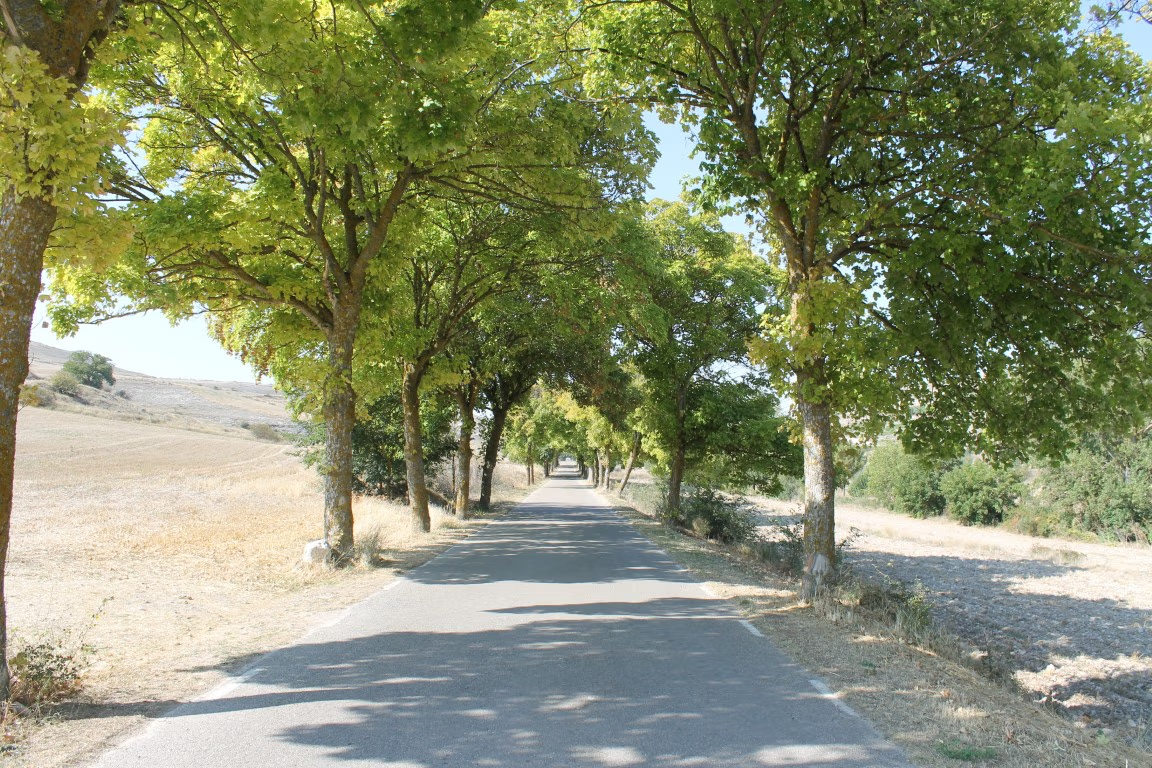
With its green trees, the avenue between Hontanas and the San Anton monastery made a pleasant contrast to the dusty yellow of the landscape.
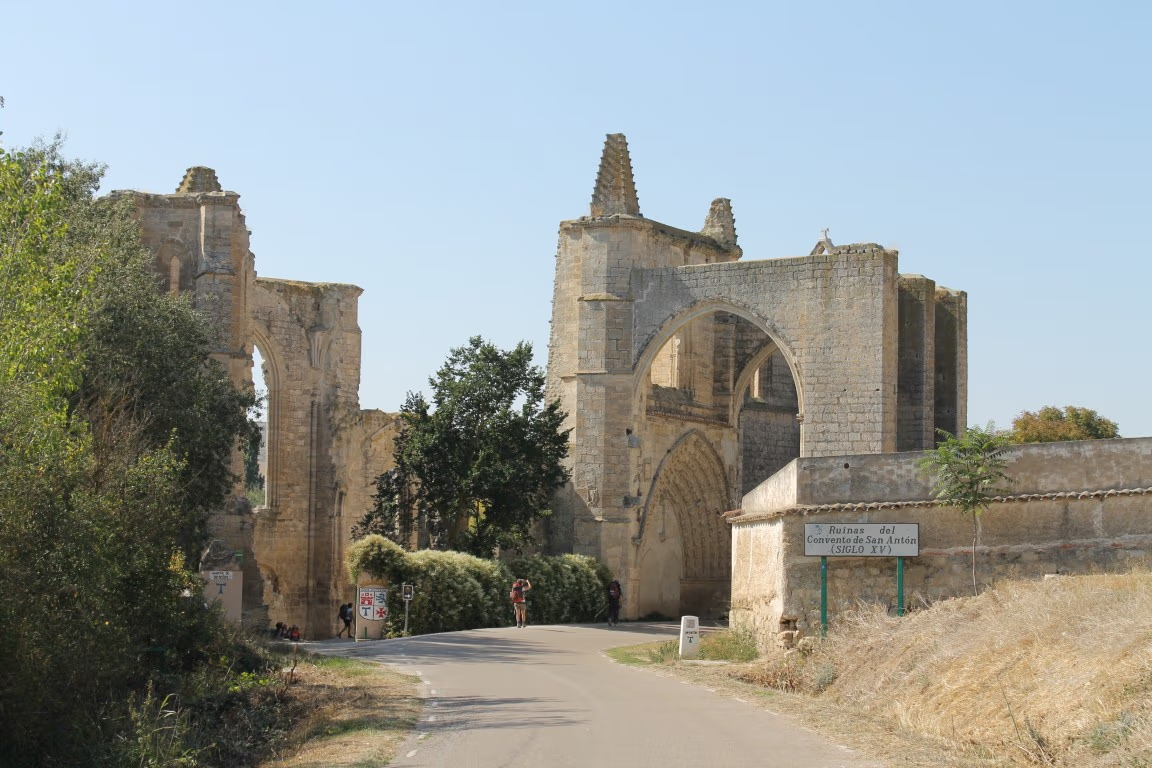
The road ran right through the San Anton monastery ruins.

The old castle ruins on the hill behind Castrojeriz.
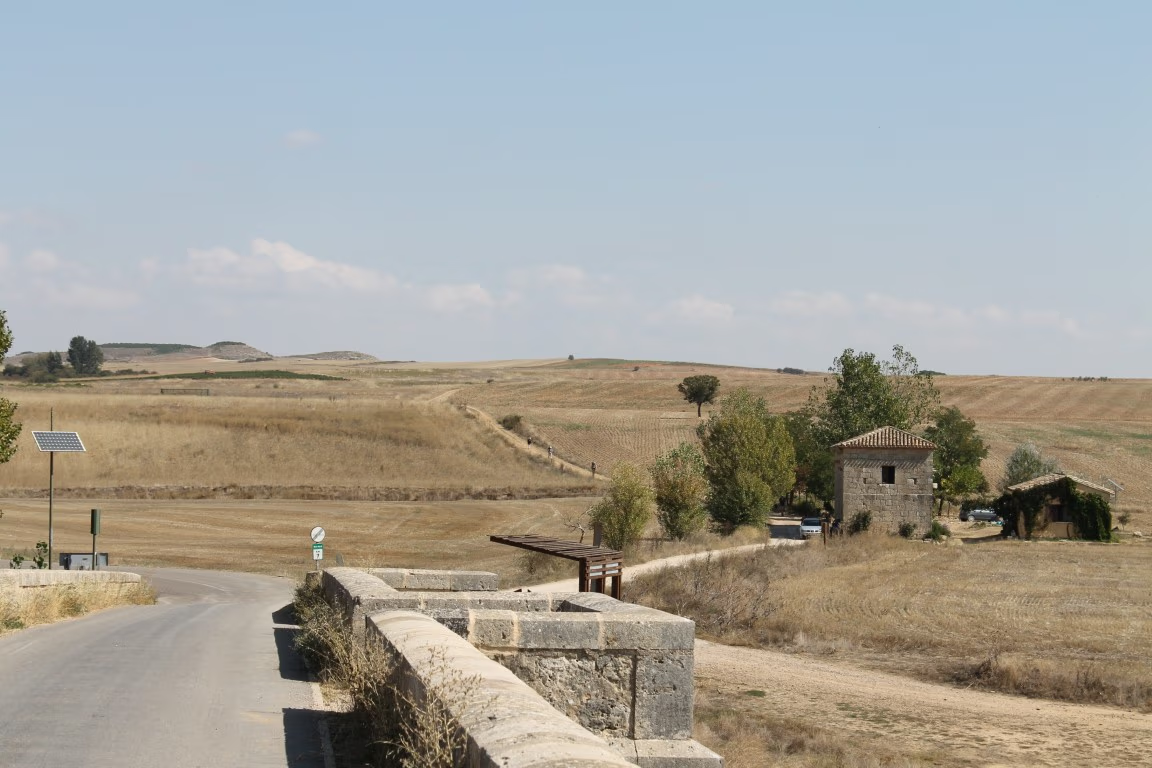
A rest area right on the Camino.

In the Meseta. It's simply flat, and you can see for kilometres. I can't imagine marching along here in summer without a trace of shade.

Canal de Castilla. Even though it looks very dry here for the most part, there's water now and then, like this canal just before Frómista.

Impressions of the Camino.
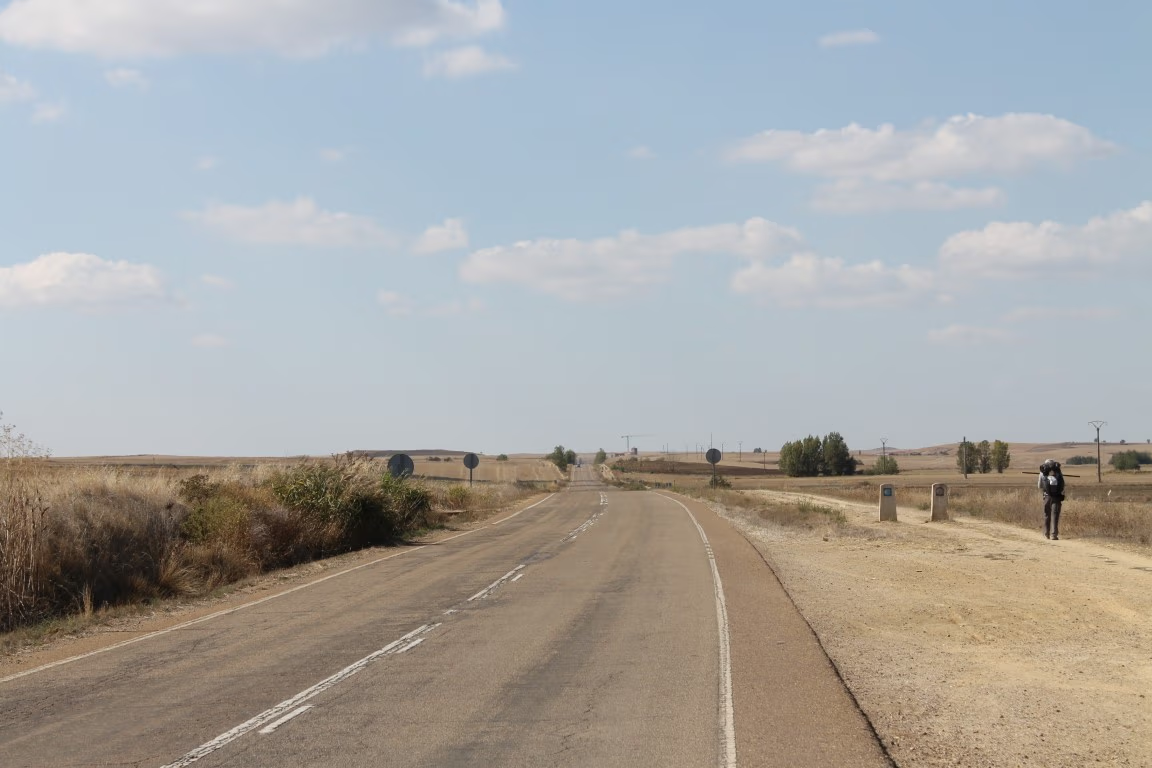
For walkers this must be a real test. Walking endlessly straight ahead while the sun mercilessly gives off its heat. No shade, no variety. I imagine this stretch is one of the hardest for walkers. By bike, on the other hand, it was pleasant.
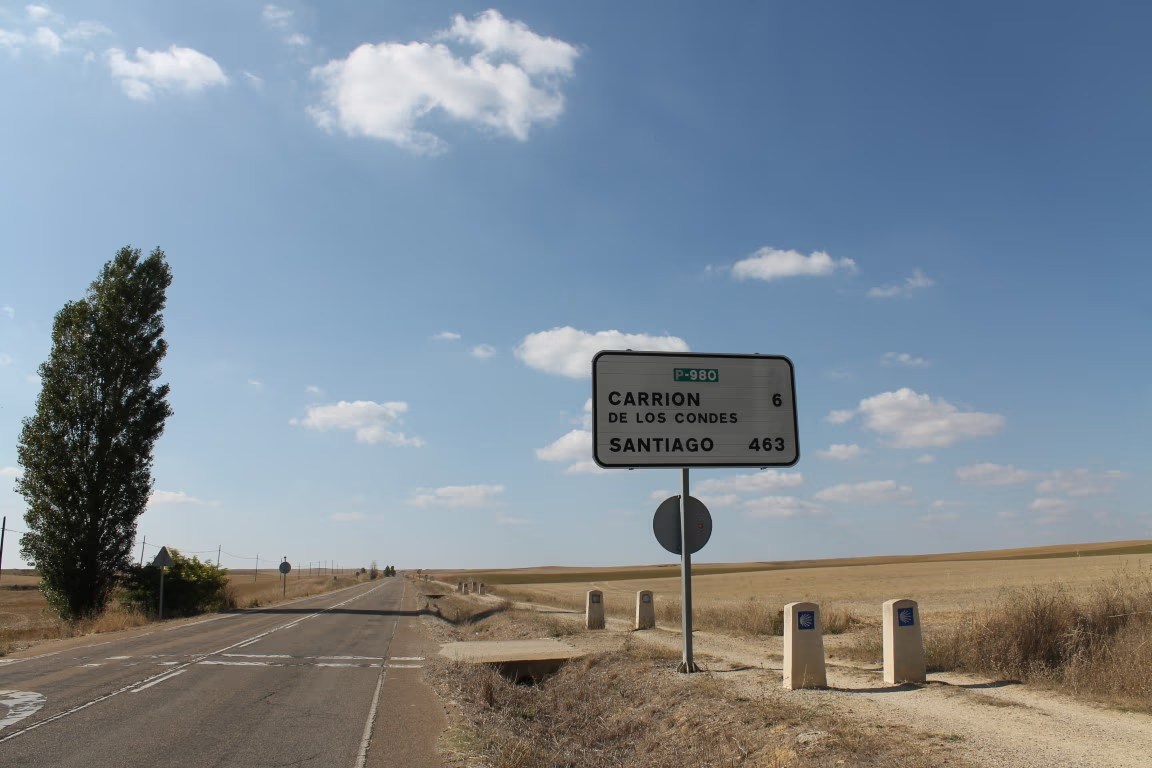
Especially when there are still more than 450 km to go to Santiago.
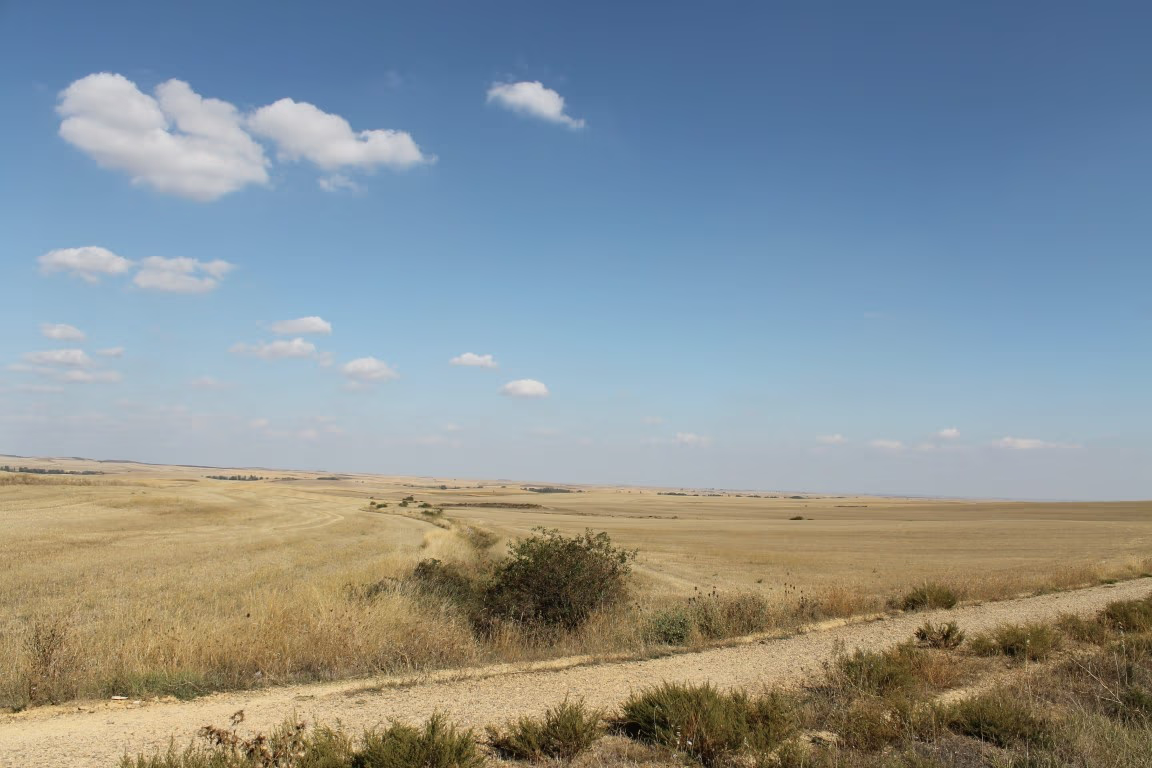
Endless expanse, blue sky, white clouds.
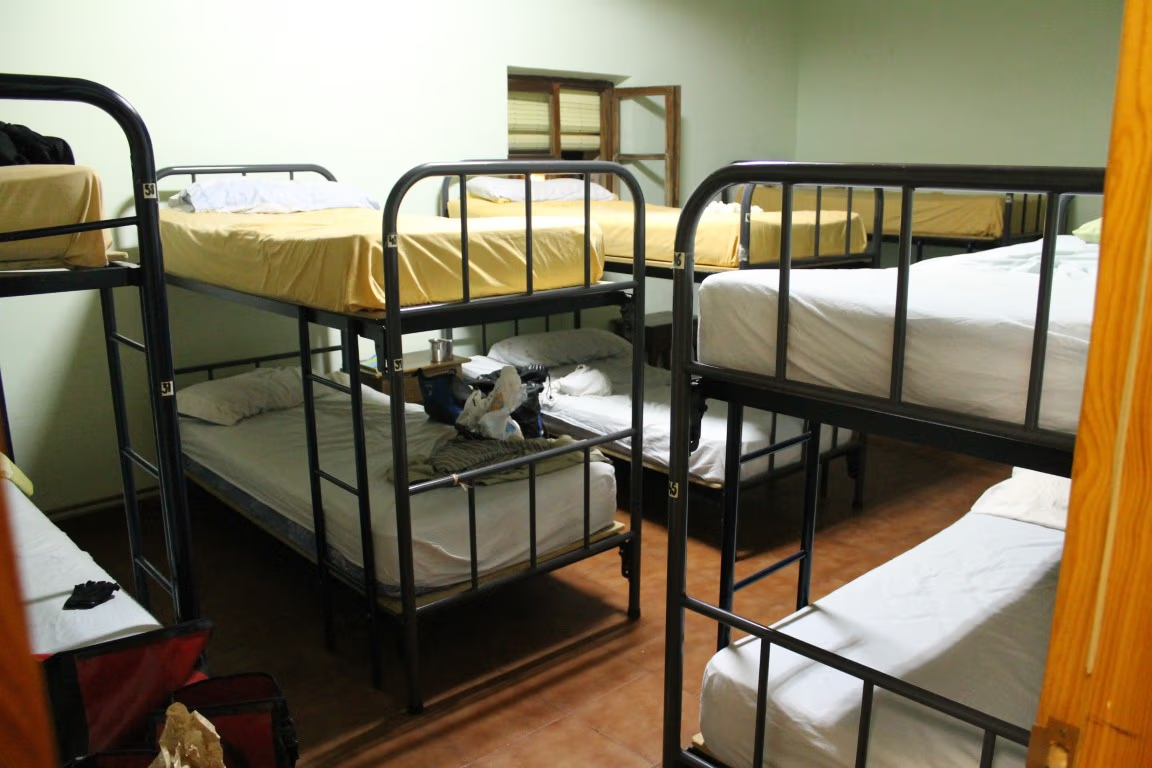
Dormitory of the hostel in Carrión de los Condes.
25/09/2011: Carrión de los Condes – León (98 km, 650 m of climbing)
Today is the second day in the Meseta, and it takes us to the centre of the Camino Francés in Sahagún. Anyone who has made it this far has half the route behind them. Today, too, the landscape remains lonely and uniform. The day's destination is León, with its cathedral that is extraordinary on the inside. In contrast to the barren simplicity, the city of over 100,000 inhabitants offers a big contrast and plenty of comforts.
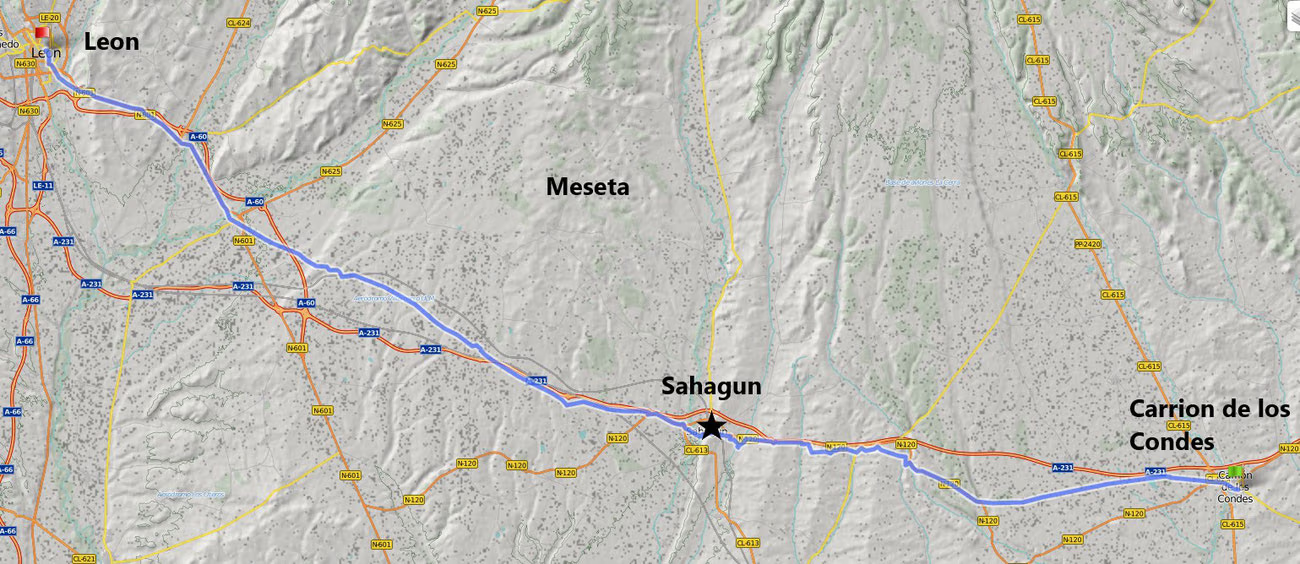
Map: © GPSies.com and OpenStreetMap contributors

Map: © GPSies.com and OpenStreetMap contributors
Once again I was the last one to get up. Shortly before 7 the room was already completely empty. At half past 7 I too set off again into a new sunrise.
It was cold today. My thermometer showed 5 °C. But the air was lovely and fresh, and cycling soon warmed you up again. I met a little dog by the wayside who greeted me in the dawn light. Maybe he was hoping for a few treats, but unfortunately I had nothing for him. On I went. I overtook one pilgrim after another on a dead-straight farm track. Slowly it grew lighter and lighter, and the sun appeared on the horizon.
There was no trace of civilisation here. The path ran for kilometres through wide-open countryside. Now and then a house or a small deserted village, but otherwise just landscape again. At some point I switched back to the N-120. The Camino ran parallel to the road, a little way off. But it was very pleasant on the road. In Ledigos I treated myself to a tapas platter in one of the few bars along the way.
On I went to Sahagún, the midpoint of the Camino. Anyone who has made it this far has exactly half the route behind them. Motivation or a sobering thought for the individual pilgrims? I think that's a matter of opinion. I saw it positively, in that I still got to ride many beautiful kilometres through Spain. The rest of the way to León continued through the flat Meseta.
On the horizon you could once again see the mountains of the Cantabrian range. The sun shone intensely from the blue sky and the thermometer climbed to 36 °C in the sun. It was hot and lonely here, but beautiful. I didn't really come into contact with people today. I had the impression that the pilgrims weren't as open as they had been at the beginning. The euphoria and curiosity of the early days seemed to have faded somewhat. When you consider that the walking pilgrims have already been on the road for about three weeks, you can imagine that by now they've settled into their routine and are focusing more on themselves. I found that a bit of a shame, because I had found the encounters at the start of the journey very enriching. But that's also the downside of being a cycling pilgrim. You travel three times as fast and whizz past all the people without having the time to get talking to them. Nevertheless, I enjoyed the ride to León.
The ride into the city was much more pleasant today, as it was Sunday. No lorries to produce dust and noise. The traffic was moderate too. I quickly reached the centre and the pilgrim hostel, which once again was right next to the cathedral. The hostel was run by a Benedictine order, with women and men accommodated in separate dormitories. The hostel had no fixed price for the night. Everyone could put a donation of their choice into a large urn. After arriving, I was drawn straight back to the cathedral. As imposing as the cathedral in Burgos was from the outside, the cathedral in León was just as beautiful on the inside. Especially remarkable were the many coloured windows through which the light poured in in every colour. Each window was elaborately painted and of exceptional size. The atmosphere in this cathedral was unique.
At some point hunger drew me back outside. Today I had the worst menú del día of all time. The only edible thing was the cake for dessert. Oh well. A pilgrimage simply isn't a culinary gourmet trip. So I made my way back to the hostel and arrived just in time for the pilgrims' blessing, a short evening service by the Benedictine nuns with wonderful singing. And afterwards, in my lovely soft bed among very quiet women, I drifted off to sleep very quickly.
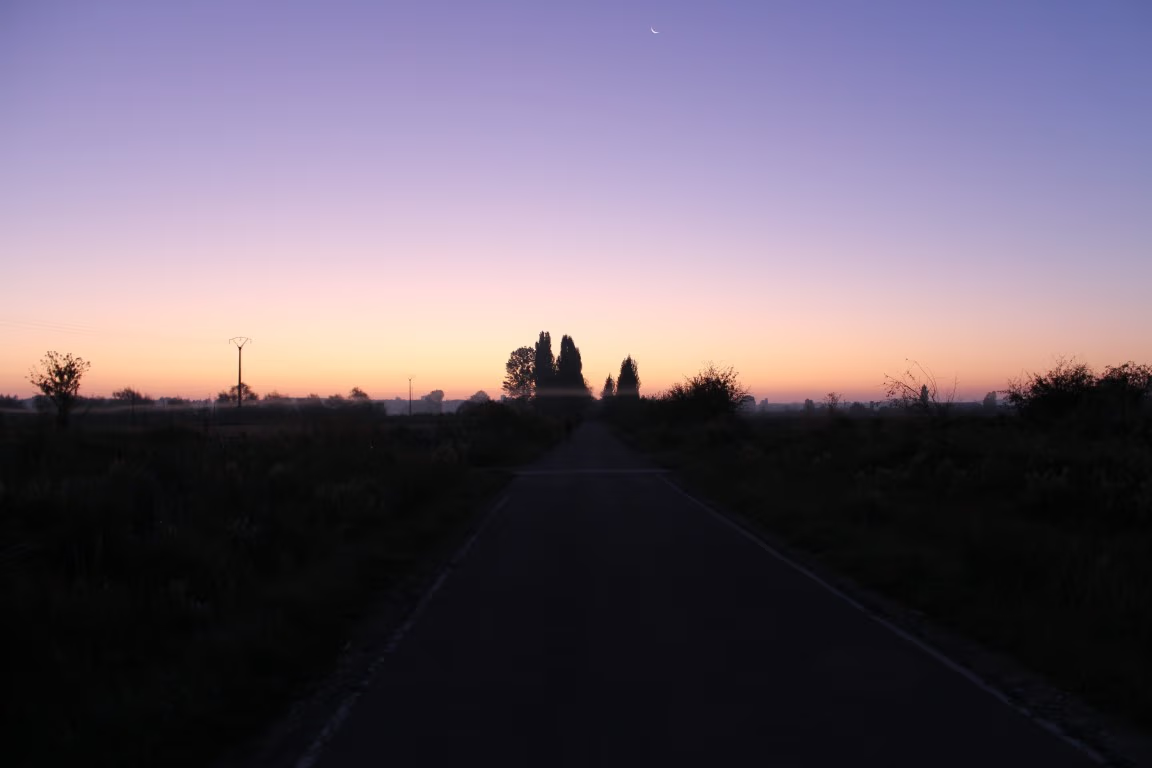
I was already on my way shortly before dawn. The mood in the morning was always the most beautiful of the day.

One by one I overtook the pilgrims.
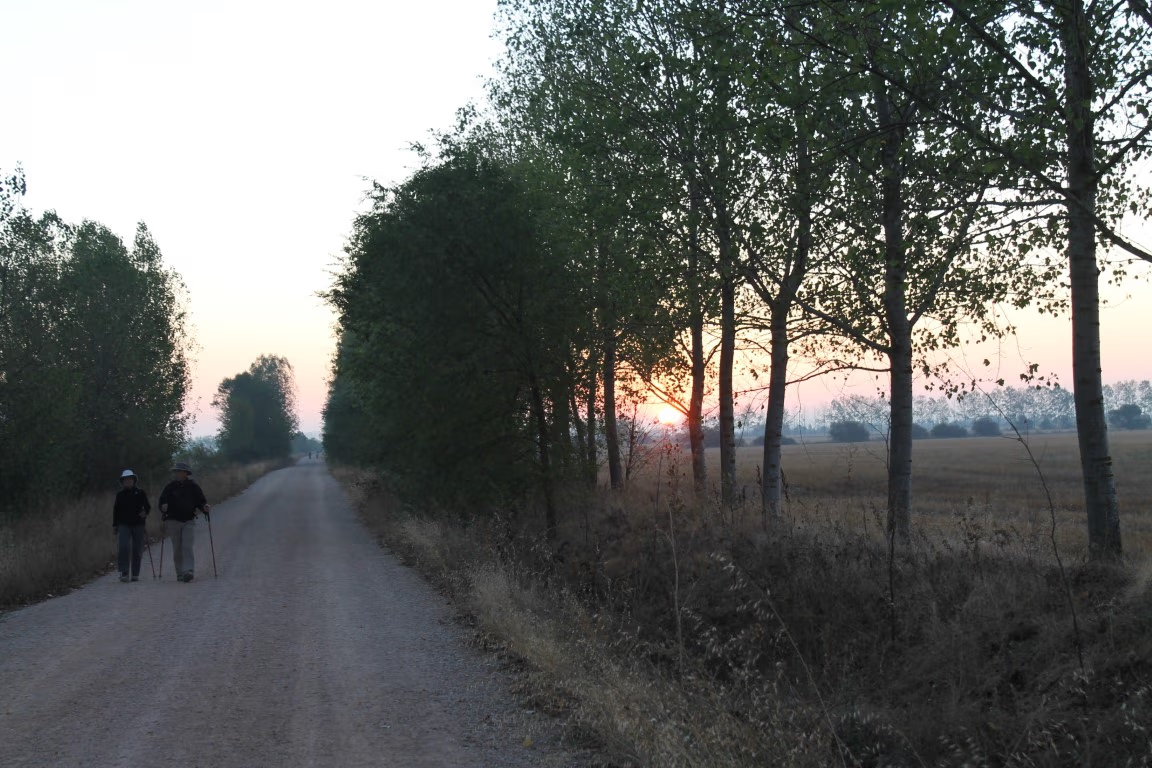
Sunrise mood. Peaceful and quiet.
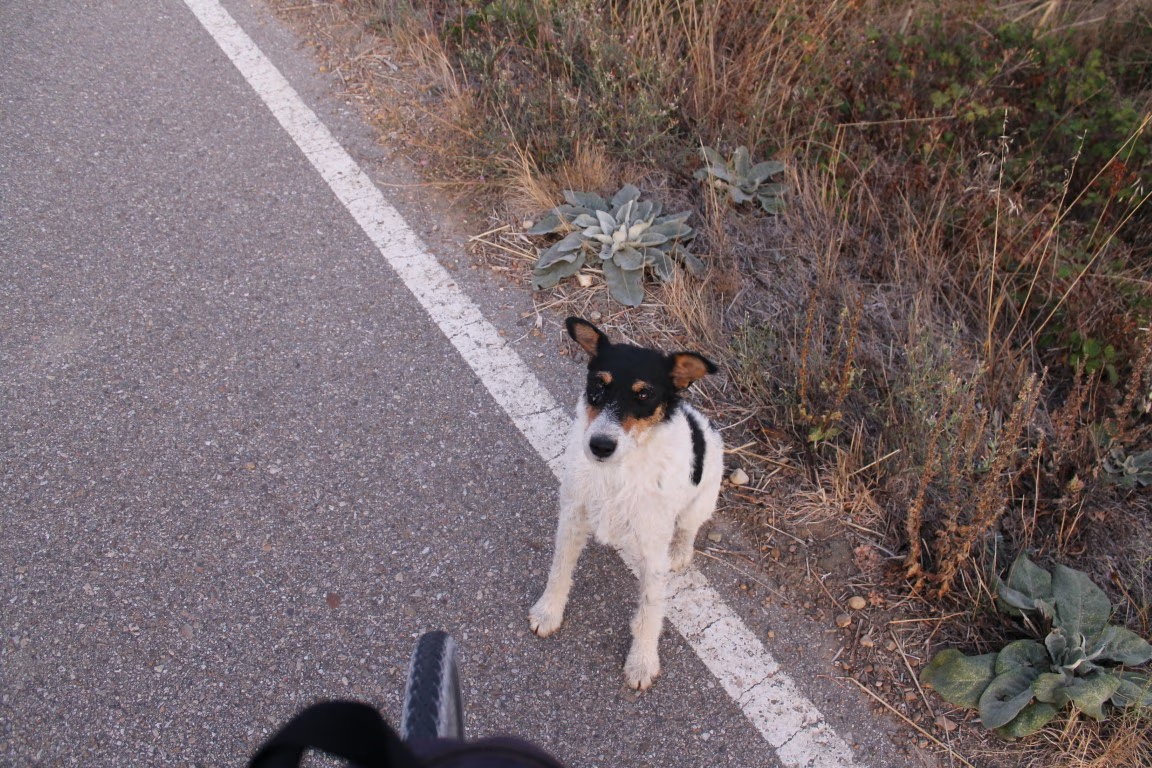
The little dog was surely hoping for a treat, but unfortunately I had nothing for him. Luckily enough people pass by here every day. Someone is bound to have something.
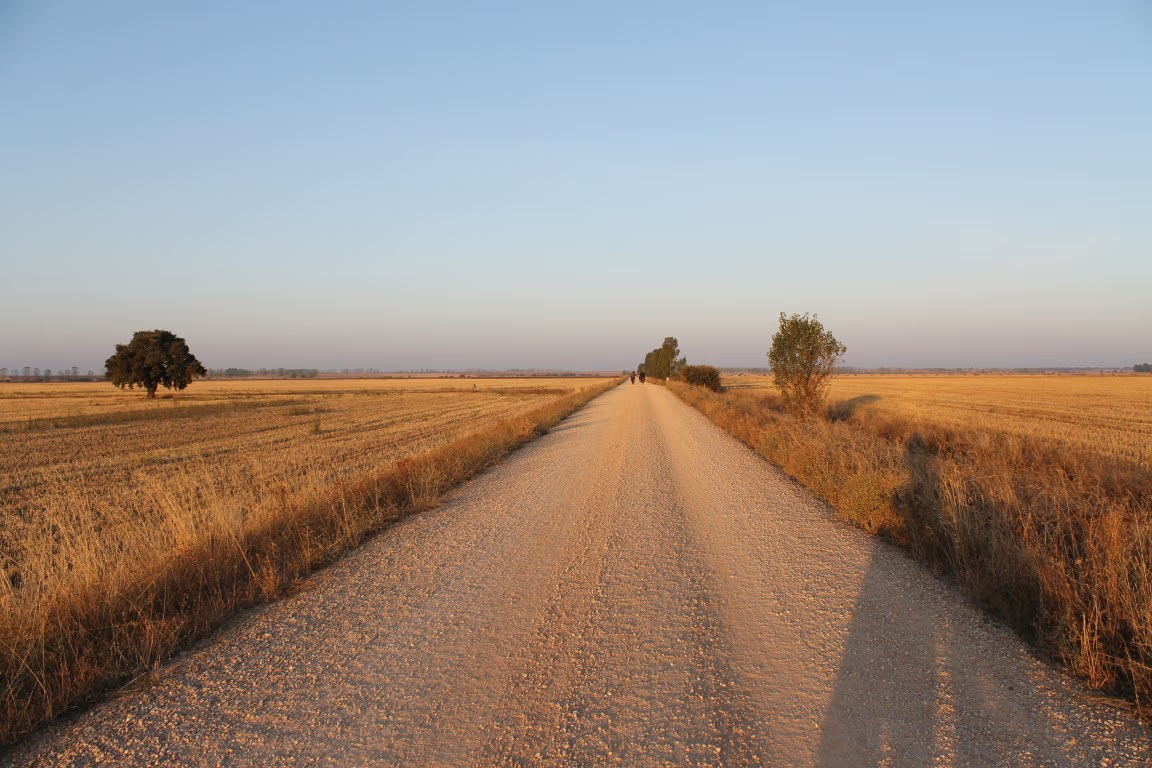
The low sun cast long shadows into the endless expanse.

A small hostel on the way to Sahagún. There's a hostel in almost every village on the Camino. On average they're about 10 km apart. With smaller hostels you may be unlucky and find them already full. Larger towns often have several. And if need be, you have to sleep on the floor or outside.

Sahagún. The centre of the Camino Francés. Anyone who has made it this far has exactly half the route behind them.
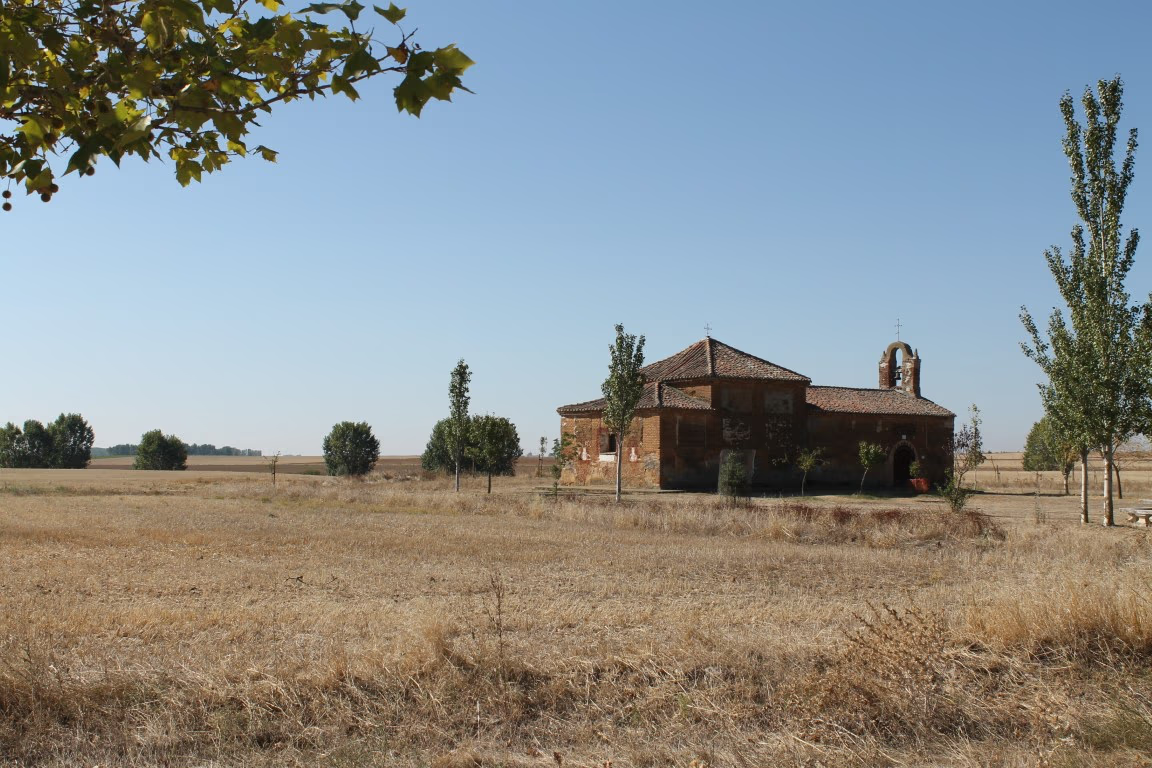
A small church building as a rest stop on the Camino.
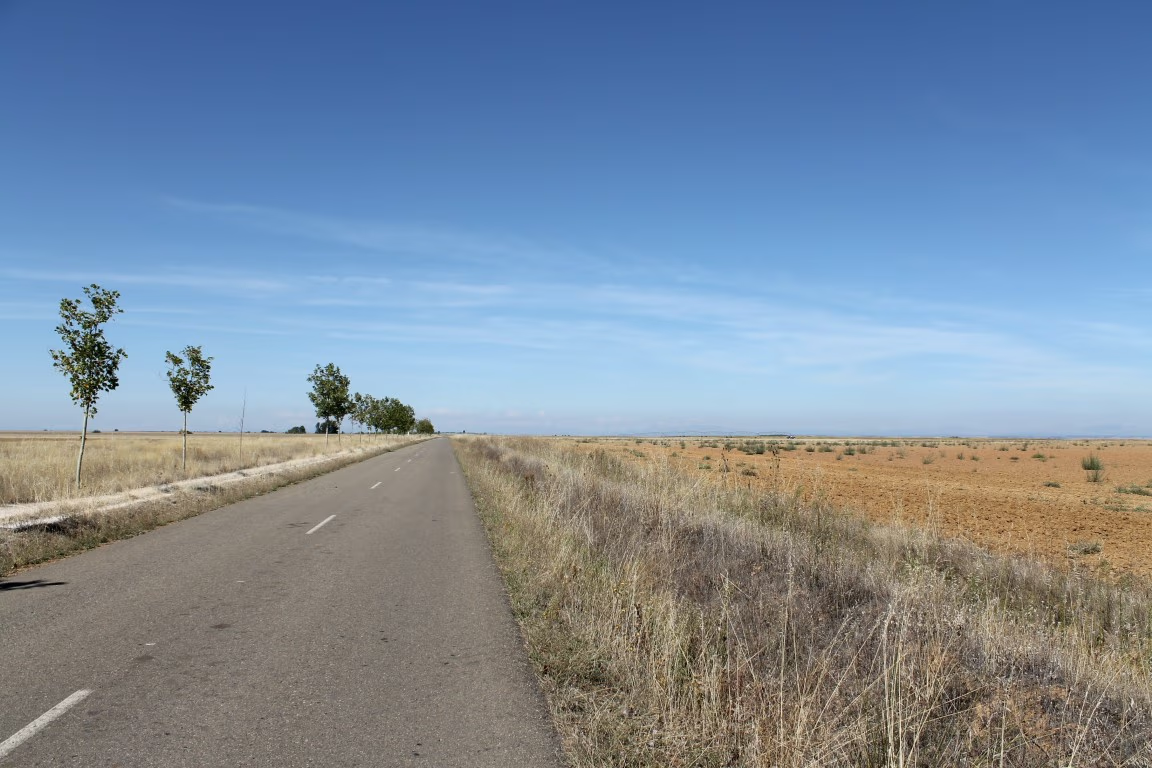
Still on the road in the Meseta. At the end you can faintly make out a mountain range. The Cantabrian Mountains, which were already visible a few days ago. They stretch right across the north of Spain.

A small bar somewhere along the pilgrims' way.
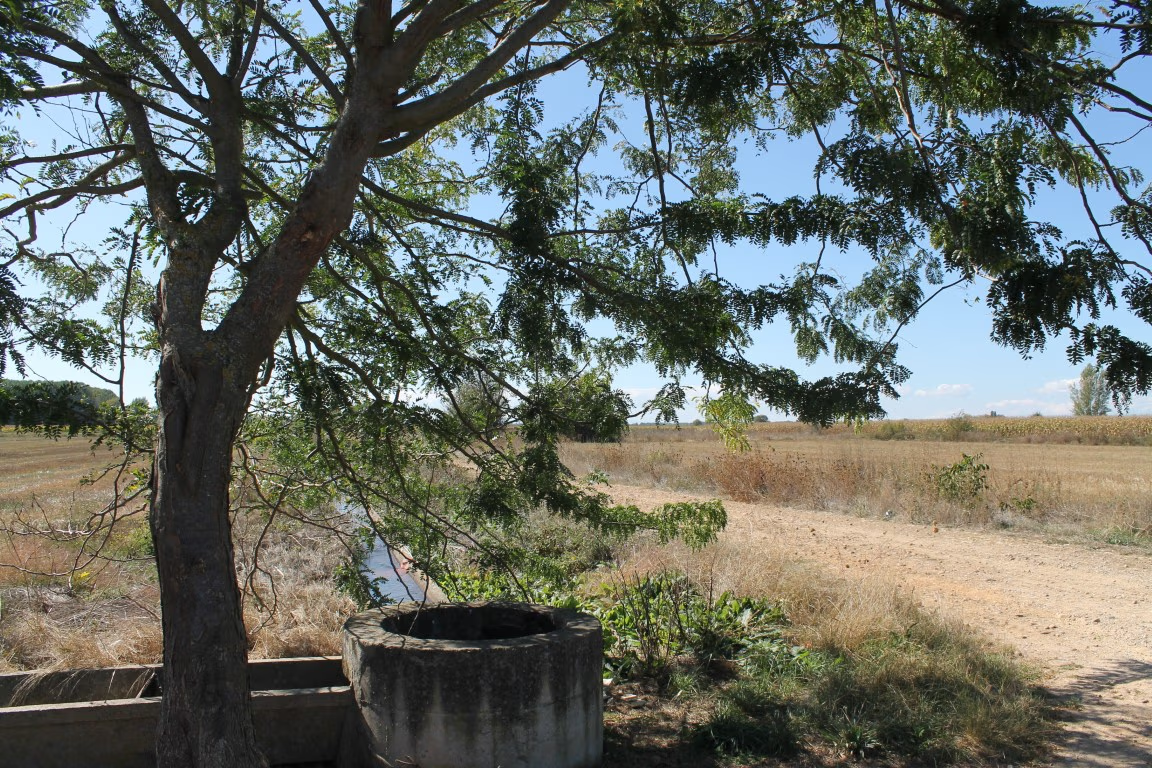
Shady spots and water are scarce in this endless landscape.

León, a very beautiful, lively city.

From the outside the cathedral isn't as grand as the one in Burgos, but it's still imposing and in the typical Gothic style so often found in Spain.

Inside, the cathedral is far more impressive and much more beautiful than the one in Burgos. Countless coloured windows cast wonderful light into the cathedral.
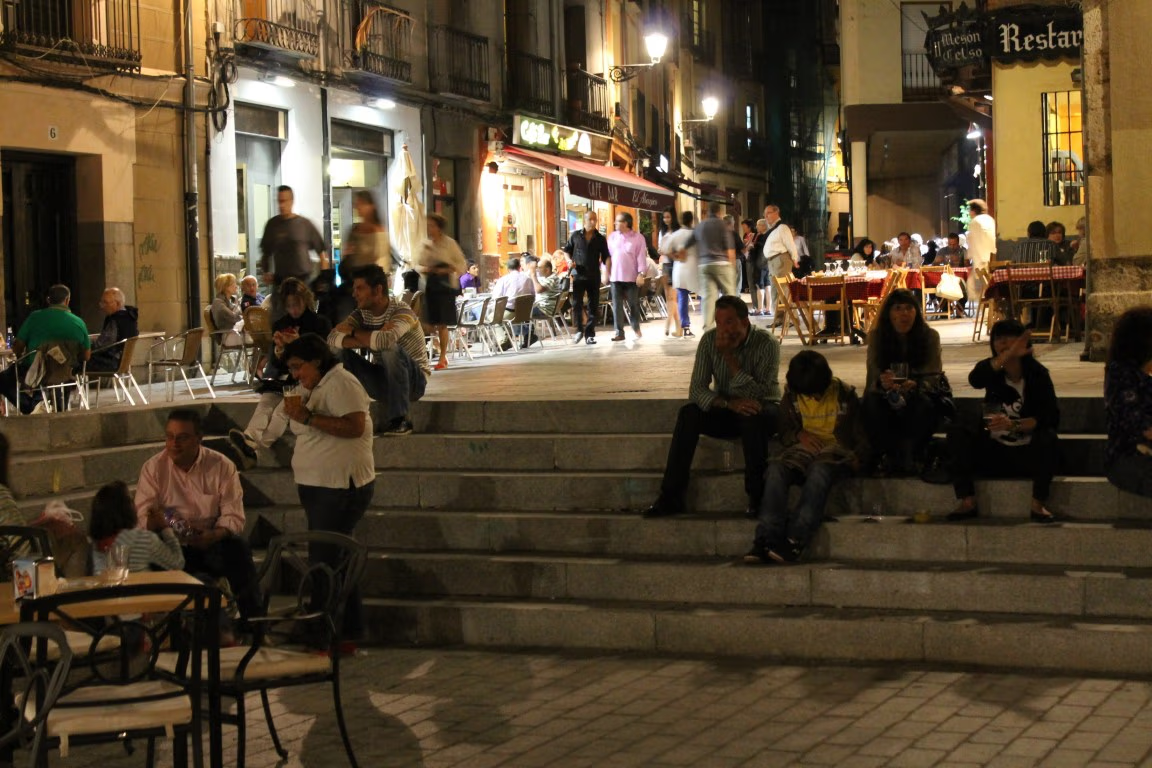
León's streets are busy until late in the evening.

Bike racks in front of the hostel. The number of cycling pilgrims increased noticeably.

Evening atmosphere in the square in front of the Benedictine convent that houses the hostel.
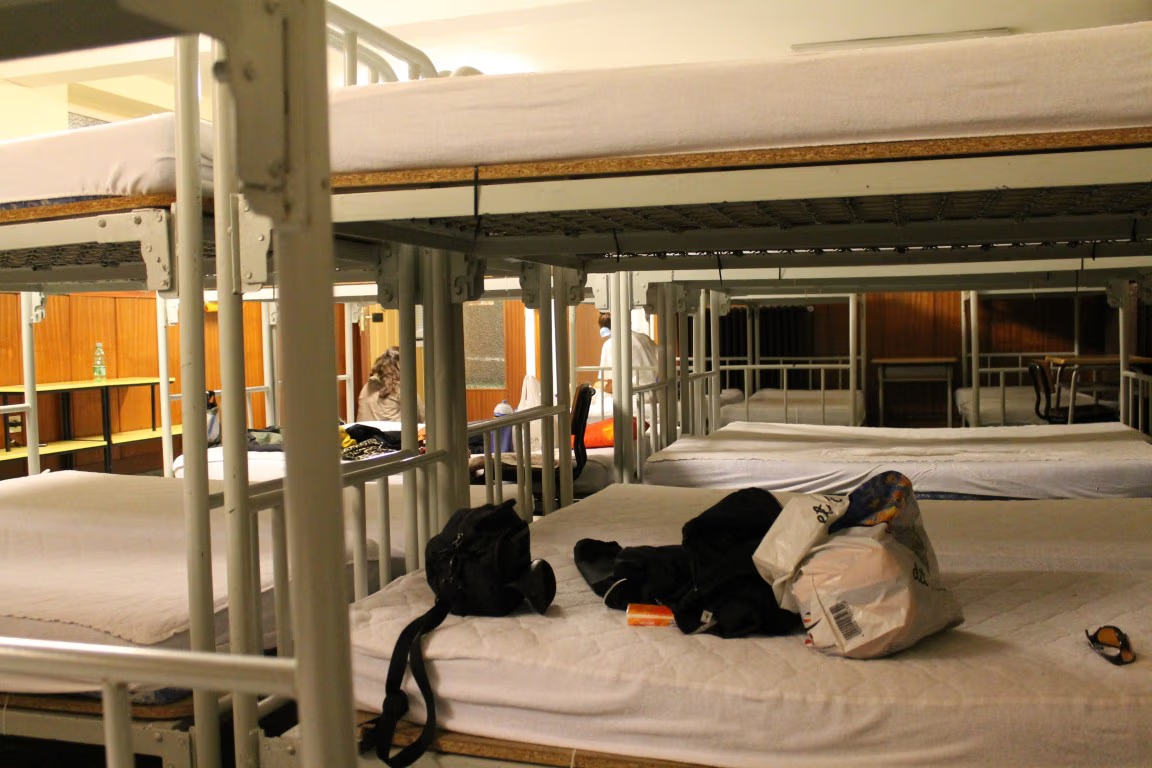
Here men and women sleep separately. As a rule you get a bed with a sheet. Everything else, like a sleeping bag and pillow, pilgrims have to bring themselves. You can't stay more than one night in any hostel unless you're ill.
26/09/2011: León – Rabanal (72 km, 750 m of climbing)
The landscape beyond León is still barren, but no longer as vast and monotonous as the Meseta. It's gently downhill to Hospital de Órbigo with its medieval knights' bridge, and then gently uphill via Astorga, with its bishop's palace designed by Gaudí, up into the foothills of the Montes de León.

Map: © GPSies.com and OpenStreetMap contributors
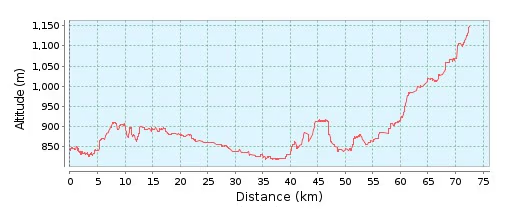
Map: © GPSies.com and OpenStreetMap contributors
Last night the city was still so full of people, so lively. This morning it was deserted. Not a soul about, except for the hard-working street cleaners you so often see in Spain in the mornings. A street sweeper cleaned the entire square in front of the church, and not a scrap from the day before was left. I followed the markers on the road and left the still-sleeping city.
Unfortunately not a nice ride out, as the area was much more built-up than before. I had to pass through lots of suburbs before I hit the N-120 national road again. It, too, had heavier traffic, and riding along here was utterly unspectacular. Only shortly before Astorga did it become more rural and quieter again.
In Hospital de Órbigo there was a little highlight to see. The Puente de Órbigo bridge from the 13th century is the longest bridge on the Camino. It crosses the Órbigo river, which by now is only narrow. A knight once had a lady of his heart named Doña Leonor. For her sake he had vowed to his brotherhood to fast every Thursday while wearing a heavy iron ring around his neck. When over time this became too burdensome for him, he wanted to be released from the vow. To do so, he had to fight all the knights who passed by here on the bridge. In the end the knight was freed from his vow and took the iron collar to the cathedral in Santiago, where to this day it hangs around the neck of the bust of James the Less. And ever since, this bridge has been a passage of honour, and once a year traditional jousting festivals are held here that re-enact the story.
Yes, riding across this bridge really was something special, and you could easily imagine the knights fighting here long ago. Today, in brilliant sunshine, the bridge was populated only by a few harmless pilgrims. I cycled on to Astorga. The town lies at an altitude of about 850 m near the Montes de León and is an important junction of the Caminos. This is where the Vía de la Plata from Seville and the Camino Francés meet and continue together to Santiago. That's also why Astorga has a mighty bishop's palace, whose building was designed and partly built by none other than Gaudí. Today the palace is a museum, which, however, happened to be closed. After a short rest in Astorga I continued my journey. The stretch from Astorga to Rabanal was one of the most beautiful sections of the Camino. The landscape was still gently rolling, and the path now ran almost entirely away from the roads, or along a stretch of lonely tarmac road, through lots and lots of nature. On the horizon you could already see the next mountains, the Montes de León, which looked very green. Climbing very gently, the route now led to Rabanal, and it became lonelier and emptier all the time. Some of the few small villages were almost deserted, and many houses were already falling into ruin. Without the pilgrims, the villages here would surely no longer exist at all. Rabanal, too, was a remote little village with a cosy hostel. Everything was full of flowers, and the whole place radiated an indescribable calm. This is where I wanted to stay, and so I ended my day's journey as early as 4 in the afternoon.
One by one the other cycling pilgrims turned up too, some of whom I'd been seeing on and off for quite a while, as well as new faces. It's kind of funny with the cycling pilgrims, a bit like competition flying in gliding. You see each other, you greet each other, you overtake each other or get overtaken, and although you only exchange a few words, you slowly start to get to know your fellow competitors. Only the 15-strong cycling group from Holland, once again with light luggage, aroused rather less interest on my part. In the evening, though, I didn't meet any cyclists, but Oliver, an IT guy from Heilbronn, and a fellow from Cologne who was incredibly happy about the German black bread I gave him. I knew there was no proper bread in Spain and had brought a good supply of packaged black bread with me. The guy had been walking for many weeks by now and was correspondingly hungry for good bread.
We talked a lot over dinner with plenty of beer, and it was a very cosy, sociable evening. At 7 we went to evening Mass, where I also briefly got talking to the other cyclists, and in the evening everyone could admire an incredibly wonderful starry sky, including a crystal-clear Milky Way.
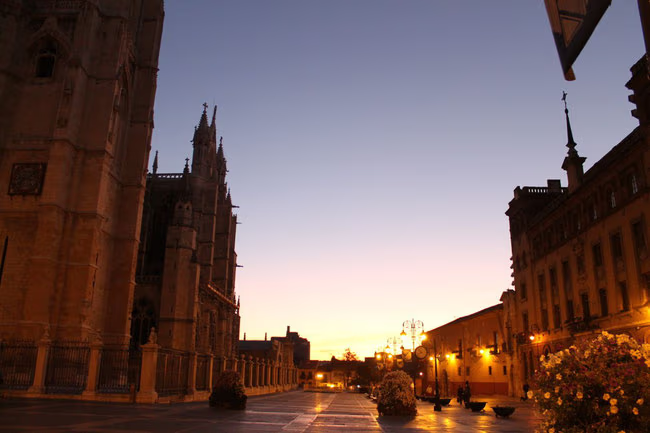
Early morning in León. Deserted streets.

300 km to go to Santiago. The yellow arrow shows the right way.
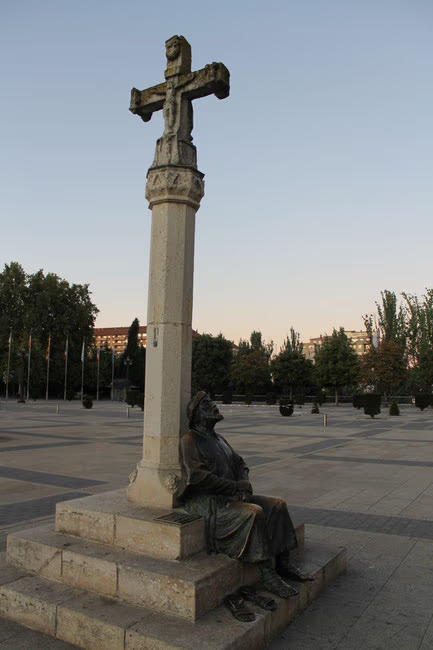
Pilgrim monument on the edge of León.

I left León through the tangle of motorways around the city.
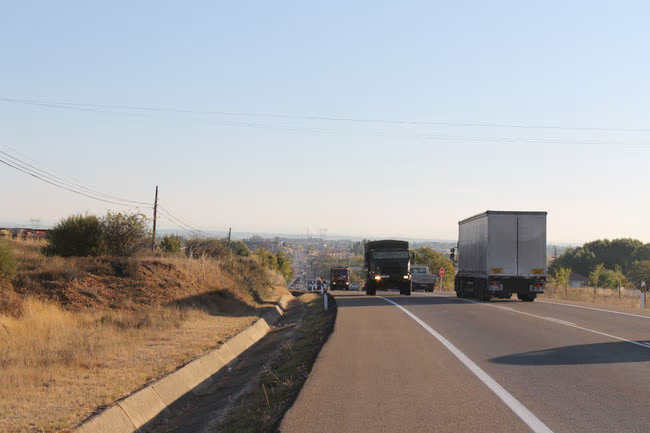
The main road out of the city was very unspectacular, busy and noisy.

Hospital de Órbigo with the Puente de Órbigo. A knight once fought on this bridge to get out of a promise made to the lady of his heart.
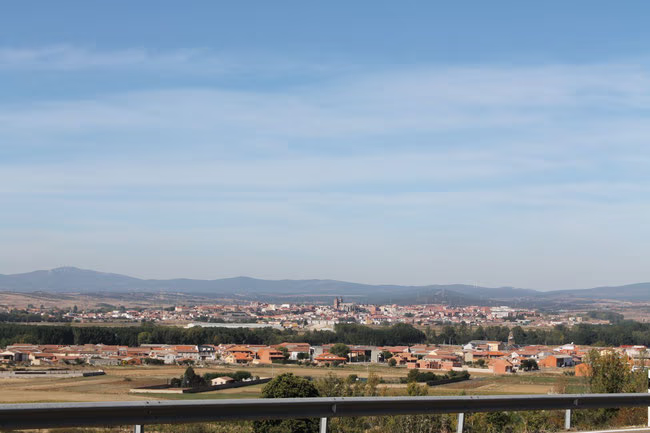
In Astorga two Caminos meet, the Vía de la Plata from Seville and the Camino Francés.
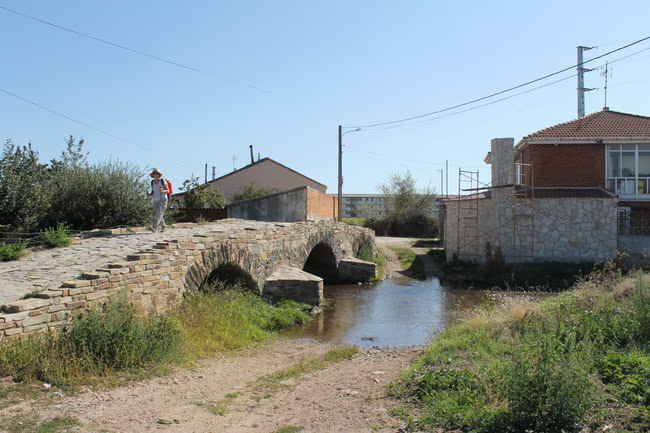
Impressions.
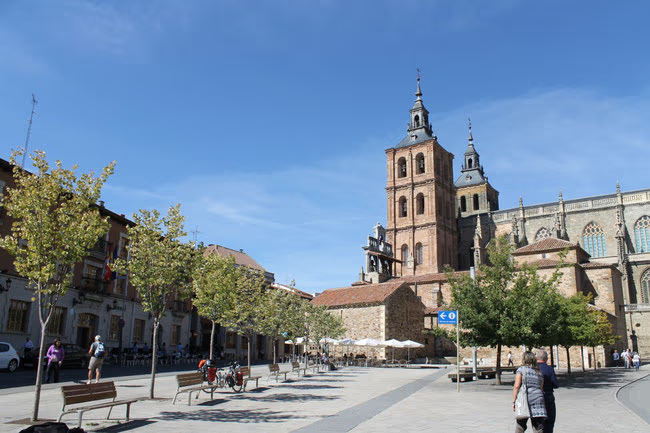
The cathedral in Astorga.
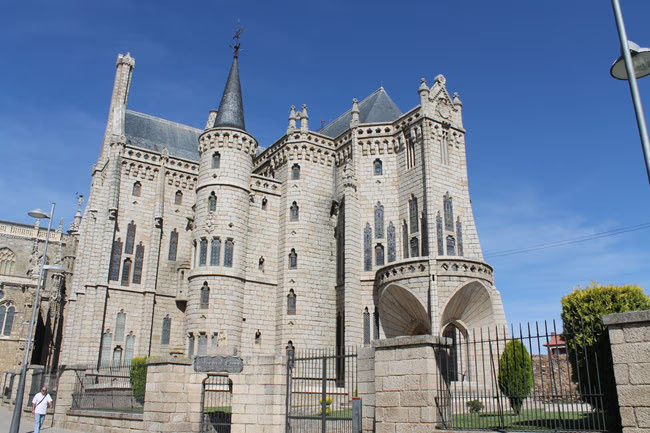
But the bishop's palace next door, built to Gaudí's plans, is far more spectacular. Today it houses a museum.

Beyond Astorga it became lonely, and the scenery was very beautiful again.
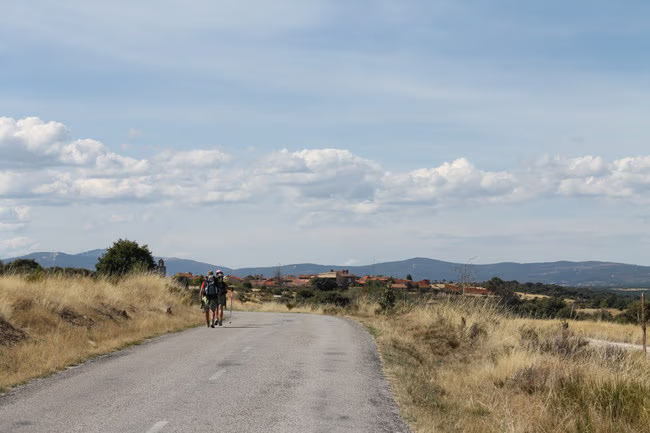
In the background, the green, wooded mountain range of the Montes de León.

Small, lonely villages west of Astorga. Some restored, but many also very dilapidated.
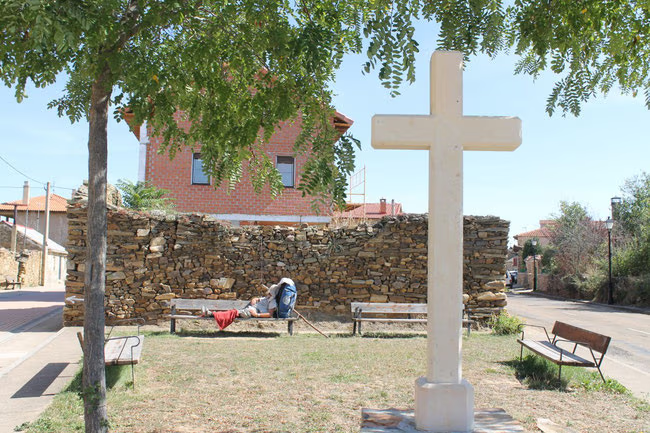
Everyone needs a break.
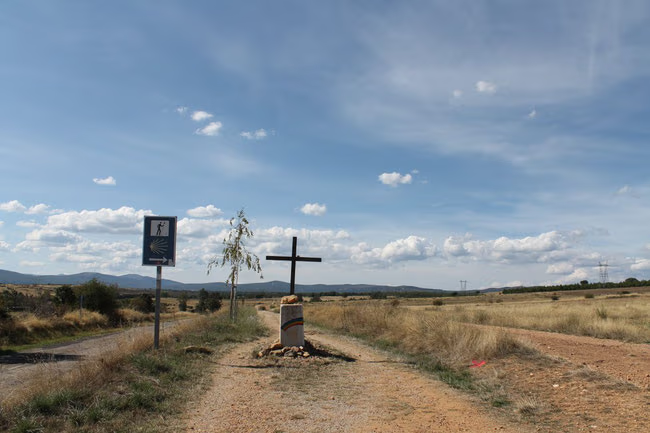
Impressions.

Evening atmosphere in Rabanal.

The hostel in Rabanal.

The hostel in Rabanal.
27/09/2011: Rabanal – Vega de Valcarce (77 km, 1,000 m of climbing)
On lovely paths the route climbs steadily into the Montes de León. At the Cruz de Ferro you reach the highest point of the Camino Francés. After that comes a breakneck descent into the fertile valley of El Bierzo, which lies between Ponferrada and Villafranca del Bierzo. Thanks to a special microclimate, a lot of wine is grown here. After Villafranca the route slowly climbs again into the south-western foothills of the Cantabrian Mountains.
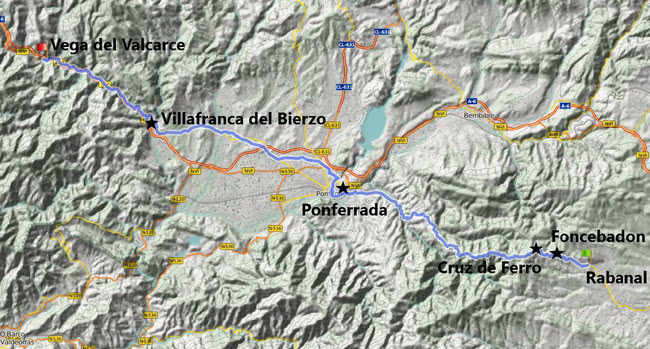
Map: © GPSies.com and OpenStreetMap contributors

Map: © GPSies.com and OpenStreetMap contributors
It was still pitch dark when most of the pilgrims were already on their way. With every day you now noticed the sun rising later and later the further west you went. When I was ready to go at a quarter to eight, a few pilgrims were still sitting in the bar, calmly drinking their coffee. For once I wasn't the last. This morning was the most beautiful of the trip so far.
When I set off, a silver streak of dawn was already visible on the horizon. The sunrises here in September are truly magical, and today's was one of the most beautiful of my journey. From purple through orange and yellow, the sky slowly turned a bright blue. You found yourself in the middle of nature, surrounded by twittering birds and almost complete solitude. Now and then a few pilgrims, whom you overtook with a greeting: “Buen camino!” It was simply glorious. Climbing gently, the route now headed towards the Montes de León. The first stop was Foncebadón, a ruined village on the Camino. Only a few people still lived in the run-down houses. The steady stream of pilgrims, however, has breathed a little life back into this place, which was important in the Middle Ages – something also reflected in a funny German property advert on the wall of a house. But beyond two restored houses, a hostel and a restaurant with a bar, there wasn't much else to discover here yet. The dilapidated charm clearly prevailed.
I would have loved to stay the night here, but it was clearly far too early in the morning for that. So I carried on to the Cruz de Ferro, at over 1,500 m the highest point of the Camino. From far away you could already see a huge wooden pole with an iron cross on top of a large pile of stones. For thousands of years it has been tradition to lay down a stone at this cross. You usually bring this stone from home and can set it down here, at this point on the Camino, as “your burden”. The stone can stand for the sins you've left behind on the way here, it can tell a story, represent a memory or serve as a farewell to something. I too had brought my stones with me, which I could finally lay down. It was busy here – lots of people laying down their stones, having their photos taken, having a quick chat in all sorts of languages. I too had a souvenir photo taken of myself, looked at the many stones, but also photos and mementos, and stayed quite a while at this historic spot. After this visit, following a short up and down, came the descent of all descents. 1,000 m of descent over 20 km. The road was very steep in places, very twisty, and the tarmac wasn't the best either.
But never mind, my bike ran well and got down safely. Down to Ponferrada, the capital of El Bierzo. Ponferrada lies at the start of a narrow plain bounded in the east by the Montes de León I had just left and in the west by the Cantabrian Mountains. Before riding on, I first took a break in Ponferrada and looked at the town's imposing Templar castle. I could have saved myself the 6 euros. The home-made Templar castle of a hermit just past the Cruz de Ferro was far more exciting, but I couldn't or didn't want to look at it, as at that moment it was being besieged by a horde of Dutch cyclists. So I set off again across the plain towards the next mountains. This time I chose the original Camino again instead of the road and regretted it fairly quickly. The Camino led over extremely stony farm tracks, constantly up and down. In muggy temperatures above 30 °C that was no fun. Grumpily, I found behind every crest that it simply wasn't getting any better. Only the area was very pretty and characterised by vineyards. The cool maritime climate coming from the west, mixed with the warm temperatures of the Meseta, creates good conditions for wine here again. After a long, drawn-out up and down along dusty, stony farm tracks I finally reached Villafranca del Bierzo, the capital of El Bierzo at the foot of the Cantabrian Mountains.
The town was beautiful, with many churches, monasteries and pretty houses, but by now I was too worn out. After a short break I still wanted to reach my destination for the day. Slowly but steadily the road, now tarmacked again, climbed up into the mountains. The area became greener and greener, and the first signs of autumn were showing in the leaves. Now I saw my Spanish cycling pilgrims again too. They had the same destination as me, the local hostel in Vega de Valcarce, at the foot of the last big climb before Santiago. While I was heating up my pasta with tomato sauce in the little kitchen – which, by the way, I'd been lugging around since France – I met three German women pilgrims. Over dinner we talked about the Camino, and it became clear to me how much more intense pilgrimage on foot must be. They told me about the many companions they had met along the way, some of whom had walked on ahead or fallen behind. We talked a lot about the people, and I realised that on the bike I was simply travelling far too fast and could only take away half the pilgrim feeling. But oh well, still better than nothing at all. Next time on foot, hopefully.
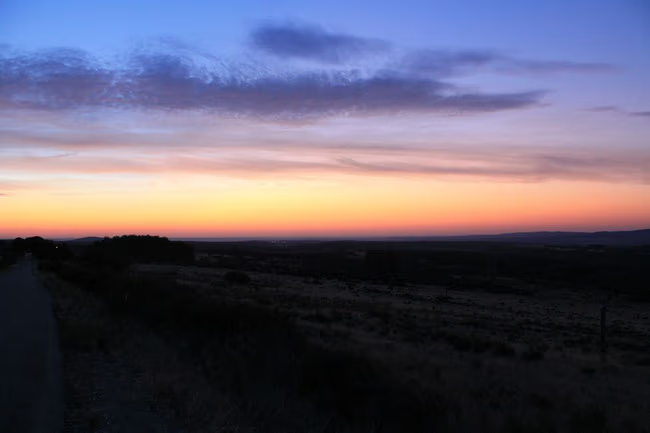
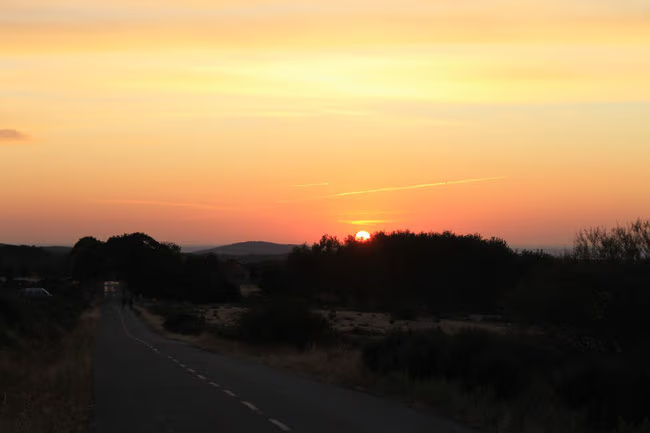
One of the most beautiful sunrises, in the morning in the Montes de León.
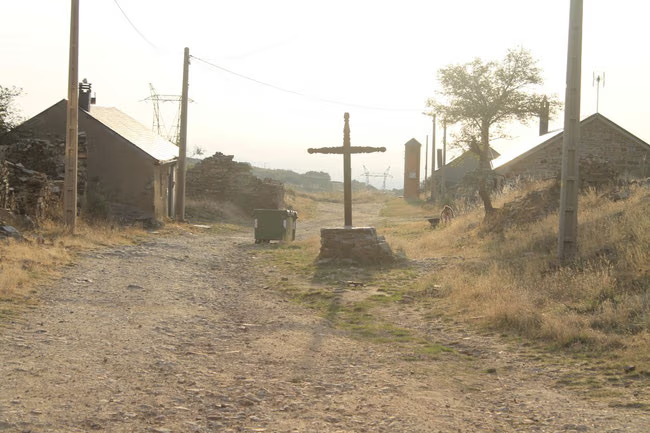
Foncebadón, an almost abandoned village at the foot of the mountains.

Foncebadón.
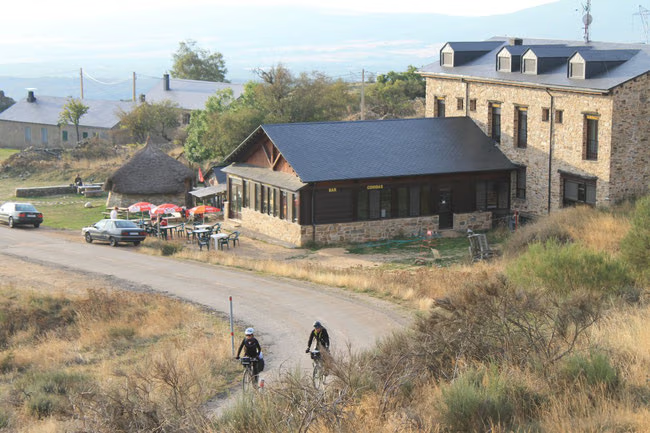
Apart from a handful of houses, only the hostel and a bar with a restaurant are relatively new.
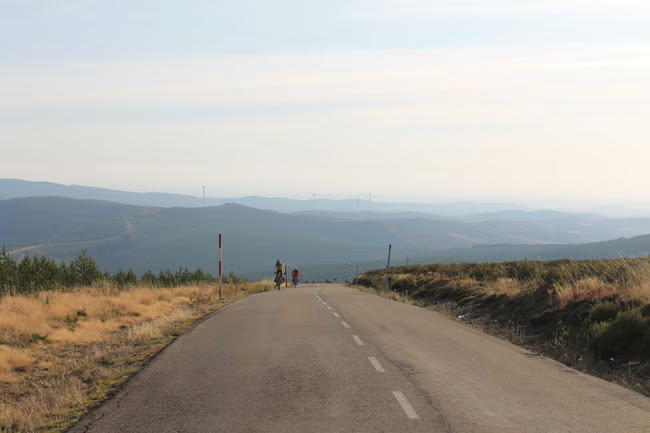
Up we went to the highest point of the Camino in the Montes de León.
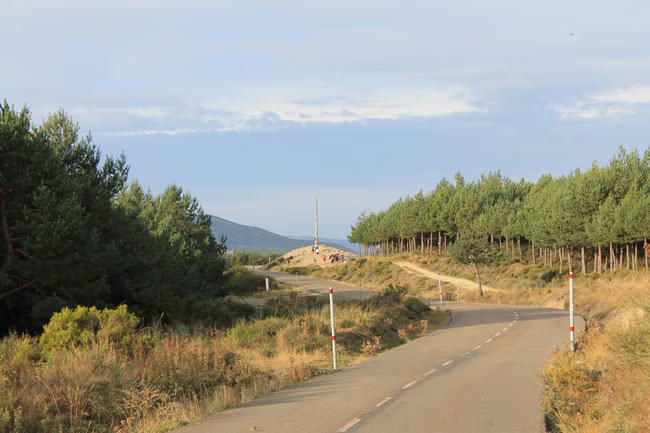
The Cruz de Ferro can be seen from far away.

Every pilgrim can lay down a stone here that they've brought from home. As a memory, as a farewell or to hand over their sins. A photo here is a must.
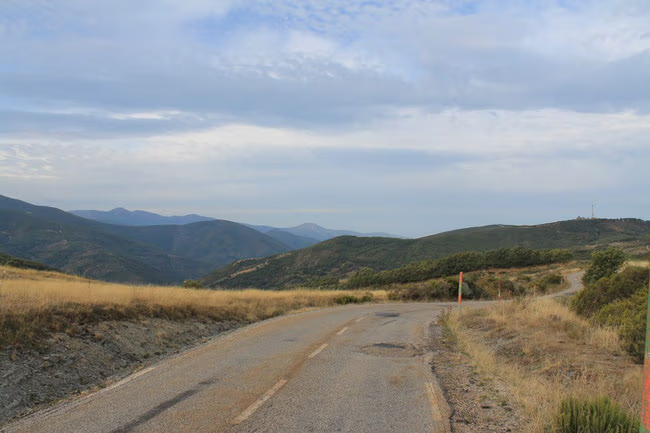
Up and down through the green hills and then steeply downhill to Ponferrada.
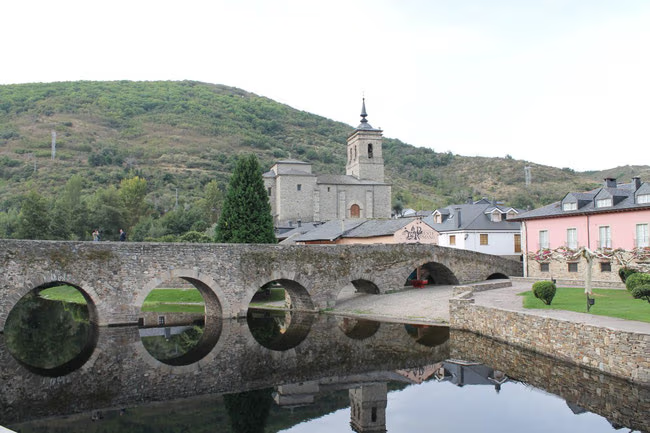
Puente de Molinaseca in the village of the same name, just before Ponferrada.

The Templar castle of Ponferrada. You can pay the entrance fee, but you don't have to.
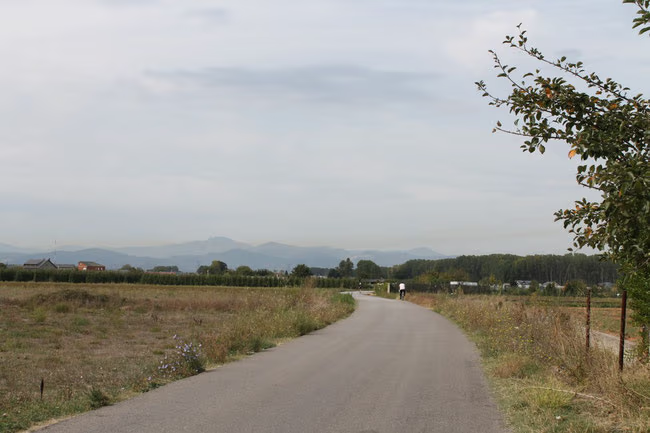
A narrow plain lies between the Montes de León and the Cantabrian Mountains, which separate the province of Castile and León from Galicia.
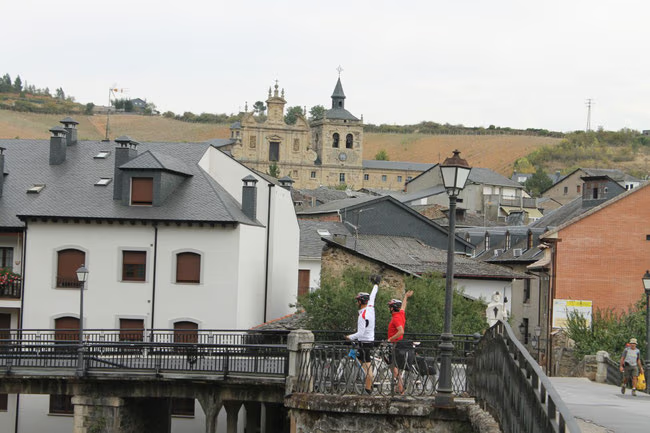
Cheerful cyclists in Villafranca del Bierzo.
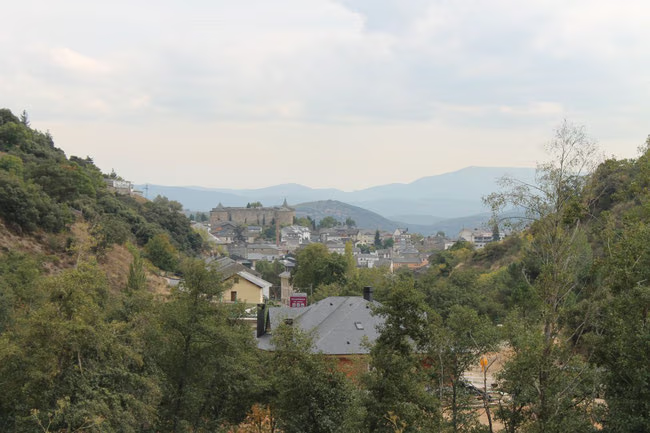
Beyond Villafranca del Bierzo the route climbed up into the Cantabrian Mountains.
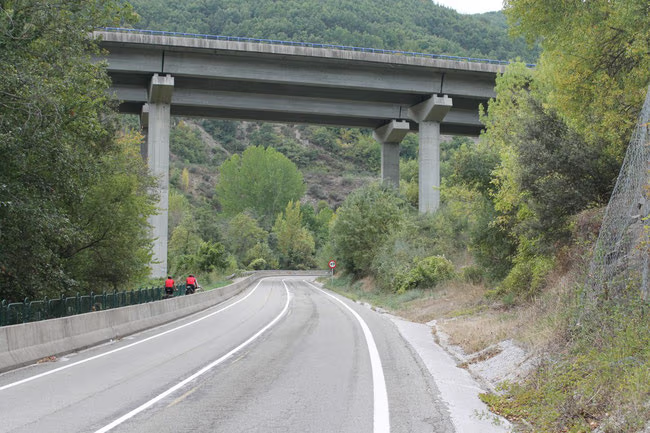
The main road is lonely, while the cars travel on the motorway.

The hostel in Vega de Valcarce.
About the author
My name is Karin, I live in Delmenhorst near Bremen and I love travelling by bike with luggage, sometimes with my partner but also, again and again, on my own. On my blog I present the cycling routes I've ridden in Germany and Europe. Maybe there's a tip or two in there for you.

The route in Camino Ninja
You'll find the Camino Francés with stages, map and accommodation in Camino Ninja: Camino Francés.