

Camino Primitivo in April: 13 stages from Oviedo to Santiago
Pilgrim's account of the Camino Primitivo: 13 stages from Oviedo via the Hospitales route and Lugo to Santiago – mountain stages, encounters, pilgrim highway.

From Oviedo to Santiago de Compostela in 13 stages in April: a pilgrim's account of the Camino Primitivo – with the Hospitales route, lots of encounters and the “pilgrim highway” from Arzúa onwards.
Less than six months after getting back from the Camino Portugués, I was drawn back to the Camino.
This time on the Camino Primitivo
I had flown from Frankfurt via Madrid and landed in Asturias on a rainy Saturday in April, then taken the bus to Oviedo, the starting point. By the evening the weather was already clearing a bit and the steady rain had turned into showers. So I looked forward with great anticipation to the path ahead of me – well aware that the Primitivo has a lot of climbing and would be more physically demanding.
Stage 1: Oviedo – Grado (28 km / 466 m ascent)
At 8 in the morning I treated myself to breakfast in a little café in Oviedo and then set off from the cathedral. I started out just as the party crowd was coming out of the nightclub. The way through the city wasn't pretty, but it wasn't bad either, and once I reached the city limits the landscape became really beautiful and I got a foretaste of the mountains. The weather was lovely, sunny and not too warm. The paths were still very wet in places and you had to watch your step here and there, but that was no big deal. I walked most of the stage with a Dane and reached Grado in the afternoon.
Stage 2: Grado – La Espina (30.5 km / 1,085 m ascent)
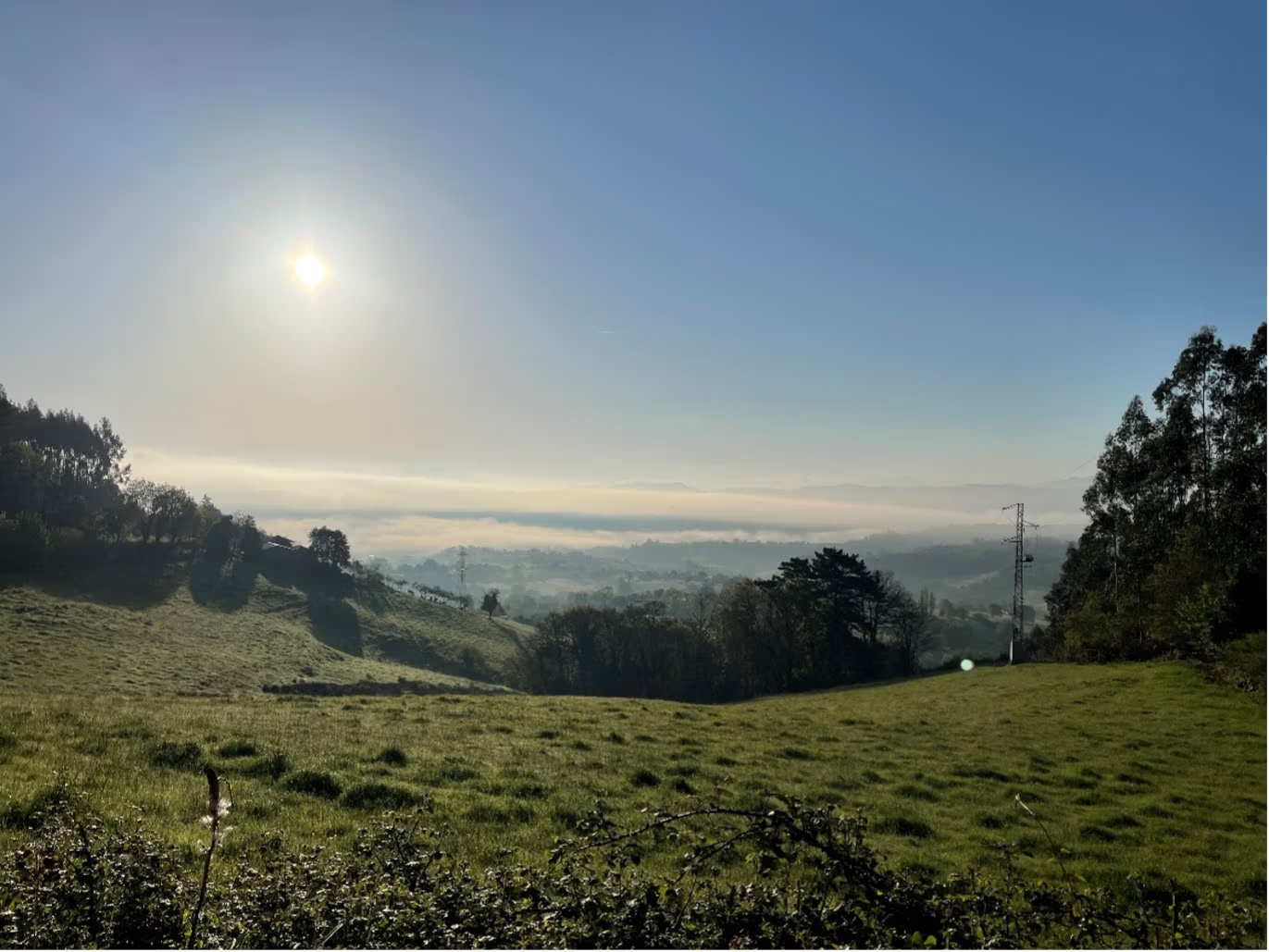
Early in the morning I set off from Grado together with a German pilgrim, and the first climbs didn't keep us waiting long, but it was all still very gentle. Again there was lots to see and nature was a feast for the eyes. In Salas our ways parted, and just past Salas I took a break and met the Dane again, along with a Pole and a Czech woman. We rested together and then came what was probably the most strenuous part of the stage – right at the end of the day. I could clearly feel that the three of them had quite a few, many years fewer on their backs, so I walked at my own pace to make sure I still got to La Espina. That was probably the first of several tough stages still to come. In the evening I chatted with a very likeable Irishman whom I was to see often again.
Stage 3: La Espina – Campiello (25.5 km / 620 m ascent)
I set off from La Espina in perfect weather and soon met pilgrims I already knew again, and we walked together for parts of the way. Past Tineo the route climbed on beautiful paths before heading downhill again towards Campiello. The last 3–4 kilometres or so weren't really nice, as they ran along a country road and it also started to drizzle. All the nicer, then, to stay in a single room at the Albergue Casa Herminia in Campiello and have good conversations there. Outside it rained almost non-stop, and you could sit in the dry. In my thoughts I was already on the next stage, the Hospitales route, which is said to be stunning but also very demanding physically. My hope was that the rain would stop so that this special route would actually make sense. I had plenty of provisions with me, because on the Hospitales route you have to bear in mind that you can't buy any food for more than 20 kilometres.
Stage 4: Campiello – Berducedo (Hospitales route, 27.8 km / 987 m ascent)
I set off very early in the morning. It was still very dark and the valley was shrouded in mist, which also gives you wonderful views.
Past the last village for a while, the path climbed slowly but steadily and the landscape grew more and more beautiful. The higher I got, the better the weather became, and the views were a dream. I was glad I had chosen this route and not the alternative. Yes, this section really is strenuous and demands a lot physically, but the peace and the nature make up for the effort. I had brought poles because of the mountain stages, and not only on this stage was I glad of them. Past the first of the ruined hospitals, the path climbs to the highest point of this Camino, past more ruins and then downhill again, which is also very demanding. Sometimes I walked quite alone, and sometimes there were a few pilgrims around me. The descent from the Alto del Palo pass is tough too – steeply downhill over loose scree. For me it was also a particularly emotional stage, as I was able to bring something personal to a close. When I arrived in Berducedo it began to rain, and it kept on into the night. Lucky with the weather once again. In the evening I went to an albergue to order the pilgrim menu and got to know a likeable Dutchman (Dolf).
Stage 5: Berducedo – Grandas de Salime (20.2 km / 664 m ascent)
I set off early in the morning, knowing that a rather shorter stage lay ahead of me, but no less challenging, because once again it went up and down with lovely regularity. But the dreamlike landscapes make up for the effort. At the start of this stage the weather was hazy and you had the feeling it wasn't really going to clear up. That day I walked for quite a while with some people from Argentina and an Italian woman. On the way we met two Germans, and by the time we had passed the reservoir and reached the Hotel Grandas de Salime, it seemed all the pilgrims were reunited. The view from this hotel is fantastic, and the weather had once again been kind to us. It cleared up and the sun came out. The conversations with people from all over the world do you an incredible amount of good, and in the evening Dolf, the Irishman and I sat together for a while and talked about everything under the sun.
Stage 6: Grandas de Salime – A Fonsagrada (26.4 km / 882 m ascent)
I started the stage with my two fellow pilgrims from the evening before. What's really interesting on the Primitivo is that in the first few days you keep running into the same pilgrims, but you also have many moments of quiet because not everyone walks in a pack. As on the previous days, we set off under cloud and then walked into the sunshine, which in the mountains offers dreamlike views with the clouds lying in the valleys. Around midday the sun was shining gloriously; I walked on with Dolf, we took a long break in the early afternoon and there we met three Spanish police officers again who were walking the Camino. They gave us two Guardia Civil pilgrim passports – a special souvenir. And during this stop Dolf and I had such a profound conversation that we were both deeply moved. That's what's special about the Camino, and I truly appreciate it.
I got my only blister on the Primitivo that day, but it was harmless – quite unlike the last climb up to A Fonsagrada, which is really tough. But you're also proud when you've made it through a stage, and it simply feels good to reach your destination at the end of the day and then spend the evening over dinner with nice, interesting people. On this stage you cross from Asturias into Galicia.
Stage 7: A Fonsagrada – O Cadavo (25.4 km / 773 m ascent)
Now that I was in Galicia, it was also clear that the mountains would slowly be behind me. At least that's what I thought, but this stage really packed a punch once more. For a long time I walked alone, which I thoroughly enjoyed. The landscape was still fascinating. Having climbed a hill, I came to a ruin that simply invited me to take a break, and I enjoyed the silence up there until, one by one, pilgrims I already knew arrived, and the greetings were just so warm. After a well-earned break I walked on with a few of them, and then came a lovely moment when an Italian woman and an Italian man sang “Bella Ciao” on the way downhill. The cheerful mood was so tangible and filled me completely. After another break I decided to walk a stretch completely on my own, and that was the right decision. Silence within me, silence on the path, and so I could let my thoughts wander. That was really good, because a really stiff climb still awaited me, which I truly hadn't expected. I was so glad when I'd made it up that climb and met some of the pilgrims, including Dolf, at a café. After that the path went uphill a little more, then downhill, all in perfect weather – which also left me with slight sunburn on one arm. By the way, the albergue there had very modern, nice rooms, whether dorms or doubles.
Stage 8: O Cadavo – Lugo (31.1 km / 499 m ascent)
I walked the whole of the eighth day with Dolf, and at first with two Germans as well. Then at one point Dolf and I chose the “Complementario”, which was really lovely, because we walked through a forest and heard only birdsong and no cars – there are more of those on the normal route, as it runs along a road. We could both feel that the tension was now slowly easing, because the stages were no longer so demanding; even though it was over 30 kilometres that day, there was less climbing. With good conversations the day seemed to pass very quickly. We had found a good pace and still treated ourselves to breaks again and again and spent time in cafés. So we were approaching Lugo, which meant we only had 100 kilometres left to Santiago. Somehow crazy how time flies on the Camino, and you get so many great moments that you can live off them for a long time. The city of Lugo has a really beautiful centre and a historic wall, which you can't make out at all from a distance. We rounded off the day with a good meal.
Stage 9: Lugo – Ferreira (27.6 km / 540 m ascent)
I left Lugo early in the morning and treated myself to a coffee on the way out of town, which in the end turned out to be a good decision. I have to say that the first 20 kilometres weren't exactly marked by beauty, and for a long time there was no café or anything like it either – just the occasional stop with vending machines. After about 20 kilometres a café finally came, and some of the pilgrims who had often kept me company were sitting there again. I stayed a little longer and was almost alone when suddenly a number of pilgrims arrived whose faces were completely new to me and who had very light packs. I called them the “100-kilometre pilgrims”: whether Germans, Americans or from wherever else, they had all started in Lugo and were having their luggage transported. Not my way of pilgrimage, but completely fine, and from the café to Ferreira I had a lovely time with three Germans who wanted to find out this way whether pilgrimage was something for them. The evening was very quiet, and I chatted briefly with four American women who were also walking the 100 km from Lugo.
Stage 10: Ferreira – Melide (20.6 km / 387 m ascent)
After it had rained in the evening, I set off alone again in the morning. The silence suited me very well, because it let my thoughts circle. The stage went to Melide, and there, as I had already found out beforehand, I would meet the Camino Francés. The weather didn't seem to want to turn really good that day, but after briefly looking like a thunderstorm it brightened up, and the landscape became more and more like the Galicia I knew from my Camino Portugués and had come to love. At first I had walked alone, then later met Dolf again, and we walked together to Melide, where we sat in a café and later rounded off the evening together in a bistro. I had decided to take the remaining stages at a leisurely pace and simply walk one day longer. The first week had really been tough, so I found it pleasant to just slow down now.
Stage 11: Melide – Arzúa (16.8 km / 316 m ascent)
From Melide to Arzúa came the shortest stage of my Camino Primitivo, so I took it really easy, set off calmly and alone in the morning and treated myself to the odd break along the way. At some point I met Dolf again and we walked until shortly before Arzúa, where we took a very long break. On a rise before Arzúa there was a wonderful café that looked unremarkable, but it had everything your heart could desire, and the bocadillo was unbelievably good. This is where the three Germans I'd met shortly before Ferreira turned up too. The five of us sat there for a while, had a drink and then walked on. That day I had pain in my shins for the first time and was really annoyed, and couldn't understand why it would happen on the shortest stage. I tried to push it out of my mind. After all, there were only two stages left. In Arzúa, by the way, the Camino del Norte joins the Primitivo and the Francés, plus the “100-kilometre pilgrims”, so a colleague of mine who had been there a few days earlier said: “Then you'll be on the pilgrim highway.” I wasn't sure whether I had understood her words correctly – but more on that later. The evening in Arzúa was fantastic, with good food, a great atmosphere during a football match and good conversations.
Stage 12: Arzúa – O Pedrouzo (20.9 km / 323 m ascent)
The second-to-last walking day, and for whatever reason I reached the Camino at 8 o'clock on the dot – I had to walk a few metres from my accommodation to get there – and then I knew exactly what my colleague had meant by the “pilgrim highway”. I looked left and saw about 25 pilgrims; I looked right, where the path continued, and there were at least as many pilgrims there too. The early peace and quiet of the Primitivo was now over, but I took it with a smile and kept looking for gaps so I could walk alone. The pain from the day before came back, so I took a break and taped my legs. A miracle, this kinesiology tape. It was also lovely that a young woman saw me sitting there taping and asked whether she could help me. That's the Camino too, and it gives you so much. Afterwards I walked as if nothing had happened. Already in the morning I reached a place that seems to be a kind of cult spot: thousands of bottles of beer with writing on them decorate the bar there. Of course I had to take a picture. And then it was on to O Pedrouzo, where I arrived in the afternoon. In the evening I met up with Dolf, and we went for dinner with a Dutch woman and a Spanish woman we had often met on the way since Lugo. There we also decided to walk the last day together and arranged to meet quite early so as not to have too much “highway”.
Stage 13: O Pedrouzo – Santiago (20.8 km / 358 m ascent)
Fortified by a coffee, we set off on the last stage to Santiago quite early. We had quite a few conversations, but every now and then we were silent too. It was really wonderful that in Dolf I had found a companion who walked parts of the way with me and with whom I could have very profound conversations. From my Camino Portugués I already knew that the Camino gives you these conversations. You meet the people you're meant to meet. On the way to Santiago we also got talking about how nice it would be to see some of the pilgrims again whom we had met in the mountains – and that's exactly what happened as we walked towards the cathedral. Almost all of them were sitting in a café that we passed. A really great moment that gave us one more boost. On top of that, my colleague had finished the del Norte a few days earlier and was waiting for me at the cathedral. Even in my first few metres in Santiago I felt the emotion rising in me, and then, beaming and deeply moved, I arrived at the cathedral with Dolf and caught sight of my colleague too. What an arrival in Santiago.
Sadly, I had to catch my flight home the very next day, but the wonderful time, the encounters and the experiences are deep within me. I'm glad I was able to walk this Camino as well, and that my body held up too.
The Primitivo is very strenuous, especially in the first week, but you're more than rewarded by the wonderful landscapes. Pictures can't express what your eyes see there. I was very glad I had bought poles before leaving, because they were worth their weight in gold in the mountains. Every Camino is probably special in its own way, and so I keep the Primitivo in just as fond a memory as the Portugués, and I'm already thinking about which one will be next – because it's clear this wasn't the last.
The route in Camino Ninja
You'll find the Camino Primitivo from Oviedo to Santiago de Compostela with stages, map and accommodation in Camino Ninja: Camino Primitivo.