

Cycling the Camino Francés – Part 1: to Burgos
Karin's photo journey by bike on the Camino Francés in 2011, part 1: getting there and the stages from Saint-Jean-Pied-de-Port via Pamplona to Burgos.

Karin from Delmenhorst cycled the Camino Francés in September 2011: after four days of travelling to the start, she spent eleven days riding from Saint-Jean-Pied-de-Port across northern Spain to Santiago de Compostela. Her photo journey is published in three parts:
- Part 1: From Saint-Jean-Pied-de-Port to Burgos – the part you are reading now
- Part 2: From Burgos to Vega de Valcarce
- Part 3: From Vega de Valcarce to Santiago de Compostela
The Way of St. James is one of the most famous pilgrimage routes in Christendom. The holy tomb of St. James in Santiago de Compostela, in Spanish Galicia, is one of the three great Christian pilgrimage destinations, alongside Rome and Jerusalem. The Way of St. James is a huge network of pilgrim routes that spans all of Europe. For most people, the Camino Francés is the classic Way of St. James. Over 800 km it runs from the little village of Saint-Jean-Pied-de-Port in the French Pyrenees right across northern Spain to Santiago de Compostela in Galicia.
People have been making the pilgrimage to Santiago along the Ways of St. James since the Middle Ages. Their reasons vary. In the past it was mostly atonement and penance that set people off on the long road; today the reasons are far more varied: “curiosity, inspiration, adventure, spirituality, help, slowing down”, to name just a few. Everyone has their own reason for walking this way.
I had my reasons too. About half a year earlier I had lost my cycling partner and friend, and I still hadn’t quite found my feet again. A book lying open by chance in the bathroom of my old university friend Stefan put me onto the Camino. Whether it just happened to be open at the right pages or whether it was fate, who can say. For me it was immediately clear how I could come to terms with this chapter. But it wasn’t only grief – my curiosity about this route, so steeped in history, was great as well. And I was curious whether the magic of the Camino could take hold of me.
The Camino Francés by bike – an overview

Map: © GPSies.com and OpenStreetMap contributors

Map: © GPSies.com and OpenStreetMap contributors
Three mountain ranges have to be crossed on the Camino: the Pyrenees, the Montes de León and the Cantabrian Mountains. Between Burgos and León you are on the Meseta, a vast high plateau in central and northern Spain. The distance from the French Pyrenees to Santiago is about 800 km with just over 11,000 metres of climbing. I was on the road for 11 days. Since there is an albergue roughly every 10 km, you can easily ride shorter or longer stages. You can’t get lost: there are signs, arrows and waymarks everywhere, whether on the road or on the farm track. Cyclists can’t follow the walking route one hundred per cent, but the signs are always visible on the road too. The best time to go is surely spring or autumn. In spring everything is fresh and green, in autumn it’s rather parched and bare. I think every season has its charm, though I would avoid summer, because temperatures can get very hot, especially on the Meseta, where there is rarely any shade. There’s no need to be afraid of riding or walking this route alone. On the Camino you are definitely not alone. Every day you can meet lots of people from all sorts of countries. In 2018 more than 300,000 people arrived in Santiago. But don’t worry. Even though the Camino keeps growing in popularity, you can still find plenty of solitude along the way, at least in autumn. Don’t expect any culinary highlights. The pilgrim menus are often simple and not always tasty, but you won’t starve either. There is plenty of literature about the Camino, and the internet is full of information too. For my trip I relied on the Bruckmann cycling guide “Der spanische Jakobsweg”, which was written specifically for cyclists. All the stages are described in detail, and it points out when you can ride on the walking Camino and when you’d better not.
What follows is my account of this meaningful, history-laden route, including the journey there and back. Next time I wouldn’t do it by bike, because two weeks are really too short to fully open yourself up to the Way, to yourself and to other people. But it’s enough for an intense foretaste.
16–19 September 2011: Bremen to Saint-Jean-Pied-de-Port
The summer of 2011 was not a nice summer. After a reasonably pleasant spring and early summer, it rained a lot for the rest of the summer and it was far too cold. I was longing for warmth and looking forward to the trip to Spain, which was still very warm. Getting there, however, was rather complicated for me. There was no direct flight to the French Pyrenees and I wanted to travel as cheaply as possible.
That meant a train journey from Bremen to Kevelaer, a small town near the Dutch border. From there I planned to fly the next day with Ryanair from the regional airport at Weeze to Béziers in France, then ride a stretch along the sea, take the train from Narbonne to Orthez and then cycle another stretch to Saint-Jean-Pied-de-Port.
After a cheap night in Kevelaer, I flew to Béziers the next morning, full of excited anticipation. Béziers lies right on the Mediterranean coast in the south of France, between Montpellier and Narbonne. The plane landed in sunny France right on time at half past one. It took a while to unpack everything and get the bike ready to go. After a quick snack of two cheeseburgers (there was nothing else to be had there just then), I set off towards the Mediterranean. My destination for the day was a small campsite in Narbonne Plage. At first the route wasn’t very nice. It was insanely hot and I rode mostly on busy main roads towards the sea. Only from Valras Plage did it get nicer, but a strong south-westerly wind made progress very slow. Around half past six I reached the little campsite and was glad I hadn’t picked another one earlier. It was so lovely here and the sea was right next door. After quickly pitching the tent, I headed off to the sea. A huge, wide beach without a soul on it. The water was so beautifully warm and I enjoyed cooling off after a hot, dusty afternoon. Back at the campsite came the usual routine: shower, eat, brush teeth and off to bed. And very quickly it was back: that feeling of travelling. The feeling of only having to take care of the essentials: cycling, looking at the world, putting the tent up and taking it down, eating, reading, sleeping. No more distractions, no TV, no appointments. It felt very good, and in a warm 25°C with the chirping of the crickets I fell asleep very quickly.
The next morning the sky was overcast. It was very stormy, but it hadn’t turned cold. In less than an hour I was back on the bike, ready to go. The first kilometres to the turn-off for Narbonne went by quickly with a tailwind, but then the route turned into the wind. What followed reminded me of the Levante on the way to Ronda in Spain last year. The wind was so strong and gusty that you could barely stay on the bike. It took me almost two hours to cover the 19 km to Narbonne station, including a range of hills to get over. Good thing I had set off so punctually, so I still had a little time to see the town before the train to Bayonne left. After a train journey of several hours along the Pyrenees, I reached Orthez, where I quickly rode to the campsite, ate something and fell into bed exhausted. The day had been more strenuous than planned. The weather turned bad and it rained now and then.
But the next morning the world looked good again. The weather was fine again, I was able to have my bike tuned up once more (the gears were out of adjustment), do some shopping at Intermarché and set off for Saint-Jean-Pied-de-Port, 65 km away. It was a bit cooler today and I felt as if I were back in Germany. Gentle hills, lush meadows with cows, houses like ours. Only the nasty, vicious climbs of the rolling Pyrenean foothills were a bit unpleasant. And at some point you could see them, the Pyrenees, and Saint-Jean was signposted. At last I was approaching my goal, the most famous village in the Pyrenees, the starting point of the Camino Francés, Saint-Jean-Pied-de-Port. How many people had already started out from here before me. A strange feeling. And now I was here too. At first the place seemed very unspectacular: workshops, houses, petrol stations, but then I reached the old town and recognised everything immediately. Of course I had read Hape Kerkeling’s and other books about the Camino beforehand and had studied the route at length. And now I was here, and suddenly everything was full of life. The small municipal campsite was full of people getting ready for the Way. The many little souvenir shops had everything a pilgrim’s heart could desire. Outside the pilgrim office there was a short queue for those who didn’t yet have a pilgrim passport. I only bought myself a scallop shell, the sign of the pilgrim to Santiago. And after a lousy pilgrim menu in a touristy pilgrim pub, the long journey to the start came to an end. A little excited, I fell into a deep sleep.

The trip began on a sunny September afternoon at Bremen station. Then came 4 days of travel to Saint-Jean-Pied-de-Port in the French Pyrenees.

A day later I was already in the warm south of France. It took about an hour until the bike was ready to go.

And a few hours further on, I was finally by the warm Mediterranean in Narbonne Plage.

The next day, somewhere on the Mediterranean between Béziers and Narbonne. You can already see the Pyrenees in the background.

After a longer train ride along the Pyrenees I reached Orthez. The last overnight stop before the start.

On the way to Saint-Jean-Pied-de-Port. It looked a bit like Germany. The lush meadows, the gentle hills and here and there black-and-white cows.

At first Saint-Jean-Pied-de-Port seemed rather unspectacular.

The old town of Saint-Jean-Pied-de-Port.
20 September 2011: Saint-Jean-Pied-de-Port to Pamplona (75 km, 1,500 m of climbing)
The first stage of the classic Camino through the Pyrenees. The first test comes right at the start of the Way, with a high pass just beyond the French–Spanish border.

Map: © GPSies.com and OpenStreetMap contributors

Map: © GPSies.com and OpenStreetMap contributors
At last we were off. The Camino and Spain were waiting for me. Thick fog lay over the campsite in the morning. My tent neighbours from Eckernförde had already left while I was still packing up. At the pilgrim house I got my first stamp. I had already applied for the passport in Germany, but you can also get it here on the spot. Without this passport the journey isn’t official and you don’t get a certificate at the end. Every day you have to collect at least one stamp at an albergue, and on the last 100 km (or 200 km by bike) two stamps a day. Now I had my first stamp and could set off, fully motivated, on a cool morning. While the walkers have to climb laboriously straight over the Pyrenees on narrow, steep footpaths, the cyclists take the national road. First rolling, then steeper and steeper, it led upwards. The border crossing into Spain was completely unspectacular, but the landscape was magnificent. After just under 3 hours I had reached the Ibañeta Pass at 1,057 m. Yes, it was a bit tiring, but I made it up well with my heavy luggage. At the pass I saw the first “tourist” pilgrims. A coach stopped at the top of the pass, Asian-looking tourists got out, photographed the chapel and the surroundings and disappeared a short while later back into their coach, which quickly drove on. After a short rest and a few photos, I set off for Roncesvalles, 2 km away, the first stage destination for most pilgrims. An old Augustinian monastery surrounded by a restaurant, a hotel and a tourist office. A stamp from here was a must. The place is known for the Battle of Roncesvalles in 778, in which the last troops of Charlemagne, returning from a military campaign, were wiped out by Basque forces. A large stone at the pass commemorates this famous battle.
While I was eating my bread roll on the monastery steps in what was by now brilliant sunshine, I met a pilgrim from Kiel. A man who had given up his whole life, sold everything and was now looking for the way into a new life here on the Camino. I was impressed by this man’s courage.
After the break I carried on. Downhill to Pamplona, an hour away. On this side of the Pyrenees it was warm again, hot even, and I was looking forward to the coolness of the city. I saw lots of road cyclists and also a pilgrim couple on bikes, but I never saw them again after that. Around 5 o’clock I reached the tourist office, looking for the municipal pilgrim albergue. So today my first real pilgrim night lay ahead. The building in the city centre had a huge dormitory. 55 beds on each of two floors. Crammed tightly together and the room full of people. Luckily I had got a bed upstairs on the second floor, where there was a little less “through traffic”. A good-looking young Frenchman was just settling into the bed next to mine, but I didn’t say a word to him. After a pleasant shower, though, I first went to see the old town. Pamplona is a city full of life. In the evening the squares are so full of people; they sat outside in the restaurants and bars, music rang out of the pubs and young people sat in lots of little groups on the street. People here live outdoors much more than we do. No wonder, with this weather. On a cold September day at 12°C I wouldn’t want to sit outside in Bremen. I watched the nightlife for a while and then, tired from the long ride, went back to the albergue and tried to sleep.

Through the town gate and then over this bridge across the River Nive. This is where the classic Camino begins.

And at a cool 11°C on a foggy morning, my pilgrimage began.

While the pilgrims choose the arduous path straight over the Pyrenees, the cyclists ride towards Spain on the quiet national road.


Pictures of the climb to the Ibañeta Pass.


The Ibañeta Pass. At the top, at over 1,000 m, a small church and a stone in memory of the Battle of Roncesvalles. In the past the little church rang its bell for pilgrims searching for the way up to the pass in the fog. Climatically, this pass is the coldest and foggiest on the Camino Francés. Today, though, the weather was magnificent.


The Augustinian monastery of Roncesvalles. The first albergue on the pilgrim route.

But my way led on. Not as far as Compostela, but to Pamplona, 77 km from the start in total.


Gently downhill through beautiful countryside with little traffic towards Pamplona.

While I didn’t really feel like a pilgrim alone on the road, I came to a spot where the pilgrim path crosses the road. So I wasn’t travelling alone after all – I just couldn’t see them.

A magnificent green landscape in the southern foothills of the Pyrenees.

The first suburbs of the city.


Pamplona, capital of Navarre, famous for its controversial San Fermín, the running of the bulls through the city’s narrow streets in summer. Pamplona is a very lively city. Until late in the evening people throng outdoors, on the street, in the bars and parks. I liked the city.

The municipal albergue (Jesús y María) in Pamplona. 114 beds on 2 floors. Note the foot massage machine.
21 September 2011: Pamplona to Los Arcos (75 km, 1,100 m of climbing)
Through the province of Navarre, with a visit to the Romanesque church of Santa María de Eunate and the famous bridge in Puente la Reina, where two French Ways of St. James join to form the Camino Francés. In between, gentle hill country surrounded by a few mountain ridges, such as the Sierra del Perdón. Shortly before the end, the free wine fountain of the Irache monastery awaits.

Map: © GPSies.com and OpenStreetMap contributors

Map: © GPSies.com and OpenStreetMap contributors
Shortly before 8 in the morning. I wished I had my tent back. 114 people in one big open dormitory really did make a lot of noise. I couldn’t get to sleep and slept very badly. And even before 6 the room got restless. The pilgrims got up, packed their things, made noise doing it, and I couldn’t sleep any more. Why do they rush off so early? They have the whole day for their stages. I couldn’t make sense of it. My good-looking Frenchman was gone too. I probably won’t ever see him again. I got up without hurrying, packed up, found a panadería and a supermarket and then set off at a leisurely pace.
While the walking pilgrims beyond Pamplona hiked over the Alto del Perdón, a ridge with a great view and lovely pilgrim figures at the top, the cyclists rode a little further east on a pretty little side road. It ran lonely through hill country with harvested fields. After crossing the foothills of the Perdón came a short stretch of expressway with little traffic, and then I carried on along a well-built, moderately busy road towards Puente la Reina. Before that, though, I paid a short visit to the little church of Santa María de Eunate. The church dates from the 12th century and is one of the few churches on the Camino built in the Romanesque style. Its octagonal floor plan is reminiscent of the Church of the Holy Sepulchre in Jerusalem, but why this church was really built here remains unclear to this day. Here I again came across coach tourists who disturbed the peaceful, meditative calm, but they too soon disappeared again. At least afterwards I knew that you have to walk round the church three times. I never found out why, but I thought it couldn’t hurt to do it too.
Around midday I reached Puente la Reina. A small town with a beautiful old stone bridge. Here, on the bridge over the River Arga, the two French Ways of St. James from the Pyrenees join to form the official Camino Francés. I got an extra stamp, had tapas for lunch and carried on. The first pilgrims were already standing outside the local albergue, waiting to be let in. Do they set off so early because they absolutely want to secure their bed, like Germans on package holidays reserving their sunloungers by the pool at half past five in the morning? Or do they want to avoid walking in the afternoon heat by arriving early? I didn’t know yet. Yes, and sometimes you do meet again. Just past Puente I met the Frenchman from the albergue again, who introduced himself, however, as a Belgian. We chatted briefly about where from and where to, and then each of us went our own way again. But we soon met again, because instead of the road I chose the footpath, and it ended in a steep gravel climb. I had to push laboriously. Just before I reached the road, he caught up with me again and helped me push the last few metres. I thought that was very kind. During a short rest at the top of the climb we talked a little more. He had started in Belgium at the beginning of August and wanted to walk to Finisterre, the end of the world, about 100 km west of Santiago. Where the sea begins. That’s also why he was walking so incredibly fast, as he had already covered quite a few kilometres since Pamplona.
The route from Puente to Los Arcos was phenomenal. A wide, hilly landscape dominated by harvested fields and surrounded by beautiful sierras. I didn’t leave the quiet national road again until Los Arcos. Beyond Ayegui stood the Benedictine monastery Monasterio de Santa María de Irache. What is special about this monastery is the winery next door, Bodegas Irache. It is famous for the Fuente del Vino, a public wine fountain where pilgrims can quench their thirst without having to pay anything. A great PR idea that is listed in every book about the Camino. I don’t like wine, but even I tried a tiny sip before setting off on the last kilometres to Villamayor de Monjardín, my actual destination for the day. Unfortunately I was too late, because the albergue in that little hamlet was already full. The next one, in Los Arcos, was about 12 km away. I had no choice but to swing back into the saddle and pedal on. I felt a bit sorry for an older pilgrim who had also been turned away. He would either have to walk the 12 km and would certainly have another two hours on foot ahead of him, or find an expensive guesthouse room. I suspected that getting a bed as early as possible really is the reason many pilgrims set off so early.
The pilgrim albergue in Los Arcos was much smaller than the one in Pamplona. A friendly Belgian volunteer assigned me a bed in a 4-bed room. That would certainly be a more pleasant night than the previous one. With an ice-cold Coke (it was pretty hot in the sun today), I first lay down, exhausted and content, on the green lawn in front of the albergue and enjoyed the sun. In the evening there was to be a Mass in the nearby church. I had actually meant to go, but at dinner in the restaurant opposite I met Rico. Rico came from Frankfurt, was somewhere between 20 and 25, had no training and had sunk into Frankfurt’s drug scene. He was on the Camino to find a new life, guided by God. I was impressed by his story. We sat together until half past nine in the evening and talked about everything under the sun. After we had said goodbye late in the evening, the conversation stayed in my head for a long time. What a day full of encounters. And that is exactly what the Camino is. It’s the human connections that make it so interesting. You meet people every day and keep getting into conversation with them. They are lovely, interesting encounters of a kind you rarely have in normal life.

Around 8 o’clock I was ready to go too. I quickly lost sight of the other cyclist, a somewhat older lady.

Looking back at Pamplona. Pamplona lies on a small plateau, surrounded by the Pyrenees and other mountain ridges.

The landscape beyond Pamplona is rolling and wide. Harvested fields shape the scene, with ranges of hills all around.

The Alto del Perdón. The official route for walking pilgrims leads over this mountain, alongside the wind turbines. At the top, pilgrims are rewarded with a wonderful view and lots of pilgrim figures. The path isn’t suitable for normal bikes.

Harvested fields in the gently rolling hills.

The Romanesque church of Santa María de Eunate, a few kilometres before Puente la Reina.

The octagonal building is reminiscent of the Church of the Holy Sepulchre in Jerusalem, while the double arches and columns recall the Templars. The facade is full of grotesque faces, figures and symbols. Nobody really knows to this day where the church comes from. But it is something special, and walking round it three times has some meaning that I never found out.

In Puente la Reina two major Ways of St. James come together: the Navarrese route from Saint-Jean-Pied-de-Port and the Aragonese route from Somport, which lies further east in the Pyrenees. But this is where the Camino Francés officially begins.

Puente la Reina is famous for its Romanesque bridge over the River Arga. It was donated in the 11th century by Queen Doña Mayor, wife of the King of Pamplona, to make the way easier for pilgrims.
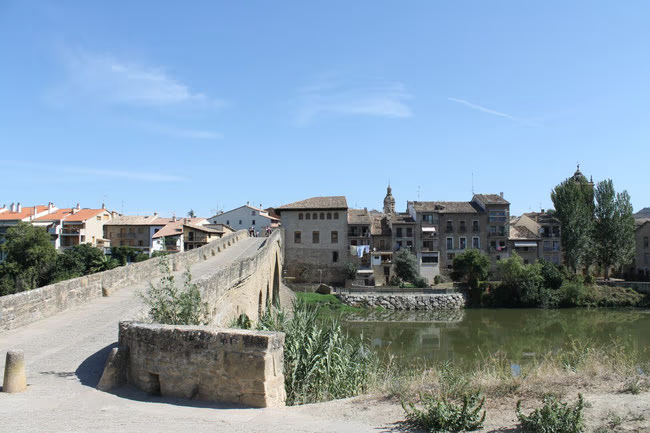
After crossing the bridge, the route continued towards Estella.

I decided to ride a stretch on the walkers’ pilgrim path. Somehow it was nicer here than on the road. But a steep climb at the end of this path showed how unsuitable the walking routes sometimes are for cyclists. Here I met the Belgian from the albergue again, who helped me push the heavy bike up.

Impressions by the wayside.

Back on the road towards Estella. The village of Lorca in the background. The road runs parallel to the motorway, which is why there was hardly any traffic here.

The Romanesque bridge in Estella is a real eye-catcher too. Most of the little villages right on the Camino have profited for centuries from the pilgrims passing through.

The next highlight is the “Fuente de Irache”. Just beyond Estella stands the former Benedictine monastery of Santa María la Real de Irache with the adjoining winery. Every pilgrim may tap a little wine from the public fountain for the moment.

The albergue in Los Arcos. It was much smaller and cosier than the one in Pamplona, and a four-bed room lets you hope for more peace and quiet.

The church of Los Arcos with its lavish gold ornamentation, so typical of Spain. But instead of going to Mass in the evening, I spent the whole evening sitting on the church square with Rico from Frankfurt, talking about everything under the sun.
22 September 2011: Los Arcos to Azofra (65 km, 900 m of climbing)

Map: © GPSies.com and OpenStreetMap contributors

Map: © GPSies.com and OpenStreetMap contributors
The night was a hundred times better than the one before. It was so much quieter during the night, and in the morning my three unknown roommates had already crept out of the room on tiptoe. Around a quarter past eight I was ready to go too. A cyclist from Swabia set off at the same time as me, but I soon lost sight of her. As I was leaving I met Rico by the road, we wished each other a cheerful “Buen camino” and then our paths parted once more.
The morning was beautiful. The low sun cast an incredibly lovely light over the almost endless expanse. In the background a sierra with a dark screen of cloud in the sky, and it was so quiet. That is what’s especially beautiful about Spain. This vastness. You can see so far; sometimes you see almost nothing but the horizon. And as soon as it gets a little more rolling, new impressions and new perspectives open up behind every rise.
On the way to Logroño I see a few cycling pilgrims now and then: the Swabian woman from this morning, an Asian woman and a few Spanish cyclists. Logroño is the capital of the province of La Rioja. This is where the famous Spanish wine comes from, and now in September the grapes are just about ready for harvest. Everywhere there were vines with juicy dark grapes, and once again I regretted not drinking wine. I had actually meant to get through the city quickly, but a feria was taking place in the centre, “San Mateo”, the big grape harvest festival. The main square and the city centre were full of people. There was a huge queue in front of an enormous cooking pot on the main square. I would have liked to try something too, but the wait seemed too long. So I soaked up the atmosphere for a while, took photos, was photographed myself (“Are you a peregrina?”) and had a quick look at the cathedral. Then I carried on. Just beyond Logroño I found a pretty lake for my lunch break. It was pleasant in the shade of the cool trees, even though it wasn’t as hot today as yesterday. Just past the lake I met the Swabian woman again and we exchanged a few words once more. But we didn’t want to ride together, and so here too our paths parted again. The rest of the way to Azofra was almost entirely on the N-120. At first a quiet national road, but at some point the parallel motorway came to an end and the traffic got noticeably heavier. I focused my gaze more on the Cantabrian Mountains, which were appearing ever more clearly to the north. Along the way I nibbled a grape here and there, and before I knew it I had arrived in Azofra. Azofra was a little hamlet in the middle of vineyards. Unspectacular, small, with a little supermarket and a municipal pilgrim albergue. There wasn’t much to see here, and I didn’t meet any interesting people today either. Azofra won’t go down as one of my fondest memories. The 5-bed room in an old annexe of the albergue was dark and spartan. At least the bed was nice and soft. The pilgrim menu in the restaurant was extremely bad. Macaroni with tomato sauce from the microwave, hake dripping and swimming in soggy chips. At least they couldn’t get the ready-made yoghurt wrong. If you want to go on a culinary pleasure trip, you mustn’t eat at the pilgrim restaurants. After dinner I took a little stroll through the dreary village and so brought the day to an end.

The low sun cast a wonderful light over the wide countryside.

Boundless expanse. On the horizon, very far away, a mountain range. If you love that sort of thing, Spain is the place for you.

Long straight stretches on the almost empty national road to Torres del Río.

You could see Torres del Río long before arriving, that’s how wide open the country is here.

Today I saw few pilgrims, but plenty of wine.

Here the Asian pilgrim was riding stoically through the vineyards of La Rioja.

Pilgrims walking alongside the road.

Just before Logroño.

On the way to Logroño there is also the little stall that once belonged to Doña Felisa, an old lady who for many years supplied pilgrims with drinks, souvenirs and a stamp. Her name was in every guidebook and Hape Kerkeling mentioned her. She died many years ago, but her children have carried on the family tradition. A stamp here is a must.

You don’t need to worry about navigation anywhere on the route. I have never seen such a well-signposted route. The signs of St. James are everywhere. In the towns you always follow the markers on the ground or the yellow arrows painted on walls and fences. Over the Río Ebro and into the city of Logroño.

San Mateo, the grape harvest festival, was taking place in the city centre.

After a short stop I rode out of the city again and carried on along the Camino.

In the shade of the trees I took a break at the Embalse de La Grajera, just beyond Logroño.

I met my fellow cyclist from Swabia again and we exchanged a few words before each of us went our own way again.

In the background the Cantabrian Mountains, in the foreground lots of green and a bit of farming, but otherwise not much going on here.

In the late afternoon I reached Azofra, a little hamlet somewhere in La Rioja.

The municipal albergue.

A simple, spartan bed in a dark dive.
23 September 2011: Azofra to Burgos (85 km, 1,100 m of climbing)
Climbing further, past the chicken miracle in Santo Domingo de la Calzada to the Montes de Oca. They form the geographical and climatic dividing line between La Rioja and Castile. The destination is the city of Burgos with its imposing cathedral.

Map: © GPSies.com and OpenStreetMap contributors

Map: © GPSies.com and OpenStreetMap contributors
Despite everything, I had slept very well that night. The three Italians who shared the room with me were friendly and, above all, quiet. They had got up early and were long gone when I woke up around 7.
My first goal of the day was Santo Domingo de la Calzada, 12 km away, which I had actually been aiming for yesterday. I took the N120 national road again as far as there. But first, just beyond Azofra, I stopped for my first breakfast break. Right in the middle of the vineyards, which still dominate the landscape. And just as I looked east, at that very moment the first ray of sunshine peeped out over a ridge. What a magical moment. And all around everything was so peaceful, with only the birds singing their morning song. The sun rose quickly and disappeared behind clouds. The road to Santo Domingo wasn’t exactly great. Even in the morning lots of lorries were thundering along it, but the wide hard shoulder made the riding bearable.
The highlight in Santo Domingo is the Gothic cathedral with its chickens. According to legend, a young pilgrim was wrongly hanged in the town because he refused to be seduced by a maid, who in revenge accused him of theft. The son was sentenced to death; his parents continued their journey without him and, on their way back from Santiago, found their son still alive on the gallows, because the apostle had been holding him up on his shoulders the whole time. The judge didn’t believe the miracle and said the son was as alive as the two roast chickens on his plate. At that, the chickens came back to life and flew away. That is how the chicken miracle came about, and in memory of this legend a cockerel and a hen are kept in the cathedral, and if they crow, it brings the pilgrim luck for the rest of the way.
And sure enough, right next to the entrance you could see two real chickens in a large cage (reportedly they are swapped every day). They didn’t crow, though. After taking a good long look at the impressive cathedral and its 70 m bell tower, I carried on along the walking Camino (the road was now too busy) towards Burgos. Since Santo Domingo the vineyards have faded away. Now I was approaching the province of Castilla y León. The landscape was again dominated by harvested fields. After a while I switched to the N-120, which always runs parallel. It was somewhat more pleasant riding here than on the gravel. Beyond Villafranca Montes de Oca I left the Camino, which runs on steep, gravelly tracks through the wooded ridge of the Montes de Oca. I didn’t dare take this path, as my guidebook spoke of great exertion and steep gravel sections, so I stayed on the road, which took me over the 1,150 m La Pedraja pass. After a short break at a rest area where black rabbits were dashing about, it was gently downhill towards Burgos. The road got more and more unspectacular, the headwind stronger and stronger. The dead-straight approach road into the city was awful. Industry appeared, chimneys blowing black smoke across the road, the traffic got worse and worse and my eyes were stinging. At some point I finally reached the old town and quickly found the pilgrim albergue next to the great cathedral. I met a few Spanish cycling pilgrims who had also set off from Azofra that morning. They looked pretty worn out. Just as well, then, that I hadn’t taken the detour through the mountains. Once I had been given my bed, I quickly showered off the sweat and dirt of the day and visited the cathedral. Every pilgrim should pay a visit to Burgos Cathedral. It is one of the largest and most beautiful churches in Spain and is on the UNESCO World Heritage list. I liked it much better from the outside than from the inside, though.
That evening I wasn’t in the mood for company. I treated myself to a mediocre doner kebab, strolled around the city a little and went back to the albergue. In the very modern, multi-storey albergue I shared a dormitory with 40 other people. Despite the numbers it was very quiet and I was able to sleep well again. The light problem was solved very simply here: at half past ten at night the lights went out and at 6 in the morning they came back on. That way there were no arguments, but sleeping in was out of the question too. That wasn’t a problem, though, because by now even as a cycling pilgrim you get up around 6 or half past and look forward to riding into the sunrise.

At 8 in the morning the bike was packed and ready to go again.

Sunrise in the morning somewhere in La Rioja. A wonderful, silent and magical moment.

The bell tower of the cathedral in Santo Domingo de la Calzada.

The cathedral is famous for the chicken miracle, and you can still marvel at the cockerel and the hen today.

The church is rich in detailed stonemasonry and works of art.

View from the church tower over the main square.

And over the wide surrounding countryside.

For a long way the pilgrim path runs parallel to the N-120 national road.

A break in Grañón, the village of cats.

Beyond Santo Domingo the wine-growing landscape gave way once more to wide, rolling country dominated by harvested fields.

Two lonely pilgrims on their way.

A change of scenery. Up and over the Montes de Oca. I preferred to stay on the road. The walking Camino ran off somewhere through the forest on steep gravel tracks.

On the pass.

Just before Burgos it started to get ugly, smelly and noisy.

The Arco de Santa María city gate is the city’s landmark. Here it became lively and beautiful again.

Burgos Cathedral is huge and very impressive.

The west front of the Gothic church. You felt very small in front of this imposing cathedral.


This cathedral is an eye-catcher on the inside too, and there is a great deal to discover.

The church of San Esteban in front of the great cathedral.

The albergue in Burgos is right next to the cathedral and charged only 4 euros a night. As a rule you pay between 4 and 10 euros a night. Usually it was a single-digit amount.
About the author
My name is Karin, I live in Delmenhorst near Bremen and I love travelling by bike with luggage, sometimes with my partner but also, again and again, alone. On my blog I present the cycling routes I’ve ridden in Germany and Europe. Maybe there’s a tip or two in there for you.

The route in Camino Ninja
You’ll find the Camino Francés with stages, map and accommodation in Camino Ninja: Camino Francés.