

Cycling the Camino (3): Through Galicia to Santiago
Part 3 of Karin's 2011 bike trip on the Camino Francés: over O Cebreiro through Galicia to Santiago de Compostela and on to Porto.

In autumn 2011, Karin from Delmenhorst cycled the Camino Francés to Santiago de Compostela. She tells the story of her journey in pictures in three parts – the third takes her from Vega del Valcarce over the O Cebreiro pass through Galicia to Santiago, and then on by bike to Porto:
- Part 1: From Saint-Jean-Pied-de-Port to Burgos
- Part 2: From Burgos to Vega del Valcarce
- Part 3: From Vega del Valcarce to Santiago and Porto – the part you're reading now
28 September 2011: Vega del Valcarce – Portomarín (85 km, 1,650 m of climbing)
The last province is on the agenda. Beyond the O Cebreiro pass in the Cantabrian Mountains, Galicia begins. A completely different region of Spain, more reminiscent of the German hill country than of Spain. Black-and-white cows and lots of farming make for an absolute contrast to the hot Meseta or the wide expanses of La Rioja. The Camino now often runs along deep sunken lanes that cost you a lot of strength and patience.

© GPSies.com and OpenStreetMap contributors

© GPSies.com and OpenStreetMap contributors
Today the last big pass of the trip was on the cards. O Cebreiro, at 1,300 m. Vega del Valcarce lay at about 600 m. Ten cyclists set off around 8 in the morning to conquer the pass. I started a bit later and quickly caught up with them again at the first bar. Last night and again this morning the pass was the big topic among the cyclists. “¡Muy difícil!” the Spaniards warned me. But the first few kilometres were surprisingly relaxed. Well, by now I was back in good shape. Only later did the road get steeper at times, but it was doable. The motorway, which in Vega still ran high above our heads, quickly came closer and closer. At some point the first Spaniards overtook me, but I kept stopping to snack on blackberries. Here they hadn't dried up yet, because I was about to reach Galicia. Galicia has a completely different climate from Castilla y León. It's much greener here, much fresher and colder, and it normally rains a lot more too. The pass is the border, and I reached it together with three Spaniards. By now we knew each other quite well and used the pass for a few photos. But it wasn't very warm. Only 17 °C and an overcast sky, though it stayed dry. While the three Spaniards rode on, I took a look at the old Celtic village of O Cebreiro. The Celts who once lived here lived in small, round, thatched huts that had no windows and no chimney.
The village is famous for a Eucharistic miracle from the year 1300. A devout farmer climbed the mountain in a storm to attend Holy Mass. The monk celebrating the Mass, however, had no faith in God and made fun of the farmer's piety. During the Eucharist, though, the bread and wine turned into the body of Christ, and from then on the monk was cured.
It must have been a lonely, enchanted place up here on the misty summit of the pass. Today you can visit the little church and admire its relics. Besides me, a few of the other Spaniards were up here too and we exchanged a few words. After the Cebreiro pass came yet another pass, the Alto do Poio, also over 1,300 m high. After that came a dreamlike descent on a wide, well-built road. From Triacastela onwards, unfortunately, it started to rain, and for the first and only time I got my rain gear out of the bag. The landscape was no longer anything like the previous days. Having crossed the pass, it felt like I was back in Germany. Cold temperatures, green meadows, black-and-white cows. How can you switch from one climate to another so quickly? Drenched in sweat, I arrived in Sarria and took my break. Luckily the rain stopped again and it got a bit warmer. After Sarria the Camino turned off onto a small farm track again. I really wanted to ride this stretch, because I was about to pass the marker stone for the last 100 km. The path was even worse than the day before yesterday. A wide farm track turned into a narrow, stony path. The stones were so big that no cart and no bike could get along here either. These were the sunken lanes between the fields that are typical of Galicia. Two other cyclists were struggling along here and offered their help. But I managed on my own and finally reached the marker stone. It was so covered in writing that there was no room left for any more words. What's special about this stone is that every pilgrim who wants to receive a certificate in Santiago must have walked at least the last 100 km. For cyclists and riders it's the last 200 km. And it really does get busier from this stone onwards. I saw more and more pilgrims along the way. Also a woman with a donkey and a few on horseback. But I was still mostly struggling through these sunken lanes on my own. Past farms and fields, and next to the round stone houses you could see lots of hórreos – granaries standing on stilts. When at some point I came back out onto the road, I didn't leave it again. Enough torture for today. Around half past 5 I reached Portomarín, my destination for the day, and was more than disappointed when I had to wait another hour for the shower. So, tired and sweaty, I killed the last hour in the little town, which once lay at the bottom of the neighbouring reservoir and had to be relocated. The plain but mighty church was completely dismantled and rebuilt on the market square. Once I was finally allowed to shower, I ate a reasonably good menú del día and then dropped into bed like a stone. My legs hurt and I couldn't fall asleep either, because someone was snoring terribly. What an exhausting day, but at some point I did fall asleep.

Setting off in Vega del Valcarce.
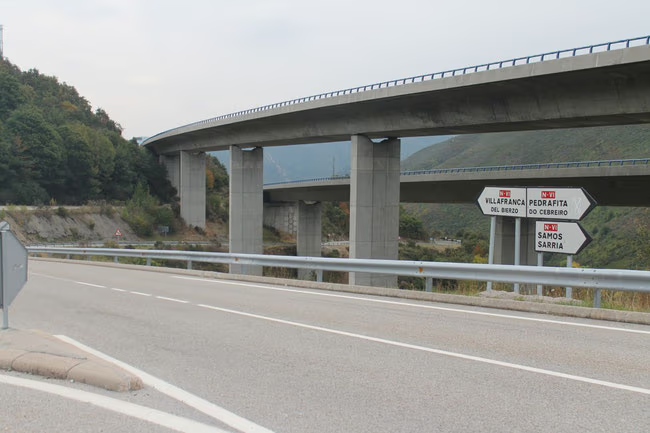
At some point you've reached the height of the motorway, but you're still a long way from the top of the pass.

At the Cebreiro pass. It's got cool – 17 °C.

Some of my Spanish fellow cyclists reached the pass together with me.

Cebreiro is an old Celtic village with the typical round houses with thatched roofs.

Today this village is only kept up for tourism and the pilgrims. In the little church you can admire the relic, the Holy Grail of Cebreiro.

Perhaps one or two people receive God's enlightenment here.

The pilgrim monument looking towards Santiago, before the Alto do Poio.

I wasn't alone here either.

And here at the next and last pass, before a fast descent down into green Galicia.

On the way you could see the monastery of Samos, one of the oldest monasteries in Spain.

And just like that, you were back home. Overcast skies, black-and-white cows, cool temperatures. Like northern Germany, and a stark contrast to the days before.

Impressions along the Camino. You're not at the end of the world but right in the middle of civilisation, and there's Coca-Cola everywhere in the world.

Galicia is shaped by farming.

The original Way of St James, only partly suitable for bikes. In places, big rocks made it hard to keep going. But it was definitely beautiful here.

The 100 km stone. A pilgrim has to walk 100 km to get the official certificate in Santiago. 200 km if you go by bike or on horseback.

Hórreos, the typical granaries of Galicia. They offer protection from rodents.

Portomarín behind the Belesar reservoir. Part of the town was lost to the reservoir and had to be relocated.

The Romanesque church of Portomarín is large and compact and plain inside. Quite untypical of the otherwise very lavish furnishings of Spanish churches.
29 September 2011: Portomarín – Monte do Gozo (92 km, 1,600 m of climbing)
Santiago is getting close. Through agricultural Galicia the route first climbs a little more, but then it's mostly downhill towards Santiago. The route continues through farming country in Galicia with the odd sunken lane in between. But the short climbs can get really nasty.

© GPSies.com and OpenStreetMap contributors

© GPSies.com and OpenStreetMap contributors
Of the 10 cyclists who set off yesterday, 5 reached the albergue in Portomarín. The rest had probably looked for an albergue earlier, as yesterday's stretch was quite long. I didn't like Galicia so much any more – it was just too similar to Germany. Not that I don't like Germany, quite the opposite, but for me Spain means warmth, starkness and wide open spaces. Today's ride was actually supposed to take me as far as Arca do Pino, and I imagined it would be fairly easy. But it didn't turn out quite so easy after all. First of all the day began with fog. The fog hung thick in the air, but the route went uphill again at first and at some point you rode up out of the fog into brilliant sunshine. So as not to get too many nasty surprises today, I stayed on the road for the most part. As the roads weren't busy, they were a good alternative to the Camino, because the guidebook was talking about lots of sunken lanes again. I knew those well enough by now.
After a while I saw two Spaniards pushing their bikes up a hill. One of them had helped me with my bike that morning. But they didn't need any help, so I left them behind. Shortly afterwards I met the next two. Alberto and Manuel had just stopped at a farm and were chatting with the cattle farmer. They explained to me that the granaries stand on stilts to keep the rats out. We rode together for a while, but then went our separate ways after all, as they wanted to continue on the Camino and I on the road. But we arranged to meet for lunch in Melide. Until then I enjoyed the road and the landscape. It was still very rural. The little villages smelled of cowsheds, the gardens were full of vegetables. Cats and dogs roamed the streets, old people sat in front of their houses or worked in the fields. The maize was still standing in the fields, waiting for the harvest. Only the chestnut and eucalyptus trees, which were becoming more and more frequent, showed that I wasn't travelling in Germany after all.
I liked the road a lot, but it went up and down the whole time. My legs were slowly getting tired, but I soon reached Melide, and since the two Spaniards weren't there yet, I visited the church and did some shopping at the supermarket. Then they turned up, and they showed me a local restaurant. The food in the packed restaurant was delicious and we got on better and better. Alberto spoke a little English, so I learned that he came from Barcelona and Manuel from San Sebastian. Manuel was an unemployed engineer and his father had died a short time ago. That was his reason for being on the Way of St James, while Alberto simply likes cycling. After lunch they wanted to have a siesta; I wanted to keep going. We loosely arranged to meet at the albergue in Arca do Pino, 35 km away. At half past two, 35 km shouldn't be a problem, and there weren't supposed to be any serious climbs left. But it kept going up and down busily, and I ventured onto the Camino once more after all, because it looked easy on the map. No, of course it wasn't easy. It was steep and led along narrow farm tracks through the beautiful countryside. After half an hour, though, I switched back to the road, if I wanted to get anywhere today.
Around 6 I reached Arca do Pino, only to find that the albergue was already full. An Englishwoman told me that the previous albergue had been closed and so everyone had come here. Great. So I had to ride another 15 kilometres to get to Monte do Gozo. I didn't feel like it any more. Of course it went up and down again, and I'd had enough. But everything else was booked up too, so there was nothing for it. At least it was still a bit light. I pushed my bike uphill, and after a few kilometres I came across a small hotel that actually still had rooms free. But 45 euros for a room. Things weren't that desperate yet. I turned down the next room for 35 euros too, and so I dragged myself – in the truest sense of the word – up Monte do Gozo. I no longer had eyes for the beautiful landscape and the pretty villages; all I wanted was to get up the hill. And I did.
Shortly after 8 I reached the albergue, and it had been worth it. It was really lovely here, quiet, no cars. I lay down in the grass and was pleased with what I'd achieved. 1,300 m of climbing and over 90 km was one of the longest stretches I'd ridden on the whole trip. And now I was close to Santiago. You could already see the city from up here, and from the big monument you could watch the evening sky.
But mine was by no means the longest ride of the day. Around half past 9 the last cyclist arrived. He had a proud 145 km on the clock. Respect. But my distance was enough for me, and after dinner I fell into bed tired and worn out. What an exhausting day.

Riding through the fog in the morning.

But you quickly rode up and out of the fog.

Sunny and pleasant on the Camino.

I met Manuel and Alberto at a farm.

You could see lots of cats and dogs along the way.

We rode a stretch together and met an older lady who was on her way to Santiago with a donkey.

We rode a stretch together through lots of countryside and woodland.

The Galician churches are much plainer than those in the previous provinces.

Eucalyptus forests show that you're not travelling in Germany.

Romanesque bridge on the Camino.

It wasn't far to Santiago any more.

Up and down through green hill country.

Impressions on the Camino.


Monte do Gozo with its artistic sculptures.

The albergue's chapel, also very plain.

View of Santiago. The goal was already very close.

The albergue on Monte do Gozo is huge, but the rooms are a manageable size.
Monte do Gozo – Santiago de Compostela (5 km)
Now I really didn't understand them any more, the pilgrims. Getting up early might make sense in the middle of the Camino. But here? All you had to do was walk down the hill and you were there. Why did people set off so early here as well? It couldn't be the midday heat any more, nor getting to the next albergue in time. Probably habit after weeks of routine. But it's the last stretch, and after that a different life begins again. Maybe not for those who walk on to the end of the world, to Finisterre. They tack on roughly another 100 km. In any case it was still pitch dark when most of them set off on the last 5 km. I took my time and was once again one of the last. But before I set off, I watched the wonderful play of colours of the sunrise. That set just the right mood for finally reaching the goal.
And then suddenly I was there, standing a little lost in front of the huge cathedral, waiting for the daily Pilgrim Mass. I had already visited the tomb of St James and collected my certificate at the Pilgrim Office. What was my reason, the man at the counter asked. Yes, what was my reason? At that moment I didn't really know and answered something about curiosity and sport. Wasn't there something spiritual in it as well, or something religious? Well, no idea. I said something about spirituality, and the older gentleman signed my certificate with a satisfied look. Yes, at that moment I really didn't know exactly. And my feelings were rather mixed too: a mixture of loneliness, because I didn't know anyone here, but also joy at what I'd achieved, sadness that it was over and helplessness at not being able to make sense of my feelings. The expectations had been so high, the whole time you'd had Santiago in your head, but then you were there and it was so sobering. But how were you supposed to behave here? Freak out? Fall to your knees? Receive divine inspiration? I didn't know; nothing happened in me at all, but it still felt good to finally be here. And then I did run into Alberto and Manuel after all, and we were overjoyed to see each other again. And at last the cathedral bells rang for the big Mass. Just imagine: every day of the year, at 12 on the dot, the bells ring and every day a big Mass takes place. The cathedral was full of pilgrims. There were hundreds, if not more. I didn't really like the Mass that much. It was dry and serious. I didn't understand a word. It felt boring. The lavish worship of God seemed over the top to me. Only the nun who sang had a beautiful voice. Here too I didn't find the feeling I'd been hoping for and searching for.
After the Mass there was a big feria on the square. A medieval market, now in full swing at lunchtime. Meat was roasting on a huge grill, octopus swam in cooking pots, musicians and dancers wandered through the market. I treated myself to an expensive meal and met a few Dutch people I had never come across, but who had often seen me on my bike. In front of the Pilgrim Office, where a long queue had now formed, I also met the other Spanish cyclists. After a few last words and goodbyes I left Santiago in the early afternoon. Was that supposed to be it now? But what could I do – the journey wasn't quite over for me yet. In three days I had to be in Porto. That's where my flight home left from.

Is this meant to be divine inspiration, early in the morning just before Santiago?

The ride into Santiago was very unspectacular. On the approach roads, amid the morning rush-hour traffic, you somehow felt out of place. The magic of the Camino faded so shortly before arriving.

But the signs were still there. Just follow the shell.

And then I was finally there. In front of the great cathedral in Santiago de Compostela.

In the morning the Pilgrim Office was still fairly empty. This is where you get your long-awaited certificate.

The Pilgrim Mass takes place every day at 12 noon. The nave with its four aisles is packed on all sides. The Mass was in Spanish and far too pompous for me.

Outside there was a medieval feria with lots of food, music and dancing.
30 September – 3 October 2011: Santiago – Porto
I left Santiago feeling a bit down. Now there were no more arrows and signs. To get out of the city quickly, I took the expressway. With that, the fun was well and truly over. Endless traffic, cars, lorries, fumes, heat, noise. Luckily it was more downhill than uphill. Going uphill I hardly had any energy left and wondered whether the train wouldn't have been the better choice after all, but my ambition to ride as much as possible by bike was too great. I more or less followed the route of the Camino Portugués, the Way of St James that ran from Portugal to Santiago. That had the advantage that I might be able to sleep cheaply in pilgrim albergues, if I found one. I had no information about this pilgrim route. Around 7 I reached Pontevedra and found out that there was a pilgrim albergue right by the station. That suited me well, because it meant I could skip a section by train the next day. I didn't have any detailed maps any more and didn't want to get lost. The stretch to Vigo looked too complicated to me. So I spent the night in the little albergue.
The next morning I took the train to Vigo for €3.50. The short train ride was really lovely. I could see the sea, saw mussel farms and small fishing boats. Once I had left the city of Vigo, the route got really beautiful again. Lots of road cyclists were out and about, and the mostly flat road was easy to ride. On the right you kept seeing the Atlantic – it was blue, there were hardly any waves and it was pleasantly warm. The 50 km to A Guarda flew by. There, before the ferry across the wide Río Miño, I ordered churros in a bar and watched the little green parrots chattering in the trees. The ferry marked the border between Portugal and Spain.
I didn't like Portugal at all. The route no longer ran along the sea, the landscape got more boring. Portuguese men whistled after me or chatted me up, cars drove past me far too close and too fast. There was supposed to be a campsite 25 km after the border, but I couldn't ask anyone exactly which way to go, because Portuguese was incomprehensible to me. When I finally found it, it was closed. Only late in the evening, around half past 8, another 25 km later, did I reach the next campsite, and all I wanted was to sleep. The ugliness of the campsite didn't get to me any more. I was just glad to sleep in my own bed.
The next day was no better. Stupid comments, people staring, no greetings. Why was Portugal so different? Was it just my imagination because I was in a bad mood? No idea, but I just didn't like it here. On the Camino people were much friendlier, everything was nicer and more beautiful. I was in such a bad mood that out of sheer anger I even overtook road cyclists on my heavily loaded bike. What a bunch of slowcoaches. In the late afternoon I reached Porto airport and found a small guesthouse near the terminal. €37.50 for one night. What a rip-off. Portugal is normally a good deal cheaper than Spain, but oh well.
But however unpleasant the last two days had been at times, the last evening by the sea was just as beautiful. And here, at the end of the journey, I had it: the encounter I had been waiting for the whole trip. An encounter that gave me the answer that it had been right to go this way. With that, I had completed my mission. It doesn't have to be the church and it doesn't have to be Santiago. It can happen somewhere else too. And in that moment everything came together, and I was able to set off home with positive thoughts and lots of beautiful impressions and memories. The Camino will stay in my head for a long time, and I was glad that back then I had found that book in my friend Stefan's bathroom.
I can recommend to everyone to think about walking a stretch of the Camino. You don't have to be religious, though you should perhaps have a certain openness towards faith and people. The Way can give you a lot, and you can see and experience a great deal and gather new impressions and perspectives. The Spanish landscape is unique, and the mere fact that millions of people have walked this way before you is enough to make you humble.
I hope you had a bit of fun with me on this journey and were able to pick up some inspiration. I'll certainly come back one day, and if all goes well I'll have the time to walk the whole Way one day.

The ride back to the airport in Porto runs right along the Atlantic.

The fresh sea air was a pleasant alternative to the hot Spanish interior.

And so a long, beautiful journey came to an end.

And I met it too. That which you're searching for and which can't be grasped. For that you don't need a church or faith. Just a little openness to the magic of pilgrimage and – who knows – maybe it does exist after all, this higher power …
Author: My name is Karin, I live in Delmenhorst near Bremen and I love travelling by bike with luggage, sometimes with my partner but also, again and again, on my own. On my blog I present the cycling routes I've ridden in Germany and Europe. Maybe there's a tip or two in there for you.

The route in Camino Ninja
You'll find the Camino Francés from Saint-Jean-Pied-de-Port to Santiago de Compostela with stages, map and accommodation in Camino Ninja: Camino Francés.