

The Way to Courage: Body, Mind and Soul on the Camino Francés
Alone, 24 and not religious: Lisa’s diary of the Camino Francés in 2014 – from Saint-Jean via Burgos and León to Santiago, in three parts.

Aged 24, with a fresh master’s degree in mechanical engineering and, in her own words, not religious, Lisa sets off alone in March 2014 on the Camino Francés from Saint-Jean-Pied-de-Port to Santiago de Compostela. She has divided her diary into three parts – for the body, the mind and the soul.
With this, I’d like to share my story with you.
The Way of St James is one of the oldest pilgrimage routes in Europe. People from all over the world make the pilgrimage to Santiago de Compostela and the tomb of the Apostle James, for religious, spiritual or sporting reasons. Between March and May 2014, I too set out for spiritual reasons, from Saint-Jean-Pied-de-Port to Santiago, Finisterre and Muxía.
A journey on which you deliberately do without luxury and carry all your belongings with you at all times.
A journey on which you sleep in a different bed every day and depend on the warmth and humanity of others.
A journey on which you learn to trust yourself and others.
I’d like to take you along on my Camino.
Since my diary is fairly long, I’ve divided it into the three typical sections of the Camino: the first third of the way is for the body, the second third for the mind and the last third for the soul. The thirds aren’t equal in length, because they last a different amount of time for each person, but EVERYONE goes through these three phases.
Part 1: The Body
The third for the body was the hardest for me, but the most important. Because this is where you empty your mind without knowing it. It prepares body and soul for a fresh start. You could also say that in this phase, body and mind get a reset.
Irun – 24/03/2014
Flight with Vueling Airlines… Pretty Spanish flight attendants. Spanish sounds great… Just far too fast. When do Spaniards breathe when they talk? The airport in San Sebastián is so cute. We land on a small runway, and at the end of it we turn around right in the middle and taxi up to the terminal as if it were valet parking. People are pressing their faces against the glass, waiting for their loved ones. Nobody is waiting for me. I’m throwing myself into an adventure that I’m starting all on my own. I do feel a bit queasy about it. All alone, as a young woman in a country I hardly know. 800 km on foot along the Camino Francés, right across Spain. A pilgrimage. I don’t speak any Spanish and hope to get by with my good English. What on earth was I thinking? I’m not even religious. This absurd plan started with the wish to simply escape from everything after my engineering degree. Take a break and wind down. A holiday? Maybe.
A quick word about me, as I would describe myself at the start of the journey: I’m a young German girl, 24 years old. I studied mechanical engineering and graduated with a master’s. Since the job market is a bit complicated at the moment, I simply want to get away for a longer time to switch off. I have a boyfriend, Markus, who at 41 is considerably older than me. He’s divorced and has a 9-year-old son. We’ve been together for just under a year and things are going great. Somehow he has set off a lot of thoughts and things in me that make me believe a pilgrimage is exactly the right thing for me at exactly this moment. But more on that as the journey goes on. On the way there I’m just nervous, as so often in my life. Will I arrive safely? Will I have any trouble getting from A to B? Is the hotel room really booked? All I’ve planned is the outbound flight to San Sebastián, the hotel in Irun for the first night and the return flight from Santiago on 01/05/2014. I haven’t planned anything more, which for me is quite an achievement in itself, because normally I plan everything. Typically German, really.
My backpack arrives in San Sebastián in one piece, with only slight damage to the bin bag (to protect the straps). Next, I want to go to the information desk and find out how to get to the hotel and, the next day, to Saint-Jean-Pied-de-Port, where my pilgrimage is supposed to start. Information desk? There isn’t one. Sooo sweet, this little airport in San Sebastián. Maybe there’s bus information outside the building. Well, no, not that either. Since it’s raining and I don’t know which direction the hotel is in, I take a taxi. The Ibis Hotel in Irun does its job. For €50 a night I have my own bathroom, a simple room and a mediocre breakfast. I couldn’t yet imagine to what extent these little things would become precious treasures over the course of the journey. But I’m definitely glad to spend one more night without a sleeping bag. I treat myself to a burger and chips in the hotel, as the weather is too bad to go looking for a restaurant outside. It’s storming, blowing and pouring. So far I could only guess at the Pyrenees in the fog. Tomorrow it finally starts for real, I just have to get to Saint-Jean-Pied-de-Port somehow. Exciting, exciting, and once again I’m jittery and nervous.
At night I’m still thinking about saying goodbye to Markus. It was hard, because we’d never really been apart before. But it was okay, because I know he’s waiting for me, loves me and will be there when I step off the plane again in 5 weeks. In a way he’ll be coming with me, too. The guardian angel he gave me before I left hangs on my backpack, and its little bell will remind me of him with every step. Only in the last few days have I realised that he loves me and that I love him, with all my heart. In my thoughts I thank him for his patience and his trust in me.
Saint-Jean-Pied-de-Port – 25/03/2014
The day began in Irun at 7 a.m. I couldn’t sleep any more and wanted to set off as soon as possible, maybe even to walk a stage. Breakfast at the hotel wasn’t exactly a highlight, but I can take an apple and water with me.
Afterwards, the lady at reception desperately tries to explain the way to the train. Since I don’t understand Spanish, I have to rely on the map she scribbles for me. What can I say. Of course I got lost before the Camino had even begun. At some point I find train tracks and follow them until I reach a metro station. And from there I at least get to Hendaye in France. There I storm into the station full of drive. I still have this “I can do anything” feeling, because I found the metro all by myself! Well. I get to Bayonne fairly quickly on the TGV, which is already standing at the platform ready to board. Then the first setback: the French railways are partly on strike, so the train to Saint-Jean-Pied-de-Port is cancelled. There is one single bus that day, leaving in the evening at 6.40 p.m. When I find this out, it’s only 11 a.m. So I dawdle away the day in Bayonne with sightseeing, eating and drinking. I visit the church in Bayonne and leave my mark in a book in which many pilgrims have already signed their names. I ask myself whether I have anything like a religious motivation for this pilgrimage. But I have no answer and don’t think about it any further. Because actually, I don’t have a religious motivation. I’m one of those minimalist Protestant believers. I go to church at Christmas and pay church tax. And that’s it.
Wandering around, coffee, sightseeing, eating, buying food, and sitting out the time at the station. What does spoil my plans, though, is the weather. Whenever I was outside, it was bucketing down. Wisely, I was already wearing my rain hiking gear today. Eventually the time came and the bus was already packed with pilgrims. A spark of anticipation flickers. The others are full of expectations too, and you can listen in on the first tentative conversations: “How many days do you want to do it in?”, “Where are you from?”, “What, you’re walking the Camino for the second time?”. I curl up in my seat. Everything is already too much for me, I don’t want to have to answer to German pensioner pilgrims on top of it. Especially because I sometimes don’t have answers to some of the questions myself yet. It’s a bit like a school trip. One pilgrim goes to the front and takes a photo of the whole bus from there. Is he even allowed to do that, data-protection-wise?
The further inland we drive, the hillier the landscape becomes. Oh, here comes another roundabout. There were loads of them in town already. The “mountains” get higher and higher, in places you can see snow, the rest disappears into the clouds. Sh**, I really thought I’d have good weather. Roundabout. Great how the bus driver steers us along the narrow country roads. Roundabout. Man, someone really should have been counting them. Roundabout. It’s getting darker and darker. At least that way I can’t see any more mountains in Saint Jean, but it’s still raining. As I get off the bus and grab my backpack, lots of pilgrims are already running off. Since I’m standing in front of the station with no real idea where I’m supposed to go at 10 p.m., I follow the group. I catch up with Stina, a German, overweight pilgrim, and ask where everyone is going. “To the pilgrim office, that’s where we get the stamp and a place to stay!” Sounds good, so after them. In the pilgrim office I drop onto a chair and let all the other excited Germans go first. That’s just so typically German: queuing and wanting to be first. Well, this time I should have been typically German too. The pilgrim passport allows you to stay in the albergues and is proof of your pilgrimage. At the end, in Santiago, you get your personal Compostela issued with it. I also receive my scallop shell here, which I attach to my backpack. A sign of the pilgrims of St James. When it’s my turn and I get my first stamp, I’m told that the municipal refugio is full. Oof… Don’t worry, Eric would come and put us up in his private albergue. Okay then. Then the information that all routes over the mountain pass are closed because of snowfall. Strange, there’s no snow here. Oh well, never mind, they’ll know what they’re talking about. When Eric arrives, a middle-aged man in a great mood, he takes me and 6 other male pilgrims to his albergue. It’s a dilapidated house from the 15th century, which he’s currently having renovated. It’s freezing cold in the house, we have to take our shoes off on the ground floor and he wants to stamp our passports. Then he charges us €17, which I think is outrageous. Eric also gives us a talk about the Camino. He means well and the tips aren’t the worst. He says we’ll get to know our bodies first. We should listen to them. And the Camino isn’t a race. Right now I don’t care, I’m so annoyed about the accommodation. Inwardly, of course. That’s what they call culture shock. A first Camino culture shock. The room is the next outrage. 6 bunk beds in a cold room, next to it a shared bathroom. At least there’s hot water. I just shower, blow-dry my hair and go to bed without dinner. I do at least have enough gallows humour left to think of the provisions in my backpack, which certainly won’t go off at these temperatures, so you save on a fridge. I can hardly sleep… It’s too cold, and besides, the gentlemen in my room are snoring. Still, I do get a few hours of sleep in the end.
Roncesvalles – 26/03/2014
Argh, whose idea was it again that I should do this? At around 6.30 a.m. my fellow pilgrims start stirring and we pack our backpacks. At 7 a.m. there’s breakfast. Breakfast… Hmph… Coffee from a cereal bowl, dry baguette and giant jam pots with a spoon in them. Well, it was to be expected that breakfast wouldn’t be any better than the accommodation. At 7.30 a.m. I shoulder my backpack, step out of the house and mutter to myself, “Here we go!”. A few steps later I stop, because I have absolutely no idea which direction to go in.
I meet Stina again, who stayed in the refugio, and we ask our way to the first shell and arrow waymarks. I walk with her until we’re out of Saint Jean. She tells me she had actually wanted to start in Germany and had even tried it once. After a few days she ended her journey because the Germans took her for a homeless person and a tramp. She lost all enjoyment of it, because people treated her very badly. And that’s why she’s now walking in Spain, since everyone here travels like that and pilgrimage is nothing out of the ordinary. Then I pick up my pace a little, because she’s walking too slowly for me. We say goodbye and then I’m on my way. The first few km are unspectacular. You meet lots of other motivated pilgrims. Motivation hits rock bottom when it starts to rain. I take my Europa-Park poncho out of my backpack and now look like a walking bin bag. I give the sky the finger. I simply have to let out what I think of the whole situation. The next 5 to 10 km still go well. Again and again you meet pilgrims you already know by sight, then they disappear again, only to pop up unexpectedly somewhere else. I’m never alone, and the people I meet don’t scare me. I notice straight away that the Camino connects people. You quickly get talking to other people of all ages. Sepp from Switzerland is walking the second part of his Camino. He started in Switzerland last year and walked to Saint Jean. And this year he’s walking on from Saint Jean to Santiago. Why the other people are walking, I don’t know, and I don’t ask. It’s too personal for me, and I don’t want to deal with it just yet, because I’m starting to struggle with my fitness and my body.
The route via Valcarlos mostly runs along the road and isn’t particularly memorable. As the climb gets hard, the rain turns into snow. Higher and higher, and at some point the snow at the roadside is knee-deep. By now the Pyrenees look great, hilly and full of snow, the peaks vanishing into the clouds. But I only notice it in passing, because I’m fighting. I get problems in my groin and can only drag my left leg along. My steps get smaller and I have to grit my teeth just to make any progress. My shoes are soaked and the destination is nowhere in sight. Several times there’s the option of taking a shortcut along forest paths full of snow. I decide against it, because I can’t lift my feet far off the ground and the snow would finish me off. I’d rather drag myself up the road’s hairpin bends. I curse loudly to myself. I can hardly cry, I don’t have the strength for that.
On one hairpin bend that I’m dragging myself up alone, a Spaniard is waiting for me. He asks if I’d like a biscuit. I don’t know why, but that sentence does bring tears to my eyes. In the middle of the path, close to despair and at the end of my strength, comes exactly what I need: sugar, company and a lot of humanity. And suddenly, out of the middle of the snow, two Venezuelans and a Hungarian woman appear as well. Now we’re a group, and walking gets easier again. Nobody can talk. Everyone is fighting for themselves. Eventually we reach a church on a hilltop. We’ve made it to the highest point and we’re in Spain. A feeling of relief and joy. I’m also told that Roncesvalles is only 2 km away. So now it’s downhill, which brings new problems, because now all sorts of muscles make themselves felt. But we arrive and are warmly welcomed in a monastery for €10. The man at reception speaks many languages and greets every pilgrim in their own language. I’m assigned bed 120. It’s one of the top bunks in a big room where the bunk beds were divided into a kind of four-person compartments. It’s fairly new and the washrooms have enough showers. I can wash and dry my laundry. I hang everything up overnight in a warm drying room. In my four-person compartment are Bo, an Australian of Chinese descent, Tobias, a German trainee teacher, and Anita, a young Hungarian. I write my diary and mainly record the km and steps walked (for anyone interested: 43,179 steps, approx. 27 km in 6 h 40 min). Lying down feels good. I get talking to my compartment mates. At first it’s all about the most important thing: dinner. It’s served in a restaurant next to the monastery for €9: pilgrim menu. Together with acquaintances of the others, we organise a table for 9 people.
I get to know Peter from England. He’s an ex-soldier. He’s about mid-fifties and retired, because he can no longer work due to the gunshot wounds he received in Afghanistan. He talks a lot, and I learn that he’s walking the Camino for the 8th time. He immediately wants to give me tips on albergues along the whole way, but I’m completely overwhelmed and can’t remember a thing. He asks me the question I consciously wanted to avoid today. “Why are you walking the camino?” I answer, “Vacation.” A holiday. He looks at me, doubtful and interested. He says nobody walks the Camino as a holiday, just like that. Nobody walks the Camino by chance. I leave it at that and we go and eat. The menu consists of soup, meat with chips and a fruit salad. With it there’s red wine and water. After dessert we could have eaten the whole menu again, that’s how hungry we are. The table with the Venezuelans, a Spaniard, Dylan from Idaho, Peter, Tobias, Anita and her Hungarian friend Brigitta is cheerful, and as the alcohol level rises we learn a little about the others. Anita (27) and Brigitta (I think she was 40) have children, and Brigitta is getting over a separation. Tobias wants to improve his English for his teacher training. What Dylan is doing on the Camino, I don’t know. Peter reckons he’s looking for a wife. I talk about my relationship, and at the age difference between Markus and me, everyone pricks up their ears. We’re so busy talking that we miss the pilgrim mass, which apparently was very beautiful. When I’m finally in bed, I fall asleep immediately and recharge properly.
Zubiri – 27/03/2014
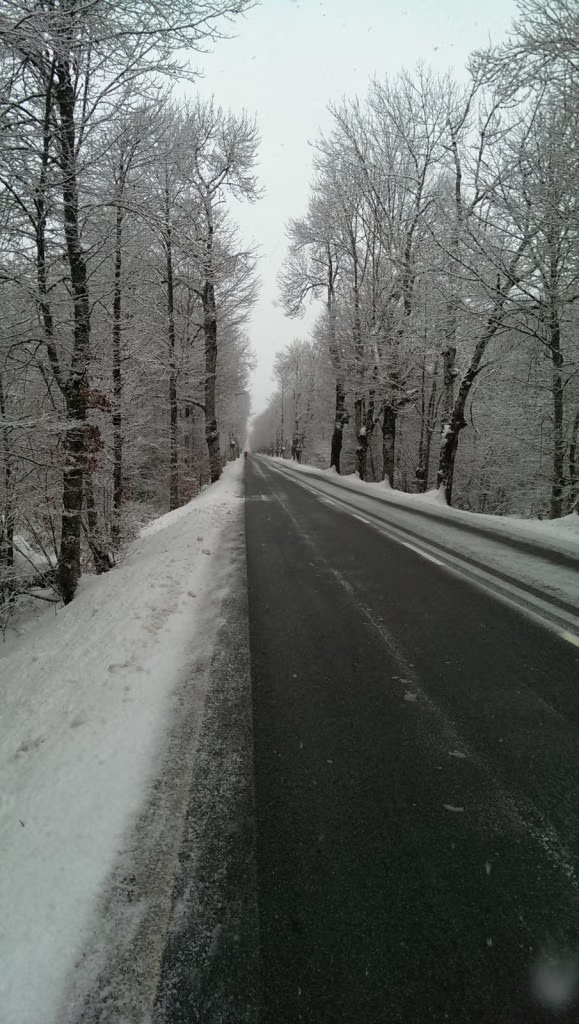
Snow beyond Roncesvalles
At 5.30 a.m. the first over-motivated pilgrims start packing their things. I can’t go back to sleep with all the rustling, and I start getting myself ready to walk too. Shortly after 7 a.m. I set off, and somehow we’re suddenly a group: Anita, Brigitta, Tobias and me. It’s still snowing, and the first thing we see after the monastery is a road sign to Santiago saying 790 km. Well, if that isn’t motivating. Because of the snow, everyone is wearing their poncho. A walking bin bag walks 790 km through Spain with other bin bags. Okay, no problem. We keep walking on the tarmac road, as the forest paths simply aren’t an option in this snow. At first I’m surprised how well I can walk after everything hurt yesterday. Our breakfast consists of packaged chocolate croissants that we pick up on the way in a small supermarket.
After a few km all the pain comes back. I’m dragging my leg behind me again and my steps become smaller and heavier. Our group no longer walks together but one behind the other, with big gaps. We lose Brigitta after only a few km. Then I fall behind, but I hold out bravely and keep catching up. My thoughts mostly revolve around the words hope and confidence. Despite the pain, I walk. Despite the problems, I more or less keep up the pace, because I like having company. At some point we do turn onto a farm track, as there’s less snow now. The road is poison for the joints. We climb up to the Alto de Erro. A climb straight out of a picture book, and I thought it was all downhill! When we reach a viewpoint that you can also get to by road, we take a break. And at that very moment Brigitta turns up again, together with Peter and a Canadian called Ryan. The three of them had walked along the road.
On the descent the path got muddier and more slippery. At one point I slip and end up with one hand in the mud. By then there’s no snow left. The descent is hard and my knees are hot and throbbing like crazy. After 23 km we reach the village of Zubiri. I’m overjoyed and my day ends here. The Hungarian women only have limited time and need to cover distance, so we say goodbye and they walk on. Of course we take a photo first so we won’t forget each other. Suddenly the weather is completely different. It’s warm, dry, the sun is shining and we’re already at our destination at 1.30 p.m. Today the laundry is taken care of by the washing machine in the little albergue run by Maria. So before long we’re sitting in the sun, freshly showered, our shoes drying propped against the wall of the house, and we’re enjoying ourselves. The albergue was a tip from Peter, who expressly warned us about the municipal albergue in the next village. Since on the one hand I didn’t feel like walking on and on the other hand didn’t feel like a dreadful albergue, I’m completely happy with my choice. The albergue has several rooms, and my room had 7 beds in total, so it was small and cosy. Tobias is put in with me, and over the course of the evening two Koreans and Judith, a 59-year-old Australian, join us in the room. Judith is reserved but open and friendly. She proudly shows us her tattoos on the tops of her feet, a colourful star for each family member. Ryan, the young Canadian (I think he was 23 or 24), tells us in the sun that he has problems with other people. That he doesn’t like people and prefers to be alone, and that’s why he’s often considered arrogant. Hm. Well, at least he knows what his problem is. But actually I find him quite likeable, except that otherwise he doesn’t say much. Since the day is still young, Peter, Tobias and I go to a restaurant at around 6 p.m. and start with a bottle of red wine. We talk and talk about Peter and Tobias. Tobias pretends to be someone else at home, he can’t be himself. I think everyone has this problem more or less in certain situations. I hold back and listen.
When Tobias goes to fetch a jacket, Peter asks me again why I’m walking. I’m tipsy from the red wine and try to explain my situation further. About our relationship and how my boyfriend Markus motivated me to find myself. Soon Peter interrupts me and asks whether I love my boyfriend. I answer yes. Without a doubt. Then he asks whether I love myself. I answer quickly, because I’ve known the answer for a long time but never said it out loud: no. Peter says that’s the reason I’m walking. And then it all comes bubbling out of me. The difficult moments at home, the pressure to find a job, the pressure to somehow please everyone. During the conversation I pick the skin around my fingernails until it bleeds, because I’m so nervous. Letting strangers see so deeply into my innermost self is unfamiliar to me. Actually, only one person knows me that well.
While we’re eating our pilgrim menu, more and more pilgrims come into the restaurant. Peter and Tobias look baffled when a tall, lanky man in hiking clothes walks in. Adrian, a 38-year-old Irishman, had apparently walked 5 km further to the municipal albergue. But it had been so dirty that he walked back to us. The mattresses were apparently stained and damp. I shake my head. Nothing in the world would have made me walk back. I’d rather have walked even further, but not back. Oh well, we have another walking partner, who soon says good night and lies in bed as if dead. The clothes are washed, dried and neatly folded when we get back from the restaurant. What luxury! In this small, warm albergue we sleep wonderfully.
Pamplona – 28/03/2014
We set off at 7 a.m. without breakfast. Today “we” means Peter, Tobias, Ryan, Adrian and me. After about an hour we pass a beautiful café by a river. We drink milky coffee and eat a bocadillo (baguette sandwich) with tortilla (egg and potato omelette). I get a stamp here, and the owners proudly show us their new stamp. Tobias and I get the first one, and the owners take a photo of us and our pilgrim passports.
The path is easy, the weather is good and I no longer have to drag my leg. This joy at my regained mobility makes me keep pace with the others. We’re gloriously fast! It feels like flying. We warn each other about piles of poo on the path and help each other over rough spots. Until… just before Pamplona we have to carry on along the tarmac. The tarmac reminds me with full force that I have knee pain and shouldn’t have overdone it like that. In Pamplona we stay at Casa Paderborn, an albergue run by German volunteers. By now I can hardly get up or down a staircase. Here women and men are separated.
When I come into the room at 12 noon, Stina is lying in bed, the heavier German woman I set off with in Saint Jean. I ask in surprise how she can be here before us. She tells me she had health problems. She took the bus to Pamplona and went to the hospital there. She lost over 10 kg in these two days and now has to walk more slowly and rest more often. I’m impressed by her willpower, because she doesn’t give up. We hand in our laundry to the laundry service again. Afterwards I’m told that there’s a healer here. Wolf, an older German who now works as a hospitalero near León, drops in on his German colleagues now and then, gives the pilgrims tips and lays on hands. I got a treatment too, although the success of the laying on of hands was rather modest. But he checks how my backpack sits and completely readjusts my straps. What a difference. A well-fitting backpack is much more important than the weight you carry. Afterwards we explore Pamplona, the city of bullfighting. A beautiful city with lots of flair. We eat in a bar full of students. I don’t feel well. The pain is bad, I feel feverish. In the albergue I take a painkiller and sleep badly, even though there are only two other women in the 4-bed room.
Puente la Reina – 29/03/2014
I’m awake by 5 a.m. The floorboards in the old house creak loudly, the river behind the house rushes, and the shutters rattle in the wind. By 6 a.m. I’m already sitting at breakfast ready to walk, and for a change it actually passes as breakfast. Peter, Adrian, Ryan, Tobias and I set off together at 7 a.m., as soon as it’s light enough. I can’t describe how incredibly bad my knee pain is. And with every step the pain gets even worse. So I torment myself at a tortoise’s pace behind the group. On the way, Peter tells me about the film “The Way”, which I hadn’t known until that day. Peter, who is completely captivated by the Camino and is walking it for the eighth time, knows every scene by heart, quotes it and shows us the filming locations along the way. “Look, this is where Martin Sheen meets the Canadian woman!”, he says in an idyllic Spanish village. “This is the place where the Canadian woman joins Martin Sheen and the Dutch guy!”, he shrieks in front of a small Spanish church. I take pictures everywhere, because I want to match it all up later when I watch the film.
Today we climb up a mountain ridge, the Alto del Perdón. Going up works relatively well with the knee pain. At the top of the mountain I listen to a song on my MP3 player that, for me, belongs on a mountain summit: “Atlas” by Coldplay. On the windy summit with the rusty metal figures I have a wonderful panoramic view over the hilly land. I hold my nose into the wind and listen to the song. This is what freedom and happiness feel like. Living in the moment. That’s what I think as I stand there and forget my pain for a moment. The happiness doesn’t last long, because we start the descent. Well, the others leap down the stony path like mountain goats. I, on the other hand, try to find the sequence of movements that hurts the least. I’m as slow as a snail doing it. Since my left knee hurts more, I step down with it first without bending it, so that I have to bend my right knee. That hurts less, and so I torment myself downhill. I walk the rest of the stage alone, though, because I can’t or won’t keep up. I’m afraid of overtaxing myself physically. I cry terribly as I walk along on my own. How quickly a person reaches their limits. And it’s “only” a path. Hardly any big obstacles in the way, and yet so powerful. We humans depend on our bodies. We should become more aware of that and learn to appreciate it. And suddenly I hear a voice inside me telling me that I’m strong and can do it. Be yourself, be confident and grit your teeth. I curse, sing and grumble loudly to myself, and I make it.
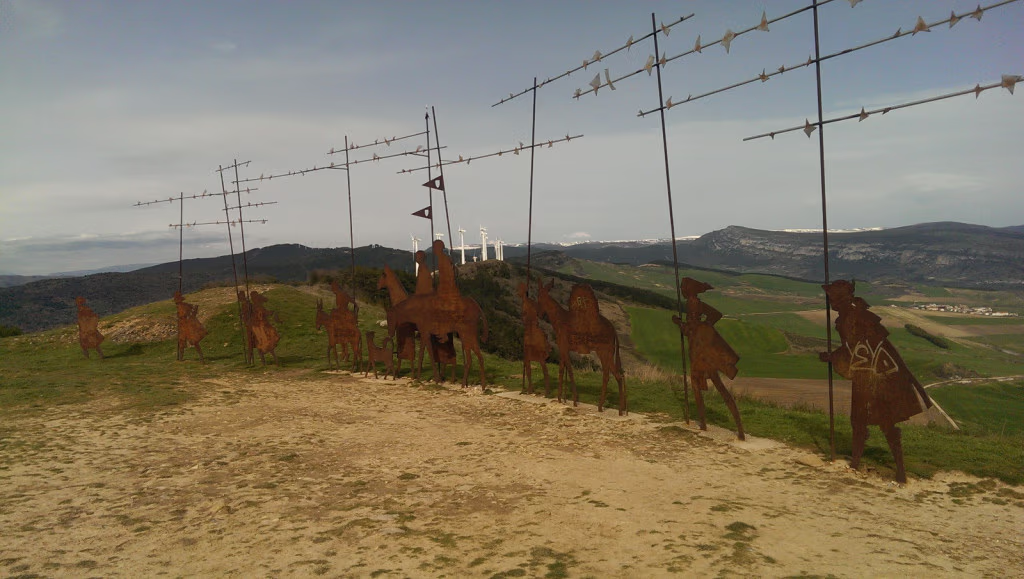
Alto del Perdón
The group waits for me every now and then. The feeling of being waited for is wonderful. I almost cry again when I find everyone in a bar over a glass of Coke. Peter tells me later that they deliberately left me alone for so long. So that I would have to fight. At times they even feared I would stop one village earlier. Well, I did think about it. But it wouldn’t have made my pain any better, and I would have lost the group. Without knowing exactly how and why, I made it to Puente la Reina with the others. Once there, it’s definitely the end for me. That was the day’s goal, and I’ve reached it. The two lads Ryan and Tobias want to keep covering distance and leave us today. The goodbye isn’t hard, but I still think it’s a pity, because I would have liked to get to know them better. The small albergue in the village is not exactly fancy, more functional. To top it all off, I realise that I left my big microfibre towel in Pamplona. Argh… The only luxury I own, apart from my hairdryer. So showering gets harder and harder, and I try to dry myself with the smelly clothes that need washing. Luckily it works more or less, and then the washing machine washes everything.
More and more Spaniards from other routes are now joining the Camino. The pilgrims who started with me in Saint Jean are now spread out all along the way, I suspect. Today we only met two other pilgrims along the way. I think of Stina. Peter told me today that she used to self-harm in Germany. She showed him her scars yesterday in Pamplona. I didn’t know or suspect that. And once again I notice that everyone out here has a good reason to walk. I hope she’s doing well. Today I feel like I can do anything. Walking six hours with that kind of pain is pretty insane in itself. Still, I treat myself to a lot of red wine today to numb the pain, since ibuprofen tablets don’t help. What reassures me is that everyone is walking like a cripple. Everyone has their aches and pains, and mostly it has to do with tendons, blisters, cramps or knees. Apparently it’s normal after all and I just have to keep walking…
Over a bottle of red wine in the albergue before dinner, Peter and I talk about my “problems”. It’s good that he’s here. That he’s here right now. For me. He’s putting me on the path, so to speak. He’s training me to be a pilgrim, that would be the right way to put it. The conversation is emotional and I find it hard to summarise. But basically it’s this: I have a hard shell around me. I protect myself from all sorts of things. I don’t let anything get close to me, then it can’t hurt me. I don’t allow feelings, because, as I know from recent experience, they’re strong and intense. I’m a big scaredy-cat. I’m on this journey so that I can let go of my negative inner attitude. So that I open up. So that I know who I am and why I’m worth being loved. I will fight, I will walk and I will open up. Only then will this journey be special for me! And I will make it.
For dinner we go to a bar that Peter already knows from previous pilgrimages. The bar owner remembers Peter when he mentions his orange tree. Back then, Peter had apparently asked whether the oranges for the juice were fresh. The bar owner was outraged and said his oranges were the freshest of all, because he had his own orange tree. Peter didn’t believe him and was then allowed to inspect the tree and pick an orange. The bar owner beams at us, delighted that Peter is honouring him again and bringing customers too. So he waves us all into his garden to the orange tree and everyone gets a fresh orange from the tree. An unforgettable experience.
Dinner is delicious. Here I get the best paella ever, and my fish tastes delicious too. A child in the place sets off a firecracker, which makes Peter flinch. It takes him back to a completely different (military) world. Poor guy. On the way back we visit the little church in the village. As in all Spanish churches, a lot of gold has been used here. It’s wonderfully quiet. Adrian prays, probably remembering his mother, who is the reason he’s on this pilgrimage.
We keep drinking in the albergue too, and Peter is a real drinker. I talk to Christa, a German woman whose husband comes from Gambia, Africa. The two of them also have a fairly big age difference. She simply wants to do something for herself for once, since her husband often visits his family or travels for work. There’s probably more behind it. Then I quickly go to bed too, after all I somehow still need to recover. The night in the room with six men is very restless for me, since there are snorers among them. But what the heck, at least I have a bed. And supposedly I snore right back.
Estella – 30 March 2014
The next morning I feel like I've been run over because of the pain, and the red-wine hangover does the rest. Breakfast is out of the question, and the prospect of the walk ahead doesn't make things any better. Adrian sets off without us. Peter has breakfast, but he's just as hungover. The first half of the stage (only yesterday Peter said, "There will be no climbs the next day!") begins with a steep climb… Thanks for the warning, Peter. At least I'm hardly in any pain. After the first short but stony descents my knees make themselves felt again, and my right ankle too. From that point on the kilometres get long again. But I still held up well all the way to Estella.
At the youth hostel everyone can have their own four-bed room for €14, lockable, and since I'm the only woman in the hostel at that point, I even have the bathroom all to myself. So I take a long shower and put on lotion, because I have the space and the time. Space, light, hot water, a room of my own. Pure luxury. After my spa treatment I lie down in bed and, for the first time, fall asleep in the afternoon before dinner, and only wake up when someone is hammering on my door. Peter, Adrian, another Peter from Cornwall and I head into town to find something to eat. In a pub-like restaurant we get spaghetti and olives. Today I stick to water instead of red wine. After dinner a few more people have arrived at the hostel, but I go straight back to bed. I have to make the most of that room, after all. I fall asleep immediately, and my sleep is deep, sound and very restful.
Torres del Río – 31 March 2014
Breakfast at the youth hostel is wonderfully lavish. Café con leche, toast, sweet things, fresh fruit and so on. I take a little with me as provisions. In the morning lots of people are discussing today's stage. There are two options: Los Arcos at about 21 km or Torres del Río at just under 30 km. I've pretty much set my mind on Los Arcos; I don't trust myself to do more. Besides, Military Peter would like to carry on alone, and I assume he'll leave me and the others behind today. I set off with Military Peter while the others take forever over breakfast. At every moment I expect him to take off with his military marching step and leave me behind. But as if by a miracle, today I can walk. I walk almost without pain and with great stamina. I can keep up with Peter's pace. What a restful night can do!
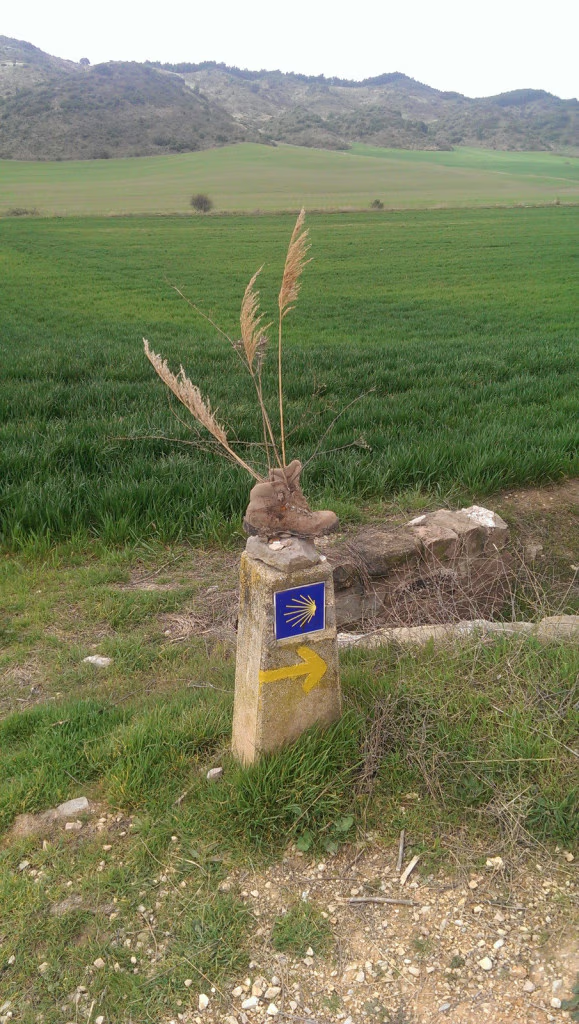
Old boot
Along the way Cornwall Peter and Adrian catch up with us again. In Los Arcos we settle down at a café on the square in front of the church and treat ourselves to a cup of coffee, after Adrian and I have bought ibuprofen gel at the pharmacy. We all feel fairly good, so we all carry on together. By midday it's already very hot, and the last kilometres drag on and are hard. But we push through, and when we arrive at Casa Mariela we're warmly welcomed by the young owner. Of course, he knows Military London Peter. When you walk 30 km, you feel invincible. It's a wonderful feeling. Today we see lots of cats and dogs. The weather is great and the path is wonderfully easy. Walking without a cap in the blazing sun, however, is not recommended.
After my shower I look at my feet, which have red, swollen spots where my socks end, and they itch. Military Peter sees them and says they're definitely bedbug bites and that I shouldn't show them to anyone, or nobody will let me sleep anywhere. This news horrifies me. Creepy-crawlies, bedbugs after such a short time?? Yuck… First I go to the bar and get myself a beer, which tastes simply wonderful after a stretch like that. Naturally, after hearing this, I now itch all over. Purely out of imagination. At this point I assume I picked up the little critters on the first night in Saint Jean. While I'm sitting in the bar drinking my beer and writing my diary, a German family arrives at the albergue. They have a big handcart full of luggage with them. Three little girls are travelling with their parents: Finja, 1 year old, carried on Dad's back; the middle one (sadly I've forgotten her name :/), about 3, who walks some of the time and gets pulled along in the cart the rest of the time; and big Ronja, 6, who walks the whole way. Respect for taking this on with the kids, who go along with it totally relaxed and without any problems. In the father's own words: "Walking isn't the problem – the problems always start in the evening at the albergues." I also meet a couple from Chicago who have all the time in the world for the Camino and mostly walk only half stages. But hey, my greatest respect to them too, for young Americans my age finding their way to Europe and onto the Camino. Here, too, the film "The Way" has had a big influence; I think otherwise the Camino phenomenon would be pretty much unknown over there.
At dinner we all sit together at one table. An Austrian joins us too. Thanks to the kids, the meal is rather loud and not very cosy, but it's wonderfully lively… I've eaten too much too quickly, so I say goodbye to everyone early and go to bed. At that point I had no idea the night would turn into a disaster. It started with some friction with my boyfriend back home. I'm plagued by a touch of jealousy and incomprehension. Even far away, I need his full support. Then my roommates come back from dinner, and I can already hear how very drunk Military Peter is; apparently he also has a bottle or two of wine with him, which he empties on the balcony. Then the others in the room start snoring. I can't fall asleep, and suddenly Peter, in the bed opposite, starts coughing, spitting, throwing up on the balcony, and so on.
I'm disgusted, I itch all over, and I can't get to sleep until about 3 a.m.
Logroño – 1 April 2014
I wake up this day fuming and exhausted. I'm angry with myself, with my boyfriend, with Military Peter, who drinks without any consideration for others, and about the stolen sleep that I needed so badly. I eat a quick breakfast (the freshly squeezed orange juice helps a little) and shoulder my backpack. I walk with the others, but for the first time I deliberately listen to music on my MP3 player so I don't have to talk. And I listen to music that matches my mood, namely anger. No, I don't listen to metal or anything like that, but something louder, more combative.
Today's stretch was easy, but it felt incredibly heavy and hard. My head was full and my body wasn't fit because of the lack of sleep. Peter tries to cheer me up. He asks what I actually like about myself. I like that I persevere and fight. Just as I'll walk the Camino to the very end. There's a lot I don't like about myself. My insecurity, first and foremost. Peter points out my good sides and boosts my self-confidence. He's not wrong about much of it, and I know my boyfriend thinks the same as he does. So why can't I just see it that way too and value what I have in myself? He tells me that Ryan, the Canadian who was with us until a few days ago, asked him whether I was single. Of course, news like that does wonders for a woman's self-esteem. Being desired is a great feeling, especially when you don't have to pretend, but are liked for who you really are. And on the Camino nobody pretends, at least nobody who is seriously dealing with their problems.
Shortly before Logroño we pass the stall of Felisa's daughter Maria, who gives us a stamp. I buy a shell necklace from her, which now goes with me everywhere. In Logroño I treat myself to a single room in a guesthouse for €20. I just need that tonight. To be on my own for once, plus towels and a duvet… Luxury. I buy an insect spray and spray all my gear and myself with it. I eat what I bought at the supermarket. The heat blisters on my nose, which I've been carrying around since yesterday, are getting worse. Some burst and become open wounds. I'm practically disfigured.
I don't leave my room again that evening, write postcards and go to sleep early.
Nájera – 2 April 2014
First thing in the morning I'm annoyed that not all my clothes have dried. I set off at 7 a.m. and want to have breakfast somewhere, but I can't find an open café yet. That annoys me no end, and I keep walking. I fill my water bottle at a fountain and eat an apple. It's still dark, but since it takes me half an hour to get through Logroño, where everything is lit up, it's not so bad. I assume the others will catch up with me anyway. As on the last few days, the first 10 km are no problem. The path goes past a beautiful lake, and in my solitude I even start singing a bit of "Tanz der Vampire" to myself. Louder and louder, until a few cycling pilgrims ride past, cheerfully greeting me. Then I'm embarrassed again.

On the way to Nájera
I take a shortcut and so skip the little town of Ventosa. The Rioja region is a reddish brown, the vines are still stunted, gnarled branches, and the weather is oppressive. And so I walk and walk, and I don't meet a living soul. The others are nowhere in sight, and I fight and fight, and alone as I am, the last kilometres become torture. Everything hurts and I drag myself into Nájera. Today all I thought about on the way was keeping going. I wanted to prove something to myself and to the others. In Nájera I head for the albergue Peter mentioned and I'm the first to arrive there today, after 28 km. At least I found my way on my own and didn't get lost. Still, walking alone was oppressive. I shower in the albergue, which really is very nice, and I'm getting myself ready when I hear Military Peter, Cornwall Peter and Adrian arriving downstairs. The three of them are relieved when they see me. They thought I'd gone home. In reality the three were only 20 minutes behind me. One longer break, and they would have caught up with me after all. But I guess it was my fate today to walk alone.
In the albergue I meet Richard, a young German of about 20. He asks me if I'd like to talk with him. I say yes, because that's what we're all here for, after all. But then comes a speech that I couldn't follow, owing to my lack of drug consumption… "I had a total enlightenment when I was walking with two Hungarian girls! We're all individuals. But still, we're all here. And we're all One." While he philosophises away, he rolls his joints. The only reason I'm pleased is that by the two Hungarians he meant Anita and Brigitta, and I'm glad that the two of them are still walking together and seem to be doing well. When, after 10 minutes, he gets to the Big Bang and starts talking about the universe, I definitely tune out and think to myself: "As long as he's happy!" By now the whole room smells of weed. When Military Peter notices, he gives Richard a real dressing-down. That it's illegal, especially in albergues, and that he'll get thrown out for it, or end up in jail. Richard then takes his leave with the words "Then I'll just go up the mountain." … For a moment I'm speechless and ask myself, "What mountain????".
By now I'm longing for a hot meal, and after we've posted my 12 postcards, Military Peter, Cornwall Peter, Adrian and I go to a very modern restaurant. There we meet the New Zealand couple I'd already heard about. The two of them are on their honeymoon on the Camino. After the husband developed problems with his Achilles tendon, the two bought complete cycling gear, including bikes and panniers, and are now cycling the Camino. To each their own. I often heard people comment on this story: "Well, they really want to find out whether the marriage will last!" At the restaurant I get pasta salad, meatballs and ice cream. My feet are hurting quite a bit too, and after dinner and a nice cold beer I go to bed at 8 p.m. to gather my strength again for the next day.
Grañón – 3 April 2014
When we set off together the next morning (Military Peter, Teacher Peter, Adrian and I), Richard is still asleep. He doesn't want to rush anything, he told me yesterday, and he takes about 2 to 3 rest days a week, walking about 15 km a day. Well then, have fun and have a nice life. The way to Grañón is easy.
I start walking consciously. I place one foot in front of the other deliberately. I start pushing my body forward with the back foot instead of dragging myself along behind the front foot. It's a completely different way of walking. I become consciously aware of my breathing and find a rhythm that keeps me from getting out of breath. Even though a lot of things hurt, I can walk and it feels good. Once you forget the pain and the walking, you start to focus on yourself and to enjoy yourself. My body is starting to change. It's as if I've slowly walked myself in. Military Peter says the fat around my organs burns off first. I think that process is well underway. I feel good. Important insight: lengthen your stride while keeping the same rhythm. That way you automatically take fewer steps, and the distance is no longer a problem.

taking a shortcut across the field
And so, for the first time, my thoughts start to revolve around my life and no longer around my pain. Actually, I'm doing really well. A healthy environment at home, a loving boyfriend, good friends, health, beautiful moments. What more could you want? That's life. And you only get one. In Grañón we head for the church. There's a donation-based albergue here, run by volunteer hospitaleras. I'm sceptical as we make for the bell tower, in the rain by now, and climb up, freezing. Once we're inside, my mood changes instantly. The sight that greets you can't help but make you feel welcome. A fire is burning in the stove, the warmth is very pleasant and fills the whole room. Patrizia, the Spanish hospitalera, receives us with the words "Welcome, we've been waiting for you. I've just got a stew on the stove!" We settle into the mattress dormitory in the upper part of the room. Of course, no luxury awaits us here. But the hot water of the shower feels good.
Afterwards I'm given a tea while I write my diary and listen to the Peters' conversation with Patrizia, the hospitalera. Military Peter says he once stayed at another albergue in Grañón and that the man running it is crazy. Patrizia, a very direct and brusque woman, says she knows the man, that he's her friend, and that she doesn't like the way Peter is talking about him. The conversation escalates for reasons I can't explain. I didn't think the discussion was all that bad – two people standing up for their points of view. But Military Peter angrily packs his things and leaves the albergue without a word. I'm shocked, but Teacher Peter tells me that Military Peter simply can't handle criticism, especially not from women. I can't understand this exit, but I accept his decision.
I call my boyfriend back home, since the Wi-Fi in the church isn't really set up yet. He's over the moon, and I have tears in my eyes. It's the first time I've heard his voice since I left. He has good news: he's been accepted onto a qualification course. And I tell him about the lightness I've gained today. After the call I help the young Hungarian hospitalera with the shopping for the evening (bread and biscuits). As we sit around the stove, I meet more wonderful people who will go on to become very important to me. Ellen, an American from Seattle (51), who wants to reorient herself professionally and personally, currently works for Microsoft. But she'd simply like to find her bearings again and move professionally in a more spiritual direction. I meet Antonio (mid-30s), an Italian radio presenter from Bergamo. He entertains the whole group. Pure joie de vivre. There's also a Spaniard who comes from near Santiago. So he's walking home. Well, he has a bike with him, but he mostly pushes it, because he simply enjoys chatting with the pilgrims. A funny guy. Two elderly ladies from Norway join us. They're walking slowly, partly by bus. I'm impressed. And when I mention my knee pain, one of the ladies gives me a cream. I rub it on my knees, and I don't really know whether they're getting hot or cold, but something is happening. The second-to-last to arrive is Phillipe, an old man who has walked all the way from northern France. He has a cart with his backpack strapped onto it, which he pulls with his hips. He speaks a little German and is the embodiment of warmth.
We all go to the pilgrims' Mass together (except the Italian, who has to cook). Even though I don't understand a word, I feel moved and gladly receive the pilgrims' blessing. The last to join us is a Basque, and during dinner I sit between the Basque and Patrizia, who is Catalan. I learn a lot about the conflicts between Basques, Catalans and Spaniards. The evening is so harmonious. After dinner we go up into the choir stalls of the magnificent church and light a candle. The candle is passed from pilgrim to pilgrim, and everyone talks about the reasons for their pilgrimage. It's deeply emotional, and, profoundly moved, I say honestly that I don't accept myself and want to find myself and learn to love myself. You aren't judged on the Camino – that's the beautiful thing about it, and that's why you can be who you are. Once more we read the pilgrims' blessing, which goes like this in English:
Lord Jesus Christ, who called your servant Abraham out of the city of Ur of the Chaldeans and protected him on all his wanderings, and who led the Hebrew people through the desert: we ask you to bless these your children who, out of love for you, on their pilgrimage to Compostela pass through the streets and squares of Grañón. Be for these pilgrims a companion on their march, a sure guide at every crossroads, a shelter on the way, shade in the heat and light in the darkness, comfort in their discouragement, steadfastness in their intentions, trust and presence in their doubts. So that under your guidance they may arrive strengthened at the goal of their journey and, enriched with grace and virtue, return home again unharmed, full of salvation and happiness. Go in the name of Christ, who is the Way, and pray for us in Compostela.
During our minute of silence everyone is very emotional. But we're all glad of the experience that binds us together. Afterwards everyone gradually goes to sleep. The thin mattress on the wooden floor isn't really comfortable, and it got colder and colder during the night, so I slept rather badly. But the evening was worth it.
Villafranca Montes de Oca – 4 April 2014
The next morning the hospitaleras conjure up breakfast for everyone. The young Hungarian woman takes me aside and tells me she walked her Camino for the same reasons as me. She says God helped her and that I should have faith. As I'm not very religious, I find her encouragement kind, but I don't really feel that what she's said will help me. At that point I have no idea how wrong you can be.
We set off in good spirits, and the only topic of conversation is Military Peter. I think only about him and about what it is that bothers me about him. He has too many problems. Problems he can't solve himself. And he's running away from his problems – that's why he's walking the Camino for the eighth time. He helps lots of other pilgrims so he can push away his problems and his true self. We meet him in the next village, where he apparently spent the night on a playground. He seems confused and talks rather incoherently about how terrible his night was. Afterwards he walks with us for a bit and I tell him what I've been thinking. And what does Military Peter do? He starts to cry, speeds up and runs away from me. Bad enough that I (a 24-year-old) have to point out his problems to him. He rushes past Cornwall Peter with a nasty remark. Adrian and Cornwall Peter aren't exactly keen on seeing Military Peter again. But I can't get the whole thing out of my head. It may be my Camino, but maybe you can help someone else too.
After the treatment with the Norwegian lady's cream, my knee pain has almost disappeared and walking is wonderful. I also think about the kindness I've received in life and on the Camino. And about the love I can give and hopefully receive too. And I'm simply grateful and happy about everything and cry tears of joy. For the last few kilometres a terrible wind comes up, and we have to walk straight into it. We fool around, saying you have to walk like Superman. It saps our strength, and we're glad to have arrived at the Hotel Villafranca with its albergue. Military Peter isn't there, which has a positive effect on everyone's mood. We meet Ellen there again, which makes me really happy. We empty a few bottles of wine together and go for a nice dinner in the restaurant of the three-star hotel. There's spaghetti, a burger and rice pudding. The evening is simply what you'd call a good time. At around 10 p.m. we go to bed. Despite the nice accommodation, the night is restless. An American, who is lying under Peter and next to Adrian (bottom) and me (top bunk), snores so loudly that we all make annoyed noises… At some point I hear something clatter, but I don't bother about it any more.
Atapuerca – 5 April 2014
The next morning I find out that Cornwall Peter threw his glasses at the snorer. Ha ha, I have to laugh so hard it hurts. As we come out of the hotel garden, Military Peter crosses our path. He ignores us. I wish him good morning, but barely get an answer. And so we walk behind and in front of each other, and I slowly get angry. Angry that he's having such a negative effect on my thoughts and mood. This was really supposed to be MY Camino. And so that day I take the lead, walking out in front, full of strength and energy, and I have the feeling that I need to look after my fellow pilgrims Cornwall Peter and Adrian and be strong for everyone. For the first time I take on a leadership role.
The long way to the next village (aka my breakfast) is about 13 km and a case for my emergency power bar. We walk through the forest, where it's extremely muddy. I don't take a single step towards Military Peter, because I've tried. He has to let himself be helped too, and apparently he doesn't want that. The way to Atapuerca isn't particularly far, so we're already there by midday. I feel great, but I don't want to leave my group, so I stay with Adrian and Cornwall Peter in a bungalow-like albergue. Military Peter crosses our path once more and apologises for his behaviour. I hug him; at first he flinches away from me, but then he lets it happen. Poor guy. He stays in another village, and we have another calm, harmonious rest of the day.
In the little village shop we drink lots of coffee, and Cornwall Peter and I watch Antonio, the Italian from Grañón, shopping with two pilgrim friends for a home-cooked dinner… Watching Italians go shopping is incredibly entertaining. Antonio: "Ah, I forgot something! Il formaggio! Queso! The cheese! No dinner without cheese!" We then laze away the long free afternoon in our beds. My rash, or heat blisters, keeps getting worse. And despite these blemishes I feel loved and just good. The pilgrims' menu in Atapuerca was the tastiest of all. Pasta in oil with fried vegetables, then Thai chicken with rice and fresh strawberries, for €12. Since Peter, Adrian and I have a six-bed room to ourselves, each of us has taken a bottom bunk, and we all get a big helping of peaceful sleep. The snoring American is in the same albergue, but in the room opposite, with two doors and a corridor between us. We sleep soundly.
Burgos – 6 April 2014
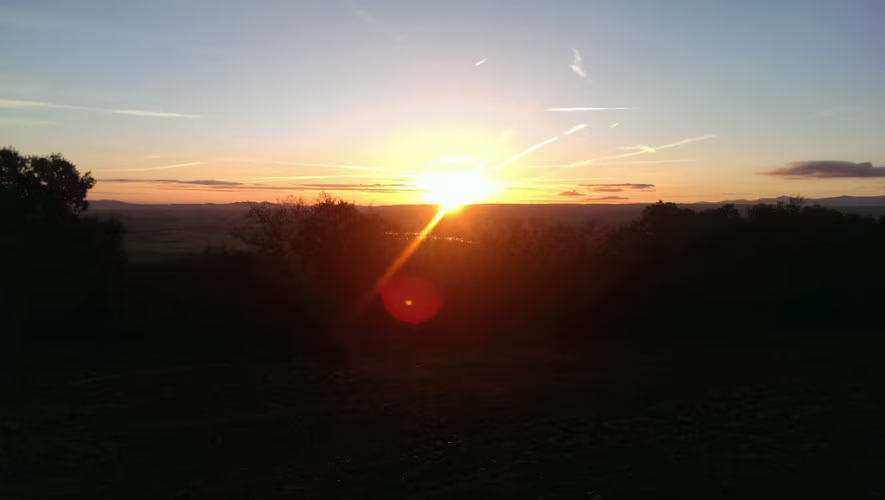
Sunrise beyond Atapuerca
Morning comes far too quickly. None of the three of us wanted to get up. And yet, like every morning, we pull ourselves together, pack our things into a backpack and keep walking west. On our way towards Burgos we experience a beautiful sunrise in the middle of a flock of sheep. The second half of the route is on tarmac roads, and the path runs for kilometres through the industrial area of Burgos. All this walking on asphalt is a real strain, and we're immensely relieved to reach the modern municipal albergue.
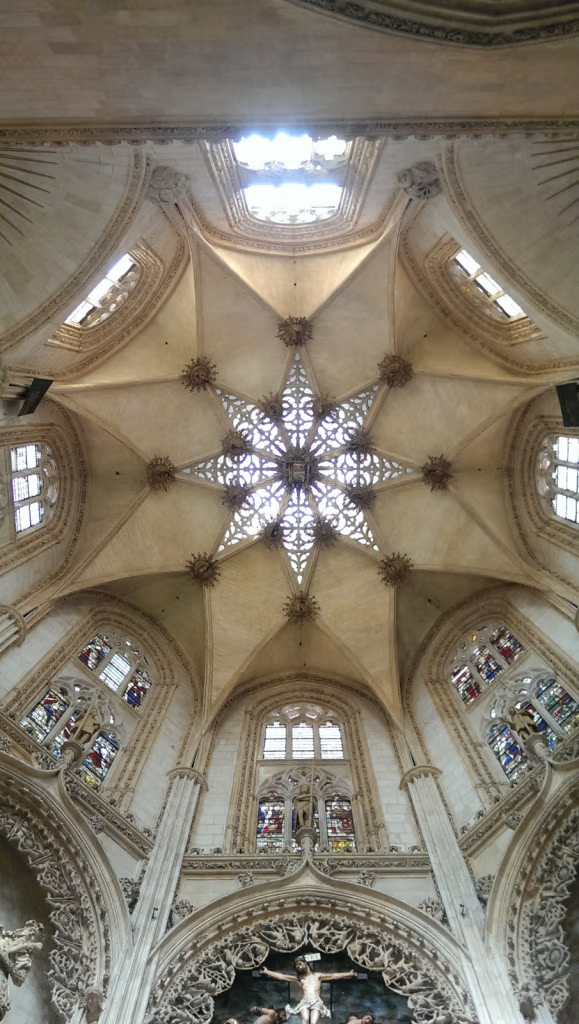
Ceiling of a side chapel in Burgos Cathedral
One by one, familiar faces trickle in: Military Peter, Ellen, an older Spaniard I've been seeing again and again for a few days now, who always chatters away at me in Spanish even though he knows I don't understand a word, and Antonio and his pilgrim friend. Once again I'm sleeping in a top bunk, but that's no big deal. What is bad is my face. I'm puffy, red and have open sores all over my nose and cheeks. For a while I hit a low and want to go home. Burgos has an airport, which is tempting. But I pull myself together and go sightseeing in Burgos with the others, especially the most beautiful cathedral I've ever seen in my whole life.
In the cathedral, for the first time, I feel like a real pilgrim, in awe of the architecture and the paintings. How long it must have taken to create something like this. What perseverance the people who built it must have had. I thank God for everything I've experienced so far and for the people I've been lucky enough to meet. The weather is perfect and we enjoy our time together. On top of that, here we get the worst and most expensive pilgrims' menu of the entire trip. Thawed, cold paella, lamb drowned in fat with chips swimming in fat, and rice pudding with cinnamon. The restaurant's barmaid was barmaid, waitress and cook all in one… That says it all. In the albergue I run into Antonio, who asks me about my face. I say I've no idea what it is. In his great, cheerful Italian accent he says: "It's the sun!" So I swear that from tomorrow on I'll put on sunscreen and wear a cap. I'm glad of the sleep I'm getting again and I'm looking forward to the rest of the journey. Military Peter once said that things change from Burgos on. For one thing, Military Peter is going to stay another day in Burgos. That means we won't run into him again. What else awaits me, I don't know.
Part 2: The Head
Just as I start to feel good, the work for the head begins. The vastness of the wheat fields, the flat landscape and the endlessly straight paths lead you to turn inward. And you notice many more details: lizards, snakes, frogs… Everything you might otherwise overlook is like a scream in the barrenness of the landscape here. From now on I slowly begin to find myself.
Hontanas – 7 April 2014
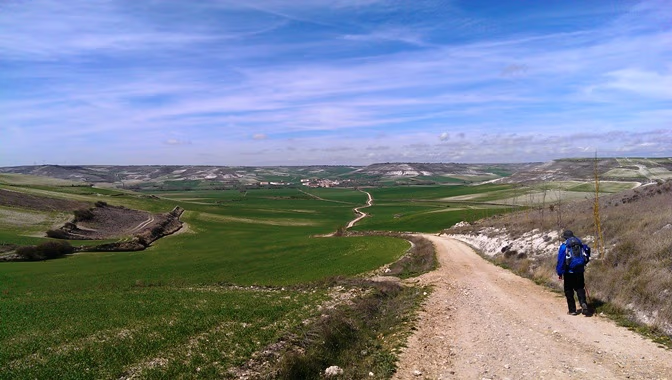
On the way to Hontanas
Today Ellen, Cornwall Peter, Adrian and I walk together. The region is changing now. The dreaded Meseta awaits us. Endless wheat fields, vastness, no changes in elevation, boredom for the body and work for the head. We gladly accept the challenge. Along the way we push each other on. Sometimes we chat, sometimes we just walk side by side. I don't think much, because I simply want to make it to Hontanas (32 km). I enjoy myself and my body. I'm happy that my body is taking on these hardships. The last kilometres are, as always, the worst. Especially because you can't see this village until you're there, since it lies in a hollow. But arriving at the albergue feels like a class reunion. Antonio and his friend, whose name I still don't know, the New Zealand couple with the bikes… I meet a couple who speak Italian but no English, which rules out communication and getting to know each other better. On the other hand, I meet a couple from Inzell who work in the restaurant business, and Jürgen, a Swabian who has just walked his first day and is complaining about the pain. Nothing spectacular, just a good time, and I decide for myself to simply accept this time as it is without reading anything into everything. Dinner with Ellen, Peter and Adrian was harmonious. We talk a lot, laugh a lot, everything fits, everything is light and buoyant. It's as if my soul is now on holiday. Recovering. At 9 p.m. it was off to bed. There's not much more to say about the day, except perhaps that my face feels less tight. Antonio was right, it's sun allergy…
Boadilla del Camino – 8 April 2014
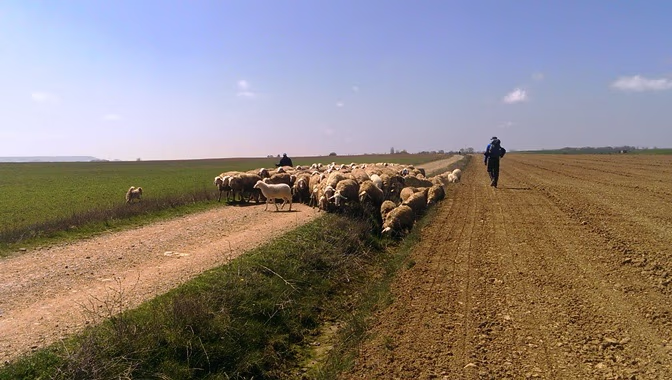
Oncoming traffic on the Camino
We get up at 7, have breakfast and set off. Every 8–10 km we take a break, because we run into the Italians. In Antonio's own words: "The breaks are the camino! Espresso and bocadillo!" He's entertaining, and we enjoy the breaks, the coffee, the beer, the food, the weather… At the start a steep climb awaits us, and I have so much strength that I almost sprint up the hill. It's a rush. That's what it's all about, isn't it? Enjoying the good times, living! Around midday it gets sweltering, and the kilometres across the shadeless Meseta get hard, partly because there are an insane number of flies. Adrian and I break away from the rest at a marching pace; we just want to get there. A flock of sheep comes towards us, with a donkey walking in front and the shepherd and two dogs keeping watch. How sweet! In Boadilla we get into an albergue with a beautifully laid-out garden. After my shower I look at myself in the mirror in my sports bra, and I actually enjoy the sight of myself. Something like a six-pack is reappearing. Despite my disfigured face, I feel sexy. I lie down in the sun with a beer, which draws smiles and envy from Antonio and his friend Felipe (yes, I finally know his name, and that he's Brazilian!). My face is slowly getting better; the swelling is going down. You might even think the two guys are in a flirty mood. And hey, why not – that adds to the good mood too. There's a communal dinner, and I sit next to an Australian woman and Ellen. When the subject of my job comes up, which is still a big problem for me, I go very quiet. Both of them tell me it doesn't matter what I do, but I have to be aggressive, I have to show determination, and then I can get anything. I have to speak in the "I form" instead of the "we form" (we women, we Germans, we …) to stand out as an individual. I'll take that advice to heart and hopefully put it into practice successfully at home. The night was very cold once again and I get little sleep, but at least there are no snorers in the room.
Carrión de los Condes – 9 April 2014
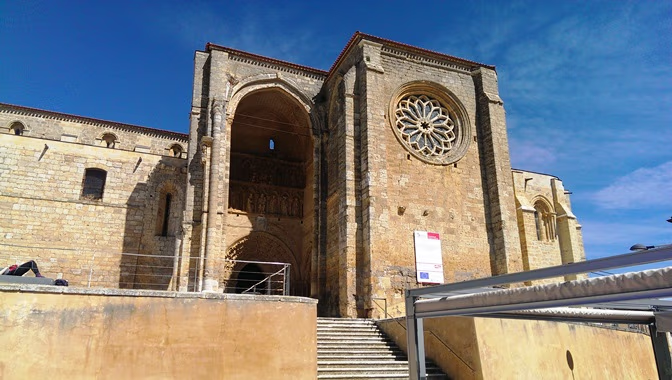
Church in ?? Who knows? Must have been somewhere between Boadilla del Camino and Carrión de los Condes.
The next morning starts with “my” group (Ellen, Adrian and Cornwall-Peter) wanting to set off without breakfast. Peter lost his phone in Logroño and hopes to buy a new one in the next town. The albergue offers breakfast, and I don’t like walking without breakfast. So I decide to walk with Antonio, Felipe and the Italian couple and meet the others along the way. It’s a wonderful time. I can’t really understand Federica and Christien (the couple), but I like them both. They’re so nice and, in typical Italian fashion, full of good cheer. I learn that Federica is a triathlete and is doing the whole thing for sporting reasons. And she’s a vegetarian but doesn’t like strawberries. Her boyfriend would apparently just love to keep up with her, but he’s struggling with his calves.
The walking is no longer contemplative and quiet but full of life. Antonio loves to talk, and a lot, but he sings just as much, and I also talk a great deal with Felipe, who at least speaks good English. On the very first day he too encourages me to be myself. We stop in every village for coffee. I don’t know why, but on this day a little knot in my throat bursts and for the first time since my school-leaving party I sing in front of my fellow pilgrims. It sounds unbelievably awful, but what counts here is above all the courage and the experience. Because that’s who I am: I like music, I love singing. And I think to myself, Military-Peter was right: things change after Burgos. And mostly through all the positive energy of the people I’m meeting now.
We head for the Santa Maria albergue, which is run by nuns. A lovely, simple albergue with a kitchen, where the Italians want to let loose again. On this day I also get to know Youn from Korea. I had already seen him in Burgos but hadn’t had any further contact. His English is poor, so even after the whole journey I can’t say why he was there. All I know is that he provided so many funny moments. Because from this point on we run into him every day, and he always reaches the albergues before us. I know that he was in the military too. And who else do I meet in the albergue, of course? The older Spaniard, who once again tells me about his foot and boot problems in Spanish. After a shower I head into town on my own and get something from the pharmacy for the wounds on my face, which are healing by now. I get money from the cash machine. And as I’m strolling through Carrión, suddenly someone yells: Lisa, come here! And there I see all my dear ones sitting on the plaza over a beer. I join them and get a beer, which I empty quickly because of the heat. I meet more people (what else do you do on the Camino?): Pascal from Luxembourg and Pauline from Holland. Pauline has only just started. She tells me about conflicts with friends and how she pretends to be someone else at home. As far as I’ve already managed to help myself, I try to give her some advice. At this point I can’t put a name to everything that has already happened to me, to what has changed. Only in hindsight was this the beginning of my new self. The Italians, Felipe and I go shopping for dinner. In the end, pasta amatriciana for 12 people is cooked that evening, including salad, wine and bruschetta. The menu comes to €3 a head. We also talk about the next day’s stage, which is a tough one. We’re facing the longest stage with no village in between. Tomorrow morning it’s 17 km to the next place. The route has no shade and simply runs straight ahead. So we decide to set off early so as not to get caught in the midday sun.
Terradillos de los Templarios – 10 April 2014
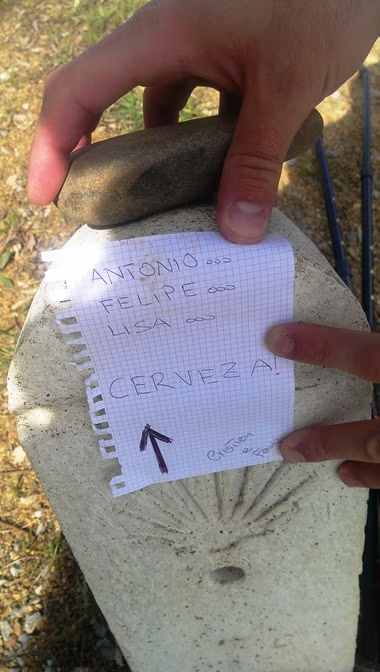
Notes left as messages are not unusual along the Way.
We leave at 7 a.m., and after coffee and pastries we get going. I stick with Felipe, with whom I get on amazingly well. He’s one of those few people you’d describe as being on the same wavelength, a kindred spirit of sorts. He knows what I need in certain moments, how to motivate me. So we talk a lot during the 17 km, which fly by for me. He simply makes me feel normal, even though I’m often not convinced I am. You learn to read people and to trust them, and Felipe is one of those people. I come to the conclusion that you have to stand by yourself and your inclinations. Nothing else makes you happy.
When I arrive at the bar, I’m greeted by a funny sight. All the others, especially Cornwall-Peter, are completely worn out from the forced march in the heat, and everyone’s boots are off. By now I’m walking in short shorts and a T-shirt too, but always with a cap and sunscreen. The Italians with their walking poles have of course raced ahead of us at breakneck speed. Everyone at their own pace. At last I also find out what I often see written on stones and walls: A Passo Lento. Walk slowly. Doesn’t really apply to many Italians, which is probably why they write it to slow themselves down. The rest of the way flies by too. In Terradillos we split up. Felipe and I stay in a lovely albergue with a big garden. The Italians walk on. Youn and the others are in an older albergue in the village. In our albergue we stay in an 8-bed room where, apart from the two of us, there’s only one other pilgrim. The older Spaniard. Since Felipe can speak Spanish, I have him ask the gentleman’s name: Alfonso. At last the man has a name. And once again he tells me about boot problems in Spanish. Felipe tries to translate, but Alfonso talks fast and mumbles. I learn that from now on he’s sending his backpack ahead and only taking the bare essentials for walking, to take the strain off his back. The rest of the day is unspectacular: showering, lazing around, eating something and sleeping. I think I look really sexy, my trousers need a belt by now and my nose is getting much better too. I feel great.
El Burgo Ranero – 11 April 2014
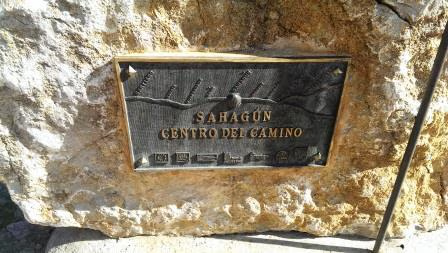
Sahagún – the halfway point of the Camino
Today we start at 7:30 a.m. and catch up with the Italians and the others along the way. We’re making good progress, my head is empty and it feels great. Like a fresh start. As I walk, I think about what other people think of me and that they might be talking about me. And suddenly the thought comes to me: “Hey, so what?!” We walk a stretch that doesn’t change for hours. A gravel footpath, trees lined up like an avenue on the left, the road on the right. It goes straight ahead like that for hours, and I think to myself: “I’m so many kilometres away from home and people are talking and gossiping about me.” And instead of worrying and fretting about it, I think: “Wow, what a success! Let them talk! It may be envy, admiration or whatever, but it isn’t indifference!”
And as I’m gazing at the beautiful clouds in the sky and worrying less, suddenly something goes CLICK. In the middle of this monotonous landscape my positive inner voice says: “Here I am. This is you. And you are positive!” I search inside myself for the cynical, sarcastic voice that used to comment negatively on everything and everyone. But I can’t find it. And I’m over the moon about that. With OneRepublic’s “I Lived” in my ears, I walk into El Burgo Ranero fast, buoyant and without any sign of tiredness. The guys have trouble keeping up. We arrive at an albergue looked after by two volunteers from the USA, Trish and Stef. Cornwall-Peter must have announced us already, because we’re expected. Youn is already there and of course Alfonso, the usual suspects. Later Ellen and Adrian arrive too. Once again we treat ourselves to a beer first and then go shopping for the risotto we’ve planned. A Spanish woman cooks tortilla, and once again we have a big, delicious meal. Felipe has withdrawn; he carried his salami around in the heat one day too long. Poor guy. In the evening an interesting conversation develops between Stef and Ellen. Stef is a yoga teacher, and over the course of her journey Ellen has also been thinking about leaving Microsoft to teach yoga classes. And so this encounter, too, is a strange stroke of fate.
Arcahueja – 12 April 2014

Sunrise beyond El Burgo Ranero
Today I’m full of strength and energy and just want to get going. Walking comes easily to me, and today I walk with Ellen and Adrian, who set an equally fast pace. The battered Felipe stays with Antonio, who is dawdling just as much today. After 12 km we come to a bar where I treat myself to freshly squeezed orange juice. The vitamins simply do me and my body good. Further along the way I talk to Ellen. I tell her about my special moment and thank her for the positive energy she radiates. She tells me that she sees a huge reserve of energy in me that is just waiting to break out. That she thinks I’m very strong and that I’m slowly starting to radiate it too. Then we talk about how important good friends are, and she starts to cry. But with joy, because she treasures her friends so much. I’m moved that I get to share this emotional moment with her, just as in Grañón.
We walk more kilometres, and the midday heat quickly tires us out. When we arrive in Arcahueja, who’s waiting for us? Youn! Alfonso stopped earlier; sadly I won’t see him again. From what I hear, I’ve also seen Teacher-Peter for the last time, because he too stops one village earlier. Antonio is a bit pressed for time, because his flight is booked in a few days, and he takes the bus to León. Felipe at least trickles in a little later. The heat is claiming victims and tearing our group apart. A pity, but that’s the Camino. After a glass of sangria with Ellen I write in my diary, sit in the sun and let the day pass in review:
- I love myself and my life.
- I love the hobbies I gave up because of my studies. Over time I have to win one of them back, probably horse riding.
- I’m beginning to connect with nature, which does me good. For me that means moving out of the city, which weighs on me and gets on my nerves.
- I love my body, and in future I want to treat it better. For me that means more exercise, cycling.
- Maybe I’ll learn another language; Italian is so beautiful, and I can “only” get by in the world with my English. That’s a shame, isn’t it?
The set menu we get in the only albergue in the village is the “they always tried their best” kind. Spaghetti, fried fish with potato wedges, salad and pudding. Afterwards we more or less roll into bed, and a melancholy feeling comes over me. We’re just outside León, just before the last third of the Way, and I wonder what happened to the time. I’ve had important insights up to this point, but I’m not ready to end the Way yet. Sad but with my soul full, I fall asleep that evening.
Villar de Mazarife – 13 April 2014
We get up at 6:30 a.m. and wolf down the breakfast that was already prepared for us the evening before. We set off for León, which is only 7 km away. We get there fairly quickly too and enjoy the morning atmosphere of the city on Palm Sunday. On the big square in front of the cathedral I feel a certain awe, just as I did in Burgos. And as we sip our coffee there, we experience something like a class reunion once again: the New Zealand couple, the couple from Inzell, Youn… Everyone streams in here, and we at least hear that Antonio set off only a few hours ahead of us. I look at the cathedral’s entrance portal. A gorgeous rose window sits enthroned above the doors. Gorgeous. But then I notice the two ugly creatures on either side of the rose. I wonder why these ugly creatures have been put on such a beautiful work of art. And that’s when it hits me for the second time on the Way. It’s precisely the ugliness of the figures, and the courage of whoever placed them exactly there, that makes this rose so beautiful in the first place. Without our knowing it, the rose is only perceived this way because these ugly figures are there. And that is art. It makes you think. It isn’t always beautiful. People argue about it. And I understand what I have to do at home. I had hung up my work as a hobby model because the pictures were always the same. In the end it was just a job. And now I know that I should definitely keep working as a hobby model. But I have to make art out of it. At least for myself. Maybe the pictures can be shared, let people discuss them, provoke liking and disliking. Then people will talk about them, and isn’t that exactly what I want? The thought of seeing myself as an artist appeals to me and is taking shape in my head.
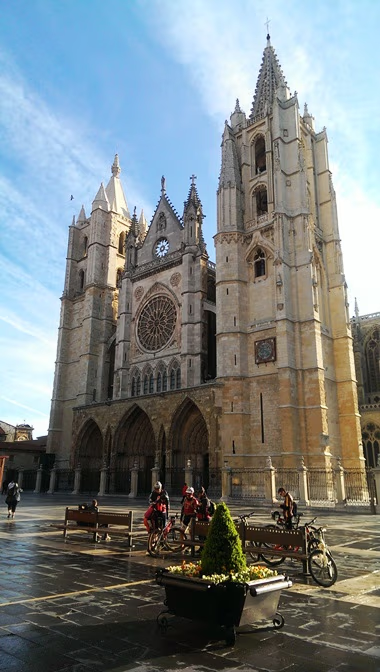
León Cathedral on Palm Sunday
And suddenly ideas for shoots come tumbling out and I’m bursting with a creativity I had never noticed in myself before. Here in León, on the square in front of the cathedral, a stone starts rolling. I want to walk on and now let the Way inspire me. We say goodbye to Ellen, who wants to spend the day in León. It’s a pity she isn’t coming with us, but that’s the Camino. For a few days I’ve also had the idea of getting a tattoo. I can’t get the name La Peregrina, the pilgrim woman, out of my head. But now I know that this is the name under which I want to carry out my new projects. La Peregrina was born in León. I notice how nature, the landscapes, the people and also the music I listen to inspire me.
In Virgen del Camino stands one of the most modern churches along the Way. People are just streaming out of the church, and we get talking to a hospitalera. She tells us that the artist who made the church’s figures died only recently. I’m moved by these ghostly figures, and one of my first picture ideas comes to me.
We walk on, and I have more ideas. At our destination I buy myself a little notebook in which I write them all down so as not to forget any. We meet a group of Americans (Lindsay, Christy, Cary and Ian), who eat with us that evening. They’re from Tennessee and are what you’d call good company. I’m a bit overwhelmed by all my ideas and switch off for the rest of the evening.
Part 3: The Soul
In the last third you rebuild your self-confidence and your strength and reinforce what you discovered for yourself in the previous section. This time is there to be enjoyed and to realise what a wonderful experience you’ve been allowed to have. You learn to appreciate many things, and pieces of the puzzle come together into one big whole. And you find something else wonderful – your faith.
Astorga – 14 April 2014
Now that I’m consciously letting myself be inspired, I pay close attention to nature and my surroundings. We’re heading towards the mountains, and I’m already looking forward to some variety in the landscape. The 33 km are fairly easy going. And I notice that water looks as if it’s happy to be allowed to flow. I feel as if I’m connected with the water. Maybe nature-based belief and the teaching of the elements are something I can identify with and believe in. I don’t know, but I like flowing water. I like watching it. Astorga lies in an idyllic setting, but I notice that the soles of my feet are starting to burn. I’m glad when we arrive at the albergue, and who do we meet there? Antonio! The joy is enormous, and off we go shopping again. Because once more there’s a big meal for 15 people. This time I get to cook the tomato sauce. A challenge, but with the Italians’ help, no problem.
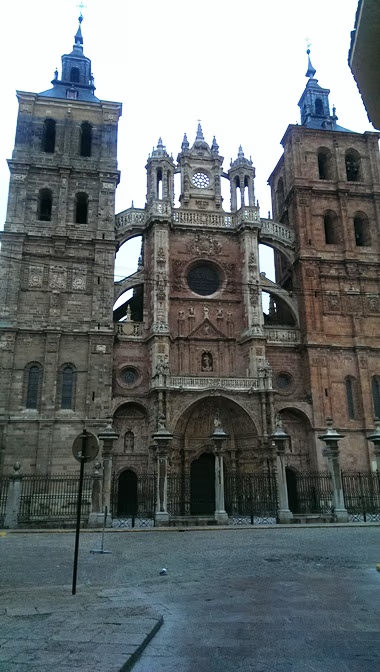
Astorga Cathedral
I see Maxime again, a Frenchman who was already on the bus to Saint Jean with me. He’s another of those acquaintances who show up and disappear again. Today I chat with him a little. I get on brilliantly with him from the start too. He trusts me very quickly and tells me that he has a boyfriend at home. He reminds me of a teenage love I met on an exchange in France, Sebastien. We met, fell for each other, and then I had to leave. We stayed in touch for a while, but it gradually petered out. I get sad when I think about it, but funnily enough I can no longer remember what he looked like. Only his necklace. A triskele, a symbol that matters to me. He always wore it, and I remember it exactly. And another piece of the puzzle falls into place. Why does this symbol stay in my head and not the man himself? Does what you later can’t stop already announce itself at a young age? I’m the last to go to bed that evening, because the conversation with Maxime dragged on a bit. Full of thoughts and wonder, I fall asleep.
Foncebadón – 15 April 2014
The next morning we take a look at Astorga’s cathedral and the Bishop’s Palace. We have churros for breakfast and start a stage that for me is one of the most beautiful on the Camino. The landscape, the flowers, the approaching mountains, thorny bushes, and a climb that really packs a punch. I’ve cracked open my energy reserve and fly up the mountain to music. I overtake the Americans, leave Felipe behind, and Jürgen from Swabia. I feel the mountain and the ground. Today I connect with the element of earth. I know exactly where to put my feet so as not to stumble. Foncebadón is a tiny village in the mountains. We find a place to stay that’s run by hippies and yoga gurus. The place is packed to bursting, but we have hot showers and in the evening a huge pan of paella is set before us. I buy a round of beer for my friends, who have been joined by another Italian woman, Cristina.
The evening is fun and relaxed, and we’re full of anticipation for the next day, when early in the morning we’ll reach the Cruz de Ferro, where every pilgrim can leave a stone from home. The stone is a sign of the pilgrim’s burdens, and the worries and burdens are literally laid down at the Cruz de Ferro. For Antonio it will be the end of the journey, because he has to fly back to Italy.
Ponferrada – 16 April 2014
Today’s stage tops all the previous ones. The path to the Cruz de Ferro is glorious. Mystical in the light of the rising sun. I feel a very strong bond with nature, the plants, the earth and the air. So high up in the mountains I connect with the element of air. I feel something that feels like a strong femininity, and I have the sense that I have now finally become a woman. I cry because these feelings simply overwhelm me. That makes the path to the Cruz de Ferro unique and special for me. By the time I arrive there, the magic is actually over. But the mood and emotion of the other pilgrims is overwhelming. I take it all in and lay down my stone. The atmosphere can probably be understood better from the pictures. Enchanting. Antonio stays for a while. We walk on through the mountains and hills, with snow still lying on them in the distance. The weather is glorious and the view is amazing. The descent is like a dream. A Sleeping Beauty valley, incredibly romantic villages. Really, any description would fall short of how beautiful it is, so I’ll leave it at that. We stop in lovely Molinaseca, where we take a break by the cool river and dangle our feet in the cold water. After this dream, unfortunately, it gets urban again as we walk to Ponferrada. On the descent today I had an important realisation. Good friends are like the stones firmly anchored in the ground. They give you support on the way down, but you have to be able to pick them out from the heap of loose stones. You don’t need many firm stones to get down, but always one within a step’s reach! Antonio says today: “This is my Camino, YOU are my Camino my friends. Being here with you is my own personal Santiago.” And he’s so right.
Villafranca del Bierzo – 17 April 2014
We say goodbye to Antonio in the morning and walk out of town past Ponferrada’s Templar castle. In the most beautiful weather we walk through the hilly landscape. We’re back in a wine region. The walking goes great, and after 24 km we arrive in picturesque Villafranca. I decide to split off from the others here. The Way now divides into the Camino Duro, which climbs 500 metres over 11 km across a mountain, and the route without any change in altitude along the road. Since the others want to cover distance, they choose the route along the road. But I want to go over the mountain, and I want to enjoy it, which is why I only want to walk it the next morning. We have one more beer together and then say goodbye.
Now I’m all alone, and that feeling is terrible. I look for an albergue and I’m glad I arrived so early, because Villafranca is full of pilgrims and the albergues are completely full by the evening. In the albergue, which looks more like a dump, there are definitely too many Germans, Austrians and Swiss. Jürgen, the Swabian in his mid-40s, is here too, and I decide to tag along with him a little. I went out for tapas with him and a Dane, also in his mid-40s (I think). I’m shocked by how the evening goes. Jürgen is what you’d call a man in a midlife crisis. At least the way I imagine one. He behaves incredibly immaturely and is probably trying to be cool, everywhere and nowhere so as not to miss anything. I mean, I only grew up myself this morning. And somehow he isn’t good company for me. We meet Christiane with her son Anton, whom we’ve seen walking every day since León. Anton is 9 years old and a bundle of energy. He loves making new friends. The two of them live in Barcelona and are originally from Mühlheim. I’ve never been good with children, but I get on well with Anton. He tells me so much that I can hardly get a word in. I think of my boyfriend’s son, who is also 9 years old. And I think that somehow my newfound femininity and my growing up have helped this child trust me. I hope it will also help me get on well with the junior back home. Then another German joins us. Thomas. Probably also in his mid-40s. In a very typically German way he starts right off with deep and analytical questions and really gets on my nerves. Above all, he analyses every answer he gets. Loosen up. Enjoy la dolce vita. And I miss my old group. I go back to the shabby albergue, where I barely have room on the top bunk. I can hardly turn over. I’m lying with my face right towards the door, which leads outside and doesn’t really exist. So the night will be cold again. And I make up my mind to catch up with my old group somehow, sometime.
O Cebreiro – 18 April 2014 (Good Friday)
I slept so badly that I’m glad to be able to set off alone. After a quick breakfast I head off towards the Camino Duro, whose climb really packs a punch. It goes steeply uphill, and it takes me a good hour to get to the top. But the sunrise and the view are worth it. At least I’m completely alone here. After the descent I also walk along the road until, at the end, it goes uphill once more. I’m feeling so good that I take on this climb all the way to the top too and arrive in O Cebreiro as early as 2 p.m. Since it’s Good Friday, the village is full of Spanish tourists and Spanish pilgrims. There I run into Maxime again and I’m thrilled to see him. He’s just washing his things, and I ask how he managed to get there so fast. He shows me his arms, which are covered in bites from top to bottom. He says he got the bedbug bites in the last albergue, where I had been too, and that he’s heard of four other people with bites. I’m secretly glad that I didn’t get any. Later that evening I go out to eat with Maxime. The menu is mediocre, but I’m happy to have his company. Apart from that, all you can say is that today, on my own, I walked too fast. I have to slow myself down more. I realise that I don’t just miss my group, I need them. Not because the Italians push me on and are too fast. No, because they slow me down and calm me. I go to bed as early as 7 p.m., because I’m simply bored and I’m not looking for or wanting company here. That turns out to be difficult, though, because it’s light, there are 50 people in the room, and it’s restless and stuffy.
Sarria – 19 April 2014
The worst case has happened. I wake up at 5:20 a.m. and feel uncomfortable. I touch my neck and feel bites everywhere. Sleep is out of the question now. I immediately pack all my things and flee the dormitory. Outside I try to calm down and get ready in the bathroom as best I can. My whole neck is covered in red dots. These are definitely bedbug bites. How awful. And yesterday I was still glad. Since no bar in Spain is open yet at 6 a.m., I march off in the dark. The good thing is that other nutters also like walking at night with a torch, and I join the torchlight pilgrims. They walk too slowly for me, because I’m upset and furious about the bites and want to work it off. But I stay with them until it’s light enough. And then I’m off. On the positive side: I get to see another wonderful sunrise. There’s some more climbing, and at the next opportunity I treat myself to breakfast. I walk and walk, and just like yesterday, on my own I’m simply too fast. At the second bar I see, I rush past at full speed and quickly greet a pilgrim sitting outside. I think briefly about stopping and turn back. Antonio said the breaks are the Way, and who knows when the next chance for a stop will come. Inside sit two Austrians, and the man from outside joins us.
The man from outside is Boris, an Austrian living in Munich. We have a coffee, and in my head the idea of catching up with my group, who must be about 10 km ahead, keeps taking shape. Adrian and Felipe let me know via Wi-Fi that they’re aiming for Sarria. Since I set off early, I can definitely make it today, but you still have to walk those 42 km. I walk on together with Boris. We talk about pilgrims’ health problems and all sorts of things. It’s easy and relaxed; he’s become a fellow pilgrim and friend, and in no time at all. Of course the subject once again comes round to my non-existent job… And I get a few good tips from him. It turns out that he himself is managing director of well-known companies in the tourism sector. My jaw drops and for a moment I can’t say anything at all. It’s that “this man is completely superior to me” feeling. Usually, though, I only get it with male colleagues in suits. But then I start to think: he’s a perfectly normal, nice person in hiking clothes. And so far we’ve been able to talk perfectly well. And again it becomes clear to me: I didn’t meet this person by chance. It was the ultimate test of whether I can stay myself and not let myself be immediately put down. And then suddenly it works again. I’m glad about what I’ve just learned. And with all these strange things going on, I’ve forgotten how far I’ve actually walked. We arrive in Sarria together at around 4 p.m., and I go off to look for Felipe and Adrian. We say goodbye, and I’m happy to have met him and to have treated myself to the coffee and the break that morning. Without the break I would just have walked past him with a greeting. How beautifully things fall into place, I think.
Felipe and Adrian are already waiting for me with a cold beer. I can’t describe how relieved and happy I am. It’s like coming home. And that in the middle of Spain. I shower and we go shopping. Since I arrived so “late”, I don’t really have time for a lie-down. That evening Felipe and I drink a lot. Adrian doesn’t drink, after all. We eat pizza and the locals invite us for a few drinks. The hospitality and warmth of the Spanish are simply wonderful. Around 10 p.m. we go back to the albergue. How exactly we get there, I no longer remember.
Portomarín – 20 April 2014
WOW, do I have a hangover… I feel miserable, and the missing rest in the afternoon is making itself felt too. Everything hurts after the forced march and I feel totally sick. It’s Easter Sunday and I’m completely wrecked. But Sunday or not, it’s a walking day like any other, and a break is not an option now that I have my friends back. We start early to catch up with the Italians, who walked one village further. Achilles tendon, shoulders, stomach, feet. Everything hurts. With the Italians, who are also really pleased about my forced march and our reunion, we walk through beautiful Galicia. But I can’t enjoy it. Today I don’t take any photos, because walking alone is more than I can handle. Federica lends me one of her walking poles, which I use to drag myself along. Still, I manage 24 km to Portomarín. There’s a festival on, and we eat the typical dish, pulpo (yes, by now I can keep food down again!). I stay in Portomarín, and so does Felipe (last night is still catching up with him a bit too), and we treat ourselves to a double room with separate beds in an albergue. Simply to get a big helping of cosy sleep. For €15 a head it works out, and the room is lovely. We even have a balcony, and first of all we have a nap in the afternoon. In the evening we pop back to the festival to grab a bite to eat. We go to bed early and fall into a comatose sleep.
Melide – 21 April 2014
Wow, was that a good and restful night. We get breakfast and start a long day. Our destination, Melide, is 40 km away, but we’re fit and the walking works perfectly again. Walking, coffee, walking, lunch, walking, coffee, walking. The landscape in Galicia is glorious. Most of the time we walk side by side in silence; sometimes I listen to music, sometimes we simply enjoy the mystical quiet of the forests. Just as we reach the edge of town, it starts to pour. As we happen to be standing at an inn, we go in, eat pulpo and ask about a guesthouse. A restful night in a double room is just too lovely, and we treat ourselves to the luxury again. In my own bathroom I take plenty of time to shower and relax. We drink another bottle of wine together in the bar. I feel good, and I feel as if I’m consolidating and strengthening my new SELF. I dance and enjoy the landscape. I soak it up like a sponge. I want to draw on these experiences for as long as possible. The forests inspire new picture ideas, and I think a lot about my love back home and our future. No matter what it looks like, it will be great and positive and full of energy.
O Pedrouzo – 22 April 2014
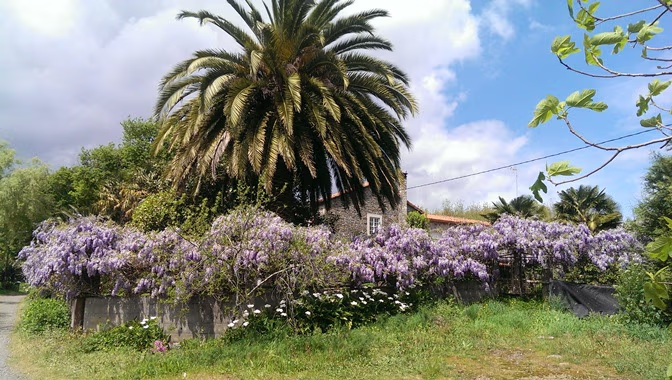
In Galicia
The luxury is over just as quickly. That really makes me want to cry. Getting up is hard by now, and the alarm is only set for 7:15 a.m. The constant walking may be routine, but it’s slowly getting hard to pull yourself together anew every day. We have breakfast in the bar, then off we go. Today’s goal is to catch up with the others again so we can walk into Santiago together. Today’s 35 km are magical again, but also hard. I get sentimental when I think about having to get on a bus in Muxía. I’ve grown so used to the earth under my boots. I’m glad when I see Federica outside the albergue. Felipe and I check in, and lo and behold, our friends have even reserved beds for us in the same part of the room. The joy is great, and once again we cook together. The mood is divided. Some are happy to finally arrive. Others (like me) wonder why it all went by so fast. Well, this night I sleep rather poorly again, but at least the gang is back together.
Santiago – 23 April 2014
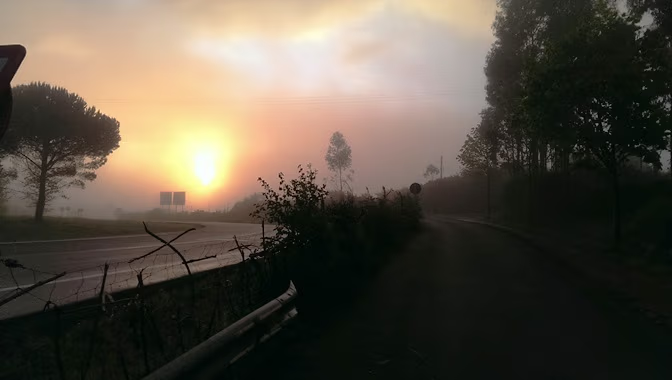
Play of light and colour on the way to Santiago
The journey is the destination, and today a great circle closes in a way I never thought possible. At a roundabout…
If you remember: on the way to Saint Jean I noticed all the roundabouts… What an irony of fate. But I no longer believe in coincidences. Today I feel ALL the elements. The water raining down on me. The earth I walk on. The air I pump into my lungs. And I see the fire, the ball of the sun, which I can look at directly through the Galician mist. This interplay of the elements results in a phenomenon: a rainbow. And it takes my breath away as so much becomes clear to me. This rainbow is light. The fifth element. Light, the purest form of energy. And this energy must be God. I feel deeply touched in my soul.

Santiago Cathedral
I cry and cry. I’m overwhelmed. There are lots of other pilgrims on the Way now, but I don’t register a single one. So I walk on, crying, kilometre after kilometre. The others want to stop for a coffee. I wave it off and keep walking, because I can’t tear myself away from this nature. I know: THIS, and only this MOMENT, was the goal of my pilgrimage. And that this moment happens on the way to Santiago is wonderful.
Calm again, I walk into Santiago with Felipe and sit down on the big square in front of the cathedral. Lots of happy pilgrims are lying there. We stare at the cathedral. Speechless and happy. But sad too, because this is the end of the journey.
We collect our Compostela at the Pilgrim Office, where at midday we already have to queue for 40 minutes. I meet Boris again and see a happy face. Maybe he had just as beautiful a moment as I did today. The bureaucracy is not very moving. I’m saving my visit to the cathedral, though, for my return from Muxía. We check into a smart hotel and enjoy our last evening together. Tomorrow I’ll walk on towards the sea. I have three days of Galician rain ahead of me. But it will be worth it. Now that I’ve found not only myself and my femininity… No, I’ve found much more.
Something I didn’t know I was looking for:
My faith.
The Way in Camino Ninja
Lisa walked the Camino Francés; because of the snow, she walked the first stage across the Pyrenees on the winter route via Valcarlos. You’ll find both routes with their stages in Camino Ninja.