

Via Regia / Ecumenical Pilgrimage Route
The Ecumenical Pilgrimage Route along the Via Regia: A firsthand account of the route, highlights, and personal impressions from a journey right on our doorstep.

The Ecumenical Pilgrimage Route follows the historic course of the “Royal Road,” the Via Regia. Since 2003, it has thus connected with the history of pilgrims from centuries past and offers pilgrim hostels along its entire length. Andrea and Gert Kleinsteuber walked the route in May 2012 and brought back this detailed report.
The original article is available hereon their own website.
The Preparation
It was more by chance that we learned about a pilgrimage route that passes almost right by our front door: the Via Regia, also known as the Ecumenical Pilgrimage Route through Saxony, Saxony-Anhalt, and Thuringia.
The route begins in Görlitz and passes through Bautzen, Kamenz, Großenhain, Strehla, Wurzen, Leipzig, Merseburg, Freyburg, Naumburg, Eckartsberga, Erfurt, Gotha, and Eisenach all the way to Vacha, which covers the most important towns along the route.
We had read in the press about a small pilgrimage and cultural association in Kleinliebenau near Leipzig that had made it its mission to provide lodging for pilgrims. A small church, which used to belong to a manor, was brought back to life thanks to funding from the Delitzsch district, sponsors, and a great deal of volunteer work. But more on that later.
In any case, our interest had been piqued by our Camino Francés in May/June 2011 and the very positive experiences that were still fresh in our minds. And we wanted to take a closer look at the whole thing.
So, in early 2012, we decided to start running from home.
Why not from Görlitz?
The flights for the Camino Primitivo in September 2012 had already been booked, and three weeks of my vacation were already set aside for that. And even a German civil servant doesn’t get enough vacation time to be able to go on two long pilgrimages a year. So we decided to start walking from home. And that was a whole new feeling—just closing the door behind us and setting off.

Werbeliner Lake, south of Delitzsch
Of course, I was also a little curious about the route. I did some research online, mapped out the route, got the addresses and phone numbers of hostels, and hopped on my bike to explore a nice, short stretch from Delitzsch to Kleinliebenau. People usually only know these connections by car. Of course, you won’t find any shell signs, since the route doesn’t appear until just before Kleinliebenau.

Muddy path near Lindenthal
So, on a frosty day, I hopped on my bike to explore this route. Things went smoothly all the way to the county line at the A14. I know my way around the bike paths there. But then it got noticeably more difficult, and I had to turn back several times because the path led to a dead end. The B6, the Leipzig–Schkeuditz railway line, and the Weiße Elster and Luppe rivers posed particular obstacles. The floodplain forests were terribly muddy, as the topsoil was starting to thaw. It was a real mud pit, and I hadn’t brought enough to drink or anything to eat. I had thoroughly underestimated the route, not to mention that a stiff breeze was blowing against me.

Kleinliebenau Manor Church
I didn’t stay long in Kleinliebenau and set off again, hoping for a tailwind. – Fat chance – in the afternoon the wind died down and I had to pedal hard again. It wasn’t until dusk that I arrived home, suffering from a bonk (cyclists know what I’m talking about). And I still didn’t have a clear idea of the route.

My muddy bike
I still hadn't learned to sit back a little and let things happen. And that was the price I paid for it.
In the weeks that followed, we made a number of purchases related to the Camino Primitivo. We needed new lightweight trekking poles, new rain jackets, and other essential and non-essential items. In any case, it was fun to pack our backpacks again.
Trekking poles on the relatively flat Via Regia?
First of all, there are a few hills here and there; second, we’ll definitely need them on the Camino Primitivo; and third, our route plan had changed in the meantime, and we wanted to turn onto the Rennsteig trail past Eisenach and follow it all the way to Oberhof. We have friends living in Suhl, and we wanted to visit them on foot.
From Eisenach to Oberhof is at least a two-day hike. So we still needed to find a place to stay along the Rennsteig. That’s easier said than done. Many of the mountain huts that existed there during the GDR era have since fallen victim to the market economy. There are hardly any villages along the Rennsteig itself. It’s a ridge trail, and our ancestors knew that it’s always windy up there, so they built their houses down in the valley. After a long search, however, we found a small, affordable guesthouse in Friedrichroda that would take us in even for just one night.
Day 1: Delitzsch – Kleinliebenau
Time flies, and I used to smile whenever older people said that about their age. Once you’re over 50, you start to feel it more and more, and it’s hard to smile about it anymore.
And just like that, the day was here again—the day we’d be locking our front door behind us for 14 days.

And all of that is supposed to fit in the backpack
The night before we set off, we laid out everything we thought we’d need for our hike on the floor. I’m not going to list everything here, but suffice it to say that the larger of the two backpacks is mine (7.5 kg) and the smaller one is Andrea’s (6.3 kg). On top of that, we each carried a bottle of water (1 kg). That puts us right at the limit and about the same as what we carried on our backs on the Camino Frances. We also brought a sleeping pad this time. It’s specifically required in the pilgrim guide, which we ordered from the Verein ökumenischer Pilgerweg e.V. along with our pilgrim passes via this link. The pilgrim guide is very informative and beautifully designed, but for me it was a bit too heavy and too big.

My backpack on the left, Andreas's on the right
I photocopied the most important stuff—the maps and the hostel information—and that took a few more grams off my back. It wasn’t really full this time; my 35+10-liter Deuter backpack and Andrea’s 35-liter Gröden still had plenty of room. That ended up working out well for us, since we often had to stock up on food. But more on that later, when the time is right.

The two of us in front of our house
So at 6:30 a.m., we were standing in front of our house. The weather was on our side and was set to stay that way for the entire trip; our backpacks were pleasantly light, and we were really looking forward to it.
But it does feel a bit strange walking through your hometown in pilgrim attire. Everyone knows everyone here, and some people still didn’t believe that we had actually walked the entire 800 kilometers of the Camino Francés. Actually, everyone knew about our plan, since the posters from our local club were still hanging in the town’s display cases.
Just a week ago, at an event hosted by the club we’re both members of, I gave a talk about our Camino and mentioned at the end where else we plan to walk this year. I can understand these skeptics. After all, just a few months ago, I myself didn’t believe it was possible to cover such distances—distances where you’d even take a break if you were driving—on foot.

Linden Avenue in front of Brodau
The first few kilometers to the A14 highway were slow going. We know every stone here from our bike tours around the newly created lakes south of Delitzsch. We rarely walk these paths, although we had already done a few preparatory tours here to test whether our shoes fit and our backpacks sat right. We usually hike further north of Delitzsch in the Goitzsche, another former open-pit lignite mining area, since nature is already further along here in reclaiming the ravaged landscape. So now it’s a whole new hiking experience—we’re heading in one direction, not back in a circle to the car. The houses in our village grew smaller and smaller, and soon we had reached the neighboring village and Lake Werbelin.
As we were walking along the lower lakeside path, the doorbell suddenly rang behind us. Our club president had come up on his bike to say goodbye. Or was he just checking to see if we were really walking?
We stopped for our first break at the Radefeld butcher shop. We’d already walked 14 kilometers by then, but our feet weren’t hurting too much yet. After a cup of coffee, we continued on toward Schkeuditz.
The road that runs alongside the Porsche factory seems to go on forever and is anything but idyllic.
Running alongside a newly built road, it winds its way as a paved bike path beneath young trees that don’t yet provide any shade, with the Porsche plant on the left and the southern runway of Halle Leipzig Airport—home to DHL’s massive logistics center—on the right. Every now and then we encountered cyclists who had nothing but pitying glances for us. It was actually exciting for us to see how people reacted to us. In Spain, everyone along the way knows why people with a scallop shell on their backpack (almost) always walk in one direction toward the west (some also walk back); but here in Germany?

Bridge over the Luppe
The path along the B6 to Schkeuditz, which was also actually intended as a bike path, wasn’t very suitable for walking on either. At some point, you start to feel the hard asphalt all the way up to your hips, not to mention your feet. Anyway, we were glad when we sat down at an ice cream shop on the market square in Schkeuditz and took a break. It had gotten quite warm by then—very warm for early May. But better than rain, we told ourselves.

Signposts along the Via Regia
But we hadn’t seen a single mussel yet—no wonder, since we still weren’t on the right path. We found it after driving a few kilometers along the B186, where we had taken refuge in the ditch to escape the oncoming trucks, and after crossing the bridge over the Luppe. The pilgrimage route that pilgrims take when coming from Leipzig runs along the Luppe embankment.
We keep going until we reach the next fork in the road, where we finally spot the first sign indicating that we’re on the right track. The trail markers are really small, and you have to pay close attention so you don’t miss one.
There is certainly a German standard that specifies the size of these signs. Some are simply painted on stones or tree trunks using a stencil and some blue and yellow paint. There are no yellow arrows like in Spain. The shell always points in the direction of the path. So if the path goes to the left, the shell is tilted 90 degrees to the left. Signs pointing to a hostel feature a small yellow house with the roof peak pointing toward the accommodation. It’s actually quite simple, and except for the sections in larger cities, the route is also very well marked.
Two kilometers later, you reach the entrance to Kleinliebenau. “My feet hurt! 34 kilometers on the very first day!” But what can you do? This is what we wanted. “It doesn’t do any good,” Andrea always says.
Getting a ride there by car was out of the question. So we politely declined the offer from one of our club members who approached us in Schkeuditz—he’d recognized us—and offered us a ride. He wanted to take us past the dangerous stretch along the B186 and drop us off in Kleinliebenau. Nice! But that would be just the icing on the cake—giving up on the very first day.
The display case at the Rittergutskirche lists the addresses of the members of the Kultur- und Pilgerverein e.V. Kleinliebenau who have a key to the hostel, and I immediately headed straight for the one at the very top of the list. Well, he also lived the closest. Two turns to the left and I was standing in front of a garden gate, behind which a lawn mower was humming. An elderly gentleman was walking behind the mower; I spoke to him cautiously so as not to startle him. But I did startle him when I tapped him on the shoulder. “We’re two pilgrims on the Via Regia and would like to spend the night here in town,” I said. “That’s nice, but you’ve come to the wrong place,” he said. “Why? You’re on the list, aren’t you?” I asked. “Yes, but I’m not on duty today!” How embarrassing—I hadn’t read all the way to the end, because at the very bottom there was a note indicating who was on duty that day. Man, this is organized almost like the military!

Kleinliebenau Manor Church
But the gentleman (I’m afraid I’ve forgotten his name) took pity on me and, seeing that I wasn’t feeling quite myself today, didn’t want to put me through any more trouble by sending me all the way across town. So he took his key and walked me to the church.
Once we got there, he asked if we wanted to take a look at the church. To be honest, we were more in the mood for a shower and some time to put our feet up. But now he had gone to the trouble of opening it up for us outside of his working hours. We didn’t want to upset him, and we were already interested in this little church with its eventful history, which, after being deconsecrated, had nearly fallen victim to the wrecking ball. In great detail and not without pride, he told us how the church had been saved from a real estate developer who tore down the entire manor to build single-family homes on the site.
He told us about donors from Switzerland, the county’s involvement, the countless hours the association members had put in, and the artists who designed the outdoor areas despite conflicting opinions among the members. He also mentioned that weddings and church services are now being held here again, even though the church isn’t owned by the regional church, and that the association’s supply of beverages is stored behind the altar. Amused, I realized, however, that I was thirsty too and urgently needed to get my shoes off.
So we asked him to show us the hostel.

Hostel in the Kleinliebenau Manor Church
“They’ve really created something beautiful here!” was our first reaction when we stepped into the annex on the left side of the nave. It has everything a pilgrim’s heart could desire: a small kitchen with a stove, a refrigerator, two chairs with a table, and a clothes dryer that could be placed outside in the sun. There’s also a shower, and one floor up on a loft there’s room for at least five mattresses, which were stored in a large box.

Bedroom on the first floor
Everything was spotless and thoughtfully furnished. After a brief introduction, the friendly gentleman went back to his lawnmower and we headed for the shower. Assuming no one else would be coming, we placed two mattresses in the middle of the room, spread out the sleeping pads—which are required on the Via Regia for hygiene reasons—and rested for half an hour. It’s more comfortable than expected to sleep on such a simple foam mattress—definitely better than in the squeaky, sagging bunk beds we often encountered on the Camino Francés.
Hmm, we still need something to eat. Just past the town limits there’s a small lake with a campground, according to the pilgrim’s guide. In addition to another place to stay—in a small garden shed or in rented tents—there’s also a small restaurant that’s supposed to take care of our meals. The large restaurant near the church was unfortunately closed today. So we set off, our feet having already recovered quite well. But unfortunately, the trip was in vain. There was nothing to eat there either. Well, at least they sold us a few drinks at the campground office—without hiding the fact that they weren’t actually allowed to do so. We’re in Germany, after all, where so-called “freedom” languishes in the chains of bureaucracy. In any case, the operators were missing some kind of permit to serve drinks. The problem of getting supplies would haunt us for the rest of the journey, though we had no idea of that yet.

That evening after "dinner"
So, back at the hostel, we had to dip into our emergency rations already today, and we sat down on the bench in front of the church with a piece of bread and some cheese.
Then the “person on duty” finally showed up to check that everything was in order. We felt a little like we were being watched, but we certainly understood. After all, a lot of time and money has been invested here to create something so beautiful. They want to make sure it stays that way for a long time and that many pilgrims can enjoy it. She also told us that there are some rather strange pilgrims who, instead of a donation, toss a pants button or a gas receipt into the box—we could hardly believe it. Our donation was already in there. Along the entire Via Regia, they expect a donation of about €5 per pilgrim in the boxes provided as a contribution toward expenses, but they’re not upset if it’s a euro or two more. That certainly doesn’t cover costs and is more of a symbolic gesture. This association here in Kleinliebenau supplements its budget by organizing various events and through sponsors, just like our home association back home.
Andrea then called home to let them know we’d arrived safely. And she actually asked what the weather was like back home. “Home” is 34 kilometers from here! It just goes to show how far your mind can wander when you’re running.
We quickly crawled into our sleeping bags and were truly alone tonight. The pilgrim logbook says there are three pilgrims from Dresden ahead of us. After we’d signed in, we said, “Good night!”
Day 2: Kleinliebenau – Merseburg
What can I say, I slept like a log. The sun is shining again. My feet are feeling pretty good, so after a quick breakfast, we set off at 7 a.m. Today it’s only 18 kilometers to Merseburg, and according to the description, the route often runs along meadows and dirt paths and past open-pit mining lakes. We were both excited about the lodging in Merseburg. It’s located in the Neumarktkirche, right inside the church on a gallery. That promises to be exciting.
Immediately after Kleinliebenau, you leave the Free State of Saxony at the overpass under the A9, and we are now in Saxony-Anhalt, the land of early risers. Who actually came up with that silly advertising slogan that’s posted everywhere along the highways when you cross the state border into Saxony-Anhalt? What is it supposed to suggest? That everyone else is a late sleeper? Well, they do have a point. In the eastern part of the country, people get up earlier. At least, that’s been my experience with coworkers who come from the “former East German states.” They show up a bit later and then look a little skeptical when you’re already leaving the office at 3:30 p.m. because you’ve been there since 6:30 a.m.
And that’s how we’ve always done it on our pilgrimages and on vacation in general. Time is far too precious to waste sleeping it away. In the morning, you’re still fresh and full of energy. In my experience, that energy drops off sharply after 2 p.m. Or could it be because we already had over 20 kilometers under our belts?
The body eventually adapts to one’s daily routine, and since I’ve been getting up at 6:30 a.m. for almost my entire life, I’m awake at that time even when I’m on vacation. I hardly ever need an alarm clock. And why should I lie in bed tossing and turning when the weather outside is so beautiful?
Luckily, Andrea feels the same way. She’s a morning grouch by nature, but you can’t blame her for that—it’s just in her genes.

Horburg
And so we’re up early again today and are currently walking through Horburg, a small town right off the highway that was once destined to become a major city. The church tower in this village towers over everything else with its massive proportions. The parish church houses the Horburg Madonna, a sculpture attributed to the workshop of the famous Naumburg Master. Unfortunately, this church, like almost all the others along the way, was closed.

Riparian forest behind Horburg
After passing through the town, you walk parallel to Goseweg. Gose is a top-fermented beer served in the Gosenschänken pubs in Leipzig, and it’s especially recommended for people who are—let’s just say—a bit hardy. It’s not for everyone—it’s not my cup of tea either, by the way—but it’s a cult favorite in Leipzig.

At Lake Raßnitz
The trail continues through a beautiful floodplain forest, running parallel to the Luppe River all the way through Dölkau to Zweimen. Here, the route is a bit confusing, as the signs lead straight to a closed bridge over the Luppe. The bridge has clearly seen better days. But we take a chance and ignore the closure, partly to avoid having to search for another route. Besides, we can both swim. We were disappointed to find that we could still hear the noise from the A9 here, even though we’d left it far behind us.
Past Zweimen, you then walk along beautiful meadow paths to Lake Raßnitzer and Lake Wallendorfer. These, too, are the remnants of former open-pit lignite mines, now filled with water and perfect for swimming and fishing. There are also efforts to develop low-impact water-based tourism. Whatever that may mean. The main focus, however, is on nature conservation and the revitalization of an area that suffered greatly from industry in years past. The flourishing landscapes that our former chancellor promised us—here they are becoming a reality, and that is not meant ironically. Anyone who, like us, has lived since childhood in an area that was no longer compatible with the word “nature” and could not imagine that things would ever get better is delighted by every lake, every tree, and every blade of grass growing alongside the former mine roads. Anyone who sees Bitterfeld today, for example—the very epitome of filth during the GDR era—will not believe their eyes.
We live in a town that, had things turned out differently, would now be surrounded by open-pit lignite mines. A strip about 2 kilometers wide would have remained “intact” to the south toward Leipzig and to the north toward Bitterfeld—a horrifying thought. These plans were kept under wraps and only became known to the general public after the fall of the Berlin Wall.

Beach at Lake Wallendorf
That is why we are very interested in these areas, where, not too long ago, the earth was torn open to extract low-grade lignite.
But back to the trail: A beautiful beach has been created near Wallendorf, and there’s a brand-new pier there. The short detour was well worth it.
The next town is Löpitz, from which a very nice path leads toward the B181. According to the information signs posted there, the path was funded by the EU and the federal government. I wonder if the funders ever take a look at what was done here with the money? There’s a bench at regular intervals along the path. So far, so good. Next to them, however, are bike racks set in concrete—big enough to hold the entire village’s bicycles, mind you—at every single bench. Not only is it ugly. Such a waste of money always upsets me. If they had built according to actual need and used the remaining money to maintain and preserve what was built over the years, everyone would have been better served. But the funding has to be spent first, otherwise someone else will get it. Yeah, I’m getting worked up again.
Precisely because there is so much beauty along the way, this waste struck us as particularly glaring. Nightingales and blackbirds were singing, and a chorus of frogs could be heard from the nearby marshes along the banks of the Luppe.
What a contrast—just before Merseburg, you emerge from the thicket lining the path and find yourself on a paved bike path that runs alongside the B181. Poor cyclists!
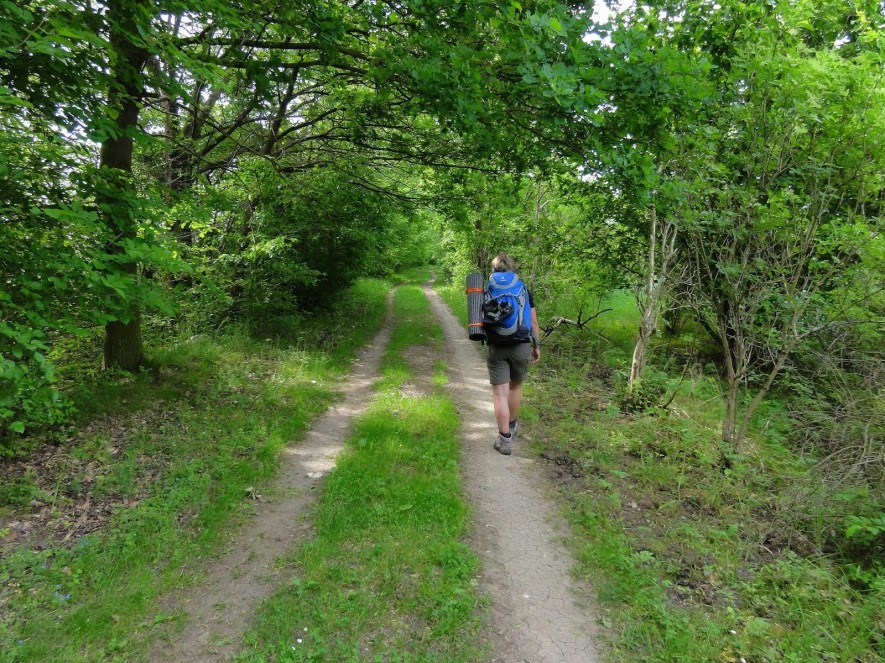
A beautiful trail behind Löpitz
Fortunately, the entrance to Merseburg wasn’t far off, so we walked briskly through the suburb of Meuschau and turned toward the old town just past the bridge over the Old Saale. The pilgrim’s guide mentioned that the key to the Neumarkt Church could be obtained at the bakery just ahead. And that’s exactly how it was. No sooner had we spotted the Neumarkt Church with its striking tower than we found ourselves standing right next to the bakery. The saleswoman knew right away why we had entered the shop and pulled out a little booklet in which we had to write down our personal information to get the key. It had apparently been taken in the morning rush. Hustle and bustle!! They’ve probably never been to Spain—at 7 a.m. in Roncesvalles or Burgos or Portomarin or or… There, some people create a flurry of activity, and others get swept up in it. Here, you’re very much on your own and can structure your day exactly as you please.
That makes me feel very calm.
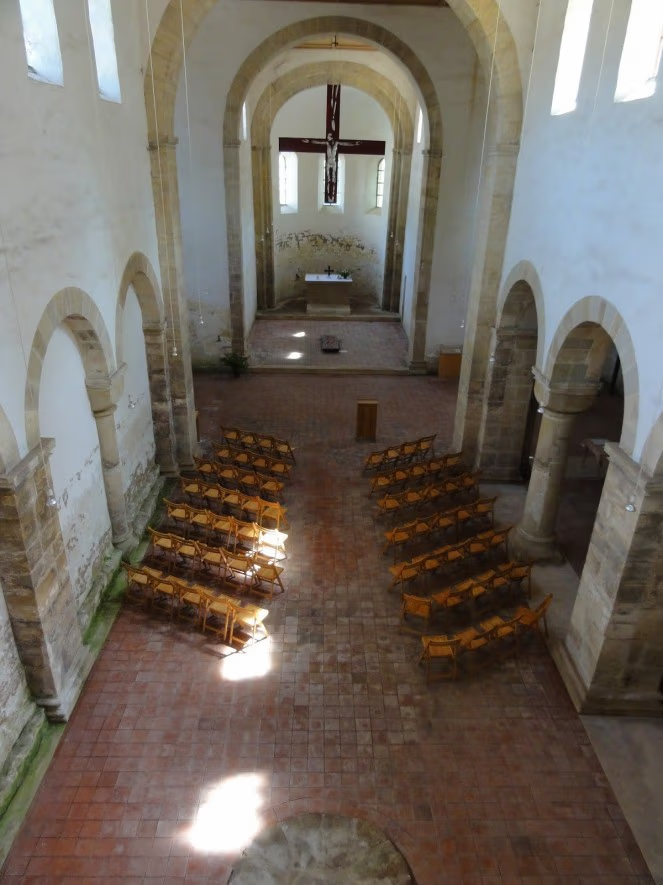
St. Thomas Church in Merseburg
Armed with the large key, we took a few more steps and entered the dark, cool church interior after managing to open a thick, heavy door. Nice and cool—that was our first thought, because it must have been over 30 degrees outside. A little damp but cool, nice and cool—that was still our impression after we found the light switch.
A small sign directed us up a flight of stairs, and there we stood, on a balcony-like gallery above the large, unadorned nave. Below, in front of a small altar and a lectern, stood several rows of folding chairs arranged in a herringbone pattern. A large crucifix hung above them. The air in the room is very damp—no wonder, given the history of St. Thomas Church in Neumarkt.
Originally, the church—first mentioned in 1188—was a cruciform, three-nave basilica without a defined crossing, featuring two west towers. Later, the south tower and both side aisles were demolished. The church stands directly on the banks of the Saale River and has constantly struggled with flooding. As a countermeasure, more and more soil was piled up around the church, and the floor inside was raised several times, which explains the dampness still present today. In 1973, the church was abandoned by the parish and fell into visible disrepair, which caused further damage to the building’s structure.
In the early 1990s, the church underwent extensive renovation; the south aisle, a tower stump, and the sacristy were rebuilt. The floor was excavated to restore the original spatial impression. Significant furnishings are located in the cathedral. For example, the baptismal font stands in the cathedral’s narthex.
None of this, however, changes the fact that the church still presents a sad sight. Algae grows on the walls, and the indoor climate is certainly not normal. The most culturally and historically remarkable feature is a knotted column at the entrance portal—probably unique in central Germany—which was likely intended to keep the devil away from the door.

Hostel at Neumarkt Church
And this is where we’re supposed to sleep? There are two rickety camp beds on the loft, and a few damp blankets lying around the corner. Well, luckily it’s very warm outside. So it’s actually quite comfortable in here. But in cool temperatures or rain, this accommodation is borderline. You certainly won’t be able to dry wet clothes here. The two restrooms (separated by gender) offer only a toilet and a sink with a hot water heater. That will certainly do for one day.

View of Merseburg Cathedral
After unpacking, we lie down for a bit, and I’m woken up by my own snoring. In this room, with its acoustics, my snoring takes on a whole new dimension. Then I heard the door lock being turned. Ah, a pilgrim, I thought. But it was a group on a guided tour. Well, lucky for me I was already awake. My snoring from the loft would surely have caused confusion. We hadn’t noticed that there was a sign at the entrance that you’re supposed to hang outside when the room is occupied. That way, you avoid unwanted or even embarrassing encounters.

Merseburg Cathedral
We quickly grabbed our things and headed out onto the street so as not to disrupt the event. Besides, we had planned to visit the cathedral anyway. So we crossed the Saale Bridge, from which you can already see the cathedral and the City Palace at their best. Climb the cathedral steps and keep to the right, and you’ll find yourself right in front of the portal. Pilgrims who can present a pilgrim’s passport enjoy free admission on the Via Regia to the major monuments that would otherwise require an entrance fee. And so we enter the venerable, very impressive sacred building.
Everything you need to know about theMerseburg CathedralYou can find out how to write it by following the link.
I was particularly taken with the organ and the pews. And so the memory card in my camera kept filling up.
After Andrea lit a candle in the foyer, we stepped back out into the hot afternoon sun, looking for a place to eat. We quickly found a small café where we were not only well looked after, but also learned quite a bit about Merseburg from the waitress. The decline of industry in the southern region of Halle an der Saale has also hit Merseburg hard. The exodus, especially of young, well-educated residents, is gnawing away at the city’s very existence. The population, which once exceeded 80,000, has nearly halved, and what remains (in the waitress’s own words:) are the elderly, the unemployed, and foreigners. She therefore described her hometown as the city of the three big A’s. It all sounded very bitter and resigned, which is especially painful given the beauty of the old town.
However, many cities in eastern Germany are struggling with these problems, especially those that served as dormitory towns for industrial complexes that were shut down after reunification. I’ve always hated that term! Tens of thousands of people found themselves unemployed overnight—it was a disaster. This is how social hotspots emerged, particularly in such places, driven by unemployment, a sense of hopelessness, and low educational levels. It is not the people who are to blame, but the social environment. And this is also reflected in the cityscape.
I’d actually much rather spend more time here promoting this beautiful city. But I want to stick to the truth—or at least to how it appeared to me. Because the many “bums” (I can’t think of a better word right now) who spend their time on many street corners indulging in their favorite pastime—drinking alcohol—unfortunately contribute to this rather negative overall impression.

View of the Cathedral
After wandering around downtown for a while and picking up a few things for the evening and tomorrow’s long trek to Freyburg an der Unstrut, we shuffled back to Neumarkt Church as evening fell.
Right next to the Saale Bridge, a path begins that runs along the riverbank, marked by a sign pointing toward the cathedral view. Armed with a bottle of red wine (Rioja), we walked to what we thought was the spot with the cathedral view and spent a cozy evening on a bench until after sunset.
Day 3: Merseburg – Freyburg/Unstrut
Luckily, the church clock’s quarter-hour chimes were turned off that night; otherwise, I would have woken up even more often during the night. But the clacking of the balance wheel (the word “ticking” would have been too cute here) and the mechanics of the silent chime were still annoying before falling asleep—or rather, falling back asleep again and again. And as pleasant as the coolness in the room was during the day when you stepped in from the street, it became just as unpleasant at night. Andrea needed extra blankets, which I fetched for her from the vestibule to the gallery, walking barefoot across the concrete floor. The camp beds creaked loudly whenever you moved. No, it wasn’t such a good night. And it was eerie at times, too. Because the acoustics of the large room amplified every little sound, and it was impossible to pinpoint where it was coming from. You hear and then pay attention to every creak in the beams above the coffered ceiling, every rustle in the corners. “Are there mice here?” “Yeah, for sure!” What church doesn’t have them?

Ready to depart in Merseburg
6:30 a.m. – finally time to get up. The sleeping pad had done its job by keeping body heat from escaping downward. So bringing it along had already paid off several times over. They are simple EVA foam mats, only 2 cm thick, weighing just 180 g, and costing about €30. To save even more space and weight, I then cut off the unnecessary edges of the mats and adjusted their lengths to fit our sizes. Since we’ve both only grown on Sundays, this saved us another 50 g per mat and a few centimeters in circumference on the roll that hangs on the outside of the backpack. (No, we don’t cut off the toothbrushes!)
The backpack was packed in no time. Did we have everything? We took one last look around to make sure, and then we locked the church door from the outside. We grabbed breakfast at the bakery and picked up a few fresh rolls for the road.
Today’s stage is a bit longer and was set to be the most strenuous leg of our Via Regia journey. On the way out of town, there was a detour due to bridge construction. Thanks to the directions in the pilgrim guide’s update—which you should download again before starting the hike—we found our way without any trouble. Passing the train station, you soon walk through a beautifully landscaped park with large bodies of water. After crossing the B91, you enter the Merseburg Zoo. The enclosures are simply built into the park, and there is no admission fee. The garden is completely open, and many hardworking people were busy planting new plants in the flower beds or simply tidying up. The garden made a very well-maintained impression.

Wetland behind Merseburg
Then you leave the city for good and walk along overgrown paths through a kind of swamp. You’d better put on some bug spray here, because those pests were already pretty annoying even in the morning. We tried to get through without getting bitten by walking quickly and swatting wildly around us, which almost worked. One had managed to bite me on the ear. Then you step onto a dead-straight concrete path that leads all the way to Frankleben. Oh boy, it was already getting really hot, with no shade in sight. What’s it going to be like in the afternoon? We’d only covered three of the 34 kilometers so far.
Before reaching Frankleben, you cross the A38 and see the dilemma that has befallen Frankleben. Half the town lives in the shadow of a massive noise barrier. But Frankleben does have a small grocery store (just for those who want to walk through here and need to do some shopping right now). Unfortunately, the open store was of no use to us yet. Our water bottles were still almost full, and we had brought enough food with us today.

Lake Runstadt
Shortly after passing Frankleben, you reach Lake Runstädter and the larger Lake Geiseltal, both of which were once open-pit lignite mines. The busy L178 runs between these lakes. And on the parallel bike path, we walked straight ahead on the asphalt for a long time amid the traffic noise until a sign finally directed us to the lakeside path of Lake Runstädter. What a relief, despite the constant asphalt. We could hear the birds singing again. You have to walk halfway around the lake until the path branches off to the right. Just before the turn, a rather athletic cyclist passed us, but he caught up with us a little later. I was sitting on a boundary stone, trying to finally get rid of the small pebble in my right shoe that had been bothering me for quite some time. And so the cyclist, who was much older than he initially appeared, spoke to us. “I talk to everyone and am curious about people like you. You’re probably walking this pilgrimage route?” he said, sounding a bit apologetic.
We never even got a detailed answer, because the real reason he had stopped was that he wanted to get something off his chest—namely, his entire life story. Being the polite people we are, we listened intently. Well, at least I pretended to at first. But from his wild cycling tales—he had traveled almost the entire world by bike—it was clear he couldn’t be a nutcase. His stories made sense and were coherent. Only writers like Karl May can lie that skillfully. Well, he was a bit off his rocker, all right. But the explanation followed immediately, without us even asking. He had dealt with mercury in his professional life and had suffered nerve damage as a result. Only on his bike can he escape his daily routine and forget his shortcomings and pain.
I actually wanted to keep going—the road was still long, and it was getting hotter and hotter. But somehow his stories captivated me: how he sought out and found odd jobs in all sorts of countries to make ends meet while traveling, and how and where he had spent his nights.
Thanks to my cycling, I had come to know several people like that out of personal interest—people who had conquered the world on two wheels. But now they were trying to cash in on it through various publications.
This wiry old man tried to share his experiences by striking up conversations with people. He’s probably often left standing there alone, bewildered. But out of politeness and curiosity, I stayed put—for a long time, actually too long.
But just as suddenly as he had appeared, he was gone again. We talked about this man for quite a while, even though we’re usually pretty quiet when we’re walking.
He had made quite an impression on us.

The Way to Rossbach
We hardly even noticed that we had long since left Lake Großkaynaer behind us and were now heading toward Rossbach. The path first climbs gently and then descends again across vast fields. Grain as far as the eye can see. In the distance on the southern horizon, a row of wind turbines stands on a hill (I wouldn’t dare call it a mountain, but by local standards, it’s quite a climb to get there). “We still have to get there today,” I said. Andrea immediately started checking her water bottle. “Hey, we need fresh water!” My bottle was almost empty too, so I kept an eye out for a place to refill it. At the entrance to Rossbach, a crowd of people was setting up a large festival tent on a sports field. There were already a few carousels and food stands there. There’s definitely going to be a celebration here this coming Pentecost weekend. Where there are men doing physical labor, there must be something to drink—so let’s go. But when I asked for water, I was just met with incredulous stares. Or was it our backpacks and our outfits that made people look at us that way? One worker directed us to the street performers: “They might have something to sell!” “Nope, we just need a tap with drinking water—surely there’s one at the sports clubhouse, right?” was my reply and question. I think if I’d asked for a bottle of beer, I’d have had one in my hand by now. But instead, they acted as if we’d made an impossible request, and everyone avoided our gaze. But now I’d had enough. I headed straight into the sports clubhouse. There had to be a water faucet somewhere in here! A woman crossed my path with a questioning look. Everyone here seemed to be in a flurry of excitement, and I hardly dared to speak to her. But at least she should know why I was there: “I’m looking for a water faucet.” She led me into a washroom with many small sinks. Desperately, I tried to get the bottles under the faucet—it won’t work—I cursed. I hurried after the woman, who had already disappeared again. “This isn’t working. I can’t get the bottles under the faucet. Isn’t there a place where I can clean the mud off my soccer cleats?” Yes, there was—in a restroom. But I didn’t care about that anymore, and I filled both bottles with water. “That took a long time,” Andrea said outside. And I told her the story. “That in Germany you have to beg for water?” she said jokingly.
Back at the intersection where we had left the trail, we quickly found our way again. The path leads through a long row of houses to a fork in the road, where a sign clearly pointed to the left.

Nap
We were standing by the side of the road on a freshly mowed meadow under a shady tree. “This is a nice spot to have lunch. I wanted to check the map anyway to see where to go from here.” And just like that, we were sitting in the grass, unpacking our food. I had the maps on my phone, but even in the shade, the screen was hard to read today. A resident of a fancy house across the street came over to us and said that there used to be a bench here under the tree, and many pilgrims had used it. But some good-for-nothing stole it, and now the pilgrims have to sit on the grass. “But you can come over to my place and sit on my bench.” We politely declined, since his bench was in the sun. “Do you need anything? Water or something?” – too late. Too bad; we would have liked to take him up on his offer and make him feel good. So I asked him for directions anyway, even though I actually already knew the way. “Yes,” he said, “many pilgrims get lost here because they mistake the hostel sign for a trail marker, and the scallop shell symbol pointing straight ahead is missing.” And they end up asking for directions once they realize they’re in a dead end. He pointed to the road we’d come from and said, “Just keep going straight, uphill, past an old factory until you reach the B176, then turn left there and immediately right through the town of Pettstädt. You have to keep your eyes on the wind turbines standing up on the ridge (see!? I said to Andrea). Walk along the wind turbines until you come to the old Göhle, that’s the stream above Freyburg. At the Napoleon Oak, turn left and you’ll soon be in Freyburg.” That all sounded great. But when I asked what “soon” meant and was told, “Well, about 15 kilometers or 3–4 hours,” we were a bit taken aback.
So let's go! It's no big deal! We said goodbye to the nice man and learned that people were already aware of this relatively new pilgrimage route, and that there were already people who didn't look back in surprise when you walked past their property and greeted them warmly.
The road started to climb noticeably, and soon the old factory—which still seemed to be in operation—and the highway came into view.

Hill behind Pettstädt
Just past Pettstädt, we reached the hill with the wind turbines in question—six of them in all. And we never would have thought that wind turbines would be spaced so far apart in the countryside. Speaking of the landscape, from this hill you have a wide and beautiful view of the Burgenland and all the way to Merseburg, which is quite far away. Our steps grew heavier and heavier, and it seemed as though someone kept moving the last wind turbine farther and farther away. “We can still make it to the Göhle, then we’ll take a break.”

A break under the apple tree
We didn’t make it. Just 2 kilometers before we got there, there was a very spreading apple tree whose shade literally pulled us to the ground. That was exactly what we needed! But I can’t stand lying around like this for long. Once the pain has subsided, I want to keep going. Long breaks lead to only one thing: even more pain. Because if people are watching you try to get up, they might think you’re on an outing with the residents of the local retirement home. The longer the break, the longer the pain lasts afterward. It takes quite a while for my legs to remember their duty and do what they’re supposed to. So, in my experience, it’s either a very short break or a really long one.

The Old Göhle near Freyburg
When we finally arrived at the old Göhle, we tried to find the spot described as the site of the Napoleon Oak and expected to see an ancient, lush tree. But what was that? A charred tree stump jutted out of the ground, and in front of it stood a sign explaining that the oak had unfortunately fallen victim to a lightning strike, but that an association had decided to plant a new one right here. And there it stood, the new Napoleon Oak—a scrawny sapling (colloquial term here for spindly wood)—which bore absolutely no resemblance to the great general who had conquered nearly all of Europe. “Well, it’s still growing.” And to speed things up, I went to “take a leak” (colloquial term here for relieving oneself). Relieved, I continued on my way through the very beautiful oak and beech forest. Everything was a fresh, lush green. When I see a sight like this, I especially love spring and am convinced that this is the best time of year for me to take this path.

View of Freyburg
Just a bit further along the B180, and then it’s all downhill into town. And what a descent it was! Near the Berghotel zum Edelacker, a footpath runs alongside the vineyards, with many steep steps leading down to the town. After more than 30 kilometers, every step hurts twice as much. But from up here, you have a magnificent view of the beautiful town on the Unstrut.

View across the Unstrut River toward Neuenburg
We know Freyburg quite well because we recently took a trip here with our local heritage association—and took a guided tour of the Rotkäppchen sparkling wine cellar located here. Afterward, we went to a wine cellar for a tasting—highly recommended, both the tour and, of course, the wine. Freyburg lies on the Unstrut River in the middle of a valley basin formed by the river. The limestone-rich soil and the microclimate on the slopes have guaranteed successful winegrowing for centuries. Wine has been produced here for 1,000 years. Later, bottle fermentation began, and when champagne became the trendy drink, a legal battle over the name was lost to the wine-growing region of the Champagne. Since then, the sparkling wine made by adding sugar and allowing it to ferment in the bottle has been called not Champagne but (easier for German tongues to pronounce anyway) – Sekt. The winery is so successful that it has already acquired several well-known wineries throughout Germany. There are many wineries that open their doors to visitors for various occasions and celebrations or offer tastings of their products in the numerous wine taverns. And all of this is set against the backdrop of a beautiful medieval townscape. Freyburg is truly worth a visit.
Well, we actually walked here, and it’s much more uplifting to walk through a city gate than to drive through it while looking for a parking spot.
But we were now looking for a place to stay. The only pilgrim lodging in Freyburg is located near the train station. The Fiedelak family, who run a body shop, welcome pilgrims here and offer a simple room with two bunk beds. We really have to be grateful that there are people who go out of their way to provide lodging for pilgrims. Without them, a route like this wouldn’t be feasible, because the number of pilgrims isn’t high enough for the association or the local municipality to justify running a hostel. Here on the Via Regia, it is mostly families, church groups, Christian educational institutions, or parsonages that provide the simple, affordable lodging that a pilgrim desires. Of course, one could also book guesthouses or hotels everywhere. But first, that’s a hassle because in Germany it’s better to book in advance; second, it gets quite expensive; and third, in my opinion, it is not in keeping with the true spirit of pilgrimage, namely to practice a degree of abstinence from daily excess in order to learn to appreciate once again what otherwise falls into one’s lap every day.

Hostel in Freyburg
The room seemed to have been a kitchen at one time. A row of tiles was still stuck to the wall. The beds had stickers from an LPG (for those not from East Germany—Agricultural Production Cooperative) and, in addition to a lot of rust, still had some paint on the steel frames. I have absolutely no problem with the condition of the place; it’s dry and I have a roof over my head. But what I really had to complain about here was the lack of hygiene. The kitchen appliances had dirty streaks on them, which must have been left over from before the place was converted into pilgrim lodging. The trash can was overflowing with waste left by the previous guests. If it weren’t so disgusting, I’d even describe everything that was still in the toilet wastebasket. I certainly don’t blame the family for this. But it has to be noticeable, and you can certainly lend a hand yourself. We Germans are so quick to point fingers at other cultures. Almost only Germans stay here, and we should all take a good look at ourselves before once again blaming others.

in the evening by the Unstrut
We unpacked only the bare essentials here and headed into town. Today we went out for a proper meal—no cheese today, no rubbery roll that’s been sitting in your backpack all day, no sausage in foil. Today we had Greek food. We really like going to Greek restaurants, even back home. Here in Freyburg, you sit on the banks of the Unstrut and look out at the entrance to town, watching the many out-of-town drivers searching for a parking spot.
"We should have walked here!" I call out to them.
Day 4: Freyburg – Roßbach
That evening we had another bottle of red wine, and we slept a little better that night. We grabbed a quick bite to eat, had some instant coffee, packed everything up, went down to the courtyard, and set off. But we didn’t want to rush things with the “young” horses. Because Mr. Fiedelak called us back into his office. He stood up very solemnly, which looked a little strange in his work clothes, took a small booklet in his hand with great significance, and then read us the daily verse from the Herrnhut books for that day and wished us good luck on our way. We thanked him warmly and wished him all the best as well.
Now let's get going. After crossing the Unstrut Bridge, the path branches off to the right and leads out of town along the left bank.

The Herzog Vineyard in Freyburg
The trail runs alongside the Saale–Unstrut Bicycle Trail here, so we weren’t surprised to encounter many cyclists today. As for other pilgrims, there hadn’t been any so far. Below the ducal vineyard, the trail runs along the Unstrut on a road with concrete lanes all the way to Großjena.
The valley, which is quite narrow near Freyburg, now opens up toward Blütengrund, a floodplain landscape just before Naumburg.
The main attraction in Großjena is the vineyard of the sculptor Max Klinger. His restored country house houses a memorial featuring the artist’s tomb and a sculpture by Max Klinger.
A short while later, the observant hiker will notice large rock formations on the left. What could they mean? They are located on the terraced rocky ledges between the vineyards on the left bank of the Unstrut.

Stone Bible
A few information boards explained things to us. (No, I didn't just copy the information boards.) I'll consult Wikipedia here. It says:
Stone Bible
The court jeweler J.C. Steinauer of Naumburg had an unusual idea: In 1722, the tenth anniversary of Duke Christian of Saxony-Weissenfels’s reign, he had a monument erected in his vineyard near the village of Großjena that was unique in Germany: The Stone Festbook, a 200-meter-long relief consisting of 12 panels, depicts scenes from the Old Testament that illustrate work in the vineyard, the enjoyment of wine, and its consequences—and, of course, pay homage to the Duke. Just as extraordinary as the occasion for its creation are the challenges of its preservation. The reliefs are carved from a natural rock ledge of Middle Buntsandstein. The balustrade adorned with figures along the upper terrace edge was reconstructed based on old photographs and a few remaining fragments.
I don’t think this is unique to Germany. We took our time and looked at the sights thoroughly and without rushing. Today’s drive was only 12 kilometers. Planning the route this way was important to us so we’d have enough time for Naumburg. We’ve driven through this city dozens of times on the B87 on our way to visit friends in Thuringia, without ever stopping to take a look around. Now we finally have the chance to do so. Above all, Naumburg Cathedral, with its cathedral treasury and the donor figures by the Naumburg Master in the west choir, has gained worldwide fame and is visited by thousands of tourists every year.

Passenger ferry across the Saale River
But we were still on our way there. And before reaching Naumburg, we still had to cross the Saale. The Unstrut flows into the Saale at Blütengrund, where there is a passenger ferry. The ferry was moored at the dock, but there was no one in sight. What’s the ferry bell there for? To call the ferryman. So I rang the big bell. But the startled ferryman called out from the café around the corner: “It’s not even 9 o’clock yet!!” in a somewhat gruff voice. Well, I really could have read that—the operating hours were posted in such large letters. So we quickly popped into the ferry café to have a cup of coffee before the ferryman started his shift for the day.
The photos displayed everywhere showed the extent of the last flood. According to them, I would have been standing at least two meters underwater where I am now.

The Unstrut just before it flows into the Saale
Down on the Saale, the sightseeing boats were still securely moored, waiting for customers. The Unstrut is navigable upstream from here for over 71 kilometers. This is because there have been 12 locks in the river since 1795, which maintain the water depth at 80 cm. That was sufficient for the cargo barges of that time. Today, there are only three sightseeing boats, a few private motorboats, and countless waterway travelers. Here in Blütengrund, in addition to a large campground, there is also a kayak and canoe rental service, which we have used before. Especially on the Saale downstream from Camburg to Naumburg, it’s a lot of fun to paddle below the famous Saaleck Castle and through Bad Kösen over the rapids. On the Unstrut, on the other hand, things are a bit more leisurely due to the many weirs and locks.

"Cheerful Dörte"
By the way, one of the tour boats is called the “Fröhliche Dörte” and has an impressive history.
Built in 1887, this Elbe River ferry steamboat—which was in service at the time in Dresden Blasewitz—was involved in a dramatic rescue operation in 2004 to save three children and their teacher, whose canoe had capsized at the Freyburg weir during a flood. The Dörte itself was caught in a whirlpool, took on water, and sank shortly thereafter. Two months later, it was salvaged at great expense, restored, and now once again ferries tourists, clubs, and work groups back and forth on the Unstrut and Saale rivers alongside the other excursion boats “Reblaus” and “Unstrutnixe” as part of the Saale Unstrut Schiffahrtsgesellschaft mbh, ferrying tourists, clubs, and work groups back and forth on the Unstrut and Saale rivers.
It was now 9 o'clock; the ferryman had finished his coffee, got his boat ready, and took us across in his cable ferry for one euro.

The Flower Bed
The beautiful path through the Blütengrund that follows ends on the outskirts of Naumburg. And unfortunately, this is also where the trail markers end. There is no sign of the cathedral or the even taller Wenzelskirche. One could have used their towers for orientation. But as it is, you have to rely on your sense of direction. Even the description in the pilgrim’s guide, which I had copied in excerpts, didn’t help much. We took one of the side streets at random, walked by compass direction, and ended up almost right.

Market Square with St. Wenceslas Church
You enter the Old Town through the Marientor, cross Marienplatz, and (unsurprisingly) walk down Marienstraße to the market. Here, the imposing St. Wenceslas Church immediately catches your eye; though partially obscured, it still commands your attention.

Hildebrand – Organ at St. Wenceslas
We crossed the market square to look for the gate. At the back, we found an open door at the bottom of a large flight of steps. A kind lady at the entrance took our backpacks and looked after them while we toured the building. A burly man strode toward us with purposeful steps, his gaze fixed on my camera. Quickly stepping in front of him, I politely asked if I could take a few photos. “But only a few for personal use!” he grumbled at me. Understandable, since they’re trying to supplement the budget for maintaining the church by selling postcards. I hope he isn’t too upset with me, though, if I post a photo of the famous Hildebrand organ here. Concerts are held here regularly. The link leads to a page where you can find information about the events.
On the way out, I slipped a few coins through the slot in the donation box, and Andrea donated another candle. The nice lady at the entrance and ticket booth wanted to know all about our journey, and when we told her that we had been on the Camino Francés and in Santiago de Compostela the previous year, she was absolutely thrilled. We would have loved to chat with her longer, but we had a tight schedule. Because now Naumburg Cathedral was on the agenda. On the way to the cathedral—which you can really only see from a great distance or when you’re in one of the side streets leading to the cathedral square—we noticed a nice outdoor seating area on Steinweg. The restaurant is called Bocks and also houses a cooking school. It was still too early for lunch. So we just had a drink and promised the nice waitress that we’d come back later. So we hoisted our backpacks and headed to the cathedral. We did stand out a bit among all the well-dressed tourists from Germany and abroad, who were eyeing us from the sidelines. But at the cathedral ticket office, they were quite surprised when not only did we not have to pay, but we also got a lockable locker for our backpacks without having to wait in line. Of course, we had our pilgrim’s pass stamped here as well.

In front of the west screen of Naumburg Cathedral
Once you’ve seen St. Peter and Paul Cathedral in Naumburg—and especially the group of donor figures in the west choir, led by the sculpture of Margravine Uta—you’ll understand why these sights have gained worldwide fame. The expressions on the figures’ faces are so vivid and expressive that you truly believe you can discern a character behind them. In many of the religious buildings I have seen so far, many of the figures depicted gaze humbly toward the heavens and all have a similar facial expression.

West Choir with the Donor – Group of Figures
Here, the figures smile at those around them or give a mischievous glance to their neighbors. All the decorations are so precisely modeled after nature that it is possible to identify the plant species by the stone leaves. When you consider that all of this is carved from stone, it is even more impressive to see the mastery and meticulousness with which this work was created. In the adjacent cathedral garden, you can admire an exhibition that juxtaposes the plants with their stone counterparts. It is truly astonishing how easily one can recognize the plants.

View of the west towers from the cathedral garden
By the way, I took these photos with express permission. You can purchase a photography permit for 5 euros. Photography is prohibited only in the room where the cathedral treasury is located. More photos are available via the link in the text of the foreword above.
Preserving these world-renowned works of art naturally costs a lot of money, so it’s no surprise that admission prices here are a bit higher. It’s also worth noting that the cathedral is funded solely by a foundation. Neither the regional church nor the city or state provides a budget for it. If you’d like to learn more about the cathedral and its history, simply follow the link above.

Steinweg in front of “Bocks” Restaurant
After a two-hour, in-depth sightseeing tour, we were starting to get a little hungry, so we went back to the restaurant we’d been to that morning. We even sat in the same seats again and ordered something light from the very promising menu—a salad plate. I’ve never had such a good dressing on my salad. If the rest of the food is just as good, then this Bocks Restaurant is a real gem for fine dining in Naumburg.
But it was time for us to get moving, so we looked for directions on how to get out of town. Unfortunately, you’re mostly reliant on the description in the pilgrim’s guide. The scallop shells are few and far between in Naumburg. It’s best to stick to the B180 heading west, that is, toward Freburg, until you pass the railroad overpass at the edge of Naumburg.

“On the Bright Banks of the Saale” (folk song)
There, the path takes a slight right turn through the greenery and leads to the banks of the Saale. A blue sign catches your eye here.
It says that there was a public bathhouse on the Saale River here until 1960. In 1893, Franz Kayser opened “Kayser’s Bathhouse” here.
“Just keep going cheerfully,
down the Saale River,
It only costs a dime
“and that’s enough.”
as the River Bathers' Association wrote in 1892.
By 1960, swimming was a thing of the past, because the Saale had become one of the dirtiest rivers in Germany. They say moped riders even drowned in it because they mistook the river for an asphalt road—or was that the Pleiße?.... Nah, just kidding. Thanks to the decline of industry along the Saale and the construction of many wastewater treatment plants, the Saale is now almost back to being suitable for swimming. There are fish in it again, too. And if you look very closely, just like in the folk song (written by Franz Kugler in 1826 at Rudelsburg), the Saale’s sandy beaches have returned.
Just before Roßbach, you need to be a little careful. The route has changed slightly due to the construction of the new Saale Bridge. But you can already see the town, so you can just head in that direction.

Roßbach Wine Trail
Roßbach is a wine village. And we could see that very clearly, because something was definitely going on here. Everyone was bustling about, and the houses and streets were festively decorated. Preparations were underway for the Saale Wine Festival. Between Bad Kösen and Roßbach, on Pentecost Saturday and Sunday, the winemakers open their estates for tastings of last year’s wines. Stalls were being set up, and benches and tables were everywhere. There must be quite a lot going on here, and judging by the makeshift parking lots on the meadows outside the village, several thousand visitors are expected. In amazement, we strolled through the village without losing sight of our actual destination. Because here, once again, there were shell signs. And they led us to the St. Michael Catholic Youth Education Center. Just as we were leaving the village, a little above the town, we found this modern new building.

St. Michael Catholic Youth Education Center
A side door was open, and I heard voices. “We’d like to stay the night here.” “You’ll have to go to the main building and check in at the front desk,” replied a young man who was sitting at a computer with a few other young people. Oh, so they have a computer lab here. A long iron staircase leads to the main entrance, behind which there was a sort of foyer with a reception desk.
“Hello!” we said loudly.
But the teenagers lounging on the sofas were all deeply engrossed in their smartphones. It’s an epidemic! We waited patiently for someone who was in charge here or knew someone who held that position, because when I asked if anyone ever came to this reception desk, I was met with nothing but a disinterested shrug from a smartphone—disciple. I set out to search the building. Kitchen! That’s good.
“HELLO!!?” I called out. There was a rustling around the corner, and a moment later a young woman came up to me. “Are you the pilgrims?” “Yes,” I said, of course.
They were really expecting us. Well, I had called ahead from Freyburg to check if there was a room available. The educational center is run almost like a hotel. Groups can book and stay there. I heard it gets booked up quickly, so it’s better to call ahead. That way, if it’s full, you can still look for a place to stay in Naumburg. But this way we were on the safe side, and the place made a very good impression on us—everything was new and very modern.

The Pilgrim's Room
She stamped our pilgrim’s pass, and then the staff member led us to our room. “This is the pilgrims’ room.” Wow! Now that was some accommodation! Real beds with sheets, a table, chairs, and closets. Our own shower is across the hall, opposite the room. From the window, we looked out onto the volleyball court, where a few teenagers and a nun in a nun’s habit were just getting ready. It looked kind of funny. I couldn’t hide my grin, and she grinned back. Above the bed, on the yellow wall, the route of the Via Regia is painted with the most important places, and we see that we’ve already covered quite a bit of this path, but still have quite a bit ahead of us.

A View of Naumburg
After we took a shower and did our laundry, we decided to explore the area. Past the church on the left, a path leads steeply uphill to a hill overlooking the town. From there, we had a beautiful view of Naumburg.
After coming back down from the mountain, we walked through the village again—or rather, I walked alone, since Andrea wanted to take the laundry down. I waited on a bench from which I could watch the bustling activity of the festival organizers. I was curious and sat down on a bench that was even closer to the action. It wasn’t long before I struck up a conversation with a local. “This is the highlight of the year, right up there with the grape harvest.”
That’s exactly how it looks, because a lot of work has gone into it. The large double wooden gates leading to the three-sided courtyards stood wide open, and you could see how beautifully they were decorated and how many benches and tables were waiting for visitors under the tents that had been set up. “You must be one of the pilgrims?” That question again. So here, too, people had already noticed the pilgrimage route—amazing, given the small number of pilgrims. We still hadn’t seen any other pilgrims. I was offered a bottle of beer. “Wine isn’t served until the weekend. You’ll have to stay longer. You’re really missing out,” the guy serving the beer told me. “Nope, we have to keep going. We still have a long way to go. But maybe we’ll come here by car next year to check out the spectacle.”
Too bad—guess I won't be getting any wine either.
I saw Andrea coming from a distance, and together we looked for a place to have dinner. Unfortunately, the wine bar in the town center had just closed. On our way from Naumburg, I thought I’d spotted a pub at the town entrance. We continued on to the town entrance, where we found the quaint pub “Zur Hupe”. I couldn’t figure out where the name came from, but I could guess, since the pub is right on the street, next to a railroad crossing and a train stop. Well, and locomotives just honk before they pull out.

Thuringian Barbecue
Thuringian grilled meat Hmmm! We’re not in Thuringia yet, but you can find this dish at any self-respecting East German restaurant. It was a bit of a walk around the corner, but we still wanted to sit outside after another sunny and hot day.
Tomorrow we’re heading to Eckartsberga, another town on the B87 that we’ve only ever driven through. “They have an old knight’s castle there—we’ll check it out.”
On the way back, our plan to have another glass of local wine was unfortunately thwarted.
Things had already calmed down again in the village. The people had left, and the gates were closed once more.
All right, let's just go to bed, then.

Naumburg in the evening sun
Day 5: Roßbach – Eckartsberga
It wasn't easy to fall asleep last night. A large group of teenagers was staying at the youth education center along with us. I think they were nursing students—both male and female, of course. You could tell from the unmistakable (no, I wasn’t eavesdropping!) conversations at the neighboring table while we were still sitting on the terrace that evening. And some alcohol must have been flowing as well. Because as night fell, a lively exchange began between the buildings. About 250 meters above us there’s an older outbuilding, and people were shouting all sorts of things back and forth across that distance. I’d call it adolescent banter. Anyway, sleep was out of the question for the first two hours. But we didn’t want to be the spoilsports either; after all, we were young once too.
So, out of bed and off to breakfast. Yes, they serve a really good breakfast here. Just as we were about to leave, the dean of the educational center came by to wish us a safe journey and ask if we’d enjoyed our stay at his place. Of course, we didn’t rat out the young people.
The day looked set to be another sunny one, so we set off for Eckartsberga. We planned to spend the night at the parsonage there and had already called the pastor, Mrs. Plötner-Walter, the day before to ask if that would be possible. She’ll probably be out until 7 p.m., but Mr. Röder in Lissdorf, a town just before Eckartsberga, also has a key, she replied. We had already read that in the pilgrim’s guide. So we were able to set off without rushing, since everything was taken care of.

Ascent to the Seat of the Gods
Just past Roßbach, a lovely climb up to the Göttersitz awaits. This is a ridge between Freyburg and Bad Kösen that has been designated a nature reserve. The goal of the nature reserve is to preserve the Muschelkalk region with its characteristic rocky outcrops, dry and semi-dry grasslands, and near-natural deciduous forests. And through this deciduous forest, we were just walking up a steep, old cobblestone road known as the Katzenkopf. It’s even likely that we’re walking on a section of the historic Via Regia here. Along the route of the Via, efforts have been made to stay as close as possible to the historic path. Of course, that’s not possible everywhere. Because the important trade route of our ancestors was also used later and adapted to the times—what’s known as “overbuilding.” Now, no pilgrim particularly enjoys walking for hours among cars on a federal highway like the B87. So the organizers set out to find pilgrim-friendly routes that lie as close as possible to the actual, historically documented course of the Via. However, some historical sections that had fallen into disuse also had to be made passable again. In addition to marking the route and organizing accommodations, that must have been an enormous amount of work. Based on what we’ve seen so far, we can say that they’ve succeeded very well. Of course, we can only judge this particular route, as we haven’t yet traveled on other pilgrimage routes in Germany. But it is often said that the Ecumenical Pilgrimage Route is one of the best-developed and most organized routes in Germany. There is a seamless network of hostels and accommodations and seamless signage. (Despite all the minor shortcomings already mentioned.) That’s why I think it’s time for me to say thank you here on the blog—thank you to those in charge and to the many little helpers who brought this route back to life.
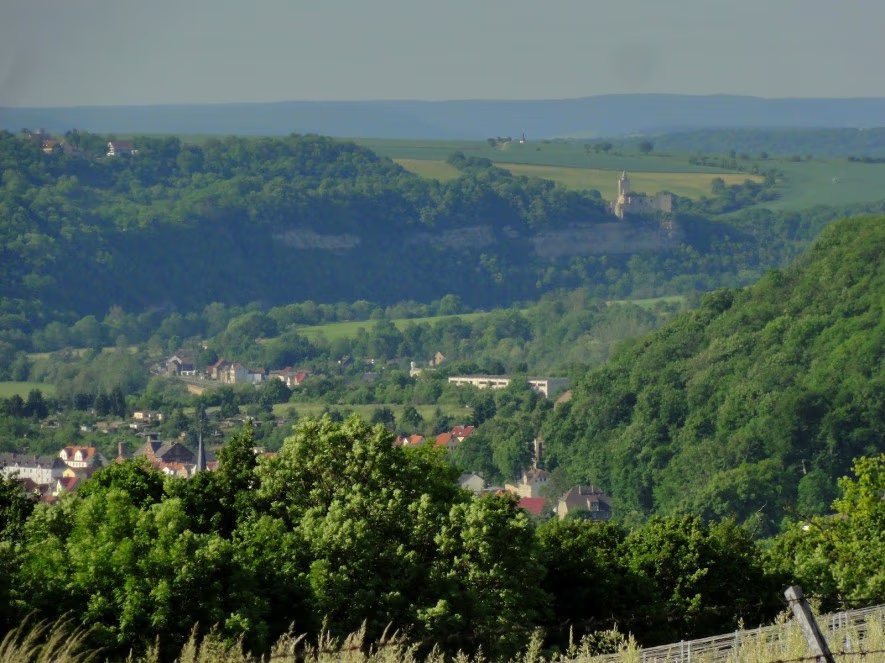
View from the Göttersitz toward Bad Kösen and Rudelsburg Castle
So here we are at the Göttersitz, sitting on a bench above a fenced-in vineyard and looking down on Bad Kösen with its salt works, the Saale River, and, beyond the river, Saaleck Castle and Rudelsburg Castle. We’re in the Burgenlandkreis district, and here you come across them more often—the proud keep towers from a bygone era, standing on the highest elevations of the area, surrounded by thick walls, to provide a better view of the land. We have a lovely view here, too. If I were a knight, I would have built a castle here. A beautiful view that we enjoy for a while before continuing on our way.
The next town is Punschrau. Here, we noticed a plaque mounted on a courtyard gate. At the top was a Swedish flag, and next to it, an equestrian portrait of the Swedish King Gustav Adolf. This piqued my curiosity about the text written in old German script next to it. It stated that Gustav Adolf’s army had camped here in Punschrau during its march toward Naumburg, and that he himself had taken up quarters at the Punschrau Inn. Coming from Eckartsberga, the Swedes had gathered large forces along the Saale River and established a bridgehead near Bad Berka. Shortly thereafter, Naumburg fell into Swedish hands, and after the Thirty Years’ War, the heyday of Naumburg—like that of many Central German cities—came to an end for the time being.
Very interesting, but we continued on the Via Regia, since we wanted to visit Eckartsburg today.

Hungry! – Bakery truck in Spielberg
In Spielberg, the next town, we took a break and realized we were practically out of food. And as is often the case, that’s exactly when you get really hungry. So, what now? Looking for a “tienda” like in Spain makes no sense in Germany. Almost all the small village stores that still existed in the GDR era have fallen victim to the market economy and the big shopping malls on the greenfield sites. The elderly people in the remote villages, who are no longer mobile or don’t have a mobile grandchild nearby, rely on traveling vendors who occasionally make their rounds through the villages with mobile sales stands.
And just then, a vehicle loaded with baked goods drove into the village. “He’s just what we needed!” I said to Andrea and jumped up to flag him down. To my surprise, he actually stopped and opened the large hatch on his food truck. He couldn’t have made much money off us. “Four rolls and two pancakes, and thank you so much for stopping. Otherwise we would have starved to death in wealthy Germany,” I said. I didn’t care at all what it cost. The goods from the mobile bakers or butchers are a bit more expensive than those in the supermarket anyway, because of the effort involved. We devoured our pancakes with great pleasure and now had some provisions for the road as well. I don’t know why we hadn’t taken anything with us from Naumburg. And there’s no way to get supplies in Roßbach anyway.

Cornfields like those on the Meseta
Amid vast fields of grain (it sometimes felt as if we were in the Meseta), we made much faster progress toward Lissdorf. About an hour before reaching Lissdorf, I called Mr. Röder about the key to the rectory in Eckartsberga. His wife said it wasn’t a problem; just call again when you’re in Lissdorf. We then walked through Lissdorf, hoping for a small clue as to where we might find Mr. Röder. And so we reached the edge of town without any clues, where there is a bench and an information board about the town. Here I called again, and Mr. Röder said he would bring us the key to Eckartsberga. “Well, I can just take it with me. You don’t have to…” “Okay, stay where you are, I’m coming.” A little later, a sort of garden tiller with a single-axle trailer rattled toward us.

Mr. Röder in Lissdorf
An elderly man descended the steps somewhat slowly and introduced himself. Once the formalities were out of the way, he began to tell us about the history of the village (we were standing on historic ground that had been fought over by many, from the King of Sweden to Napoleon, and where many battles had been fought). He described to us in particular a battle he had personally fought, namely to preserve the church in Lissdorf.

The Church in Lissdorf
He used to be the chairman of the agricultural production cooperative and had some influence, which he used with the higher-ups to preserve the church. Building materials were actually always available in the GDR. You just had to know where, from whom, through whom, and for what (often for West German currency). But there was also talk of copper nails smuggled in letters from Switzerland for the church roof. We were so fascinated by his story that we almost forgot the time. He then asked, almost cautiously, if we’d like to take a look at the church. He seemed almost surprised by our answer: “Of course, we’d love to!” And so we walked back to the village, and he rattled off ahead in his vehicle. Even from the outside, the church made a very well-maintained impression. Well, every church makes a better-maintained impression than the one in our home village—unfortunately. Inside, too, everything was in tip-top shape. To our delight, he then rang the church’s three-part bells. If a pilgrim calls in time or he sees one on the way, the bells ring as the pilgrims enter the village. That’s a very nice and touching gesture and shows a certain appreciation for the people who set out on a pilgrimage. We robbed the people of Lissdorf of their peace and quiet for at least 15 minutes.
Promising to tell many people about what we had just experienced and to send many of them here to Lissdorf to visit this warm and hospitable man, we said our goodbyes with the key to the rectory in our pockets and his advice to keep to the far left at the Napoleonic Oak (yet another one!) and take the gravel path down into town. After all, many pilgrims have already walked right past the town because you can’t see it from there.
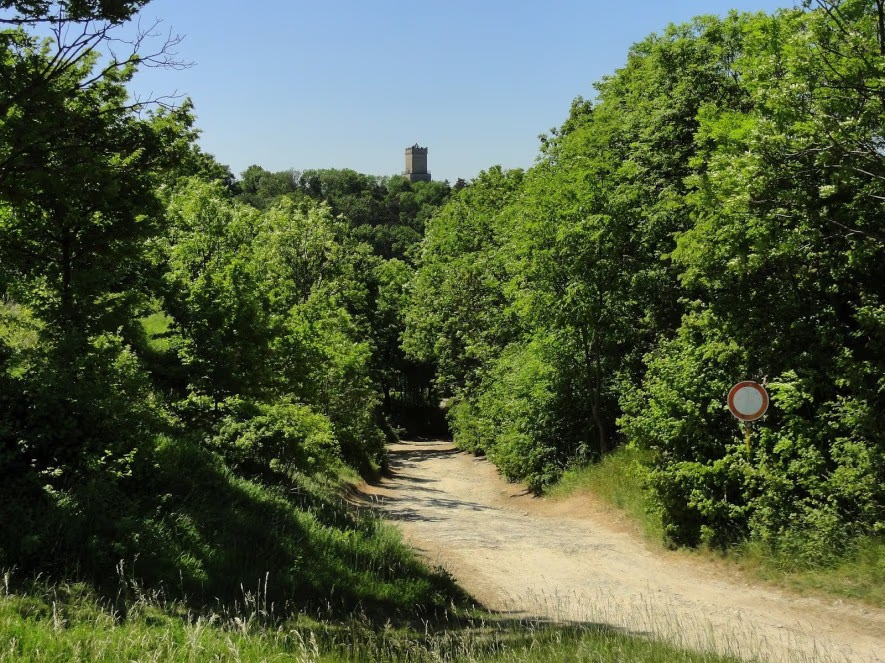
The path down to Eckartsberga, with Eckartsburg in the background
When we finally arrived at the spot later on, we realized that the note was important, because the shell could indeed point in two directions. But as it turned out, we entered the city without any detours around 2:30 p.m.

The Rectory in Eckartsberga
The parsonage was easy to find; after all, it was bound to be near the church tower, which was visible from a distance. Mrs. Plötner-Walter was still there, too. And a local woman who was in the middle of preparing for a golden confirmation celebration. “It’s better if you set up your sleeping area back here in my office. I have choir practice later in the common room up front.” So we dragged two of the rather old mattresses out from under the landing, hauled them into the office, and made our beds. “You’re welcome to help yourselves to everything in the fridge and the drinks next to it. If you take anything, please put a donation in the box.” We were somewhat taken aback by the trust shown in us here. But that wouldn’t be the last time we’d be taken aback on this journey. “I have to go now. Maybe we’ll see each other again tonight.” And just like that, the tall, gaunt woman who lives with her children on the upper floor of the parsonage disappeared. After we’d taken a look at the church, we set off into town.

The Church of Eckartsberga
Eckartsberga has about 2,400 residents, so it’s a very small town, which is why our sightseeing tour was quite short. The most important things here were the availability of a place to shop, a restaurant (which even offers a pilgrim’s menu), and an ice cream shop, which we immediately visited. After that, we had enough energy again to climb the castle hill.

Eckartsburg Castle
Eckartsburg Castle, located on the southwestern edge of the Finne mountain range, is the landmark of Eckartsberga. No wonder, since the town owes its very existence to this castle. In 966, Margrave Ekkahart I built the castle along the Via Regia, thereby consolidating his influence over this important trade route. Its prominent location on the Sachsenberg, with sweeping views of the Thuringian Basin, guaranteed him a steady income. The castle is partially preserved, and visitors can climb the 36-meter-high keep after making a small donation at the restaurant located in the castle courtyard. The slightly smaller keep, standing 22 meters tall, served in earlier times as a prison and torture chamber. It is covered in scaffolding and not accessible. The accessible, taller keep was formerly used as living quarters and served as a watchtower. On the third of the five floors, there is a diorama depicting the Battle of Jena and Auerstedt in 1806. When you insert a 50-cent coin into the machine, the lights turn on and armies of tin soldiers appear, charging at each other in the heat of battle. A voice comes from a loudspeaker and explains the course of the battle. The corresponding locations are illuminated in sync with small lights. I wish we’d had something like this in history class. But the battle went on for a very, very long time, and we finally wanted to go up the tower to enjoy the view. But only after the voice fell silent did we continue climbing the creaking wooden staircase. That much cultural history was worth 50 cents.

View from the keep looking west
Once we reached the top, a truly fantastic view awaited us. The weather was on our side, too, and we could already see the ridges of the Thuringian Forest stretching out across the Thuringian Basin. You also get a nice view of Eckartsberga on the opposite side of the tower. Then Andrea spotted a grocery store on the outskirts of town along the B87 heading toward Apolda. “Shouldn’t we pick up some fresh vegetables for tonight?” – “It’s at least 2 kilometers out there. Don’t you think I’ve walked enough for today?” But Andrea is very (let’s say) persistent. And so we climbed down the other side of the hill, and I trotted along behind her to the Penny. On the way back, I thought to myself: “And all that for a green cucumber!”

Waiting for the next stage
We hadn’t been sitting on the bench in front of the rectory for very long. I had just opened a beer when something hobbled through the gate of the rectory garden—yes, a pilgrim! Or rather, a female pilgrim. She had set out from Freyburg today, started her journey in Königsbrück, is originally from Gera, and I’ve forgotten her name. It’s a shame—I can remember the names of towns and cities for years, but when it comes to people and their faces, I fail miserably. Oh well, it’s too late now anyway. She wasn’t very steady on her feet anymore and was absolutely delighted to have made it here. We told her the essentials about the accommodations, and I helped her set up her sleeping area. She got the large common room all to herself, since it seemed the choir rehearsal had either already taken place or been canceled. After she’d rested a bit, we walked down to town together and sat down at the restaurant that had advertised a pilgrim’s menu. And lo and behold, suddenly two other female pilgrims were sitting at our table, though they were only on a weekend trip and would definitely never stay at these hostels. Well, I guess I was a bit off the mark with the word “pilgrims.” By the way, the “pilgrim’s menu” was called that because, in addition to the meal ordered from the menu, a banana was served at the end. Oh well, it’s the thought that counts. And the inexpensive meal tasted excellent, too.
That evening, we sat outside in the parish garden with a bottle of wine and invited the pastor, who had come home late, to join us. We learned from her that, in addition to the parish here in Eckartsberga, she looks after several others, and there are also parishes in the surrounding area that are without a pastor. She takes care of her flock there as well. We asked how she manages things on Christmas Eve, for example. “I have volunteers there who read the sermon I’ve prepared, and they do a really good job. There’s no other way to make it work. I usually don’t finish work until very late, just like today.” We have the utmost respect for this woman, because in addition to her heavy workload, her children were waiting for her at home. And then she also finds time to welcome pilgrims or sit with them in the garden in the evening and chat with them.
With these memories in mind, we went to bed late that night, thinking about the kind people we had met again that day.
6. Stage: May 26, 2012 – Eckartsberga to Stedten

Breakfast in Eckartsberga
The sun was just rising behind Eckartsburg Castle as we left the town heading southwest. Before that, we had enjoyed a hearty breakfast in front of the idyllically situated parsonage. Our fellow pilgrim was still asleep and preferred to walk alone, which was understandable given her foot problems. We would certainly have had to slow down considerably to stay together. So we set off again in perfect hiking weather through the morning villages and fields. Today we planned to make it all the way to Stedten am Ettersberg. Here, too, the lodging promised to be extraordinary. For it is, once again, located in a church. The sleeping quarters are said to be in the bell tower of St. Kilian Church in Stedten, and the pilgrim guide promised us a beautiful view of the Weimarer Land from this tower.
The first place we headed to is called Seena. It’s one of those villages you’d probably never have come across if you weren’t traveling on foot, since it’s not located on any major highway and doesn’t have any particular attractions that would make it worth a visit.

Church in Seena
The downside of living out here in the middle of nowhere is certainly offset by the peace and quiet you find here. The villages we’ve seen so far have all been beautifully spruced up. There are often new roads with new streetlights, the power lines have long been buried in the ground alongside the new sewer system, the churches have been renovated, and everyone has spruced up their house and property according to their taste and financial means. A lot has changed in the 23 years since the “Wende.” The only thing these villages are really struggling with is the exodus of young people. Only those who own property stay in the countryside long-term and put up with long commutes to work. Country life also has its charm because there’s often a strong sense of community in the villages. People meet up in clubs or simply at the garden fence. Everyone knows everyone. Aside from the well-known “Knallerbsenstrauch” (those unfamiliar with it should Google Stefan Raab and “Knallerbsenstrauch”), these are actually idyllic conditions.

Seena Fire Department
Here in Seena, there seems to be a small but active fire department, which is very interesting to me as a volunteer firefighter. An old Robur stood next to the tiny firehouse, and the huge grill was still warm. There was a party here yesterday, surely with plenty of beer and Thuringian grilled sausages. Yes, we’re almost in Thuringia. Somewhere past Seena, we crossed the state border. In Lissdorf, Mr. Röder mentioned a sign he had put up. Or did he just want to, and the bureaucracy had something against it?

Green
If there was one there, we unfortunately missed it. Thuringia, the green heart of Germany, the land of bratwurst, as Rainald Grebe sings, was set to continue blessing us with beautiful weather. Here, too, the route follows dirt roads, occasionally on quiet local roads, but always idyllic and easy to find.

Stop in Oberreißen

That's it!
The grain stood tall on its stalks, and green is the dominant color at this time of year. You almost have to look down constantly as you walk—not just because there are often stones in the way, but because the field mice literally run right over your feet. On paths bordered by shrubs or trees, we noticed the many small remains of rodents—a sign that there are also many birds of prey here. And so we often had to adjust our stride at the last moment to avoid stepping on the rodents’ carcasses.
It’s all pure nature here, and when the sun is shining too, it’s a real pleasure to walk along here. If only I didn’t start feeling hungry again.
When we arrived in Nermsdorf in the Weimarer Land region—another beautifully spruced-up village—we were lucky again with the bakery van. We had just settled in on a picnic bench when we heard the bell ringing that the mobile baker used to signal to the residents that they could now get their fresh bread and rolls—for me, it was also the signal to stock up on provisions. It came just at the right time. Without these traveling vendors, things would look bleak for pilgrims on the Via Regia. They’d have to carry much more provisions in their backpacks. We still had an emergency stash left, though, because who knows the vendors’ schedule?

Breakfast in Nermsdorf
In Buttelstedt, we had to get more water from the fridge, because not only were our water bottles almost empty, but what little water was left had gotten really warm in the sun and now tasted like feet that had been asleep for too long.

Ostrich farm near Schwerstedt
We really needed that fresh water, because the temperatures had once again reached summer levels that day, and the path to Schwerstedt—running straight along the road on a former railroad embankment—was getting longer and longer. It was about time we got there. On the outskirts of Schwerstedt, we stopped once more at the huge ostrich farm, with curious glances exchanged on both sides of the tall fence.

St. Kilian in Stedten
A short while later, we reached Stedten. And there we were, standing in front of St. Kilian’s Church, which stands completely open—with no fence around it—right in the middle of a meadow in the village. I was a little disappointed by the thick, somewhat stodgy-looking church tower. I had expected a tall tower from which, as promised, one could see far into the countryside. But this one was not only particularly thick, but also rather short. So it looked almost just like me. :)

The Renovated St. Kilian Church in Stedten
Tired and sweaty, we sat down on a bench in the shade of the tower and waited for the key that a woman from the village—whom I had called earlier—was going to bring us. By the way, the phone number is listed on a small sign hanging in one of the church windows. A short time later, the woman unlocked the door for us and showed us into the hostel. St. Kilian had fallen into near-ruin by 2006 and was subsequently extensively renovated. The funds for this were provided through the European LEADER program for rural development, according to an information board in the church.

Pilgrim's Room in the Church Tower
Fortunately, during the very successful renovation, the decision was made to incorporate pilgrim accommodations here. To the right and left of the entrance, there are modern restroom facilities and a small kitchen. A glass door separates this area from the main church interior. There are two mattresses in the gallery and six in the bell tower. And from the small windows in the tower, there really is a beautiful view of the town and the surrounding area, even if it’s not as spectacular as I, as an amateur photographer, had hoped. The accommodation is very spacious and clean, which we also expressed our gratitude and appreciation for when saying goodbye to the lady. “Just leave the key there. I’ll pick it up again tomorrow morning.” With her note that the woman at the beverage store around the corner takes care of the pilgrims and also has food available, she was gone as quickly as she had come. After doing a big load of laundry and making the beds, we headed into the village in search of the aforementioned beverage store. We didn’t have to walk far. The town really isn’t very big. In the garden stands a “flower” made of hundreds of “Kümmerling” bottles glued together. That must be the beverage shop we were told about. But there’s a sign hanging there: “Open from 7 p.m.” Having come up empty-handed, we turned back and headed back to the church. Our “limping” fellow pilgrim had arrived there in the meantime. Understandably, she had taken her time and was already walking much better today than yesterday. She made herself comfortable in the gallery (she’d probably noticed the night before that I’m a bit of a snorer). A few words about the route, and suddenly it was 7 p.m., so we set off for dinner—or rather, we hoped to get some.

Dinner at the beverage store
At the beverage store, an elderly gentleman approached us and called out over the garden fence: “You’re the pilgrims, aren’t you? (I guess it really shows. Or is it perhaps because no other stranger would ever find their way to this place?) “Of course,” I said. “You were here a little while ago—why didn’t you come in?” “Well, the sign, the opening hours…!” “Nonsense—opening hours? If we’re here, you can come in too. We’ve got sausages on the grill—want to have some? The fridge’s back there—go grab yourself a beer!” Well, you don’t have to ask me twice! That’s just how I like it—totally laid-back, like you’re at a garden party with friends. The sausages were excellent, by the way—Thuringian, of course…

In front of the church in the evening
That evening, we sat with our fellow pilgrim on the cozy wooden benches in front of the church and chatted about all sorts of things. That’s when we found out that we’d be on our own again starting tomorrow, since she’s finishing up tomorrow and has to head back to Gera. Her vacation is over; tomorrow is Pentecost, and she wants to be home by then. So we said our goodbyes now, since we wanted to set off on time again. Tomorrow we’re heading to the state capital, Erfurt.
Day 7: Stedten – Vieselbach

In the morning beyond Stedten
Today, too, we set off very early after a quick breakfast in front of the church in Stedten. We said goodbye once more to our new—though fleeting—acquaintance from Gera, as she planned to head toward Erfurt later in the day. A quick check of the bedroom, kitchen, and bathroom—nothing forgotten—and off we went. The sun was just rising as we walked through the still-damp meadows toward Ottmannshausen. It rose, as it had every day so far, into an almost cloudless sky. Man, we’ve been so lucky with the weather so far! Our unused rain gear had now made its way to the bottom of our backpacks, and we hoped it would stay there for the next few days.

East German Agricultural Machinery
As I approached the small village of Ottmannshausen, I noticed a farmyard filled with old farm machinery from the GDR era. Whether it was the E512 combine harvester, the RS09 utility vehicle, the Famulus tractor, the T157 excavator (jokingly called the “strawberry picker”), or the ZT300 tractor—I still knew all these machines well, and I wondered who would come up with the idea of collecting such things, given the space they require. Some of it didn’t even look like it was still in working order. But the most surprising thing that morning was a very nice outdoor pool on the outskirts of the tiny village. How such a small village can afford a pool like that is really beyond me. Our town can’t even afford a space large enough for the 46 members of our local heritage association.

Outdoor swimming pool in Ottmannshausen
The terrain gradually became hillier. To our left, we walked right around Ettersberg, on which the Buchenwald Concentration Camp Memorial is located and behind which lies the city of Weimar. An alternative route of the Via Regia runs through Weimar, but we didn’t want to take it. To the right, we looked out over a plain toward Sömmerda. There, we could clearly see the route of the new ICE line from Leipzig to Erfurt, which is currently under construction. For a long time, all we saw here were completed bridges standing lost and lonely in the fields. Now it seemed construction was moving forward again. On a hill before Ollendorf, we could already see the houses of Erfurt on the horizon. It was a holiday today, so the villages were even quieter than usual. People were probably sleeping in. And so we were often the only ones causing the village dogs to bark.

Via Regia
The leg of the journey to Erfurt isn’t very long, and besides, we only wanted to go as far as Vieselbach, a small town in the “affluent suburbs” just outside Erfurt, the capital of the Free State of Thuringia. Vieselbach is located about 7 kilometers before Erfurt and the truly boring stretch through the industrial parks just outside the city. In Vieselbach, we had private accommodations in a private home. And here’s how it came about: The husband of a clubmate works in Erfurt during the week. And so that he doesn’t have to commute from Delitzsch to Erfurt every day, he rented a granny flat in Vieselbach. When the club found out what we were planning and where we would be walking, they immediately offered for us to stay there, since he doesn’t need the apartment himself on the weekends. We gratefully accepted. Because in Erfurt, accommodations aren’t just a bit more expensive—you often can’t get in because they’re fully booked. Especially at the Augustinian Monastery, the top choice for pilgrims in Erfurt, groups often stay there, and they’ll sometimes turn a pilgrim away, even though they’ve set up special pilgrim rooms there.
Erfurt is a popular tourist destination, and many events take place there. As a result, rooms in guesthouses and hotels can be hard to come by. So rather than leaving it to chance, it’s best to book well in advance to secure affordable accommodations.

A panoramic view on a sunny day near Erfurt
None of that mattered to us today. We were still hiking across blooming meadows and through swaying grain fields. We made good progress again, so that by noon we were already standing in front of the house in Vieselbach that I’d found using my GPS and rang the doorbell. We were a little early, so at first we thought no one was home. But I don’t give up that easily. And so I found the owners in their garden by the pool. They welcomed us warmly, and the husband in particular wanted to know everything about the route, since he had already been on the Camino Frances himself. Over a bottle of beer, we got into a long, relaxed chat about the trail before they showed us our accommodations. And those accommodations were pure luxury for us—I could have fallen right down on the spot.

The Krämerbrücke (the only inhabited bridge north of the Alps)
Still, we really wanted to see Erfurt, so we did something that’s usually frowned upon on a pilgrimage and that we’d normally only do in an emergency. We got on a bus. Twenty minutes later, we were standing in the center of Erfurt and had spared ourselves the industrial parks and concrete silos of Erfurt’s suburbs. Today we were just regular tourists, without backpacks on our backs, without walking sticks in our hands, without searching for the next signpost or the next hostel. Only our outfits were still pilgrim-appropriate, because of course we hadn’t carried the nice clothes we usually wear on Sundays here in our backpacks. Although I do wonder how some of the pilgrims on the Frances managed it—the ones you saw on the trail during the day and who strolled across the Plaza Mayor in a jacket that evening. By the end of the day, however, our feet were aching despite our short walk, because you really have to walk your way through the center of Erfurt.

The Erfurt Fish Market
Even pilgrims who are just passing through should take the time to walk around a bit. It’s really worth it. Andreas’s father is from near Erfurt, and she knew the city on the Gera River, at least from her childhood. I’ve never been to Erfurt; I’ve only ever driven through or past it. I only knew sights like the Krämerbrücke, the fish market, or the cathedral from photos or TV reports. But they’re worth seeing in person, just as thousands of other tourists do every day. Now, I don’t want to just copy the city’s marketing brochure here. If you want to know more about Erfurt, you should take a closer look at this site. It actually contains the most important information about Erfurt.
So we strolled leisurely through the streets of the old town, our only worry being that we might miss something. The Krämerbrücke was photographed from every angle as soon as you could get it unobstructed in front of the lens amid all the crowds of tourists. At the fish market, we sat at an outdoor table and admired the magnificent townhouses on the square while we had lunch, as a street musician played Bob Dylan.

Cathedral Square
And at Erfurt Cathedral, we got our pilgrim’s stamp after also visiting St. Severus Church on the Cathedral Hill. Even the somewhat less spectacular paths through the narrow alleys of the old town are well worth seeing, and you keep discovering interesting details on the facades of the medieval houses, which have been lovingly restored. The city was especially crowded today. We often had to weave our way through the crowds, and the wait times at the popular street cafés were a bit longer today. The Pentecost weekend and the beautiful weather had drawn many people into the city. And honestly, I’d rather walk 30 kilometers at a brisk pace through the countryside than slowly stroll around here on this Pentecost Sunday and have to keep stopping. My feet hurt even more, and all this hustle and bustle gets on my nerves pretty quickly after walking through the solitude of nature for days on end. Pilgrims know that feeling of needing to get out of here fast once the novelty has worn off.

At Erfurt Cathedral
Our hosts were also quite surprised when we showed up at their door again before 6 p.m. We didn’t want to take advantage of these kind people’s hospitality any further, so we decided to find something to eat in town. It was Pentecost, so surely something would be open. From a distance, we heard what sounded like a large sound system being tuned up. Every now and then, we caught snippets of conversation or the screeching sounds of guitars. I tried to pinpoint the source of the sound and figured the noise (which would turn out to be music later) was coming from the sports field. Where there’s music, there are people. Where there are people, there’s food and drink. So we set out to satisfy our hunger. The sports field was easy to find. All we had to do was follow the others. Behind the construction fences surrounding the sports field, covered with tarps for privacy, suspicious plumes of blue smoke rose, smelling of Thuringian grilled sausages. Let’s get in here, because my mouth was already watering—or rather, I had a puddle on my tongue. Eight euros admission—per person!! No haggling allowed! That was the most expensive bratwurst of my life so far. Andrea was pretty surprised when I handed over the money almost without a murmur. At first, I didn’t care at all who was playing or what kind of music it would be. I was hungry and also a bit tempted by the beguiling smell. With our sausages and a mug of beer or shandy in hand, we sat down at a table where another couple was already sitting.

Concert with “Accustica”
The technicians were still tuning their equipment. “Who are those guys?” “Accustica from Erfurt. You don’t know them? They’re funny,” someone across the way shouted to me, referring to the “sound technicians.” “Nope, I don’t know them. We’re not from around here.” But the band seemed to enjoy a sort of cult status here, because you could see lots of groupies wearing T-shirts with the band’s logo.
The venue was filling up rapidly, and the apparent age range of the crowd was something you wouldn’t typically expect at a rock concert. Everyone from 7 to 70 was there, and everyone seemed to be in joyful anticipation, which made me feel confident that the 16 euros had been money well spent. The band members were sitting at the next table, but I didn’t notice them until quite late, since they looked just like you and me and didn’t put on any airs. It looked more like a family outing with kids.
Then things really seemed to get going, and suddenly the band members looked completely different on stage. The drummer, for example, was sitting at his kit in a police uniform, really going for it. And what they were doing up there was absolutely wild. “When Mom Goes to Work Early”—a kindergarten song from my earliest childhood in a rock version—the crowd went wild and everyone sang along—me too. Check out the video on YouTube and you’ll understand my excitement. Unfortunately, we couldn’t stay until the end, since we had plans for the next day: to walk all the way to Gotha. You can’t do that if you’re at a rock concert late into the night and then set off the next morning to walk 30 kilometers. So, with a heavy heart, we set off. On the way home, we tried to catch a few more songs as they echoed through the streets of Vieselbach.
The apartment's windows were quite well-sealed, though, so we still managed to get a quiet and restful night's sleep.
Day 8: Vieselbach – Gotha
We slept well at the Tilp family’s home in Vieselbach, and to top it all off, Mrs. Tilp prepared a wonderful, hearty breakfast for us. Mr. Tilp then realized that with full stomachs, we wouldn’t make it all the way to Erfurt on foot, so he drove us in his car to Domplatz. It would have been too far for us today as well. And the industrial parks between Vieselbach and Erfurt really aren’t particularly inspiring. Enough with the excuses??
The streets were almost deserted this Monday morning. It’s Whit Monday, and most people were probably still sound asleep in their beds. That was fine by us. With little traffic on the roads, we were in Erfurt in no time, and after saying goodbye to our host, we followed the signs—which were quite common here again—and headed through Erfurt toward the EGA grounds.

Signposts in Erfurt
Running parallel to the B7, which leads toward Gotha, we walked along the Bühlauer Hohlweg, away from the highway and thus far from the traffic and noise that began to pick up as the day wore on. Beautiful suburban mansions and older homes lined the path. At one house, a sign caught our eye: “Santiago de Compostela 2364 km,” with a small car symbol next to it and “3000 km” next to a small pedestrian figure. A scallop shell was also nailed to the signpost. We discussed at length why the person who put up the sign knew the distance to Santiago by car so precisely, whereas the distance on foot could only be a very rough estimate. It would be quite a coincidence if, of all places, it were exactly 3,000 kilometers at this very spot. The big difference between road and walking kilometers also seemed quite questionable to me. But the gesture and the fact that this sign stands here of all places shows once again that this path and its pilgrims are recognized and appreciated. We did want to arrive in Santiago this year, even though there were still quite a few kilometers by plane, bus, and on foot to cover at that point. And we discussed whether we could make it (assuming we had enough vacation time and would try) by the agreed-upon date. The result: We would have made it with plenty of time to spare. Whether it would have been physically feasible is another matter entirely. At that point, we still planned to walk the Camino Primitivo on our own starting from Oviedo, and our friend Jörg wanted to take the same flights to Asturias with his daughter but continue on by bus to León. So while we would have set out from Oviedo, Jörg and his daughter would have started their journey in Hospital de Orbigo. We planned to meet in Palas de Rei after 10 stages each and walk the rest together. Jörg intended to complete the Camino Francés he had abandoned in 2010, and we had the opportunity to walk a new route—one that, as we now know, turned out to be completely different. Anyone who has already read the report on our Camino Primitivo in my blog knows that things turned out quite differently. Jörg’s daughter’s family planning just happened a bit faster, and shortly after our journey together from Oviedo to Finisterre, he became a grandfather for the second time—which is also wonderful.

grease
But I'm getting off topic. So back to the Via Regia!

View of Gleichen Castle (in the foreground) and Mühlburg Castle
We had left Erfurt behind us in no time. On the slightly uphill path to Schmira, we caught another glimpse of the city’s silhouette, with the striking towers of the cathedral and St. Severus Church. To our right, we spotted Erfurt Airport. In Schmira, we unpacked our snacks on a bench for a second breakfast. There wasn’t much more than an apple. I was still full from the breakfast in Tilp. Beyond Schmira, a brand-new paved bike path climbs gently but steadily toward the A71, which we crossed via a narrow bridge. From here, you can already see the distinctive hills known as the “Three Gleichen.” That’s the name given to Gleichen Castle near Wandersleben, Mühlburg near Mühlberg, and Veste Wachsenburg near Holzhausen. The castles, dating from the 8th and 11th centuries, never had the same owner and also look very different on the outside. So why are they still called the “Three Gleichen”? As is often the case, a legend attempts to explain this: The term “the Three Gleichen” originated after a ball lightning event on May 31, 1231, when, following a lightning strike, all three castles caught fire simultaneously and were visible from afar like torches. Mühlburg and Gleichen Castle are now well-preserved ruins. Only Wachsenburg has been restored, and today a hotel is located within its medieval walls.
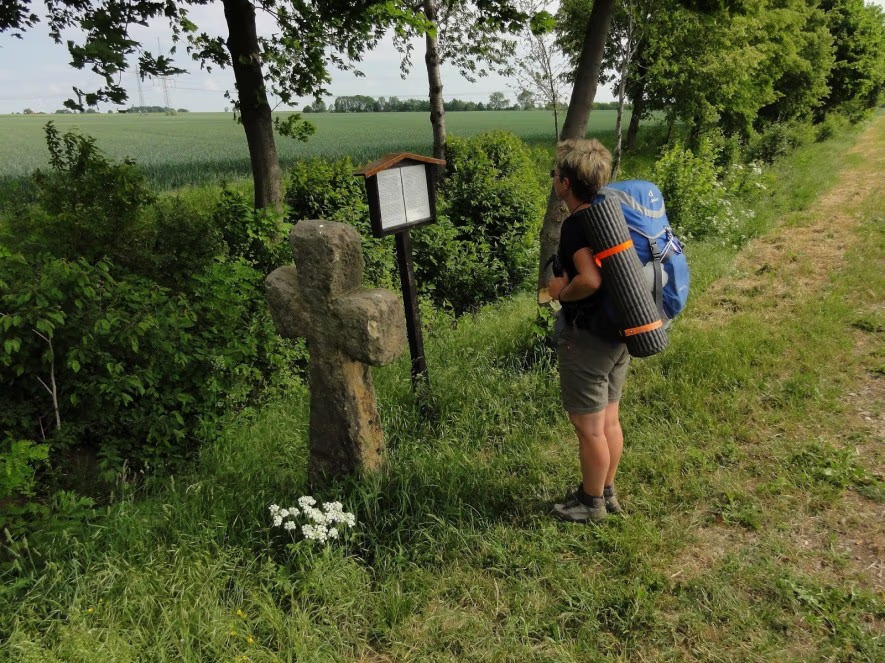
Stone cross near Kleinrettbach
Just past the highway overpass, we almost got lost for the first time. The trail marker there was badly weathered, barely visible as it was painted on a rock in a drainage ditch, and to make matters worse, it was also hidden by weeds. In any case, for those who want to follow us on this route: Keep to the right after the highway overpass. Just to be safe, I’m including a link to this spot here.

Stone cross behind Kleinrettbach
On today’s stage, we noticed several stone crosses standing along the path. We spotted one east of Kleinrettbach and one west of it. An information sign at the latter explained that the cross had been moved 350 meters to this location because it originally stood in the middle of a field, where it naturally couldn’t be seen in the summer. Now it stands right on the Thuringian Way of St. James. Once again, a legend explains the origin of the cross: During the Thirty Years’ War, two enemy troops faced off east and west of the village of Kleinrettbach, but missed each other in the fog. Thus, the village was spared, and in gratitude, a stone cross was erected at each of the encampments. According to the legend, these two crosses therefore had a rather positive background. However, many such stone crosses were erected as expiatory crosses. Penitential crosses are monuments of medieval law. So-called penitential agreements were concluded between hostile parties to end a blood feud resulting from a committed murder or another act of violence. The cross was the part of the agreement visible to all. Stone crosses, on the other hand, emerged in the 16th century and were erected as weather crosses, plague crosses, and waymarkers for pilgrims and processions, or even as boundary markers. Since inscriptions have weathered away and written documents are scarce, it is difficult to distinguish one from the other. Much of this is based on stories and legends, which makes the whole subject exciting and interesting for us today.

All day on asphalt
The monotony of the paved bike paths today called for interesting spots like this. As much as I like these bike paths as a cyclist, today I was really longing for a natural dirt road like the ones we’ve often come across before. The only solution is to use the shoulder of the road so that our feet get a little variety too. We found some variety in Tüttleben. As we were leaving town, we spotted a quad bike zipping back and forth across a meadow at breakneck speed. But we didn’t realize what that meant until we got closer. The meadow had been mowed into strips about 3 meters wide, similar to a traffic playground, and on these strips, the ATV was pulling a rope through numerous pulleys located at the curves of the course. At the edge of the meadow stood a tower of scaffolding with several people standing on it. Now it was clear what we were seeing: a greyhound race.

Greyhound Racing in Tüttleben
The “decoy rabbit” was attached to the rope and pulled across the course at breakneck speed using a small winch. My first impression: The dumb dogs were chasing after the “hare,” while the smart ones took a shortcut through the tall grass—which, much to their owners’ annoyance, led to disqualification. But we were told: Greyhounds hunt with their eyes, which is quite strange for dogs that are actually nose-driven animals. But you could see that as soon as the greyhounds lost sight of the prey, they stood there confused and wandered across the field, which really annoyed the owners. Dog owners had traveled here from all over Europe with their pets. There were Italians, Dutch, and even Brits who had parked their campers on the club grounds. We saw something like this for the first time. Our dog is more of a couch potato, meaning: he’s not really into running and just lies around the house looking pretty, eats every now and then, and then has to go out to the garden for a quick bit. He lives what you might call a dog’s life, and sometimes I find myself wishing that if there were a second life, I’d like to come back to this world as my dog.
As interesting as all this was, human ambition certainly does produce some strange creatures. Whether the animals there are always well cared for or even enjoy their lives is open to question when you look at some of the breeds. And I spotted quite a few exotic specimens here as well. I don’t even want to get into the topic of animal cruelty, so as not to offend any readers who might be sensitive to the subject. But it’s safe to assume that the desire to win is so excessive in some people that the animals end up suffering as a result. But we were far more interested in the blue columns of smoke rising above the club grounds than in the various breeds of greyhounds. Yes, there were Thuringian grilled sausages here again, along with other delicacies like homemade, authentic Italian pizza or smoked trout. It was just past noon, and thus exactly the right time for lunch. We had agreed anyway to take every opportunity to stock up on food as needed. A food truck isn’t always nearby when you’re hungry. Our journey so far had taught us that. And if the food is served already prepared—all the better. It wasn’t far to Gotha, so we took our time. We had already called the von Rhoden family, with whom we planned to stay the night. Mrs. von Rhoden even called back in response to the message I’d left on her answering machine. “Of course you can come. If we’re not there, the key is hanging…” (Nah, I’d rather not write that so publicly). Surprised by the trust that had once again been placed in us, complete strangers, we headed toward the address in Gotha Siebleben. We were already curious about this family, whose surname includes the little prefix “von.” Could they actually be “blue-bloods”? The house we were now standing in front of didn’t really look like a “noble” residence, or at least didn’t match our preconceived notions—a two-story old row house with green shutters, neatly but unobtrusively renovated.

Welcome!
The large key to the padlock on the courtyard gate was indeed in the agreed-upon spot. What awaited us when we entered the courtyard nearly blew us away. There was a large rustic table in the small courtyard under a walnut tree. On this table stood a carafe of water and two glasses behind a handwritten note. Deeply moved, we read the note: “Welcome! We’re out today. Make yourselves at home. (The pilgrim’s room is above the workshop; the bathroom and kitchen are in the house.) We’ll be back late in the evening.” There, a family opened their home to us, people they had never seen before. I imagined how I would react as a homeowner if complete strangers asked to be let in and I wasn’t there when they arrived.

Staircase to the Pilgrims' Room
In this day and age, when many homeowners are considering even more secure locks or even better electronic security systems—or have already spent a fortune on them—people are often publicly urged to be suspicious of their fellow human beings. The family was just about to leave; there was far too little time to get to know each other better. We were only able to exchange a few sentences—not enough to get a full picture of who we were dealing with, and above all, who they were dealing with. And if we had stayed with the greyhounds just five minutes longer, we wouldn’t have seen them again. “If we spend the night in the garden and don’t see each other again, throw the key into the ….” These people gave us an intimate glimpse into their family by opening their home to us. We were completely taken aback. Our first stop was the pilgrim’s room. A steep wooden ladder at the front of the workshop leads up to a room in the attic.

The Pilgrim's Room
Inside were two mattresses, a floor lamp, a stool, and a small table on which sat the donation box, the pilgrim’s book, and the stamp. Outside, on a tiny landing, stood a wicker rocking chair—far too big for the space—in front of the entrance. Everything looks very rustic, yet it shows a distinct sense of form and color. It looked exactly the same inside the house, which we admittedly entered with great curiosity to take a shower. A curious glance into the rooms on the ground floor revealed to us that very special people live here. I don’t think a single piece of furniture here was less than 100 years old.

The family cat
Everything was harmonious, simple, tidy, and perfectly suited to its purpose. Although the entire collection could have been donated to a museum, everything still seemed to serve its purpose. In today’s throwaway society, it was very refreshing for me to see something like this. The people who live here appreciate the craftsmanship and the tastes of our ancestors. They used practical and functional items in their daily lives that others had long since thrown away. And these everyday objects continued to serve their purpose very well. Here, people follow a way of life that may seem completely foreign to us—perhaps even strange to some—but upon closer inspection is actually something to aspire to. Life in our affluent society continues to generate ever-greater desires for the latest trends or whatever advertising suggests to us. And once the allure of the new has faded, we only then realize how superfluous some things are and how many of them are actually just status symbols. This lodging and the way of life of these “hostel parents” best embody the motives that led us to undertake this pilgrimage: namely, to learn once again to get by with simple means and still be content. It is certainly quite easy to live this way for the limited duration of a pilgrimage. But if, as a result, we could incorporate even just a part of this way of life into our daily routines on a permanent basis, society would certainly be better off.
But back to the accommodations:
Much of it had been built by hand or lovingly restored. No wonder, since the host has a well-equipped woodworking shop located beneath our pilgrim’s room.
A quick peek into the workshop—which, by the way, was also open—made my DIY heart skip a beat. There were tools I remembered from my grandfather’s time. You can probably sense my enthusiasm for this place from these lines. And I assume the von Rhoden family won’t mind if I share this here so publicly.

Heavy-duty wash (Energy Class AAAAA)
Before settling in for the evening in the courtyard with a bottle of red wine as dusk fell, we took a stroll through the town. Siebleben is a suburb of Gotha, a long, narrow village along the B7. The town has 5 restaurants and 3 cafés. The main attractions are the many significant sites on the Seeberg: Mönchhof Castle with its park and pond, St. Helena Church with its church garden and monument, and the Gustav Freytag Memorial. But we only saw a small part of these, because even today we were already full of the impressions we’d gathered along the way. And at some point, you really just want to sit there, just like the fat man with the bulbous nose in the Loriot sketch “Feierabend.”
And so I’ll wrap things up for today and just sit here like this. Tomorrow we’ll walk the penultimate leg of the Via Regia to Mechterstädt. The terrain is getting hillier and hillier.

Day 9: Gotha/Siebleben – Mechterstädt
This pilgrim’s lodging feels a bit like a tent, since it’s housed in the workshop’s roof truss. The mud-plastered walls resemble tent walls, and the roof truss looks like the tent poles.
#I slept really well again last night, but had to get up around 4 a.m. (I guess I had one glass of red wine too many last night.) Since the bathroom is inside the house, you have to feel your way down the steep wooden stairs, which wasn’t easy at all while half-asleep and in the dim light. That’s when bringing a headlamp really pays off. Unfortunately, mine was lying somewhere between Roßbach and Stedten by the side of the road—at least the part that was supposed to produce light. Only the rubber band and the base plate were dangling from my backpack. Too bad—the lamp was really good and the batteries lasted quite a long time. I always kept it hanging outside on my backpack because it had once turned on by itself inside, and then the batteries were dead when I needed it. In the meantime, though, I’ve got a new lamp of the same design.

A New Beginning in Siebleben
After breakfast in the courtyard, we closed the gate to the von Rhoden family’s remarkable inn in Siebleben. We’ll remember them for a long time to come. Feeling a bit sleepy, we trudged along the B7 through the suburbs of Gotha. Rush-hour traffic roared past us, and after so many quiet days in nature—and because of the holidays—it was a bit annoying. Here, you can still clearly see the city’s grim past. The former royal seat of the Dukes of Saxe-Coburg-Gotha was an industrial city (trams, aircraft, mechanical engineering, printing industry) and also a military base. And so, alongside various industrial wastelands that bear witness to the decline of heavy industry after the fall of the Berlin Wall in 1989, you also find dilapidated barracks from the imperial era. Because of its great industrial importance, Gotha was bombed by the Allies at the end of World War II and suffered severe damage. I knew Gotha only from a visit in the early nineties. And even then, the city was still a sorry sight. It appeared gray and black, just like many industrial cities in the former GDR. In many places, one could still see the remnants left behind by the departing Soviet occupation forces. Huge military training grounds near Ohrdruff or on the Kriegberg near Gotha accounted for this high concentration of troops.

Marktstraße with a view of St. Margaret's Church
Now, after 20 years, I was walking through Gotha again. I didn’t have particularly fond memories of the city, so I didn’t have any specific expectations either. We walked past long, high fences with signs indicating that a security company was keeping order here. Behind them, however, were only empty, dilapidated buildings for which no investor had yet been found. Even the large bus station we passed didn’t seem particularly inviting or imaginative. It’s strange that most cities neglect their calling card like this. You arrive in a city at a bus or train station, and that’s where you get your first impression of it. But if that first impression isn’t the best…? Well, Gotha will have to really pull out all the stops now if it wants me to remember it fondly.

Gotha's Historic City Hall
But the closer you get to the center, the more beautiful the city becomes. At Neumarkt, we took a short break on a bench by St. Margaret’s Church. Unfortunately, the church was closed, so we took a closer look at the beautifully restored merchant and patrician houses on Neumarkt. Now, just walk up Marktstraße and you’ll find yourself at the Hauptmarkt. Here, the historic town hall and the Guild Hall with its carillon are particularly eye-catching. Looking past the town hall, you can see Friedenstein Castle. Gotha’s landmark is the largest early Baroque feudal building in Germany. The range of sights is vast. The walk-through casemates, the castle park, the orangery, Friedrichthal Castle, the Winter Palace and the Prince’s Palace, the Ducal Museum, and the oldest English garden on the European continent are all waiting to be explored. To see all of this, you’d certainly need more than a day in Gotha. How were we supposed to manage that if we were walking through the city and still had 24 kilometers ahead of us? So we didn’t even consider spending time on it. But now we know that, fortunately, our first impression was wrong and that Gotha is now worth taking a closer look at. Not today, though, because (as already mentioned) we still had a few kilometers to cover. We made our way out of the city on a gentle incline through the “Die Klinge” neighborhood of single-family homes and allotment gardens. On the right, we saw the Bürgerturm, a 30-meter-high observation tower on the Krahnberg. We would certainly have climbed the 158 steps if the path had led past it. But it didn’t. We had hoped it would, though, because it would have been a good landmark and a good way to get our bearings.

On the Kriegberg
Here on the Kahnberg and the adjacent Kriegberg, trail markers were very scarce. So we were glad to run into a forest ranger with his dog, who was able to tell us which way to go. Basically, you just have to head west and stay on the wider paths at forks. The paths up here on the Kriegberg gradually turned into concrete tracks. These concrete tracks are remnants of a huge military training area that used to be located up here. The many side paths leading to nowhere are evidence that there used to be much more here. Apart from the concrete paths, there was nothing left to see on the surface of the contamination left behind by the Soviet troops. I don’t even want to know what else might still be lying underground here. But the former military use does have one advantage. The area could never be used intensively for agriculture and has thus remained largely free of fertilizers or pesticides. The Kriegberg has thus become one of the most important areas for species and habitat conservation in the state.
This mountain also holds a very interesting secret. According to legend, the French war chest, bulging with treasure, has been buried here since October 1757. The French were forced to abandon their camp in a great hurry and left the chest behind. They planned to dig it up again on their intended return journey. But that never happened. None of the officers in charge survived the war, and so the chest remains lost to this day. So if anyone has plenty of time and a mining permit…?
But money alone doesn't bring happiness either. And so we continued our hike across the vast grassy plains dotted with scattered trees and low shrubs. Far away from the noise of traffic, you can hear the songs of the songbirds, which are found here in large numbers and have found an ideal habitat here. After two hours, we had reached the highest point of today’s stage.

View of the Great Inselsberg
From here, you have a beautiful view of the great Inselsberg, one of the highest peaks in the Thuringian Forest. We planned to be there in two days, and we also wanted to cross it. It actually looked quite close, but also incredibly high. So I started wondering if there might be a way around it. But we weren’t there yet, so I should have been thinking more about the detour via Eisenach that still lay ahead of us. The Kriegberg area stretches for about 10 kilometers. But the concrete path would remain under our feet for the entire day. You don’t pass through a single town on this stage. We’re heading north again, parallel to Federal Highway B7, which here follows the original route of the Via Regia. The trail was rough, but still better than walking along the highway. It’s just a shame that this means we’re literally leaving most of the towns behind us.

Stone cross near Aspach
So we didn’t pass through Aspach either, near which we spotted another stone cross. This one was well-preserved, and a large executioner’s sword and the year 1839 were clearly visible on the stone. The cross commemorates the last public execution in the Duchy of Gotha in 1839 and was not erected until 1929. According to legend, this was the site where a cobbler’s apprentice was killed.
You rarely look back on such a long walk; more often than not, you just glance to the side. This time, however, I did look back and spotted a lone bicycle approaching us from far away. Otherwise, we’d been walking all alone again. In the shimmering, warm air, I saw the cyclist slowly getting closer. You immediately feel like you’re being followed and find yourself looking back more often. The next time I turned around, I could see that it was a woman and that her bike was quite heavily loaded. The woman greeted us warmly as she passed, and I noticed a scallop shell on her luggage. Before I could even call out to her, she had already gotten off her bike. She was from Jena, had set out today for the first time, and we were the first pilgrims she had met. She was clearly just as happy as we were to have met someone with the same destination. Even if that’s only relative, since she wanted to make it to Eisenach today and we wouldn’t reach the city until a day later. We chatted about this and that, and before long she was back on her bike.

Endless concrete runway outside Mechterstädt
We said goodbye, watched her go, and were a little surprised when she suddenly turned right off the path. That’s the way to Neufrankenroda. “Well, maybe she just wants to check out the hostel there?” Neufrankenroda is home to the SILOA e.V. family community. It’s a kind of commune made up of several families who live together, run a farm collectively, and are very active socially and culturally. Among other things, they also offer pilgrim accommodations. We had already heard about this way of living and farming together last year on the Camino Frances. A fellow pilgrim, with whom we’re still in touch today, follows a similar concept of jointly running a farm in the Lüneburg Heath. Unfortunately, the SILOA didn’t fit into our stage plan. It would certainly have been very interesting there. So we passed the turnoff to Neufrankenroda on our right and continued on. We also ran into our cyclist again. She passed us for the second time a little later. She had simply gotten lost. That’s how it goes with biking. You often only see half the picture, so it’s easy to miss a little blue sign or mistake it for something else. Because at the fork, there was only the sign with the little yellow house and no shell sign pointing straight ahead. So we watched her go again and didn’t envy her bike at all. She was struggling terribly up a long hill and even had to get off and push her bike for a few hundred meters. Then, on top of the weight of your luggage, you’ve got the bike to deal with too. Nah, that wouldn’t be for me. It’s not even made up for by the fact that you can put your feet up on the downhill. And when you add a headwind to that…!
Just past a turn-off, we too had made it up the hill a short while later, and it was time for a break. We rolled out our sleeping pads and, after a quick snack, lay down in the sun. Then more pilgrims showed up. “What’s going on today?” It was a couple from Baden-Württemberg who had set out very late from Neufrankenroda and wanted to make it to Eisenach today. So we wouldn’t be seeing them again either. After a bit of small talk, they headed off and we were alone again.

Turn-off to Mechterstädt
The turnoff for Mechterstädt couldn’t be far now. And then we came to a signpost that directed us to turn left off the main path toward the hostel at Bodelschwingh-Hof Mechterstädt. Although the accommodation is a bit off the beaten path, it comes highly recommended in every respect. The Bodelschwingh-Hof is a Diakonie facility that provides a home and a dignified life for people with mental or physical disabilities. In addition to the residential home, various employment opportunities are offered in so-called sheltered workshops. We saw a nursery and a metalworking shop, and the residents also work diligently in the kitchen. It is an institution with a long tradition, as a gardener who was wounded in the war and displaced from his homeland founded a nursery here on fallow land as early as 1949 on behalf of the Evangelical Church. The aim was to provide people in need with a place to stay and meaningful work. The goal here is not only therapy but also integration into social life.

Accommodations at Bodelschwingh – Hof
Today, this is a very modern facility, and we were quite amazed by its size. During a renovation, three guest rooms were created beneath a newly built terrace on the first—and thus oldest—building on the grounds. The aim here is to provide an opportunity, especially for visitors coming from far away, to stay with their relatives for an extended period. A nice side effect of this is that pilgrims are now also offered a place to stay. We quickly found the entrance to the lodging and someone to let us in. What we found here is on par with a hotel.

Pilgrim lodging with hotel-quality amenities
A new double bed with proper bedding promised a comfortable night’s sleep. Having your own shower and private restroom isn’t exactly the norm on pilgrimage routes either. In the hallway, there was a small kitchenette where you could cook your own meals. But we didn’t plan on doing that today, since we were sure to find something in town. We also wanted to look for a place to buy some provisions for the road. While searching for the facility’s office, I had to ask for directions several times. After all, I wanted to pay our share for the accommodation, since there was no donation box in the room. It costs €10 per person here—a very reasonable price. The two nice ladies at the front desk kept me there for at least half an hour; they wanted to know everything in great detail—where we came from, where we were going, why, and how we were doing. And when I told them that this was just a brief stopover and that, after walking the Camino Francés last year, we wanted to walk this one to Santiago again, they were completely fascinated and kept bombarding me with questions. But I also learned a lot of interesting things about the facility.
Later, we walked into the village, which is located about 700 meters south of the farm. There, we quickly found a small supermarket to do our shopping. We were a bit at a loss, though, when we couldn’t immediately find tomorrow’s route. That’s because you don’t have to take the same path back to the Camino de Santiago; you can take a shortcut instead. At the country inn “Zum Stern” across the street, we had a delicious dinner and were served by a very friendly waitress, who then explained to us how to get out of town tomorrow. As dusk fell, we sat outside our lodging for a long time, watching a fantastic sunset behind the Hörsel Mountains. We’ll have to climb those tomorrow, and the ascent is supposed to be quite steep.

Sunset over the Hörsel Mountains
Day 10: Mechterstädt – Eisenach
Today was the last day of our hike along the Via Regia. Of course, it would have been nice to continue on to Vacha. But we had never been on the Rennsteig before, even though we visit the Thuringian Forest very often because we have friends there. And so we were on the road at 8 a.m. to tackle this stage. With the crossing of the Hörselberge, it promised to be a bit more strenuous and quite interesting. Why so late today? The Bodelschwingh-Hof serves an excellent breakfast in the dining room, and of course we didn’t want to miss out on that. We then headed back down to the village of Mechterstädt to rejoin the Camino de Santiago via the shortcut we’d scouted the day before. There’s also a signpost at this junction, likely for pilgrims walking the route in the opposite direction or who had missed or overlooked the first one.

Back on the road
In the next town, Burla, we left the concrete road—which had been getting on our nerves a bit the day before—and walked along the local road to Hastrungsfeld. But first, we crossed the new A4. The old route of the highway used to run directly over the Hörselberge; it was quite winding, narrow, and therefore, of course, very accident-prone. The location of this heavily trafficked east-west corridor between Dresden and Kassel or Frankfurt am Main meant that the Hörselberge were increasingly losing their significance as a place for recreation, nature experiences, and conservation. The ever-increasing traffic, with its accompanying noise and pollution, and the deteriorating condition of the roadways made a new construction necessary; however, there was no room for it on the old route without further destroying the biotope. And so, thanks to private investors, this highway now runs far to the north, bypassing the mountain range. I knew the old section of the route quite well and was curious to see if one could still make out the course of the old highway.

Frau Holle's Mailbox
By the way, I now know where Frau Holle lives—in Hastrungsfeld. In any case, her mailbox is here, and there’s a Frau Holle House. This is the village’s former schoolhouse, which, now that it’s no longer needed, is used as a community center. During Advent, the Frau Holle Festival is held here, where the old lady heralds the arrival of winter—or rather, “shakes it in.”

Hike up the Great Hörselberg
From the town center, a path leads up to the large Hörselberg hill and its Hörselberg House. A road leads up here to service the inn and a transmission tower at the summit. We, however, took the forest path that branches off lower down, which, though somewhat steeper, is much shorter and more scenic. Leading straight through a beautiful beech and oak forest, the path takes you directly to the ridge trail. When you spot a bench at the edge of the forest, you’re almost there. We emerged from the forest, a bit out of breath, and marveled at the magnificent view of the ridges of the Thuringian Forest, down into the Hörsel Valley, and toward the villages of Sattelstädt, Kälberfeld, and Schönau. The landscape lay before us like a toy train set, and we watched as a train passed right through Kälberfeld. The B7 winds through the valley and the villages, and if you step closer to the slope, you can still see the route of the old A4 about 100 meters below. Only piles of gravel remained of the once-noisy ribbon of asphalt.

View from the Groß Hörselberg
It can’t have been much fun to be up here in the old days. I’ve driven the old A4 many times and was always glad when I got past this stretch, when the highway widened again and ran straight ahead. The name Hörselberg came up quite often on traffic reports. Traffic jams and accidents were the order of the day. The gravel mounds are slowly being overgrown by plants, and a species was found here whose seeds can lie dormant in the soil for over 70 years and still be viable. The highway was built about 70 years ago. The seeds of the red poppy lay dormant beneath the road for all that time.

The Kammweg Trail on Hörselberg
A few steps further on, and we found ourselves at the Hörselberg House. We didn’t even bother to check if the restaurant was open yet. It was still too early for breakfast. Many hiking trails branch off from here, leading through the popular hiking area, which covers about 40 square kilometers. We chose the ridge trail because it offers the most beautiful views and because there was also a signpost pointing to the Little Hörselberg. Beautiful panoramic views opened up time and again.

The trails on Hörselberg
We could even see the Wartburg at the far end of the valley, which ran from east to west. We planned to climb up to the Wartburg tomorrow. Neither of us had ever been to Wartburg Castle—which is actually a shame, since it’s considered THE German castle. Then the path led us to the right into the forest. Narrow, winding trails led through a dark, deep forest. No wonder so many legends and myths originated here. Richard Wagner was inspired to write his Tannhäuser here at the Venus Grotto. Around the Hörselbergloch, as the Venus Grotto is also called, a veritable Frau Holle cult developed through folk legends. In prehistoric times, the people living here believed the mountain range was the seat of nature gods, and many of the horror stories originated at this mysterious place. None of this is surprising, as you walk through the dense, dark forest with its thick, gnarled trees. Despite the bright sunshine, it was quite dark and somewhat eerie beneath the dense canopy of leaves.
The border between the duchies of Saxe-Gotha and Saxe-Eisenach used to run across the Hörselberge hills. A few weathered boundary stones still line the path today. The area is only 6.5 kilometers long. Still, we didn’t seem to be making much progress and felt like we’d been walking on these winding, narrow paths for ages. Maybe that was also why we ended up getting a little lost here.

A clearing at the foot of the Hörselberge
Here and there, there were signs pointing to the small Hörselberg, and we even spotted a few shell-shaped signs. Still, we got lost. At this point, instead of turning right, we turned left. And so we ended up descending into the valley much too early. To this day, I still don’t know if there was a signpost at that fork. But it wasn’t really that tragic. Because if you follow the course of the Hörsel River in the valley, you can’t really get lost. In Wutha, we eventually found our way back onto the right path. When I looked at the map at home, I realized the detour wasn’t that big of a deal. But I would have actually preferred to stay on the mountain as long as possible. From the small Hörselberg, which lies along the correct route, there’s another beautiful view. So unfortunately, we had missed that one.

Eisenach Central Station
The rest of the route to Eisenach runs for a long stretch alongside the Erfurt–Eisenach railway line and passes through several industrial parks parallel to the Hörsel River, which wasn’t particularly appealing. And then, suddenly, the signs stopped. A passerby we asked for directions at Eisenach’s main train station unfortunately led us astray—or rather, into a dead end. A construction fence suddenly blocked our path. Even my usually proverbial good sense of direction failed me here. The last time I’d been to Eisenach was as a child, and I could hardly remember anything. It was no use; I had to dig my cell phone out of my backpack and try the GPS, which wasn’t easy at all, since the device couldn’t find any satellites for a long time in this narrow valley. I did have the address of the Neulandhaus, and now I could at least see the approximate location in the city on the map. In any case, we had to head uphill toward Wartburg.

The Neulandhaus
And what a climb that was! But we couldn’t go on without asking someone first. If only to be on the safe side, so we wouldn’t have walked all the way up the hill for nothing. Then we discovered the Neulandhaus, on the edge of a very beautiful neighborhood with Wilhelminian-style villas. And it really was the last house before the narrow cobblestone street turned into a forest path. How anyone gets up here in winter remains a mystery.

Our little room
The imposing yellow wooden house serves as the training center for youth work for the Protestant churches of Central Germany. It also offers affordable lodging for visitors to Eisenach. Oh, and for those on the ecumenical pilgrimage route, accommodation is of course provided in exchange for a donation. A young man introduced himself as the director of the house and gave us a warm welcome. The twin room he showed us to was on the upper floor and was very cozy. You have a beautiful view of Eisenach from up here. Of course, that wasn’t enough for us, so we decided to brave the arduous walk down into the city and, later, back up again. Going down was faster, of course, and we emerged right on the market square.

Eisenach Market Square and St. George's Church
Of course, St. George’s Church immediately catches the eye here. As we entered the vestibule, organ music was playing—unfortunately, only the final bars of the piece. After that, there was silence—unfortunately. At least we were able to catch a glimpse through the glass door, which was unfortunately locked. Back at the market, where I particularly liked the town hall, we noticed that the stalls of the weekly market were just being taken down. There was nothing left to see here either. So we wandered a few more times through the bustling alleys of the old town. Always on the lookout, careful not to miss a single one, we turned this way and that. It was easy to overlook something. For example, the “Schmale Haus” on Johannisplatz, probably Germany’s narrowest inhabited half-timbered house.

Market Square with City Palace and City Hall
But at some point, we passed the same store for the third time. Or was it because everything here just looked the same? I get the impression that German city centers are becoming more and more alike, and the only difference is the order of the stores. I don’t know what it was. Maybe I’m being unfair to the city. But somehow, Eisenach didn’t really appeal to me. This mishmash of historic half-timbered buildings, tall Wilhelminian-style houses, and faceless “gap-fillers” doesn’t come together to form a cohesive, homogeneous whole. Sure, Eisenach was heavily damaged during the war, and many of those gaps could only be filled after German reunification. But what was sometimes done there isn’t always an architectural highlight, and not everyone can get on board with the city planners’ taste. This isn’t just the case here in Eisenach; it’s the same in Leipzig, too—I need only think of the Picture Museum on Sachsenplatz. But back to Eisenach: I found it appalling, for example, to see a truly pretty little half-timbered house that was now “peeking out” from a new building, with only its facade remaining. It looked as if it might be crushed at any moment.

The Luther Monument, St. Nicholas Gate, and St. Nicholas Church on Karlsplatz
Several streets converge at Karlsplatz, so it’s no surprise that we passed by the Luther Monument, the Nikolaitor, and St. Nicholas Church at least three times. It was already too late to visit a museum, such as the Bach House or the Luther House, so we just looked for a small café after agreeing that we’d buy some food for dinner and eat upstairs at the Neulandhaus. So we sat in the café for quite a while, sorting through our impressions of the city. Slowly, the hectic pace that had unfortunately crept in during our stroll began to fade. A little while later, we were huffing and puffing our way up the hill again. Once we reached the top, we unpacked our groceries in a seating area in front of the Neulandhaus and had dinner. The other residents looked at us a bit strangely, but that’s something you have to get used to when you’re traveling through Germany.
People do notice us more often than we initially thought. But compared to Spain, there are a lot of people who give you strange looks when you walk through town with a backpack. And so we took stock of the journey we’d made so far—a journey we planned to leave behind tomorrow.

Wilhelminian-style villa near the Neulandhaus
We walked through beautiful landscapes and interesting places. We got to know our home country from a completely different perspective. We met warm-hearted people who selflessly work to keep this trail alive. We thought of the many unseen helpers who ensure that you don’t get lost by maintaining the signage. We also thought of those who had once explored or rediscovered this route along the old Via Regia and, through their choices, had found a very good compromise between the original route and the desire for peace and closeness to nature. But we also thought about the part of the trail we hadn’t seen yet and decided that someday we would walk from the trail’s starting point in Görlitz all the way home.
We compared this route to the Camino Francés, which we had walked a year ago, and realized that walking “at home” is really quite a different experience. Fortunately, we didn’t encounter the communication problems we often faced in Spain. This helps you better understand the connections between history and the present. The climate was also more pleasant. Although we were really lucky with the weather. However, we encountered other things we hadn’t expected. Especially the solitude and the challenges with getting supplies during the day demanded our special attention. The issue with food was easy to solve. We just had to carry a little more in our backpacks. But since we were on our own most of the time, hardly met any other pilgrims, and had little contact with the hostel owners, that pilgrim vibe we’d enjoyed on the Frances route never really materialized.
I think loneliness can become a problem for pilgrims traveling alone. It certainly would be for me. It’s also quite different to walk routes you’re familiar with because you’ve often driven them before. This creates a completely different sense of distance and a different relationship to it. The overall “Via Regia” experience turned out to be very, very positive for us. But I hope that even more people will discover this route and decide to set out on it. If this blog contributes even a little to that, I would be delighted. And last but not least, this route certainly helps to break down many prejudices about East Germany and its residents among many of our fellow countrymen as well as visitors from other countries, tearing down the walls in people’s minds.
Tomorrow we’ll head up to Wartburg Castle and then continue to the fork in the road at the “Wilde Sau.” Here, the ecumenical pilgrimage route turns right onto the Rennsteig, with which it runs parallel for a few kilometers. We, however, will turn left and follow the large “R” from here on.
I’ll also write a bit about these two days and include some photos, even though the Rennsteig isn’t actually a pilgrimage route. But why not? Pilgrimage is a state of mind, and it begins within oneself and right at one’s own front door. You don’t need a scallop shell or a yellow arrow to show you the way.

"Buen Camino," from Andrea and Gert in Delitzsch.