


A Guarda is your first evening in Galicia: the boat from Caminha lands in Camposancos, and above the fishing port rises the 341-metre Santa Trega with a settlement from around the time of Christ. In 2025, 32,785 pilgrims passed through. An afternoon is enough, as long as you spend it up on the mountain.
Right now in A Guarda (as of October 2026)
- No ferry, only boats: The car ferry from Caminha has not run since 2021. The scheduled boat lands at A Pasaxe in Camposancos, and from November to March it only runs in the morning between 8:00 and 9:00 Portuguese time.
- Winter break at the hostel: Last winter the municipal albergue closed for maintenance from 15 December to 15 January. We could not find out whether it will close again in 2026/27. Call ahead: +34 619 258 075.
- Museums by the port: The town lists the Museo do Mar and the visitor centre in the Castillo de Santa Cruz as closed. For the MASAT on Santa Trega it gives regular opening hours.
How long to stay?
An afternoon is enough. Caminha is only just over ten kilometres away, so you arrive early. Santa Trega needs the afternoon: about an hour's climb, then the castro, the chapel, the museum and the view over the mouth of the Miño. In the evening there is time for the port and the small old town. A whole rest day is more than A Guarda can fill.
A Guarda in Ninja numbers
- 32,785 pilgrims passed through A Guarda in 2025, according to the town, and more than 3,850 began their Camino here.
- 2,600 pilgrims walked the Portuguese Coastal Way in 2016, the year it was officially recognised in Galicia. In 2025 it was around 90,000.
- About 159 kilometres separate A Guarda from Santiago on the Senda Litoral, according to Camino Ninja.
- 341 metres is the height of Santa Trega. On a clear day you can see from the top the coast you will walk tomorrow.
Arriving: from the boat landing around the mountain
After about ten minutes the scheduled boat from Caminha docks at the Estación marítima of A Pasaxe, in the district of Camposancos. Put your watch forward an hour, you are in Spain. The direct route to A Guarda is 3.6 kilometres long. It climbs to the left past the abandoned building of the old Jesuit college, through Camposancos and the Saa neighbourhood to the A Sangriña sports grounds at the foot of Santa Trega, and then along the main road into town.
The Senda Litoral, as Camino Ninja routes it, takes the longer way: around the southern tip of the peninsula to the river mouth, then along the shore path past O Muíño beach to the port. According to Camino Ninja that is 8 kilometres from A Pasaxe, a good 4 more than the direct route.
In brief: a watch at the river mouth
Around the time of Christ, thousands of people already lived on Santa Trega in a large fortified settlement. In the Middle Ages the Cistercians of the monastery of Oia ran the town, which had a triangular wall with the church at its tip. During the war between Spain and Portugal the fortress of Santa Cruz was built around 1664. As early as November 1665 the Portuguese captured it, and A Guarda belonged to Portugal for three years.
Later the town lived from the sea and from emigration. In the nineteenth century many left for Puerto Rico, Santo Domingo and Brazil, and those who came back rich built themselves a house. Today A Guarda has just over 10,000 inhabitants.
The mountain and the sea: lobsters beneath the holy mountain
Above, the holy mountain with its ruins, below, the port: from Santa Trega you see the path of recent days and the coast to the north, and down below stone tanks in the rocks tell of a time when A Guarda shipped spiny lobsters abroad. At the end of the 1960s the fishermen were still landing huge quantities. By the mid-1970s the spiny lobsters had almost vanished from the coasts of Galicia and Portugal, and in 2005 the port landed less than 500 kilos. They are celebrated all the same, since 1991 at the Festa da Langosta on the first weekend of July.
From mountain to port: what to see
Santa Trega needs the afternoon, an evening stroll is enough for the port and the old town.
- Monte Santa Trega and the castro: The mountain has two summits, O Facho at 328 metres and San Francisco at 341 metres. On its slopes lies a fortified settlement of round houses that flourished around the turn of the era and covered about 20 hectares. At the top stand the chapel of Santa Trega from the twelfth century and, in front of it, a stone wayside cross from the sixteenth. For you as a pilgrim this is the great look back and look ahead: below you the Miño, which you crossed today, flows into the sea, and on a clear day you can see the coast you will walk tomorrow. The climb on foot takes about an hour, and the stations of a Way of the Cross line the path.
- MASAT, the museum on the summit: The archaeological museum shows what was found on the mountain: two gold terminals of a neck ring, Roman coins, millstones and the Cabezón, the "big head" of Trega. Admission €1.50 (as of October 2026), and you download the audio guide to your phone. Open in October from 10:00 to 19:00, in November and December from 11:00 to 17:00, closed on Mondays and in January. We could not establish for certain whether walkers pay at the access road.
- The port and the Cetárea Redonda: Fish and seafood are auctioned at the port, and the hall is open to visitors on weekdays from 16:00. On the promenade two monuments remember the fishermen and the women who lost someone at sea. North of the port, set into the rocks, are the cetáreas, old tanks in which spiny lobsters and other sea creatures were kept alive until they were sold. The largest, the round Cetárea Redonda, lies right on your path to Oia.
- Old town and the Indianos houses: The parish church of Santa María is first recorded in the twelfth century and was enlarged in the sixteenth. In a side altar hangs a crucifix which, according to tradition, was thrown into the sea in the time of Henry the Eighth of England and recovered here. By the port stands the convent of San Benito from the sixteenth century, whose church is still in use. More than 50 houses were built by emigrants returning from the Americas; a walk past twelve of them takes less than an hour and starts in Rúa Puerto Rico, the street of the pilgrim hostel.
Food and drink
A Guarda is a fishing town, and you can taste it. The spiny lobsters are its emblem, even though hardly any are caught off its own coast today. We could not find out where the ones on the plates come from. For the Festa da Langosta a large marquee goes up at the port; 2026 was the 34th edition. On the last weekend of July comes the festival of the swordfish. In the market hall on Rúa Concepción Arenal you can buy fish, seafood and vegetables in the mornings.
Honestly
- The municipal hostel had bed bug reports in 2026. Several Camino Ninja pilgrims reported bed bugs between May and September 2026, along with open showers without curtains. Others praised the cleanliness and the welcome. Check your bed when you check in.
- The famous round houses are replicas. The two round houses that became the symbol of the castro are reconstructions from 1965 and 1972, and archaeologists consider them inaccurate. The climb is worth it anyway, if only for the view.
- The museums by the port are a gamble. The town's website lists the Museo do Mar and the fortress visitor centre as closed. Rely on the MASAT up on the mountain.
- Tomorrow morning there is nothing for a long time. Bars and shops are thin on the ground until Oia. In June 2026 one pilgrim found the first café only after 8 kilometres, and it opened at 9:00. Buy breakfast and water the evening before.
Where pilgrims sleep
- Albergue de peregrinos de A Guarda: the town's hostel at Rúa Puerto Rico 7, in the centre and a few metres from the Camino. 36 beds in two dormitories, €10 a night, no reservations, credencial required. Check-in from 14:00 to 20:30, doors locked at 22:00. Kitchen yes, washing machine no. Often full in summer and on long weekends.
- Albergue O Peirao: a private hostel with 16 beds, €18 to €20 a night, bookable, open from 1 March to 27 December. Camino Ninja pilgrims praise the curtains on every bed, the lockable lockers, the kitchen and the warm hosts.
There is no parish or donativo hostel in A Guarda.
Ninja tips
- Put your watch forward: In Spain it is an hour later than in Caminha. The hostel opens at 14:00 Spanish time, so if you cross early you have time.
- The long way only in clear weather: The loop around the peninsula at the river mouth is a good 4 kilometres longer than the direct route. It is best on a clear morning.
- Up the mountain without your pack: Go up after checking in; in winter the museum closes as early as 17:00.
- Watch the auction: On weekdays from 16:00 you may go into the fish hall at the port.
- Official boats only: In 2025 there were checks on the Miño against illegal pilgrim transport, with fines for operators. If in doubt, ask before you step into a boat.
Practical tips for pilgrims
- Credencial: You need one at the municipal hostel; without it there is no bed.
- Shopping: Supermarkets, a pharmacy and cash machines are a few minutes' walk from the municipal hostel.
- Tourist office: Praza do Reló 1, in winter Monday to Friday 10:00 to 14:00 and 16:30 to 18:30, Saturday mornings only.
- Festivals: 16 July is a local holiday, and on 23 September there is the pilgrimage to Santa Trega. On that day and on the second Sunday in August the MASAT is closed. On feast days beds fill up early.
Onward: past the lobster tanks to the north
From A Guarda you follow the Senda Litoral north along the open Atlantic coast. You leave town along Rúa Puerto Rico, past the hostel. The arrows are poor here, so watch for the sign to Area Grande beach. Over the beaches of Fedorento and Area Grande you pass the cetáreas until, at the Cetárea Redonda, the arrows lead up to the main road.
According to Camino Ninja you reach Portecelo after just under 6 kilometres and Oia after 11.7 kilometres. On the open stretches the headwind can blow hard.
What awaits you tomorrow
Tomorrow is a short day by the sea. In Portecelo, a good 6 kilometres beyond A Guarda and ten minutes from the Explanada do Horizonte rest area, lies the Laxe do Lapón, a rock with a carved spiral from the Bronze Age, around 4,000 years old. At the end waits Oia, a small fishing village above which the Cistercian monastery of Santa María from the twelfth century stands right by the sea. It is the same monastery whose monks ran A Guarda in the Middle Ages.
If you have more energy, carry on to Baiona, just under 30 kilometres from A Guarda according to Camino Ninja.
Deep dive: The holy mountain above the border
A long read, in case you want to learn more about A Guarda. About fifteen minutes' reading.
The first step in Galicia
When the little boat from Caminha docks at A Pasaxe, you have changed countries in ten minutes. The clock jumps forward an hour, the language on the signs changes, and in front of you rises a mountain that commands the whole mouth of the Miño. This is Santa Trega. On the other side of the water lies Portugal, which you have just left. Ahead of you lies Galicia and, just under one hundred and sixty kilometres away, Santiago.
A Guarda is a town that has settled between this mountain and the sea. Above, the ruins of a settlement from around the time of Christ and a chapel for a saint from Asia Minor. Below, a fishing port, a small old town and houses that emigrants built with money from the Americas. In between lies a story of border wars, spiny lobsters and a school that became a prison in one of the darkest chapters of Spain's history. This text tells it, as far as the sources carry it.
A saint from Asia Minor
The mountain is named after a woman from faraway Asia Minor. Tecla, in Galician Trega or Tegra, came according to tradition from Iconium, today's Konya in Turkey. Everything told about her comes from a single source, the Acts of Paul and Thecla, a text from the second century that was not included in the Bible. According to it, the young woman heard the apostle Paul preach and decided to follow him, against the will of her mother and her fiancé. She was condemned to be burned, but a storm of rain and hail put out the pyre. Later she was thrown to wild beasts, and the beasts did not attack her.
In Spain, Tecla is above all the patron saint of Tarragona, where a relic of her arm arrived in 1321. How her name came to a mountain at the mouth of the Miño, we do not know. The town of A Guarda dates her veneration to the seventh century, and a chapel is recorded from the twelfth century. In 1994 excavations up there found several graves from Visigothic times. A Galician tradition tells that Tecla ended her life as a hermit on this mountain. That is a legend.
Wax, baby shoes and a mantle
The chapel you see up there today took its shape in the sixteenth and seventeenth centuries. In front of it stands a wayside cross from the sixteenth century dedicated to Saint Francis, just as the highest summit is called San Francisco. Inside stands a figure of the saint with real hair, which can be dressed. In 2024 the Argentine anthropologist Constanza Ceruti described what people leave here: body parts made of wax, photos of sick relatives, baby shoes. In popular belief, Santa Trega heals the heart and the head.
The faithful touch the figure's mantle and rub handkerchiefs on it. Ceruti tells of a caretaker who reported that a priest once wanted to move the figure up onto the high altar. The congregation objected, because up there nobody could have touched the mantle any more. The figure stayed where hands can reach it.
On 23 September, the saint's feast day, the families of A Guarda climb the mountain, with Masses, a procession, the auction of gifts given to the saint, and a picnic under the trees. In August, in the week of the Festa do Monte, there is a second great pilgrimage with music and dancing. In 2009 this festival was declared a festival of tourist interest in Galicia. If you arrive on one of these days, you will not climb alone.
Stones older than the settlement
Long before anyone knew the name Tecla, people carved signs into the rock on this mountain. The rock carvings date from the final phase of the Neolithic and are around 2,000 years older than the settlement whose ruins you see. They have nothing to do with it. One of these slabs was interpreted as a map of the Miño and named Laxe do Mapa, the slab of the map. There is no scientific basis for this lovely idea.
For a long time nobody knew that a whole town had once stood up here. When the learned Benedictine Martín Sarmiento came to A Guarda in 1745, he mentioned the mountain, the chapel and the pilgrimage, but no ruins. In 1862 quarrymen found a small bronze figure of Hercules near the chapel. It later went to the museum and was stolen in the 1970s. In 1864 Ramón López García wrote about the ruins for the first time, and in 1888 the historian Manuel Murguía linked them with the Celts.
A road finds a town
The real discovery was an accident. In 1912 a society to promote the mountain was founded in A Guarda, the Sociedad Pro Monte. A year later it had a road built to the summit, and the workers came upon walls and foundations. On 26 February 1914 permission came for proper excavations. Ignacio Calvo of the National Archaeological Museum in Madrid led them until 1923. He called the site a citania, a small town.
From 1928 to 1933 Cayetano de Mergelina of the University of Valladolid continued digging, mainly on the eastern slope. On 3 June 1931 the settlement was declared a national monument of art and history. In those very years, the widening of the road and a reforestation badly damaged the ruins. After 1933 hardly anyone looked after them for almost fifty years, and vegetation grew over them. Only in 1979 did clearing and consolidation begin again, and new excavations followed in 1983.
The museum on the summit has its own history. It was founded in 1917 by the same society. In 1943 the society bought a building on the summit that the famous Galician architect Antonio Palacios had designed as a restaurant. On 23 July 1953 the museum was inaugurated there, with the participants of a national congress of archaeologists as guests.
Who lived up here
What the excavations reveal is a densely built settlement of round and oval stone houses. Several of them were grouped around a shared courtyard; archaeologists speak of family units. The town estimates that at its height between 3,000 and 5,000 people lived on some 20 hectares.
The finds speak of trade far beyond the mountain. Almost a hundred coins were found, most of them from the time of the emperors Augustus and Tiberius. There were also sherds of Roman tableware, amphorae that mostly held wine, and millefiori glass that ranks among the finest of its kind on the Iberian Peninsula. The most precious piece is a pair of terminals of a neck ring made of sheet gold, one of them with a triskele, a triple spiral. You can see them today in the centre of the museum.
Exactly when people lived here is disputed. Mergelina believed in a long occupation from the sixth century before Christ to the third century after. The view widely held today, that of the archaeologist Antonio de la Peña Santos, is much shorter: from the first century before Christ to the first century after. The town names traces going back to the fourth century before Christ. Everyone agrees that the settlement flourished around the turn of the era, when Rome had already arrived and the people here still stayed in their round houses.
The mountain where a people is said to have killed itself
Ignacio Calvo, the first excavator, had a bold idea. He believed he had found Mons Medullius. Roman historians tell of this mountain as one of the last scenes of the wars with which Rome subdued the north of Spain. The Romans, they say, encircled the defenders with a ditch fifteen miles long, and when there was no way out, those trapped inside killed themselves after a last feast, by fire, by the sword or with the poison of the yew. The late Roman author Orosius writes that the mountain stood above the river Minius, and the Minius is the Miño.
The German classical scholar Adolf Schulten also considered Santa Trega a possible candidate, alongside Mount Aloia near Tui. But that is only one of many theories. Others look for Mons Medullius in Cantabria, because the war raged there, and others again in inland Galicia. The question is still considered unresolved. When you stand at the top and look down at the river, you may imagine the scene. No one can prove it.
Also disputed is what you see in every photo of Santa Trega: the two round houses by the path. They were rebuilt in 1965 and 1972. Archaeologists find serious flaws in their accuracy. Even so, they soon became the symbol of the entire Galician castro culture. That is sometimes how it goes with images: the inaccurate one becomes more famous than the real thing.
A fortress against Portugal
Down by the sea, the town of A Guarda grew up in the Middle Ages. In the twelfth century it was run by the monks of the Cistercian monastery of Oia, which you will see tomorrow. The wall formed a triangle with the church at its tip. In the sixteenth century epidemics decimated the population, and in 1558 the noble Sotomayor family founded a convent for Benedictine nuns by the port, with the permission of Philip the Second.
Then the border heated up. In 1640 Portugal had broken away from Spain, and the war dragged on for almost three decades. Around 1664 the fortress of Santa Cruz was built in A Guarda, using stones from the medieval town wall. It did little good. In November 1665 a Portuguese army under the Count of Prado took the fortress, after resistance led by the governor Jorge Madureira. For three years A Guarda belonged to Portugal, until the war ended in 1668.
When the French came
A century and a half later, the two banks stood on the same side. In February 1809 the French marshal Soult tried to cross the Miño at A Guarda in order to invade Portugal. On 5 February his vanguard occupied the fortress, and on 12 February the main army arrived. The people fled into the hills, and the men formed militias known as alarmas. Soult gave up the crossing and withdrew on 17 February, but left a garrison behind.
On 10 March 1809 six hundred Portuguese soldiers under Colonel Serpa came across the river. Together with the militias under Captain Juan de Almeida e Sousa they took the fortress and hauled down the French flag. The Spanish Wikipedia calls A Guarda the first place where a French flag fell in that period. This time, then, the Portuguese came not as conquerors but as allies, across the same river you crossed by boat today.
Spiny lobsters for Europe
The nineteenth and twentieth centuries belonged to the sea. Along the coast, tanks were built into the rocks, the cetáreas, where seawater flowed in at high tide and kept spiny lobsters, crabs and other sea creatures alive until they were sold, to other parts of Spain and abroad. Four of these tanks survive in A Guarda. The largest is the round Cetárea Redonda; one source gives 1895 as the year it was built.
Spiny lobster fishing stretched along the whole Galician coast, from Ribadeo in the north to A Guarda in the south. Francisco Pérez, formerly in charge of the Santa Tecla fishermen's guild, remembered that at the end of the 1960s the fishermen of A Guarda were still catching huge quantities every month. A few years later it was over. By the mid-1970s the spiny lobsters had almost vanished from the coasts of Galicia and Portugal, and the boats from A Guarda had to sail as far as Morocco. In 2005 less than 500 kilos arrived in the port. In 2024 a journalist called the abandoned tanks along the coast silent witnesses of a vanished species.
Today the A Guarda fleet sails far out to sea, and its swordfish boats are among the most important in Spain. The spiny lobsters are celebrated all the same, every July in a large marquee at the port. On the promenade stand two monuments: one from 1991 for the fishermen and the women who made the nets, and one from 2004 for the women who lost someone to the sea.
Puerto Rico, Santo Domingo and back
Those who did not go out to sea often went across it. In the nineteenth century many people from A Guarda emigrated to the Americas, above all to Puerto Rico, and also to Santo Domingo and Brazil. Those who grew rich there came back and built. More than 50 of these houses of the Indianos, as the returnees were called, still stand in the town, most of them from the second half of the nineteenth century and the beginning of the twentieth.
One is called Villa Borinquen, built in 1910, and Borinquen is the old name of Puerto Rico. Today's cultural centre was built between 1921 and 1932 as a hospital and asylum. And the pilgrim hostel where you may be sleeping stands in Rúa Puerto Rico. The bond has lasted to this day: in 2005 A Guarda entered a partnership with Santo Domingo in the Dominican Republic.
A college named after the Apostle James
When you walk up from the boat to A Guarda, you pass a large, crumbling building. It is the old Jesuit college of Camposancos. The school had been founded in 1872 in the manor house of Ancéis near A Coruña and moved here to the mouth of the Miño in 1875. It bore the name Colegio Apóstol Santiago, the College of the Apostle James.
Two of its people left their mark on Galicia. The Jesuit Baltasar Merino, born in 1845 in Lerma near Burgos, came to the school in 1880 to teach natural sciences. He ran its weather station, whose observations from 1881 to 1890 he published, and wrote a major work on the plants of Galicia, which appeared in three volumes between 1905 and 1909. Among the pupils was a boy from Lalín, Ramón María Aller. In 1912 he built the first astronomical observatory in Galicia at his house in Lalín and later directed the observatory of the University of Santiago. The botanist died in Vigo in 1917, the astronomer in his home town in 1966.
In the mid-1910s the college moved to Vigo, where it still exists today as the Jesuit school Apóstol Santiago. The Portuguese Jesuits, who also taught in Camposancos, stayed until 1932. After that a different story began for the building.
The gate of hell
After the military coup of July 1936, A Guarda quickly sided with the rebels, and the old college became a prison. In October 1937 the Republican front in Asturias collapsed. On 28 October the steamer Arichachu docked in the port of Baiona, carrying 3,167 men, 140 women and some children who had been captured in Asturias. They were taken to Camposancos in lorries. The college became a concentration camp in which thousands of prisoners were crammed together. In Galicia it was called the gate of hell.
At least 74 prisoners died from beatings or from diseases caused by overcrowding, filth and the lack of medical care. From 4 June 1938 a military court sat in the camp. The historian Marcelino Laruelo documented 31 summary trials, collective proceedings in which each defendant was given about five minutes. In the end there were 222 death sentences. The sources differ on how many were carried out; it was more than one hundred and fifty. The condemned were shot outside A Guarda, in Pontevedra and above all in Tui.
In the cemetery of Sestás in Camposancos a simple plaque remembers 49 people who lie there in a mass grave. The college itself is falling into ruin. When you come up from the boat in the morning and walk past its empty windows, you are walking past this chapter. It is not a place for photos, but perhaps one for a quiet moment.
Pilgrims at the river mouth
Whether many pilgrims crossed the Miño here in the Middle Ages is not documented. The anthropologist Ceruti suggests that Santa Trega, visible from far away, may have served pilgrims on the Portuguese way as a landmark, much as O Cebreiro does on the Camino Francés. That is a supposition, nothing more.
What is certain is what has happened in recent years. Only in 2016 was the Portuguese Coastal Way officially recognised under the Galician heritage law. In that year it counted 2,600 pilgrims. In 2025 there were over 90,000, and in April 2026 the president of the Xunta spoke of spectacular growth. According to the town, 32,785 pilgrims passed through A Guarda in 2025, and more than 3,850 started here. The mayor, Roberto Carrero, observes that more and more of them stay longer to enjoy the food, the culture and the landscape.
From 1995 a car ferry carried people across the river; since 2021 it has not run, and in October 2026 it was up for sale as scrap. As this text was written, in the autumn of 2026, pilgrims were once again coming to A Guarda in small boats, probably much as they once did.
What A Guarda gives you
Santa Trega is a mountain for looking back and looking ahead. Behind you lies Portugal with all its days along the coast, ahead of you the coast of Galicia to Baiona and beyond. On this same mountain people carved signs into the rock thousands of years ago, lived in round houses two thousand years ago, and to this day bring body parts made of wax and baby shoes to a saint from Asia Minor. Whatever you are looking for up there, a view, history or a prayer, the mountain has already given it to many.
And below, at the foot of the mountain, stands the empty college that bore an apostle's name and became a camp. That too belongs to this place. Those who are on the way learn to see both: the wide view and the wound. Tomorrow you walk on to the north, with the sea on your left.
Where to stay in A Guarda
Places to stay in A Guarda.

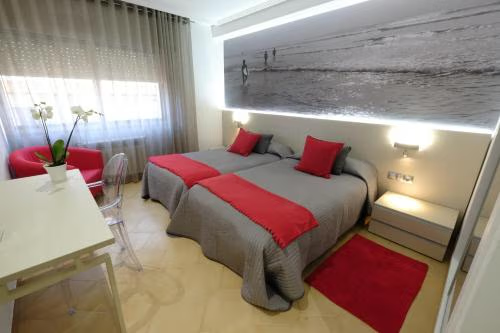 OpenReservations acceptedHotel Vila da GuardaA Guarda
4.73 reviews
45€KitchenMicrowavePlates & UtensilsAnd more
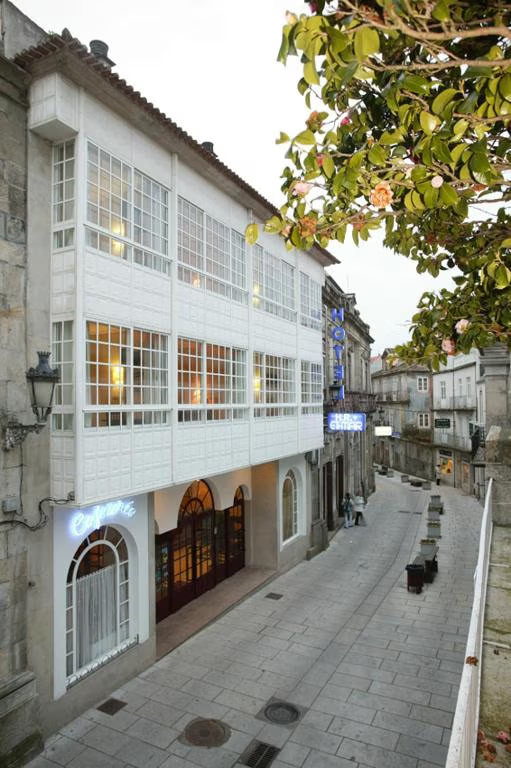 Open0 reviewsReservations acceptedHotel Eli MarA Guarda41€BreakfastBreakfast is includedWi-FiAnd more

Services in A Guarda
What you can find in town before the next stage.
- ATM
- Café
- Shop
- Tobacco
- Medical clinic
- Pharmacy
- Fountain
- Post office
- Train station
- Restaurant
Source: © OpenStreetMap contributors · updated April 2026
Caminos through A Guarda
Open a Camino to follow it on the map from A Guarda.