

Stage town on the Camino
Burgos
Burgos, Castilla y León, Spain
- places to stay
- 27
- Caminos
- 2
- Elevation
- 861 m
Burgos was once the capital of Castile, and for pilgrims it is the threshold to the Meseta. Its Gothic cathedral, begun in 1221, is a World Heritage Site and the tomb of El Cid; with a credencial you pay €6 instead of €11. A rest day is worth it before you head out into the vastness of the high plateau.
Right now in Burgos (as of October 2026)
- Small albergue in hibernation: The Santiago y Santa Catalina pilgrim albergue in the Divina Pastora chapel closes on 31 October and reopens on 1 April.
- Municipal albergue on winter hours: Since mid-October it only opens at 14:00 and closes at 22:00 in the evening.
- Cathedral: From 1 November to 18 March it is open daily from 9:30 to 18:00.
- No pilgrim office in winter: The pilgrim office in the cathedral is only staffed from 1 June to 30 September.
- Hostel Catedral: Closed in December, ask ahead for January and February.
How long to stay?
Worth a rest day. The cathedral takes time, and after that the Museum of Human Evolution awaits with the finds from the Sierra de Atapuerca, which you crossed yesterday or today. Then there's the old town with the Arco de Santa María, the tapas streets in the evening and the Hospital del Rey, which pilgrims have known since the twelfth century. Above all, Burgos is the right place to gather strength before the Meseta. Beyond the city begin days with a lot of sky and little shade.
Burgos in Ninja numbers
- Around 492 kilometres to Santiago from here, according to Camino Ninja. You have more than a third of the Camino Francés behind you.
- €6 instead of €11 is what the cathedral costs if you show your credencial (as of October 2026).
- More than 800 years have passed since the cathedral's foundation stone was laid on 20 July 1221.
- Around 676 kilometres is the length of the Ruta de la Lana, according to Camino Ninja, which comes from Alicante and meets the Camino Francés in Burgos.
- Since 1921 El Cid and his wife Jimena have lain beneath the cathedral's crossing.
Arriving: through the industrial zone or along the river
On the Camino Francés you climb over the stony, shadeless Sierra de Atapuerca. At the top stands a wooden cross, and on a clear day you can already see Burgos. After Orbaneja Riopico, just under 12 kilometres before the cathedral according to Camino Ninja, you cross the AP-1 motorway. Then you have to decide.
The main route, which Camino Ninja also follows, skirts the airport and leads via Villafría along the pavement of the old main road through a long, noisy industrial corridor. Through the Gamonal district and the Avenida de Vitoria you finally reach the cathedral via the Calle San Juan and the Calle Fernán González.
The nicer alternative is the variant via Castañares. Shortly after the motorway, an unmarked path branches off to the left by an estate of white terraced houses. In Castañares you cross the N-120 and walk around a large factory. A footbridge takes you to the Río Arlanzón, and you follow the riverside path into the city. Stay down on the Paseo de la Quinta as far as the Puente Gasset, then take the Calle Victoria to the Plaza de San Juan and go through the arch in the wall into the old town.
The Ruta de la Lana from the southeast also ends here, coming via Cardeñadijo. A variant of the Camino Vasco via Monasterio de Rodilla also reaches Burgos.
In brief: the capital of Castile
According to tradition, Count Diego Rodríguez Porcelos founded the city in 884. Around 931 Burgos became the capital of the County of Castile, and in 1038 the capital of the kingdom. In 1075 it became a bishop's see. In the fifteenth century the wool trade made it rich, and today pilgrims walk the old routes of the wool merchants on the Ruta de la Lana.
For pilgrims, King Alfonso VIII founded the Hospital del Rey outside the city in 1195. Burgos lived through its darkest time in the Civil War: from 1936 to 1939 the leadership of the rebels around Franco was based here, and from 1 April to 18 October 1939 Burgos was the capital of Spain.
The threshold: stone before the open plain
For pilgrims, Burgos is a threshold. Behind you lie Navarre and La Rioja with their vineyards and hills. Ahead of you lies the Meseta, the Castilian high plateau, with grain fields to the horizon. In between stands this city of stone with its gates, towers and its enormous cathedral.
The Middle Ages marked this threshold. Pilgrims entered the cathedral through the Puerta de la Coronería. Anyone leaving the city passed the Hospital del Rey, where pilgrims were taken in and the dead were buried. Treat yourself here to what the pilgrims before you were also looking for: a bed, a good meal, perhaps a mass, a day of rest. The Meseta is waiting for you.
From gate to gate: what to see
The old town is compact. From the municipal albergue behind the cathedral you can reach everything on foot, and the way out takes you past the Hospital del Rey anyway.
- Catedral de Santa María: King Fernando III and Bishop Mauricio laid the foundation stone on 20 July 1221, and since 1984 it has been a UNESCO World Heritage Site. For pilgrims it is more than a museum: in the Middle Ages pilgrims entered the church through the Puerta de la Coronería. Beneath the crossing lie El Cid and his wife Jimena. Look at the Escalera Dorada by Diego de Siloé, a gilded staircase said to have been the model for the staircase of the Paris Opera, and the Capilla del Condestable, a small cathedral in its own right. The Cristo de Burgos, a figure of Christ from the fourteenth century, is still venerated today. Open daily, in winter from 9:30 to 18:00, in summer until 18:30. Admission €11, with a credencial €6 (as of October 2026).
- Papamoscas: High up in the cathedral sits a figure that strikes the bell on the hour and opens its mouth wide as it does. The name means "flycatcher".
- Arco de Santa María: This splendid city gate by the bridge over the Arlanzón was one of what were once twelve gates. It was rebuilt in the sixteenth century in honour of Charles V. In the niches stand the heroes of Castile: the city's founder Diego Porcelos, Count Fernán González, El Cid and Charles V. An earlier gate is already mentioned in the Cantar de mio Cid. Today it is a cultural centre with a pharmacy museum.
- Museo de la Evolución Humana: By the river, since 2010. On the lower floor are the finds from the Sierra de Atapuerca, including the skull "Miguelón" and the hand axe "Excalibur". For pilgrims this has a special appeal: you have just walked over the hills where some of the oldest humans in Europe were found. We could not reliably find opening hours and admission.
- Hospital del Rey and San Amaro: King Alfonso VIII founded the hospital in 1195 as a pilgrim hostel. In front of the entrance lay a cemetery for pilgrims who died here. The sixteenth-century doorway shows a pilgrim family. Next to it stands the chapel of San Amaro, a saint who devoted his life to pilgrims and is buried here. Today the university occupies the hospital. You'll pass it tomorrow morning on your way out of town.
Food and drink
The classic is lechazo, roast milk-fed lamb. In the evening, head to the Calle San Lorenzo, the Calle Herreros or the Calle Sombrerería for tapas. Try a cojonudo with fried chorizo or morcilla, Burgos's famous black pudding. For dessert, almost every pastry shop sells yemas de Burgos made of egg yolk and sugar.
Honestly
- The main route into the city is a slog. On the pavement of the old main road you walk through a long, noisy industrial corridor. Take the river variant via Castañares, even though the turn-off isn't marked.
- The cathedral isn't cheap. €11 standard is a lot on a pilgrim budget. Show your credencial and you pay €6.
- In winter it gets really cold here. Burgos has cold, snowy winters, and in cold spells the thermometer drops below minus ten degrees. If you come in November or December, you'll need warm clothes for the evening.
- In winter the options thin out. The small albergue with the pilgrim blessing in the Divina Pastora chapel closes at the end of October, the pilgrim office is only open in summer, and a large hostel closes in December.
Where pilgrims sleep
- Albergue municipal Casa del Cubo y de los Lerma: the municipal albergue right behind the cathedral, in a sixteenth-century house at Calle Fernán González 28. It belongs to the city and is run by the Burgos association of Friends of the Camino with volunteer hospitaleros. €10 (as of October 2026), open all year, pilgrims only, no reservations. There are lockers, a washing machine and a dryer. You can get a credencial here for €3.
- Albergue Santiago y Santa Catalina: a small albergue with 16 places in the Divina Pastora chapel at Calle Laín Calvo 10, about 100 metres from the cathedral. Run by an association with volunteers, €11, no reservations, pilgrims on foot have priority. Every evening at 19:00 there is a mass with a pilgrim blessing. Open from 1 April to 31 October.
- Casa de Espiritualidad of the Benedictine nuns: The guesthouse of the San José convent at Calle Emperador 9 is right on the route. Reservations by phone.
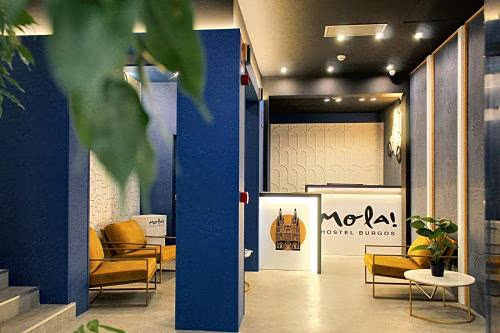
There are private hostels in the old town and by the bus station, for example Hostel Catedral Burgos near the cathedral and Hostel Burgos (Mola!) by the bus station, with breakfast. A dorm bed there costs around €17 to €25 (as of October 2026).
Ninja tips
- Credencial in your pocket: It saves you €5 at the cathedral. On Tuesdays there's also a free-entry window, but the sources disagree on the time, so ask at the ticket desk.
- Take the river variant: After Orbaneja Riopico and the motorway bridge, turn left by the white terraced houses and go via Castañares to the Arlanzón. The path isn't marked, but it is much more pleasant than the industrial zone.
- On the hour: Stand beneath the Papamoscas in the cathedral when the clock strikes.
- Pilgrim mass: A pilgrim mass is held in the cathedral daily at 19:30, though times may change in winter.
- Supplies for the Meseta: Stock up in Burgos. There's a large supermarket next to the hostel by the bus station. On the next stage you'll mainly find fountains.
- Look up on the way out: At the Hospital del Rey the doorway shows a pilgrim family. Right next to it lies San Amaro, who devoted his life to pilgrims like you.
- A quiet way out: Instead of the marked streets, tomorrow morning you can walk along the river through the Parque de la Isla to the Puente de Malatos, about 20 minutes.
Practical tips for pilgrims
- Credencial and stamps: You can get a credencial at the municipal albergue for €3. In summer the pilgrim office in the cathedral also stamps and sells credenciales.
- Shopping: Burgos has around 175,000 inhabitants, and you'll find pharmacies, supermarkets and ATMs everywhere. Many shops are closed on Sundays.
- Laundry: The municipal albergue has a washing machine and dryer.
- Getting here and away: Burgos has a bus station near the old town if you start or finish here.
Onward: out onto the Meseta
From the cathedral you leave the old town via the Calle Fernán González and the Calle Emperador, cross the Arlanzón on the Puente de Malatos after a little over a kilometre and walk through the Parque del Parral to the Hospital del Rey. Then the route passes the university and heads out on dirt tracks. Over the sixteenth-century Puente del Arzobispo you reach Tardajos, 11.0 kilometres according to Camino Ninja. Beyond Rabé de las Calzadas (12.8 km) the open plateau begins. It is 20.6 kilometres to Hornillos del Camino, according to Camino Ninja.
What awaits you tomorrow
Between Tardajos and Rabé you cross the floodplain of the Urbel, once feared when it flooded. Hence the saying: "De Rabé a Tardajos, no te faltarán trabajos; de Tardajos a Rabé, libéranos Domine." From Rabé to Tardajos you'll not lack for toil, from Tardajos to Rabé deliver us, Lord. After Rabé you climb between grain fields to a rise at 925 metres, and from there you can already see Hornillos del Camino, your goal for the day.
Deep dive: Burgos, city of thresholds
A long read, in case you want to learn more about Burgos. About twenty-five minutes' reading.
When the Papamoscas strikes the hour
Go into the nave of the cathedral, to its western end towards the main portal, and look up. About fifteen metres above the floor, in a window above a clock, sits a half-length figure in a red doublet, with a green collar and a face people call Mephistophelian. In its right hand it holds a sheet of music and the chain of a bell clapper. On the hour it pulls the chain, the bell strikes, and with every stroke it opens its mouth wide. The people of Burgos call it the Papamoscas, the flycatcher. To the left, on a small balcony, stands a smaller figure, the Martinillo, who strikes the quarter hours on two bright bells with both arms. It is best at twelve noon: twelve strokes, and twelve times the mouth opens and shuts.
Today's Papamoscas dates from the eighteenth century. It replaced an older automaton from the sixteenth. Benito Pérez Galdós mentioned it in two novels, and Edmondo de Amicis and Victor Hugo knew it too. At the end of the nineteenth century even the city's most important newspaper was named after it, a liberal, mocking paper called El Papa-Moscas.
It is a good way to begin with Burgos, because this city takes itself seriously and laughs anyway. Behind you lie a good two hundred and eighty kilometres since Saint-Jean-Pied-de-Port, ahead of you just under five hundred to Santiago. You are standing in a building that took more than three centuries to build, above the grave of Spain's most famous warrior, in a city that was once the capital of a kingdom. And above you a painted wooden man snaps at flies. This text tells how all of that belongs together.
Castles on a river
The hills above the Arlanzón were already inhabited in the Neolithic and the Bronze Age. But the city of Burgos begins, so tradition has it, in the year 884. That was when King Alfonso the Third of Asturias sent Count Diego Rodríguez Porcelos to build a fortification on a hill on the right bank of the river. First there were two watchtowers, then a wall, then a castle. Burgos was an outpost on the frontier between the Christian north and the Muslim south.
Where the name comes from is not entirely settled. Most people think of the late Latin burgus, a fortified tower, which in turn may go back to a Greek word for tower. Others hear in it the Germanic word Berg, mountain, or a Visigothic word for a fortified place. What all the readings have in common is the picture you can still see today when you look up at the castle hill: people lived here because they had to defend themselves.
Around 930 or 931 Count Fernán González united several counties under Burgos. Until then the area had been subject to the Kingdom of León. Now Burgos was the capital of the County of Castile, a land whose very name comes from its castles. Fernán González became the founding figure of Castile. When you walk through the Arco de Santa María into the old town, he looks down at you from one of the niches, next to Diego Porcelos, El Cid and the Emperor Charles the Fifth.
The capital of a kingdom
In 1038 Ferdinand the First became king, and the County of Castile became a kingdom with Burgos as its capital. His sons fought over the inheritance. In 1071 Sancho the Second had his brother García imprisoned in Burgos. In 1074 Alfonso the Sixth gave his palace for the building of a cathedral, and in the same year the old episcopal see of Oca was moved to Gamonal, today a district of Burgos through which the main route leads into the city. In 1075 the king and Pope Gregory the Seventh confirmed Burgos as a bishop's city. The diocese of Oca was old: its bishop had already taken part in the Third Council of Toledo in 589. So Burgos inherited a long history.
In 1080 a council met here under Alfonso the Sixth that replaced the old Spanish liturgy with the Roman rite. It was a turn towards Europe, towards Rome and towards France. And it was the time when the Way of St James began to shape the city. In the eleventh century the route took over the role that the military had played before. The city grew from east to west along the river valley, exactly in the direction in which the pilgrims came and went. Around 1100 about a thousand people lived here, in the thirteenth century about seven thousand, at the end of the fifteenth about twenty thousand.
In 1085 Alfonso the Sixth conquered Toledo, and the capital moved south. Burgos nonetheless remained a city of kings. Up to the time of the Catholic Monarchs the court came back here again and again, and the Cortes, the assemblies of the estates, met here. In June 1187 Alfonso the Eighth, at the request of his wife Eleanor of England, founded the Cistercian convent of Las Huelgas outside the city. It became the burial place of the royal family, and until the sixteenth century its abbess also ruled as a secular lord over more than fifty villages. In 1254 the English heir to the throne, later Edward the First, married Eleanor of Castile there. In the Chapel of St James in the convent garden stands a movable figure of the apostle from the thirteenth century. With it, so it is said, kings, princes and infantes were dubbed knights.
Rodrigo Díaz, the man
No name belongs to Burgos as much as that of El Cid, and hardly any name is so overgrown with legend. The man behind it was called Rodrigo Díaz. He was probably born around 1048. That he came from Vivar, a village a few kilometres north of Burgos, is tradition. There are no contemporary sources for it; only a poem of the fourteenth century explicitly links him to the place.
As a young man he came to the court of Ferdinand the First, as page to the Infante Sancho. Under Sancho the Second he fought in the battles against Sancho's brother Alfonso. After Sancho's death in 1072 he served Alfonso the Sixth, and the king married him to Jimena Díaz, a great-granddaughter of King Alfonso the Fifth of León. The document in which Rodrigo settled property on his wife, the so-called Carta de arras, is kept to this day in the archive of Burgos Cathedral.
Then came the break. In 1081 Alfonso sent him into exile after he had raided the territory of Toledo without permission. In 1089 he exiled him a second time and confiscated his property. From then on Rodrigo was a lord on his own account. He fought for Muslim and for Christian rulers, and against both. On 17 June 1094, after a long siege, Valencia surrendered to him, and he ruled the city as an independent prince. He signed in Latin as Rodericus Campidoctor, Rodrigo the master of the open battlefield. That is where his epithet Campeador comes from. The name Cid, on the other hand, comes from Arabic, from sayyid, lord. It is first recorded in a Latin poem from the middle of the twelfth century.
Rodrigo died in Valencia in 1099. In 1102 Jimena left the city with his people, and it soon fell to the Almoravids again; she brought his remains to Castile, to the monastery of San Pedro de Cardeña near Burgos. They could have stayed there. But the dead man found no rest. In 1808 French soldiers desecrated the tomb. In 1809 the French general Thiébault had the remains taken to a mausoleum on the Paseo del Espolón in Burgos. In 1826 they returned to Cardeña, and in 1842 they were moved to the chapel of the town hall. Only in 1921 did Rodrigo and Jimena find their present place, beneath the crossing of the cathedral. The epitaph was written by Ramón Menéndez Pidal, the great scholar of El Cid.
El Cid in song: a locked gate
That El Cid became a hero of all Spain he owes less to his battles than to a poem. The Cantar de mio Cid was written between 1195 and 1207, probably by an educated man versed in law who knew the area around Burgos. It survives in a single copy from the fourteenth century, now kept in the National Library in Madrid. At the end it says that one Per Abbat wrote it in May 1207. Scholars today regard him as a copyist rather than the poet.
Right at the beginning of the surviving text, the exiled Cid comes to Burgos. The people stand at their windows and weep, and with one voice they speak the most famous line in Spanish literature: "¡Dios, qué buen vasallo, si oviesse buen señor!" God, what a good vassal, if only he had a good lord. But no one opens the door to him. The king has forbidden, in a sealed letter, that anyone take him in, on pain of losing their goods, their eyes and their lives. The gate is barred. At last a nine-year-old girl steps forward, explains that they are not allowed to open, and wishes him God's protection. El Cid prays in the church of Santa María and pitches his camp outside on the gravel bank of the river, as if in the mountains, because no one in the city will sell him anything.
For pilgrims this scene is strangely familiar. A man arrives exhausted in a city, needs a bed and bread, and every door is shut. Burgos wrote this experience into its founding myth, and in the centuries that followed it built many hospitals for strangers.
In the poem a trick follows straight after. Because El Cid needs money, his follower Martín Antolínez leaves two chests full of sand as a pledge with the Jewish moneylenders Raquel and Vidas and tells them they contain gold. In the cathedral an old chest is shown as the Cofre del Cid. In reality the cathedral chapter used it to store documents. A second famous scene is also invention: in the church of Santa Águeda El Cid is said to have forced King Alfonso to swear that he had nothing to do with the death of his brother Sancho. Historians see no basis whatsoever for this. The story first appears in 1236, more than a hundred years after Rodrigo's death. It is still told today all the same, and the church still stands.
A bishop who had seen Europe
The cathedral in which El Cid lies today is not the first on this spot. Alfonso the Sixth had given an old palace of his father and a small church of Our Lady, and by 1096 a Romanesque cathedral was complete. A hundred years later it was too small. Even before 1200 the cathedral chapter had more than thirty members, and the city was growing with the pilgrims.
That a Gothic cathedral rose in its place has a lot to do with one man: Bishop Mauricio, in office from 1213. He travelled through France and Germany to seek a bride for the young King Ferdinand the Third, Beatrice of Swabia, a granddaughter of the Emperor Frederick Barbarossa. The wedding still took place in the old Romanesque cathedral. A royal privilege of 1221 compensated the bishop for his journey. Whether he was impressed on that journey by the new Gothic cathedrals beyond the Pyrenees, the sources do not say. But the man who began his new building very probably came from France.
On 20 July 1221 the foundation stone was laid in the presence of the king and the bishop. This first master builder remains nameless. Some scholars think of a canon named Johan de Champagne, recorded in 1227, whom Mauricio might have brought with him. Work began in the east, with the chevet and the sanctuary. As early as 1230 services were held there. When Mauricio died in 1238, the chevet, a large part of the transept and the naves were almost finished. He was buried in the sanctuary and later moved to the middle of the choir stalls. In 1260 the cathedral was consecrated.
Around 1240 Master Enrique took over the works, probably also from France. He later also directed the building of the cathedral of León. When you stand under the coloured windows there in a few days' time, you will be looking at the work of the same man. After his death in 1277 he was succeeded by Johan Pérez, the first Spaniard in this line.
Masters from Cologne
The cathedral was consecrated but not finished, and the second great chapter of its building history has a name that sounds familiar to German ears. Juan de Colonia, Hans from Cologne, probably worked before 1440 in Dijon for the Dukes of Burgundy. Tradition tells that Bishop Alonso de Cartagena brought him back from the Council of Basel. That is not documented. What is certain is that in 1442 he was enrolled in a confraternity in Burgos and that on 18 September 1442 the foundation stone for the new towers was laid. In 1458 the cathedral's books noted: "Este día se acabaron de facer las torres." On this day the towers were finished.
He had crowned the west front with two openwork stone spires, delicate as lace and clearly shaped by German Gothic. To this day they are the landmark of the city, and you may already have seen them from afar. Below them, above the gallery of the west front, stands a Madonna and Child, also by Juan de Colonia, with the inscription "pulchra es et decora", you are beautiful and comely.
Juan de Colonia also built a first lantern tower over the crossing, drew up plans for the Carthusian monastery of Miraflores outside the city after a fire, and married a woman from Burgos. He died between 1476 and 1481, the exact year is uncertain, and lies beneath the floor slabs at the entrance to the chapel he had built for Alonso de Cartagena. His son Simón and his grandson Francisco carried on the work. In 1482 Simón began the Capilla del Condestable, the funerary chapel of the Constable Pedro Fernández de Velasco and his wife Mencía de Mendoza. Its official name is the Chapel of the Purification of Mary. It is so large that people call it a cathedral within the cathedral, and its octagonal star vault is open in the middle, so that light falls as if through a net of stone. In 1517 Francisco built its sacristy. Three generations of one family from Cologne thus shaped the face of this Castilian cathedral.
What you see inside
In the night of 3 to 4 March 1539 the crossing tower collapsed, in the early hours of the morning. No one was killed. As the cause the sources name excessive weight and yielding piers on the north side, some also a storm. Juan de Vallejo rebuilt it on four massive round piers, and in 1568 the work was complete. When you stand under this tower and look up, you see a star of stone through which the light falls. And beneath you, in the floor, lies a simple slab: the grave of El Cid and Jimena.
In the north transept a staircase leads up to the Puerta de la Coronería, which lies higher than the floor of the church because the cathedral is built into the slope. This is the Escalera Dorada, the golden staircase. The cathedral chapter and Bishop Juan Rodríguez de Fonseca commissioned it from Diego de Siloé in 1519. The gilded iron railings were made between 1523 and 1526 by a master named Hilario. It is said that Charles Garnier took inspiration from it for the staircase of the Paris Opera. Today it is used only in Holy Week.
The walnut choir stalls were carved from 1505 onwards by Felipe Bigarny. The high altarpiece was begun by Rodrigo de la Haya in 1562; after his death his brother Martín completed it by 1580. In the Chapel of St Anne stands an altarpiece by Gil de Siloé, Diego's father, who also worked for the Charterhouse of Miraflores. The altarpiece of the Capilla del Condestable was made by Diego de Siloé and Felipe Bigarny between 1523 and 1526.
And then there is the Christ. The Santísimo Cristo de Burgos is a figure from the fourteenth century, startlingly lifelike: it has movable limbs, real human hair and a wooden body covered with skin. For a long time it belonged to the city's royal Augustinian monastery; only after the dissolution of the monasteries in 1835 did it come to the cathedral. Legends cluster around it. One attributes it to Nicodemus, the man who took Jesus down from the cross. Another was recorded by the Bohemian nobleman Leo of Rožmitál on his great journey through Europe between 1465 and 1467: sailors from Burgos were said to have found the figure on a ship at sea. The merchants of Burgos took its veneration abroad with them and founded chapels of the Christ of Burgos in Bruges and Antwerp, and the Augustinians carried it through Spain and to America. Before this image stood Teresa of Ávila, the Venetian envoy Andrea Navagero and, centuries later, Jean-Paul Sartre.
The pilgrims' door
The cathedral has four great portals, and one of them belongs to the pilgrims. On the north side, towards the slope, lies the Puerta de la Coronería, also called the Apostles' Door. It was built between 1250 and 1257 by artists from Master Enrique's circle, with a Last Judgement in the tympanum. Through this door the pilgrims of the Way of St James entered the cathedral. The route led, and still leads, through the city above the cathedral, and from the old street, today's Calle Fernán González, you came straight to this door. In the end the cathedral chapter had it closed because too much traffic passed through it. In 1786 a Baroque arch was set in front of it.
As early as 1516 Bishop Fonseca had had a second north portal built as an alternative to the Coronería: the Puerta de la Pellejería, the door of the fur traders, designed by Francisco de Colonia in the style of the early Renaissance. When you enter the cathedral as a visitor today, you come in through the south side, the Puerta del Sarmental, built around 1230 to 1240. Its tympanum with Christ and the Evangelists is attributed to a sculptor who also worked on the cathedral of Amiens.
You will find the apostle himself several times in the cathedral. The Chapel of St James, which Juan de Vallejo enlarged in the early sixteenth century, is today the most important room of the museum and houses the treasury. Its sixteenth-century altarpiece shows James as the Moor-slayer, high on horseback, as warlike Spain saw him. In the upper cloister, by contrast, a relief shows James as a pilgrim. The knight and the wanderer, both in one house: that is pretty much exactly the tension that accompanied the Way of St James through the Middle Ages.
One pilgrim found his last resting place in this cathedral. Alonso de Cartagena, Bishop of Burgos, was born in Burgos in 1384, the son of a rabbi who had converted to Christianity and had himself become a bishop. Alonso was a diplomat at the Council of Basel, translated Cicero and Seneca, and in 1449 and 1450 defended the Jews who had converted to Christianity against their persecutors in a treatise of his own. In 1456 he returned from a pilgrimage to Santiago and died shortly afterwards, on 12 July, in Villasandino in the province of Burgos. He lies in the Chapel of the Visitation, which he had had built in 1440, and at whose entrance his master builder Juan de Colonia is buried.
Lesmes and the hospital by the city gate
Whoever came to Burgos in the Middle Ages did not come to a city that shut its door on them as it did on El Cid in the poem. The city had many hospitals, and behind the two most important stand two strangers who stayed.
The first was called Adelelmus, in Spanish Lesmes. He came from Loudun in the French Poitou, had been a soldier and, on a pilgrimage to Rome, had met Robert of Turlande, the founder of the abbey of La Chaise-Dieu. Lesmes became a monk and later abbot there. Queen Constance of Burgundy, the French wife of Alfonso the Sixth, heard of his reputation and brought him to Burgos. In 1079 the king and queen founded a monastery on condition that Lesmes become its abbot. Soon he added a church and a hospital for the sick and for pilgrims. He died around 1100, and Burgos made him its patron saint. His remains lie in the church of San Lesmes on the Plaza de San Juan, across which the route leads into the old town. Opposite stands the Hospital de San Juan, founded in 1476 as successor to the old hospital. The present building is attributed to Simón de Colonia; only the portal and the coats of arms survive from the original building. Today it is a cultural centre.
The second, and larger, was the Hospital del Rey. King Alfonso the Eighth founded it in 1195 outside the gates, on the road to the west, expressly to receive pilgrims, and placed it under the abbess of Las Huelgas. It became one of the most important pilgrim hostels on the whole route. In 1234 the hospital of Valdefuentes and its lands were added. The Hospital del Rey itself ruled over villages in the surrounding countryside, among them Cardeñadijo, through which pilgrims on the Ruta de la Lana pass today. In the thirteenth century a large infirmary was built, a Gothic hall with three naves and ceilings in the Mudéjar style, that is, in the design language of Moorish craftsmen. Nothing of it remains; the last ruins, the Arcos de la Magdalena, were demolished in 1910.
The pilgrims were cared for by lay brothers. In 1474 these hospital brothers broke away to form an order of their own; in 1587 the order was dissolved and placed under the abbess again. There were quarrels between the convent and the hospital too. In 1429 the abbess and the hospital faced each other in court, and it was Alonso de Cartagena, the pilgrim bishop, who intervened as royal counsellor. In 1430 the convent won.
San Amaro and the Puerta de Romeros
A second stranger who stayed is linked to the Hospital del Rey. Amaro was, according to tradition, a French pilgrim of the thirteenth century. Instead of going home, he devoted his life to the sick poor and to the pilgrims in the Hospital del Rey. He is buried in a small chapel next to the hospital, and in front of its entrance lay the cemetery where pilgrims who died here were buried. There is also the legend of an abbot named Amaro who is said to have sailed with companions across the sea to the earthly paradise. Whether he has anything to do with the pilgrim of Burgos, our sources cannot say.
The entrance to the hospital is still the Puerta de Romeros, the pilgrims' gate, an early Renaissance portal with the apostle standing on top. The Emperor Charles the Fifth had the hospital renovated in the sixteenth century. The wooden church doors with motifs of St James also date from this time. One of the images shows a woman pilgrim nursing her child as she walks. Take a look at it when you pass tomorrow morning. You probably have not thought in recent weeks about mothers who walked to Santiago with babies. The image tells you that they existed.
The hospital's story does not end peacefully. After the dissolutions of the monasteries in the nineteenth century it passed to the municipal welfare board, and in 1874 to the Crown. In the Civil War the insurgents used it as a military hospital for Moroccan soldiers from Franco's troops, and a mosque was built for them in the courtyard. By the end of the 1940s it was a ruin, and today no trace of it remains. In the 1980s the hospital was restored and handed over to the university. Where pilgrims once slept, the rector's office, the law faculty and the old library now sit. In the garden there is a large chessboard, and in summer there are concerts.
What the pilgrims' guide says about Burgos
In the twelfth century the Liber Sancti Iacobi was written, the great Book of St James, which is also called the Codex Calixtinus after its most famous manuscript. Its fifth book is a guide for pilgrims. It divides the route from the Pyrenees to Santiago into thirteen day's journeys, some of them expressly on horseback. The fifth, it says there, also on horseback, "va de Nájera hasta la ciudad llamada Burgos", the sixth "de Burgos a Frómista". In the list of places along the route there are three names in a row that you know: Atapuerca, the city of Burgos, Tardajos. The place behind you, the one you are standing in, and the one ahead of you.
About Castile the author is kinder than about some other regions. On the way to Burgos, he writes, come Castile and the Campos, "una tierra llena de tesoros, de oro, plata", rich in cloth and strong horses. So the pilgrims came into a prosperous landscape, and Burgos was its gateway.
Many came. Leo of Rožmitál noted the legend of the Christ from the sea here in the 1460s. The priest Domenico Laffi from Bologna walked to Santiago three times, in 1666, 1670 and 1673, and wrote a book about it that appeared in 1681. He too visited the crucified Christ in Burgos, said to be one of three crucifixes from the hand of Nicodemus. For the pilgrims of these centuries Burgos was a place where you did not just sleep, but where there was something you had to see.
Wool, Bruges and the Jews of Burgos
In the fourteenth and fifteenth centuries Burgos was the trading centre of northern Spain, above all for wool. The wool of Castilian sheep went to Flanders, and in Bruges and Antwerp merchants from Burgos founded chapels for the Christ of their home city. In the sixteenth century Burgos grew to around twenty-five thousand inhabitants, built palaces and spread across the river. Pilgrims today walk the old routes of the wool traders as the Ruta de la Lana, around 676 kilometres from Alicante to here.
This rich city was home to one of the largest Jewish communities in northern Spain. Its quarter lay on the slope below the castle, divided into an upper and a lower part by today's Calle Fernán González, in other words by the very street on which you walk to the cathedral. A synagogue is recorded in 1440, a Jewish cemetery in 1386. Alonso de Cartagena and his father came from this world. With the expulsion of the Jews and later of the Moriscos began, as the city's history puts it, a long decline.
In the Constable's house, the Casa del Cordón, so an inscription on the façade tells, the Catholic Monarchs received Christopher Columbus after his second voyage. In the same house Philip the Handsome died, the husband of Joanna the Mad. In honour of Charles the Fifth, who came to Burgos in 1520, the city rebuilt the old city gate by the bridge into the Arco de Santa María from 1531 onwards. Burgos had taken part in the revolt of the Castilian cities against the young emperor and wanted to win back his favour. Above all the heroes of Castile there stands the Virgin Mary.
Quiet centuries
From the second half of the sixteenth century things went downhill. The city's history names many reasons: the wars in Flanders, the discovery of America, the centralisation of the empire, the move of the court to Madrid, and the plague, which struck hardest in the last quarter of the century. The population fell to about four thousand five hundred. A document of the city administration laments: "La Ciudad está tan despoblada y sin gente." The city is so depopulated and without people. In 1750 about nine thousand people lived here, around 1800 ten thousand.
Then came the French. In the War of Independence against Napoleon, Burgos suffered from hunger, especially in the crisis year of 1812. Soldiers plundered the Charterhouse of Miraflores and desecrated the grave of El Cid at Cardeña, and in the cathedral many of the old stained-glass windows were broken. On 13 June 1813 the French withdrew, blowing up beforehand the castle after which the city is named.
In the nineteenth century, in 1834, Burgos became a provincial capital. Promenades were laid out, the Espolón, the Isla, the Quinta, along whose riverbank you may have come in. In 1885 the cathedral was declared a national monument. The architect Vicente Lampérez restored the Chapel of the Christ from 1887 and the cloister between 1899 and 1911. The city began to understand its stones as a heritage.
A question people argue about
There is a chapter Burgos does not like to tell, and you should know it all the same. In July 1936 parts of the army rose against the Republic, and from the start Burgos lay in the territory of the insurgents. The Junta de Defensa Nacional, the insurgents' leadership, sat here. Here Franco formed his first government in 1938. From 1 April to 18 October 1939 Burgos was the capital of the victorious regime. In the Hospital del Rey, as told above, lay Moroccan soldiers of the insurgents.
Later, too, the city's name remained linked to the regime. On 3 December 1970 the Burgos trial began here before a military court against sixteen members of the Basque underground organisation ETA, charged with three murders. Six death sentences were handed down and then commuted to prison terms.
What follows from this? In Spain people still argue about how these years should be remembered, which monuments should stay, which street names should disappear, how to speak of victims and perpetrators. Burgos is not a city of perpetrators, and it is not a city of victims. It is a city where both happened. You do not have to form an opinion to walk on. But it is more honest not to see the cathedral merely as a backdrop for kings and heroes. The same city that sings of El Cid has also seen dark years.
The oldest Europeans
About fifteen kilometres before Burgos you walked through the Sierra de Atapuerca, a low, stony ridge with a wooden cross on top. The village of Atapuerca already appears before Burgos in the pilgrims' guide of the twelfth century. No one then suspected what lay inside the hill.
In the twentieth century a narrow-gauge railway cut deep trenches into the hill, and in doing so it exposed caves and fissures full of bones. In 1964 Francisco Jordá Cerdá excavated the first finds. From 1978 Emiliano Aguirre led the research, and after him Eudald Carbonell, José María Bermúdez de Castro and Juan Luis Arsuaga took over.
In the Gran Dolina, from 1994 onwards, more than one hundred and sixty human bone fragments were found, between 850,000 and 780,000 years old. The researchers assigned them to a species of their own, Homo antecessor, the predecessor, even though this classification is still debated today. More than thirty per cent of these bones bear cut marks. These early humans ate one another, and the researchers interpret it as cannibalism for food. In the Sima de los Huesos, the pit of bones, lay more than five thousand five hundred skeletal remains of at least twenty-eight people, at least 350,000 years old. Among them was a complete skull that the researchers named Miguelón, and next to it a hand axe of red quartzite, called Excalibur. Some experts consider it a grave offering. If that is true, people here would already have given their dead something to take with them hundreds of thousands of years ago. In the Sima del Elefante, in July 2022, an upper jawbone with a tooth came to light, around 1.4 million years old, the oldest human face found in Western Europe so far.
In 2000 Atapuerca became a World Heritage Site. Since 2010 the Museo de la Evolución Humana on the bank of the Arlanzón, a building by the architect Juan Navarro Baldeweg, has displayed the finds. For you as a pilgrim it is a strange thought. The cathedral, the hospital, El Cid, all of that is a few centuries old. Over the hills you walked on your way here, people were moving more than a million years ago. The path is far older than the Way of St James.
Burgos today
Today Burgos is an industrial city of around 175,000 inhabitants. Since the 1960s large industrial estates have grown up, and if you came in on the main route via Villafría and Gamonal, you have seen them. They belong to this city as much as the towers do.
The cathedral became a World Heritage Site on 31 October 1984, as the only cathedral in Spain listed entirely on its own, not as part of an old town or a group of buildings. On 12 August 1994 a statue of St Lawrence fell from the north tower. Since then around 30 million euros have gone into restoration, so it is said, more than into any other monument in Europe. In 2012 Spain minted a two-euro coin showing the façade and the crossing tower. Perhaps you have one in your purse.
And the pilgrims come. For them there is the municipal albergue in a sixteenth-century house right behind the cathedral, run by volunteers, and in summer the small albergue in the Divina Pastora chapel with its evening pilgrim blessing. In the Middle Ages pilgrims entered the cathedral through the Coronería. Today you show your credencial at the ticket desk and pay less. That is a kind of door too.
What Burgos gives you
Tomorrow you cross the Puente de Malatos, the bridge named after the lepers, pass the Hospital del Rey and head out onto the Meseta. Ahead of you lie days with a lot of sky and little shade.
Burgos has shown you a great deal: a hero who had the door shut on him, and strangers like Lesmes and Amaro who stayed so that the door would be open for others. A bishop who had seen Europe, and a master builder from Cologne who is buried here. A pilgrim bishop, son of a rabbi, who came home from Santiago and died. A city that was rich, became poor, was the capital of a regime and today lives from its industry. And bones in a hill, older than any history.
You do not have to take any of it with you. But perhaps this: every one of these stories is about a threshold, about a gate that opens or closes. On the Meseta it grows quieter. When you stand on the rise beyond Rabé and see nothing but fields ahead of you, you may let go of the splendour of Burgos. It has done its work.
Where to stay in Burgos
The places pilgrims rate highest in Burgos come first.
- Top #1
 OpenReservations accepted
Hostel Burgos
- Top #2
 OpenReservations not accepted
Albergue municipal de peregrinos de Burgos - Casa de los Cubo
- Top #3
 OpenReservations accepted
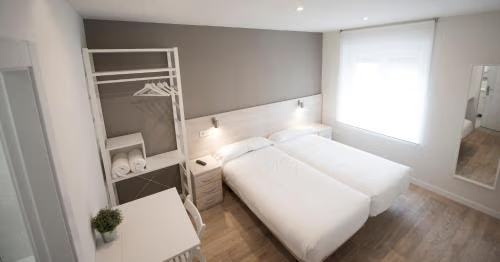
Happy Hostal Carrales


Services in Burgos
What you can find in town before the next stage.
- ATM
- Café
- Shop
- Tobacco
- Medical clinic
- Pharmacy
- Fountain
- Post office
- Train station
- Bus station
- Airport
- Restaurant
Source: © OpenStreetMap contributors · updated October 2025