

Town on the Camino
Irún
Gipuzkoa, Basque Country, Spain
- places to stay
- 15
- Caminos
- 4
- Elevation
- 25 m
Irún is the threshold of the Camino del Norte: a border town on the Bidasoa, 850.7 kilometres from Santiago. The donation-based hostel run by the local St James association took in 4,880 pilgrims between February and July 2025 alone. Here you pick up your credencial and a pilgrim blessing before the first stage leads you over Guadalupe and Jaizkibel to San Sebastián.
How long to stay?
An afternoon is enough, and it belongs to preparation. Irún is a border and railway town, not a postcard town. Most people who arrive here only have an afternoon: secure a bed in the hostel, pick up your credencial, go to the pilgrim blessing at 19:00. If you want to see more, walk to the old town of Hondarribia, just under three kilometres away as the crow flies. A rest day is not worth it here; it is better spent in San Sebastián.
Irún in Ninja numbers
- 850.7 kilometres separate you from Santiago. In our data the Camino del Norte already begins in Bayonne, but for many it only starts at this border.
- 4,880 pilgrims slept in the Irún hostel between February and July 2025. A good quarter came from Spain, followed by France, Germany and Italy.
- 60 beds in the hostel, and no fixed price. You give what you can.
- 25.6 kilometres to San Sebastián. On the way you climb to 274 metres on Jaizkibel, and between Guadalupe and Pasai Donibane there is no bar.
- Every six months the Isla de los Faisanes in the Bidasoa switches administration between Spain and France. It covers about 2,000 square metres.
Arriving: across the Bidasoa
If you come from Hendaye, you cross the Bidasoa at the Santiago bridges, and from the middle of the river you are in Spain. The name suits the Way, but nowhere is it explained. The Santiago bridge was finished in 1915 and stayed closed until 1918 because of the First World War. During the Civil War, supporters of the Republic fled across it to France; in 1940 German troops occupied the bridge, and at this border refugees were handed over to the Franco regime, among them the Catalan president Lluís Companys. Beyond the bridge begins a border and railway town. The centre is still a good kilometre and a half away.
In brief: Oiasso and the border
Long before the Camino, this place was called Oiasso and was a Roman settlement; the Museo Oiasso shows the finds today. The Ermita de Santa Elena stands on the remains of a first-century church. After that, the border shaped everything. In 1522 Spaniards and French fought on the San Marcial hill, where a chapel on the summit still recalls the battle. On the little Pheasant Island in the river the Treaty of the Pyrenees was signed, and ever since two states have shared a piece of land smaller than a football pitch. During the Civil War the town burned in 1936; the town hall was rebuilt afterwards.
Border town: what to see
Irún is quickly seen. These places are worth a pilgrim's afternoon:
- Iglesia de Santa María del Juncal: The parish church was begun in the 16th century and completed in the 17th; since 1973 it has been a national monument. Above the high altar stands the Virgen del Juncal from the 12th century, older than almost anything you will see in the next few days. The parish also issues credenciales in the mornings.
- Town hall: The baroque town hall from the 18th century burned in 1936 and was rebuilt. The first stage to San Sebastián starts on the large square in front of it. This is where you will stand tomorrow morning.
- Museo Oiasso: The Roman museum shows the finds from Oiasso. If you arrive early, this is where you understand how old this border town is. We did not find opening hours.
- Ermita de Santa Elena: A 10th-century building over a Roman church and an older burial ground. A quiet place for your first pilgrim minute in Spain.
- Santiago bridges: Three bridges side by side: the railway bridge of 1862 to 1863 with five arches, the bridge of the narrow-gauge "Topo" line from 1913 and the Santiago bridge from 1915. If you walk in from France, this is where you cross the border.
Honestly
- Irún is not a postcard town. The first kilometres tomorrow run through the town, over roundabouts and under the viaduct of the old N-I. The beauty only starts on the mountain.
- The first stage is hard. 25.6 kilometres, steep climbs at Guadalupe and on Jaizkibel, then more than 300 steps on Monte Ulía. This is no warm-up.
- After Guadalupe there is nothing. There is a fountain at the sanctuary, then no bar and no shop until Pasai Donibane. Buy food and water today.
- The hostel cannot be booked. Beds go in order of arrival, and groups of more than seven are not accepted.
Where pilgrims sleep
The Irún pilgrim hostel at Calle Lesaka 1 belongs to the town and is run by the St James association Irun-Bidasoa Jakobi with volunteer hospitaleros. It has around 60 beds in bunks, and you pay with a donation (donativo). Check-in is from 16:00 to 22:00, you cannot reserve, and pilgrims heading for Santiago have priority. In 2025 it was open from 1 February to 30 November. There are also guesthouses in town, mostly from about 50 euros for a double room (as of October 2026).
Ninja tips
- Credencial without staying: The hostel stamps and issues credenciales even if you don't sleep there, in the afternoons from March to October. In the mornings, try the Passionist fathers at Calle Estación 24–26, Tuesday to Sunday 9:00 to 12:30 (as of October 2026).
- A blessing to start: At the church of San Miguel de Garikoitz there is Mass with a pilgrim blessing Monday to Saturday at 19:00 (as of October 2026).
- Fill up at Guadalupe: It is the last fountain before Pasai Donibane, about twelve kilometres further on.
- Ridge only in clear weather: Beyond Guadalupe the Way splits. The forest track along the slope is the sensible choice; take the Jaizkibel ridge only in good weather and good shape.
- Small change for the ferry: In Pasai Donibane a small boat takes you across the bay. It costs just under 2 euros (as of 2026).
Onward: over Guadalupe to the sea
The Way leaves Irún through Amute, past the little Ermita de Santiago, Santiagotxo, and then climbs steeply to the Santuario de Guadalupe at around 200 metres. From up there you see the mouth of the Bidasoa, Hendaye and Hondarribia. A long forest track follows along the slope of Jaizkibel up to 274 metres, then a steep descent to Pasai Donibane, 17.0 kilometres from Irún. The ferry takes you across the bay, then over Monte Ulía and, after 25.6 kilometres, down into San Sebastián. Irún is also the starting point of the Camino Vasco del Interior heading inland and of the route to Saint-Jean-Pied-de-Port.
What awaits you tomorrow
San Sebastián, and before it your first look at the open sea. When you come down from Jaizkibel into Pasai Donibane and cross the bay by boat, you will know why so many choose the North.
Deep dive: A border you cross on foot
A short read, in case you want to learn more about Irún. About three minutes' reading.
A Roman place
Irún is older than its border. The Romans called it Oiasso, and the town's museum still shows what remains of it. The Ermita de Santa Elena still stands on the remains of a first-century church, and beneath it lies an older burial ground. Whoever prays here stands on two thousand years.
Two kingdoms on one river
Later the Bidasoa became the border between two kingdoms, and Irún became a town that had to be guarded. In 1522 Spanish and French troops clashed on the San Marcial hill, and the chapel on its summit still recalls it. In the middle of the river lies a small island, Pheasant Island. The Treaty of the Pyrenees was concluded on it, and ever since it has belonged to both countries. Every six months the administration passes from one side to the other. It is one of the smallest shared territories in the world, and it shows how much effort it takes to keep a border peaceful.
The bridge of those who fled
In the twentieth century the border became a place of escape. The Santiago bridge was finished in 1915 but only opened in 1918, because Europe was at war. During the Spanish Civil War people fled across it to France before Irún fell and burned in 1936. In 1940 German soldiers stood on the bridge, and at this border refugees were handed over to the Franco regime, among them Lluís Companys, the president of Catalonia. Whoever crosses it today with a backpack does so without a passport and without fear. That, too, is not to be taken for granted.
What Irún gives you
Irún is not a place you fall in love with, but a place you cross. That is exactly what makes it the right beginning. Many pilgrims arrive here, sleep one night among strangers from dozens of countries and set off into the hills the next morning. The border you cross here is the first of many on this Way. Most of them are not on the map.
Where to stay in Irún
Places to stay in Irún.
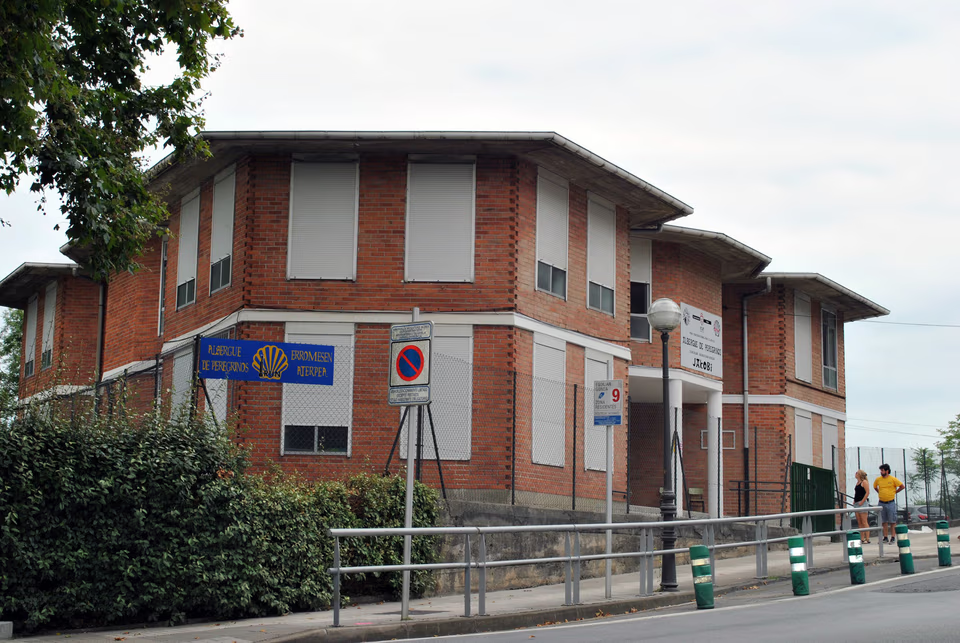 OpenReservations not accepted
Albergue Peregrinos Irún
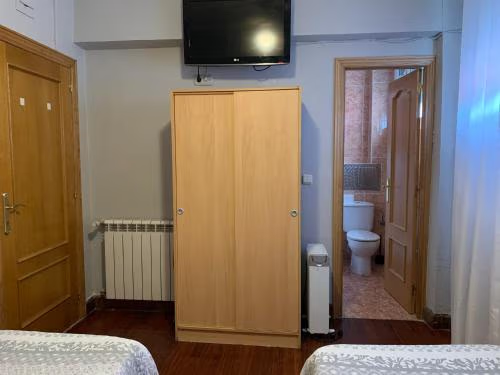 OpenReservations accepted
Pensión Bowling
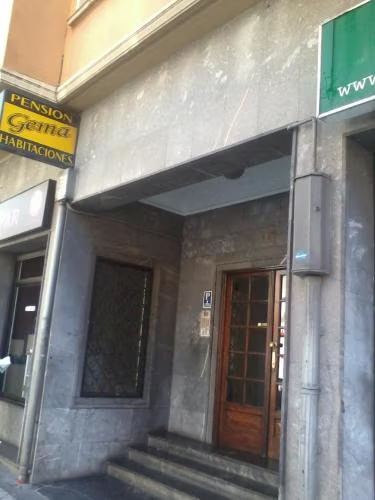 OpenReservations accepted
Pensión Gema


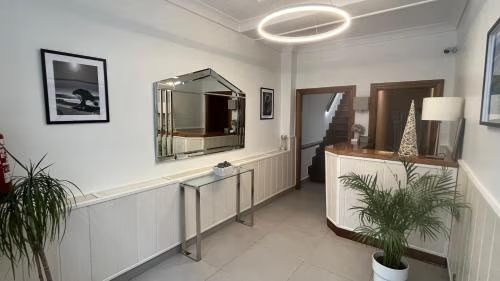

Services in Irún
What you can find in town before the next stage.
- ATM
- Café
- Shop
- Tobacco
- Medical clinic
- Pharmacy
- Fountain
- Post office
- Train station
- Bus station
- Airport
- Restaurant
Source: © OpenStreetMap contributors · updated February 2026
Town 1 of 49