


Stage town on the Camino
Ponferrada
León, Castilla y León, Spain
- places to stay
- 21
- Caminos
- 2
- Elevation
- 534 m
Ponferrada owes its name to pilgrims: around 1082 a bishop had an iron-reinforced bridge built over the Sil for them. Later the Templars guarded the Way from their castle. Today the city is the stage end after the descent from the Cruz de Ferro and the starting point of the Camino de Invierno. An afternoon is enough, just not on a Monday.
Right now in Ponferrada (as of October 2026)
- New at the Basílica de la Encina: Since 30 July 2026 the Museo de Arte Sacro and the viewpoint in the tower have been open. We haven't found opening hours or prices yet.
- The castle in winter: From 1 November the Templar castle opens Tuesday to Sunday from 10:00 to 14:00 and from 16:00 to 18:00, closed on Mondays.
- Farewell to the benefactor: Joseph Leutenegger, the Swiss man who paid for a large part of the parish albergue, died near Zurich in September 2026, at almost ninety.
How long to stay?
An afternoon is enough, just not on a Monday. The old town is small, and everything you should see is there: castle, basilica, clock tower. After the long descent from the Cruz de Ferro you won't have energy for much more anyway. On Mondays the castle and museums are closed, and all you get is the view from outside. You only need a rest day here if your knees are protesting about the descent.
Ponferrada in Ninja numbers
- Around 213 kilometres separate Ponferrada from Santiago on the Camino Francés, according to Camino Ninja. On the Camino de Invierno it is around 271.
- 5,367 pilgrims started their Camino in Ponferrada in 2025 up to the end of October, a small increase on the previous year according to the Pilgrim's Office.
- Around 15,000 pilgrims slept at the San Nicolás de Flüe parish albergue in 2025, seven out of ten from abroad.
- More than 150,000 visits a year are counted at the Templar castle.
Arriving: across the Boeza into the city of the bridge
You come down off the Camino Francés. Behind you lies the toughest descent of the day, from Manjarín to Molinaseca, over slate slabs that turn slippery in the rain. From Molinaseca it is another 7.5 kilometres, according to Camino Ninja. The Way passes through Campo, which almost belongs to Ponferrada already and has an old church, Santa María de Vizbayo. Then it follows the river Boeza on asphalt. You cross it on the old stone bridge, the Puente Mascarón, and enter the city. If this stretch drags after a long day, you are not alone. If you have had enough, you can stop in Molinaseca.
In brief: a city named after a bridge
Around 1082 Bishop Osmundo of Astorga, with the help of King Alfonso VI, had a bridge built over the Sil so that pilgrims could cross the river safely. Because it was reinforced with iron, it was called Pons Ferrata, and that became Ponferrada. Around 1178 the Templars arrived and stayed until their order was dissolved in 1312. They extended the castle that bears their name today, although its most important buildings only went up in the fifteenth century under the first Count of Lemos. In the twentieth century iron, coal and power stations turned Ponferrada into an industrial city. Today around 63,000 people live here.
Protection for pilgrims: a bridge, a castle, an albergue
When you arrive in Ponferrada, you enter a city that has been built for pilgrims again and again. First the bridge that gave the place its name. Then the Templars, who according to the castle's leaflet came to protect the Camino and the iron bridge. In the fifteenth century the Catholic Monarchs supported the Hospital de la Reina for pilgrims.
And in 1999 came the albergue where you may be sleeping tonight. A Swiss couple, Joseph and Úrsula Leutenegger, paid for a large part of the building. It is named after Nicholas of Flüe, the patron saint of Switzerland. Since April 2000 pilgrims have slept here on a donation basis, looked after by volunteer hospitaleros. Nine centuries lie between the bridge and the albergue, but the idea has stayed the same: whoever is on the road should arrive here safely.
Between castle and basilica: what to see
Everything is in the small old town, just a few steps apart. Don't plan your visits for a Monday, when almost everything is closed.
- Castillo de los Templarios: At more than 8,000 square metres, the castle is one of the largest fortresses in north-western Spain. The Templars extended it to protect the very Way you are walking. It took on its present look, with the Torre del Homenaje and the Palacio Nuevo, in the fifteenth century under the Counts of Lemos. In the Palacio Nuevo the exhibition Templum Libri shows more than a hundred facsimiles and originals, among them the Book of Kells and Beatus manuscripts. After weeks on the Way, it is a quiet hour among old books. Full admission is €6, reduced €4. Pilgrims report paying €4. In October it opens from 10:00 to 14:00 and from 16:00 to 19:00, closed on Sunday afternoons and Mondays (as of October 2026).
- Basílica de la Encina: The church was built from 1572, its tower completed in 1614. Here stands the Virgen de la Encina, patron saint of the Bierzo. Legend has it that the Templars found her image in an oak while cutting timber for their castle. Since July 2026 the new Museo de Arte Sacro in the sacristy and crypt has shown more than 150 works of art, many of them for the first time. From the tower you look out over the city and the Bierzo, the valley you will walk through tomorrow.
- Torre del Reloj and Museo del Bierzo: The sixteenth-century clock tower was a gate in the old city wall and is its only surviving part. Right next to it, the Museo del Bierzo tells the story of the area, including finds from Las Médulas, the Roman gold mines that the Camino de Invierno passes. Admission is €2.70. In October it opens Tuesday to Saturday from 10:00 to 14:00 and from 16:00 to 19:00, Sunday mornings only, closed on Mondays (as of October 2026).
Food and drink
The speciality of the Bierzo is botillo, a smoked sausage made from a pig's stomach stuffed with ribs and other cuts. It comes with roasted Bierzo peppers. As for wine: red wines from the Mencía grape are at home here and cost little in the bars.
Honestly
- On a Monday, Ponferrada is only worth half as much. The castle and museums are closed. If you can, time your arrival for another day or stop in Molinaseca.
- Not every pilgrim is a fan. Some find the city skippable and the castle mostly a tourist magnet. If castles aren't your thing, you really won't miss much here.
- The big albergue is big. Well over a hundred beds, so the showers and washing area are busy in the afternoon. If you want quiet, book a private place.
- The last kilometres drag. After the steep descent from Manjarín there is still a stretch of asphalt along the Boeza, and the next morning you leave through Compostilla and Columbrianos.
Where pilgrims sleep
- Albergue de peregrinos San Nicolás de Flüe: the parish albergue of the Basílica de la Encina, run by volunteer hospitaleros. You give a donation (donativo), with at least €10 as a guideline. You can't book; beds go in order of arrival, and a credencial is required. It is open all year, with check-in from 13:00 to 15:00 depending on the season, and it closes around 22:30 in the evening. There is a kitchen, washing machines and a garden. The old town is a little over 400 metres away.
Private albergues charge around €15 for a dorm bed, according to Camino Ninja. Two of them are only open seasonally. Pilgrims praise a small albergue outside the old town, run by a couple who offer a shared dinner: Albergue Alea, open from April to November.
Ninja tips
- Pilgrim blessing in the evening: In the Capilla del Carmen opposite the parish albergue there is a blessing for pilgrims every evening.
- Show your credencial at the castle: Several pilgrims report paying only €4 instead of €6 with their credencial.
- Not just the walls: Take time inside the castle for the Templum Libri exhibition in the Palacio Nuevo. Between the Book of Kells and the Beatus manuscripts you find the calm that the battlements lack.
- The new tower: Since July 2026 you can climb the tower of the Basílica de la Encina and look out over the city and the Bierzo.
- No late arrivals: The parish albergue closes around 22:30, and in the morning you have to be out before 8:00. If you go out for dinner, keep an eye on the clock.
Practical tips for pilgrims
- Tourist office: Calle Gil y Carrasco 4, Monday to Saturday 10:00 to 14:00 and 16:00 to 19:00, Sunday 10:00 to 14:00.
- Post office: Monday to Friday 8:30 to 20:30, closed on Saturdays.
- Shopping and gear: Ponferrada is a city with everything you need: supermarkets, pharmacies, cash machines and outdoor shops.
- Getting here and away: Ponferrada has a railway station and a bus station. The nearest airport is León, about two hours by car.
- Festivals: In the first week of July the city celebrates the Noche Templaria. On 8 September it honours its patron, the Virgen de la Encina. Beds fill up early then.
Onwards: through the Bierzo or along the winter route
On the Camino Francés you leave Ponferrada through Compostilla and Columbrianos, just under 5 kilometres away according to Camino Ninja. The Way continues through Camponaraya to Cacabelos, after 15.4 kilometres, and it is 23.6 kilometres to Villafranca del Bierzo.
Ponferrada is also where the Camino de Invierno, the winter route, begins. It leaves the city to the south across the Boeza, avoids O Cebreiro by following the Sil valley and, according to Camino Ninja, after 26 kilometres passes through Las Médulas, the Roman gold mines. On this route it is around 271 kilometres to Santiago.
What awaits you tomorrow
A day through the wine country of the Bierzo to Villafranca del Bierzo. There stands the Iglesia de Santiago, for which the bishop of Astorga obtained a papal bull in 1186: pilgrims who could not finish the Way were to receive the jubilee indulgence here. You will walk on, of course. But it is good to know that someone thought of those who don't make it.
Deep dive: The city that protects pilgrims
A short read, in case you want to learn more about Ponferrada. About three minutes' reading.
A bridge of iron
In the eleventh century the Sil was an obstacle. Anyone heading for Santiago had to cross the river, and that was difficult. Around 1082 Osmundo, the bishop of Astorga, with the support of King Alfonso the Sixth, had a bridge built. It was reinforced with iron, and the Latin Pons Ferrata became the name of the city. So at the beginning of this city stood a safe crossing for pilgrims.
The knights and the oak
Around 1178 King Ferdinand the Second of León allowed the Templars to settle here. They were to protect the Way and the bridge. They stayed more than a hundred years, until their order was dissolved in 1312. A legend comes from this time. An image of the Virgin, so it is said, had once been brought from Jerusalem to Astorga and hidden from the Moors in an oak forest in the Bierzo. Centuries later the Templars are said to have found it in the trunk of an oak while felling timber. Ever since, the Virgen de la Encina, the Virgin of the holm oak, has been the patron saint of the area. Her basilica, built from 1572, stands just a few steps from the castle.
Counts, kings and coal
Much of the castle you see today is younger than the Templars. In the fifteenth century Pedro Álvarez Osorio, the first Count of Lemos, built the towers, the keep and a new palace. At the beginning of the sixteenth century the town passed to the Catholic Monarchs, who also supported the Hospital de la Reina for pilgrims. In the twentieth century Ponferrada changed completely once more. Iron and coal were mined, power stations were built, and the small town by the bridge became an industrial city of around 63,000 people today.
An albergue from Switzerland
As early as the nineteen eighties a priest, Antolín de Cela, took in pilgrims in parish rooms. Then someone built for them again. Joseph Leutenegger, a Swiss man, had approached the Bierzo pilgrims' association in 1995. With his wife Úrsula he paid for a large part of a new albergue on land belonging to the basilica. In September 1999 it was inaugurated and named after Nicholas of Flüe, the national saint of Switzerland. In April 2000 the first pilgrims arrived. To this day it runs on volunteers and lives on donations. In 2025 alone, around 15,000 people slept here. In September 2026, when this text was written, Joseph Leutenegger died near Zurich at almost ninety. The albergue said of him that he had gone, but his work remained.
What Ponferrada gives you
Ponferrada is not a city that overwhelms you with beauty. But it tells a story you will meet again and again on the Camino. A bishop builds a bridge, knights guard a road, a stranger pays for an albergue. People who will never meet you made sure that you can sleep safely here tonight. Tomorrow morning, as you walk out through the outskirts, think of them for a moment. And perhaps also of whom you might one day build a bridge for.
Where to stay in Ponferrada
The places pilgrims rate highest in Ponferrada come first.
- Top #1

- Top #2
 OpenReservations acceptedResidencia La Rosa AzulPonferrada
5.02 reviews
34€KitchenCooktopsMicrowaveAnd more - Top #3

- Top #4
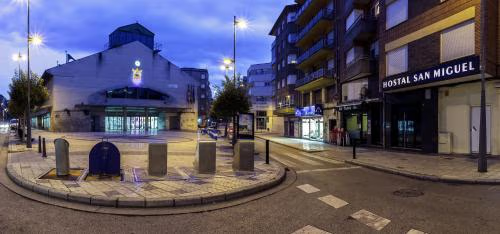
- Top #5
 OpenReservations not acceptedAlbergue de peregrinos San Nicolás de FlüePonferradaKitchenCooktopsPlates & UtensilsAnd more
Services in Ponferrada
What you can find in town before the next stage.
- ATM
- Café
- Shop
- Tobacco
- Medical clinic
- Pharmacy
- Fountain
- Post office
- Train station
- Bus station
- Restaurant
Source: © OpenStreetMap contributors · updated December 2025
Caminos through Ponferrada
Open a Camino to follow it on the map from Ponferrada.