

Town on the Camino
Salvaterra de Magos
Portugal
- places to stay
- 4
- Camino
- 1
- Elevation
- 9 m
Salvaterra de Magos was the kings' winter quarters: of the palace where the court hunted until Carnival and opened its own opera house in 1753, a chapel and a falconry with some 305 niches remain. It lies 6.7 kilometres beyond Benavente and 18.7 before the end of the Way, with the fishing village of Escaroupim on the Tejo as a bonus.
How long to stay?
A break is enough, but give yourself two hours. From Benavente you are here in a good hour and a half, and it would be a pity to just walk through. The falconry with its film and exhibitions deserves time, and the chapel of the old palace and the parish church are a few steps away. If you slept in Benavente, you carry on afterwards via Escaroupim towards Muge. If you stay the night in Salvaterra, you have a quiet afternoon, but you must sleep privately, as there is no pilgrim hostel.
Salvaterra de Magos in Ninja numbers
- 434.1 kilometres since Faro according to Camino Ninja, another 18.7 to the end in Benfica do Ribatejo. You are, so to speak, taking the last bend here.
- 6.7 kilometres from Benavente. That is a morning stroll, not a day's march.
- Around 305 niches has the Falcoaria Real for its birds. A housing complex for falcons, built in the 18th century.
- 64 performances were counted at the palace's opera house between 1753 and 1792. The opera is gone, the falcons are still there.
Arriving: through the king's door
After Benavente you go via Coitadinha along a minor road to Salvaterra. According to the description in the regional pilgrim guide, you enter the town by the Rua do Tejo and pass everything that is left of royal Salvaterra: the Falcoaria Real, a small marina, the chapel of the old palace, and a bridge over the Vala Real, the royal canal.
That sounds splendid, but the palace itself has vanished, and you have to imagine it. Since 8 September 2024 a museum with a 3D reconstruction of the palace in the 18th century has helped with that.
In brief: hunting lodge, opera, ruin
As early as 2 April 1383 a royal marriage contract was signed in Salvaterra. In the 16th century King João III gave the estate to his brother, the Infante Luís, who built the palace with gardens or rebuilt it. In 1590 Philip II of Spain, at that time also King of Portugal, had it extended, among others by the Italian architect Filippo Terzi. From 1690 Pedro II gave it a baroque face.
The great time came in the 18th century. The court often spent the winter here until Carnival, mostly arriving by barge from Lisbon up the Tejo. José I had an opera house built, which opened on 21 January 1753. After the royal family fled to Brazil in 1807 the palace fell into decay. A fire in 1817 spared the chapel, opera house and falconry; a second one in 1828 destroyed the palace. The last walls collapsed in 1858 in an earthquake.
Birds of the king: what to see
Of the palace two buildings remain: one for God, one for the falcons. Add to that the parish church and, a little further along the way, the fishing village of Escaroupim.
- Falcoaria Real: The royal falconry from the 18th century is considered unique on the Iberian Peninsula, designed under the direction of Carlos Mardel on the model of Dutch falconries. In 1752 about a dozen falconers came from Valkenswaard in the Netherlands to teach the art here. Some 305 niches gave the birds room. Since 1953 the building has been protected as a building of public interest. Later it served as a granary and a tenement house, until the municipality bought it, restored it and in September 2009 opened it as a "living museum", with falcons, a short film and two permanent exhibitions. Open Monday to Friday 9–12:30 and 13:30–17, Saturday and Sunday 10–13 and 15–19, telephone 263 509 522 (as of November 2026, details from a portal, call ahead). For pilgrims it is a rare opportunity: since 2016 Portuguese falconry has been on the UNESCO list of intangible cultural heritage, and Salvaterra submitted the application.
- Capela do Antigo Paço Real: The chapel of the old palace survived the fires. The Mannerist building with a square floor plan preserves a gilded wooden altar from the 17th century, a Pietà from the 16th century, and paintings and figures from the 17th and 18th centuries. It was the chapel of the palace where the court stayed for the hunt. We have not found opening times, telephone 263 509 520.
- Igreja Matriz de São Paulo: The parish church on the main square on the Rua Luís de Camões goes back to a building begun in 1296 and altered several times afterwards. After the earthquake of 1755 it was rebuilt. In the nave a painted wooden vault shows the patron saint Paul ascending to heaven, accompanied by angels. Add paintings by Bento Coelho da Silveira, an azulejo panel dated 1725 in the old sacristy, and an organ of 1825 by António Machado e Cerveira.
- Escaroupim: The fishing village on the Tejo was founded in the mid-1930s by fishermen from Praia da Vieira, who came to the river every winter, above all for the allis shad. Their colourful wooden houses stand on stilts because the Tejo often bursts its banks. A small museum commemorates these Avieiros. According to a report of 2019, boats leave from the quay to go between the Tejo islands, where Lusitano mares graze in summer. According to a tip of 2023 there are benches, barbecue tables and a water point here, ideal for a break.
Honestly
- The palace is gone. If you read "royal palace" and expect halls, you will stand in front of a square. Two buildings remain; the rest is memory and, since 2024, a 3D reconstruction in the museum.
- No pilgrim hostel. In Salvaterra too there is no pilgrim or municipal hostel. If you want to sleep here, you book privately.
- The programme depends on opening times. For the falconry we have times only from a portal, for the chapel and the church none at all. If you arrive at lunch break, you may find yourself in front of locked doors. Call ahead.
- The way in is road. From Benavente to here the path runs for a good part along a minor road, after a dangerous junction shortly beyond Benavente. If the fields are flooded, there is no alternative to the asphalt.
- Beyond Escaroupim it gets lonely. After the village come about 4 kilometres of track through the forest of Escaroupim, and in Muge accommodation is scarce according to the regional pilgrim guide. Fill up your water in Escaroupim.
Where pilgrims sleep
There is no pilgrim hostel in Salvaterra de Magos, only private rooms and pensions. The cheapest option on the way is the Parque de Campismo do Escaroupim in the pine wood of Escaroupim, which the regional pilgrim guide also recommends. It lies beyond Salvaterra, right on the stage towards Muge.
Ninja tips
- Don't plan the falconry for the lunch break. On weekdays it closes, according to the portal, from 12:30 to 13:30, at weekends from 13:00 to 15:00. If you set off from Benavente at eight, you will be there in good time in the morning.
- Take your break in Escaroupim. Water point, benches and a view of the Tejo: a good place for second breakfast before you head into the forest.
- Look for birds at the Tejo islands. At Escaroupim, on a boat trip in 2019, spoonbills, great and little egrets, glossy ibises, kingfishers, cormorants and ospreys were seen.
- The link to the main Way. Shortly before Muge, according to the regional pilgrim guide, the Rainha D. Amélia bridge leads across the Tejo to the north bank, where the Camino Portugués Central from Lisbon to Santarém passes. If you want to go straight to Santarém, this is where you join it.
Practical tips for pilgrims
- Stamp: We have not found a fixed stamp point for pilgrims. Ask at the Falcoaria Real or at the Câmara Municipal.
- Water: In Escaroupim there is a water point according to a tip of 2023; after that, none documented on the way to Muge.
- Accommodation in Muge: The regional pilgrim guide advises asking at the Junta de Freguesia de Muge, telephone +351 243 581 130.
Onward: through Escaroupim to the Tejo
Beyond Salvaterra the path, according to the description in the regional pilgrim guide, turns off to Escaroupim and then follows a track through the forest for about 4 kilometres to a level crossing. After 10.8 kilometres you reach Porto de Muge, where the Camino Portugués Central and the Caminho do Tejo also run. Then follow Muge with the palace of the Dukes of Cadaval and, after 18.7 kilometres, the end of the Caminho Português Central do Sul in Benfica do Ribatejo.
Deep dive: A court for the falcons
A short read, in case you want to learn more about Salvaterra de Magos. About 3 minutes' reading.
A treaty that shook a kingdom
When you stand on the square in front of the chapel in Salvaterra, you stand at a place where the history of Portugal once almost took a different direction. On 2 April 1383 a marriage contract was signed here. It concerned Beatriz, the daughter of King Fernando, and Juan the First of Castile. Had the treaty worked out, Portugal would have got a Castilian king. Instead came a crisis that ended only in 1385 with the Battle of Aljubarrota and a new dynasty. A palace must therefore already have stood then, even if the sources on it are sparse.
A winter by the river
In the sixteenth century King João the Third gave the estate to his brother, the Infante Luís, who built the palace with gardens or rebuilt it. In 1590 the Spanish king Philip the Second, who then also ruled over Portugal, had it extended. From 1690 Pedro the Second renewed it in the baroque style, and the chapel shows traces of it to this day.
Salvaterra experienced its great time in the eighteenth century. The court came in winter and often stayed until Carnival, mostly on barges up the Tejo from Lisbon. People hunted in the woods and meadows, and they amused themselves: King José the First had an opera house built, which opened on 21 January 1753 with the opera Didone abbandonata. By 1792 some sixty-four performances followed. In 1775 a bullring was added.
Dutchmen on the Tejo
For hunting with falcons the palace got a building of its own. The architect Carlos Mardel, who also took part in the rebuilding of Lisbon after the earthquake of 1755, designed it on the model of Dutch falconries. In 1752 about twelve falconers came from Valkenswaard in the Netherlands to Salvaterra to train the local falconers. Some three hundred and five niches gave the birds room. The staff of 1778 is on record: two masters, six officers, eight assistants and two apprentices.
Fire, earthquake and a granary
In 1807 the royal family fled from the French troops to Brazil, and the palace fell into decay. A fire in 1817 still spared the chapel, opera house and falconry; a second fire in 1828 destroyed the palace. In 1849 the estate passed to the state, and in 1858 the last walls collapsed in an earthquake. Much was auctioned off, the falconry too. It served as a granary and as a tenement house until the municipality bought it back and had it restored. In September 2009 it opened again, with live falcons.
What Salvaterra gives you
In 2016 UNESCO added Portuguese falconry to the list of intangible cultural heritage, following an application that came from Salvaterra. A palace has vanished, an opera too, but an art that demands patience and trust between human and bird has survived. For a pilgrim close to the end of their Way, that is not a bad thought: of everything that was built big, what sometimes remains is precisely what was handed on with patience.
Where to stay in Salvaterra de Magos
Places to stay in Salvaterra de Magos.
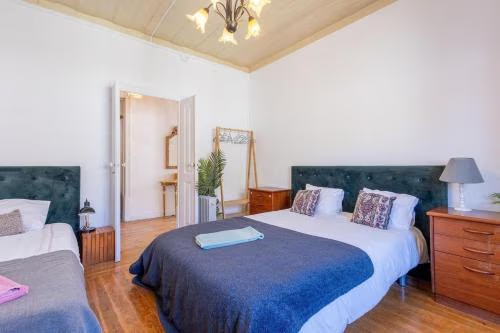 OpenReservations accepted
Salvaterra de Magos
KitchenWi-FiTVAnd more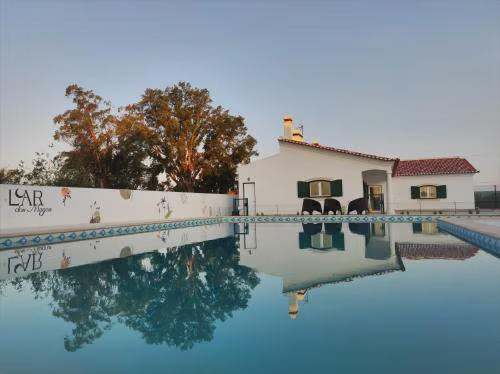 OpenReservations accepted
Luar dos Magos
KitchenCooktopsMicrowaveAnd more OpenReservations accepted
Pensão Residencial Nova Estrela
Town 24 of 24
Continue along the Caminho Português Central do Sul
Salvaterra de Magos is the last popular town on the Caminho Português Central do Sul.