


Stage town on the Camino
Santiago de Compostela
A Coruña, Galicia, Spain
- places to stay
- 164
- Caminos
- 14
- Elevation
- 251 m
Santiago de Compostela is where 14 Caminos end, and in 2025 more pilgrims than ever collected their Compostela here: 530,987. Around the cathedral with the apostle's tomb you'll find granite squares, monasteries and tapas bars. Stay at least two nights, because arriving takes time.
Right now in Santiago (as of October 2026)
- Pilgrims' Masses: Because of construction work in the Capilla Mayor, the Masses at 9:30, 12:00 and 19:30 have been held in the church of San Agustín since 16 October 2026, until further notice. The 7:30 Mass stays in the cathedral, in the Capilla de la Comunión.
- Botafumeiro: Out of service since 24 August 2026, because the scaffolding for the restoration of the crossing dome is attached to its suspension. The cathedral has not given a date for its return.
- Cathedral: Still open for visits daily from 7 to 21, entrance via the Praza das Praterías, backpacks must stay outside.
- Pilgrim Office: daily 8-20 until 31 October, from 1 November 10-19. Register online beforehand, otherwise you won't get into the building.
- Albergues in winter: The Seminario Menor closes on 31 October, the parish albergue Fin del Camino has been closed since mid-October. The two public Xunta albergues, San Lázaro and Monte do Gozo, stay open all year.
- Holy Year 2027: The Holy Door at the Praza da Quintana will be opened around noon on 31 December 2026. Expect much fuller albergues and queues in 2027.
How long to stay?
Stay longer: at least two nights. On the day you arrive you're tired, you queue at the Pilgrim Office and only just manage one Mass. Only on the second day are your head and legs free for the Pórtico, the rooftops, the market and the museum. Then you can also sit on the Obradoiro in the evening and meet again the people you lost sight of along the way. With seven sights that deserve more than a glance, and an old town you can't walk through in one day, Santiago is the place on the Camino where an extra day pays off the most. If you're walking on to Fisterra, you can also put the second day at the end of your journey. Most people travel home via Santiago anyway.
Santiago in Ninja numbers
- 530,987 Compostelas were issued by the Pilgrim Office in 2025, more than ever before and for the first time over half a million.
- 24,594 pilgrims from Germany were among them. Overall, 57 percent of pilgrims came from abroad.
- 3,000 to 3,500 pilgrims a day are currently arriving in Santiago (autumn 2026). So you're rarely alone on the Obradoiro.
- Almost one in three pilgrims began their Camino in Sarria in 2025, a good 100 kilometers before the finish.
- 14 Caminos end in Santiago according to the Camino Ninja map (as of October 2026), from the Camino Francés to the Caminho Minhoto Ribeiro.
Arriving: the last kilometers
From O Pedrouzo it's still about 20 kilometers on the Camino Francés. Beyond the airport you pass through Lavacolla. The name recalls that medieval pilgrims washed in the stream here before appearing before the Apostle. The Codex Calixtinus from the 12th century already mentions the place. Next comes Monte do Gozo, the "Mount of Joy", from where earlier generations first saw the towers of the cathedral. Today trees and new buildings are in the way. So you'll have to bring the joy yourself.
Then you walk down through the suburb, along the Rúa de San Pedro to the Porta do Camiño, the pilgrims' old city gate. In the old town it gets narrower, your steps slow down, and under the arch of the Bishop's Palace a bagpiper often plays. Then the Praza do Obradoiro opens up, and the baroque facade of the cathedral stands in front of you. Many pilgrims simply lie down on the paving here. That's allowed, and nobody finds it odd.
Not everyone comes from the east. If you come along the Camino Portugués, you reach the old town from the south via the Rúa do Franco. Pilgrims on the Camino Inglés arrive from the north. Pilgrims on the Camino Primitivo and the Camino del Norte join the Camino Francés at Melide and Arzúa respectively, and walk the last stretch with it.
In brief: Santiago in three minutes
The story begins with a light. In the early 9th century, the hermit Pelayo is said to have seen strange lights above a field. Bishop Teodomiro of Iria Flavia had the ground dug up and found a tomb that he attributed to the Apostle James. King Alfonso II of Asturias came, had a first church built, and the field became a town. Where the name Compostela comes from is still disputed. The beautiful interpretation "campus stellae", the field of stars, is the better known. The more likely one is "compostum", a burial ground.
The Romanesque cathedral you see today was begun in 1075. Its centerpiece is the Pórtico da Gloria by Master Mateo. On the lintel is the date 1 April 1188, the day the lintels were set. In the 18th century the cathedral received its baroque facade facing the Obradoiro, and the Pórtico disappeared behind it into the half-dark. That is exactly what preserved its colors, which came to light again during the restoration that ended in 2018.
In 1589 the English privateer Francis Drake threatened from A Coruña, and Archbishop Juan de Sanclemente had the Apostle's bones hidden. He hid them so well that for almost 300 years nobody found them. Only in 1879 did excavators come across them again behind the high altar, and in 1884 Pope Leo XIII declared them authentic in the bull "Deus Omnipotens". Since then they have rested in the silver shrine in the crypt, which you walk past today.
The bells that were carried twice
In 997 the commander Almansor marched from Córdoba against Santiago and found an almost empty city. He left the Apostle's tomb untouched, but took the bells and doors of the church with him. Captive Christians had to carry them on their shoulders all the way to Córdoba. There the bells hung upside down as oil lamps in the great mosque.
In 1236 Ferdinand III of Castile conquered Córdoba. According to tradition, he had the bells brought back to Santiago, this time carried by Muslim prisoners. That is around a thousand kilometers, twice, and none of the bearers had chosen the road.
When you stand on the Obradoiro with your backpack after a few weeks, it's worth a brief thought: you came of your own free will and got to pack your own luggage. On this road, that has not always been a given.
Compostela, Mass and Apostle
You get the Compostela at the Pilgrim Office on Rúa das Carretas 33, a few steps below the Obradoiro. The requirement is at least the last 100 kilometers on foot or on horseback, or 200 kilometers by bike, and at least two stamps per day in your pilgrim passport on this final stretch. Register beforehand at oficinadelperegrino.com. With the code you receive by email, you get into the building. The Compostela itself is free. The distance certificate with your starting point and your kilometers costs €3 (as of October 2026).
Two rituals belong to arriving in the cathedral. Via a narrow staircase behind the high altar you climb up to the statue of James and hug it from behind, the Abrazo. Below lies the crypt with the silver shrine. The queues are shortest in the morning.
Besides the Spanish Pilgrims' Masses, there are Masses in other languages. According to the cathedral, the German-speaking community celebrates daily at 8 in San Fiz de Solovio, right by the market. The English Mass is at 10:30 in the chapel of the Pilgrim Office, except on Wednesdays.
You've arrived: what to see
Most of it is only a few minutes' walk from the Obradoiro. Take the day after your arrival for it, without a backpack and without a distance goal.
- Cathedral and Pórtico da Gloria: For centuries the Camino did not end on the square but here: medieval pilgrims entered the cathedral through this west portal. Master Mateo placed around 200 figures in it. On the central pillar sits James himself, with his pilgrim's staff, looking toward you. Above him Christ is enthroned, and in the arch the 24 elders of the Apocalypse tune their instruments. They are so precisely carved that musicians have rebuilt them. On this central pillar generations of pilgrims placed their hand, until five hollows had formed in the stone. On the back a figure kneels who is thought to be a self-portrait of Mateo, the "Santo dos Croques". Students bumped their foreheads against it so that some of his wisdom would pass to them. Today both are roped off, so you look instead of touching. The Pórtico can only be seen with a reservation through the cathedral museum, in small groups. Book on the day you arrive for the next day. Admission to the cathedral costs €5 (as of October 2026).
- The cathedral rooftops: Up on the roof stands an unassuming iron cross, the Cruz dos Farrapos, the "Cross of Rags". Here, after confession, Mass and greeting the Apostle, medieval pilgrims burned the clothes they had arrived in and put on new ones. It was a sign of conversion and probably also plain hygiene. The guided roof tour takes you up over the stepped granite slabs. From there you see the four squares around the cathedral, the rooftops of the old town and, to the east, the hills you came over. You may keep your clothes. For many, the look back at the Camino is farewell enough.
- Praza da Quintana and the Holy Door: Behind the cathedral lies the Quintana, a square on two levels. The people of Compostela still call the lower part "Quintana de Mortos", because a cemetery once lay here. The upper part they call "Quintana de Vivos". In the east wall of the cathedral lies the Puerta Santa. It is open only in Holy Years, when the feast of St James, 25 July, falls on a Sunday. In 2027 it's that time again. The 24 prophets and apostles around the door come from Master Mateo's stone choir, which once stood inside. Come back in the evening. When the lamps come on, a column on the cathedral casts a shadow on the wall in which the people of Compostela see a pilgrim with hat and staff. Half of Santiago has already looked for him, and whoever has found him gladly shows him to the next person.
- Hostal dos Reis Católicos: The Catholic Monarchs Isabella and Ferdinand had visited Santiago and seen how many pilgrims arrived sick and without a roof over their heads. So in 1499 they founded this Royal Hospital right on the Obradoiro. It was a hospital until the 1950s, and since 1954 it has been a Parador with four cloisters. For you as a pilgrim, the building is something like the ancestor of every albergue you've slept in along the way. Here the idea took shape in stone that someone who arrives on foot gets a bed and care. You can visit parts of the building.
- San Martín Pinario: If you arrived on the Camino Francés, you have already walked past it. The north facade of the Benedictine monastery stands on the Praza da Inmaculada, just before the way leads under the arch to the Obradoiro. The monastery originated in the 10th century and is considered one of the largest monasteries in Spain. You enter the church from the Praza de San Martiño via stairs going down. Inside it is almost always quieter than in the cathedral. The baroque altars and the choir stalls are worth the visit, and if after the crowds on the Obradoiro you feel like a quiet bench, you'll find one here.
- Mercado de Abastos: The granite market halls were built in 1941 on the site of the old city market. It's open Monday to Saturday from morning until early afternoon, closed on Sundays. Farm women from the villages sell vegetables, eggs and cheese here, including the Arzúa-Ulloa from the region you walked through two days ago. After weeks of pilgrim menus, this is the chance to finally choose for yourself what you eat. Buy fish or seafood at the stalls and have it prepared in one of the market bars next door. Saturday is the busiest.
- Parque da Alameda: From the Paseo da Ferradura you get the classic view of the west facade of the cathedral, loveliest in the evening light. At the park entrance stand As Dúas Marías, two brightly dressed bronze women. They commemorate the sisters Coralia and Maruxa Fandiño, who for decades strolled through the city every day at 14 in striking clothes. Behind the Paseo begins the oak wood Carballeira de Santa Susana. After weeks in which every step had a goal, this is the place to walk aimlessly for once.
- Santo Domingo de Bonaval and Museo do Pobo Galego: The Dominican monastery lies right next to the Porta do Camiño, where you arrived. According to tradition, Saint Dominic himself founded it on his pilgrimage, though this is not documented. The first record dates from 1228. Today the Museo do Pobo Galego shows Galician everyday life here: hórreos, wayside crosses, fishing boats, costumes and bagpipes. These are the things you walked past over the last 100 kilometers, and here you learn what they were for. Famous is the triple spiral staircase from the late 17th century. Three people can climb it at the same time and never meet. In the monastery church lies the poet Rosalía de Castro. The park of Bonaval behind it is one of the quietest places in the city.
Food and drink
The Rúa do Franco and the Rúa da Raíña are the food mile of the old town. Look for the boards with the lunch menu, which is much cheaper than the menu in the windows. Typically Galician are Pulpo á feira with paprika and coarse salt, Pimientos de Padrón and seafood such as scallops, cockles or, if you want to treat yourself, percebes.
The Tarta de Santiago is an almond cake without flour. An almond pastry called "torta real" is documented as early as 1577. The dusted St James cross goes back to the pastry shop Casa Mora and today sits on every tarta between León and Fisterra. To round off an evening, Galicia has an Orujo. If you're in a group, the Queimada is more entertaining, a burning pomace brandy over which a spell against evil spirits is spoken.
Honestly
- The last day is not the most beautiful. Beyond O Pedrouzo you pass the airport runway and go through suburbs. From Monte do Gozo the towers of the cathedral are barely visible any more because of trees and new buildings. Save your expectations for the Obradoiro.
- On the Rúa do Franco you pay double. The seafood in the windows there costs tourist prices. Two lanes further on, around the Rúa da Raíña, you eat for about half.
- Santiago is full. Thousands of pilgrims arrive every day, plus tour groups. For the Pórtico da Gloria and the rooftops you need a ticket with a time slot, and in front of the Pilgrim Office there are long queues in the afternoon.
- The Pilgrim Office sometimes feels like a government office. Pilgrims reported in summer 2026 mass processing and little warmth at the counter. That's down to the numbers, not to you. The Compostela is yours all the same.
- The moment can feel empty. Many pilgrims say that arriving moved them less than expected. That's normal. Often the feeling only comes on the second day or at home.
Where pilgrims sleep
- Albergue de peregrinos San Lázaro: the public Xunta albergue at the entrance to the city, right on the Camino Francés, about three kilometers before the cathedral. 80 beds in large dormitories, €10 per night, open all year, and you can normally stay up to three nights (as of October 2026).
- Albergue de peregrinos Monte do Gozo: also part of the Xunta network, with 500 beds in several pavilions the largest albergue on the Camino, €10 per night, no reservations. It lies about four kilometers before the Obradoiro. If you sleep here, you walk into the city rested and early the next morning.
- Albergue Seminario Menor: in the archdiocese's large seminary above the old town, run by a hotel company, with around 170 dormitory beds from about €22 and bookable. Good for a second day in Santiago. Season until 31 October.
- Albergue Fin del Camino: the albergue of the parish of San Antonio de Fontiñas, run by a foundation with volunteer hospitaleros, 112 beds for €16. Season from Easter to mid-October.
There is no longer a donativo albergue in Santiago. Besides these you'll find many private albergues, near the cathedral mostly between €17 and €26. Since October 2025 the city also charges an overnight tax of about €1 to €2.50 per night.
Ninja tips
- Don't wait in the queue: If you registered online beforehand, you get a ticket with a QR code in front of the Pilgrim Office. With it you can see on your phone when it's your turn, and have a coffee in the meantime.
- Have your fish cooked: At the Mercado de Abastos you buy fish or seafood at the stall and have it prepared right next door for a small extra charge. The market is open Monday to Saturday from 7 to 16.
- Tapas like the locals: In the bars around the Rúa da Raíña, every drink comes with a free tapa. You can't choose it, but you'll be full for under €10.
- Free museum: The Museo das Peregrinacións e de Santiago on the Praza das Praterías tells the story of pilgrimage and costs nothing to enter. It's the perfect place to make sense of what you've experienced.
- Leave your luggage at the post office: At the main post office at Rúa do Franco 4 you can leave your backpack for €4 a day. That's handy if you stay another day or before the walk to Fisterra.
- Look for the pilgrim in the shadow: Come to the Praza da Quintana in the evening. When the lamps come on, a column of the cathedral casts a shadow on the wall in which you can see a pilgrim with hat and staff.
- Music at ten: In the evening around 22, students of the Tuna often sing under the arcades of the Pazo de Raxoi on the Obradoiro. Join them.
- Sunset with the cathedral: From the Paseo da Ferradura in the Alameda or from the Miradoiro de Belvís you see the cathedral in the evening light. Both cost nothing.
When it rains
Santiago is one of the rainiest cities in Spain: almost 1,800 millimeters fall per year, and in October alone it rains more than in the whole summer put together. The city is set up for it.
- Museo das Peregrinacións e de Santiago: Free entry, Tuesday to Friday 9:30-20:30, Saturday 11-19:30, Sunday mornings, closed on Mondays (as of October 2026).
- Museo do Pobo Galego in Bonaval: €5, free on Sundays, Tuesday to Saturday 11-18. With the triple spiral staircase and the pantheon where Rosalía de Castro lies.
- CGAC, the Centre for Contemporary Art: right next door in a building by Álvaro Siza, free entry, Tuesday to Sunday 11-20.
- Museo Diocesano in San Martiño Pinario: open since January 2026, €5, free with the cathedral museum ticket.
- Under the arcades: The Rúa do Vilar with its covered walkways is the classic rainy-day route of the old town, as are the arcades of the Pazo de Raxoi on the Obradoiro.
- Into the market: The Mercado de Abastos is covered, and at the stalls you can eat in the dry.
Practical tips for pilgrims
- Compostela without waiting: Register on your phone while you're still on the way, for example the evening before in O Pedrouzo. Then it's best to go to the Pilgrim Office right at opening on the morning after your arrival, rather than in the afternoon when everyone arrives at once.
- Get the certificate home in one piece: The Compostela is large and creases in a backpack. At the Pilgrim Office you can get a cardboard tube for it.
- Getting rid of your backpack: You may not take a backpack into the cathedral or into Mass. In the old town there are several luggage storage places for a few euros a day. If you already have accommodation, leave it there.
- Pilgrims' Mass: Be there at least half an hour beforehand, especially at midday. Since October 2026 the Mass has been held in San Agustín (see the box above). The church is smaller than the cathedral.
- Sending ballast home: What you no longer need, you can send home as a parcel from the post office (Correos). You can also send parcels ahead to the post office in Santiago and collect them there, such as fresh clothes for the journey home.
- Arriving in your head: At the Pilgrim House at Rúa Nova 19, volunteers welcome arriving pilgrims. There you'll find a quiet room to catch your breath and talk, and occasionally a shared dinner.
- Sunday: The market and many shops are closed on Sundays, while churches, bars and restaurants are open. For errands, Saturday is better.
- Journey home: The train station and bus station are next to each other, about ten minutes' walk from the Praza de Galicia. City bus 6A runs from there to the airport every 20 to 30 minutes. You already walked the way there this morning. When buying a ticket, ask about a pilgrim discount on presentation of the Compostela, some bus companies grant one.
Onward to the end of the world?
For many, Santiago is not the end. In three to four days the Camino a Fisterra takes you to Fisterra on the Atlantic, long considered the end of the known world. On the Camino a Fisterra-Muxía you combine that with Muxía and its pilgrimage church right on the rocks. The Camino is emptier, the sea is really there at the end, and you walk it without pressure to arrive. Many say that only here do they truly stop walking.
What awaits you tomorrow
If you walk on to the sea, most Camino Ninja pilgrims stay next in Negreira, a good 20 kilometers to the west. Shortly before it, one of the loveliest places on the whole Camino awaits: Ponte Maceira, a hamlet with a medieval bridge over the Tambre, built on the piers of a Roman one. According to legend, the disciples fled here from Roman soldiers with the body of the Apostle, and the bridge collapsed behind them. In Negreira itself the Pazo do Cotón greets you with its stone arch over the way, and on the Praza do Cotón stands a monument to the many people who emigrated to America from this area.
Deep dive: A tomb, a city and twelve centuries of Camino
A long read, in case you want to learn more about Santiago. About twenty minutes' reading.
A city that wouldn't exist without a tomb
Most cities arise at a ford, at a harbor, at a crossing of trade routes. Santiago de Compostela is different. Here there was no river to cross, no harbor and no mineral resources. There was a hill in a rainy corner of northwestern Europe, a few remains of a Roman settlement and a tomb. Everything you see today, the cathedral, the monasteries, the granite squares, the university, the lanes full of bars, has grown because people walked to this tomb. And because they never stopped coming.
That makes Santiago a rare place: a city that lives from arrivals. When you walk across the Obradoiro, you are not a visitor in a city that would function just as well without you. You are the reason it exists. You and the millions before you.
This story is a story of faith and politics, of legend and forgery, of business sense and real devotion. It is not always edifying. But it explains why you are here in these days, and perhaps also what you have just done.
The man from Galilee
At the beginning stands a fisherman. James, son of Zebedee, was working with his father and his brother John at the Sea of Galilee when Jesus called them. The Gospels tell that the two brothers immediately left their nets behind. Jesus gave them a nickname that reveals they were not the gentlest: Boanerges, Sons of Thunder. James belonged with Peter and John to the inner circle. He was present on the Mount of Transfiguration and in the Garden of Gethsemane, where the three fell asleep while their Master prayed.
The Acts of the Apostles reports his end in a single sober sentence: King Herod Agrippa had James, the brother of John, put to death by the sword. That was around the year 44 in Jerusalem. James was thus the first of the twelve apostles to die for his faith. We know nothing more from the early sources. Spain is not mentioned in them.
How an apostle came to Galicia
That James is said to have preached on the Iberian Peninsula appears in writings only about six hundred years later, in a Latin list of the apostles and their mission fields. It says briefly that James preached in Hispania. From there the story grows. The legend tells that he traveled through the country with little success, until in Zaragoza the Mother of God appeared to him on a pillar and encouraged him. From this arose the veneration of the Virgen del Pilar, to this day one of the great Marian pilgrimages of Spain.
Bolder still is the second half of the legend, the transfer, in Latin the Translatio. After his death in Jerusalem, his disciples are said to have laid the body in a boat without oars and without sails. Steered by angels, the boat drifted across the Mediterranean and along the Atlantic coast as far as Galicia and landed at Iria Flavia, today's Padrón. If you came along the Camino Portugués, you walked through Padrón. In the church there, under the altar, they show a Roman stone to which the boat is said to have been moored, the Pedrón, which gave the town its name.
The legend also knows a pagan queen named Lupa, who sent the disciples into the mountains with a team of oxen. The animals were in truth wild bulls, but before the body they became tame as lambs and pulled the cart to where James wanted to be buried. Lupa had herself baptized. And then, as the tradition goes on, the tomb fell into oblivion for almost eight hundred years.
This is the point at which one has to be honest. Historically, none of this can be proven. The story is a fabric of pious imagination and the wish to give one's own country an apostle. But it was powerful. As early as the end of the eighth century, the monk Beatus of Liébana sang in a hymn of James as the golden, shining head of Spain. At that time the tomb had not even been found.
Lights over a field
Sometime between 820 and 830, so the tradition says, a hermit named Pelayo saw strange lights at night over a patch of woodland, and he heard singing. He reported it to his bishop, Teodomiro of Iria Flavia. The bishop fasted for three days, then had the ground dug up and found an old tomb that he recognized as that of the Apostle James.
Bishop Teodomiro is no legendary figure. He died in the year 847, and in 1955 the archaeologist Manuel Chamoso Lamas found his gravestone with exactly this date during excavations under the cathedral. Under the slab lay bones. In 2024 a research team examined them with radiocarbon dating, DNA and isotope analysis. The result: a man of about 45 years, who died around the right time and had lived near the coast, just as a bishop from Iria Flavia would have. The researchers are cautious, but very probably the man who found the Apostle's tomb himself lies only a few meters from it. When you stand in the crypt, you are therefore also standing at his grave.
Teodomiro reported the find to his king. Alfonso II of Asturias, called the Chaste, set out from his capital Oviedo across the mountains. He is considered the first pilgrim to Santiago, and the way he took is the Camino Primitivo, the original way. Alfonso had a small church built over the tomb. Around it monks settled, then craftsmen, then merchants. A tomb became a town.
The beautiful legend explains the name Compostela as campus stellae, field of stars, after the lights Pelayo saw. Most linguists consider a more sober origin more likely, the Latin compostum, a burial ground. Under the cathedral, archaeologists have indeed found a burial ground reaching back to Roman times. So both interpretations have something going for them. One tells what people were looking for, the other what they found.
An apostle for a small kingdom
To understand why this find became so important so quickly, you have to imagine the map of the ninth century. Almost the whole Iberian Peninsula belonged to al-Andalus, the Muslim-ruled south with its capital Córdoba. In the north a narrow strip of small Christian kingdoms held out, squeezed between mountains and sea. The Kingdom of Asturias had no large cities and little money. An apostle's tomb was an enormous treasure for such a realm. It gave it spiritual weight, a patron saint and a reason for people from all over Europe to come to the country.
From this situation arose a second, less peaceful form of the saint. According to the legend, James appeared in the year 844 at the Battle of Clavijo on a white horse and helped the Christians defeat the Moors. Since then, next to the pilgrim with hat and shell, there is the Santiago Matamoros, the Moor-slayer with raised sword. You will meet him in the cathedral and in many churches along the Camino. Historians largely agree that this battle never happened that way. The document by which the farmers of northern Spain were afterward obliged for centuries to pay a grain levy to the cathedral, the so-called Voto de Santiago, was a forgery from the twelfth century. The levy was only abolished in the nineteenth century.
It is worth keeping both images of the Apostle in mind. The James you walked to was from the very beginning also a political saint. Which is exactly why it is remarkable how many people over the centuries understood him quite differently: as a companion, as one who was himself on the road.
The first foreigner and the fire of Córdoba
Already in the tenth century the first pilgrims came from far away. The first whose name has been handed down was Gottschalk, Bishop of Le Puy in France. He traveled to Santiago around the year 950 with a large retinue. Le Puy is still the starting point of the Via Podiensis, one of the great French Caminos. If you met pilgrims from there in Saint-Jean-Pied-de-Port on the Camino Francés, they came in his footsteps.
How vulnerable the new place was became clear in the year 997. The commander Almansor marched from Córdoba against Santiago and destroyed the city. He did not touch the tomb, he took the bells, and captive Christians had to carry them all the way to Córdoba. Only in 1236, after the conquest of Córdoba, did they come back, this time on the shoulders of Muslim prisoners. Santiago was rebuilt, bigger than before.
A cathedral for all of Europe
In 1075 construction began on the cathedral you know today. Bishop Diego Peláez and King Alfonso VI wanted a church that could rival the great pilgrimage churches of France, with Saint-Sernin in Toulouse or Sainte-Foy in Conques. It was built for crowds: with ambulatories on which pilgrims could walk around the altar without disturbing the service, and with galleries on which they spent the night. Pilgrims kept vigil in the church at night, in groups by language and origin, sang, prayed and slept there. It is said that things were not always peaceful and certainly not fragrant. People like to say that the great incense burner, the Botafumeiro, made sense for this reason too.
The man who turned the building project into a European institution was Diego Gelmírez, from 1120 the first Archbishop of Santiago. He was ambitious, shrewd, power-conscious and a brilliant organizer. He saw to it that Santiago became an archbishopric, built the Bishop's Palace under whose arch the bagpiper now stands, and promoted the book that would shape the pilgrimage.
This book is the Codex Calixtinus, written around 1140 and falsely attributed to Pope Calixtus II. It contains sermons, Mass chants, miracle accounts and, in the fifth part, something one can call the first travel guide of Europe. A cleric from Poitou, usually called Aymeric Picaud, describes in it the four roads through France, the stages through Spain, which rivers you can drink from and which will kill you, and what the people along the way are like. About the Navarrese he writes so spitefully that one does not want to read it aloud today. The Galicians, on the other hand, he praises as the people most similar to the French. He probably knew who would read his book.
In 1188 Master Mateo set the lintels of his Pórtico da Gloria, and in 1211 the cathedral was consecrated. Around this time, according to tradition, the Holy Years were also introduced. In every year in which 25 July falls on a Sunday, the Holy Door is opened, and whoever comes as a pilgrim then receives a plenary indulgence. The pattern repeats at intervals of six, five, six and eleven years. 2027 is such a year again.
The book that invented the Camino
It is worth staying a little longer with the Codex Calixtinus, because without this book the Camino might never have become so great. It was probably compiled between 1138 and 1145, and it consists of five books. The first contains prayers, chants and sermons for the feasts of the Apostle. The longest of them begins with the words Veneranda dies, venerable day. It was probably read aloud on 25 July and speaks of the road on two levels at once: of the road you walk with your feet, and of the path the soul takes.
The second book collects miracles that the Apostle is said to have worked for pilgrims. There, a young pilgrim hanged innocently is held up on the gallows by James until his father returns. There, the saint rescues the drowning, prisoners and the sick. These stories wandered with the pilgrims through Europe, and you will have met them again in many places, often in slightly altered form. The third book tells the transfer of the body to Galicia.
The fourth book is an invention with great effect. It presents itself as the chronicle of Archbishop Turpin of Reims, a companion of Charlemagne, and was in truth written in the twelfth century. In it James appears to the emperor in a dream and shows him the Milky Way in the night sky. It leads to his forgotten tomb, says the Apostle, and Charles should free the way there from the Moors. Since then many people in Europe call the Milky Way the Way of St James. If on a clear night on the Meseta, in the mountains of Galicia or on the coast you have looked up, you may have seen this band of stars, under which pilgrims have been moving west for nine hundred years.
The fifth book is the travel guide already mentioned. In addition, the Codex contains music, and rather remarkable music at that. In it stands the oldest known piece for three voices, a chant with the title Congaudeant catholici, Rejoice together, you Catholics. Whether it was really sung in three parts is disputed, and some of its sounds are unusually harsh. But when music from the Codex is performed in Santiago on special occasions, you hear some of the earliest attempts in Europe at singing in several voices.
The Codex lies in the cathedral archive to this day, and how valuable it is is shown by a crime story. In July 2011 it disappeared from the secured archive. Exactly one year later the police found it in the garage of a former employee who had worked for years as an electrician in the cathedral. In his possession they also found millions of euros that he had taken from the collection boxes over the years. In 2015 he was sentenced to ten years in prison. A man who worked every day near the Apostle had stolen of all things the book that has been sending people to him for centuries.
Why people walked
Who were the pilgrims of the Middle Ages? It is certain that there were many. How many exactly, nobody knows. Figures of half a million a year, which one sometimes reads, are estimates without a firm basis. But the traces are everywhere: hospitals at intervals of a day's walk, bridges built especially for pilgrims, whole towns like Puente la Reina or Santo Domingo de la Calzada that arose on the Camino and for the Camino.
The reasons were as varied as today. Many came to do penance for their sins or to fulfill a vow they had made in illness or danger. Others hoped for healing. In Flanders and other regions, courts sentenced offenders to a pilgrimage to Santiago, a kind of temporary banishment with the chance of improvement. The wealthy sent paid pilgrims in their place or left money for it in their wills. And of course adventurers, merchants, minstrels and thieves went along too. The Camino was never only a pious place. It was one of the great roads of Europe, on which ideas, building styles, songs and diseases traveled.
As proof of a successful pilgrimage, people brought a scallop shell home. Already the Codex Calixtinus mentions that you could buy it at the cathedral, and the shell sellers needed a license from the archbishop. The shell was thus what the Compostela is today: a proof. That pilgrims today hang it on their backpack at the beginning of the Camino instead of at the end is a modern reversal. In the past you first had to earn it.
Pouch, staff and shell
What a medieval pilgrim looked like we know quite precisely, because he had a kind of uniform. Before setting off, he had himself blessed in his home church. The priest also blessed two things that were to accompany him: the pouch and the staff. The pouch was narrow, made of animal hide and without a clasp. In the sermon Veneranda dies it is interpreted roughly like this: it is narrow because the pilgrim should own little, made of the hide of a dead animal because he should tame his own flesh, and open because he should be ready to share and to receive. The staff was his third leg and his weapon against dogs and wolves, and the preachers saw in it at the same time a support against all evil on the way.
To this came the broad-brimmed hat against sun and rain, the wide cloak that served as a blanket at night, and the gourd bottle for water or wine. And at the end, in Santiago, the shell was added. The scallop lived off the Galician coast, and pilgrims who had reached Santiago brought it home as proof. In the sermon Veneranda dies, it too is interpreted. Its ribs look like the fingers of a hand, and so they stand for the good works the pilgrim should do after returning.
When you look at your backpack, you may discover more of this old pilgrim than you thought. Your walking poles are his staff, your rain jacket his cloak, your water bottle his gourd bottle. And the shell, which you probably hung on your backpack in Saint-Jean, Porto or Oviedo, he would only have received here. But the question it put to him perhaps applies to you as well: What will you do with these hands when you are back home?
An incense burner that flies
No ritual in Santiago impresses pilgrims as much as the Botafumeiro. Already the Codex Calixtinus mentions a large incense burner in the cathedral. It had a very practical purpose. Pilgrims arrived after weeks on the road unwashed and tired, many had spent the night in the church, and incense was also considered protection against plagues. At the same time, the rising smoke was always an image of prayer rising to God.
The incense burner has an eventful history. In the fifteenth century the French King Louis XI donated money for a new one made of silver, which was in use from 1554. In April 1809 Napoleonic troops took it away. The present one was made by the goldsmith José Losada in the year 1851, of brass and later silvered. It weighs a good fifty kilos and is one and a half meters high. Eight men in violet robes, the Tiraboleiros, pull on a thick rope that runs over a pulley in the crossing dome. With every pull the burner swings higher, until it almost flies up under the vaults, at up to 68 kilometers an hour and over the heads of the faithful.
It has not always gone well. In the year 1499, at a Mass in honor of Princess Catherine of Aragon, who was on her way to England to marry there, the burner tore loose and flew out through a window above the south portal. Nobody was hurt. In 1622 it crashed down at the feet of the Tiraboleiros, and in 1937 glowing coals fell on the floor of the church. That in spite of this history hundreds of people look up spellbound every time says something about the power of this ritual.
As this text was written, in autumn 2026, the Botafumeiro hung still because of restoration work on the crossing dome. If you see it, you are lucky. If not, you belong to the many pilgrims over the centuries who arrived without it. It is still arriving.
Decline and oblivion
From the sixteenth century on, fewer and fewer came. The Reformation called pilgrimages and the veneration of relics fundamentally into question. A sentence is attributed to Martin Luther in which he advised against walking to Compostela, because nobody knew whether Saint James lay there or a dead dog. All of northern Europe largely dropped out as a country of origin for pilgrims. Wars between Spain, England and France made the roads unsafe.
In 1589 the English privateer Francis Drake came to A Coruña. Out of fear that he might march on Santiago and destroy the relics, the archbishop had the bones hidden. He hid them so well that nobody found them again. For almost three centuries people made pilgrimages to a tomb in which nobody knew exactly where the saint lay.
The city nevertheless did not stand still. In the eighteenth century the cathedral received its baroque facade facing the Obradoiro, designed by Fernando de Casas Novoa. It was meant to protect the Pórtico from the weather and to open the church toward the city. It is the facade under which you arrived. But the pilgrims remained fewer. The Napoleonic Wars brought plunder, and in the nineteenth century Santiago was a quiet, devout provincial town on the edge of Europe.
In 1879 the canon Antonio López Ferreiro searched with a small crew behind the high altar and found the hidden bones again. In 1884 Pope Leo XIII declared them authentic in the bull Deus Omnipotens. The silver shrine in the crypt, which you walked past, dates from this time. The rediscovery revived the pilgrimage, but it was a long way from becoming a mass movement.
Students, a poet and a pantheon
Santiago is not only a city of pilgrims but also one of students. In 1495 the university was founded here, and to this day young people shape the picture of the old town. In the evenings they sit in the bars of the Rúa do Franco, and sometimes groups of students in black capes with guitars and mandolins wander through the lanes, the Tunas. When the pilgrims fill the city by day, at night it belongs in good part to the students. This mixture of ancient and young makes Santiago livelier than many other pilgrimage places.
In 1837 Rosalía de Castro was born in Santiago, the most important poet of Galicia. In 1863 she published the Cantares gallegos, poems in the Galician language, which at that time was regarded as the language of peasants and was hardly ever printed. The day the book appeared, 17 May, is now the Day of Galician Literature in Galicia. Rosalía wrote about homesickness, about women who stayed behind while the men emigrated, and about the peculiar sadness the Galicians call saudade. She died in 1885 in Padrón. If you came along the Camino Portugués, you walked past her house, which is now a museum.
She is buried in Santiago, in the monastery of Santo Domingo de Bonaval, right next to the Porta do Camiño, through which the pilgrims of the Camino Francés enter the old town. There is a pantheon of famous Galicians there. Beside Rosalía lie the poet Ramón Cabanillas, the cartographer Domingo Fontán, the sculptor Francisco Asorey and, since 1984, also Castelao, the painter and politician who had died in exile in Buenos Aires. Many pilgrims walk past this monastery without noticing it. Yet here lies, in a way, the memory of the country through which they walked the last hundred kilometers.
The question that remains
At this point a question deserves an honest answer: Does the Apostle James really lie there?
Scientifically this cannot be proven, and it cannot be disproven either. What archaeology shows is a Roman-era tomb building around which people were buried over centuries. It was a place where people wanted to be buried, long before Pelayo saw his lights. Who was originally venerated there, we do not know.
One of the best-known counter-theses, incidentally, leads to Germany. Priscillian, Bishop of Ávila, preached a strict, ascetic Christianity in the fourth century and had many followers in Galicia. He was accused of heresy and executed in Trier in 385, the first Christian condemned to death by a secular power for his faith. Some historians have suspected that his followers brought his body to Galicia and venerated it there, and that the cult of James later grew out of this cult. This can be proven just as little as the opposing view.
Perhaps the more interesting question is a different one anyway. For almost twelve hundred years people have been going to this place, out of faith, out of need, out of curiosity, out of grief, out of gratitude. Their steps, their prayers and their hopes are real, no matter whose bones lie in the silver shrine. A place to which so many have gone with so much has become a holy place, literally a set-apart place. What brought you here now also belongs to this story.
The rebirth of a Camino
Even in the 1970s only very few pilgrims a year came to Santiago on foot, barely more than a few hundred. That today it is hundreds of thousands, the Camino owes to a few stubborn people, a few political decisions and a few books.
The most important of the stubborn people was Elías Valiña, born in 1929 in Sarria and parish priest of O Cebreiro, the mountain village where you may have spent the night on the climb into Galicia. He had earned a doctorate on the history of the Camino and wanted to make it walkable again. From 1984 he drove the old routes in his car and painted arrows on trees, stones and house walls. He had gotten the yellow paint cheaply, it was left over from road construction, where in Spain construction-site markings are yellow. Every yellow arrow you have followed in recent weeks goes back to this idea. For a pilgrim there is perhaps no finer monument than one you follow every day.
Then came the institutions. In 1982 John Paul II was the first pope to visit Santiago and called on Europe to return to its roots. In 1985 the old town became a UNESCO World Heritage Site. In 1987 the Council of Europe declared the Camino the first European Cultural Route, and in 1993 UNESCO also added the Camino Francés to the World Heritage List. Galicia discovered that the Holy Years could also be celebrated as tourism, and from 1993 built up a network of public albergues.
And the books came. In 1987 Paulo Coelho's The Pilgrimage appeared, which brought readers above all in Latin America and southern Europe to the Camino. In the German-speaking world, a book from 2006 changed everything: Hape Kerkeling's I'm Off Then. The account of a television comedian who doubts, grumbles, gets blisters and arrives all the same made the Camino imaginable for people who had never thought of a pilgrimage. After that the number of German pilgrims rose sharply. The American film The Way with Martin Sheen did the same for the English-speaking world in 2010.
In 2025 the Pilgrim Office issued more than 530,000 Compostelas. In the eighties it was only a few thousand in a whole year. Hardly any religious tradition in Europe has grown as strongly in the last forty years, and that at a time when the churches are emptying. In that lies a puzzle worth pondering.
What you have just done
Many pilgrims who arrive today would not call themselves religious. Nevertheless they stand in the queue to the crypt, hug the statue of the Apostle, sit down in a Mass whose language they don't understand, and suddenly have tears in their eyes. What is happening there?
Perhaps this: for weeks you did the same thing every day. Get up, pack, walk, arrive, wash, eat, sleep. Your life shrank to a backpack and to the question of how far it is today. You noticed how little you need and how much strangers can give you. You spent hours with your thoughts until at some point they grew quieter. Walking long distances is a form of meditation, and at some point, whether you want to call it that or not, it becomes a prayer with the feet.
And then it stops. The Obradoiro is the end of a movement that your body had come to take for granted. The mixture of happiness, emptiness, pride and sadness that many feel here is not strange. It belongs. The medieval pilgrims burned their old clothes up on the roof. That was a sign that the journey was not only a way to a place but also a way away from an old life.
You don't have to burn anything. But take time in Santiago. Sit on the steps of the Quintana, walk through the quiet lanes behind San Martín Pinario, look at the faces of the others who are just arriving. Many pilgrims walk on to Fisterra, to the sea, to where the Romans suspected the end of the world, because they sense that Santiago is a goal but not yet a conclusion. Others travel home and only there notice what has changed.
The history of this city may have shown you that none of this is new. For twelve hundred years people have been arriving here, with aching feet and full hearts, asking themselves what they will now do with what the Camino has given them. You are in good company.
When you get home
One last thing belongs to this story, even though it doesn't take place in Santiago. The pilgrims of the Middle Ages had to walk all the way back again. For them Santiago was the halfway point, not the end. The way home was just as long, often more dangerous because money ran short, and it led them back into a life that had not changed while they themselves had changed.
You will probably travel back by bus, train or plane and be there in a few hours, after what took you weeks. Many pilgrims say that this very speed throws them off balance. Suddenly you are back in the world of appointments, screens and expectations. People ask how it was, and after three sentences you realize you cannot explain it.
Perhaps it helps to remember the shell the medieval pilgrims took home. It was proof that they had arrived, and it was a task for the time afterward. The Camino does not end on the Obradoiro. It goes on in your everyday life, in the way you walk, how you meet others, how much you need. Some pilgrims say the real Camino begins only when you are back home.
And if in a few months or years you once again feel that your life has become too heavy, too full, too fast, then you now know that there is a way on which one can lay that down. It has been there for twelve hundred years. It will still be there then.
Where to stay in Santiago de Compostela
The places pilgrims rate highest in Santiago de Compostela come first.
- Top #1
 OpenReservations acceptedDream in SantiagoSantiago de Compostela
4.411 reviews
15€KitchenCooktopsMicrowaveAnd more - Top #2
 OpenReservations acceptedAlbergue Santiago Km.0Santiago de Compostela18€KitchenMicrowaveWashing MachineAnd more
- Top #3
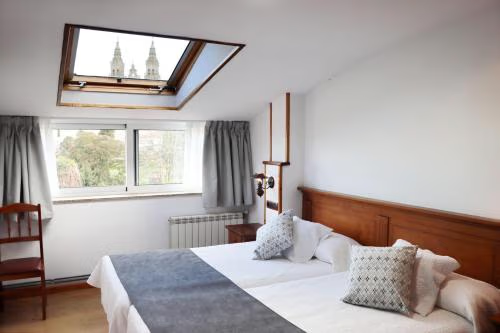 OpenReservations acceptedHotel Pazos AlbaSantiago de Compostela87€BreakfastWi-FiTVAnd more
- Top #4
 ClosedReservations acceptedAlbergue Seminario MenorSantiago de Compostela16€KitchenCooktopsMicrowaveAnd more
- Top #5
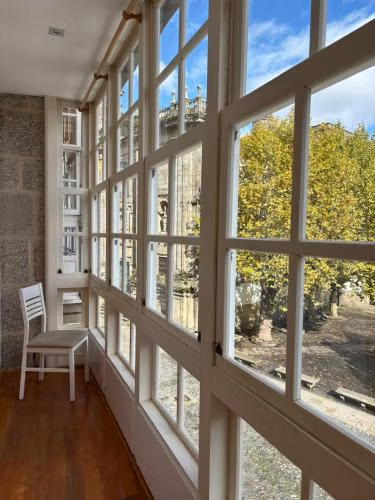 OpenReservations acceptedPension Via-StellaSantiago de Compostela66€Wi-FiTVIndividual Power PlugsAnd more
Services in Santiago de Compostela
What you can find in town before the next stage.
- ATM
- Café
- Shop
- Tobacco
- Medical clinic
- Pharmacy
- Fountain
- Post office
- Train station
- Bus station
- Airport
- Restaurant
Source: © OpenStreetMap contributors · updated April 2026
Caminos through Santiago de Compostela
Open a Camino to follow it on the map from Santiago de Compostela.
- Camino FrancésSt. Jean Pied de Port -> SantiagoView on map
- Camino Portugués CentralLisbon --> Porto -> SantiagoView on map
- Caminho Português da CostaPorto -> Valença / Tui -> SantiagoView on map
- Senda LitoralCaminho Português da Costa. Porto (coastline) -> at Caminha by ferry to Spain -> Vigo -> SantiagoView on map
- Camiño a FisterraSantiago -> FisterraView on map
- Camiño a MuxíaSantiago -> MuxíaView on map
- Camino PrimitivoOviedo -> SantiagoView on map
- Camino SanabrésGranja de Moreruela -> SantiagoView on map
- Camiño InglésFerrol -> SantiagoView on map
- Camino del NorteBayonne -> SantiagoView on map
- Camino de InviernoView on map
- Camino Muros-NoiaCamino de la Ría de Muros-NoiaView on map
- Caminho da Geira e dos ArrieirosCaminho da Geira e dos ArrieirosView on map
- Caminho Minhoto RibeiroCaminho Minhoto RibeiroView on map