

Town on the Camino
Treuen
Germany
- places to stay
- 7
- Camino
- 1
- Elevation
- 428 m
Treuen is the town with two lords: since an inheritance dispute in 1592 it has had one manor of the upper part and one of the lower part, and both manor houses still stand. For pilgrims on the Saxon Way of St James, Treuen is an honest stage town at km 245, with a Romanesque tower base and a lookout tower. An afternoon is enough.
How long to stay?
An afternoon is enough. Treuen is a working town with a weaving past and industrial estates, not a museum village. What there is to fill your time takes two or three hours: the tower of St. Bartholomäi, the two Feilitzsch manor houses if you still have legs, the Perlaser Turm. After that comes quiet, and you will need it: tomorrow it is 27.1 kilometres to Oelsnitz.
Treuen in Ninja numbers
- 245.2 kilometres since Bautzen. More than three quarters of the Saxon Way of St James lie behind you.
- 62.8 kilometres to Hof. Two good days, then Saxony is done.
- 1592 is when the Feilitzsch heirs divided their estate into an upper and a lower part. Treuen then had two manor houses, and it has them to this day.
- 1806 is when the town burned. Of the church only parts of the tower remained, and those are now the oldest structure in Treuen.
- 20 metres is the height of the Perlaser Turm of 1907 on the Wilhelmshöhe, the town's viewpoint.
Arriving: from Zwickau into the upper Vogtland
From Zwickau it is 31.1 kilometres via Hirschfeld, Irfersgrün, Waldkirchen and Lengenfeld. You have been in the Vogtland since Waldkirchen. Treuen lies at around 424 metres, a good 13 kilometres east of Plauen, and has about 7,700 inhabitants (as of 2021). The Saxon Way of St James leads through Treuen; according to Camino Ninja, no other Way of St James crosses here.
In brief: one castle, two estates, one fire
Treuen is first mentioned in 1214 as a Waldhufendorf (a forest-strip village), and in 1390 it receives town rights. Above it stood a castle of the Vögte of Plauen, built in stone in the 11th century, destroyed in the Hussite Wars and a second time before the Thirty Years' War. In 1510 the lordship passed to Jobst von Feilitzsch. His descendants quarrelled over the inheritance and divided the property in 1592: from then on there were the manors of Treuen's upper and lower parts, sealed with the enfeoffment charters of 1612.
Weaving began in the 18th century, and around 1850 a Saxon album of castles counted about 4,000 inhabitants, who mainly made muslin, calico and brightly coloured cloths. The Gründerzeit (the boom years of the late 19th century) was the heyday, and in 1865 the railway arrived. Today car-parts suppliers and four industrial estates from the years after reunification shape the town.
Two lords, one town: what to see
Treuen is small, and everything important lies close together. It is worth reading the town as a double portrait: the one estate above, the other below, and between them the church that outlived both. - Stadtkirche St. Bartholomäi (town church): The tower is the oldest structure in town, its lowest part is Romanesque and dates from the late 12th century. A nave was added in 1514, the town fire of 1806 left only parts of the tower standing, and afterwards the nave was rebuilt in the neoclassical style. We did not find opening times. - Schloss Treuen unteren Teils (Treuen Castle, lower part): A half-timbered manor seat, built from 1608 to 1610 on a former outer farm of the castle, with St Andrew's crosses in the timber frame, two transverse wings and a masonry stair tower with a Welsche Haube (onion-shaped cap). After the land reform the Belger family was dispossessed and the house partly fell into ruin. In 2003 the Förderverein Schloss Treuen (support association) bought it at auction, renovated it and has used it for events since. You can see it from outside at any time, inside only on the association's event dates. - Herrenhaus oberen Teils (manor house, upper part): Also built from 1608 to 1610, on the walls of the old castle. It was rebuilt in the early 20th century and is now privately lived in. The farm business "Gut Treuen" uses the successor buildings of the old farm buildings. You only see it from outside, but then you know both halves of the inheritance dispute. - Perlaser Turm: Built in 1907 on the Wilhelmshöhe, 20 metres high, with a survey point of the Royal Saxon Triangulation of 1876 beside it. From here you look out over the land you will walk through tomorrow. We did not find opening times.
Honestly
- Treuen is not a picture-book town. The town fire of 1806 took the old centre, and industry and industrial estates shape the view. If you are looking for half-timbered lanes, you will only find them at the castle.
- We did not find a pilgrim hostel. You sleep in guesthouses, guest rooms or holiday flats. It pays to ask in good time, the choice is limited.
- The sights are often closed. For the church, castle and Perlaser Turm we found no reliable opening times, and the castle opens for association events.
- The next stage is long. It is 27.1 kilometres to Oelsnitz, with no larger place in between.
Where pilgrims sleep
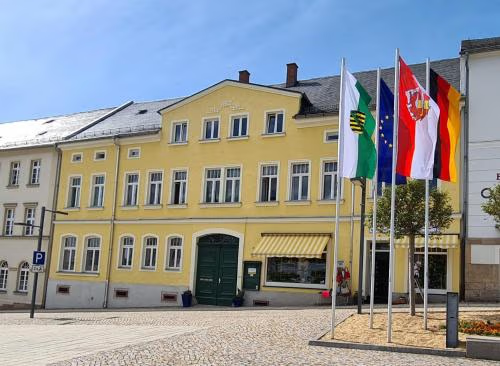
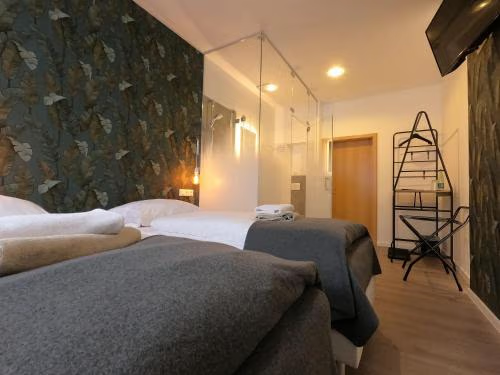
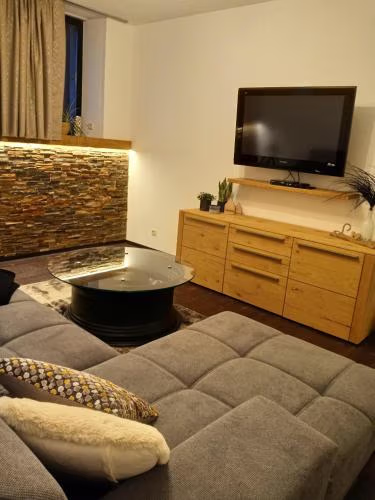
We did not find a pilgrim hostel, a parish lodging or a donativo accommodation in Treuen. If you stay here, you book a guesthouse, a guest room or a holiday flat, some of them right on the market square. The accommodation list further down this page shows you what Camino Ninja knows.
Ninja tips
- Read the town twice. If you look first at the lower castle and then at the upper manor house, you understand Treuen in ten minutes: two branches of a family, two houses, one name.
- Step into the shadow of the church tower. The Romanesque tower base of St. Bartholomäi is the only piece of Treuen that survived the fire of 1806.
- Watch for the milestone. A restored Royal Saxon milestone was set up again in November 2013, a greeting from the days when distances were still chiselled in stone.
- A bit of outer space to finish. The Saturn Way of the Vogtland planet trails ends in Treuen. If you feel like a few more steps in the evening, you will find its end here.
Onward: through the Vogtland to Oelsnitz
The Saxon Way of St James takes you via Altmannsgrün, Unterlauterbach, Schönau, Bergen, Lottengrün, Tirpersdorf and Hartmannsgrün to Oelsnitz im Vogtland, 27.1 kilometres in all. Bergen lies after 12.1 kilometres, roughly halfway.
What awaits you tomorrow
Oelsnitz im Vogtland, and there, of all people, Saint James himself awaits: the town church is called St. Jakobi, and its towers rise 73.5 metres into the sky.
Deep dive: The town of two lords
A short read, in case you want to learn more about Treuen. About two minutes' reading.
A tower that was left over
When you stand in front of the town church in Treuen, you look at two eras at once. Below is the tower, whose lowest part was built in the late twelfth century, Romanesque, heavy, the oldest structure in town. Above and beside it is a neoclassical nave that was only built after the great town fire of 1806. The fire took the church, the vicarage, the school and a large part of the town at that time. The tower is what remained.
A castle of wood, then of stone
The story begins earlier. Around 800 there is said to have been a Slavic moated castle of wood in the Treuen area, and in the eleventh century the Vögte of Plauen replaced it with a hilltop castle of stone. In 1214 the village is first mentioned, and in 1390 it receives town rights. The castle changes lords, is destroyed in the Hussite Wars, rebuilt and destroyed again before the Thirty Years' War. Today nothing of it can be seen.
One inheritance, two houses
In 1510 Jobst von Feilitzsch takes over the castle and lordship. Two generations later his descendants cannot agree. In 1592 they divide the property, and in 1612 the division is sealed with the enfeoffment charters. From then on Treuen has two manors, the upper and the lower. Between 1608 and 1610 both family branches build their manor house, the upper one on the walls of the old castle, the lower one on a former outer farm. For more than three centuries the little town thus has two lords.
After the lords
The land reform after the Second World War ends the story of the estates. The families are dispossessed, farm buildings are pulled down, and the lower castle is meant to take in resettlers. In 1987 and 1988 it is partly renovated, in 1993 the town sells it, and plans for a hotel fail. In 2003 a support association buys it at auction, renovates it and opens it for events. The upper manor house is a residential house today.
What Treuen gives you
Treuen tells of a division that nobody has reversed and that the town has lived with all the same. Two houses, two lines, one place. On the Way it is sometimes similar: you carry things with you that cannot be reconciled, and you walk on anyway. Tomorrow the Way leads to Oelsnitz.
Where to stay in Treuen
Places to stay in Treuen.
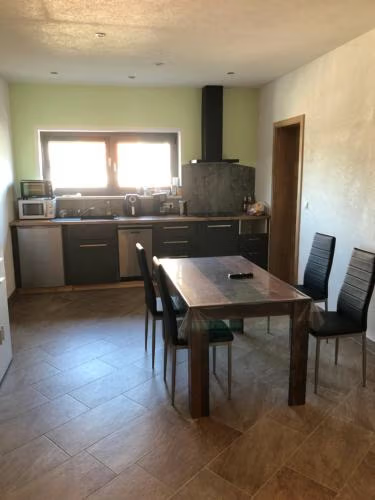 OpenReservations accepted
Ferienwohnung Zeitler
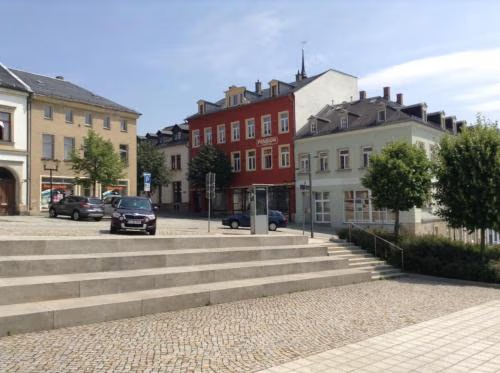 OpenReservations accepted
Pension Eberhart
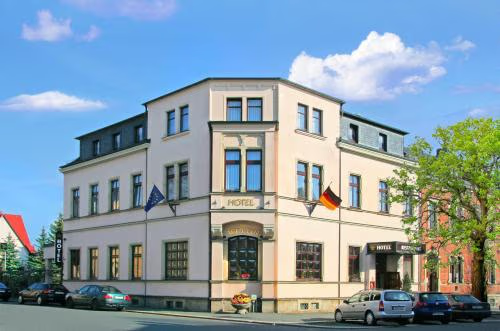 OpenReservations accepted
Hotel Wettin

Town 13 of 15