

Bray Coastal Camino
31.9 kilometres with 174 metres of ascent from Bray to Dublin, the sea always on your right: from the promenade below Bray Head via Shankill, Killiney, the medieval harbour of Dalkey, Dún Laoghaire, Blackrock, Sandymount Strand and Ringsend to St James's Church in James's Street — to the place where Irish pilgrims set off for Santiago from 1220, until a brewer demolished the city gate and Arthur Guinness took a 9,000-year lease in 1759. One or two days, seven stamp points, nine DART stations beside the route; an accredited Celtic Camino of the Camino Society Ireland, in operation since 2019. No waymarking, no hostel network — but a certificate that is worth 25 kilometres in Santiago.
- 01At a glance
- 02Overview
- 03Other names
- 04Who it is ideal for – and who it is not
- 05Route and landscape
- 06Stages, terrain and difficulty
- 07The gate that stood in a brewer's way
- 08Highlights along the way
- 09The Celtic Camino: walk in Ireland, arrive in Spain
- 10How pilgrims reach this route
- 11Continuing the pilgrimage?
- 12The Celtic Camino
- 13Preparation and practicalities
- 14What the route costs you
- 15Getting there
At a glance
- Start / Finish: Bray (Co. Wicklow), Seafront / Dublin 8, St James's Church, James's Street
- Length: 31.9 km (operator: 30.5 km)
- Duration: 1 day (8–9 hours) or 2 stages
- Elevation: ↗ 174 m / ↘ 156 m
- Highest point: 65 m on Killiney Hill; lowest point 0 m on the beach
- Stages: 2 — Camino Ninja division at Dún Laoghaire; the operator lists the route as one walk in both directions
- Landscape: seafront promenade, cliff path below Bray Head and Killiney Hill, harbour towns, Sandymount Strand, Liffey quays
- Waymarking: none — route directions as PDF in both directions, the sea as your guide
- Traces of St James: St James's Gate Dublin, pilgrim departures since 1220; St James's Church Crinken (1840); home of the Camino Society at St James's Church
- Accommodation: no hostel network; hotels and hostels in Bray, Dún Laoghaire and Dublin
- Sister routes: Boyne Valley Camino (Drogheda), Croagh Patrick Heritage Trail (Mayo)
- Onwards in Spain: Camino Inglés from A Coruña — 75 km, with the Irish 25 km the Compostela
- Best time: April to October; walkable all year
- Associations along the way: whole route: Camino Society Ireland
Overview
This route ends where Dublin's pilgrims once set off. On James's Street stood St James's Gate, the western city gate, "the traditional starting point for the Camino pilgrimage from Dublin to Santiago de Compostela" — pilgrim departures from 1220, a pilgrim hospice is documented for 1216. In 1734 a brewer demolished the gate because he needed a wider entrance for his barrels, and on 31 December 1759 Arthur Guinness leased four acres there "for 9,000 years at £45 per year". Today you collect your certificate at St James's Church, a few steps from the Guinness Storehouse. You start on the promenade in Bray beneath a summit cross from the Holy Year 1950, walk with the sea on your right via Shankill, where the route's only St James's church is named after a husband called James, over Killiney Hill, through Dalkey, Dublin's medieval harbour with its seven castles of 1390, to Dún Laoghaire, past the Martello tower at Sandycove where Ulysses begins, across Sandymount Strand and along the Liffey quays into the city.
Beside you all the way runs the DART, successor to Ireland's first passenger railway of 1834 — nine stations in 31.9 kilometres, you can get off wherever you like and carry on another day. To be honest, this is no hiking trail in the classic sense: no waymarking, plenty of pavement and promenade, no hostel network, and the operator itself says "it is for the individual walker … to decide whether a route is safe". In return you get Dublin Bay in one day, a 14th-century harbour, the first page of modern literature, a gate that stood in a brewer's way — and a certificate that is worth 25 kilometres in Santiago.
Other names
The operator calls the route Bray Coastal Camino — that is how it appears in the official list of Celtic Camino routes of the Camino Society Ireland, with 30.5 kilometres and the note "Bray → Dublin". Bray Tourism calls it the Bray Celtic Camino Coastal Route, the Galician Camino Inglés portal gives 32 kilometres, the Irish Times 30.5, the diocesan report of 2019 30.2; our route data gives 31.9. The route is bidirectional — the Society provides "Bray to Dublin" and "Dublin to Bray" directions — and we describe it in the direction that makes sense as a pilgrimage: towards St James's Church. And it is one of ten Celtic Caminos whose Irish kilometres count in Santiago; the siblings are the Boyne Valley Camino, Croagh Patrick Heritage Trail, Kerry Camino, Tóchar Phádraig, St Kevin's Way, St Declan's Way, St Finbarr's Pilgrim Path, Slí ár Sinsear and Coalisland Camino.
Who it is ideal for – and who it is not
Ideal if you want a Camino with a sea view and a safety net: 31.9 kilometres, the water always on your right, and a DART station every three kilometres — you can stop wherever you like and carry on where you left off; with the Leap Card daily cap of €6.00, complete freedom to bail out costs less than a lunch. Ideal if you like literature: you walk past the tower where the first sentence of Ulysses is set, and across the strand where Stephen Dedalus ponders the "ineluctable modality of the visible". Ideal if you are visiting Dublin anyway and want to pick up the 25 kilometres for the Celtic Camino Compostela — this is the only one of the ten that ends in the capital. And ideal for beginners: 174 metres of ascent, highest point 65 metres, cafés every half hour.
To be honest, though, it is not for you if you are looking for nature. This is suburban coast: promenade, pavement, level crossings, villa districts, and finally city streets and quays — "mostly on roads and on even grounds", as one organiser puts it. Not for you if you expect scallop-shell signs: the route is not waymarked, you walk with the Society's PDF directions on your phone and the sea as your guide. Not for you if you need hostels — there are none, you sleep at Dublin prices. And not for you if you take the stamps for granted: seven points with seven different opening hours, "where available. This is a trust system!", the Society writes — anyone starting late arrives with two stamps. Gaps like these are planned away beforehand, not on the road.
Route and landscape
You start on the promenade in Bray, the "Brighton of Ireland", beneath the 241-metre Bray Head with its summit cross of 1950; the first stamp is on the seafront, then you head north along the coast. Via Shankill — with the little St James's Church in Crinken, stamp point and curiosity — and Loughlinstown you reach Killiney: the coastal path climbs onto Killiney Hill, at 65 metres above the sea the highest point of the route, with the obelisk of 1742 and the view over the whole bay to the Wicklow Mountains and, on a clear day, to Wales. Beyond lies Dalkey, a Viking foundation and from the mid-14th to the late 16th century Dublin's deep-water harbour: the merchants built seven castles in 1390 to protect their cargo, Dalkey Castle in Castle Street is the last one you can enter. Via Sandycove with Joyce's Martello tower and the Forty Foot, the famous bathing place, you come to Dún Laoghaire — harbour of 1817 in Dalkey granite, tourist office with stamp, the natural halfway point of the day.
The second half is bay. Via Blackrock with the Seapoint Tower you follow the coast to the Merrion Gates and onto Sandymount Strand, that kilometre-wide tidal strand where two Ulysses episodes are set and from which you see the Great South Wall — the longest sea wall in the world when it was built from 1715 to 1795 against the silting of the Liffey, the same silting that had made Dalkey a harbour. Through Ringsend and across the River Dodder you reach the Liffey, walk the quays into town, past Grand Canal Dock, Christ Church Cathedral and St Audoen's — both stamp points — and up James's Street to St James's Church, where the information centre of the Camino Society Ireland checks your passport. Surface: promenade, pavement, coastal path, beach if you choose, city street; trainers suffice, sunscreen is the real issue.
Stages, terrain and difficulty
We divide the route into two stages, with the break at Dún Laoghaire — the only point on the route with a tourist office, a major station and hotels, almost exactly halfway. That is our division: the operator lists the route as one walk of 30.5 kilometres and at the same time itself recommends cutting it into sections as you like. Our kilometres are calibrated to the 31.9 kilometres of our route data; externally documented is only the total length (operator 30.5, other sources 30.2 to 32). Difficulty: technically none — 174 metres of ascent, most of it on Killiney Hill.
- Bray – Shankill – Loughlinstown – Killiney – Dalkey – Dún Laoghaire (16.8 km) — promenade, coastal path, Killiney Hill with obelisk, the medieval harbour of Dalkey, Martello tower at Sandycove; stamps in Bray, Crinken, Joyce Tower and Dún Laoghaire.
- Dún Laoghaire – Blackrock – Sandymount – Ringsend – Dublin, St James's Church (15.1 km) — Seapoint, Merrion Gates, Sandymount Strand, Dodder, Liffey quays, Christ Church, St Audoen's, James's Street; certificate at the information centre.
Anyone walking it all in one day needs a documented eight and a half hours including stamp stops — the guided walks start at ten and arrive in the early evening. For the Celtic Camino rule the division is not irrelevant: stage 1 alone is 16.8 kilometres and falls short of the 25, the certificate is only for the whole route. The route is tiring not because of climbing but because of hard surfaces, sun and the clock: pavement and promenade over 30 kilometres are harder than any woodland path, the bay has no shade, and anyone who wants all seven stamps must start early. One organiser puts it this way: "The group will not wait for you – especially if you are not prepared!" Blister plasters, sunscreen, water — and the DART as plan B.
The gate that stood in a brewer's way
For five centuries pilgrims went out through here, then someone needed more room for barrels. St James's Gate was Dublin's western city gate, named after the 12th-century parish of St James, documented from the 13th century, drawn on the maps of John Speed in 1610 and Charles Brooking in 1729 — and "the traditional starting point for the Camino pilgrimage from Dublin to Santiago de Compostela". Tradition dates the pilgrim departures to 1220, a pilgrim hospice in Dublin is documented for 1216. Dublin's pilgrims were no overland travellers: they did not take the road through England and France but "found passage on merchant ships plying the busy trade route to the Spanish coastal city of A Coruña", the port that had received Irish pilgrims since the 12th century. And Dublin's merchant ships in that period did not dock on the Liffey but at Dalkey — waypoint five of this Camino — because the estuary had silted up and "the treacherous shallows of Dublin Bay" allowed no direct landing; in 1390 the merchants built seven castles there for the waiting cargo. That the pilgrim ships specifically left from Dalkey is an inference, not a record — but the harbour is waypoint five, and the Great South Wall, built from 1715 against exactly this silting, you see three hours later from Sandymount Strand.
There are names: in 1267 Fulk de Sandford, Archbishop of Dublin, went on pilgrimage to Santiago — the earliest Dubliner we know of; in 1445 Mairgréag an Einigh Ní Chearbhaill, the first documented Irish woman pilgrim; in 1602 Red Hugh O'Donnell sailed to A Coruña with 25 companions. A chronicler of Ferdinand of Aragon noted around 1474 of the Irish: "Many of them frequent the jubilee pilgrimages to Santiago." And in 1473 the "La Mary London" brought 400 Irish pilgrims back from Santiago — we know it only because pirates captured the ship. Then the break, without a decree but with a date: in 1734 Captain Paul Espinasse, brewer and leaseholder, had the gate demolished to widen the entrance; on 31 December 1759 Arthur Guinness signed his lease there "for 9,000 years at £45 per year". The revival has a date: in 1992 returned pilgrims founded the Camino Society Ireland, in 2015 its information centre moved into the St James's Church of 1852, in 2019 this route went into operation. The finest footnote stands in Shankill: the only St James's church on the route, St James's Church Crinken of 1840, is so called because a widow wanted her husband's name in the church's name — "Mrs Clarke asked that her husband's name should be associated with the dedication, and so the name of Saint James was decided on." The apostle was added afterwards. Today this church stamps passports for Santiago.
Highlights along the way
- Bray Head — 241 metres of slate above the starting point, summit cross "placed there in 1950 during the holy year"; the railway line around it was designed by Isambard Kingdom Brunel, "Brunel's Folly", relocated three times. First stamp on the seafront.
- St James's Church Crinken, Shankill — opened on 28 June 1840, endowed by two widows, Margaret Clarke and Hannah Georgina Magan; the name comes from the late husband James, not from the apostle. Stamp point.
- Killiney Hill — 153 metres, the route crosses its flank at 65 metres; the obelisk of 1742 is no victory monument but a relief scheme for the victims of the famine of 1740/41. View to the Wicklow Mountains and to Wales.
- Dalkey — Viking name, from the mid-14th to the late 16th century Dublin's deep-water harbour; seven merchants' castles in 1390, Dalkey Castle in Castle Street is the only one open to visitors (€18, closed Tuesdays, as of September 2026). Beside it St Begnet's Church from the 10th century.
- James Joyce Tower, Sandycove — the Martello tower where Joyce spent six nights in September 1904 and where Ulysses begins: "Stately, plump Buck Mulligan came from the stairhead". Museum since Bloomsday 1962, admission free, Tuesday to Sunday; stamp point. Below it the Forty Foot, Dublin's most famous bathing place.
- Dún Laoghaire Harbour — East Pier from 1817 to John Rennie's design, in granite from Dalkey; renamed Kingstown in 1820 after George IV's departure, changed back in 1920. Stamp at the tourist office.
- Sandymount Strand — the tidal strand of the Ulysses episodes "Proteus" and "Nausicaa"; opposite, the Great South Wall, built 1715 to 1795, then the longest sea wall in the world, with the Poolbeg Lighthouse of 1767.
- Christ Church Cathedral and St Audoen's — stamp points in the old town, shortly before the finish.
- St James's Gate — Dublin's western city gate, pilgrim departures from 1220, demolished in 1734; Arthur Guinness's lease of 31 December 1759 for 9,000 years. The name stayed, the stamp is there.
- St James's Church, James's Street — Catholic church of 1842–1852, since 2015 home and information centre of the Camino Society Ireland: "Come and talk to us, we're here to help!" Pilgrim passport and Celtic Camino Compostela are available here. Its medieval predecessor stood where the Pearse Lyons Distillery is today.
The Celtic Camino: walk in Ireland, arrive in Spain
The Bray Coastal Camino is one of ten routes that the Camino Society Ireland has accredited as a Celtic Camino, and behind it is a calculation: the Cathedral of Santiago demands 100 kilometres on foot for the Compostela, the Camino Inglés from A Coruña has only 75. "The Cathedral of Santiago has agreed to grant a Compostela to pilgrims who complete the 75km Camino Ingles route from A Coruña" — provided they prove 25 kilometres in Ireland. You need an official pilgrim passport from the Society or a sister organisation, collect stamps at start and finish — "STAMP AT THE START AND FINISH, where available. This is a trust system!" — and present the passport at the information centre at St James's Church, Thursday to Saturday 10:30–15:30. There you receive the Celtic Camino Compostela: free with a Society passport or as a member, otherwise for a donativo of €1–2 (as of September 2026).
In Spain you then walk the 75 kilometres from A Coruña with two stamps a day and present both in Santiago. A Coruña is no accident: "the main port of disembarkation for Irish pilgrims since the 12th century". What matters is the order — Ireland first — and completeness: for the 25 kilometres the whole route counts, our stage 1 alone is not enough. And the Society itself says where its role ends: "The society have no responsibility for any of these routes!" — it accredits, it does not operate.
How pilgrims reach this route
This route needs no feeder route, it has a commuter railway. The DART links Bray with Dublin city centre in around 45 minutes; Bray Daly, opened in 1854 as "Bray", was its southern terminus until 2000. From Dublin Airport you take the bus into the centre and continue on the DART from Pearse or Connolly; from the south of Ireland you come via Dublin Heuston. Anyone who only wants the second half gets off at Dún Laoghaire — stamp at the tourist office, hotels by the harbour.
Anyone wanting to combine several Celtic Caminos has it easy: the Boyne Valley Camino begins in Drogheda, an hour by train north of Dublin — the geographically closest relative. Further west lie the Croagh Patrick Heritage Trail in Mayo and the Kerry Camino in Kerry. All meet the same 25-kilometre condition — you only need one of them.
Continuing the pilgrimage?
Yes — and the connection is the real point of this route: it leads to Spain. The Camino Inglés from A Coruña is the prescribed continuation, 75 kilometres to Santiago de Compostela, two stamps a day; with your Irish 25 kilometres that makes the 100 for the Compostela. Anyone who wants the full English route starts instead in Ferrol on the Camino Inglés, around 115 kilometres — then you no longer need the Irish section for the Compostela. And anyone who wants to collect the Irish family: the Boyne Valley Camino (25 km), the Croagh Patrick Heritage Trail (63 km), St Declan's Way (115 km), Tóchar Phádraig (35 km), St Kevin's Way (32 km), St Finbarr's Pilgrim Path (35 km), Slí ár Sinsear (29 km) and the Coalisland Camino (26 km) are on the same list. For the Compostela only one counts — for the collection all of them.
The Celtic Camino
The Celtic Camino links Ireland with Santiago. For the Compostela the Pilgrim Office requires at least 100 km on foot, but the Camino Inglés from A Coruña is only about 75 km long. You walk the missing kilometers on one of the ten Irish Celtic Caminos: at least 25 km, with stamps in your pilgrim passport. The Camino Society Ireland checks the passport in Dublin and issues the Celtic Compostela; together with the stamps from the Camino Inglés it earns you the Compostela in Santiago. The ten Celtic Caminos:
- Croagh Patrick Heritage Trail – Mayo
- Tóchar Phádraig – Mayo
- Kerry Camino – Kerry
- Slí ár Sinsear – Kerry
- St Finbarr’s Pilgrim Path – Cork
- St Declan’s Way – Tipperary – Waterford
- St Kevin’s Way – Wicklow
- Bray Coastal Camino – Wicklow – Dublin
- Boyne Valley Camino – Louth
- Coalisland Camino – Tyrone
Preparation and practicalities
Navigation: the route is not waymarked. Download the Camino Society's PDF directions — "Bray to Dublin Directions" or "Dublin to Bray Directions" — and take an offline map; the guide is the sea, in the city the Liffey. Start time: early, ten at the latest if you want all seven stamps — St James's Church Crinken, Joyce Tower (Tue–Sun 10–16), Dún Laoghaire Tourist Office, Christ Church and St Audoen's each have their own opening hours; start and finish stamps are compulsory, everything in between is a bonus. Best time is April to October, walkable all year; the bay has no shade, sunscreen and water are the real issue, food is available everywhere. Footwear: worn-in trainers or light walking shoes, blister plasters — hard surface over 30 kilometres. Language: English.
Pilgrim passport and accommodation: you need an official pilgrim passport to turn the stamps into the Celtic Camino Compostela — the Camino Society Ireland issues it in the sacristy of St James's Church (Mon, Tue, Thu 9–12, phone ahead), online and through partner shops; a passport from an international sister organisation is accepted. Do not use the QR code on the passport to register for the Compostela — it does not work, registration is only via the Pilgrim's Office website. There is no hostel network: you sleep in Bray, Dún Laoghaire or Dublin — hotels, B&Bs, hostels, city market — or walk the route from one base and take the DART back in the evening. The easiest way is to plan it directly in the Camino Ninja app together with your stages.
What the route costs you
To be honest, the route itself is free, the city is not. All amounts as of September 2026. Documented: the Celtic Camino Compostela free with a Camino Society Ireland passport or as a member, otherwise a donativo of €1–2; James Joyce Tower admission free, groups €1 donation; Dalkey Castle €18 (seniors and students €17, children under 12 €12); the DART with Leap Card €2.00 for 90 minutes, daily cap €6.00, weekly cap €24.00 — with a Leap Card around 30 per cent cheaper than a single ticket. Guide values: a hostel bed in Dublin €35–60, a B&B or simple hotel alone €90–140, a hotel double room in Dublin or Dún Laoghaire €140–220, hotels in Bray from around €100; coffee €3–4, sandwich €6–9, pub dinner €18–28.
Realistic daily budget: anyone walking the route in one day, arriving by DART from a Dublin base and eating en route manages on €20–35, excluding accommodation; with Dalkey Castle and a pub evening €50–70. For two stages with a night in Dún Laoghaire reckon on €100–140 frugal, €160–220 mid-range, €250–350 comfortable. We do not give the price of the pilgrim passport and membership — they are in the Society's shop, which changes.
Getting there
To the start (Bray): Bray Daly lies on the DART and on the Dublin–Rosslare line. From Dublin Connolly or Pearse you reach Bray in around 45 minutes; from Dublin Airport by bus into the centre and on by DART, or by Aircoach to Bray. The starting point on the promenade is five minutes on foot from the station.
En route and from the finish: Shankill, Killiney, Dalkey, Sandycove, Dún Laoghaire, Blackrock, Sandymount and Grand Canal Dock have DART stations — every stage can be shortened at will. The finish at St James's Church is on the Luas Red Line, stop James's, served by buses G1, G2, 13 and 73, with a Dublin Bikes station right by the church; the airport bus leaves from the city centre. Anyone wanting to complete the Celtic Camino in Spain flies from Dublin to A Coruña or Santiago.
- DART and trains Ireland: irishrail.ie — Bray – Dún Laoghaire – Dublin
- Leap Card, fares: transportforireland.ie — daily cap €6.00
- Operator, pilgrim passport, directions, Celtic Compostela: caminosociety.ie — Camino Society Ireland, St James's Church
- Starting town: bray.ie — Bray Tourism, Bray Celtic Camino Coastal Route
- Stamp point Sandycove: joycetower.ie — James Joyce Tower & Museum
Partners
Partner for Bray Coastal Camino
Camino Ninja is cooperating with official partners. For this camino the partner is:

Get your pilgrim credential and shell
Everything you need for the Bray Coastal Camino, shipped to your door.
Visit Camino Shop
Other Caminos
Ansbacher Jakobsweg
Ansbacher Jakobsweg
From Weihenzell via Ansbach, Feuchtwangen, Dinkelsbühl, Ellwangen and the Ostalb to Ulm and Oberdischingen: 9 stages, monasteries, imperial cities and the watershed between the Kocher and the Brenz.
ReadAppenzeller Weg
Appenzeller Weg
52.6 km from Rankweil across the Rhine to St. Peterzell: St. James Chapel (1464), 163 Years of the Wedding Trail, connection to the Via Jacobi. Stages, costs, how to get there.
Read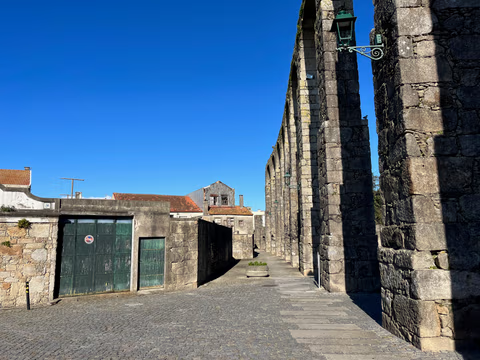
Aqueduct Trail – A path running along the Vila do Conde Aqueduct
From the Coastal Trail to the Camino Central: 12.9 km along the aqueduct from Vila do Conde to São Pedro de Rates. Route, stage, hostels, costs—explained honestly.
Read
