

Camino Inglés from A Coruña
The Camino Inglés from A Coruña is the shorter of the two branches of the English Way: 30 kilometres from the Romanesque church of Santiago in the old town over the medieval Ponte do Burgo, through Sigrás and Sergude up onto the plateau of Hospital de Bruma, where it meets the main branch from Ferrol. From there it is another 43.4 kilometres to Santiago – 73.4 kilometres in all, and thus below the 100-kilometre threshold for the Compostela. That is exactly what makes this route a special case: you only get the certificate if you have collected kilometres in your home country beforehand or are a registered resident of A Coruña. In return, you start where the English pilgrim ships docked in the 15th century.
- 01At a Glance
- 02Overview
- 03Other Names
- 04Who It's Ideal For—and Who It's Not So Ideal For
- 05Route & Landscape
- 06Stages, Terrain, and Difficulty
- 07The 100-kilometre question: why A Coruña only gives you the Compostela with prior kilometres
- 08Where the sea pilgrims came ashore
- 09Highlights Along the Way
- 10How Pilgrims Find Their Way onto This Path
- 11Continue the pilgrimage?
- 12Preparation & Practical Information
- 13What the journey will cost you
- 14Getting Here
At a Glance
- Start / Finish: Church of Santiago (Igrexa de Santiago) in the old town of A Coruña / Herves near Hospital de Bruma, where the route joins the Camino Inglés from Ferrol
- Length: 30.0 km to Herves; to Santiago it is another 43.4 km, 73.4 km in all
- Duration: 2 stages to Bruma (20.4 and 9.6 km), plus 2 days via Sigüeiro to Santiago – 4 days in total
- Elevation: ↗ 786 m / ↘ 350 m – more than half of the ascent (435 m) lies on the last 9.6 km
- Highest point: 456 m at km 29.5 shortly before Herves, on the edge of the plateau of the Terra de Ordes
- Landscape: old town, Ría do Burgo, suburbs, then hamlets and eucalyptus in the Barcés valley, finally the steep slope up to the plateau
- Operator / Waymarking: Xunta de Galicia; yellow arrows and shell markers, brass shells in the pavement in the city
- Compostela: only with prior kilometres – at least 25 km on a recognised Way of St. James in your home country (Camino Celta, Ireland/Great Britain) or residence in A Coruña (Cathedral Chapter decision of 21 December 2016)
- Credencial: available at the church of Santiago in A Coruña; order online in advance
- Traces of St. James: churches of Santiago in A Coruña and O Burgo (12th century), pilgrim hospital in Sigrás, Hospital de Bruma documented since 1175
- Accommodation: Xunta hostels in Sergude (30 beds) and Hospital de Bruma (around 35 beds), 10 € each (as of September 2026)
- Connecting routes: Camino Inglés from Hospital de Bruma to Santiago; from Santiago the Camiño a Fisterra
- Best time: April to October; always expect rain, and wind on the plateau of Bruma
Overview
The Camino Inglés has two beginnings. The longer one starts in Ferrol, the shorter one here, in A Coruña, at the Romanesque church of Santiago in the old town. Both branches meet at Hospital de Bruma, where a pilgrim hospital has been documented since 1175, and run together to Santiago. The branch from A Coruña is the historically weightier one: this is where the pilgrim ships from England and Ireland docked in the 14th and 15th centuries.
Honestly, though, today it is the branch with the flaw: A Coruña–Santiago is 73.4 kilometres, and the Pilgrim's Office demands 100 for the Compostela. Most pilgrims therefore start in Ferrol – on the whole Camino Inglés, around 30,000 arrived in Santiago in 2025, just under six per cent of all pilgrims. If you set off from here anyway, you get two very different days: first 20 kilometres of city, ría and suburbs, then ten kilometres of hamlets and a steep slope that serves up more than half of the climbing in one go.
Other Names
The route is a branch of the Camino Inglés, Galician Camiño Inglés, English English Way – named after the pilgrims from the British Isles who landed here. For the section from A Coruña you also read Camiño do Faro or Camino de Faro: Faro was the medieval name of the harbour town of O Burgo ("Burgo de Faro"), and at the same time a reference to the lighthouse, the Torre de Hércules. Not to be confused with the Camino de Faro in the Algarve. Tour operators also sell the route as the Celtic Camino – actually the name of the Compostela arrangement for Irish and British pilgrims, not of a route of its own.
Who It's Ideal For—and Who It's Not So Ideal For
Ideal if you have little time and want to walk from a harbour city to the cathedral in four days. Ideal if you are looking for the seafaring history of the Way of St. James – the church where the ship-borne pilgrims were received exists like this only here. Ideal, too, for pilgrims from Ireland and Great Britain on the Camiño Celta.
Honestly, though, it is not for you if you want the Compostela and are neither registered in A Coruña nor have collected kilometres in your home country beforehand – then start in Ferrol. Not for you if asphalt and industrial estates bother you: the first stage is paved almost throughout, and Gronze calls the surroundings "escasamente sugerente" (hardly inspiring). And not for you if you expect the "short" route to be a flat one – the last 9.6 kilometres have 435 metres of ascent.
Route & Landscape
City, ría and suburbs (km 0–20): The route begins at the Igrexa de Santiago in the old town, leaves the centre via the Plaza de María Pita and follows the shore of the Ría do Burgo, the most beautiful part of the first day. At O Burgo (km 10.0) you cross the ría on the medieval bridge and pass the Romanesque church of Santiago of the old harbour town. Via Almeiras (km 11.0), right next to Alvedro airport, you go on to Sigrás (km 14.1) with its Romanesque church and the rectory on the site of a pilgrim hospital, then to Anceis (km 16.9) and Sergude (km 20.4), where the Xunta hostel stands.
Hamlets and steep slope (km 20–30): After Sergude it turns rural: via Calle (km 23.7) and Bordel (km 24.0) the route leads through the valley of the Barcés, past eucalyptus and small hamlets to Xeixade (km 26.6). Then comes the climb to the plateau of the Terra de Ordes – around 400 metres of ascent in one go, until the route rises to 456 metres at km 29.5 and meets the Camino Inglés from Ferrol at Herves (km 30.0). The stage destination of Hospital de Bruma lies immediately beyond.
Stages, Terrain, and Difficulty
We show the route in 2 stages to Herves (Hospital de Bruma); the kilometres and elevation figures come from our route data. Many pilgrims walk the 30 kilometres in one day – then it is around seven to eight hours to the hostel in Bruma, with the climb at the end. If you split it, you sleep in Sergude and reach Bruma early on the second day, before the Ferrol pilgrims fill the beds.
- A Coruña → Sergude (20.4 km) — ↗ 350 m / ↘ 255 m. Old town, Ría do Burgo, Ponte do Burgo, Sigrás. Pavement and asphalt almost throughout; the shore path along the ría is the most beautiful part.
- Sergude → Herves (Hospital de Bruma) (9.6 km) — ↗ 435 m / ↘ 95 m. Short, but the real day: hamlets in the Barcés valley, then the steep climb to 456 m onto the plateau.
From Hospital de Bruma you follow the Camino Inglés: 43.4 kilometres in two days via Sigüeiro to Santiago, flat to rolling, mostly forest tracks and minor roads. The difficulty of the A Coruña branch lies not in its length but in its distribution: hard surfaces on the first day, 435 of the 786 metres of ascent on the last 9.6 kilometres.
The 100-kilometre question: why A Coruña only gives you the Compostela with prior kilometres
The Pilgrim's Office in Santiago demands at least 100 kilometres on foot for the Compostela – and according to our route data A Coruña lies 73.4 kilometres from the cathedral, the Xunta reckons 75. For years that meant: whoever started here went home without a certificate. After the first international meeting on the Camino Inglés in November 2016 in A Coruña, the Cathedral Chapter decided on 21 December 2016 on two exceptions that still apply today.
First, the Camiño Celta: If you walk at least 25 kilometres beforehand on a recognised Way of St. James in your home country and prove it with stamps in your pilgrim passport, the 75 kilometres from A Coruña bring you to 100. This has been worked out for Ireland and Great Britain: the Camino Society Ireland issues the "Celtic Camino Compostela" in Dublin, which you present in Santiago together with your stamped passport. On Camino Ninja you will find such home routes in the Kerry Camino in Ireland, the Finchale Camino Inglés in England and El Camino de San Antonio Missions in Texas, for which the organisers state a credit of 30 kilometres. Whether routes in other countries count is decided by the Pilgrim's Office case by case – ask there before you start, not the tour operator. Second, residence: If you are registered in the city of A Coruña (not just the province) and can prove it with an ID card or a certificate of registration, you receive the Compostela for the 75 kilometres alone.
In practice that means: a stamp at the church of Santiago, two stamps a day along the way – and if you are neither Irish nor British nor Coruñés, expect to end up without a Compostela. The route itself doesn't ask about the certificate.
Where the sea pilgrims came ashore
A Coruña was the most important pilgrim harbour of Galicia in the late Middle Ages. Margery Kempe reports sailing from Bristol to Galicia in seven days in 1417, and back in five. William Wey noted down in A Coruña in 1456 the song with which Galician children begged the arrivals for a "blanca"; in the same year John Goodyear from the Isle of Wight donated to the cathedral of Santiago the alabaster retable with the legend of St. James, which still stands there today. After the Reformation the flow dried up, and in 1589 Francis Drake besieged the city – the people of Coruña vowed a feast to the Virgin of the Rosary, which they celebrated for a hundred years in the very church of Santiago where the English pilgrims had previously been received.
That church is your starting point today; the pilgrim hospital stood next to it. Before you start, the detour to the Torre de Hércules is worthwhile, a good two kilometres north of the old town: the only Roman lighthouse in the world still in operation, re-clad in 1791 under Eustaquio Giannini, a UNESCO World Heritage Site since 2009. For the sea pilgrims it was the first sign of Galicia – hence the name Camiño do Faro.
Highlights Along the Way
- Igrexa de Santiago, A Coruña (km 0) — the oldest church in the city, Romanesque from the 12th century, rose window from the end of the 14th century, St. James on the portal and three times inside; listed monument since 1972. Stamp and credencial.
- Torre de Hércules (detour, around 2 km from the start) — Roman lighthouse of the 1st/2nd century, 55 metres high; the inscription at its foot names the architect Gaius Sevius Lupus from present-day Coimbra.
- Ponte do Burgo (km 10.0) — medieval bridge over the ría, coats of arms of the Andrade family from the late 14th century; blown up in 1809 by the British under Sir John Moore to hold back Soult's French, restored in 1992 as a footbridge. Next to it the Romanesque church of Santiago of O Burgo, the former Templar harbour "Burgo de Faro".
- Sigrás (km 14.1) — Romanesque church, old fountain and a rectory standing on the site of an early modern pilgrim hospital.
- Sergude (km 20.4) — parish of San Xián in the Concello of Carral; Xunta hostel with 30 beds since 2014, bar 400 metres further along the route.
- Hospital de Bruma (beyond km 30.0) — documented as a pilgrim hospital in 1175, founded against the highway robbers recorded in 1124; Emperor Charles V spent the night here in 1520 on his way to A Coruña. The chapel of San Lourenzo belonged to it, and the Xunta hostel has stood in its place since the mid-1990s.
How Pilgrims Find Their Way onto This Path
Most arrive in A Coruña by plane or train. Alvedro airport lies in Culleredo, ten kilometres south of the city – and practically on the route: the path runs right past it at Almeiras (km 11.0). If you land, you could set off straight away, but you would then miss the old town, the church of Santiago and the ría; the city is worth the extra day.
On foot, no other Way of St. James leads to A Coruña. The twin of this branch is the Camino Inglés from Ferrol at 114.0 kilometres; both are independent beginnings of the same route, and anyone who wants the Compostela for sure takes Ferrol.
Continue the pilgrimage?
Yes, necessarily: the route does not end at Herves but joins the Camino Inglés there. From Hospital de Bruma it is 43.4 kilometres to Santiago, usually in two days via Sigüeiro; both are far more relaxed than the climb to Bruma.
If Santiago is not enough for you, carry on to the end of the world: the Camiño a Fisterra begins at the cathedral and leads to the Atlantic.
Preparation & Practical Information
Pilgrim passport and app. As on all Spanish routes you need a pilgrim passport (credencial) to stay in the hostels and to receive the Compostela at the end. It is best to order it online in advance so that it reaches you in time for the start of your journey; locally you can get it at the church of Santiago in A Coruña. The easiest way to plan your stages is directly in the Camino Ninja App, where you put together your stages and plan suitable accommodation at the same time.
Hostels. There are exactly two public hostels on this branch: the Xunta hostel in Sergude (30 beds, since 2014) and the one in Hospital de Bruma (around 35 beds). Both cost 10 €, open at 1 pm, take no reservations and allocate beds by order of arrival – walkers before cyclists (as of September 2026). Honestly, Bruma is the bottleneck: all the Ferrol pilgrims arrive there too, and in summer the beds are gone early. Alternatives are the Hostal San Lorenzo on the route or guesthouses in Mesón do Vento, just under two kilometres further on. In A Coruña itself there is no pilgrim hostel, but there are hostels and hotels.
Weather and waymarking. Always expect rain, even in summer, and wind on the plateau of Bruma; between O Burgo and Sergude there is little shade. The waymarking in the city is good but inconspicuous – brass shells in the pavement, so watch out for them at the junctions.
What the journey will cost you
The hostels are cheap: 10 € per night in Sergude and Bruma, and the same in the Xunta hostels on to Santiago (as of September 2026). With hostel beds, supermarket and a pilgrim menu in the evening you get by on 30 to 40 € per day; the Xunta reckons 25 to 30 € for the Camino Inglés. The hostal in Bruma charges 60 € for a single and 70 to 75 € for a double room (as of September 2026).
On top of that come the nights in A Coruña before the start – city prices, considerably higher in summer – and the journey there; the credencial usually costs a few euros.
Getting Here
To the start. A Coruña has an airport (Alvedro, LCG) with connections to Madrid, Barcelona, Lisbon and London; bus line 4051 takes around 25 minutes into the centre, and the ticket costs under 2 € (as of September 2026). By train you reach A Coruña from Madrid and Santiago (regional train around 30 to 40 minutes), by Monbus in a good hour; from San Cristóbal station it is a good two kilometres to the church of Santiago.
From the finish. If you stop at Hospital de Bruma, you depend on a taxi; buses run from Mesón do Vento on the old national road towards A Coruña and Santiago. From Santiago you travel back to A Coruña by Renfe or Monbus in half an hour to a good hour.
- Train: renfe.com — Madrid–A Coruña, Santiago–A Coruña
- Bus: monbus.es — A Coruña–Santiago, Mesón do Vento
- Official route site: caminoingles.gal — stages, hostels, Camiño Celta
- Camiño Celta: caminosociety.ie — recognised routes in Ireland, Celtic Camino Compostela ---

Get your pilgrim credential and shell
Everything you need for the Camino Inglés from A Coruña, shipped to your door.
Visit Camino Shop
Other Caminos
 Appenzeller Weg
Appenzeller Weg
52.6 km from Rankweil across the Rhine to St. Peterzell: St. James Chapel (1464), 163 Years of the Wedding Trail, connection to the Via Jacobi. Stages, costs, how to get there.
Read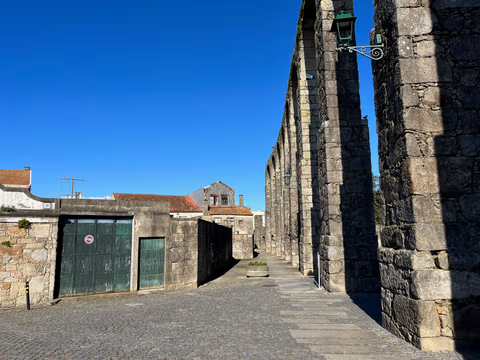
Aqueduct Trail – A path running along the Vila do Conde Aqueduct
From the Coastal Trail to the Camino Central: 12.9 km along the aqueduct from Vila do Conde to São Pedro de Rates. Route, stage, hostels, costs—explained honestly.
Read
Augsburg Way of St. James
The Augsburg Way of St. James runs 231.7 km in 11 stages from Oettingen in the Ries via Donauwörth, Augsburg, Bad Wörishofen and Ottobeuren to Ermengerst in the Allgäu — the Fuggerei, the Jakobervorstadt, a pilgrim of 1446 and Mozart's organ duel. Stages, hostels, costs.
Read

