

Camiño a Fisterra
The Camiño a Fisterra runs 90.8 kilometers from the cathedral of Santiago de Compostela to the lighthouse on Cape Fisterra, the finis terrae of the Romans. As far as the hamlet of Hospital at kilometer 60.1 it shares its line with the Camiño a Muxía; then it crosses 14 village-free kilometers down to the Atlantic at Cee and follows the coast via Corcubión to Fisterra. Five stages, 2,227 meters of ascent, a high point of 477 meters near Monte Aro, and at the end the kilometer marker 0.000 and the Fisterrana certificate.
- 01At a Glance
- 02Overview
- 03Other Names
- 04Who It's Ideal For—and Who It's Not So Ideal For
- 05Route & Landscape
- 06Stages, Terrain, and Difficulty
- 07Kilometer 0.000 – the end of the world lies a little further west
- 08Highlights Along the Way
- 09Hospitals, knights, and an Austrian who saw scallop shells
- 10How Pilgrims Find Their Way onto This Path
- 11Continue the pilgrimage?
- 12Preparation & Practical Information
- 13What the journey will cost you
- 14Getting Here
At a Glance
- Start / Finish: Cathedral of Santiago de Compostela / lighthouse on Cape Fisterra (km 90.8); the town of Fisterra is at km 87.3, and the last 3.5 km lead out onto the cape
- Length: 90.8 km; the first 60.1 km to Hospital on the same line as the Camiño a Muxía
- Duration: 5 stages, averaging about 18 km; traditionally also done in 4 days via Negreira, Olveiroa and Cee
- Elevation: ↗ 2,227 m / ↘ 2,367 m
- Highest point: 477 m at km 47.1 between A Gueima and Lago, near Monte Aro
- Landscape: Oak and eucalyptus woods along the Tambre, the open Xallas uplands with the Fervenza reservoir, heath and wind turbines after Hospital, then the Ría de Corcubión and the Atlantic
- Operator / Waymarking: Xunta de Galicia; yellow arrows and granite markers with scallop shell and remaining kilometers, counting down to 0.000 at the lighthouse
- Pilgrim passport / Certificate: Credencial with stamps; at the finish the Fisterrana from the municipality of Fisterra, free of charge (as of October 2026)
- Traces of St. James: Duio and Ponte Maceira from the legend of the apostle's translation, the 1534 figure of St. James as a pilgrim in Santa María das Areas, pilgrim hospitals in Hospital, Corcubión, Cee and Fisterra
- Accommodation: Xunta albergues in Negreira, Olveiroa and Fisterra (10 €), municipal and association hostels in Vilaserío and Corcubión, private albergues and guesthouses in Cee and along the way
- Connecting routes: Camiño a Muxía from Hospital, Camiño a Fisterra-Muxía (28.7 km along the coast to Muxía), and the Camino dos Faros also ends at the cape
- Best time: April to June and September to October; crowded in July and August, open in winter but wet and stormy
Overview
The Camiño a Fisterra is the walk after the walk. It starts where almost all the others end, on Praza do Obradoiro, and stops only when there is no more land. Ever since the municipality of Fisterra issued the first Fisterrana in August 1997, it has been the busier of the two Atlantic routes: in 2024, 27,304 pilgrims collected the certificate from the cape, while Muxía handed out 17,201 Muxianas. In August and September 2025, the Xunta's sensors counted around 300 pilgrims a day heading for Fisterra, more than twice as many as toward Muxía.
The idea isn't new. The Roman general Decimus Iunius Brutus only turned back around 137 BC once he had watched the sun sink into the sea from this shore, "non sine quodam sacrilegii metu et horrore" – not without a certain dread, as if committing a sacrilege, wrote the historian Florus. In the Middle Ages, pilgrims walked on from Santiago to the coast, to hospitals in Corcubión (1458), Fisterra (1469) and Cee (1497); then the route fell asleep until the Fisterrana in 1997 and the Xunta hostel in 2001 brought it back. The line you'll want to say out loud at the cape is already carved in stone: kilometer 0.000. Honestly, though, that's a convention, not geography – more on that below.
Other Names
In Galician the route is called Camiño a Fisterra, in Spanish Camino a Finisterre; the Xunta lists it as Camiño de Fisterra e Muxía, together with the Muxía branch. In German you'll read Jakobsweg nach Finisterre or Fisterra-Weg, in English Camino Finisterre. Older guidebooks speak of the Epílogo or the Prolongación xacobea, the Jacobean extension. Fisterra (Galician) and Finisterre (Spanish) both go back to the Latin finis terrae, the end of the earth. The certificate at the finish is called the Fisterrana.
Who It's Ideal For—and Who It's Not So Ideal For
Ideal if you still have four or five days after the Compostela and want to finish your Camino by the sea rather than in the Pilgrim's Office. Ideal, too, if after weeks in the stream of the Camino Francés you're looking for a route with a clear dramatic arc: three days of hinterland, then the moment past the Cruceiro da Armada when the ría suddenly lies below you, and at the very end a lighthouse beyond which there is nowhere to go.
Honestly, though, it's not for you if you expect solitude: in summer you walk here with hundreds of others, and at sunset tour buses park next to the backpacks at the cape. Not for you if asphalt wears you down, because long stretches run on minor roads and forestry tracks, and the 14.3 kilometers from Hospital to Cee have neither a bar nor a fountain in a village. And not for you if you're looking for a quiet holy place at the finish – you're more likely to find that in Muxía.
Route & Landscape
Santiago to Olveiroa (km 0–55.0): The route leaves the city through the Carballeira de San Lourenzo, climbs via Roxos (km 6.4) to Alto do Vento (km 8.9) and drops into the valley of the Tambre. At Ponte Maceira (km 17.1) it crosses the river on the medieval bridge, then continues past the Barca chapel to Negreira (km 21.0). Beyond that it turns rural: pines, oaks and pastures as far as Vilaserío (km 33.9), then via As Maroñas (km 40.9) and Santa Mariña (km 42.0) up onto the ridge near Monte Aro, at 477 meters at km 47.1 the highest point, with views of the Fervenza reservoir. The village of A Picota (km 51.1) lies 2.3 km off the route; via Ponte Olveira (km 53.4) you reach Olveiroa (km 55.0) with its restored stone houses.
Olveiroa to the cape (km 55.0–90.8): Via O Logoso (km 58.7) you come to Hospital (km 60.1), home of the granite marker with the two arrows. The Fisterra branch turns west across a bare plateau dotted with wind turbines, past the Santuario da Virxe das Neves and the chapel of San Pedro Mártir, until the Atlantic appears at the Cruceiro da Armada. Then steeply down to Cee (km 74.4, 6 meters above the sea), through the harbor town of Corcubión (km 76.9) and via A Amarela (km 78.7) to the beaches of Estorde (km 80.2) and Sardiñeiro (km 80.9). Through pine woods above the water you reach the Praia da Langosteira and Fisterra (km 87.3); the final kilometers follow the road along the slope of Monte Facho out to the lighthouse.
Stages, Terrain, and Difficulty
We show the route in 5 stages; kilometers come from the Camino Ninja map, calibrated exactly to 90.8 km. The third stage is deliberately short because it crosses the highest point and ends at the Xunta hostel in Olveiroa. The classic split manages in 4 days and goes from Negreira to Olveiroa in a single 34.0-kilometer push; those in a real hurry walk from Olveiroa to Fisterra in one day.
- Santiago de Compostela → Negreira (21.0 km) — out of the city, over Alto do Vento into the Tambre valley and via Ponte Maceira to Negreira.
- Negreira → Santa Mariña (21.0 km) — woods and hamlets, via Vilaserío and As Maroñas; Santa Mariña has only a few beds.
- Santa Mariña → Olveiroa (13.0 km) — over the heights near Monte Aro (477 m) with views of the reservoir, then down via Ponte Olveira.
- Olveiroa → Cee (19.4 km) — via Hospital, where the Muxía branch splits off, 14.3 km across the plateau without a single village, and the steep descent to the sea.
- Cee → Cape Fisterra (16.4 km) — Corcubión, the beaches of Estorde and Sardiñeiro, Fisterra and the last 3.5 km out to the lighthouse.
Nothing is technically difficult, but the route adds up. The plateau between As Maroñas and Olveiroa and the stretch from Hospital to Cee offer no shade and nowhere to stop; carry enough water there. The descent to Cee is slippery on wet granite, and beyond Corcubión there's one more stiff climb. The Logoso stream was a dangerous ford well into the 21st century; today a stone bridge crosses it.
Kilometer 0.000 – the end of the world lies a little further west
At the lighthouse stands the granite marker everyone photographs: shell, arrow and the figure 0.000 km. Next to it a bronze boot, a cross with St. James the pilgrim, and below them the rocks where pilgrims burned their clothes for decades. The marker is the end of the Xunta's count, which has accompanied you with remaining kilometers since Santiago – not a medieval monument but a modern signpost. And it measures only itself: Xacopedia gives 87 kilometers from Santiago to the cape, our map comes to 90.8, depending on where at the cathedral you start counting and which variant you take.
The end of the world is a convention, too. The Romans considered the cape the westernmost point of the known world, and many pilgrims still believe it today. In fact, Cabo Touriñán near Muxía already lies further west and is the westernmost point of mainland Spain; Portugal's Cabo da Roca reaches another 16.5 kilometers further out. So the line to read aloud goes like this: Europe doesn't end here, the Way does – and that's the better reason to stand here.
What makes the cape unique all the same is its layering. In the 12th-century Liber Sancti Jacobi, the apostle's disciples go to the king of Duio on the cape to ask for a tomb, and flee from his soldiers across the bridge near Negreira. The 13th-century Golden Legend knows of a sun altar on the cape, the Ara Solis – no one has ever found a trace of it, yet the sun still sets there every evening. On Monte Facho, 239 meters high, lie the ruins of the hermitage of San Guillerme, where the Hungarian knight György Grisaphan lived as a hermit for five months in 1355, and where couples prayed for children on a stone bed until the Church had it removed. Excavations have been under way there since 2009.
In practice, that means: come in the late afternoon, walk the 3.5 kilometers out from town, and stay until after sunset; in June that's around 10 p.m. No fire, not even a sock – burning is now prohibited. If you want to leave something behind, leave it behind in your mind.
Highlights Along the Way
- Ponte Maceira (km 17.1) — 13th- and 14th-century bridge over the Tambre with mills and the chapel of San Brais; according to legend, the bridge collapsed here beneath the soldiers of the king of Duio as they pursued St. James's disciples.
- Negreira (km 21.0) — in 876 King Alfonso III gave the town to the church of Compostela; Pazo do Cotón with its archway and the 18th-century chapel of San Mauro.
- Heights near Monte Aro (km 47.1) — 477 meters, the highest point, with views over the Fervenza reservoir in the Xallas valley.
- Olveiroa (km 55.0) — stone village with hórreos and a Xunta hostel in restored farmhouses; the church of Santiago still shows traces of Romanesque work.
- Hospital (km 60.1) — the fork; the name recalls a pilgrim hospice that a cleric named Esteban handed over to the cathedral chapter of Santiago in 1209.
- Corcubión (km 76.9) — harbor town with the church of San Marcos, begun in 1430; in 1458 Count Rodrigo de Moscoso and Juana de Castro founded a pilgrim hospital here.
- Santa María das Areas (Fisterra) — 12th-century Romanesque church with the Gothic Santo Cristo, which legend says washed ashore from a ship in a storm, and a figure of St. James as a pilgrim from 1534; the pilgrim hospital stood next door.
- Lighthouse on the cape (km 90.8) — in service since 1853 to plans by Félix Uhagón; the foghorn known as "A Vaca", the cow, was added in 1888; electric since 1931. Next to it the Semáforo, now a hotel.
Hospitals, knights, and an Austrian who saw scallop shells
In the Middle Ages, the walk to the cape wasn't a whim of a few; it had infrastructure. Hospital is documented in 1209, Corcubión in 1458; Fisterra was refounded in 1469 and expanded in 1479 by the cleric Alonso García Rodríguez, and Cee turns up in a will in 1497. A visitation report from 1589 still found a chapel and beds in Cee; after 1702 the hospital was closed. In the 15th century, according to Xacopedia, "comienza a intensificarse la llegada de peregrinos, que desde Santiago se dirigen a Fisterra y Muxía" – the arrival of pilgrims walking on from Santiago to Fisterra and Muxía grows.
The names come from all over Europe. Gabriel Tetzel, chronicler of the Bohemian nobleman Leo of Rožmitál on his journey of 1465 to 1467, noted that beyond the cape you saw nothing but sky and water, and that no one had ever come back. In 1580, Erich Lassota saw wine stains on the stones at the hermitage, said to have been spilled by a devil. And in 1654 the Austrian Christoph Guzinguer wrote soberly that the shore was full of scallop shells, "de los que suelen llevar colgados los peregrinos" – the kind pilgrims like to wear hanging around their necks. After the skirmish at the bridge of Ponte Olveira, Napoleonic troops laid waste to the village of Olveiroa and the hospital on the Logoso; for a long time afterward only a few came. The scholar Martín Sarmiento still climbed up to the hermitage in 1745, and at the end of the 18th century José Cornide described the steep climb beyond Ponte Olveira and the dangerous ford on the Logoso.
How Pilgrims Find Their Way onto This Path
Almost everyone arrives in Santiago on foot and tacks the Fisterra route on. Among the routes that end there:
- Camino Francés — the classic over the Pyrenees and across the Meseta
- Camino Portugués Central — from Porto through the interior
- Portuguese Coastal Way — from Porto along the coast
- Camino del Norte and Camino Primitivo — from the Cantabrian coast and from Oviedo
- Camino Inglés — from Ferrol or A Coruña, the short route of the seafarers
- Camino Sanabrés — the continuation of the Vía de la Plata
If you only want to walk this route, you also start at the cathedral and get your first stamp at the Pilgrim's Office or at the hostel. The reverse is possible too: first take the Camiño a Muxía to Muxía, and from there follow the coast to Fisterra.
Continue the pilgrimage?
On foot, yes, along the coast: from Fisterra the Camiño a Fisterra-Muxía leads 28.7 kilometers via Lires to Muxía and the Santuario da Virxe da Barca. With a stamp from Lires you'll get the Muxiana there; many walk Santiago–Fisterra–Muxía as one big loop and take the bus back from Muxía.
The Camino dos Faros also ends at the cape, a coastal hiking route from Malpica, not a Way of St. James. It's designed to be walked toward Fisterra; if you want to hike it, you're better off traveling to Malpica and walking it in its own direction. No other Way of St. James starts in Fisterra – this is where the land runs out.
Preparation & Practical Information
Pilgrim passport and app. As on all Spanish routes, you need a pilgrim passport (credencial) to stay in the hostels and to receive the Fisterrana at the end. It's best to order it online in advance so it reaches you in time for the start of your trip; if you're walking on from Santiago, simply keep using your old one. With the Camino Ninja App you have the map and track offline; the easiest way to plan the route is right in the app, where you put together your stages and plan suitable accommodation at the same time.
The Fisterrana. The certificate is issued by the municipality of Fisterra, according to Xacopedia at the public hostel in town, free of charge (as of October 2026). You have to show that you came from Santiago on foot, by bike or on horseback; collect at least two stamps a day along the way. The current design has been by the Catalan artist Enric Pascó since 1999; the first version of 1997 was based on a drawing by Correa Corredoira.
Hostels and season. The Xunta albergues in Negreira, Olveiroa and Fisterra open in the early afternoon, take no reservations and let walkers in before cyclists. The hostel in Corcubión has been run since 2004 by volunteers from AGACS, the Galician association of Friends of the Camino, on a donation basis. In Santa Mariña and Hospital options are scarce; in July and August you're better off booking private beds in Fisterra ahead of time. Spring and fall are ideal; in winter it rains on the Costa da Morte more days than not.
What the journey will cost you
The formalities are free: the Fisterrana costs nothing, the credencial a few euros. The Xunta hostels cost 10 € a night, the association hostel in Corcubión asks for a donation, private albergues run 15 to 20 € in a dorm, and double rooms in Fisterra guesthouses 50 to 80 € (as of October 2026). The bus from Fisterra back to Santiago costs roughly 8 to 15 €, depending on the connection.
Budget 30 to 40 € a day with hostel, bar breakfast and pilgrim menu, or 60 to 80 € with a guesthouse. Honestly, Fisterra in August costs you more than the rest of the route put together – in nerves, not money: beds are scarce, not expensive.
Getting Here
To the start. Santiago de Compostela has an airport with direct flights from Germany, Austria and Switzerland, a train station with Renfe connections to Madrid, A Coruña and Vigo, and a bus station next door. The route begins on Praza do Obradoiro in front of the cathedral.
From the finish. Monbus runs several times a day from Fisterra via Cee to Santiago, taking roughly two and a half to three hours depending on the service (as of October 2026); the stop is at the harbor, a good 3 kilometers from the lighthouse. If you walk on to Muxía, take Monbus back from there.
- Bus: monbus.es — Santiago – Cee – Fisterra line, timetable and tickets
- Route and hostels: caminodesantiago.gal — official Xunta site for the Camiño de Fisterra e Muxía
- Train to Santiago: renfe.com — timetable and tickets

Get your pilgrim credential and shell
Everything you need for the Camiño a Fisterra, shipped to your door.
Visit Camino Shop
Other Caminos
 Appenzeller Weg
Appenzeller Weg
52.6 km from Rankweil across the Rhine to St. Peterzell: St. James Chapel (1464), 163 Years of the Wedding Trail, connection to the Via Jacobi. Stages, costs, how to get there.
Read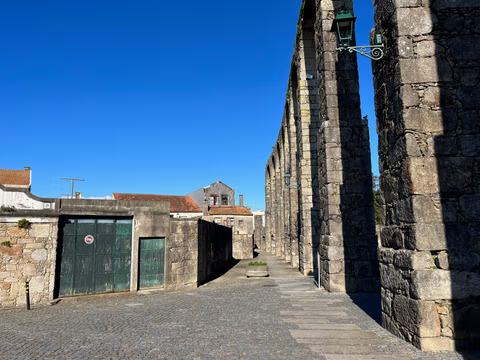
Aqueduct Trail – A path running along the Vila do Conde Aqueduct
From the Coastal Trail to the Camino Central: 12.9 km along the aqueduct from Vila do Conde to São Pedro de Rates. Route, stage, hostels, costs—explained honestly.
Read
Augsburg Way of St. James
The Augsburg Way of St. James runs 231.7 km in 11 stages from Oettingen in the Ries via Donauwörth, Augsburg, Bad Wörishofen and Ottobeuren to Ermengerst in the Allgäu — the Fuggerei, the Jakobervorstadt, a pilgrim of 1446 and Mozart's organ duel. Stages, hostels, costs.
Read

