

Camino Portugués de la Vía de la Plata
The Camino Portugués de la Vía de la Plata runs 212.5 kilometers from Zamora via Alcañices and Portuguese Bragança to Verín in Galicia – better known as the Camino Zamorano-Portugués.
- 01At a Glance
- 02Overview
- 03Other Names
- 04Ideal For – and Less So For
- 05Route & Landscape
- 06Stages, Terrain & Difficulty
- 07The Border That Was Invented Here
- 08Highlights Along the Way
- 09How Pilgrims Reach This Route
- 10Continuing the Pilgrimage?
- 11Preparation & Practicalities
- 12What the Route Costs
- 13Getting There
At a Glance
- Start / Finish: Zamora (Spain) → Verín (Galicia), via Bragança in Portugal
- Length: 212.5 km
- Stages: 8
- Duration: 8–9 days
- Difficulty: moderate to demanding – long stages, thin supply, hilly middle section
- Waymarking: yellow arrows, stone markers and boards of the Fundación Ramos de Castro; in Portugal fully re-signed since 2018
- Best time: spring and autumn; avoid July and August
Overview
On 12 September 1297 the negotiators of two kings sat down in Alcañices and drew a line: „Sepan quantos esta carta viren y leer oyren que como fuesse contienda sobre villas y castiellos …“ The border between Castile and Portugal that was created then is considered one of the oldest in Europe and still stands. On this route you sleep in the village where it was invented – and cross it on foot two days later, on a bridge over the Río Manzanas, beyond which the city of Bragança locates „a porta Xacobea mais antiga de Portugal“: the oldest Jacobean gateway to Portugal lies not by the sea but in the mountains of Trás-os-Montes.
212.5 kilometers, eight stages, two countries, almost no pilgrims. In 2024 a total of 328 people began their Camino in Zamora; the hostel in Vinhais, opened in 2023, counted „mais de meia centena de peregrinos“ in its first year. That is not a weakness, that is the offer: chestnut forests, empty plateaus, hostels on a donation basis and villages where someone still asks in the evening where you come from.
Other Names
In Spain the route is almost always called Camino Zamorano-Portugués, because it starts in Zamora and runs through Portugal; in Portuguese it is the Caminho Português da Via da Prata, the Portuguese branch of the Silver Route; Gronze also lists it as the Camino de Bragança. Its official name is Camino Portugués de la Vía de la Plata – that is how the Junta de Castilla y León lists it, and so do we. Do not confuse it with the Camino Portugués Central from Porto or the Portuguese Coastal Way – those lie 300 kilometers further west and share only the country's name with this route.
Ideal For – and Less So For
This route is for you if you can enjoy borders: the political one of 1297 and the linguistic one you cross in the middle of a stage without the route changing. You walk through two countries, three comarcas and a biosphere reserve, almost always alone – in half the hostels you will be the only one in the dormitory.
Honestly, though, it is not for you if you need predictable daily stages and a bed every fifteen kilometers. Two stages exceed 30 kilometers, one is 34.6 – not out of ambition but because there is nothing in between. Between Sejas de Aliste and Edral pilgrims regularly report loose mastiffs. The last Spanish stage from Feces de Abaixo is asphalt-heavy and more poorly marked than everything before it; a pilgrim wrote in October 2024: „Lastima que el camino acabe asi en Verin.“ And you should manage at least fragments of Spanish or Portuguese – English will not get you far in Vinhais.
Route & Landscape
The route begins in Zamora – for pilgrims on the Vía de la Plata at its kilometer 564, for everyone else in one of the densest Romanesque cities in Europe. Instead of heading north like the main route, it turns west while still in the city. After eleven kilometers stands La Hiniesta with a Gothic south portal you would not expect in a village of 300 souls. Then the Tierra del Pan opens up: grain, holm oaks, the waters of the Ricobayo reservoir. Via Almendra, Villaseco del Pan and Fonfría the route climbs imperceptibly but continuously until it reaches Alcañices, the main town of the Tierra de Aliste – a district many Spaniards know only by hearsay.
Beyond Trabazos you cross the Río Manzanas and are in Portugal. Here it gets serious: the route climbs along the edge of the Parque Natural de Montesinho with its old chestnut and oak forests to Bragança, whose citadel with 23 towers and 670 meters of wall rises above the town. Westwards it runs through the Terra Fria via Castro de Avelãs and Soeira to Vinhais and into the loneliest section of the route as far as Segirei. Only before the Galician border does the land open up again: beyond Feces de Abaixo you walk through Tamaguelos, Mourazos and Tamagos, whose churches are dedicated to St James, down to Verín, above which stands the triple-walled fortress of Monterrei.
Stages, Terrain & Difficulty
Eight stages, 26.6 kilometers on average – but the average lies. From Zamora to Alcañices the route climbs gently and steadily; the Confraternity of Saint James calls the section from the Portuguese border „extremely strenuous“ before it flattens out towards Galicia. Stage lengths follow the beds, not your fitness: between Almendra and Fonfría and between Segirei and Verín there is no reliable intermediate accommodation. Water for the whole day, shopping two days ahead, tracks offline – GPS is no luxury here. Kilometers from the Camino Ninja map, calibrated exactly to 212.5 km; the database holds no elevation data for this route.
- Zamora → Almendra (26.7 km) – From the Romanesque old town to La Hiniesta with its Gothic portal, then via Valdeperdices into the reservoir landscape of Ricobayo.
- Almendra → Fonfría (34.6 km) – The long, sparsely populated crossing of the Tierra de Alba via Villaseco del Pan; almost nothing on the way, at the end a twelve-bed hostel on donations.
- Fonfría → Alcañices (19.4 km) – A short day through Ceadea and Fornillos de Aliste to the main town of Aliste, where the border was negotiated in 1297.
- Alcañices → Quintanilha (19.8 km) – Via Sejas de Aliste and Trabazos to the international bridge over the Río Manzanas and across into Portugal.
- Quintanilha → Bragança (30.5 km) – Through Outeiro and Gimonde along the edge of the Parque Natural de Montesinho up into the citadel.
- Bragança → Vinhais (28.0 km) – Past the brick apse of Castro de Avelãs, via Gondesende and Soeira to the mountain town of Vinhais.
- Vinhais → Segirei (21.4 km) – The loneliest section: chestnut slopes, hamlets, hardly any supply, overnight in private lodgings.
- Segirei → Verín (32.1 km) – Via Vilarelho da Raia and Vila Verde da Raia to the border village of Feces de Abaixo, then through the St James villages of the Támega valley to Verín.
The Border That Was Invented Here
In 1297 Alcañices was a border town with walls and towers, laid out under Alfonso IX and Alfonso X. Here the representatives of the under-age Fernando IV of Castile – his mother María de Molina led the negotiations – met King Dinis of Portugal and exchanged castles and towns: Olivenza, Campo Maior, Moura and the places on the Côa went to Portugal, Aracena, Aroche and Ayamonte to Castile, and two marriages sealed the whole. The line that came out of it has held for seven centuries with minor corrections. Whoever sleeps today in the hostel of Alcañices – donativo, the hospitalero cooks – sleeps at the birthplace of a border.
That the border later stopped pilgrims rather than counting them is the break in this route's story. Under Franco and Salazar the crossings were closed, the old paths between Zamora and Trás-os-Montes disappeared – or were walked at night: the Diputación of Zamora lists, alongside the churches, a „Ruta del Contrabando“ as a sight of this Camino, because along the Raya under both dictatorships people carried coffee, sugar, chickpeas and medicines in 25-kilo loads on foot over the same paths. Today you walk them by day with a half-empty rucksack. The revival came late and with a figure: on 27 April 2018 Bragança, Vinhais and Chaves approved 365,958.04 euros for hostels in Bragança, Vinhais and Segirei and for signing the route from Quintanilha to Segirei; the Vinhais hostel opened in 2023. José Almeida of the Asociación Zamorana said in June 2025: „Tenemos que tratar de recuperar la influencia de nuestras rutas.“ A route being unlocked again – and you are one of the first to walk through.
Highlights Along the Way
- Santiago el Viejo, Zamora – according to the ballad tradition El Cid was knighted here at the altar of St James; first charter 1168, and the canons used to open the church every year on 25 July.
- Santiago del Burgo, Zamora – three-aisled Romanesque church that once came under the jurisdiction of Santiago de Compostela: Alfonso VII had handed it to Archbishop Diego Gelmírez.
- Santa María la Real, La Hiniesta (km 10.9) – a Gothic south portal of royal scale in a tiny village; legend has it Sancho IV had the church built after a 29-centimeter figure of Mary was found in the broom.
- San Pedro de la Nave (detour near Almendra) – Visigothic cross-shaped church built between 680 and 711, moved stone by stone in 1930–1932 because the Ricobayo reservoir would have flooded it; it stands in El Campillo, not directly on the route.
- Alcañices (km 80.7) – main town of Aliste, church of Nuestra Señora de la Asunción from the 12th century – and the place where the Spain–Portugal border came into being on 12 September 1297.
- Río Manzanas (km 100) – the international bridge: one step, two countries, an hour's time difference; the stamp is available at the Guardia Civil post just beyond the bridge.
- Cidadela and Domus Municipalis, Bragança (km 131.0) – 3.2 hectares behind 670 meters of wall with 23 towers, plus the 33-meter Torre de Menagem and a pentagonal Romanesque building from the 12th century whose purpose scholars still argue about.
- Mosteiro de Castro de Avelãs (km 134.6) – remains of a 12th-century Benedictine monastery with the only Romanesque-Mudéjar brick apse in Portugal.
- Parque Natural de Montesinho – chestnut and oak forests of the Terra Fria, wolves in the wild, villages of slate and granite.
- Castelo de Monterrei above Verín – triple ring of walls from the 12th century on a pre-Roman settlement, around two kilometers above the finish.
How Pilgrims Reach This Route
Most arrive on foot: whoever walks the Vía de la Plata north from Seville stands in Zamora after 564 kilometers with a choice to make. The main route continues to Granja de Moreruela and only splits there; this route turns west in Zamora itself and takes the detour through Portugal – according to the Confraternity of Saint James around 18 kilometers shorter than the connection via Puebla de Sanabria.
You can just as well start fresh in Zamora. The city lies on the Madrid–Galicia high-speed line, the municipal hostel issues the credencial on the spot, and the Vía de la Plata is thinly populated from here anyway: more than half its pilgrims only join at Ourense.
Continuing the Pilgrimage?
Verín is the end – but only of this route. The town is a junction where the routes from the Portuguese interior via Soutochao and Feces de Abaixo converge into Galicia. You continue on Sanabrés via Verín, which you join at its kilometer 40.7; the remaining roughly 68 kilometers lead via Laza towards Ourense, where the Camino Sanabrés takes over and brings you to Santiago.
Reckon on a good week from Verín to the cathedral. The hardest part is then behind you – from here on you meet other pilgrims again.
Preparation & Practicalities
Spring and autumn are the right time; the Confraternity puts it briefly: „Avoid July and August but otherwise the route is normally practicable throughout the year.“ In high summer the plateau between Almendra and Fonfría becomes a trial, in winter it can snow in Trás-os-Montes above 700 meters. Accommodation must be planned, not searched for: pilgrim hostels exist in Zamora, Fonfría, Alcañices, Quintanilha, Bragança, Vinhais and Verín, in between fire stations, private lodgings and in Edral a mattress dormitory at the local day-care center. For Vinhais you need your own sleeping bag, and you may stay only one night. In Segirei you phone ahead.
As on all Spanish routes you need a pilgrim passport (credencial) to sleep in the hostels and to receive the Compostela at the end. Best order it online in advance so it arrives in time for your start; the hostel in Zamora also issues it on the spot. The waymarking is better than its reputation – yellow arrows, stone markers, boards of the Fundación Ramos de Castro, in Portugal fully renewed since 2018. Still: download the stages offline, especially for the last stretch from Feces de Abaixo. The easiest way is directly in the Camino Ninja app, where you put together your stages and book suitable accommodation at the same time.
What the Route Costs
This route is cheap because hardly anyone walks it. Almost all hostels work on donations or cost a token amount: Zamora (32 beds, donativo, breakfast included), Fonfría (12 beds, donativo), Alcañices (donativo, the hospitalero cooks), Quintanilha (20 beds, 5 euros for pilgrims), Bragança (8 beds in the Cidadela, free, register at the tourist office), Vinhais (municipal, donativo) and at the finish Verín (38 beds, 10 euros, Xunta de Galicia) (as of September 2026).
With 25 to 35 euros a day you manage well if you sleep in hostels and cook for yourself – shopping happens where there are shops: Zamora, Alcañices, Bragança, Vinhais, Verín. Where you eat out it does not get expensive: bacalhau, lamb and the Godello wines of the Monterrei appellation are the opposite of pilgrim prices (as of September 2026).
Getting There
Zamora is the easy part: the city lies on the Madrid–Galicia high-speed axis, Alvia and AVE trains from Madrid-Chamartín stop here, and the bus station connects it to the coach network. From the station it is less than two kilometers on foot to the old town, where route and hostel begin.
Verín is the awkward part: no railway station. If you want to go home after the last stage instead of on to Santiago, take the bus – Verín lies on the A-52 with services to Ourense, Salamanca and Madrid. If you carry on walking, you need no ticket.
- Rail to Zamora: Renfe (Alvia/AVE Madrid–Galicia)
- Coach to Zamora: Alsa, Estación de Autobuses de Zamora
- Bus from Verín: services to Ourense, Salamanca and Madrid; Verín tourist office +34 988 411 614
- Back to Zamora from Galicia: Alsa Ourense–Zamora
Partners
Partner for Camino Portugués de la Vía de la Plata
Camino Ninja is cooperating with official partners. For this camino the partner is:


Get your pilgrim credential and shell
Everything you need for the Camino Portugués de la Vía de la Plata, shipped to your door.
Visit Camino Shop
Other Caminos
Ansbacher Jakobsweg
Ansbacher Jakobsweg
From Weihenzell via Ansbach, Feuchtwangen, Dinkelsbühl, Ellwangen and the Ostalb to Ulm and Oberdischingen: 9 stages, monasteries, imperial cities and the watershed between the Kocher and the Brenz.
ReadAppenzeller Weg
Appenzeller Weg
52.6 km from Rankweil across the Rhine to St. Peterzell: St. James Chapel (1464), 163 Years of the Wedding Trail, connection to the Via Jacobi. Stages, costs, how to get there.
Read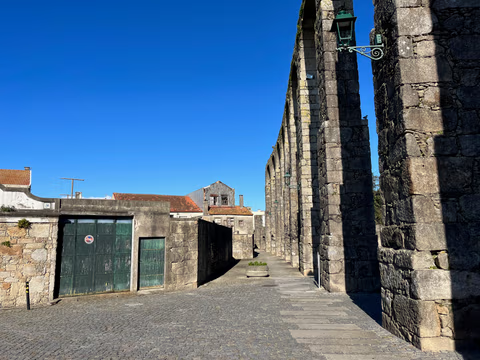
Aqueduct Trail – A path running along the Vila do Conde Aqueduct
From the Coastal Trail to the Camino Central: 12.9 km along the aqueduct from Vila do Conde to São Pedro de Rates. Route, stage, hostels, costs—explained honestly.
Read
