

Camino Vadiniense & Lebaniego
Over 221.3 kilometers, the Camino Vadiniense & Lebaniego links the Camino del Norte on the Cantabrian coast with the Camino Francés at Mansilla de las Mulas. The first part, the Camino Lebaniego, leads to the monastery of Santo Toribio de Liébana and its Lignum Crucis, the largest surviving piece of the Cross of Christ; from there the Vadiniense climbs to 1,785 meters at the foot of the Picos de Europa and runs down the Esla valley into the plains of León. Ten stages, 6,681 meters of ascent, a Holy Year all the monastery's own, and on the mountain section often days on end with hardly another pilgrim in sight.
- 01At a Glance
- 02Overview
- 03Other Names
- 04Who It's Ideal For—and Who It's Not So Ideal For
- 05Route & Landscape
- 06Stages, Terrain, and Difficulty
- 07The Door That Opens When April 16 Falls on a Sunday
- 08Highlights Along the Way
- 09St. James Was Praised Here Before Anyone Found His Tomb
- 10How Pilgrims Find Their Way onto This Path
- 11Continue the pilgrimage?
- 12Preparation & Practical Information
- 13What the journey will cost you
- 14Getting Here
At a Glance
- Start / Finish: San Vicente de la Barquera on the Cantabrian coast / Mansilla de las Mulas on the Camino Francés (province of León)
- Length: 221.3 km; of which about 67 km are the Camino Lebaniego to Santo Toribio, and the first 11.7 km to Muñorrodero follow the line of the Camino del Norte
- Duration: 10 stages, averaging a good 22 km; 11 to 12 days with a rest day in Potes or Riaño
- Elevation: ↗ 6,681 m / ↘ 5,921 m
- Highest point: 1,785 m at km 101.1, on the crossing between Fuente Dé and Portilla de la Reina (around the Horcada de Valcavao)
- Landscape: coastline, mountain pastures above the La Hermida gorge, the Liébana valley, high mountains on the edge of the Picos de Europa, the Riaño reservoir, the Esla valley
- Operator / Waymarking: Lebaniego: Fundación Camino Lebaniego (Gobierno de Cantabria), garnet-red arrows and stones bearing the cross of the Lignum Crucis; yellow arrows from Santo Toribio on, patchy in places in the León section
- Traces of St. James: around 784, Beato de Liébana invoked St. James as patron of Spain in the hymn "O Dei Verbum"; since 2015 the monastery has been part of the UNESCO World Heritage site of the Routes of Santiago in northern Spain; at the finish, the Camino Francés
- Accommodation: public and private albergues on the Lebaniego (Cades, Cicera, Cabañes, Potes, Santo Toribio); in the mountain section and in León, municipal albergues, guesthouses and rural houses
- Connecting routes: Camino del Norte (San Vicente to Muñorrodero), Camino de las Asturias (Las Salas), Camino Olvidado (Cistierna), Camino Francés (Mansilla de las Mulas)
- Best time / Certificate: late May to early October because of the high mountain crossing; at the monastery, the Lebannensis pilgrim certificate, credencial with stamps
Overview
This route is really two routes with a shared goal in the middle. The Camino Lebaniego is a pilgrimage in its own right: it leaves the coastal route at San Vicente de la Barquera and takes three days to reach the monastery of Santo Toribio de Liébana, where since the 8th century a reliquary of the Cross has been venerated that the Church holds to be the largest surviving fragment of the Cross of Christ. In the Middle Ages, the pilgrims who made their way there were called "crucenos," the pilgrims of the Cross. The Camino Vadiniense picks up the thread at the monastery and takes you over the mountains to Mansilla de las Mulas on the Camino Francés. The Fundación Camino Lebaniego quotes a line that sums up the old logic: "En la Edad Media era inconcebible peregrinar a Santiago sin pasar por Santo Toribio, sin atravesar Liébana" (in the Middle Ages it was unthinkable to make the pilgrimage to Santiago without passing through Liébana).
It's not quite that busy today. Gronze counted around 200 pilgrims on the Vadiniense in 2021, and the same site calls it the toughest Camino in its entire directory. Instead of the pilgrim-menu routine, you get mountains and villages where nobody expects backpacks anymore.
Other Names
In Spanish the whole route is called the Camino Vadiniense y Lebaniego, often just Camino Vadiniense or Ruta Vadiniense, which is how the Fundación Camino Lebaniego lists it. The name goes back to the Vadinienses, a pre-Roman mountain people whose main town was Vadinia and whose territory covered western Cantabria, eastern Asturias and northeastern León. The first part is the Camino Lebaniego, in English the Lebaniego Way, named after the Liébana region. Two certificates have names of their own: the Lebaniega, a confirmation of your visit to the monastery, and since 2026 the Lebannensis, the actual pilgrim certificate.
Who It's Ideal For—and Who It's Not So Ideal For
Ideal if you've walked the Camino del Norte before and want to give it a different ending this time, or if you only want to walk the Francés from León and are looking for mountains first. Ideal, too, if pilgrimage itself interests you and not just the distance: Santo Toribio is one of the few places in Christendom with a Holy Year of its own, and the next one begins in 2028. Short on time? Walk just the Lebaniego, three days to the monastery.
Honestly, though, it's not for you if you have no mountain experience: between Espinama and Portilla de la Reina you climb around 900 meters in a single day and end up at almost 1,800 meters, with no village, no bar and no cell signal everywhere along the way. Not for you if you want to walk in April or November—Gronze warns of snow and ice at the Horcada de Valcavao outside the window from late spring to early fall. And not for you if you rely on continuous waymarking: according to Gronze, the León section has stretches that are marked superbly and others that are barely or contradictorily marked.
Route & Landscape
Coast and Lebaniego (km 0–67.1): From San Vicente de la Barquera you first head west with the pilgrims of the Camino del Norte. At Muñorrodero (km 11.7) the Lebaniego branches off south into the Nansa valley and via Cabanzón to Cades (km 26.6). Then it gets hilly: via Sobrelapeña, Burió and Los Pumares (km 39.4, 586 m) you climb onto the pastures above the La Hermida gorge—the route avoids the road through the gorge and goes around it up top—and descend via Cicera (km 42.5) to Lebeña (km 49.7), at the southern mouth of the gorge. One last climb to Cabañes (km 54.5, 544 m), then the Liébana valley opens up, and via Tama and Ojedo you reach Potes (km 64.0). Three kilometers uphill lies the monastery of Santo Toribio (km 67.1, 497 m).
Vadiniense (km 67.1–221.3): From the monastery you don't go back to Potes but head via Turieno into the upper Deva valley: Camaleño (km 72.3), Mogrovejo (km 74.7), Cosgaya (km 79.9) and Espinama (km 90.9). Just past Pido the route leaves the valley; the valley station of the Fuente Dé cable car lies about 1.2 kilometers off the route. The crossing into León reaches the route's highest point at km 101.1, 1,785 meters, before you descend to Portilla de la Reina (km 115.0). From there you follow the Yuso valley via Boca de Huérgano to the reservoir at Riaño (km 134.8), then the Esla via Las Salas (km 151.9) and Crémenes to Cistierna (km 173.8). Then Gradefes (km 196.8), San Miguel de Escalada (km 207.1) and finally Mansilla de las Mulas (km 220.2), where the Camino Francés passes through.
Stages, Terrain, and Difficulty
We show the route in 10 stages; the distances come from the Camino Ninja map, calibrated exactly to 221.3 km. If you like, end the third stage in Potes instead of at the monastery and walk the three kilometers up the next morning.
- San Vicente de la Barquera → Cades (26.6 km) — with the Camino del Norte as far as Muñorrodero, then through the Nansa valley; lots of back roads, moderate climbs.
- Cades → Cicera (15.9 km) — short but steep: via Burió and Los Pumares onto the pastures above the La Hermida gorge.
- Cicera → Santo Toribio de Liébana (24.6 km) — down to Lebeña, back up to Cabañes, through the Liébana valley to Potes and up to the monastery.
- Santo Toribio de Liébana → Espinama (23.8 km) — up the upper Deva valley via Camaleño, Mogrovejo and Cosgaya, climbing steadily.
- Espinama → Portilla de la Reina (24.1 km) — the queen stage: the climb to 1,785 m and a long descent into León, no services along the way.
- Portilla de la Reina → Riaño (19.8 km) — through the Yuso valley to the reservoir.
- Riaño → Crémenes (22.5 km) — along the Esla through the mountains of León, via Horcadas and Las Salas.
- Crémenes → Cistierna (16.5 km) — a short day via Valdoré and Verdiago; in Cistierna the Camino Olvidado crosses.
- Cistierna → Gradefes (23.0 km) — out of the mountains, through the villages of the Ribera de Rueda to the Cistercian convent.
- Gradefes → Mansilla de las Mulas (24.5 km) — via San Miguel de Escalada into the plains and through the town gate of Mansilla.
The 6,681 meters of ascent are unevenly spread. The first five stages carry most of it, with the steep ramps between Cades and Cabañes and the big crossing into León. After that the route stays between 1,100 and 800 meters, and the last three days are easygoing. Nothing is technically difficult—according to Gronze there are no exposed sections; what makes it dangerous is fog, thunderstorms and snow on the crossing. Set off early on the fifth stage, carry water and food for the whole day, and turn back if the weather turns.
The Door That Opens When April 16 Falls on a Sunday
According to tradition, the Lignum Crucis at Santo Toribio is the left arm of the Cross of Christ, cut into the shape of a cross and set in a gilded silver reliquary. Legend links it to Toribio of Astorga, a 5th-century bishop said to have brought it back from Jerusalem; around the middle of the 8th century, his remains and the relic are said to have been carried into the Liébana to keep them from the Muslim armies. The monastery itself had been founded back in the 6th century by a different Toribio, the one from Palencia, and for a long time it was called San Martín de Turieno—the Benedictine community only took the name Santo Toribio in the 12th century. Honestly, the relic is only reliably documented from the early 14th century; everything before that is tradition. The present Gothic church was begun in 1256, the Baroque chapel of the Cross was added on the west side in the 18th century, and today Franciscans watch over monastery and relic.
What makes it special is the calendar. In 1512 Pope Julius II granted the monastery a jubilee—but only for one week, and only when the saint's feast day, April 16, fell on a Sunday. Xacopedia records that it wasn't until 1967 that Pope Paul VI "ampliase la duración del jubileo a un año," extending it to a full year. Since then, the Holy Year of the Liébana is decided not by a bishop but by the day of the week: it came around in 2000, 2006, 2017 and 2023—by the Fundación's count, 2023 was the 74th time—and that one was extended into 2024. The next begins in 2028, and the Fundación is already promoting an "Año Jubilar 2028–2029." In these years the Puerta del Perdón, the Door of Forgiveness, stands open; whoever walks through it, prays, goes to confession and receives communion within 15 days obtains a plenary indulgence. For a long time the monastery shared this status only with Rome, Jerusalem, Santiago and Caravaca de la Cruz.
In practical terms: plan half a day at Santo Toribio. The pilgrim Mass is held daily at noon, the monastery issues credencial stamps and the certificate, and the reliquary can be seen in the chapel. In jubilee years, the beds in Potes fill up early.
Highlights Along the Way
- San Vicente de la Barquera (km 0) — harbor town, a chartered villa under Alfonso VIII since 1210, with a castle, the Gothic church of Santa María de los Ángeles from the 13th and 14th centuries and the Puente de la Maza, which has 28 arches today; the Puebla Vieja has been a protected heritage site since 1987.
- Santa María de Lebeña (km 49.7) — 10th-century Mozarabic church with horseshoe arches, one of the oldest buildings in Cantabria.
- Potes (km 64.0) — the main town of the Liébana at the confluence of the Deva and Quiviesa, with the 15th-century defensive tower Torre del Infantado; pilgrim office in the Centro de Estudios Lebaniegos.
- Santo Toribio de Liébana (km 67.1) — church from 1256, the chapel of the Cross with the Lignum Crucis, the Puerta del Perdón.
- Fuente Dé (about 1.2 km off the route at km 94.7) — valley station of the cable car that since 1966 has carried visitors up to over 1,800 meters in a few minutes; a side trip for you, not part of the route.
- Crossing into León (km 101.1) — 1,785 meters, the highest point of the route, the border between Cantabria and Castilla y León.
- Riaño (km 134.8) — the town above the reservoir, ringed by limestone peaks; the old village lies under the water.
- Santa María la Real de Gradefes (km 196.8) — convent of Cistercian nuns, founded in 1168 and still inhabited today.
- San Miguel de Escalada (km 207.1) — Mozarabic monastery church, consecrated in 913, with horseshoe arches in its portico.
- Mansilla de las Mulas (km 220.2) — town with medieval walls and the Arco de la Concepción; a church of the Magdalena with a hospital is mentioned here as early as 1139.
St. James Was Praised Here Before Anyone Found His Tomb
In the 8th century the monk Beato de Liébana, who died in 798, lived in the monastery of the Liébana. In 776 he wrote his Commentary on the Apocalypse, revising it in 786; its illuminated copies are still known today as the Beatus manuscripts. In it he states that the Apostle James preached in Hispania—according to Xacopedia, only the second Spanish text ever to make that claim. Even clearer is the hymn "O Dei Verbum," written around 784 to 785 under the Asturian king Mauregatus and often attributed to Beato, though not without dispute. It is the first to invoke St. James as protector of Spain: "O vere digne sanctior apostole, caput refulgens aureum Ispaniae, tutorque nobis et patronus vernulus" (O truly worthy, most holy apostle, shining golden head of Hispania, our protector and patron born of our own land).
The punchline is in the dates. The Apostle's tomb was only discovered in Galicia around 820 to 830, some 40 years later. So before there was any Way of St. James to Santiago, people in this mountain valley were already singing the praises of the patron it would lead to.
How Pilgrims Find Their Way onto This Path
Most come along the coast. The Camino del Norte passes through San Vicente de la Barquera, and the two routes share the same line as far as Muñorrodero; that's where you choose between the coast and the Liébana.
Along the way, two more mountain routes cross:
- Camino de las Asturias — from Pamplona to Oviedo, 578.8 km; it meets the Vadiniense in Las Salas (km 151.9) and heads north from there over the Tarna pass into Asturias.
- Camino Olvidado — from Bilbao to Cacabelos, 493.6 km; it crosses in Cistierna (km 173.8) and runs west along the edge of the mountains until it meets the Francés in Cacabelos.
Continue the pilgrimage?
In Mansilla de las Mulas you're standing on the Camino Francés. León is just under 20 kilometers away, and according to Xacopedia Santiago is about 327 kilometers—two weeks if you keep going straight away, with León, Astorga and the Cruz de Ferro still ahead of you.
If you'd rather stay in the mountains, you can switch to the Camino Olvidado in Cistierna, which leads via La Robla and the Bierzo to Cacabelos, or in Las Salas take the Camino de las Asturias to Oviedo, from where the way continues on to Santiago.
Preparation & Practical Information
Pilgrim passport and app. As on all Spanish routes, you need a pilgrim passport (credencial) to stay in the albergues and to receive the Compostela at the end. It's best to order it online in advance so that it reaches you in time for the start of your trip. Since May 2026 the Diocese of Santander and the Fundación Camino Lebaniego have been issuing a joint official credencial for the Lebaniego—in Santander at the cathedral, in San Vicente at the church of Santa María de los Ángeles, at the pilgrim office in Potes and at the monastery. The Camino Ninja App has the map and track available offline, which matters on the crossing into León; the easiest way to plan the route is right in the app, where you put together your stages and plan suitable accommodation along with them.
The certificates at the monastery. The Lebannensis is the new pilgrim certificate, issued only at Santo Toribio, in Spanish or Latin, with the final stamp of the Franciscan friary and the monastery's embossed seal. The older Lebaniega is a confirmation of your visit for 1 € (as of October 2026).
Season and accommodation. From late May to early October the crossing between Espinama and Portilla is usually free of snow; the Lebaniego can be walked almost all year round. The Lebaniego has a dense network of albergues, including public ones in Cabañes and Potes and the albergue at the monastery. In the León section there are fewer, and in some places you'll have to fall back on a guesthouse or rural house—call the day before, especially in Portilla de la Reina and Crémenes. For the Lebaniego, the company Fidel offers luggage transfer from San Vicente to Santo Toribio.
What the journey will cost you
The formalities are cheap: the Lebaniega costs 1 €, the credencial a few euros. Albergues on the Lebaniego mostly cost between 10 and 18 € in a dorm, guesthouses and rural houses in the mountain section 40 to 60 € per room (as of October 2026).
Budget 35 to 50 € a day if you mostly sleep in albergues and live on bar breakfasts and pilgrim menus; with guesthouses, more like 50 to 70 €. Honestly, what you save on here isn't accommodation—it's crowds.
Getting Here
To the start. The easiest way to reach San Vicente de la Barquera is by ALSA bus from Santander or Oviedo; Santander has an airport and a rail connection, and Bilbao has direct flights from many European cities.
From the finish. From Mansilla de las Mulas, buses take about 20 minutes to León; from there, trains offer fast connections to Madrid.
- Bus: alsa.es — Santander, Oviedo, San Vicente de la Barquera, León
- Rail: renfe.com — connections from Santander and León
- Route and certificates: caminolebaniego.com — Fundación Camino Lebaniego with a list of albergues and credencial outlets

Get your pilgrim credential and shell
Everything you need for the Camino Vadiniense & Lebaniego, shipped to your door.
Visit Camino Shop
Other Caminos
 Appenzeller Weg
Appenzeller Weg
52.6 km from Rankweil across the Rhine to St. Peterzell: St. James Chapel (1464), 163 Years of the Wedding Trail, connection to the Via Jacobi. Stages, costs, how to get there.
Read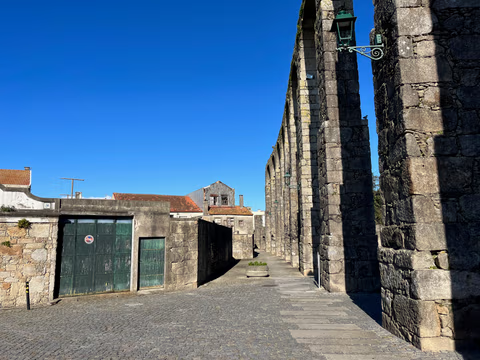
Aqueduct Trail – A path running along the Vila do Conde Aqueduct
From the Coastal Trail to the Camino Central: 12.9 km along the aqueduct from Vila do Conde to São Pedro de Rates. Route, stage, hostels, costs—explained honestly.
Read
Augsburg Way of St. James
The Augsburg Way of St. James runs 231.7 km in 11 stages from Oettingen in the Ries via Donauwörth, Augsburg, Bad Wörishofen and Ottobeuren to Ermengerst in the Allgäu — the Fuggerei, the Jakobervorstadt, a pilgrim of 1446 and Mozart's organ duel. Stages, hostels, costs.
Read

