

Cammino di San Benedetto
316 kilometres along a biography: from Norcia, where Benedict was born around 480, via Cascia and the ridge crossing of the Monti Reatini into the Franciscan landscape of the Valle Santa near Rieti, along the Turano reservoir into the Aniene valley to Subiaco, where he lived three years in a rock cave, and across the Monti Ernici, the Certosa di Trisulti and the Cistercian abbey of Casamari to his tomb at Montecassino. 16 stages, 8,082 metres of ascent, five great monasteries, Italy's first printing press — and expressly not a Way of St James. Norcia's basilica has stood again since October 2025.
- 01At a glance
- 02Overview
- 03Other names
- 04Ideal for — and not so much for
- 05Route & landscape
- 06Stages, terrain & difficulty
- 07Birthplace, cave, tomb — a trail in the right order
- 08Highlights along the way
- 09How pilgrims reach this trail
- 10Carrying on?
- 11Preparation & practicalities
- 12What this trail costs
- 13Getting there
At a glance
- Start / Finish: Norcia, Basilica di San Benedetto (Umbria) / Montecassino abbey and Cassino (Lazio)
- Length: 316.4 km
- Duration: 16 days
- Elevation: ↗ 8,082 m / ↘ 8,222 m
- Highest point: 1,524 m on the ridge of the Monti Reatini; lowest point 113 m
- Stages: 16 (the trail body's official division, kilometres calibrated to our route data); 7 stages by mountain bike
- Regions: Umbria (Valnerina) and Lazio (Sabina, Valle Santa, Turano, Aniene valley, Ciociaria)
- Responsible body: Associazione Amici del Cammino di San Benedetto; traced by Simone Frignani, opened 2012
- Waymarking: yellow "b" with a crossbar, signs with distances
- Not a Way of St James: a St Benedict trail — the trail body's Credenziale, Testimonium at Montecassino, no Compostela
- Crossings: Cammino di Francesco at Poggio Bustone and Rieti, Cammino di San Tommaso at Subiaco
- Connection at the end: Via Francigena del Sud via the inland branch from San Vittore del Lazio
- Best time: April to June and September to October; ridges snow-covered in winter
Overview
Most pilgrim trails link places. This one links the chapters of a life, and in the right order: Norcia, where Benedict was born around 480, Subiaco, where he lived three years in a rock cave, Montecassino, where around 529 he founded the abbey, wrote the Rule and lies buried. In between you walk through the Valnerina to Cascia and Santa Rita, over the ridge of the Monti Reatini at 1,524 metres, through the Franciscan landscape of the Valle Santa — Poggio Bustone, La Foresta, Rieti —, past the Turano reservoir with its ghost village and down into the Aniene valley. Beyond Subiaco, Lazio grows warmer: Trevi nel Lazio in the Simbruini, the Certosa di Trisulti in the forest, the Cistercian abbey of Casamari, the waterfall in the middle of Isola del Liri, Cicero's Arpino, the castle of Thomas Aquinas at Roccasecca — and at the end the long climb up the mountain where Montecassino was destroyed four times and rebuilt four times.
The trail is young: Simone Frignani traced it, his guidebook appeared in 2012, and since then the trail has grown year by year. The places are old. Frankly, this is not a Way of St James — no scallop, no Compostela, not a single St James dedication along the way, the marker is a yellow "b" — and it is not a hostel trail: you book ahead, mostly by phone, mostly in monasteries, parishes and B&Bs. Almost every day begins with a climb and ends with a descent, 8,082 metres up in 16 days. In return you walk from monastery to monastery — Santa Scolastica, Sacro Speco, Trisulti, Casamari, Montecassino all lie directly on the trail — and in Norcia you set off from a basilica that did not exist for eight years: collapsed on 30 October 2016, reconsecrated on 31 October 2025. Between birthplace and tomb you walk through a single book — the Life that Gregory the Great wrote around 593.
Other names
In Italian it is simply the Cammino di San Benedetto, in English The Way of St Benedict — that is how Terre di mezzo titles the English guide. In German you meet it as Benediktsweg, though no standard German name has caught on; you mostly find it under the Italian original. And the most important thing first: this is not a Way of St James. No scallop, no yellow arrows, no Compostela. The marker is a yellow "b" with a crossbar that looks like a little cross, and the document you receive at the end is called the Testimonium and is issued at Montecassino. St James dedications or pilgrim signs along the way: none. The only "San Giacomo" on the route is the Franciscan sanctuary above Poggio Bustone — a namesake, not a waymark.
On the figures you need to know: the trail body and the book title say 300 kilometres, other sources 305 to 310, our route measures 316.4 kilometres — partly because it does not end at the abbey but takes in the last kilometres down to Cassino station. The 16 official stages below are calibrated proportionally to that. The same Credenziale, incidentally, is valid for three interlinked trails: the Benedict trail, "Di qui passò Francesco" and "Con le ali ai piedi" — if you combine them, you need no second document.
Ideal for — and not so much for
This trail is ideal if you want a trail that tells a biography rather than a route: birthplace, cave, tomb — in exactly the order Benedict himself took. Ideal if you like mountains but not high-alpine tours: the trail stays almost throughout between 400 and 1,000 metres, with one outlier at 1,524. Ideal if you are looking for Italian villages that have never seen a coach — Pozzaglia Sabina, Orvinio, Vico nel Lazio, Collepardo. And ideal if you like walking from monastery to monastery: Santa Scolastica, Sacro Speco, Trisulti, Casamari and Montecassino all lie directly on the trail, plus the Carthusians' pharmacy and Italy's first printing press.
Frankly, though, it is not for you if you need flat stages: 8,082 metres of ascent and 8,222 of descent over 16 days means almost every day begins with a climb and ends with a descent. Not for you if you count on a hostel network — there is none here, you book ahead, and many lodgings are parishes and monasteries without a booking portal, so by phone and in Italian. Anyone wanting to walk in winter finds snow on the ridge between Leonessa and Poggio Bustone. Anyone who needs a Compostela or a link to the St James network: wrong trail. And anyone expecting Norcia to look as it did before 2016: the basilica stands, the town is still a building site.
Route & landscape
You start in Norcia, 604 metres up at the edge of the Piana Santa Scolastica, and walk south over the heights of the Valnerina to Cascia, where Santa Rita lies. Via Roccaporena, her native village with the prayer rock, and Monteleone di Spoleto, whose Etruscan chariot stands in New York, you leave Umbria and enter Lazio. Beyond Leonessa comes the test: the crossing of the Monti Reatini up to 1,524 metres, beech forest, open ridge, often windy on top. The descent ends in Poggio Bustone — and from here you walk for two days on paths that also belong to the Franciscan ring of the Valle Santa: Cantalice, the Santuario della Foresta, then Rieti. From Rieti the trail turns into the Turano valley, which narrows steadily from Rocca Sinibalda until the Lago del Turano appears, a reservoir of 1938 with the ghost village of Antuni and the balcony village of Castel di Tora above the water.
Across high ground and the Parco dei Monti Lucretili you drop into the Aniene valley, through Vicovaro — and on the tenth evening you stand in Subiaco, the place where Western monasticism began. The rest is Lazio south of Rome, and it grows ever warmer: across the Monti Simbruini to Trevi nel Lazio, on through the Monti Ernici past the Certosa di Trisulti to Collepardo with its giant sinkhole and down to the Cistercian abbey of Casamari. Then the Liri valley opens: Isola del Liri with its 27-metre waterfall in the middle of the old town, Arpino on its hill with cyclopean walls, the gorges of the Melfa near Roccasecca — and right at the end the long climb up the mountain where the abbey of Montecassino stands, 500 metres above the town of Cassino, where the route runs out.
Stages, terrain & difficulty
The trail body divides the trail into 16 stages on foot, alternatively 7 by mountain bike, and we adopt the order and stage towns. The kilometres are calibrated proportionally to the 316.4 kilometres of our route data — the book title says 300, and our route runs the last kilometres beyond the abbey down to Cassino; the total is exact, the individual values accurate to a few hundred metres. Anyone wanting to split the longest stage finds beds in Vicovaro or Agosta.
- Norcia – Popoli – Fogliano – Cascia (18.2 km) — Valnerina heights, Santa Rita at the finish.
- Cascia – Roccaporena – Monteleone di Spoleto (18.8 km) — Rita's native village, prayer rock, farewell to Umbria.
- Monteleone di Spoleto – Ruscio – Leonessa (13.8 km) — shortest stage, crossing into Lazio.
- Leonessa – Poggio Bustone (14.8 km) — ridge crossing of the Monti Reatini up to 1,524 m; only in stable weather.
- Poggio Bustone – Cantalice – Santuario della Foresta – Rieti (18.3 km) — Franciscan sanctuaries of the Valle Santa.
- Rieti – Belmonte in Sabina – Rocca Sinibalda (21.3 km) — Sabina hills, Renaissance castle.
- Rocca Sinibalda – Posticciola – Castel di Tora (15.8 km) — narrow Turano valley, reservoir, ghost village of Antuni.
- Castel di Tora – Pozzaglia Sabina – Orvinio (14.2 km) — springs along the way, high ground.
- Orvinio – Licenza – Mandela (21.2 km) — Monti Lucretili, descent into the Aniene valley.
- Mandela – Vicovaro – Agosta – Subiaco (30.7 km) — longest stage; San Cosimato, Benedict's monasteries; can be split.
- Subiaco – Colle Pasquiano – Trevi nel Lazio (18.0 km) — Monti Simbruini, springs of the Aniene.
- Trevi nel Lazio – Guarcino – Vico nel Lazio – Collepardo (23.2 km) — Monti Ernici, Pozzo d'Antullo.
- Collepardo – Certosa di Trisulti – Casamari (26.3 km) — charterhouse in the forest, Cistercian abbey.
- Casamari – Isola del Liri – Arpino (23.1 km) — waterfall in the town centre, Cicero's town.
- Arpino – Roccasecca (18.6 km) — Melfa gorges, castle of the Counts of Aquino.
- Roccasecca – Piedimonte San Germano – Montecassino – Cassino (20.1 km) — climb to the abbey, Benedict's tomb, descent to the station.
Difficulty: moderate — not because of individual key passages but because of the sustained effort: 8,082 metres up and 8,222 down spread over almost every day, "almost every day has a fast descent and a steep climb", as the trail body itself says. Two stages need deliberate planning: stage 4 over the ridge of the Monti Reatini should only be walked in stable weather, snow lies there in winter; stage 10 to Subiaco is the longest at 30.7 kilometres. Surface: forest paths, cart tracks, gravel roads, stream fords, plus village streets and quiet minor roads — the trail runs practically throughout in the Apennines. The waymarking, the yellow "b" with a crossbar, is not everywhere continuous in the forest sections and on the ridge crossings: take the trail body's GPX tracks. On the long stages 10, 13 and 14 there are stretches with no refreshment; springs lie along the way, but don't rely on them.
Birthplace, cave, tomb — a trail in the right order
Everything we know about Benedict is in a single book: the Dialogi, which Pope Gregory the Great wrote in 593/594 and which begin with the sentence "Fuit vir vitae venerabilis, gratia Benedictus et nomine" — there was a man of venerable life, blessed by grace and by name. This trail walks through that book. In Norcia you start at the basilica over the presumed birthplace; Benedict came into the world here around 480, and tradition gives him a twin sister, Scholastica. On the tenth evening you stand in Subiaco before the rock cave on Monte Taleo where he lived three years while the monk Romanus let bread down to him on a rope; he then founded twelve monasteries in the valley, and exactly one survives, Santa Scolastica, which in 1464/65 housed Italy's first printing press. Along the way, in Vicovaro, local tradition tells of the monks who mixed poison into his wine — the cup shattered when he blessed it; Gregory relates the episode but names no place. And on the sixteenth day Benedict and Scholastica lie together beneath the high altar of Montecassino, the abbey he founded around 529 on a temple of Apollo, where he wrote the Rule and traditionally died in 547. Frankly, the trail itself dates from 2012, not 1212 — not a single historical pilgrim is documented for this alignment. The depth lies in the places, not in a pilgrim tradition.
That you can set off from a basilica in Norcia at all is not to be taken for granted. On 30 October 2016 the Basilica di San Benedetto collapsed in the strongest shock of the earthquake sequence; eighty per cent of the building lay as rubble on the square, the campanile was gone, only parts of the façade stood. What followed is called anastylosis: every recovered block was numbered and reinserted, work began on 16 December 2021, cost around 15 million euros, and on 31 October 2025, nine years after the collapse, Archbishop Renato Boccardo reconsecrated the church. The monks, back in Norcia since 2000, moved two kilometres uphill to San Benedetto in Monte after the quake, where they live in earthquake-proof timber buildings and brew Birra Nursia. At the other end of the trail, "Succisa virescit" has stood above the gate for centuries — cut down, it grows green again. Montecassino has had to honour the motto four times, most recently after 15 February 1944, when 230 bombers dropped 453 tonnes on an abbey in which some 1,500 civilians had sought shelter and not a single German soldier was present; around 400 people died. On 24 October 1964 Paul VI consecrated the rebuilt abbey and in the same act declared Benedict patron of Europe. The birthplace and the tomb of this trail have both collapsed and both been rebuilt — that is no coincidence, it is the programme of the man you are following.
Highlights along the way
- Basilica di San Benedetto, Norcia — over Benedict's presumed birthplace; almost completely collapsed on 30 October 2016, rebuilt stone by stone by anastylosis, reconsecrated on 31 October 2025; the Chiesa della Madonna Addolorata is still a building site.
- Basilica of Santa Rita, Cascia — foundation stone 1937, consecrated on 18 May 1947, minor basilica since 1955; the body of the patroness of impossible causes, canonised in 1900, lies in a glass sarcophagus; her native village Roccaporena with the Scoglio della Preghiera lies on stage 2.
- Monteleone di Spoleto — here the farmers Isidoro and Giuseppe Vannozzi found an Etruscan ceremonial chariot from the 6th century BC in 1902; it has stood in the Metropolitan Museum in New York since 1903, and the village keeps a copy and a rather old grievance.
- Leonessa — founded in 1278 as Gonessa, fief of Margaret of Austria, who endowed the Fontana Farnesiana in 1548; home of the Capuchin San Giuseppe da Leonessa and of Lazio's most famous potato.
- Poggio Bustone — in 1208 Francis greeted the people here with "Buon giorno, buona gente"; the Porta del Buongiorno still stands, and on 4 October a drummer carries the greeting from door to door; above the village the Santuario San Giacomo with the hermit's cave.
- Santuario della Foresta near Rieti — one of the four Franciscan sanctuaries of the Valle Santa, directly on the trail.
- Lago del Turano — reservoir of 1938, 38 kilometres of shore at 536 metres; in the water the ghost village of Antuni with the Palazzo del Drago, above it Castel di Tora on its rock spur with the polygonal tower of the 11th century.
- San Cosimato near Vicovaro — the place where, according to tradition, the monks tried to poison Benedict and the cup shattered as he blessed it.
- Monastero di Santa Scolastica, Subiaco — the only surviving one of Benedict's twelve monasteries; three cloisters, campanile 1052–1053, church of 1769 by Giacomo Quarenghi, some 100,000 volumes; in 1464/65 the Gutenberg pupils Konrad Sweynheym and Arnold Pannartz set up Italy's first printing press here.
- Sacro Speco, Subiaco — built into the rock of Monte Taleo, carried by nine arches, around Benedict's cave; frescoes from the 8th to the 15th century, among them the oldest known portrait of St Francis, painted around 1223/24 in his lifetime, without stigmata and without a halo.
- Certosa di Trisulti, Collepardo — built in 1204 at the behest of Innocent III at 825 metres in the Selva d'Ecio, Carthusians until 1947, Cistercians from Casamari since then; the 18th-century Antica Farmacia with its trompe-l'œil paintings is the most beautiful room of the whole trail; 36,000 volumes, national monument since 1879.
- Pozzo d'Antullo, Collepardo — collapse sinkhole over 140 metres across and 60 metres deep; legend has it the Madonna made the threshing floor collapse because people threshed here on the Feast of the Assumption.
- Casamari Abbey — on the estate where Gaius Marius was born, church begun in 1203 and consecrated in 1217, one of the very few examples of Cistercian Gothic in Italy; Joachim of Fiore wrote here in 1182–1184; plundered by French troops in May 1799, six monks killed.
- Isola del Liri — the Cascata Grande, 27 metres high, in the middle of the historic centre beside the Castello Boncompagni-Viscogliosi; unique in Italy.
- Arpino — birthplace of Cicero (106 BC) and of Gaius Marius, with cyclopean walls and the pre-Roman pointed-arch gate Arco a sesto acuto; on the trail the abbey of San Domenico, founded in 1011 on Cicero's family estate.
- Roccasecca — Castello dei Conti d'Aquino, built in 994 on the orders of Abbot Mansone of Montecassino; according to tradition Thomas Aquinas was born here in 1225.
- Montecassino Abbey — founded by Benedict around 529 on a temple of Apollo, destroyed in 577, 883, 1349 and on 15 February 1944, reconsecrated by Paul VI on 24 October 1964; beneath the high altar the tombs of Benedict and Scholastica; motto "Succisa virescit".
How pilgrims reach this trail
Most travel directly to Norcia and walk the trail from the beginning — which is also the order that makes sense, because it follows Benedict's life: birth, cave, tomb. Norcia has no railway station; you take the train to Spoleto and from there the bus for an hour. A second, growing share comes from the Valle Santa near Rieti: the Cammino di Francesco — in its ring variant through the four Franciscan sanctuaries of Greccio, La Foresta, Poggio Bustone and Fonte Colombo, in its long variant from Florence via Assisi to Rome — literally shares the ground with the Benedict trail on stages 4 to 6: Poggio Bustone, the Santuario della Foresta and Rieti lie on both trails. Anyone who has walked the Franciscan way simply switches at Rieti or Poggio Bustone and carries on towards Subiaco, without a bus, just with a different waymark in mind.
And a third trail crosses at Subiaco: the Cammino di San Tommaso, which runs from Rome along the ancient Via Tiburtina Valeria to Ortona on the Adriatic, where the relics of the apostle Thomas have lain since 1258. Anyone wanting to arrive from Rome on foot walks its first four stages to Subiaco and there changes to the Benedict trail — north to Norcia or south to Montecassino. Subiaco is thus the hub where Benedict, Thomas and, fifteen minutes' walk away in the Sacro Speco, Francis too come together.
Carrying on?
The Benedict trail does not end in Santiago but at a tomb — Benedict's, beneath the high altar of Montecassino. For many that is a full stop. Anyone who wants to carry on anyway has one realistic option with an important caveat: the Via Francigena del Sud runs through Lazio along the coast — Terracina, Fondi, Gaeta, Formia — and does not touch Cassino. The fitting connection is its inland branch, which starts at San Vittore del Lazio, some ten kilometres west of Cassino, and leads via San Pietro Infine to Venafro and on through Molise. You organise the ten connecting kilometres yourself — then you are on your way south to Santa Maria di Leuca.
The second option thinks backwards: at Subiaco, six stages before the finish, the Cammino di San Tommaso crosses towards Ortona on the Adriatic — anyone wanting to combine both trails walks to Subiaco, turns east and comes out at the sea. And a third connection lies behind you rather than ahead: the Cammino di Francesco in the Valle Santa can be added as a prelude or postscript.
Preparation & practicalities
The season runs from April to October, best in spring and autumn: the trail is theoretically walkable all year, but snow lies on the ridges between Leonessa and Poggio Bustone in winter, and in high summer the south from Casamari on gets hot; even in summer the evenings in the mountain villages are cool. There is no hostel network. You sleep in monasteries, parishes, ostelli, B&Bs and agriturismi — and you book ahead, mostly by phone. The church-run lodgings often work on a donation basis; a sleeping-bag liner and your own toiletries are a must. The easiest way to plan your stages and lodgings is directly in the Camino Ninja app.
You need the Credenziale of the Cammino di San Benedetto for the church lodgings and for the Testimonium at Montecassino; you order it via the trail body's website or collect it in Norcia at the Ostello Capisterium. It is valid for three interlinked trails — the Benedict trail, "Di qui passò Francesco" and "Con le ali ai piedi". The waymarking, the yellow "b" with a crossbar and signs with distances, is not everywhere continuous; the official GPX tracks are free on the trail body's website, separate for walkers and cyclists. Plan around opening hours: Sacro Speco and Santa Scolastica in Subiaco, the Certosa di Trisulti and Montecassino have fixed visiting hours with a midday break — arrive at 5 pm and you see nothing inside. Language: Italian; in Rieti, Subiaco and Cassino you get by with English, in the mountain villages hardly at all — three sentences of Italian pay off for the accommodation calls. Equipment: mountain boots with grip, rain and wind protection for the ridge, water for the long stages 10, 13 and 14, tick protection for the beech forests.
What this trail costs
Frankly, the Benedict trail is considerably cheaper than the well-known Spanish routes, because you sleep almost only in small places — the following figures are guide values, not individually checked rates (as of September 2026). A night in a monastery or parish for a donation costs around €15–20, a bed in an ostello €20–35, a B&B or agriturismo in a double room per person €30–45. Lunch at a bar or a panino is €6–12, a trattoria set menu in the evening €18–30, self-catering from the alimentari €10–15 a day.
Realistic daily budget: frugal with church lodging and self-catering €30–40, mid-range with ostello or B&B and one hot meal €55–75, comfortable €85–120. For 16 stages that makes roughly €480–640 frugal and €880–1,200 mid-range, excluding travel and equipment. Documented fixed costs: Credenziale €5–10, admission Pozzo d'Antullo €2, bus Spoleto–Norcia €6–9, train Cassino–Rome €8–15 (as of September 2026). Monasteries and churches cost nothing.
Getting there
To the start (Norcia): Norcia has no railway station — the line has been closed since 1968. The standard way is train plus bus: by train to Spoleto (from Rome Termini around 1:20 h, from Florence around 2:30 h), there onto bus line E401 Spoleto–Norcia, about an hour's ride, around five services a day. There are also buses from Rome Tiburtina, Terni and Perugia. The nearest airport is Perugia; for international arrivals Rome Fiumicino is more practical.
Along the way: Rieti has rail and bus links to Rome and Terni, Subiaco buses to Rome Tiburtina, Mandela lies on the Rome–Pescara railway — good entry and exit points for sections. The mountain villages of the Sabina and the Ciociaria are reachable only by bus.
From the finish (Cassino): Cassino lies on the Rome–Cassino–Naples railway; to Rome Termini you need 1:20 to 2:00 hours depending on the train, to Naples around 1:30. The abbey lies some 8 kilometres and 500 metres above the town — the last stage takes you up and back down to the station. Start and finish are 200 road kilometres apart; for the return to Norcia allow a detour via Rome and a whole day.
- Rail Italy: trenitalia.com — Spoleto, Rieti, Mandela, Cassino
- Trail body, Credenziale, GPX, accommodation, updates: camminodibenedetto.it — Associazione Amici del Cammino di San Benedetto
- Montecassino Abbey: abbaziamontecassino.org — opening hours, Testimonium, history
- Note: Norcia reachable only by bus; ridge stage 4 snow-covered in winter

Get your pilgrim credential and shell
Everything you need for the Cammino di San Benedetto, shipped to your door.
Visit Camino Shop
Other Caminos
 Appenzeller Weg
Appenzeller Weg
52.6 km from Rankweil across the Rhine to St. Peterzell: St. James Chapel (1464), 163 Years of the Wedding Trail, connection to the Via Jacobi. Stages, costs, how to get there.
Read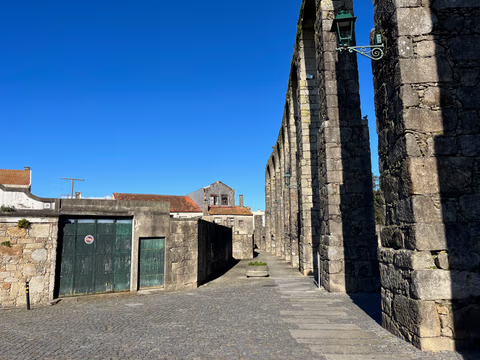
Aqueduct Trail – A path running along the Vila do Conde Aqueduct
From the Coastal Trail to the Camino Central: 12.9 km along the aqueduct from Vila do Conde to São Pedro de Rates. Route, stage, hostels, costs—explained honestly.
Read
Augsburg Way of St. James
The Augsburg Way of St. James runs 231.7 km in 11 stages from Oettingen in the Ries via Donauwörth, Augsburg, Bad Wörishofen and Ottobeuren to Ermengerst in the Allgäu — the Fuggerei, the Jakobervorstadt, a pilgrim of 1446 and Mozart's organ duel. Stages, hostels, costs.
Read

