

Cammino Toscana
174.8 kilometres, 8 stages, highest point 327 metres: the Cammino Toscana — the operator's Cammino di San Jacopo in Toscana — leads from the Piazza della Signoria in Firenze parallel to the Roman Via Cassia to Prato, over the Monteferrato to Pistoia, where a bone fragment of the apostle has rested since 1144 and the city is called „Santiago minore", through the castle villages of the Valdinievole to Collodi, over the hills of Petrognano into the Piana di Lucca, beneath the 460 arches of the Acquedotto Nottolini to Pisa and through the coastal pines to Livorno, to the church of San Jacopo in Acquaviva above the cove from which pilgrims set sail for Spain for centuries. Operator: Comunità Toscana „Il Pellegrino" with Pistoia and 17 municipalities. Frankly: the line dates from 2020, the signage ends at Lucca, the first stage is asphalt — and the Livorno–Barcelona ferry no longer runs.
At a Glance
- Start / Finish: Firenze (Piazza della Signoria) / Livorno (port, Chiesa di San Jacopo in Acquaviva)
- Length: 174.8 km
- Duration: 8 stages (Camino Ninja division), 7–9 days
- Elevation: ↗ 2,020 m / ↘ 2,081 m — almost all of it in two pieces: Monteferrato and the hills behind Collodi
- Highest point: 327 m at Petrognano (km 90.7); lowest point −2 m in the Pisan plain (km 143.5)
- Stages: 8 — Camino Ninja system on our waypoints; the operator cuts six stages with seven cathedrals: Firenze–Prato–Pistoia–Pescia–Lucca–Pisa–Livorno
- Landscape: Florentine plain, Bisenzio and Monteferrato, Valdinievole with spas and castle villages, hills above the Piana di Lucca, aqueduct plain, Serchio gorge at Ripafratta, Arno estuary, coastal pines to Livorno
- Operator: Comunità Toscana „Il Pellegrino" (Firenze), Comune di Pistoia as capofila, cooperation agreement of 17 municipalities, funded by the Regione Toscana; route design Nedo Ferrari. The name „Cammino Toscana" is Camino Ninja system, the operator's name stands in the subtitle
- Waymarking: „una conchiglia stilizzata a nove scanalature, di colore giallo su fondo blu" — a nine-ribbed shell, yellow on blue, plus yellow arrows towards Santiago and orange ones towards Rome; around 800 signs Firenze–Lucca (December 2024), GPX after that
- Traces of St James: relic and Cappella di San Jacopo in the Cattedrale di San Zeno, Pistoia (1144/1145); Altare argenteo di San Jacopo (1287–1456); milestone Pistoia–Santiago 2,505 km; San Jacopo in Acquaviva, Livorno (1163)
- Accommodation: donativo hostels in Serravalle Pistoiese, Lammari and Pistoia (Accoglienza Pellegrina); otherwise hotels, B&Bs and parish lodging in all stage towns — Firenze, Lucca and Pisa at tourist prices
- Feeders and connection: start at the end of the Via degli Dei; junction with the Via Francigena (Italy) at Lucca
- Best time: April to June, September to October; 25 July for the festivals in Pistoia and Livorno
Overview
This route ends where two pilgrims came ashore 880 years ago. In early July 1144 the Pistoians Mediovillano and Tebaldo brought home a relic of the apostle from Compostela — Archbishop Diego Gelmírez had reached into the tomb for a lock of hair, „con la ciocca venne via anche un piccolo frammento osseo": with the lock came a splinter of bone. On 25 July 1145 the chapel in the Cattedrale di San Zeno was consecrated, and from then on Pistoia was called „Santiago minore". That is exactly where the Cammino Toscana leads, and then on to the sea: from the Piazza della Signoria in Firenze parallel to the Roman Via Cassia to Prato, over the Monteferrato to Pistoia with silver altar and milestone, through the castle villages of the Valdinievole via Montecatini Terme to Pescia and Collodi, where Carlo Lorenzini found his pen name, over the hills of Petrognano — 327 metres, the highest point — down into the Piana di Lucca, through the city walls of Lucca, five kilometres dead straight beneath the 460 arches of the Acquedotto Nottolini, through the Serchio gorge at Ripafratta onto the Piazza dei Miracoli in Pisa and through the coastal pines to Livorno, to the church of San Jacopo in Acquaviva above the cove from which pilgrims set sail for Spain for centuries.
Frankly: the cult is old, the line is young. Pistoia's city council approved the route on 24 November 2020, the 800 signs went up in December 2024 — and they run from Firenze to Lucca; the 65 kilometres after that you walk by GPX. The first stage is mostly asphalt, the plains are built up, and donation-based pilgrim hostels we know of only three. The name „Cammino Toscana" is our Camino Ninja system, so the route isn't confused in our network with Italy's many other San Jacopo routes — the operator says Cammino di San Jacopo in Toscana. And the Livorno–Barcelona ferry, with which the operator wanted to revive the sea route to Spain, no longer runs. What you get instead: seven cathedral cities, a railway station at every stage town, the only Camino de Santiago milestone in Italy — and at the end a cove where the arrival of 1144 is re-enacted every year on 25 July at 21:30. You walk the two men's way home backwards.
Other Names
Cammino Toscana is Camino Ninja system: in our network it is the Tuscan Camino, and we didn't want it confused with Italy's many other San Jacopo routes. The operator calls it the Cammino di San Jacopo in Toscana, short Cammino di San Jacopo — „Jacopo" is the Tuscan form of Giacomo, that is James, and nobody in Pistoia says „San Giacomo". The standard work carries the full title: Nedo Ferrari, „Il Cammino di San Jacopo in Toscana" (Nuove Esperienze Editore). In the Regione Toscana's promotion it is one of the ten Cammini di Toscana, alongside the Via Francigena, Via di Francesco, Via Lauretana, Via Romea Strata and others; pilgrim reports call it „il Santiago d'Italia".
For the stretch between Lucca and Pisa you'll hear a second name on the way: Via degli Acquedotti, because the route follows Lorenzo Nottolini's aqueduct there — the Confraternita di San Giacomo logs its walk exactly so: „Il cammino di San Jacopo in Toscana da Firenze a Lucca e la Via degli Acquedotti da Lucca a Pisa". Between Pescia and Collodi it goes as the Via della Fiaba, the fairy-tale way, because of Pinocchio. And Pistoia itself carries three honorary titles from the Middle Ages that have sounded official again since 2019: Santiago minore, Compostela d'Italia, seconda Compostela. Four lengths you have to live with: 170, 172.5 and 174 kilometres in outside sources, 174.8 in our route data — all documented, all measured differently; we go with ours.
Ideal For – and Less So For
Ideal if you want art history at walking pace: seven cathedral cities in eight days, a silver altar 169 years in the making on which the young Brunelleschi is said to have worked, a relic with the names of its bearers, an aqueduct under which you walk five kilometres straight ahead, and at the end the Leaning Tower not as a detour but right on the route. Ideal if you want logistics without nerves: every stage town has a railway station, you can get off, shorten or take a rest day at any time without losing the thread. Ideal for Francigena pilgrims who want to turn off at Lucca, and for anyone who wants to see the Giostra dell'Orso in Pistoia on 25 July and the landing of 1144 in Livorno that evening. And ideal for beginners: 2,020 metres of ascent over 174.8 kilometres, two hill days, otherwise plain.
Frankly, though, it's not for you if you seek solitude and nature trails: the first stage is „mostly flat terrain on asphalt roads", and the plains between Firenze and Pistoia and around Pisa are densely built up — urban sprawl was exactly the problem route designer Nedo Ferrari had to get around, and he couldn't everywhere. Not for you if you want to rely on signs: the 800 signs of 2024 end at Lucca, after that you need the track. Not for you if you expect Spanish albergue density — three donativo hostels we know of, the rest is the lodging market, and Firenze, Lucca and Pisa charge tourist prices; gaps like that you plan away beforehand, not on the way. And in July and August the plains are hot and shadeless — the 35.6 kilometres to Livorno are no pleasure at 35 degrees.
Route & Landscape
Firenze to Pistoia: The route starts in the middle of Firenze on the Piazza della Signoria, works its way ten kilometres out of the city to the Medici villas of Castello and then runs flat and often asphalted parallel to the Roman Via Cassia via Sesto Fiorentino and Colle di Sotto to Prato. Beyond Prato it turns green for the first time: the route follows the bank of the Bisenzio, skirts the Monteferrato nature reserve — the first helping of elevation — and runs via Figline, Montemurlo, Montale and Chiesina Montalese to Pistoia: cathedral, relic, silver altar, milestone, all around the Piazza del Duomo.
Pistoia to Livorno: Then the Valdinievole opens up. Via Pontelungo and Stazione Masotti the route climbs to the castle village of Serravalle Pistoiese at 165 metres, drops via Pieve a Nievole into the spa plain of Montecatini Terme and then climbs to the castle villages of Buggiano Castello and Uzzano Castello before reaching Collodi via Pescia. Beyond Collodi comes the only real mountain day: via San Gennaro and Petrognano up to 327 metres, the highest point of the route, then via Tofori and Sant'Andrea in Caprile almost 300 metres down in six kilometres to San Colombano in the Piana di Lucca, via Lammari and Monte San Quirico into the city walls of Lucca. From here it's water and plain: the arches of the Acquedotto Nottolini, Gattaiola, Meati, Cerasomma, the gorge between the Monti Pisani and the Serchio at Ripafratta, Pontasserchio, Tre Ponti and the Pisan alluvial plain, where the route drops to minus two metres at kilometre 143.5. After Pisa come 35.6 kilometres of coast: the basilica of San Piero a Grado in the Arno estuary, the pines of Tirrenia and finally the port of Livorno with San Jacopo in Acquaviva above its little cove. Surface: asphalt and cycle paths in the plains, old stone-paved lanes in the Valdinievole, field tracks along the aqueduct, coastal cycle path at the end.
Stages, Terrain & Difficulty
We divide the 174.8 kilometres into eight stages averaging 21.9 kilometres — Camino Ninja system; the operator cuts six stages between its seven cathedrals, and two of them are sporty: Pistoia–Pescia with 29.5 kilometres over the hill chain and Pisa–Livorno with 35.6. Our division defuses the first; the second we leave as it is — it's flat. Every stage boundary below is a waypoint in our route data, every kilometre figure the difference between two points, the total exactly the 174.8 kilometres of our route. If you want nine days, split the last stage at Tirrenia (19.4 + 16.2).
- Firenze – Prato (27.1 km) — from the Piazza della Signoria to the Medici villas of Castello, via Sesto Fiorentino and Colle di Sotto; flat, lots of asphalt.
- Prato – Pistoia (27.8 km) — Bisenzio bank, Monteferrato, Figline, Montemurlo, Montale, Chiesina Montalese, Cattedrale di San Zeno.
- Pistoia – Montecatini Terme (19.9 km) — Pontelungo, Stazione Masotti, castle village of Serravalle Pistoiese (donativo hostel), Pieve a Nievole, spa town.
- Montecatini Terme – Collodi (13.5 km) — the short day: Buggiano Castello, Uzzano Castello, Pescia, Villa Garzoni.
- Collodi – Lucca (20.8 km) — the hill day: San Gennaro, Petrognano (327 m), Tofori, Sant'Andrea in Caprile, descent to San Colombano, Lammari (donativo hostel), Monte San Quirico, city walls.
- Lucca – Pontasserchio (17.4 km) — beneath the Acquedotto Nottolini, Gattaiola, Meati, Cerasomma, Ripafratta, Serchio.
- Pontasserchio – Pisa (12.7 km) — Tre Ponti, Pisan plain, Piazza dei Miracoli; half a day with time for cathedral and tower.
- Pisa – Livorno (35.6 km) — San Piero a Grado, coastal pines of Tirrenia, Livorno, port and San Jacopo in Acquaviva.
Technically nothing is difficult: cycle paths, stone paving, field tracks, hardly any rock. The 2,020 metres of ascent sit almost entirely in stages 2 and 5; everything else is plain, partly below sea level. What's tiring is something else: asphalt and village streets on the first stage, heat and lack of shade in summer, the 35.6 kilometres at the end, and finding a bed in Collodi and Pontasserchio, which are small. Sun protection, two litres of water, GPX from Lucca — and the train timetables in case a day turns out too long.
The Hand in the Sarcophagus
When Bishop Atto of Pistoia — Vallombrosan abbot, bishop from 1134 to 1153 — had a request made in Compostela for a relic of the apostle, the cleric Ranieri acted as intermediary and Archbishop Diego Gelmírez opened the tomb. Tradition tells the scene precisely: „L'arcivescovo Didaco […] introdusse la mano nel sarcofago con l'intenzione di staccare una ciocca di capelli; con la ciocca venne via anche un piccolo frammento osseo." He wanted a lock of hair; a splinter of the skull came with it. Two Pistoian pilgrims, Mediovillano and Tebaldo, brought both home in early July 1144; their names and the handover appear on a 14th-century bas-relief on the cathedral façade. On 25 July 1145 the Cappella di San Jacopo in San Zeno was consecrated, and Pistoia was a pilgrimage station — alongside Rome and Jerusalem, say the Tuscans, „Santiago minore" says the city. Whether the relic came in 1143 or 1144, whether from Gelmírez or his successor Pedro Elías, scholars still debate; the reliquary with its temple-shaped capsule of the early 17th century stands in the cathedral, and that is the point: no other Italian Camino has two 12th-century Santiago pilgrims with names, mission and return journey.
The cult then spent 169 years building an altar. The Altare argenteo di San Jacopo „fu realizzato fra il 1287 e il 1456 da alcuni degli orafi più valenti del tempo" — Andrea di Jacopo d'Ognabene, Giglio Pisano, Piero d'Arrigo Tedesco, and in 1400 and 1401 the workshop in which a young Filippo Brunelleschi sat, to whom the busts of the prophets Jeremiah and Isaiah are attributed. Six years after work began came the break-in: „Nel 1293 l'altare subì il sacrilego furto da parte di Vanni Fucci", a Black Guelph from Pistoia who forced his way into the cathedral with a gang and plundered the chapel. Dante put him among the thieves in the Inferno, Canto XXIV, for it — the St James cult of Pistoia produced not only a silver altar but also an inmate of Hell. Opposite stands the Ospedale del Ceppo, founded in 1277 and named after the hollowed tree stump in which alms for the poor were collected, with the terracotta frieze of the Works of Mercy by Santi Buglioni (1525–1529). And at the corner of Piazza del Duomo / Via degli Orafi a gift from the Xunta de Galicia has stood since 23 November 2019: a Camino de Santiago milestone, „il primo e unico cippo chilometrico del Cammino di Santiago in Italia", 2,505 kilometres to the apostle's tomb.
The end of the route is the beginning of the story. San Jacopo in Acquaviva in Livorno, first securely documented in 1163, was a rest station for pilgrims who „per secoli si imbarcavano dalla cala naturale dietro la chiesa per Santiago de Compostela" — who for centuries set sail for Santiago from the natural cove behind the church; in 1367 Popes Urban V and Gregory XI passed through, in 1760–1762 the church was rebuilt and turned 90 degrees in the process, the crypt has been accessible again since 2013/14. Here Mediovillano and Tebaldo landed with their relic, and here the Associazione Vivi San Jacopo re-enacts the arrival of 1144 every year on 25 July at 21:30 — after a Mass in which the Credenziali are handed out. The route itself is an administrative achievement: designed by Nedo Ferrari on the ancient Via Cassia, approved unanimously by Pistoia's city council on 24 November 2020 and by Firenze on 14 December 2020, carried by 17 municipalities, signposted in December 2024 for around 100,000 euros. Not a rediscovered ancient way — we say so — but an 880-year-old cult at both of whose ends you can still stand today. Whoever walks from Firenze to Livorno walks the two pilgrims' way home backwards. Right down to the cove.
Highlights Along the Way
- Piazza della Signoria, Firenze — official start; the Florentine section runs ten kilometres out to the Medici villas of Castello.
- Monteferrato — nature reserve above the Bisenzio, the route's first metres of ascent and the first green after the Florentine plain.
- Cattedrale di San Zeno, Pistoia — the apostle's relic since 1144, chapel consecrated on 25 July 1145; the Altare argenteo di San Jacopo, built 1287–1456, plundered by Vanni Fucci in 1293; on the façade the bas-relief with Mediovillano and Tebaldo.
- Battistero, Pistoia — where the Testimonium „Jacopea" is issued after 50 kilometres on foot.
- Milestone, Pistoia — gift from the Xunta de Galicia of 23 November 2019, corner of Piazza del Duomo / Via degli Orafi: 2,505 km to Santiago.
- Ospedale del Ceppo, Pistoia — founded 1277, loggia of 1502, glazed terracotta frieze by Santi Buglioni 1525–1529 with the Works of Mercy.
- Serravalle Pistoiese — castle village at 165 m with a donativo hostel of the Accoglienza Pellegrina, the only hill between Pistoia and the Valdinievole.
- Buggiano Castello and Uzzano Castello — two castle villages at 141 and 201 m above the spa plain of Montecatini.
- Collodi — the village whose name Carlo Lorenzini took as his pen name; Villa Garzoni and Parco di Pinocchio on the route, which here is called Via della Fiaba.
- Petrognano — 327 m, highest point of the route, then almost 300 metres of descent in six kilometres into the Piana di Lucca.
- Cattedrale di San Martino, Lucca — stage finish and Tuscany's route junction: Via Francigena, Via Matildica del Volto Santo and Cammino di Santa Giulia cross here.
- Acquedotto Nottolini — 3.2 km, 460 brick arches around 12 m high, built 1822–1833 by Lorenzo Nottolini, with the Doric tempietti of San Concordio and Guamo; „rettilineo di circa 5 km sotto gli archi".
- Piazza dei Miracoli, Pisa — cathedral, baptistery and Leaning Tower right on the route.
- Basilica di San Piero a Grado — Romanesque basilica in the Arno estuary plain at the start of the last stage.
- San Jacopo in Acquaviva, Livorno — finish; documented 1163, rebuilt 1760–1762, crypt open since 2013/14; from the cove behind it pilgrims set sail for Santiago, re-enacted every year on 25 July.
How Pilgrims Reach This Route
The start lies at one of Italy's great walking junctions. Whoever walks the Via degli Dei from Bologna over the Apennines to Firenze — 133 kilometres along the ridges of the Etruscans and Romans — arrives exactly where this route begins: on the Piazza della Signoria. From the north that is the natural chain: first over the mountains to Florence, then across Tuscany to the sea. The second access is Lucca, kilometre 109.1, where the Via Francigena (Italy) crosses: whoever is on the way to Rome from France, Switzerland or the Po plain can turn off here and walk west to Pisa and Livorno instead of south-east to Rome — or take the Cammino Toscana only as far as Lucca and then continue south on the Francigena. Through Pistoia also run the Via Romea Strata and the Via Romea Germanica; neither has a page with us yet, but they are why the city calls itself a „snodo dei pellegrini", a pilgrims' junction.
If you only want to walk individual stages, use the train: Firenze, Prato, Pistoia, Montecatini Terme, Pescia and Lucca lie on the Firenze–Viareggio line, Pisa and Livorno on the Ferrovia Leopolda — no other Camino in Italy has a railway station at every stage town. The Credenziale is issued by the operator, the Comunità Toscana „Il Pellegrino"; the Credenziali of the Confraternita di San Jacopo di Compostella are also recognised. It costs 4 € (as of September 2026); order it in advance or pick it up in Pistoia. Whoever proves at least 50 kilometres on foot receives the Latin Testimonium Jacopea at the Battistero on the Piazza del Duomo.
Continuing the Pilgrimage?
In Livorno the route ends at the water, and that is intentional: from the cove behind San Jacopo in Acquaviva pilgrims set sail for Spain for centuries, and the operator wants to pick up that thread again — by ship to Barcelona, via Montserrat onto the Camino Catalán and finally onto the Camino Francés. Only: the Livorno–Barcelona passenger ferry no longer runs, „Attualmente questa rotta non è più servita da traghetti" — Grimaldi Lines today serves only Palermo and Olbia from Livorno. If you still want the sea route, take the train to Genova and the GNV ferry to Barcelona from there, from around 36 € (as of September 2026); from Montserrat to the apostle's tomb it's then another 1,100 kilometres or so.
Two alternatives lie closer. The Livorno–Olbia ferry does run, and in Olbia begins Sardegna da Olbia, a link of the Camino Maltés, which leads from Malta via Sicily and Sardinia to Catalonia — the historic sea route, just with a stopover. And overland the way leads back to Lucca: from there the Via Francigena (Italy) carries you via Altopascio, San Miniato and Siena to Rome, where the Via Francigena del Sud takes over. Lucca is the junction where you decide whether you want west to the sea or south to the tomb of Peter. From Lucca also branch off the Via Matildica del Volto Santo and the Cammino di Santa Giulia, from Pistoia the Via Romea Strata and the Via Romea Germanica — we have no pages of our own for these four. The first 174.8 kilometres will then be behind you, and you'll have seen a bone splinter that once came from Santiago itself.
Preparation & Practicalities
Best time: April to June and September to October. July and August are hot and shadeless in the Florentine and Pisan plains — if you walk in summer anyway, start before sunrise and split the last stage at Tirrenia. The 25th of July has an argument of its own, though: in Pistoia a red mantellina is draped over the saint's statue on the cathedral façade on the eve, on the feast day the city quarters ride the Giostra dell'Orso, and in Livorno the Associazione Vivi San Jacopo re-enacts the relic's arrival at the water at 21:30. Waymarking and navigation: „una conchiglia stilizzata a nove scanalature, di colore giallo su fondo blu", plus yellow arrows towards Santiago and orange ones towards Rome; around 800 signs in eight types between Firenze and Lucca, installed in December 2024. For the 65 kilometres after that: download the GPX track and plan stages and lodging most easily straight in the Camino Ninja app. Pilgrim passport: the operator's Credenziale (4 €) or that of the Confraternita di San Jacopo di Compostella; stamps in churches, hostels, town halls and shops — Massa e Cozzile has its own „punto timbro", in Pistoia the Bottega „L'Acqua Cheta" stamps; Testimonium Jacopea from 50 kilometres on foot at the Battistero in Pistoia. Language: Italian, English in the cities. Water: fountains in every village, in between long shadeless stretches in the plains.
Accommodation: true donation-based pilgrim hostels we know of three — Serravalle Pistoiese (km 65.8), Lammari (km 101.1) and Pistoia, run by the volunteer hospitaleros of the Accoglienza Pellegrina; one pilgrim reports having found donativo lodging every night to Livorno, in parish houses and with private hosts. Don't count on it: Firenze, Prato, Pistoia, Montecatini Terme, Pescia, Lucca, Pisa and Livorno have hotels, B&Bs and parish lodging, Collodi and Pontasserchio are small — book ahead there, and early in Firenze, Lucca and Pisa. Supplies: no problem, supermarkets, bars and station cafés in all stage towns. Packing list: sun protection, two litres of water, light shoes for asphalt and stone paving, offline maps, power bank, Credenziale, cash for the donativo boxes.
What the Route Costs
The route-specific items are small: Credenziale 4 €, Nedo Ferrari's official guide 18 €, both as a kit 21 € (as of September 2026); the Testimonium Jacopea in Pistoia is issued on proof. Beds split in two. In the three donativo hostels you pay what you can and want — pilgrim practice is 10–15 € a night so the houses survive. The rest is the Tuscan lodging market: parish lodging and simple B&Bs in Prato, Montecatini, Pescia and Livorno at a general order of 35–60 € per person, hotels in Firenze, Lucca and Pisa in season 90–150 € and more, considerably above that at short notice. Admissions: cathedrals free, Museo dell'Opera del Duomo and Battistero in Pisa charge, tower extra, Villa Garzoni and Parco di Pinocchio in Collodi charge; a caffè at the bar in Tuscany around 1.30 €.
Realistic daily budget: 30–45 € frugal with donativo hostel or parish lodging, supermarket and station bar; 70–100 € mid-range with B&B and dinner at a trattoria; 150–220 € comfortable with hotels in Firenze, Lucca and Pisa. For eight stages that's roughly 250–400 € frugal on the ground, plus Credenziale, travel and the return Livorno–Firenze by regional train. Two ways to save: ask the donativo hostels early — and put the three big cities at the start of a stage, so you don't have to sleep there but only arrive, look and walk on.
Getting There
To the start (Firenze): Firenze Santa Maria Novella is reached by high-speed trains from Milan, Bologna and Rome, from Germany via Munich–Verona–Bologna; Firenze-Peretola airport lies on the edge of the city, Pisa International is a good hour away by train. The route starts on the Piazza della Signoria, fifteen minutes on foot from the station. If you walk the feeder, you arrive on the Via degli Dei from Bologna.
En route and from the finish (Livorno): The Firenze–Prato–Pistoia–Montecatini Terme–Pescia–Lucca–Viareggio line, whose Lucca–Firenze section opened between 1848 and 1859, serves the first five stage towns; the 97-kilometre Ferrovia Leopolda Firenze–Pisa–Livorno has run through since 12 June 1848, its first section Pisa–Livorno opened as early as 13 March 1844 — the route can be started or ended at any stage town, division point Lucca: 109.1 kilometres before it, 65.7 after. Livorno Centrale lies on the Leopolda and on the coastal line to Rome: Pisa in 20 minutes, Firenze in around 1.5 hours, Pisa airport is the obvious departure. No passenger ferry runs from Livorno to Spain any more — the port for Barcelona is Genova (GNV); from Livorno Grimaldi sails to Olbia and Palermo.
- Rail Italy: trenitalia.com — Firenze, Prato, Pistoia, Montecatini Terme, Pescia, Lucca, Pisa, Livorno
- Rail from/to Germany: bahn.de — Munich–Verona–Bologna–Firenze
- Operator, stages, Credenziale, accommodation: ilcamminodisanjacopo.it — Comunità Toscana „Il Pellegrino"
- Donativo hostels: accoglienzapellegrina.org — Serravalle Pistoiese, Lammari, Pistoia
- Cammini di Toscana: regione.toscana.it — the regional route network
- Ferry Genova–Barcelona: gnv.it — the practicable sea route to Spain
- Ferry Livorno–Olbia: grimaldi-lines.com — connection to Sardegna da Olbia

Get your pilgrim credential and shell
Everything you need for the Cammino Toscana, shipped to your door.
Visit Camino Shop
Other Caminos
 Appenzeller Weg
Appenzeller Weg
52.6 km from Rankweil across the Rhine to St. Peterzell: St. James Chapel (1464), 163 Years of the Wedding Trail, connection to the Via Jacobi. Stages, costs, how to get there.
Read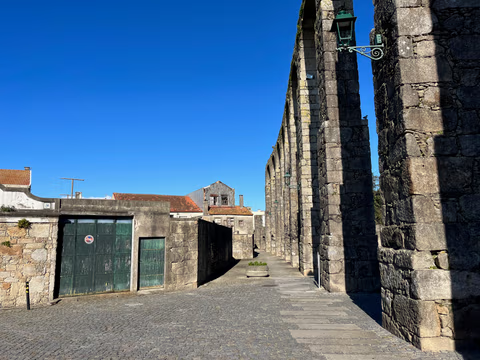
Aqueduct Trail – A path running along the Vila do Conde Aqueduct
From the Coastal Trail to the Camino Central: 12.9 km along the aqueduct from Vila do Conde to São Pedro de Rates. Route, stage, hostels, costs—explained honestly.
Read
Augsburg Way of St. James
The Augsburg Way of St. James runs 231.7 km in 11 stages from Oettingen in the Ries via Donauwörth, Augsburg, Bad Wörishofen and Ottobeuren to Ermengerst in the Allgäu — the Fuggerei, the Jakobervorstadt, a pilgrim of 1446 and Mozart's organ duel. Stages, hostels, costs.
Read

