

Via degli Dei
The Via degli Dei, the "Way of the Gods," runs 132.9 kilometers from Piazza Maggiore in Bologna across the Apennines to Florence. Along the way you cross summits named after gods, walk on the excavated paving of the Roman road Flaminia militare from 187 BC, and descend over the Passo della Futa into the Mugello. It is neither a Camino de Santiago nor a church pilgrimage route, but a hiking trail that Bolognese hikers pieced together in the 1980s and 1990s—with its own credenziale, stamps, and a keepsake instead of a certificate. 3,554 meters of ascent, a high point of 1,190 meters, and around 23,000 hikers in 2024.
- 01At a Glance
- 02Overview
- 03Other Names
- 04Who It's Ideal For—and Who It's Not So Ideal For
- 05Route & Landscape
- 06Stages, Terrain, and Difficulty
- 07Keeping the Legion Busy: The Roman Road Beneath the Leaves
- 08Highlights Along the Way
- 09Two Steps and a Big Feast: How an Idea Became a Trail
- 10How Pilgrims Find Their Way onto This Path
- 11Continue the pilgrimage?
- 12Preparation & Practical Information
- 13What the journey will cost you
- 14Getting Here
At a Glance
- Start / Finish: Piazza Maggiore in Bologna / Florence (km 132.5); the Camino Ninja map ends in the historic center
- Length: 132.9 km
- Duration: 6 stages, averaging just over 22 km; many walkers take 5 to 7 days
- Elevation: ↗ 3,554 m / ↘ 3,578 m
- Highest point: 1,190 m at km 63.0 between Pian di Balestra and the Passo della Futa, near Monte Bastione
- Landscape: Bolognese hills, the sandstone walls of the Contrafforte Pliocenico at Monte Adone, beech and chestnut forest on the ridge, the Mugello valley, olive-covered slopes above Florence
- Operator / Waymarking: hiking trail of the municipalities between Bologna and Florence (joint protocol since 2014, led by Sasso Marconi), maintained by the CAI; red-and-white CAI blazes with the trail number plus dedicated "Via degli Dei" signs
- Pilgrim passport / Certificate: Credenziale della Via degli Dei, 3.50 € (as of October 2026); at least 5 stamps on foot earn you an official keepsake, not a Compostela
- Traces of St. James: none on the trail itself—the Via degli Dei is not a Camino de Santiago; in Bologna, 500 meters from the start, stands the Basilica of San Giacomo Maggiore, begun in 1267
- Accommodation: ostelli, B&Bs, agriturismi, and small hotels; no chain of pilgrim hostels, so booking ahead is the norm
- Connecting routes: in Florence, the Cammino di Francesco (via La Verna to Assisi and Rome) and the Cammino Toscana (via Prato, Pistoia, Lucca, and Pisa to Livorno)
- Best time: May to June and September to October; hot in the valleys in midsummer, snow on the ridge in winter
Overview
The Via degli Dei is Italy's best-known long-distance trail linking two cities that you'd otherwise hop between in 37 minutes on the Frecciarossa through the tunnel. On foot it takes you six days, and that's exactly the appeal: you walk out of arcaded Bologna, over sandstone crags and beech-covered ridges, across the pass where Emilia meets Tuscany, and come down into Florence from Fiesole as if the autostrada had never been built. In 2017 the trail counted around 8,000 hikers; by 2024, according to Appennino Slow, it was around 23,000. In January 2025 it became the first hiking trail to be certified under the criteria of the Global Sustainable Tourism Council.
To put it honestly: this is not a Camino de Santiago, nor a pilgrimage to a saint's tomb. The name was coined by hikers, the credenziale is a stamp booklet issued by tourist offices, and the destination is a city, not a cathedral. Many walk it like a pilgrimage anyway, with stamps, a pack on their back, and the Monte Senario monastery as a quiet high point shortly before the finish. And underfoot lies history older than any Camino: on the ridge you're walking in places on stones that Roman legionaries laid more than 2,200 years ago—because their consul didn't want them sitting around idle.
Other Names
In Italian the trail is called Via degli Dei or Via degli Dèi, in English Way of the Gods, in German Weg der Götter or Götterweg. Wu Ming 2 titled his 2010 book about the trail "Il sentiero degli dei," so you'll also see Sentiero degli Dei—not to be confused with the coastal path of the same name on the Amalfi Coast.
The name comes from the mountains along the way. The common interpretation: Monte Adone after Adonis, Monzuno from "Mons Iovis," the mountain of Jupiter, Monte Venere after Venus, and Monte Luario after Lua, an ancient Roman goddess invoked in war. Honestly, these are folk etymologies on foundations of varying solidity—but they were enough for hikers to turn four mountain names into a trail.
Who It's Ideal For—and Who It's Not So Ideal For
Ideal if you have a week and want a real mountain crossing without heading into high-alpine terrain. Ideal if you love art cities: Bologna and Florence at either end, both with stations on the high-speed line, so getting there and back is easier than on almost any other route. Ideal, too, for a first long-distance hike with a backpack—short distances between villages, good waymarking, plenty of company.
Honestly, though, it's not for you if you expect pilgrim infrastructure like in Spain: there's no network of cheap hostels, and in season the few beds on the ridge are taken weeks in advance. Not for you if you're looking for solitude—on weekends in May and September, hundreds walk the stages around Monzuno and the Futa. And not for you if you underestimate the climbing: 3,554 meters of ascent over 133 kilometers is more than on many Spanish routes twice the length, and in the rain the clay and paved sections get slippery.
Route & Landscape
Bologna to Monzuno (km 0–42.3): From Piazza Maggiore you walk through the old town to the San Luca portico and climb beneath its arches to the sanctuary on the Colle della Guardia. Then it's down to the Reno and through Parco Talon past Casalecchio di Reno (the town lies 0.8 km off the trail); Sasso Marconi stays 2.1 km to the side. Via Badolo (km 24.2) you climb into the Contrafforte Pliocenico, a chain of sheer sandstone walls at whose foot Brento (km 31.9) sits beneath Monte Adone. Via Selve and Tre Fasci you reach Monzuno (km 42.3).
Monzuno to Florence (km 42.3–132.9): Beyond Monzuno the trail becomes a ridge walk: Cedrecchia (km 50.6), Madonna dei Fornelli (km 52.5), then Pian di Balestra (km 57.7), where the excavated sections of the Flaminia militare begin. Near Monte Bastione, at km 63.0, you reach the highest point at 1,190 meters; Bruscoli and Traversa each lie about a kilometer off the trail. At the Passo della Futa (km 68.6) Tuscany begins. From there you descend via Sant'Agata into the Mugello to San Piero a Sieve (km 90.2), climb via Tagliaferro and Tassaia to the Monte Senario monastery (km 105.0), continue via Vetta le Croci and Olmo past Fiesole (its center lies 0.8 km off the trail), and walk down into Florence (km 132.5).
Stages, Terrain, and Difficulty
We show the route in 6 stages. The distances come from the Camino Ninja map, calibrated exactly to 132.9 km; each stage ends in a place with accommodation. The popular 7-day plan splits the third stage at Madonna dei Fornelli (km 52.5): 10.2 and 16.1 km, one easy day and one for the Roman road.
- Bologna → Badolo (24.2 km) — Up beneath the San Luca portico to the sanctuary, then along the Reno and steeply up to Badolo; the day with the most asphalt.
- Badolo → Monzuno (18.1 km) — Over the sandstone ridge of the Contrafforte Pliocenico, past Monte Adone to Brento and on to Monzuno, with plenty of ups and downs.
- Monzuno → Passo della Futa (26.3 km) — The long ridge day: via Madonna dei Fornelli and Pian di Balestra onto the Flaminia militare, highest point at Monte Bastione, arrival at the military cemetery.
- Passo della Futa → San Piero a Sieve (21.6 km) — Down into the Mugello, via Sant'Agata into the Sieve valley; the descent is harder than the map suggests.
- San Piero a Sieve → Monte Senario (14.8 km) — Short, but with a steep climb from just over 200 to 761 meters; overnight at the monastery or in nearby Bivigliano, 0.8 km off the trail.
- Monte Senario → Florence (27.9 km) — Via Vetta le Croci and Olmo, past Fiesole, with your first view of the cathedral dome; the final stretch is city pavement.
Nothing is technically difficult, and there are no via ferratas. What wears you down is the cumulative climbing and the surface: rooty forest paths, washed-out clay stretches, and on the Flaminia militare rough paving that turns slick when wet. After the storms of September and October 2024, some sections were blocked by landslides; check with the tourist offices about current detours before you set off.
Keeping the Legion Busy: The Roman Road Beneath the Leaves
Livy tells it quite matter-of-factly in Book 39 of his History of Rome. In 187 BC the consul Gaius Flaminius had defeated the Ligurians in the Apennines, and then: "ne in otio militem haberet, viam a Bononia perduxit Arretium"—"so as not to keep his soldiers in idleness, he built a road from Bologna to Arezzo." The Roman road you walk on day three, in other words, was a make-work project. Historians call it the Flaminia militare to distinguish it from the famous Via Flaminia to Rimini.
For two thousand years it had vanished. The lawyer Cesare Agostini and the craftsman Franco Santi began searching for it in 1977, prompted by old-timers' tales of a road in the mountains. On August 25, 1979, near the summit of Monte Bastione, under 60 centimeters of earth, they found paving made of large sandstone blocks, 2.40 meters wide—exactly eight Roman feet. In just over ten years of manual labor the two uncovered around 7 kilometers, all the way to the Futa; in May 2000 they published their findings. Honestly, the dating of every single stone is not undisputed among archaeologists, and some stretches remained in use in the Middle Ages. But anyone who stands on these blocks near Pian di Balestra understands why Bolognese hikers built a trail around them.
In practical terms: the excavated sections lie between Pian di Balestra (km 57.7) and the Passo della Futa (km 68.6), at 900 to 1,200 meters, and are signposted. Allow time for this day and don't skip the paving just because an easier path runs alongside it. In the rain the stone is slippery; poles help.
Highlights Along the Way
- Piazza Maggiore, Bologna (km 0) — Start between San Petronio and the Fountain of Neptune; 500 meters on stands the Basilica of San Giacomo Maggiore, begun in 1267, the only major church of St. James on this route.
- San Luca portico (on the edge of town) — around 3.8 km of arcades, built from 1674, supposedly with 666 arches—according to the City of Bologna there are slightly fewer, depending on how you count; part of the UNESCO World Heritage site of the Portici di Bologna since 2021. At the top, the sanctuary with the icon of the Virgin venerated on the hill since 1160, in a church from 1723 designed by Carlo Francesco Dotti.
- Contrafforte Pliocenico and Monte Adone (around km 32) — sandstone walls from a primeval sea, topped by the viewpoint summit that gives the trail one of its gods.
- Flaminia militare (km 57.7–68.6) — the excavated Roman paving from 187 BC on Monte Bastione, discovered in 1979.
- Passo della Futa (km 68.6) — the German military cemetery, inaugurated in 1969 and designed by the architect Dieter Oesterlen: 30,683 soldiers killed in the fighting on the Gothic Line in 1944, with a 2-kilometer wall spiraling up the hill. The largest German military cemetery in Italy, and a place where even hikers fall quiet.
- San Piero a Sieve (km 90.2) — above it the Medici fortress of San Martino, begun on June 30, 1569, on the orders of Cosimo I, continued by Bernardo Buontalenti after Baldassarre Lanci, completed in 1608.
- Monte Senario (km 105.0) — a monastery at 761 meters, founded in 1234 by seven Florentine noblemen who established the Servite Order; since 1865 the monks have made the herbal liqueur Gemma d'Abeto.
- Fiesole (0.8 km off the trail, at km 119.7) — Etruscan town above Florence with a Roman theater; the detour to the center is worth it on the last day.
- Florence (km 132.5) — the finish in the old town, a World Heritage Site since 1982.
Two Steps and a Big Feast: How an Idea Became a Trail
The Via degli Dei wasn't invented by a ministry but by a group of hikers. Between the late 1980s and the early 1990s, Bolognese hikers from the CAI circle around Domenico Manaresi, known as "Mingàn," set out on foot for Florence; their group called itself "Dû pas e na gran magnè," Bolognese dialect for "two steps and a big feast." The director Pupi Avati had already told the story in his 1983 film "Una gita scolastica": a graduating class from Bologna that hikes over the Apennines to Florence in 1914.
The breakthrough came from a book and a tourist office. In 2010 Wu Ming published "Il sentiero degli dei," a hike told as a story. In 2013 the office in Sasso Marconi launched a funded project—7,000 euros from the province—and the first 4,000 maps sold out immediately; in 2014 the mayors of every municipality from Bologna to Florence signed a joint protocol. Since then the trail has grown year after year. According to the Emilia-Romagna region, the 23,000 hikers of 2024 account for around 115,000 overnight stays and more than 12 million euros in revenue across twelve municipalities.
How Pilgrims Find Their Way onto This Path
Honestly: hardly ever from another route. No route in our network feeds into the Via degli Dei in Bologna; nearly everyone arrives by train at Stazione Centrale and walks ten minutes from there to Piazza Maggiore. Bologna is a hub of Italy's high-speed rail network, and Guglielmo Marconi Airport is on the edge of town.
Some walk the trail in reverse, from Florence to Bologna—in that case they come from the Cammino di Francesco or the Cammino Toscana, both of which begin in Florence. The Via degli Dei is waymarked in both directions; guidebooks mostly describe Bologna–Florence.
Continue the pilgrimage?
Yes—and this is where the hiking trail can become a pilgrimage after all, if you want it to. Two routes from our network begin in Florence:
- Cammino di Francesco — from Santa Croce over the Consuma Pass, Camaldoli, and La Verna to Assisi and on to Rome, with its own testimonium
- Cammino Toscana — from Piazza della Signoria via Prato and Pistoia, with its relic of St. James, Lucca, and Pisa to Livorno, waymarked in yellow and blue with the scallop shell
Walk from Bologna all the way to Assisi and you'll have crossed the Apennines twice and turned a week of hiking into a month.
Preparation & Practical Information
Credenziale and app. The Via degli Dei is not an official Camino de Santiago; there's no Compostela or church testimonium. There is, however, the Credenziale della Via degli Dei, a stamp booklet for 3.50 € from Appennino Slow and the tourist offices in Sasso Marconi, Bologna, and Fiesole (as of October 2026). With at least 5 stamps from partner businesses on foot, or 3 by bike, you receive an official keepsake; emailing a photo of your stamped credenziale to the office is enough. You won't need your Camino pilgrim passport here, though you can collect stamps in it too. It's best to order the credenziale online in advance so it reaches you in time. With the Camino Ninja App you have the map and track offline; the easiest way to plan the route is right in the app, where you put together your stages and factor in suitable accommodation at the same time.
Accommodation and season. On the ridge between Monzuno and the Futa there are only a handful of places to stay; in May, June, and September they book up early. Many hosts will pick you up from the trail for a surcharge—that's part of how things work here. The best seasons are spring and fall; in July and August it's hot in the valleys near Bologna and in the Mugello, and in winter there's snow on the ridge. Water isn't available everywhere in the forest—carry two liters for the ridge stage.
Luggage. Several companies transport your luggage from one accommodation to the next; on this trail that's more the rule than the exception.
What the journey will cost you
The formalities are cheap: the credenziale costs 3.50 €, the keepsake at the end is free. The beds are what cost more. A dorm bed in an ostello runs around 25 to 35 €, sometimes with linens extra; a double room in a B&B or agriturismo 70 to 110 €, and many agriturismi on the ridge offer half board for 60 to 80 € per person (as of October 2026). Dinner at a trattoria with tagliatelle, tortelli, and wine comes to 20 to 30 €.
Budget 60 to 90 € per day, more if you're alone in a single room. Honestly, that makes the Via degli Dei twice as expensive as a Spanish Camino—but you'll eat better in Emilia and the Mugello than on any pilgrim menu.
Getting Here
To the start. You can reach Bologna Centrale on Frecciarossa and Italo trains from Milan, Venice, Rome, and Florence, and from Germany, Austria, and Switzerland via Munich, Innsbruck, and Verona or via Milan. Bologna Airport has direct flights from German-speaking countries; the Marconi Express gets you to the main station in a few minutes.
From the finish. From Firenze Santa Maria Novella, Frecciarossa and Italo trains take around 37 minutes back to Bologna, from about 10 € with saver fares, otherwise more like 20 to 30 € (as of October 2026); regional trains take longer but cost similarly little. Florence has its own airport, and Pisa is an hour away.
- Rail: trenitalia.com — Frecciarossa and regional trains Bologna – Florence
- Rail: italotreno.com — high-speed trains Bologna – Florence
- Credenziale: appenninoslow.it — stamp booklet, map, and trail information

Get your pilgrim credential and shell
Everything you need for the Via degli Dei, shipped to your door.
Visit Camino Shop
Other Caminos
 Appenzeller Weg
Appenzeller Weg
52.6 km from Rankweil across the Rhine to St. Peterzell: St. James Chapel (1464), 163 Years of the Wedding Trail, connection to the Via Jacobi. Stages, costs, how to get there.
Read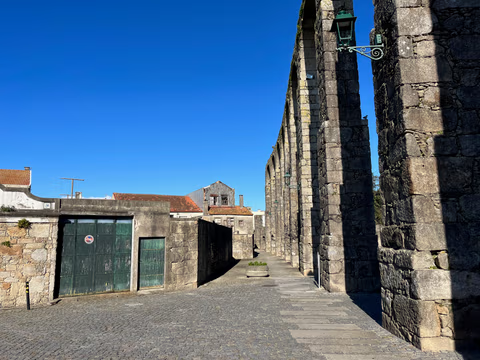
Aqueduct Trail – A path running along the Vila do Conde Aqueduct
From the Coastal Trail to the Camino Central: 12.9 km along the aqueduct from Vila do Conde to São Pedro de Rates. Route, stage, hostels, costs—explained honestly.
Read
Augsburg Way of St. James
The Augsburg Way of St. James runs 231.7 km in 11 stages from Oettingen in the Ries via Donauwörth, Augsburg, Bad Wörishofen and Ottobeuren to Ermengerst in the Allgäu — the Fuggerei, the Jakobervorstadt, a pilgrim of 1446 and Mozart's organ duel. Stages, hostels, costs.
Read

