

Caminho Minhoto Ribeiro
The Caminho Minhoto Ribeiro runs 264.4 kilometers from Braga to Santiago de Compostela, straight across the Minho and the Galician wine country of O Ribeiro. From Portugal's oldest cathedral it leads via Ponte da Barca, Arcos de Valdevez, Monção and Melgaço to Cevide, the northernmost point of Portugal, then on through Cortegada, Ribadavia, Pazos de Arenteiro and the Terra de Montes to the bridge at Sarandón and into Santiago. 12 stages, ↗ 6,994 meters of climbing, a high point of 829 meters at As Antas – and along the whole way you count pilgrims by the dozen rather than by the thousand.
- 01At a Glance
- 02Overview
- 03Other Names
- 04Who It's Ideal For—and Who It's Not So Ideal For
- 05Route & Landscape
- 06Stages, Terrain, and Difficulty
- 07The Road of Compostela's Priciest Wine
- 08Highlights Along the Way
- 09Border Road: Where Portugal Ends and Galicia Begins
- 10How Pilgrims Find Their Way onto This Path
- 11Preparation & Practical Information
- 12What the journey will cost you
- 13Getting Here
At a Glance
- Start / Finish: Braga Cathedral / Cathedral of Santiago de Compostela
- Length: 264.4 km, about 133 km of it in Portugal and 131 km in Galicia; the last 11-plus km from Deseiro shared with the Camino Sanabrés
- Duration: 12 stages, avg. 22 km; fit walkers manage it in 10 to 11 days
- Elevation: ↗ 6,994 m / ↘ 6,924 m
- Highest point: 829 m at km 201.6 between As Antas and Arnelas, in the uplands between Feás and Soutelo de Montes
- Landscape: the Vinho Verde country of the Minho, the river valleys of the Lima and the Vez, the Alvarinho vineyards along the Minho, spa towns and wine terraces of the Ribeiro, and finally the granite, pines and pastures of the Terra de Montes
- Operator / Waymarking: Asociación Camiño Miñoto Ribeiro (founded 2014, based in Cortegada, 16 Galician municipalities); yellow arrows, and in Galicia its own signposts since 2017; in Portugal newer and patchier, so bring a GPS track
- Credential / Certificate: credencial; the Compostela has been available since church recognition in 2020; the Xunta does not list the route among its official Caminos
- Traces of St. James: relics from Braga that came to Santiago in 1102, Santiago Peregrino pilgrim figures near Albarellos, in Soutelo de Montes and in Ribeira, a scallop shell on the cruceiro of Quintillán
- Accommodation: hardly any real pilgrim hostels; guesthouses, hotels and Turismo Rural, plus spa and small-town hotels in Cortegada and Ribadavia
- Connecting routes: Porto – Braga and Camino Torres in Braga, Caminho da Geira e dos Arrieiros running parallel for long stretches in Galicia, Camino Sanabrés from Deseiro
- Best time: April to June and September to October; hot in the valleys in high summer, wet in winter and cold up on the heights at As Antas
Overview
The Caminho Minhoto Ribeiro is a Way of St. James paved by wine. For centuries a trade route ran between the Minho and Santiago, carrying barrels from the Ribeiro north – and as early as 1133, Ribeiro wine topped the price list of the Compostela market as its most expensive item. Travelers, merchants and pilgrims walked alongside the traders. Today the route follows that corridor: out of the green Minho, via Monção and Melgaço, where the Alvarinho grows, across the border to Ribadavia, capital of the Ribeiro, and through the Terra de Montes to Santiago.
It was rediscovered not by an authority but by a historian: from 1998 on, Cástor Pérez Casal pieced the old connection together from archives and field names; in 2014 the Galician municipalities along the way founded an association to run it, in 2017 the first signposts went up, and in 2020 the Church recognized the route. Hardly anyone walks it, though. The tourist office in Ribadavia counted exactly 119 pilgrims in all of 2021. Walk here and you're stepping onto an old wine road where people still turn their heads when a pilgrim goes by.
Other Names
In Portuguese the route is called Caminho Minhoto Ribeiro, in Galician Camiño Miñoto Ribeiro, in Spanish Camino Miñoto Ribeiro; the first book about it came out in 2010 as "Camiño Xacobeo Miñoto Ribeiro". The name joins two landscapes: "minhoto" means coming from the Minho, and "Ribeiro" is the wine region around Ribadavia. The Asociación itself calls the route a "Camiño Histórico" and sums it up in four words: "Historia, Naturaleza, Termalismo y Vino" (history, nature, thermal springs and wine).
Who It's Ideal For—and Who It's Not So Ideal For
Ideal if you're looking for a way to Santiago that doesn't look like the Camino Portugués: small towns with castles and bridges in Portugal, hot springs and wine cellars in Galicia, and in between villages that have never gotten used to pilgrims. Ideal, too, if you like wine – hardly any other route puts two such different wine regions so close together.
Honestly, though, it's not for you if you expect hostels with an evening pilgrim community: there are almost none, so you'll sleep in guesthouses, hotels and country houses and pay accordingly. Not for you if you want to rely on continuous waymarking – on the Portuguese side it's newer, and two associations fought so fiercely over the route near A Estrada and Forcarei that signs disappeared. And not for you if you want to walk on the flat: almost 7,000 meters of climbing are spread over a constant up and down between river valleys and ridges.
Route & Landscape
Braga to Melgaço (km 0–122.8): You leave Braga via Dume and Palmeira, pass Vila Verde, which lies 1.2 km off the route, walk through winegrowing villages to Pico and cross the Portela do Vade (307 m) down into the Lima Valley to Ponte da Barca (km 38.1). Six kilometers later you reach Arcos de Valdevez on the Vez; then the route climbs via Alvora and Portela to the pass near Extremo (km 64.1, 395 m) and drops via Barroças e Taias into the Minho Valley. In Monção (km 88.0) you're on the border river; upstream the route leads via Barbeita and the Ponte de Mouro (km 99.7), through Valadares, Sá and Paderne to Melgaço (km 122.8).
Melgaço to Santiago (km 122.8–264.4): Beyond Melgaço lies Cevide (km 133.3), the northernmost point of Portugal; at Acivido you enter Galicia. Via O Condado, Trado with its old bridge over the Deva, and Vilanova da Barca you reach the spa town of Cortegada (km 147.2), then Ribadavia (km 159.9) via Meréns and A Arnoia. Up the Avia Valley you walk through vineyards to San Clodio (km 171.0), and via Gomariz and Banga to Pazos de Arenteiro (km 179.5). After that it turns into upland: via Feás and A Fenteira to the heights at As Antas (829 m), via A Ermida to Soutelo de Montes (km 207.4) and Forcarei (km 217.5). Through Quintillán, Castrelo de Arriba and Salouzáns the route descends into the Ulla Valley to the Ponte de Sarandón (km 242.0), climbs again via Sarandón and San Cristovo, and at Deseiro (km 253.2) meets the Camino Sanabrés, which it follows via Susana and Aldrei into Santiago.
Stages, Terrain, and Difficulty
We show the route in 12 stages; kilometers from the Camino Ninja map, calibrated exactly to 264.4 km. The stage towns follow where the beds are, not round daily distances – hence two short days to Ribadavia and Forcarei, which you can fill with a thermal bath or a wine cellar, or combine with the following day. In Galicia the stages largely match the operating association's breakdown.
- Braga → Pico (20.8 km) — out of the city via Dume and Palmeira, past Vila Verde; Pico de Regalados lies 0.8 km off the route.
- Pico → Arcos de Valdevez (23.1 km) — over the Portela do Vade, into the Lima Valley to Ponte da Barca and on to the Vez.
- Arcos de Valdevez → Barroças e Taias (26.5 km) — the mountain day: via Alvora and Portela to the pass near Extremo, then down into the Minho Valley.
- Barroças e Taias → Barbeita (27.7 km) — via Troporiz to Monção and upstream along the Minho.
- Barbeita → Melgaço (24.6 km) — over the Ponte de Mouro, through Alvarinho vineyards via Valadares and Paderne.
- Melgaço → Cortegada (24.4 km) — to Cevide and across the border, Trado and Vilanova da Barca, arriving in the spa town.
- Cortegada → Ribadavia (12.7 km) — a short day through the bend of the Minho and via A Arnoia into the wine town.
- Ribadavia → Pazos de Arenteiro (19.6 km) — through the Avia Valley, via Beade and San Clodio, wine cellars by the wayside.
- Pazos de Arenteiro → Soutelo de Montes (27.9 km) — the hardest day: via Feás up to 829 m at As Antas, then through empty uplands.
- Soutelo de Montes → Forcarei (10.1 km) — short, over the bridge at Gomail.
- Forcarei → A Ponte de Sarandón (24.5 km) — via Quintillán and Castrelo de Arriba down into the Ulla Valley.
- A Ponte de Sarandón → Santiago de Compostela (22.5 km) — via Sarandón, and from Deseiro on the Camino Sanabrés to the finish.
Nothing is technically difficult: back roads, farm and forest tracks, plenty of old paving in the villages, and in Galicia long stretches on medieval paths. What wears you out is the climbing and the distances between beds. The association itself calls the Pazos de Arenteiro–Soutelo de Montes stage especially long and demanding; between Feás and Soutelo there is neither a bar nor a shop for many kilometers.
The Road of Compostela's Priciest Wine
In 1133 Santiago had the prices of food on its market fixed in writing, and at the very top stood not meat, not fish, but the wine from the Ribeiro. Monks had expanded the vineyards in the valleys of the Avia and the Miño in the 12th century; in the 15th and 16th centuries the wine shipped from Vigo and A Coruña to England and Flanders; and in 1579 Ribadavia adopted Ordenanzas governing its cultivation and sale, which the World Intellectual Property Organization lists as the first forerunner of a protected designation of origin in Spanish law. In 1932 Ribeiro became one of Spain's first Denominaciones de Origen. Walk this route and you're following the supply line of a product that cost more in Compostela than anything else.
At the finish, take that literally. The association's guidebook has you enter the old town through the Mazarelos Gate at the very end: "por esta puerta entraba el vino procedente de la comarca del Ribeiro" – through this gate came the wine from the Ribeiro. The pilgrims came with it. A memorial from the cathedral canon Jorge Cisneros to the Captain General of the Kingdom of Galicia, Pedro Martín Cermeño, called for better roads after the canon had himself taken the waters in Cortegada – so that pilgrims, travelers and traders could make their way more easily.
In practical terms: plan the short days to Cortegada and Ribadavia on purpose. In Ribadavia, a historic ensemble since 1947, you can taste Ribeiro in the cellars of the old town; along the way to San Clodio stand the old bodegas; and in Monção and Melgaço on the Portuguese side, Alvarinho is at home – within the Vinho Verde region it may be grown only there.
Highlights Along the Way
- Braga Cathedral (km 0) — consecrated on August 28, 1089, older than Portugal itself, with the tombs of Henry of Burgundy and Teresa, the parents of the first king.
- Ponte da Barca (km 38.1) — the town grew in the 12th and 13th centuries at a ford on the pilgrim routes; the first bridge over the Lima probably came in the mid-14th century and gave it its name: the bridge at the ferry.
- Arcos de Valdevez (km 44.0) — here, in 1140 or 1141, Afonso Henriques and Alfonso VII of León faced off in a tournament instead of a pitched battle; the truce led to the Treaty of Zamora in 1143. The bridge over the Vez dates from 1876 to 1880.
- Monção (km 88.0) — town charter of 1261; the legend of Deu-la-Deu Martins, who in the 14th century pelted the besieging Castilians with bread, lives on in the town's motto.
- Ponte de Mouro (km 99.7) — medieval bridge over the Mouro; here in November 1386 João I and John of Gaunt met, and their agreement led to the marriage with Philippa of Lancaster.
- Melgaço (km 122.8) — castle and town charter of 1170 under Afonso Henriques, a second charter in 1258; in 1361 all traffic between Portugal and Galicia had to pass through here.
- Cevide (km 133.3) — the northernmost point of Portugal, with Galicia just beyond.
- Cortegada (km 147.2) — spa town on the bend of the Minho, home of the operating association.
- Ribadavia (km 159.9) — 15th-century castle of the Sarmiento family, town walls, a 16th-century town hall and the Jewish quarter with remains of the synagogue.
- San Clodio (km 171.0) — monastery and bridge from the late 15th century, right in the middle of the vineyards of Leiro.
- Pazos de Arenteiro (km 179.5) — historic ensemble with a Romanesque church, the house of the Knights Hospitaller commandery and the medieval Bridge of the Holy Sepulchre.
- As Antas (km 200.3) — the "Mesa de los Obispos" (Bishops' Table), a medieval boundary stone between dioceses with carved initials, just before the highest point.
- Ponte de Sarandón (km 242.0) — bridge over the Ulla, already mentioned in documents in the 12th century.
Border Road: Where Portugal Ends and Galicia Begins
The Minho was never a hinterland but a frontier, and the route runs right along it. Melgaço was built in 1170 as a fortress against Galicia; in 1387 the Castilians held the castle against João I for almost two months; and in 1492 the town was one of five places where Sephardic Jews expelled from Spain were allowed to enter Portugal. On the other side of the river lies Ribadavia with its large medieval Jewish quarter – two stations of the same story, one day's walk apart.
And then there's the punchline for everyone starting in Braga: in 1102 Bishop Diego Gelmírez carried off the relics of St. Fructuosus, St. Susanna and other saints from the churches of Braga to Santiago – the chroniclers called it a pious theft; in Braga they saw it more plainly. Susanna became co-patron of Compostela, and her church stands in the Alameda park; the bones of Fructuosus didn't return to Braga until 1966. Shortly before the finish, the route leads you through a hamlet called Susana.
How Pilgrims Find Their Way onto This Path
Almost everyone starts in Braga, and several routes lead there:
- Porto – Braga — the feeder route from Porto's airport and train station
- Camino Torres — coming from Salamanca, through Braga and on the same line for the first kilometers as far as Palmeira
- Caminho da Geira e dos Arrieiros — the sister route with the same start; it crosses the Gerês and meets the Minhoto Ribeiro again in Galicia, where the two share the line from Trado to Beade and from Pazos de Arenteiro to Feás
From the Camino Portugués Central, the easiest way to switch is by bus or train to Braga. Joining partway is perfectly possible: Ribadavia is on the Ourense–Vigo railway line, and you can reach Monção and Melgaço by bus.
Preparation & Practical Information
Credential and app. As on all routes to Santiago, you need a pilgrim passport (credencial) to collect stamps along the way and receive the Compostela at the end. It's best to order it online in advance so it reaches you in time for the start of your trip. Since there are hardly any hostels, planning matters more here than elsewhere – the easiest way is right in the Camino Ninja App, where you put your stages together and plan suitable accommodation along with them; you have the map and track with you offline.
Waymarking and status. In Galicia the association's signposts have been in place since 2017, and the route is easy to follow there. On the Portuguese side, the municipalities between Melgaço and Braga only signed a protocol for implementation in 2023; expect gaps and stick to the track. The Cathedral of Santiago recognizes the route, but the Xunta de Galicia doesn't count it among its official Caminos – which is why there's no network of public hostels. José López, then mayor of A Estrada, said of the dispute over the route: "la polémica flaco favor le hace al camino" – the controversy does the Camino a real disservice.
Season. Spring and fall are ideal; in October the vineyards glow, and at harvest time Ribadavia is buzzing. In high summer the Lima and Minho valleys bake in the heat; in winter the uplands around As Antas are wet and cold.
What the journey will cost you
Because hostels are missing, the Minhoto Ribeiro costs more than a Camino with an albergue network. In Portugal a room in a guesthouse or residencial costs around 35 to 55 €, Turismo Rural 50 to 80 €; in Galicia guesthouses and hostales run around 30 to 50 €, with the spa hotels in Cortegada and the hotels in Ribadavia above that (as of October 2026). The Compostela in Santiago is free, and the credencial costs a few euros.
Budget 50 to 75 € a day for room, breakfast, lunch menu and dinner; two people sharing a double room pay noticeably less. The pilgrim menu in Galicia usually costs 12 to 15 €, and a glass of Ribeiro or Alvarinho at the bar rarely more than 2 to 3 € (as of October 2026).
Getting Here
To the start. You can reach Braga from Porto Airport by bus in just over an hour, and from the city of Porto by CP commuter train from São Bento or Campanhã. The route starts at the cathedral.
From the finish. Santiago de Compostela has an airport with connections to Germany, Austria and Switzerland, plus Renfe trains and buses to Porto, Vigo and Madrid. For joining partway: Ribadavia is on the Ourense–Vigo railway line.
- Rail, Portugal: cp.pt — Porto–Braga
- Rail, Spain: renfe.com — Santiago, Ribadavia, Ourense
- Route operator: caminominotoribeiro.com — stage descriptions, KML tracks, guidebook

Get your pilgrim credential and shell
Everything you need for the Caminho Minhoto Ribeiro, shipped to your door.
Visit Camino Shop
Other Caminos
 Appenzeller Weg
Appenzeller Weg
52.6 km from Rankweil across the Rhine to St. Peterzell: St. James Chapel (1464), 163 Years of the Wedding Trail, connection to the Via Jacobi. Stages, costs, how to get there.
Read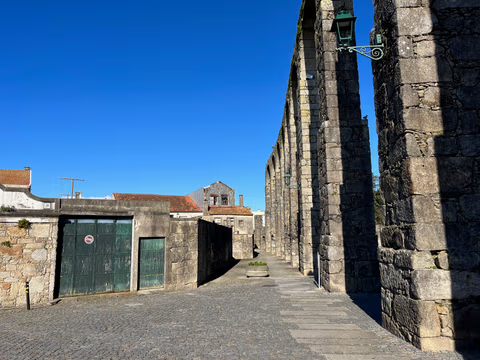
Aqueduct Trail – A path running along the Vila do Conde Aqueduct
From the Coastal Trail to the Camino Central: 12.9 km along the aqueduct from Vila do Conde to São Pedro de Rates. Route, stage, hostels, costs—explained honestly.
Read
Augsburg Way of St. James
The Augsburg Way of St. James runs 231.7 km in 11 stages from Oettingen in the Ries via Donauwörth, Augsburg, Bad Wörishofen and Ottobeuren to Ermengerst in the Allgäu — the Fuggerei, the Jakobervorstadt, a pilgrim of 1446 and Mozart's organ duel. Stages, hostels, costs.
Read

