

Porto – Braga
From the cathedral in Porto to Braga it is 61.6 kilometres in three stages: through the suburbs north of Porto, across the Romanesque Ponte de Lagoncinha to Trofa and Vila Nova de Famalicão, then over the Portela and down into the archbishop's city. The route is the historic approach of the Camino Portugués to Braga, but today it is a side route with a few hundred pilgrims a year, a lot of tarmac and no pilgrim hostel along the way. Its reward comes at the end: the oldest cathedral in Portugal, the stairway hill of Bom Jesus do Monte – and in Braga two more Ways of St. James to Santiago.
- 01At a Glance
- 02Overview
- 03Other Names
- 04Who It's Ideal For—and Who It's Not So Ideal For
- 05Route & Landscape
- 06Stages, Terrain, and Difficulty
- 07The Pious Theft: How Santiago Took Braga's Saints
- 08Bom Jesus: Pilgrimage with Water Ballast
- 09Highlights Along the Way
- 10How Pilgrims Find Their Way onto This Path
- 11Continue the pilgrimage?
- 12Preparation & Practical Information
- 13What the journey will cost you
- 14Getting Here
At a Glance
- Start / Finish: Porto Cathedral / Braga Cathedral, Sé de Braga
- Length: 61.6 km, Camino Ninja map; the Raid BTT da Trofa association reckons 61.3 km in two stages
- Duration: 3 stages, avg. 20.5 km; the short second stage can be combined with the third into a 34.7 km day
- Elevation: ↗ 835 m / ↘ 712 m – Braga lies a good 100 metres higher than Porto
- Highest point: 288 m at km 50.3 at the Portela, shortly before the descent to Braga
- Landscape: suburbs and industrial estates north of Porto, the Ave valley near Trofa, hamlets and vine pergolas in the Minho, finally the plain of Braga
- Waymarking: yellow arrows and shells, continuous in Trofa since 2021; patchy in between, GPS is advisable
- Credencial: pilgrim passport in Porto or online from the AEJ; stamps in Trofa, at the Sé de Braga and in the Albergue Casa da Roda
- Traces of St. James: Igreja de Santiago de Antas near Famalicão, Romanesque, 13th century; in Braga the cathedral from which Santiago took its relics in 1102
- Accommodation: no pilgrim hostel between Porto and Braga; hotels and guesthouses in Trofa and Famalicão, in Braga the Albergue Casa da Roda
- Connecting routes: in Braga the Caminho da Geira e dos Arrieiros and the Caminho Minhoto Ribeiro; from Porto alternatively the Camino Portugués Central via Barcelos
- Best time: April to June and September to October; in the Minho it rains a lot in winter, and in high summer the heat builds up on the tarmac
Overview
Braga is the religious capital of Portugal: a bishop's seat since the 3rd century, an archbishopric since 1107, and to this day its archbishop calls himself Primaz das Espanhas, Primate of the Spanish lands. The old way from Porto to Santiago ran through Braga before the shorter line via Barcelos prevailed. So this branch is not new, but the older of the two – it is just that pilgrims have forgotten it.
Today, by Gronze's estimate, fewer than a thousand people a year walk here, half of them starting only in Braga. So on the 61.6 kilometres you will hardly meet anyone with a backpack. In return, at the end you get the oldest cathedral in the country, the stairway sanctuary of Bom Jesus do Monte, a World Heritage Site since 2019, and three ways to Santiago to choose from. To be honest, the route there is suburban for long stretches: tarmac, roundabouts, industrial estates, in between chapels, wayside crosses and a few lovely kilometres along the Ave.
Other Names
In Portuguese the route is called Caminho Português Central por Braga or simply Caminho de Braga; Gronze calls it the Variante de Braga and means the whole arc Porto – Braga – Ponte de Lima. In forums you will also find "Camino Portugués via Braga". Not to be confused with the Via Mariana, a Marian pilgrimage route that leads from Braga via Sameiro to Santiago.
Who It's Ideal For—and Who It's Not So Ideal For
Ideal if you want to see Braga and don't just want to tick the city off as a day trip from Porto. Ideal if you are looking for a longer way to Santiago than the Central: with the Caminho da Geira e dos Arrieiros, Porto – Santiago becomes a route of a good 300 kilometres through the Peneda-Gerês National Park. Ideal too as a three-day trial – the train takes you back from every stage town.
To be honest, though, it is not for you if you are looking for hostel life: there is not a single pilgrim hostel along the way, in Trofa and Famalicão you sleep in guesthouses and hostels. Not for you either if you want to escape the tarmac – Greater Porto reaches as far as Trofa, and Gronze counts "hardly any old paths, hardly any woodland". And not for you if you need pilgrim company: on the Central via Barcelos thirty times as many people walk.
Route & Landscape
Porto and suburbs (km 0–27): Only a few hundred metres beyond the Sé do Porto you part from the Central and head north, past Paranhos (km 3.7) and São Mamede de Infesta (km 6.3). Via Milheirós (km 9.6), Nogueira (km 13.0) and Silva Escura (km 14.9) you leave the city of Maia; from Coronado (km 18.7) the Concelho of Trofa begins, with its signs put up in 2021. Via Covelas (km 22.6) you reach Trofa (km 26.9), which lies just under a kilometre off the route.
Ave valley, Famalicão and Portela (km 27–61.6): Beyond Trofa a stretch of old Roman road at Ervosa leads to the Ponte de Lagoncinha, a 12th-century Romanesque bridge over the Ave. Via Cabeçudos (km 33.8) you come to Vila Nova de Famalicão (km 37.6), an industrial town with a railway station, its centre a kilometre off the route. After that it gets more rural: São Martinho do Vale (km 40.9), São Cosme do Vale (km 45.8), Telhado (km 47.8), then the climb to the Portela (km 49.6) with 288 metres at km 50.3. Via Escudeiros (km 51.6), Santo Estêvão do Penso (km 52.8), Lamas (km 54.3) and Lomar (km 58.1) the route runs down into the plain and to the Sé de Braga (km 61.4).
Stages, Terrain, and Difficulty
We divide the route into three stages with destinations that have beds and a railway station. The second is short; if you only need Famalicão for lunch, walk Trofa – Braga in one day of 34.7 kilometres, as the Raid BTT da Trofa association suggests.
- Porto → Trofa (26.9 km) — ↗ 350 m / ↘ 320 m. Out of the city through Paranhos and São Mamede, via Milheirós and Silva Escura to Coronado and Covelas; Trofa lies 0.9 kilometres off the route. Almost entirely tarmac.
- Trofa → Vila Nova de Famalicão (10.7 km) — ↗ 150 m / ↘ 135 m. Across the Ponte de Lagoncinha and via Cabeçudos to Famalicão; a short day, can be combined with stage 3 into 34.7 km. Hostels and hotels at the destination, the centre a kilometre off the route.
- Vila Nova de Famalicão → Braga (24.0 km) — ↗ 335 m / ↘ 255 m. Through the Vale parishes and Telhado to the Portela, highest point 288 m at km 50.3, then down via Escudeiros, Lamas and Lomar to the cathedral.
The surface is mostly tarmac and paving, with farm tracks in between and the stretch of Roman road at Ervosa. Technically nothing is difficult; the strain comes from the hard ground and from traffic through the villages. The waymarking is good in Trofa and Braga, patchy in between according to pilgrim reports – have the track on your phone.
The Pious Theft: How Santiago Took Braga's Saints
Braga was long the more important city: founded as Bracara Augusta around 16 BC, capital of the Conventus Bracarensis under Diocletian, around 410 the residence of the Suebi, metropolis of the Church across the whole north-west – Santiago, by contrast, a young tomb with a great reputation. Around 1070 Bishop Pedro began today's Sé de Braga, consecrated on 28 August 1089 – which is why it counts as the oldest cathedral in Portugal. In 1107 Count Henry of Burgundy secured the archbishopric from the Pope; Henry and his wife Teresa, the parents of the first Portuguese king, lie today in the Capela dos Reis of the cathedral.
In December 1102 Diego Gelmírez, Bishop of Santiago, came to Braga on a visitation – and on the way back took with him the bones of Saint Frutuoso, of Cucufas, of Silvester and of Susanna. The Historia Compostelana, his own house chronicle, unabashedly calls this a pious theft, pio latrocínio. The relics strengthened Santiago, which itself became an archbishopric in 1120 and for decades contested Braga's suffragan dioceses; only in 1199 did Innocent III assign Braga five dioceses and secure its title of primate. The bones of Frutuoso only returned to Braga in 1966, after 864 years.
So you end in the church that lost the dispute over precedence and kept its title all the same. Take your time in the Sé for the Capela dos Reis, the cloister and the treasury – and if you continue on the Geira to Santiago, you carry something back, symbolically.
Bom Jesus: Pilgrimage with Water Ballast
Above Braga stands the second destination of this route, the Santuário do Bom Jesus do Monte. A chapel here is documented since 1373; in 1722 Archbishop Rodrigo de Moura Teles began building the baroque stairway, the Escadório dos Cinco Sentidos with fountains for the five senses, later extended by the stairway of the Virtues. At the top the church by Carlos Amarante, built from 1784 to 1811. Depending on how you count, there are 573 to 581 steps; since 7 July 2019 the complex has been a UNESCO World Heritage Site.
If you don't feel like climbing any more after 61 kilometres, take the Elevador do Bom Jesus: opened on 25 March 1882, 274 metres long, 116 metres of height difference, and to this day it runs on water alone. At the top a tank is filled with up to 5,850 litres, the heavy cabin pulls the empty one up, at the bottom the water drains away. It is considered the oldest water-ballast funicular still in operation in the world. On the neighbouring hill lies Sameiro, the Marian sanctuary whose construction began in 1861. Both are about five kilometres east of the centre – not on the route, but reachable by city bus.
Highlights Along the Way
- Sé do Porto (km 0) — starting point of all Portuguese routes from Porto; 12th-century Romanesque cathedral with a baroque cloister.
- Coronado and Covelas (km 18.7–22.6) — chapel of the Divino Espírito Santo, church of São Romão, chapel of São Gonçalo; at the ACRABE association in Abelheira there has been a rest point for pilgrims since 2009.
- Ponte de Lagoncinha (beyond Trofa) — 12th-century Romanesque bridge, six arches, around 120 metres long, on Roman foundations; in 1809 Marshal Soult crossed the Ave here. National monument since 1943.
- Igreja de Santiago de Antas (near Famalicão) — late Romanesque church of the 13th century, once a Templar monastery, with rose window and Gothic portal; the only church of St. James on the route.
- Casa de Camilo in São Miguel de Seide (a few kilometres off the route) — Camilo Castelo Branco lived here from 1863 until his death in 1890; the house burned in 1915, has been a museum since 1922, next to it the study centre by Álvaro Siza from 2005.
- Portela (km 49.6) — at 288 metres the highest point, first view down into the plain of Braga.
- Sé de Braga (km 61.4) — cathedral since 1089, tombs of Henry and Teresa, treasury, stamp for the Credencial.
- Bom Jesus do Monte and Sameiro (approx. 5 km east) — stairway sanctuary of 1722, World Heritage 2019, water funicular of 1882.
How Pilgrims Find Their Way onto This Path
Almost everyone starts in Porto: at the cathedral, where the Camino Portugués Central and the Portuguese Coastal Way also start. The three routes share only the first few metres; the Braga branch turns north straight away, while the Central heads for Vairão and Barcelos and the Coastal Way for the sea.
Many pilgrims who want to see Braga, however, simply take the train there and start in the city. The archdiocese's figures show it: in 2022, 474 pilgrims started in Braga, in 2024 it was already around 1,100 – very few of them had walked there from Porto.
Continue the pilgrimage?
Yes, and in Braga you have the choice. The Caminho da Geira e dos Arrieiros leads in 244.5 kilometres along the Roman Via Nova through the Peneda-Gerês National Park, over the Portela do Homem into Galicia and via Ribadavia to Santiago; it has been recognised by the cathedral chapter in Santiago since 2019, and in 2024 around 1,250 pilgrims walked it. The Caminho Minhoto Ribeiro is a little longer still at 264.4 kilometres and runs via Ponte da Barca, Arcos de Valdevez, Monção and Melgaço into the Ribeiro to Ourense and Santiago.
The third option is the classic arc back to the Central: via Goães and Vila Verde to Ponte de Lima, where you are back on the Camino Portugués Central. This connection is not in our map; Gronze reckons around 100 kilometres for Porto – Braga – Ponte de Lima. If you only wanted the three stages, you get on the train in Braga.
Preparation & Practical Information
Pilgrim passport and app. As on all Portuguese routes, you need a pilgrim passport (Credencial) to sleep in the albergue in Braga and to receive the Compostela at the end. It is best to order it online in advance, for example from the Associação Espaço Jacobeus, so that it reaches you in time for the start of your journey; in Porto you can also get it at the cathedral. Stamps are available in Trofa at the town hall, at the Sé de Braga and in the albergue. With the Camino Ninja App you have the map and track offline – important here, because the waymarking between Trofa and Famalicão is not reliable everywhere. The easiest way is to plan directly in the app, where you put your stages together and book suitable accommodation at the same time.
Sleeping. Between Porto and Braga there is no pilgrim hostel; Gronze calls the lack of albergues the biggest problem of the route. In Trofa and Famalicão you will find hotels, guesthouses and hostels, in Famalicão for instance the Hi!Go Hostel. In Braga the municipal Albergue Casa da Roda stands at Rua de São João 3, a few steps from the cathedral; a second albergue with 18 beds was planned in the Cividade in 2023, whether it has opened we could not confirm (as of September 2026).
Weather and water. The Minho is the rainiest corner of Portugal: from November to March you need rain gear, in July and August the heat builds up on the tarmac. Water is no problem, there are cafés in almost every village.
What the journey will cost you
Not a hostel route, but a cheap one: the train back from Braga to Porto costs around 3.60 € (as of September 2026), the Albergue Casa da Roda is listed in the city's information at 5 € per night with a pilgrim menu for 6.50 to 7 € – whether these prices still apply is best checked on the spot. For hostels and guesthouses in Trofa and Famalicão reckon on 20 to 40 € per night; in Braga hostel beds are similar, hotels above that.
With a supermarket and a Prato do dia you come to 15 to 25 € for food per day. Realistic daily budget: 40 to 60 € with a hostel, 70 to 90 € with a hotel.
Getting Here
To the start. You reach Porto via Francisco Sá Carneiro Airport with Metro line E, from Lisbon with the CP's Alfa Pendular and Intercidades to Campanhã. The route starts at the Sé, five minutes from São Bento station.
From the finish. Braga has a terminus station from which the CP suburban trains take 55 to 70 minutes to Porto Campanhã and São Bento, during the day roughly every half hour to hour; Alfa Pendular and Intercidades are faster and more expensive. Handy for the stages: the line also stops in Trofa and Famalicão, so you can break off any day or walk it as day trips from Porto. The Get Bus takes around 50 minutes to the airport.
- Rail: cp.pt — suburban trains Porto – Trofa – Famalicão – Braga, timetables and fares
- Stages and GPX: raidbttdatrofa.pt — Raid BTT da Trofa, stage description Porto – Braga
- Braga: cm-braga.pt — City of Braga, Albergue Casa da Roda and pilgrim information ---
Partners
Partner for Porto – Braga
Camino Ninja is cooperating with official partners. For this camino the partner is:

Get your pilgrim credential and shell
Everything you need for the Porto – Braga, shipped to your door.
Visit Camino Shop
Other Caminos
 Appenzeller Weg
Appenzeller Weg
52.6 km from Rankweil across the Rhine to St. Peterzell: St. James Chapel (1464), 163 Years of the Wedding Trail, connection to the Via Jacobi. Stages, costs, how to get there.
Read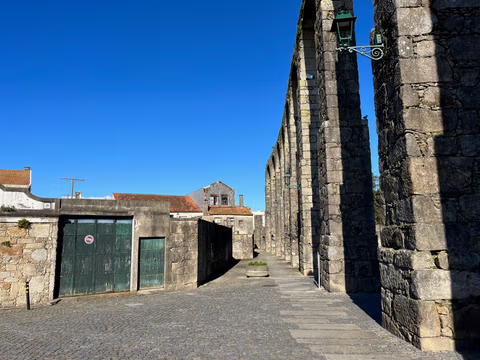
Aqueduct Trail – A path running along the Vila do Conde Aqueduct
From the Coastal Trail to the Camino Central: 12.9 km along the aqueduct from Vila do Conde to São Pedro de Rates. Route, stage, hostels, costs—explained honestly.
Read
Augsburg Way of St. James
The Augsburg Way of St. James runs 231.7 km in 11 stages from Oettingen in the Ries via Donauwörth, Augsburg, Bad Wörishofen and Ottobeuren to Ermengerst in the Allgäu — the Fuggerei, the Jakobervorstadt, a pilgrim of 1446 and Mozart's organ duel. Stages, hostels, costs.
Read

