

Via Mosana
From Maastricht to the mouth of the Sambre: The Via Mosana follows the Meuse River over 6 stages and approximately 130 kilometers—passing through Visé to the episcopal city of Liège, through the Ourthe Valley to the Condroz Plateau, and along the river to Namur. A short, well-marked trail with a very long history: In Liège in 1056, a monk named Robert set out for Santiago and returned with relics; in Namur, starting in 1406, a pilgrim hostel took in the “Jacquets.” The name simply indicates which river the route follows: “Mosa” is Latin for the Meuse.
- 01At a Glance
- 02Overview
- 03Founded in 1016, abandoned in 1056, reopened in 1406
- 04Other Names
- 05Who It's Ideal For—and Who It's Not So Ideal For
- 06Route & Landscape
- 07Stages, Terrain & Difficulty
- 08Highlights Along the Way
- 09How Pilgrims Find Their Way onto This Path
- 10Continue the pilgrimage?
- 11Preparation & Practical Information
- 12What the journey will cost you
- 13Getting Here
At a Glance
- Start / Finish: Maastricht → Namur (confluence of the Sambre and Meuse)
- Length: approx. 130 km
- Stages: 6 (7 if you go through Huy)
- Duration: 5–7 days
- Regions: The Netherlands and Belgium (Wallonia) — Meuse Valley, Ourthe Valley, Condroz
- Elevation gain: Approx. 1,610 m elevation gain (GPS track of the route)
- Difficulty: Easy to moderate — no mountain passes, but a 31-km day with a noticeable amount of paved road
- Waymarking: Yellow scallop shell, occasionally appearing alongside red-and-white GR markers
- Connection: From Namur, continue on Via Mosana 2 to Rocroi (94 km), then Via Campaniensis Toward Vézelay
Overview
The Via Mosana is the Way of St. James along the Meuse: It begins in Maastricht, the city of the relics of St. Servatius, follows the river along Visé to the old episcopal city Liège, climbs through the Ourthe Valley to the Condroz-Plateau and returns along the river to Namur, where the Sambre flows into the Meuse and the citadel towers above it all — 6 stages, about 130 Kilometers, a little over 1,600 meters of elevation gain. Mosaic"Maas" is Latin for "Maas": The name simply indicates who this path follows.
Historically, there has been no branch line here, but rather the Maas branch of the Niederstraße — the route along which, according to the Diocese of Aachen, pilgrims from northern Germany “mainly via Cologne and Aachen” sought to connect with the French routes. And the Meuse River provides the evidence right there: In Liège, Bishop Baldéric II endowed 1016 an abbey dedicated to St. James, 1056 From there, a monk named Robert made a pilgrimage to Santiago and returned with relics, and in Namur, the number began to decline 1406 A pilgrim hostel welcomes the pilgrims. Today, the route is managed by the Walloon St. James Association—founded 1986, Motto: “À chacun son chemin” Topoguide “From Maastricht to Namur” in the 2025 edition.
Founded in 1016, abandoned in 1056, reopened in 1406
Other trails have a founding date—this one has a founding pilgrim. 1016 Bishop … Baldéric II. founded a Benedictine abbey in Liège and placed it under the patronage of St. James; by 1021, the basilica stood, 1030 Bishop Réginard consecrated it. And then comes the sentence that makes all the research worthwhile: 1056 A monk named [name] fled from this abbey Robert set out for Santiago de Compostela—and returned with the relics of Saint James. A man with a name, a specific year, a return journey with tangible evidence—300 years before the great waves of pilgrims. In 1114, a canon from Compostela brought further relics to Liège; findings in the crypt show that Saint-Jacques was already a popular pilgrimage site as early as the 11th century. The church still stands: rebuilt in the Gothic style beginning in 1418 under Master Aert van Mulcken, 1552 consecrated, with a Renaissance portal attributed to Lambert Lombard.
At the other end of the path, the same handwriting: In Namur has been since 1406 The Saint-Jacques hospice, which took in sick and wounded soldiers as well as pilgrims on the Way of St. James, was discovered—remains of a 13th-century wooden chapel were found beneath its foundations. In 1755, the Frères de la Miséricorde took over the building, and in 1757 they rebuilt the church. Then came the long decline: 1972 it has been desecrated since 2015 It’s a fashion store. The scallops are still hanging on the facade—both inside and out. You can trace the history of this street just by looking at a single storefront.
In between lies the break, clearly dated: a breve issued by Pope Pius VI that secularized 1785 the Abbey of Liège, 1792 the revolution turned the page on that chapter, 1794 Lambertus Cathedral was demolished. The current landmark along the Via Mosana, the cathedral Saint-Paul, was only 1804 Cathedral—as a replacement for the one that was torn down. So your pilgrim’s stamp comes from a church that owes its status to the destruction of another. The Revival, on the other hand, bears a club date: 1986 The Association Belge des Amis de Saint-Jacques was founded, and it is this association that marks and describes the route today. Incidentally, no source mentions a specific year in which the Via Mosana itself was laid out or signposted for the first time—and there are also no finds of scallop shells along the route. Admitting this honestly carries more weight: This route doesn’t need a vague oral tradition; it has the years 1016, 1056, and 1406 in black and white on parchment.
Other Names
Via Mosana is the name of the trail in French, German, Dutch, and English alike — the name is Latin and needs no translation: Mosaic is the Meuse. Descriptively, one says The Way of St. James: Maastricht–Namur; the sponsoring association has given its current guide the same title: “Topoguide de la Via Mosana de Maastricht à Namur.” More important is the system behind it: The association is one of the Via Mosana 1 two access routes—one from Maastricht and one from Aachen. In our network, the Aachen route is a separate path, the Via Mosana DE, which runs through the countryside from Herve to Liège in two stages and joins the Via Mosana there. Via Mosana 2 Finally, the route continues from Namur to Rocroi, a distance of 94 kilometers. Jens M. Warnsloh’s German hiking guide combines the Aachen section and both parts into a single volume (“Via Mosana / Via Monastica from Aachen to Rocroi”): The Via Monastica is a separate route organized by the same club, which serves as an alternate route through the Meuse Valley in the final section. So there’s no risk of confusion regarding the root of the name, but rather regarding the numbering—if in doubt, ask for “Via Mosana 1.”
Who It's Ideal For—and Who It's Not So Ideal For
This is ideal if you have five to seven days off and are looking for a Way of St. James that doesn’t involve a complicated journey to get there: You can easily reach Maastricht by train, and from the city of St. Servatius, you can simply set off. Logistically, the route is hassle-free—train stations are close together; you can get off at any time in Esneux or Namur; finding food is never a problem; and the signage is better than its reputation: “The route is actually really well marked, without exception,” one pilgrim succinctly noted in 2019. Those with a curiosity for history will find more than the 130 kilometers promise: an abbey dating back to 1016, a pilgrim to Santiago whose name is known from 1056, and a pilgrim hospice from 1406.
To be honest, though, it’s not for you if you’re expecting Spanish-style pilgrim hostel facilities. In Belgium, traditional pilgrim hostels are rather uncommon—you book private accommodations, monasteries, and guest rooms, and it’s best to book them in advance. There are stamp stations, but not on every corner: Saint-Paul Cathedral in Liège, the rectory in Esneux, and “Pèlerinages Namurois” in Namur—that’s the list. It’s also not for you if you’re looking for trails through pristine nature: there are paved roads, and the route to Liège runs through the industrial belt of the Meuse Valley, not through a postcard-perfect landscape. And the fifth day covers 31 kilometers—you plan around such long stretches in advance, not while you’re on the road.
Route & Landscape
The trail begins in Maastricht — the city whose relics of Servatius were the reason why medieval pilgrims to Aachen would make a detour there before continuing southward. From there, the Via Mosana winds its way up the Meuse Valley, heading south toward the river: At Visé Cross the Belgian border and walk along the waterfront into the old bishop's city Liège — past the industrial belt around Herstal, which, to be honest, isn't exactly a postcard view. In Liège, the Abbey Church of Saint-Jacques, dating from 1016, and the postmark at Saint-Paul Cathedral await.
From Liège on, the Via Mosana becomes a riverside hiking trail with occasional stops at high-altitude spots: first into the Ourthetal according to Esneux, then up to the Condroz-Plateau — limestone, hedges, villages built of rubble stone, and in some places you’ll spot the red-and-white stripes of the GR 576 beneath the yellow shells; the trail shares the route with it here. Between Saint-Séverin and Andenne You decide for yourself: straight across the plateau or down to the Meuse River toward Huy. We'll spend the last day by the river, over Sclayn all the way to where the Sambre flows into the Meuse and the citadel of Namur looms over the city. The GPS track shows a total ascent of a good 1,600 meters in elevation—the edge of the Ardennes is still the edge of the Ardennes: Between river level and the plateau, there are a few hundred meters of ups and downs almost every day.
Stages, Terrain & Difficulty
Six stages is the natural length: two along the river from Maastricht to Liège, followed by the stages outlined in the German itinerary—with a 31-kilometer stretch between Saint-Séverin and Andenne. Technically, the route is not difficult: no mountain passes, no climbs, but there are sections of asphalt and a few long days. The yellow scallop shell provides reliable guidance; nevertheless, check the organizer’s detour notices before setting out—in July 2026, the route was closed near Modave, and reports still mention flood damage from 2021. All stage distances are rounded figures—the total length of 130 km is the official figure.
- Maastricht → Visé (approx. 17 km) — out of Servatius City and into the Meuse Valley: follow the river south, across the Belgian border to the small town of Visé on the right bank of the Meuse.
- See → Liège (approx. 17 km) — Continue up the Meuse Valley, past the industrial area around Herstal, to the center of Liège; get your passport stamped at Saint-Paul Cathedral; the Abbey Church of Saint-Jacques is just a few minutes’ walk further on.
- Liège → Esneux (25 km) — out of the industrial city and into the Ourthe Valley, which becomes more wooded and quieter with every kilometer; in Esneux, there’s a stamp at the rectory and a train station for an emergency exit.
- Esneux → Saint-Séverin-en-Condroz (16 km) — a short stretch of the trail leading up to the Condroz Plateau, winding through hedgerows, pastures, and limestone villages.
- Saint-Séverin → Andenne (Moulin de Kevret) (31 km) — a long day: across the Condroz, past Modave, and back down to the Meuse; lodging in an old mill.
- Andenne → Namur (24 km) — close to the river, via Sclayn, along the Meuse to its confluence with the Sambre, passing under the citadel to the train station with the bronze mussels.
The sponsoring association manages the trail via Huy — If you want to explore the city, break up the 31-km day into Saint-Séverin → Huy (about 21 km) and Huy → Andenne (approx. 20 km): seven stages instead of six, about 140 kilometers instead of 130. The reward: Huy’s collegiate church on the Meuse and the tomb Peter the Hermit at the former Neufmoustier monastery.
Highlights Along the Way
- Maastricht — Starting point at the tomb of Saint Servatius: Even in the Middle Ages, pilgrims would go out of their way to visit his relics before continuing south across the Meuse.
- Saint-Jacques Collegiate Church, Liège — the church of the abbey, founded in 1016, from which the monk Robert set out for Santiago in 1056. Flamboyant vaulting; Renaissance portal dating from 1552–1560.
- St. Paul's Cathedral, Liège — Your destination: founded in 966 as Paulsstift, Gothic style from 1240, consecrated in 1289, a cathedral since 1804. The treasury houses Europe’s largest late-Gothic bust reliquary—St. Lambert, measuring 159 × 107 centimeters.
- The Ourthe Valley and the Condroz — the most scenic part: limestone, hedgerows, villages with rubble-stone architecture, and sections that run alongside the GR 576, the 165-km loop known as the “Tour du Condroz liégeois.”
- Huy (on the 7-stage route) — Collegiate Church on the Meuse and the Tomb Peter the Hermit, the crusade preacher who died in Neufmoustier in 1115 and wished to be buried “in the bare earth”; in 1242, the monks moved him to a marble tomb.
- Moulin de Kevret — Pilgrim lodging in an old mill at the end of a long day in the Condroz: You'll be looking forward to this starting at kilometer 20.
- Namur — The mouth of the Sambre River, the Citadel, Saint-Aubain Cathedral, the Tour Saint-Jacques, and the former hospice church from 1406, on whose facade the scallop shells still hang today. At the train station, bronze scallop shells mark the way.
How Pilgrims Find Their Way onto This Path
The classic entrance comes from the Rhineland and takes just a couple of steps: The The Way of St. James: Cologne–Aachen ends at Aachen Cathedral, and there the Via Mosana DE — the Aachen feeder route, just under 52 kilometers in two stages through the Herve region, which joins the Via Mosana in Liège. This is not a modern route but the old one: according to the Diocese of Aachen, pilgrims from northern Germany sought the connection “mainly via Cologne and Aachen (the so-called ‘Niederstraße’).” And the choice between the two branches is itself historical: as early as the Middle Ages, pilgrims at Aachen’s Jakobsplatz decided whether to take the detour to the relics of St. Servatius in Maastricht—or to go directly through the Jakobstor.
If you want to walk the entire Via Mosana, start at Maastricht By yourself: You can reach the city by train via Liège or Eindhoven, and from the city center, the path runs right along the river. The third starting point is Liège Right along the route—both cities connect you to the European high-speed rail network, and if you only want to explore the Burgundian-Walloon half, just start at the stamp station in Saint-Paul Cathedral.
Continue the pilgrimage?
Namur is not a destination, but a crossroads—historically, the city was located “at the end of the Via Mosana and the beginning of the Vézelay Route.” The route continues directly from there as Via Mosana 2 according to Rocroi on the French border: 94 kilometers, listed as a separate section by the same agency, with the Via Monastica as an alternative route through the Meuse Valley via Dinant and Givet. From Rocroi, the Via Campaniensis — via Reims, whose St. James Church has been documented since the 12th century, and Troyes, all the way to Vézelay. There is no reference to a connection to Paris in any of the source materials: Although the historic Niederstraße route ran through Paris and Tours, the path marked today leads to Vézelay.
The journey begins in Vézelay Via Lemovicensis, which runs through Limoges and Ostabat to the Pyrenees, where, in Saint-Jean-Pied-de-Port, the Camino Francés takes over. According to the pilgrimage flyer, anyone who sets out from Aachen will have about 2,700 Kilometers All the way to Santiago—the Via Mosana is the first section of that route along the Meuse River. And for those who don’t want to go that far: Namur is a major railway hub, and the return trip takes just a few hours.
Preparation & Practical Information
The best time is between April and October — In winter, lodging options in the Condroz are few and far between, and the days are short. Expect Belgian weather: rain gear is a must, not just an option. The current guidebook is the Hiking Guide G001 published by the sponsoring association—“de Maastricht à Namur,” 2025 edition, 15 euros (as of August 2026)—covers exactly this route. In German, Jens M. Warnsloh’s guide “Via Mosana / Via Monastica” (Conrad Stein) describes the corridor from Aachen to Rocroi, and the free information sheet from the German St. James Society in Aachen lists the accommodations for the section starting in Liège, stage by stage.
You should book your lodging in advance. Traditional pilgrim hostels are rather uncommon in Belgium—you’ll stay in private accommodations, monasteries, guest rooms, and youth hostels; along the route you’ll find, among others, the Auberge du Pèlerin in Liège and the Moulin de Kevret near Andenne. The Pilgrim's Passport (Credencial) You can order them in advance, for example from the Belgian St. James Association; stamps are available at Saint-Paul Cathedral in Liège, at the Esneux rectory, and at “Pèlerinages Namurois” in Namur—be sure to plan for them, as they won’t just turn up on their own here.
There are two things you should note down: the 31-km stretch between Saint-Séverin and Andenne—or its shorter alternative via Huy—and the current detours on the route, which reported a closure near Modave in July 2026. With the Camino Ninja App You're in good hands—it has the entire route on board, and you can put together your own itinerary and plan suitable accommodations right away.
What the journey will cost you
Belgium isn't a cheap country, but the Via Mosana is affordable if you stay in private accommodations. Monasteries, guesthouses, and youth hostels make up the bulk of the options; hotels in Liège or Namur are significantly more expensive. A daily budget of about 45 to 70 euros Realistically — a night’s lodging with breakfast, one hot meal, and groceries along the way (estimate as of August 2026 — no trail operator publishes fixed prices). Add to that the Topoguide for 15 euros and the train ride back. You can save money on lunch breaks—there are bakeries and supermarkets practically everywhere along the route—but not on advance booking: Anyone who arrives in the Condroz without a reservation will end up paying more for a taxi than for a room.
Getting Here
Maastricht You can get there by train via Liège or Eindhoven; from Germany, the route usually goes through Aachen. If you're coming from the Rhineland and have time, you're better off walking right away: via the The Way of St. James: Cologne–Aachen to the cathedral and then on to the Via Mosana DE To Liège—in that case, don't even get on the train.
Getting back is easy: Namur is a Belgian railway hub with direct connections to Brussels, Liège, and Luxembourg—from there, you can quickly get back to Maastricht, Aachen, or Cologne. If you need to get off earlier, you'll find train stations in Esneux, Huy and Andenne; the German information sheet specifically lists Esneux and Namur as return destinations.
- Getting to the starting line: By train to Maastricht (via Liège or Eindhoven; from Germany via Aachen). Timetables: [bahn.de](https://www.bahn.de), [ns.nl](https://www.ns.nl), and [belgiantrain.be](https://www.belgiantrain.be).
- Getting on/off while the bus is moving: Train stations in Esneux, Huy, and Andenne—the route breaks down neatly into weekend segments.
- Return trip: Namur is a major railway hub with direct trains to Brussels, Liège, and Luxembourg.
- Airports: Brussels-Zaventem is the final destination; Cologne/Bonn and Düsseldorf are accessible by train via Aachen.
Partners
Partner for Via Mosana
Camino Ninja is cooperating with official partners. For this camino the partner is:


Get your pilgrim credential and shell
Everything you need for the Via Mosana, shipped to your door.
Visit Camino Shop
Other Caminos
 Appenzeller Weg
Appenzeller Weg
52.6 km from Rankweil across the Rhine to St. Peterzell: St. James Chapel (1464), 163 Years of the Wedding Trail, connection to the Via Jacobi. Stages, costs, how to get there.
Read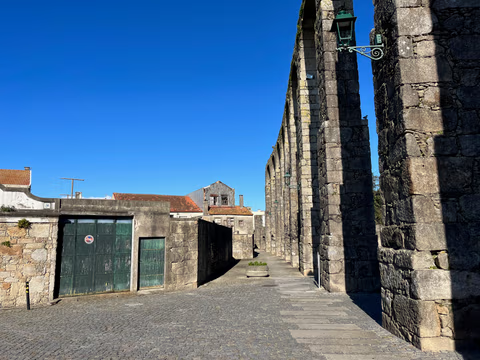
Aqueduct Trail – A path running along the Vila do Conde Aqueduct
From the Coastal Trail to the Camino Central: 12.9 km along the aqueduct from Vila do Conde to São Pedro de Rates. Route, stage, hostels, costs—explained honestly.
Read
Augsburg Way of St. James
The Augsburg Way of St. James runs 231.7 km in 11 stages from Oettingen in the Ries via Donauwörth, Augsburg, Bad Wörishofen and Ottobeuren to Ermengerst in the Allgäu — the Fuggerei, the Jakobervorstadt, a pilgrim of 1446 and Mozart's organ duel. Stages, hostels, costs.
Read

