

Camino del Norte via Oviedo – The Detour Through the Holy City
The Camino del Norte via Oviedo leaves the coastal route at the turnoff about three kilometers past Villaviciosa, climbs over the hills of Sariego into the interior, and reaches the Cathedral of San Salvador in Oviedo by way of Pola de Siero and the bridge at Colloto. From there it doesn't head into the mountains like the Camino Primitivo; instead it runs through Llanera and Corvera back to the coast at Avilés, where you're standing on the Camino del Norte again. 69.7 kilometers, three stages, 986 meters of climbing, highest point 406 meters. A detour that comes back – and picks up along the way the city that pilgrims have been leaving the coast for since the 11th century.
- 01At a Glance
- 02Overview
- 03Other Names
- 04Who It's Ideal For—and Who It's Not So Ideal For
- 05Route & Landscape
- 06Stages, Terrain, and Difficulty
- 07The Detour That Comes Back: Why Pilgrims Left the Coast for San Salvador
- 08Highlights Along the Way
- 09How Pilgrims Find Their Way onto This Path
- 10Continue the pilgrimage?
- 11Preparation & Practical Information
- 12What the journey will cost you
- 13Getting Here
At a Glance
- Start / Finish: turnoff from the Camino del Norte about 3 km past Villaviciosa / Avilés, where you rejoin the Camino del Norte
- Length: 69.7 km, of which 40.3 km to Oviedo and 29.4 km from Oviedo to Avilés
- Duration: 3 stages; 4 days with a rest day in Oviedo
- Elevation: ↗ 986 m / ↘ 994 m
- Highest point: 406 m at km 7.3 between Arbazal and Valvidares
- Landscape: apple meadows and oak woods in the hill country of Villaviciosa and Sariego, the Siero plain, a walk right through Oviedo, then pastures, industrial parks and suburbs all the way to the Ría de Avilés
- Operator / Waymarking: yellow arrows and scallop-shell markers of the Asturian Camino network; bronze shells set into the pavement in Oviedo
- Traces of St. James: the San Pedro pilgrim hospital in Pola de Siero from 1141, the apostle columns of the Cámara Santa in Oviedo, the Romanesque church of Santiago de Arlós in Llanera, the hospital of Pedro Solís in Avilés
- Accommodation: pilgrim albergues in Pola de Siero, Oviedo and Avilés, a small monastery albergue in Valdediós as a side trip; hostales and guesthouses in between
- Connecting routes: Camino del Norte at the start and the finish; in Oviedo the Camino Primitivo, Camino San Salvador and Camino de las Asturias
- Best time: May to October; albergues open year-round, rain in Asturias in every season
Overview
If you walk the Camino del Norte through Asturias, shortly after Villaviciosa you'll come to a fork. Straight ahead, the coast leads on to Gijón; to the left, the interior leads to Oviedo. Most people who turn left then stay in the mountains and walk the Camino Primitivo. This route does something different: it collects the Cathedral of San Salvador and, in one more stage, brings you back to the sea at Avilés. Here the detour isn't a farewell to the coast. It's an excursion with a return ticket.
Historically, this is no invention. The Xacopedia describes exactly this connection: from Oviedo, starting at the church of Santullano, a road runs via Llanera and Corvera to Avilés, and some pilgrims preferred it to the tough Primitivo after visiting the relics in Oviedo. From the 12th century on, Avilés was the most important port in Asturias, "el principal embarcadero de Asturias" (the main landing place of Asturias), where pilgrims from northern and northwestern Europe came ashore. Honestly, though, the second day is also the least spectacular: between Oviedo and Avilés you walk through the urban sprawl of the Oviedo–Gijón–Avilés triangle, with roads, industry and suburbs.
Other Names
The route has no fixed name. Spanish guidebooks usually call the section to Oviedo the Variante por Oviedo or Camino del Norte por Oviedo; the continuation to Avilés shows up as the Oviedo–Avilés connection, and in English people talk about the Oviedo detour. Don't confuse it with the Camino Primitivo, which in Galicia is simply called the Camino de Oviedo: it does start in the same cathedral, but it heads west into the mountains rather than back to the sea.
Who It's Ideal For—and Who It's Not So Ideal For
Ideal if you're walking the Camino del Norte and don't want to skip Oviedo, without giving up the coast for it. Ideal if you're looking for a rest day in a real city: the cathedral, the Cámara Santa, pre-Romanesque churches from the 9th century, sidrerías. And ideal if, after days full of beach towns, the quiet of the hinterland appeals to you.
Honestly, though, it's not for you if you're after the most beautiful stretch: the first day is rural and lovely, but the third runs for kilometers through suburbs and industry and alongside highways. Not for you if you want to save kilometers – you swing inland and come out on almost the same coast. And not for you if you're heading for the Primitivo anyway: then your route ends in Oviedo, and you won't need the second half of this page.
Route & Landscape
Turnoff to Oviedo (km 0–40.3): Past Villaviciosa, the route splits from the coastal route and climbs via La Fontana and Ambás into the hills. At km 7.3, between Arbazal and Valvidares, you reach the highest point at 406 meters; down in the valley lies Valdediós with its monastery, just under two kilometers off the trail. Via Figares, Pedrosa and La Vega you walk down into the plain of Pola de Siero (km 23.2). After that it gets flatter and more urban: El Berrón, Meres with the Romanesque church of San Martín de Argüelles, Granda, and the old bridge at Colloto over the Nora, before you pass through the outskirts into the center of Oviedo.
Oviedo to Avilés (km 40.3–69.6): Leaving Oviedo, you head via Cuyences and Llaviada to Cayés and Ables, through the municipality of Llanera (km 51.5). Past La Miranda, the route drops from just under 200 meters down to El Llano and Cancienes (km 62.3); through Corvera de Asturias and La Rozona you reach Avilés at 12 meters. Meadows and eucalyptus alternate with ribbons of settlement; the old town of Avilés with its arcades is the reward at the end.
Stages, Terrain, and Difficulty
We show the route in 3 stages; kilometers come from the Camino Ninja map, calibrated exactly to 69.7 km. If you spend the night in Villaviciosa, add the good three kilometers to the turnoff to your first day. The third stage is long; you can split it in Llanera, where there are hostales.
- Turnoff near Villaviciosa → Pola de Siero (23.2 km) — the mountain day: climb to 406 m, then hills, meadows and hamlets; side trip to Valdediós possible.
- Pola de Siero → Oviedo (17.1 km) — flat and short, via El Berrón and the Colloto bridge into the city; time for the cathedral.
- Oviedo → Avilés (29.4 km) — via Cayés and Llanera, then downhill to Cancienes and Corvera, lots of asphalt and built-up areas all the way to Avilés.
Technically, nothing is difficult. The first morning's climb is short and steep; after that the route rolls along in gentle waves. What wears you out is the surface: a large share is on asphalt, and after rain the farm tracks in Sariego turn muddy.
The Detour That Comes Back: Why Pilgrims Left the Coast for San Salvador
The old San Salvador saying – whoever goes to Santiago and not to the Savior visits the servant and skips the Lord – has been sending pilgrims off toward Oviedo since the Middle Ages. This route shows another side of it: leaving the coast for San Salvador didn't mean disappearing into the mountains for good. The Xacopedia names one pilgrim known by name who did exactly that: Jakub Sobieski, father of the later Polish king John III, turned off the coastal route toward Oviedo in 1611 and then continued his journey via Ribadeo – in other words, back on the coast. Some 120 years earlier, in 1489, the Armenian bishop Martyr of Arzendjan had written the first account of the northern route.
The logic is that of a port. In 1085 Avilés received a town charter from Alfonso VI, which Alfonso VII confirmed in 1155; the 1155 copy is considered the oldest surviving document in the Asturian language and has been kept in the municipal archive since 2009. From the 12th century on, pilgrims from northern Europe came into the country through this port, reached Oviedo by the road through Llanera – and took the same road back to the coast. What looks to you like a loop today was once the road between the capital and its harbor.
Most roads lead to Oviedo. This one also leads back out. And at the very end, a handover of another kind awaits – according to the Xacopedia, the Franciscan church in Avilés holds the tomb of Pedro Menéndez de Avilés, born here in 1519, who on September 8, 1565, founded St. Augustine in Florida, the oldest continuously inhabited European city in what is now the United States. A seafarer from the pilgrims' port.
Highlights Along the Way
- Valdediós (side trip at km 5.9) — San Salvador, the "Conventín," consecrated according to its inscription "SUB ERA DCCCCXXX," that is, in 892, by seven bishops; next to it the Cistercian monastery of Santa María, founded on November 27, 1200, by Alfonso IX, its church built from 1218 to around 1225, dissolved in 1835, today with a small pilgrim albergue.
- Pola de Siero (km 23.2) — market town with the San Pedro hospital from 1141, according to the Xacopedia "probablemente la hospedería más antigua del Camino de Santiago por la costa" (probably the oldest hostel on the coastal Camino de Santiago), endowed by María Ordóñez; town charter under Alfonso X, effective only in 1310.
- Colloto bridge (km 36.0) — 36.6 meters long, two arches over the Nora, called "Roman," though its age is disputed; a Bien de Interés Cultural since 2003.
- Oviedo (km 40.3) — the Cathedral of San Salvador with the Cámara Santa; plus San Julián de los Prados, known as Santullano, built under Alfonso II between 791 and 842, where the road to Avilés begins; World Heritage since 1985, extended in 1998.
- Santiago de Arlós (Llanera) — Romanesque church from the 12th century dedicated to St. James, according to the Xacopedia on the route within the municipality of Llanera.
- Avilés (km 69.6) — old town with arcades, a protected ensemble since 1955; the Pedro Solís pilgrim albergue, named after the founder of a 16th-century hospital.
How Pilgrims Find Their Way onto This Path
Almost everyone arrives on the Camino del Norte from the east, via Ribadesella and Villaviciosa. The decision is made at the turnoff past Villaviciosa: straight on along the coast to Gijón, or left to Oviedo. Planning starts in Villaviciosa, because that's where the beds are.
The second part, Oviedo–Avilés, is also used by pilgrims who arrive in Oviedo from the south and would rather continue along the coast than in the mountains:
- Camino San Salvador — from León across the Cantabrian Mountains to Oviedo Cathedral
- Camino de las Asturias — from Pamplona along the foot of the mountains to Oviedo
Continue the pilgrimage?
In Avilés you're back on the Camino del Norte. It continues west to the wild coast of western Asturias, via Luarca and Ribadeo into Galicia; near Arzúa it joins the Camino Francés and reaches Santiago. According to the Xacopedia, Llanera lies 321 kilometers from Santiago.
If you realize in Oviedo that the mountains tempt you more than the sea, switch there to the Camino Primitivo. According to the Xacopedia, the line via Oviedo from Villaviciosa is actually shorter: 355 kilometers to Santiago, compared with 377 via Gijón.
Preparation & Practical Information
Pilgrim passport and app. As on all Spanish routes, you need a pilgrim passport (credencial) to stay in the albergues and to receive the Compostela at the end. It's best to order it online in advance so it reaches you in time for the start of your trip. Get a stamp at Oviedo Cathedral; with the credencial, pilgrims pay a reduced entrance fee. The easiest way to plan your stages is right in the Camino Ninja App, where you put your stages together and plan suitable accommodation at the same time.
Accommodation. The pilgrim albergue in Pola de Siero sits at the edge of town right on the route, is run by the local pilgrims' association, has 24 beds and is open year-round. In Oviedo there's the El Salvador albergue, in Avilés the Pedro Solís albergue at the edge of the old town. Between Oviedo and Avilés, don't count on a pilgrim albergue; if you split the stage, you'll sleep in a hostal in Llanera.
Season. Asturias is green because it rains – in summer too. A rain jacket and gaiters belong in your pack; the farm tracks on the first stage get muddy fast. In July and August Oviedo is packed, and the albergues on the Norte fill up by midday.
What the journey will cost you
The albergues are cheap: Pola de Siero 10 €, El Salvador in Oviedo 7.50 €, Pedro Solís in Avilés 10 € (as of October 2026). A hostal in Avilés starts at around 35 € for a single and 45 € for a double room. The credencial and the Compostela cost nothing or a small donation.
Count on 30 to 45 € a day with albergue, bar breakfast and menú del día, or 55 to 75 € with a hostal. Honestly, the rest day in Oviedo will cost you more than any stage – blame the sidrerías on Calle Gascona.
Getting Here
To the start. You can reach Villaviciosa on ALSA buses from Oviedo and Gijón. Asturias Airport lies near Avilés, and long-distance trains arrive in Oviedo; since the end of 2023 the AVE from Madrid has run through the new Pajares tunnels in just over three hours.
From the finish. Avilés has Renfe commuter trains to Oviedo and Gijón and buses to the airport. If you finish in Avilés, the train gets you back to Oviedo quickly.

Get your pilgrim credential and shell
Everything you need for the Camino del Norte via Oviedo – The Detour Through the Holy City, shipped to your door.
Visit Camino Shop
Other Caminos
 Appenzeller Weg
Appenzeller Weg
52.6 km from Rankweil across the Rhine to St. Peterzell: St. James Chapel (1464), 163 Years of the Wedding Trail, connection to the Via Jacobi. Stages, costs, how to get there.
Read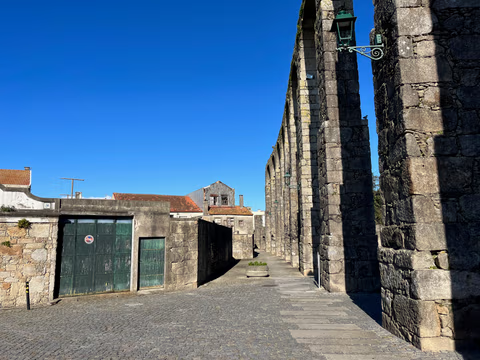
Aqueduct Trail – A path running along the Vila do Conde Aqueduct
From the Coastal Trail to the Camino Central: 12.9 km along the aqueduct from Vila do Conde to São Pedro de Rates. Route, stage, hostels, costs—explained honestly.
Read
Augsburg Way of St. James
The Augsburg Way of St. James runs 231.7 km in 11 stages from Oettingen in the Ries via Donauwörth, Augsburg, Bad Wörishofen and Ottobeuren to Ermengerst in the Allgäu — the Fuggerei, the Jakobervorstadt, a pilgrim of 1446 and Mozart's organ duel. Stages, hostels, costs.
Read

