

Camino Malta
35.5 kilometres from St Paul's Grotto in Rabat to Fort St Angelo in the Grand Harbour: via Mdina, the church of St James at Ħaż-Żebbuġ (1430), the Il-Maqluba sinkhole, Żurrieq with its St James altarpiece of 1731, the Last Judgement chapel of Bir Miftuħ, the baroque domes of Żejtun and the votive paintings of Żabbar down to the Three Cities — 188 metres up, 387 down, one or two days. An official feeder route of the Camino network since December 2022, because a Spanish hermit had the Grand Master write him a safe-conduct to „San Giacomo in Galitia" in 1617. Kredenzjal for €3, stamps even at police stations, Testimonium from XirCammini; 3,600 kilometres to Santiago lie beyond. No hostel network, hardly any shade, a young route.
- 01At a glance
- 02Overview
- 03Other names
- 04Who it is ideal for – and who it is not
- 05Route and landscape
- 06Stages, terrain and difficulty
- 07The hermit who had a safe-conduct to Galicia written for him
- 08Highlights along the way
- 09How pilgrims reach this route
- 10Continuing the pilgrimage?
- 11Preparation and practicalities
- 12What the route costs you
- 13Getting there
At a glance
- Start / finish: Rabat, St Paul's Grotto and Catacombs / Birgu (Città Vittoriosa), Fort St Angelo in the Grand Harbour
- Length: 35.5 km (operators: „only 35km")
- Duration: 1–2 days according to the operators; Camino Ninja division into 3 short stages
- Elevation: ↗ 188 m / ↘ 387 m — from the plateau to the water
- Highest point: 205 m at Mdina/Rabat; lowest point 6 m at the Grand Harbour
- Stages: 3 — Camino Ninja system; only the halfway stop at Żurrieq is officially documented
- Landscape: Mdina plateau, rubble walls and terraced fields, village domes, limestone quarries, airport plain, Three Cities on the Grand Harbour
- Operators: XirCammini (founded 2018) with Heritage Malta, the Malta Tourism Authority and the foreign ministry; in the Camino network since December 2022
- Waymarking: in progress — „a labour of love by several volunteers and a continuous work-in-progress"; ask XirCammini for the GPS track
- Traces of St James: Church of St James Ħaż-Żebbuġ (1430), St James's Church Żurrieq (built 1725–1731, altarpiece 1731), 15th-century fresco of St James at Ħal Millieri
- Accommodation: no pilgrim hostels; hotels, apartments, retreat houses; halfway stop Żurrieq
- Pilgrim passport: Kredenzjal €3.00 (as of September 2026), stamps at museums, churches, local councils and police stations; Testimonium for the Malta section
- Onwards to Sicily: ferry Valletta–Pozzallo, then the Camino Sicilia (125.4 km)
- Best time: October to May; July and August „hot, exposed, and largely shadeless"
Overview
This route is the beginning of something very long. 35.5 kilometres from the grotto where Paul is said to have sheltered after the shipwreck of AD 60 to the fort from which the Knights of St John repelled the Ottomans in 1565 — and beyond it 3,600 kilometres via Sicily, Sardinia and Catalonia to Santiago, four to five months, „one of the longest Caminos de Santiago on record". You walk from the Mdina plateau (205 m) through the village landscape of Malta's south, „rubble walls, terraced fields, and parish churches disproportionate to the settlements they serve", down to the waterline of the Grand Harbour: past the church of St James at Ħaż-Żebbuġ, older than the island's oldest parish register, past the Il-Maqluba sinkhole, which tore open in a storm on the night of 23 November 1343, past three domes by Lorenzo Gafà, a chapel with a 16th-century Last Judgement and a museum with 85 votive paintings, 74 of them from the sea.
The route has been official since December 2022, „accepted and endorsed by the competent authorities on historical grounds" — and the reason fits in one hand: a safe-conduct that Grand Master Alof de Wignacourt issued to a Spanish hermit for the journey to „San Giacomo in Galitia". The same hermit created the starting point. To be honest, Malta is no island of St James — the island belongs to Paul, and you find James in two churches and one fresco, not on every corner. The route is young, the waymarking in progress, there is no hostel network, and in August the path has no shade. In return the pilgrim passport costs three euros, you get stamps at police stations, and at the end you hold a Testimonium — for 35.5 kilometres, not for the Compostela. That lies 3,600 kilometres further on.
Other names
Officially the whole route is called the Camino Maltés — that is how it appears on caminomaltes.mt, in the Heritage Malta announcement of 23 January 2023 („Malta is now a starting point for the Camino de Santiago") and in the maps of the Spanish Instituto Geográfico Nacional. In our route database we list the Maltese section as Malta Camino with the subtitle Camino Maltés; on this page we call it Camino Malta, because it begins and ends on Malta. In Maltese the pilgrim passport is the Kredenzjal, the certificate at the finish the Testimonium — two terms you will meet along the way.
What matters is the distinction between section and whole route: the Camino Maltés in the wider sense is the 3,600-kilometre chain Malta → Sicily (Cammino di San Giacomo) → Sardinia (Camin St Jacu) → Catalonia (Camino Catalán) → Santiago; the Camino Malta is its first link, 35.5 kilometres. XirCammini issues a separate certificate for each link. And one name that is wrong: there is no „Fort St James" on Malta — the bastion in Valletta is called Saint James Cavalier and is not on the route.
Who it is ideal for – and who it is not
Ideal if you are looking for the cheapest Camino entry in the world: Kredenzjal €3.00, bus €2.00–2.50 per journey, Explore Card €25 for seven days (as of September 2026) — the expensive item is the flight, not the route. Ideal if you want to walk in winter: from October to May Malta is mild, the villages are open, and 35.5 kilometres with 188 metres up and 387 down are done in one or two days. Ideal if you want baroque and Middle Ages over a short distance: three domes by Lorenzo Gafà, a cathedral of 1702, two chapels with 15th- and 16th-century frescoes, an Inquisitor's Palace. And ideal if you want to begin a big project — this route is the first page of a 3,600-kilometre book, with a ferry to Sicily at the end.
To be honest, though, it is not for you if you come in July or August: 31.6 and 32.0 degrees on average, statistically zero millimetres of rain in July, sirocco to over 40 degrees, record 44 °C — and the route source says it bluntly: „Malta in July and August is hot, exposed, and largely shadeless." Not for you if you need waymarks: the operators themselves call the route „a work in progress", markers are being placed gradually, you ask for the GPS track in advance. Not for you if you are looking for hostels — there are none, you sleep in a hotel, apartment or retreat house. And not for you if you expect the Compostela: XirCammini's Testimonium certifies 35.5 kilometres, the cathedral in Santiago requires the last 100 on foot. If you want to see the frescoes of Ħal Millieri and Bir Miftuħ, plan your date around the first Sunday of the month — gaps like these are planned away beforehand, not on the trail.
Route and landscape
You start in Rabat outside St Paul's Catacombs, a few steps from St Paul's Grotto, documented since 1366 as „ecclesia Sancti Pauli de cripta", and walk through the gate of the silent city of Mdina past Gafà's cathedral of 1702; then the route drops from the plateau over Saqqajja hill to Ħaż-Żebbuġ, where the Church of St James of 1430 today serves the Coptic community. Via Siġġiewi with its church of St Nicholas (1675–1693, Gafà again) you reach Qrendi and the rim of Il-Maqluba: a hole 50 metres across and 15 metres deep, which according to the chronicle tore open in a storm or earthquake on 23 November 1343 — legend says God swallowed a sinful hamlet, „saving only the wise neighbour". On the rim stands St Matthew's Chapel, from at least the 14th century. Via the quarry village of Mqabba you come to Żurrieq, the official halfway stop, with St James's Church of 1731 and, a few hundred metres off the route, the chapel of Ħal Millieri with its 15th-century fresco cycle.
The second half is flatter and more densely settled. Via Safi, whose festa in late August celebrates the conversion of Paul, and Gudja — with St Mary's Chapel at Bir Miftuħ, built around 1430, listed in 1436 as one of the island's twelve parishes, with a 16th-century Last Judgement on the wall — and Għaxaq you reach Żejtun, whose dome and clock towers „have dominated the town's skyline for 300 years": St Catherine, the third Gafà on the route, foundation stone 1692, consecrated 1742. Then Żabbar with the Sanctuary of Our Lady of Graces and its museum, Bormla and finally Birgu, the Città Vittoriosa: the Inquisitor's Palace (1571–1798), the old hospital of the Order from 1534, the collegiate church of St Lawrence — and at the tip of the promontory Fort St Angelo, where the route ends at the waterline. Surface: asphalt and village streets, field paths between rubble walls, limestone; shade rare, water in every village.
Stages, terrain and difficulty
We divide the route into three short stages — that is our Camino Ninja system. XirCammini itself says: „only 35km, typically completed in 1 or 2 days", „with a common stop in the village of Zurrieq if walked over 2 days"; we adopt this official halfway stop as the end of the first stage and split the rest at Żejtun, where there are hotels and buses. We have estimated the kilometres from the waypoint chain of our route data and calibrated them to 35.5 kilometres — externally documented are only the total length and the halfway stop. Difficulty: technically none, ↗ 188 m / ↘ 387 m, almost the whole descent is in stage 1; the challenge is the sun.
- Rabat/Mdina – Ħaż-Żebbuġ – Siġġiewi – Qrendi – Mqabba – Żurrieq (19.5 km) — St Paul's Grotto, catacombs, Mdina cathedral, Church of St James (1430), Gafà's St Nicholas, Il-Maqluba, St James's Church Żurrieq; Ħal Millieri on the first Sunday of the month.
- Żurrieq – Safi – Gudja – Għaxaq – Żejtun (9.5 km) — Xarolla windmill, Bir Miftuħ with the Last Judgement, airport plain, St Catherine in Żejtun with Gafà's dome.
- Żejtun – Żabbar – Bormla – Birgu, Fort St Angelo (6.5 km) — Sanctuary of Our Lady of Graces with 85 votive paintings, Three Cities, Inquisitor's Palace, St Lawrence, Fort St Angelo on the Grand Harbour; Testimonium from XirCammini.
If you walk the official two-day version, you split at Żurrieq: 19.5 + 16.0 kilometres. If you do it all in one day, you have 35.5 kilometres with no climb worth mentioning — feasible outside summer, not advisable in it. What makes the route hard is not the elevation but heat, asphalt and opening hours: two litres of water per person and stage, headgear, sleeves against the sun, and the stamping places — museums, church museums, local councils, police stations — are more likely closed than open on Sundays. The bus is plan B everywhere: every village on the route has a stop.
The hermit who had a safe-conduct to Galicia written for him
A Camino does not become official because someone walks it, but because someone walked it in the past — demonstrably. The Maltese side formulates the rule itself: „to get a camino, you need to prove that there has historically been some sort of pilgrim movement between the two places." For Malta that proof was a single sheet: a credencial from the early 17th century, issued by Grand Master Alof de Wignacourt to Don Juan Benegas de Córdoba, a safe-conduct for the journey from Rabat to the shrines of Europe, among them explicitly „San Giacomo in Galitia". On the strength of this paper the Spanish Instituto Geográfico Nacional added the route to its maps in early December 2022. For four hundred years the letter lay in an archive, then it made 35.5 kilometres of Malta a Way of St James.
And the man with the safe-conduct is no chance find, but the reason the route begins exactly where it begins. Juan Beneguas, as the Maltese sources spell him, was a Spanish nobleman from Córdoba who lived between 1600 and 1624 as a hermit at St Paul's Grotto in Rabat, procured relics and indulgences for it and built up its veneration systematically. Pope Paul V granted him the right of patronage over the grotto by a brief of 6 December 1610, confirmed on 10 February 1611; in 1610 the grotto was detached from the parish of Rabat. On 22 April 1617 Beneguas transferred jurisdiction to Wignacourt, who accepted it two days later and founded a college whose canons were to tend the grotto „day and night". So the Spaniard who had the Grand Master write him a passport to Santiago built the church where you collect your first stamp today. The grotto itself has been documented since 1366, Nelson visited it in 1800, three popes prayed there in silence — 1990, 2010, 2022 — and Francis raised it to a basilica in 2020. Its real saint remains Paul, who was shipwrecked here around AD 60: „Barbari vero præstabant non modicam humanitatem nobis", says the Vulgate, Acts 28:2 — the islanders showed us no small kindness.
To be honest, that is the whole St James chain of Malta: a Spaniard with a safe-conduct, a church of 1430 at Ħaż-Żebbuġ, a baroque painting of 1731 at Żurrieq, a painted apostle of the 15th century at Ħal Millieri and a medieval mention of the Order of St James of Altopascio. We found no named Maltese pilgrim to Santiago from the Middle Ages, and no scallop graves either. But the route ends at a place that would not exist without pilgrims: the Order that moved into Birgu in 1530 and survived the siege of 1565 from Fort St Angelo had been founded in Jerusalem in 1113 as a hospital for pilgrims. You walk from a pilgrim's cave to a pilgrim order's fortress — and on by ferry, if you wish, all the way to Galicia.
Highlights along the way
- St Paul's Grotto and Catacombs, Rabat — starting point; the grotto documented since 1366 as „ecclesia Sancti Pauli de cripta", statue of Paul by Grand Master Pinto (1748), basilica since 2020; three papal visits (1990, 2010, 2022). Next to it the 4th-century catacombs, Heritage Malta stamp.
- Mdina, St Paul's Cathedral — rebuilt by Lorenzo Gafà after the earthquake of 1693, consecrated 8 October 1702, „Gafà's masterpiece"; font of 1495 and 15th-century choir stalls from the earlier church. The legend of Publius's palace beneath it is legend — „not supported by archaeologists or historians".
- Church of St James, Ħaż-Żebbuġ — „The original church of St. James, within limits of Żebbuġ, dates back to 1430", older than the rollo of 1436; rebuilt 1674, today the church of Malta's Coptic community. First trace of St James on the route.
- Il-Maqluba, Qrendi — sinkhole 50 metres across, „appeared violently on 23 November 1343 during a violent storm, or possibly an earthquake"; St Matthew's Chapel on the rim, at least 14th century.
- St James's Church, Żurrieq — recorded in 1575 by the inquisitor Pietro Dusina, rebuilt 1725–1731; altarpiece by Francesco Zahra (1731) showing Christ appearing to St James the Greater.
- Ħal Millieri, Chapel of the Annunciation — chapel of around 1480 in an abandoned settlement, 15th-century fresco cycle with some ten saints, among them James; in 1968 Din l-Art Ħelwa cleared out „thirteen truckloads of rubble and debris". Open every first Sunday of the month, 9–12.
- St Mary's Chapel, Bir Miftuħ (Gudja) — built around 1430, in 1436 one of Malta's twelve parishes; 16th-century Last Judgement; desecrated by the Ottomans in 1565, bells hidden in the tombs; roof collapse after an air raid on 9 April 1942, restoration 1973–2004. Open once a month.
- Church of St Catherine, Żejtun — foundation stone 25 November 1692, Lorenzo Gafà, consecrated 11 May 1742; dome and clock towers „have dominated the town's skyline for 300 years".
- Żabbar Sanctuary Museum — opened 5 September 1954, Malta's first purpose-built museum; 85 votive paintings, 74 of them maritime, „the largest number of ex-votos in Malta that were given by the Knights of St. John".
- Birgu (Città Vittoriosa) — headquarters of the Order of St John from 1530, Great Siege 1565; Inquisitor's Palace (1571–1798), „the only palace related to the Inquisition in the world that has survived and is open to the public"; old hospital of the Order from 1534; collegiate church of St Lawrence with memorials to Jean de Valette.
- Fort St Angelo — finish of the route on the Grand Harbour; the operators justify the choice with „the links to the Knights of St John, the service and raison d'être of the Order itself, the maritime routes, its position in the Grand Harbour."
How pilgrims reach this route
Malta is an island — there is no feeder route on foot, you arrive by plane or by ferry. Malta International Airport at Luqa lies in the middle of the second stage, between Safi, Gudja and Għaxaq: from the airport you take the bus across the island to Rabat for the start, and from the finish in Birgu the airport is the nearest point on the route. Single fare €2.00 in winter, €2.50 in summer, valid two hours (as of September 2026).
The second approach is by sea, and it suits this route: Virtu Ferries links Pozzallo in Sicily with Valletta in around 1 hour 45 minutes, about 30 sailings a week. If you think of the great route in reverse — Sicily first, then Malta — you arrive on the Camino Sicilia from Caltagirone to Capizzi and then cross over; from the ferry terminal in Valletta it is a few minutes by harbour ferry to Birgu and from there by bus to Rabat. Either way: the Camino Malta is meant as a beginning, not an arrival.
Continuing the pilgrimage?
Yes — and on a grand scale, for on this route Malta is the first link in a chain of around 3,600 kilometres, walkable in four to five months according to the operators. From Valletta Virtu Ferries takes you to Pozzallo, and on Sicily the Camino Sicilia awaits, 125.4 kilometres from Caltagirone via Piazza Armerina to Capizzi in the Nebrodi — the Sicilian continuation, for which XirCammini also issues a certificate. Then comes Sardinia on the Camin St Jacu, then the ferry to Barcelona and the Camino Catalán, which leads via Montserrat and Lleida into the great Spanish axes. Anyone who walks this whole chain has completed one of the longest Ways of St James there is.
A realistic note: the Compostela in Santiago is granted for the last 100 kilometres on foot, not for Malta. If you walk only the Camino Malta, you receive the Testimonium from XirCammini — a certificate for 35.5 kilometres walked, issued around 731 times to pilgrims from more than 20 nations by June 2025. Keeping the two clearly apart is part of the honesty of this route; and if you need the Spanish credencial for the final section, you get it there.
Preparation and practicalities
Best time: October to May; the climate source recommends „April, May and the first half of October". In July and August the average is 31.6 and 32.0 degrees, statistically no rain falls in July, and a sirocco from the Sahara can bring over 40 degrees (record 44 °C, August 1999). The wet months are December (110 mm) and January (100 mm) — walkable, just wetter. Waymarking and navigation: take the route for what it is, a young project: „waymarks being progressively placed", the GPS track comes on request from XirCammini (information@XirCammini.org). Plan the route offline on your phone — easiest directly in the Camino Ninja app together with your stages and accommodation. Kredenzjal: the Maltese pilgrim passport, €3.00 (as of September 2026), with „an outline of the 3,600km route through Malta, Sicily, Sardinia and Spain" and „The Pilgrim Prayer in Maltese and in English"; online with postal delivery or at the Tourist Information Offices on Malta. Stamps: „Stamps are available at Heritage Malta museums, church museums, local councils, and some police stations along the route." Testimonium: from XirCammini for the completed Malta section.
Opening hours are the real planning here: Ħal Millieri opens every first Sunday of the month from 9 to 12, Bir Miftuħ once a month — if the frescoes matter to you, plan your date around them. Accommodation: no pilgrim hostels; hotels, apartments and retreat houses in the villages, Żurrieq as the official halfway stop, Birgu and Valletta at the finish. Packing list: headgear, sunscreen, at least two litres of water per person and stage, light clothing with sleeves, power bank, small change for candles and church museums. Language: Maltese and English are both official languages, English gets you everywhere, and a large part of the population understands Italian. Festas: almost every village on the route celebrates its patron saint in summer with procession and fireworks — dates shift to the nearest Sunday, ask in the village.
What the route costs you
To be honest, this is the cheapest Camino entry there is; the expensive item is the flight. All amounts as of September 2026, Malta is in the eurozone. Documented are the official fares: Kredenzjal €3.00; bus single day-route fare €2.00 in winter, €2.50 in summer, night routes and Tallinja Direct €3.00, all tickets valid two hours with free transfers; 12 single journeys for €19.00; Explore Card 7 days €25.00 (children 4–10 €7.00), Explore Flex 4 days €21.00 or 7 days €27.00; Testimonium from XirCammini without a fixed price. Guide values: Heritage Malta single ticket €6–12; simple double room in a village such as Żurrieq or Żejtun €55–90, hotel double room in Birgu or Valletta €90–170, retreat house €25–45 per person; pastizzi and a drink €3–6, dinner in a simple restaurant €15–28, daily supermarket shop €8–13, coffee €1.50–3.
Realistic daily budget: frugal with a village room, self-catering and Explore Card €45–65, mid-range with a room, one hot meal and admissions €75–110, comfortable with a hotel in Birgu, restaurant and all museums €150–220. The only one-off extra is essentially the €3.00 for the Kredenzjal. We do not give a price for the ferry to Pozzallo — fares vary by season, check with Virtu Ferries.
Getting there
To the start (Rabat, St Paul's Catacombs): Rabat lies inland right next to Mdina, with standard bus routes from Valletta and from Malta International Airport at Luqa. Single fare €2.00 (winter) or €2.50 (summer), valid two hours; for several days the Explore Card (7 days €25.00) or Explore Flex (€21.00/€27.00) is worth it, as of September 2026. Several airlines fly direct to Malta from the UK, Ireland and most of Europe, flight time from London around three hours.
Along the route and from the finish (Birgu, Fort St Angelo): Rabat/Mdina, Żurrieq, the airport next to stage 2 and Birgu all have bus connections — every stage can be broken off or begun. Birgu lies on the Grand Harbour opposite Valletta; bus and harbour ferry take you across in minutes, and from there on to the airport. If you continue to Sicily, take the Virtu Ferries service Valletta → Pozzallo, around 1 hour 45 minutes, about 30 sailings a week.
- Malta buses, fares and Explore Card: publictransport.com.mt — airport – Rabat – Żurrieq – Birgu
- Ferry to Sicily: virtuferries.com — Valletta – Pozzallo
- Operators, route, Kredenzjal, Testimonium, FAQ: caminomaltes.mt — XirCammini
- Order the Kredenzjal: xircammini.org — shop, €3.00
- Starting point and museums: heritagemalta.mt — St Paul's Catacombs, Inquisitor's Palace, Fort St Angelo

Get your pilgrim credential and shell
Everything you need for the Camino Malta, shipped to your door.
Visit Camino Shop
Other Caminos
 Appenzeller Weg
Appenzeller Weg
52.6 km from Rankweil across the Rhine to St. Peterzell: St. James Chapel (1464), 163 Years of the Wedding Trail, connection to the Via Jacobi. Stages, costs, how to get there.
Read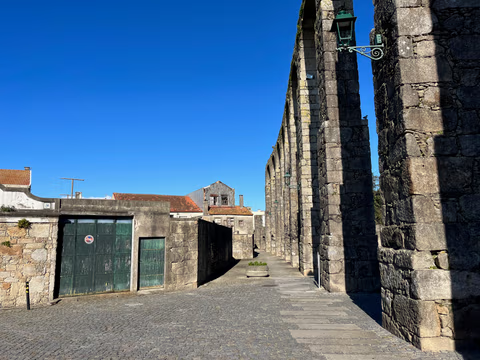
Aqueduct Trail – A path running along the Vila do Conde Aqueduct
From the Coastal Trail to the Camino Central: 12.9 km along the aqueduct from Vila do Conde to São Pedro de Rates. Route, stage, hostels, costs—explained honestly.
Read
Augsburg Way of St. James
The Augsburg Way of St. James runs 231.7 km in 11 stages from Oettingen in the Ries via Donauwörth, Augsburg, Bad Wörishofen and Ottobeuren to Ermengerst in the Allgäu — the Fuggerei, the Jakobervorstadt, a pilgrim of 1446 and Mozart's organ duel. Stages, hostels, costs.
Read

