

Camino Sicilia
The Camino Sicilia crosses Sicily from port to port: 454.2 kilometres and 11,719 metres of ascent in 20 stages, from the Malta ferry in Pozzallo through the Baroque towns of the Val di Noto to Caltagirone, along the Cammino di San Giacomo to Capizzi, then over the highest point at 1,301 metres and through the Madonie to Palermo – where the ferry to Cagliari begins the next link of the Camino Maltés.
- 01At a Glance
- 02Overview
- 03Other Names
- 04Ideal For – and Less So For
- 05Route & Landscape
- 06Stages, Terrain & Difficulty
- 07In Capizzi the Procession Smashes a Wall Every Year
- 08Highlights Along the Way
- 09How Pilgrims Reach This Route
- 10Continuing the Pilgrimage?
- 11Preparation & Practicalities
- 12What the Route Costs
- 13Getting There
At a Glance
- Start / Finish: Pozzallo, ferry port (Malta ferry) → Palermo, port (ferry to Cagliari)
- Length: 454.2 km
- Elevation: 11,719 m of ascent, 11,694 m of descent
- Highest point: 1,301 m on the ridge between Capizzi and Geraci Siculo (km 276.9)
- Stages: 20
- Duration: 20–23 days
- Difficulty: demanding – mountain country on an Alpine scale, one 47-kilometre stage, water shortage in summer
- Operator: core section Caltagirone – Capizzi: Associazione Borgo San Giacomo di Piazza Armerina; feeder Pozzallo – Caltagirone and continuation Capizzi – Palermo: Camino Ninja routing
- Waymarking: yellow arrows and logo between Caltagirone and Capizzi; no continuous Way of St. James waymarking on the other sections – GPS track required
- Best time: April–May and October; summer hot and dry, snow possible in winter in the Nebrodi and Madonie
Overview
The apostle came to Sicily with the Normans, not with the Spanish. On 25 July 1090, St. James's Day, Count Ruggero d'Altavilla defeated the Saracens near Caltagirone – according to tradition the saint had appeared to him beforehand with drawn sword – and in thanks founded the Basilica di San Giacomo, to which he entrusted the protection of the town. 125 kilometres and 2,800 metres of ascent further on, in Capizzi at 1,100 metres in the Nebrodi, stands the island's oldest shrine of St. James, documented since a papal bull of 1227, with a finger bone of the apostle – and with a procession that smashes a house wall every year on 26 July, because a Spanish king had the relics carried off in 1435. These two places are linked by the Cammino di San Giacomo in Sicilia, which Totò Trumino from Piazza Armerina traced during lockdown, completed on 10 May 2021. It is the core of this route.
The Camino Sicilia turns it into the whole island. It begins where the ferry from Malta docks, in Pozzallo, runs through the Baroque towns of Modica and Ragusa and over the hills of the Monti Iblei to Caltagirone, follows the Cammino di San Giacomo to Capizzi and then keeps climbing: over the highest point at 1,301 metres into the Madonie, to Geraci Siculo, Castelbuono and Caccamo, and down to Palermo and the harbour where the ferry to Cagliari departs. 454.2 kilometres, 11,719 metres of ascent, 20 stages, from port to port – the Sicilian link of the Camino Maltés, the chain from Malta via Sicily and Sardinia to Catalonia and Santiago. Frankly, only the middle section is a waymarked operator's route; feeder and continuation are our own routing, and you walk them with the track, not with arrows.
Other Names
Camino Sicilia is our name for the complete crossing from Pozzallo to Palermo – a Camino Ninja classification, not an official designation. The operator calls the core section Cammino di San Giacomo in Sicilia, as in the guidebook by Totò Trumino and Giuseppe Riggio (Terre di mezzo, 2025) and at Cammini d'Italia; English sources say Sicilian Camino. In Italian sources Capizzi carries the epithet „Compostela di Sicilia“ – an honorific, not a title. In the wider network the route is the Sicilian link of the Camino Maltés, the roughly 3,600-kilometre chain Malta → Sicily → Sardinia → Catalonia → Santiago. Don't confuse it with the Via Francigena Normanna, which runs from Palermo to Messina and passes Nicosia and Capizzi as its 9th and 10th stages, nor with the Magna Via Francigena, which heads further west to Agrigento.
Ideal For – and Less So For
The Camino Sicilia is for you if you have three weeks and want to cross an island properly: from the Baroque of the Val di Noto over the wheat hills of the Erei and the Nebrodi into the beech forests of the Madonie and down to the coast at Palermo, through places where hardly any tourists get off – Monterosso Almo, Mirabella Imbaccari, Assoro, Geraci Siculo, Gratteri. It is for you if you look for art history on gravel tracks: the mosaics of the Villa Romana del Casale, a reliquary that took 92 years to make, a Gagini tribune of 1515, a church on record since 1227. And it is for you if you walk the long chain: anyone arriving from Malta by ferry in Pozzallo has the continuation here, and anyone boarding the ship to Cagliari in Palermo has the next one.
Frankly, though, it is not for you if you believe „moderate“ because the sources say so of the core section: 11,719 metres of ascent over 454 kilometres is Alpine scale, the stage from Capizzi to Geraci Siculo measures 47 kilometres with no village in between, and the highest point lies at 1,301 metres. Not for you in high summer: water sources are scarce, and there is hardly any shade in the Dittaino plain. Not for you if you expect waymarking – there is some only between Caltagirone and Capizzi. And not for you if you set off without bookings: there is no hostel network but B&Bs, agriturismi and parish houses, and in the small mountain villages you would otherwise face a handful of beds. Gaps like that are planned away beforehand, not on the way.
Route & Landscape
You start in Pozzallo at the ferry port beneath the Torre Cabrera and climb through the Cava d'Ispica, a thirteen-kilometre canyon full of rock dwellings, up into the Baroque: Modica with the Duomo di San Giorgio and its chocolate made to an Aztec recipe, Ragusa Ibla with Rosario Gagliardi's cathedral – both part of the World Heritage „Città tardo barocche del Val di Noto“, rebuilt after the earthquake of 11 January 1693. Via Chiaramonte Gulfi, the „Balcone di Sicilia“, Monterosso Almo and Vizzini, where Giovanni Verga set his „Cavalleria rusticana“, you reach Grammichele, the hexagonal town of 1693, and Caltagirone, the ceramics town with Count Ruggero's basilica and the Scala di Santa Maria del Monte.
From Caltagirone you follow the Cammino di San Giacomo: via San Michele di Ganzaria to Mirabella Imbaccari, to Piazza Armerina with the Villa Romana del Casale, through the Riserva Rossomanno-Grottascura-Bellia with its wind-carved „pupi ballerini“ to Valguarnera, across the Piana del Dittaino and the sulphur hill of Assoro to Nicosia, the town of the 24 barons, and up into the Nebrodi to Capizzi. Then the third Sicily begins: a long ridge above 1,300 metres, Geraci Siculo at 1,077 metres, Castelbuono with the Ventimiglia castle, Isnello, Gratteri and Collesano in the Madonie, down via Cerda and Sciara to Caccamo beneath one of the island's biggest castles – and the last two days through Casteldaccia and Bagheria to the coast and Palermo. Surface: gravel and farm tracks, mountain paths in the Nebrodi and Madonie, asphalt in the villages and on the final kilometres into the city.
Stages, Terrain & Difficulty
Twenty days of 13 to 47 kilometres. Between Caltagirone and Capizzi we adopt the operator's stage breaks; before and after we set them by beds, which is why Modica – Ragusa stays short and Capizzi – Geraci Siculo gets long – there is simply no village in between, so plan an overnight stop at an agriturismo with pick-up or a very early start. Difficulty: the sources call the core section „moderate“, the figures say otherwise – 11,719 metres of ascent, four stages over 25 kilometres, the highest point on day 14. Kilometres from the Camino Ninja map, calibrated exactly to 454.2 km.
- Pozzallo → Ispica (15.3 km) – From the ferry port beneath the Torre Cabrera up into the hills; a short arrival day, with the Cava d'Ispica waiting.
- Ispica → Modica (23.8 km) – Through the canyon of the Cava d'Ispica with its rock dwellings into the Baroque town of chocolate.
- Modica → Ragusa (13.4 km) – Short, but with a destination: Ragusa Ibla, Duomo di San Giorgio, World Heritage.
- Ragusa → Chiaramonte Gulfi (23.2 km) – Up into the Monti Iblei to the „Balcone di Sicilia“ and its olive oil.
- Chiaramonte Gulfi → Vizzini (26.4 km) – Via Monterosso Almo into Verga country; the duel of „Cavalleria rusticana“ is set in the Cunzirìa, the old tanners' quarter.
- Vizzini → Grammichele (21.3 km) – Via Licodia Eubea into the hexagonal town that Carlo Maria Carafa founded on the drawing board in 1693 after the earthquake.
- Grammichele → Caltagirone (17.9 km) – Into the ceramics town: Basilica di San Giacomo, Scala di Santa Maria del Monte; yellow arrows from here on.
- Caltagirone → Mirabella Imbaccari (20.4 km) – Via San Michele di Ganzaria through the hills of the Erei, wheat and olive groves.
- Mirabella Imbaccari → Piazza Armerina (18.9 km) – Via the Eremo di Leano into the founder's town; Villa Romana del Casale as a detour.
- Piazza Armerina → Valguarnera Caropepe (20.7 km) – Through the Riserva Rossomanno-Grottascura-Bellia at 800 metres, „pupi ballerini“ and the necropolis of Rocca Crovacchio.
- Valguarnera Caropepe → Assoro (25.1 km) – Across the Piana del Dittaino, the lowest section of the middle part, and up into the sulphur village with the Gagini tribune.
- Assoro → Nicosia (23.6 km) – Via Nissoria through hill country to Nicosia, „Civitas Constantissima“, cathedral of San Nicolò.
- Nicosia → Capizzi (16.9 km) – Via Crociate up into the Nebrodi to the Santuario di San Giacomo, finger relic, plenary indulgence.
- Capizzi → Geraci Siculo (47.1 km) – The king stage: over the highest point of the route at 1,301 metres (km 276.9) through beech forest and pasture into the Madonie; no village in between, organise an overnight stop.
- Geraci Siculo → Castelbuono (19.6 km) – From the Ventimiglia eyrie at 1,077 metres down to the castle of 1316 and the town of manna.
- Castelbuono → Gratteri (18.6 km) – Via Isnello through the heart of the Madonie.
- Gratteri → Cerda (25.8 km) – Via Collesano, the Targa Florio town, down out of the mountains into artichoke country.
- Cerda → Caccamo (20.5 km) – Via Sciara to the Norman castle of Caccamo, one of Sicily's biggest.
- Caccamo → Casteldaccia (31.9 km) – The long descent to the coast; Bellacera and the first vineyards of the Tyrrhenian Sea.
- Casteldaccia → Palermo (23.8 km) – Via Bagheria with the Villa Palagonia, Ficarazzi and Villabate into the capital and to the harbour.
In Capizzi the Procession Smashes a Wall Every Year
On 26 July, the day after the feast of St. James, the men of Capizzi carry the Vara – the heavy frame with the statue of the apostle, the angels and the reliquary – onto the Piazza dei Miracoli and ram it repeatedly and violently against an old house wall until the masonry gives way. The ritual is called „I Miracoli“ and recalls „la spogliazione delle sacre reliquie di San Giacomo“, the plundering of the holy relics: in 1435 King Alfonso il Magnanimo ordered the Spanish nobleman Sancho de Heredia to remove the relics of James, Nicholas and Paul from Capizzi and hand them to Messina. The wall, says one interpretation, represents the hidalgo's house; old people count the blows, an even number promises blessing. What remained is a finger bone of the apostle, „la reliquia più antica della Sicilia di San Giacomo Apostolo Maggiore“, in the golden reliquary on the high altar; at dawn on 25 July the pilgrims walk barefoot.
That the anger has lasted so long is because the church is so old: the first record is a papal bull of 1227, when San Giacomo di Capizzi belonged to the possessions of the Church of Bethlehem. In the Rationes decimarum of 1308–1310, the papal tithe lists, it stands alongside the churches of St. James in Caltagirone, Piazza, Enna, Palermo, Syracuse and a dozen other places – this cult of St. James is some 400 years older than Spanish rule. And Sicilians really did go to Santiago, with name and year: Calofina de Apothecis from Messina in 1253, „Piero da Palermo con due compagni“ in 1399, Girolamo Aglialoro in 1692 with a health pass „per andare a Dio piacendo a S. Giacomo in Galitia“. Eleonora d'Aragona decreed in her will of 1402 that „tres personas pro anima nostra ad Sanctum Iacobum de Galicia“ be sent. Frankly, none of these pilgrims came from Caltagirone or Capizzi; they came from Messina, Palermo, Randazzo. And the route you walk is not a rediscovered trail but a new one – Trumino drew his core section in 2020/21 between two old destinations, and we have extended it to the two ports. That is exactly where its honesty lies: nobody claims to be old; what is old gets connected. Whoever arrives in Capizzi receives the plenary indulgence; whoever also proves the Camino to Santiago receives the certificate „Duppiu piddirinu“ – the double pilgrim, in Sicilian, not in Latin.
Highlights Along the Way
- Cava d'Ispica (stage 2) – thirteen kilometres of limestone canyon with rock dwellings, catacombs and chapels from the Bronze Age to the Middle Ages.
- Modica (km 39.1) – Duomo di San Giorgio above a 250-step stairway; chocolate made by the Aztec method, a protected designation of origin since 2018; Val di Noto World Heritage.
- Ragusa Ibla (km 52.5) – Duomo di San Giorgio by Rosario Gagliardi, 18th century, rebuilt on the old hill after the earthquake of 11 January 1693; Giardino Ibleo.
- Vizzini and the Cunzirìa (km 102.1) – Giovanni Verga's home ground, setting of „Cavalleria rusticana“; the abandoned tanners' quarter of Cunzirìa lies right on the route.
- Grammichele (km 123.4) – the only hexagonal town in Europe, founded in 1693 by Prince Carlo Maria Carafa for the survivors of destroyed Occhiolà.
- Basilica di San Giacomo Apostolo, Caltagirone (km 141.3) – founded in 1090 by Count Ruggero after the victory on St. James's Day; renewed three times after plague (1575), earthquake (1693, 700 dead inside the church) and bombs (1943). Arca delle Reliquie by the Gagini, 92 years in the making (1599–1691); Tue–Sun 9:30–12 and 17–19 (as of September 2026). Next to it the Scala di Santa Maria del Monte, 142 steps of 1606, lit on 24/25 July with some 4,000 oil lamps.
- Villa Romana del Casale, Piazza Armerina (km 180.6) – late antique mosaics, UNESCO World Heritage; 14 euros, reduced 7 euros, daily 9–19 (as of September 2026).
- Basilica di San Leone, Assoro (km 226.4) – founded 1186, marble tribune by Antonello Gagini (1515) with Hell, Purgatory and Paradise; Assoro is „il borgo dello zolfo“.
- Nicosia (km 250.0) – „Civitas Constantissima“ (Frederick II, 1209), cathedral of San Nicolò with a 14th-century wooden coffered ceiling; Gallo-Italic dialect of the Lombard settlers, „città dei 24 baroni“.
- Santuario di San Giacomo Apostolo Maggiore, Capizzi (km 266.9) – Sicily's oldest shrine of St. James, bull of 1227; finger relic, Madonna del Soccorso by Antonello Gagini (1517); Santuario Diocesano since 27 September 1999. Festa 16–26 July with Corteo storico and „I Miracoli“.
- Geraci Siculo and Castelbuono (km 314.0 / 333.6) – the two seats of the Ventimiglia: Geraci at 1,077 metres, Castelbuono with the castle of 1316, the Cappella palatina and manna, the dried sap of ash trees, harvested nowhere else any more.
- Castello di Caccamo (km 398.5) – Norman origins in the 11th century, one of the biggest and best-preserved castles in Sicily, high above the reservoir.
- Bagheria and Palermo (km 434.8 / 452.7) – Villa Palagonia, the „Villa of the Monsters“ of 1715; in Palermo the Norman cathedral of 1185 and the Cappella Palatina – and the harbour where this route ends.
How Pilgrims Reach This Route
The natural feeder comes from the sea. Anyone walking the Camino Maltés has first completed the Camino Malta from Rabat to Birgu and takes the Virtu Ferries boat from Valletta to Pozzallo – around 1 hour 45 minutes, some 30 departures a week. The Camino Sicilia starts right at the landing; the gap between harbour and basilica of St. James that the Cammino di San Giacomo leaves open is closed by the first seven stages.
By air, Catania Fontanarossa is the airport of choice, with buses to Pozzallo or Ragusa; if you only want to walk the waymarked core section, take the regional train from Catania to Caltagirone (from 4 euros, around 1 hour 50 minutes, two direct trains a day, as of September 2026) and join at stage 8. Palermo, Ragusa and Piazza Armerina are further entry points for section walkers; the Via Francigena Normanna crosses at Nicosia and Capizzi.
Continuing the Pilgrimage?
Yes – this route is built expressly as a link. From the port of Palermo the Grimaldi Lines ferry sails to Cagliari, around 12 hours across the Strait of Sicily, usually once a week and by day (as of September 2026, check sailing days beforehand). In Cagliari, at the Chiesa di San Giacomo in Villanova, the Sardegna Centrale begins, 448.6 kilometres across Sardinia to Porto Torres – from there the ferry crosses to Barcelona, and the Camino de Barcelona and the Camino Catalán take you via Montserrat and Lleida to the great Spanish axes and finally onto the Camino Francés to Santiago. Around 3,600 kilometres in all, four to five months.
If you stay on Sicily instead, the Via Francigena Normanna to Messina lies ahead of you in Palermo, and if you want to go back to Malta, take the ferry in Pozzallo. For the Compostela in Santiago the last 100 kilometres on foot still count – Sicily provides indulgence, certificate and stamps, not the Compostela.
Preparation & Practicalities
Best time: April–May and October. In summer water is the safety issue – start early, at least two litres per person, check water sources in advance; in the Nebrodi and Madonie snow can lie until April, and valley sections flood after rain. Waymarking exists only between Caltagirone and Capizzi (yellow arrows, logo, guidebook „Il Cammino di San Giacomo in Sicilia“ by Totò Trumino and Giuseppe Riggio, Terre di mezzo, 2025, 16 euros); on the other 330 kilometres you walk by track. Accommodation: no hostel network but B&Bs, agriturismi, small hotels and parish houses – few beds in the small mountain villages, so book ahead; for its core section the association offers luggage transport, transfers and a 24-hour hotline.
You get the Credenziale from the association for a donation, recognised by the Confraternita di San Jacopo di Compostella; stamps in churches and town halls. At the end of the core section, in Capizzi, the plenary indulgence awaits, and anyone who also proves the Camino to Santiago receives the certificate „Duppiu piddirinu“. Packing list: sturdy hiking boots with grip, sun protection, two litres of water capacity, rain and cold protection for the mountains, poles for 11,700 metres of ascent, power bank. If you want to experience the Festa, be in Capizzi on 24–26 July or in Caltagirone on 24/25 July – and book beds months ahead.
The easiest way to put together stages, elevation profiles and suitable accommodation is directly in the Camino Ninja app, where you plan your stages and book in your lodging at the same time – on this route with its 47-kilometre stage, that is the real preparation.
What the Route Costs
Frankly, the only reliable figure is an association estimate: around 60 euros a day for accommodation and food. Guide values: B&B or parish house 30–45 euros per person, agriturismo with dinner 55–80 euros, small hotel in Ragusa, Piazza Armerina or Palermo 60–100 euros for a double room; trattoria menu 15–25 euros, arancino and coffee 4–6 euros. Realistic daily budget: frugal 45–60 euros, mid-range with agriturismo and admissions 70–95 euros, comfortable with hotel and luggage transport 110–160 euros. For three weeks reckon roughly 1,000–1,800 euros on the ground (as of September 2026).
The small items: Terre di mezzo guidebook 16 euros, Credenziale for a donation, Villa Romana del Casale 14 euros (reduced 7 euros), basilica of Caltagirone and sanctuary of Capizzi free; Valletta–Pozzallo ferry depending on season, Palermo–Cagliari ferry as deck passage from around 50 euros; regional train Catania–Caltagirone from 4 euros (all prices as of September 2026).
Getting There
To the start: you reach Pozzallo from Malta by Virtu Ferries from Valletta, around 1 hour 45 minutes; from Catania by bus via Ragusa or Modica, around two to three hours. The nearest airport is Comiso near Ragusa, the bigger one Catania Fontanarossa.
From the finish: Palermo has an airport (Falcone-Borsellino, rail into the city), a main station and a port – from there the ferry to Cagliari for Sardinia, to Naples or Genoa for the mainland. En route Ragusa, Caltagirone, Piazza Armerina, Nicosia, Castelbuono and Caccamo have bus connections, with sparse timetables in the mountains.
- Ferries: Virtu Ferries – Valletta – Pozzallo; Grimaldi Lines – Palermo – Cagliari
- Rail and bus Sicily: trenitalia.com – Catania – Caltagirone, Palermo; Interbus, AST and Etna Trasporti for the mountain villages
- Core section operator, Credenziale, guidebook: camminosangiacomosicilia.it, terre.it

Get your pilgrim credential and shell
Everything you need for the Camino Sicilia, shipped to your door.
Visit Camino Shop
Other Caminos
 Appenzeller Weg
Appenzeller Weg
52.6 km from Rankweil across the Rhine to St. Peterzell: St. James Chapel (1464), 163 Years of the Wedding Trail, connection to the Via Jacobi. Stages, costs, how to get there.
Read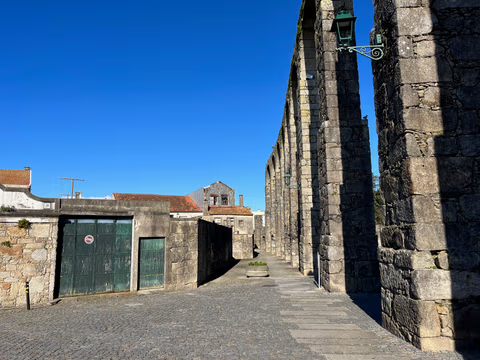
Aqueduct Trail – A path running along the Vila do Conde Aqueduct
From the Coastal Trail to the Camino Central: 12.9 km along the aqueduct from Vila do Conde to São Pedro de Rates. Route, stage, hostels, costs—explained honestly.
Read
Augsburg Way of St. James
The Augsburg Way of St. James runs 231.7 km in 11 stages from Oettingen in the Ries via Donauwörth, Augsburg, Bad Wörishofen and Ottobeuren to Ermengerst in the Allgäu — the Fuggerei, the Jakobervorstadt, a pilgrim of 1446 and Mozart's organ duel. Stages, hostels, costs.
Read

