

Jakobsweg Schrobenhausen – Augsburg
52.9 kilometres in three days, from station to station: this feeder route, waymarked since 2005, leads from Schrobenhausen on the Paar via the old pilgrimage site of Inchenhofen, Haunswies and Friedberg to Augsburg's Rathausplatz, where the Augsburger Jakobsweg carries on south. Along the way: three churches of St James, a village that late-medieval people mentioned in the same breath as Santiago and Rome, and a Rococo church that goes back to the vow of a Jerusalem pilgrim.
- 01At a glance
- 02Overview
- 03Other names
- 04Who it's ideal for – and who it isn't
- 05Route & landscape
- 06Stages, terrain & difficulty
- 07The village once named in the same breath as Santiago
- 08Highlights along the way
- 09A vow made in captivity
- 10How pilgrims get onto this route
- 11Keep walking?
- 12Preparation & practicalities
- 13What the route will cost you
- 14Getting there
At a glance
- Start / Finish: Schrobenhausen, old town / Augsburg, Rathausplatz
- Length: 52.9 km
- Stages: 3 (as set out by the association)
- Duration: 3 days, 2 if you push it
- Elevation gain/loss: ↗ 353 m / ↘ 285 m
- Highest point: 529 m between Haunswies and Derching (km 31.1); lowest point 412 m in the Paar valley near Schrobenhausen
- Character: feeder route to the Bavarian-Swabian Way of St. James, waymarked since 2005
- Regions: Schrobenhausener Land, Wittelsbacher Land, Augsburg
- Waymarking: Way of St. James signage; the main route carries the yellow shell on a white background
- Connections: at Augsburg's Rathausplatz with the Augsburger Jakobsweg (eastern route) and the Augsburger Jakobsweg (Memmingen) (western route)
Overview
The Jakobsweg Schrobenhausen – Augsburg is a short route with a long memory. 52.9 kilometres lead west from the asparagus town on the Paar, across the hill country between the Paar and the Lech, through Inchenhofen, Hollenbach and Haunswies up to 529 metres, then down via Derching and Friedberg into Augsburg's old town. The association calls the route „Vom Spargelland in die Fuggerstadt" (from asparagus country to the city of the Fuggers) and splits it into three relaxed days; Schrobenhausen and Friedberg have railway stations, Augsburg obviously does, and so the route is something pilgrim trails in Germany rarely are: a complete Way of St. James for a long weekend.
What's astonishing is the density. There are churches of St James in Schrobenhausen, Haunswies and Friedberg, and at the finish St. Jakob in Augsburg awaits with its pilgrim hostel in the tower. In between lies Inchenhofen, today a quiet market town in the Wittelsbacher Land, around 1400 the destination of what the local history society estimates was probably half a million pilgrims a year. Frankly, the walking itself is unspectacular — fields, patches of woodland, villages, city at the end — but hardly any route of this length tells you so much about how Bavaria used to go on pilgrimage.
Other names
Officially the route runs under the title „Vom Spargelland in die Fuggerstadt" (from asparagus country to the city of the Fuggers); Wikipedia describes it as a feeder route from Schrobenhausen via Friedberg to the Bavarian-Swabian Way of St. James, Augsburg Tourism as a section of the Bavarian-Swabian St James pilgrim trail. It has no fixed name of its own. The association reckons with 54 kilometres; our 52.9 kilometres come from the Camino Ninja map.
Who it's ideal for – and who it isn't
The route is ideal if you have three days and want to walk a real pilgrim trail, not just a hike: start and finish are on the railway, the stages measure 14.5 to 23.8 kilometres, the profile is gentle. Ideal, too, as a dress rehearsal before a long Camino — test boots, pack and daily rhythm without anything being able to go wrong — or as a prelude if you want to carry on from Augsburg along the Augsburger Jakobsweg towards the Allgäu and Lake Constance. If you love churches, you get three dedicated to St James, one of the great late-medieval pilgrimages of southern Germany and Rococo by Cosmas Damian Asam.
Frankly, though, it isn't for you if you're looking for a pilgrim hostel and pilgrim company in the evenings: until Augsburg you sleep in inns, and Haunswies has only a handful of rooms. Nor is it for you if you expect mountains, wide-open spaces or solitude — the last eight kilometres from Friedberg lead through suburbs and city, and the terrain stays friendly hill country the whole way.
Route & landscape
You start in the old town of Schrobenhausen, whose town wall with twelve surviving towers dates back to the early 15th century, and leave the Paar valley heading west. Via Hörzhausen and Unterbernbach you walk through fields and small patches of woodland to Inchenhofen (km 14.5), whose pilgrimage church of St. Leonhard can be seen from far away. The second day gets hillier: via Hollenbach, Schönbach, Igenhausen and Sankt Georg to Haunswies (km 29.1) in the municipality of Affing.
Shortly after Haunswies you reach the highest point at 529 metres (km 31.1), then it's downhill along the Lechrain via Derching, Stätzling and Wulfertshausen to Friedberg (km 44.3), perched high above the Lech valley. From there it's another eight kilometres or so, across the Lech and through Augsburg's eastern districts, until on the last couple of kilometres you join the Augsburger Jakobsweg and reach the Rathausplatz with it.
Stages, terrain & difficulty
We follow the association's three-way split. The kilometres come from the Camino Ninja map, calibrated exactly to 52.9 km; we calculated the ascents from the map's elevation points.
- Schrobenhausen → Inchenhofen (14.5 km) — ↗ 65 m; Paar valley, Hörzhausen, Unterbernbach, pilgrimage church of St. Leonhard.
- Inchenhofen → Haunswies (14.6 km) — ↗ 121 m; Hollenbach, Igenhausen, Sankt Georg, church of St James in Haunswies.
- Haunswies → Augsburg (23.8 km) — ↗ 166 m; highest point, Derching, Stätzling, Friedberg with Herrgottsruh, Lech crossing, Rathausplatz.
Difficulty: easy. No day brings more than around 170 metres of ascent; you walk on farm and field tracks, minor roads and through villages, mostly on tarmac from Friedberg onwards. If you like it sporty, walk the route in two days with an overnight stop in Haunswies (28.7 and 23.8 km) — in which case the room there should be firmly booked. If you prefer it leisurely, split the last stage in Friedberg (15.2 and 8.6 km).
The village once named in the same breath as Santiago
Inchenhofen is a quiet market town in the Wittelsbacher Land today. In the 14th century, so the Bavarian museums portal writes, the place was mentioned in the same breath as Santiago de Compostela and Rome. The reason was St Leonard, patron of livestock and of prisoners. From 1283 the Cistercians of Fürstenfeld Abbey looked after the pilgrimage, in 1332 an Augsburg auxiliary bishop, Heinrich von Kiew, consecrated a first large basilica, and between 1450 and 1457 the present church was built. According to the monks' books of miracles, pilgrims came from southern Poland, Bohemia and Burgundy; the local history society estimates that around 1400 probably half a million a year reached the place. The Fürstenfeld monks stayed until the secularisation of 1803, and in the local dialect Inchenhofen is still called „Leahad" after its saint to this day.
For you as a pilgrim, that's a lesson in perspective. The route you're walking was, in the late Middle Ages, an approach to one of Europe's great pilgrimage sites — and the church of St James in Schrobenhausen, according to Wikipedia, bears its dedication „vermutlich" (probably) because of its position on a feeder route to Santiago. Today thousands still come on Whit Monday and for the Leonhardiritt at the start of November; the pilgrimage museum with its books of miracles and votive offerings opens by appointment. For the rest of the year you'll mostly have St. Leonhard to yourself.
Highlights along the way
- Town fortifications, Schrobenhausen — around 1,300 metres of town wall with twelve surviving towers, extended in the early 15th century under Duke Ludwig the Bearded.
- St. Jakob, Schrobenhausen — late Gothic hall church of the 15th century, wall paintings from 1461, memorial stone for Ludwig the Bearded from 1419.
- Lenbachmuseum and Spargelmuseum, Schrobenhausen — birthplace of the painter prince Franz von Lenbach (1836–1904) and the European Asparagus Museum; asparagus season mid-April to 24 June.
- Pilgrimage church of St. Leonhard, Inchenhofen — built 1450–1457, Rococo furnishings from 1757, pilgrimage museum by appointment; Leonhardiritt on the first Sunday in November.
- St. Jakobus der Ältere, Haunswies — chancel at its core from 1507, nave 1777, chancel fresco from 1915: St James helping the poor and sick; his martyrdom on the high altar.
- St. Sebastian, Derching — former parish church, one of the best-preserved Romanesque buildings in the area.
- St. Georg, Stätzling — parish church with stucco work of the Wessobrunn school.
- Pilgrimage church of Herrgottsruh, Friedberg — begun 1731, consecrated 1753, frescoes by Cosmas Damian Asam and Matthäus Günther.
- Schloss Friedberg — built 1257, today a museum with Friedberg clocks from the era when the town was a centre of clockmaking.
- St. Jakob, Augsburg — the finish of your route, with the pilgrim hostel in the church tower.
A vow made in captivity
The loveliest pilgrim story on the route comes shortly before the finish. According to legend, a Jerusalem pilgrim who had fallen into Turkish captivity vowed to build a chapel if he made it home — and kept his word after his return; in 1964 the foundations of a small chapel were indeed found beneath the present church, probably a replica of the Holy Sepulchre. The miraculous image „Christus in der Rast" (Christ at rest) dates from around 1496, the chancel was consecrated that same year.
Out of the vow grew one of the great Rococo buildings of Bavaria: in 1731 Elector Karl Albrecht laid the foundation stone for the new church, in 1753 it was consecrated, Cosmas Damian Asam painted the domes, Matthäus Günther completed the frescoes. A pilgrim who was not allowed to go home thus built, for the pilgrims who pass by today on their way to Augsburg, their last great rest stop — fitting name included.
How pilgrims get onto this route
There is no waymarked feeder to Schrobenhausen; the town is a starting point, not a place of passage. You arrive on the Paartalbahn, which runs roughly hourly between Ingolstadt and Augsburg — from Munich with a change in Ingolstadt or Augsburg, from Regensburg and Nuremberg via Ingolstadt.
No other Ways of St. James touch the route: the Ostbayerischer Jakobsweg runs a good 25 kilometres further north, the Münchner Jakobsweg more than 30 kilometres further south. In Augsburg itself you meet, at the end, the northern route of the Augsburger Jakobsweg coming from Oettingen via Donauwörth, and the Via Romea Germanica, the Rome route of Abbot Albert of Stade, which also passes through the old town.
Keep walking?
The real adventure begins at the Rathausplatz. Heading south you have the choice: the eastern route of the Augsburger Jakobsweg leads via Bad Wörishofen and Ottobeuren to Bad Grönenbach and on to Ermengerst, the western route Augsburger Jakobsweg (Memmingen) takes the arc via Oberschönenfeld, Babenhausen and Memmingen. The two meet again in Bad Grönenbach.
In Ermengerst the Münchner Jakobsweg takes over and leads via Scheidegg to Lindau on Lake Constance; from Schrobenhausen to there it's around 260 to 270 kilometres depending on the route, so just under two weeks. If you only had three days, take the train home from Augsburg — and know where to pick up next time.
Preparation & practicalities
You can walk it all year round, most beautifully from April to October. Culinarily, asparagus season from mid-April to 24 June is the best time to start in Schrobenhausen. Plan around two dates: on Whit Monday and for the Leonhardiritt on the first Sunday in November Inchenhofen is packed — great to experience, bad for finding a room. The route is waymarked; you'll need the GPS track mainly at junctions in the open fields and in Augsburg. The easiest way to plan your stages and lodgings is in the Camino Ninja app.
There are no pilgrim hostels along the route. The association names inns in all three stage towns — in Schrobenhausen the Gasthof Baur'n Bräu, for instance, in Inchenhofen Klaras Gästehaus, in Haunswies the Gasthof Zum Bachwirt, in Friedberg the Gasthof Kreisi — and advises checking opening times in advance. If there's nothing free in Haunswies, you fall back on nearby Aichach by taxi or bus. In Augsburg the pilgrim hostel in the tower of St. Jakob awaits: six beds, kitchen and shower, open from Easter Monday to the end of October, by prior registration only and with a pilgrim passport.
The pilgrim passport is issued by the association along the route, €6.00 plus €1.80 postage (as of September 2026). Stamps are most easily obtained along the way in parish offices and inns — just ask.
What the route will cost you
Reckon with inn prices: a pilgrim group of the Deutsche St. Jakobus-Gesellschaft paid around €60 per person per night with breakfast on this route in 2024; as a solo pilgrim in a single room it can be more. For food including one stop at an inn, add €25 to €35 a day (based on experience, as of October 2026). The hostel in Augsburg works on a donation basis.
For three days with two nights at inns and one night in Augsburg you'll end up roughly at €200 to €260 excluding travel; the regional train fare to the start and from the finish costs little. The churches along the way cost nothing.
Getting there
To the start: Schrobenhausen lies on the Paartalbahn Ingolstadt – Augsburg, trains run roughly hourly; from Munich you change in Ingolstadt or Augsburg. From the station it's a few minutes' walk to the old town.
Along the way and at the finish: Inchenhofen, Hollenbach and Haunswies have no railway; the nearest station is usually Aichach on the same line, a few kilometres off the route. Friedberg has a station on the Paartalbahn, handy if you want to split the last stage. In Augsburg you finish at the Rathausplatz, a quarter of an hour on foot from the main station, the long-distance hub towards Munich, Stuttgart, Ulm and Nuremberg.
- Rail: bahn.de — Schrobenhausen, Aichach, Friedberg, Augsburg Hbf
- Region: wittelsbacherland.de — Wittelsbacher Land, hiking and bus information
- Note: no railway in Inchenhofen and Haunswies — book your room in Haunswies firmly in advance
Partners
Partner for Jakobsweg Schrobenhausen – Augsburg
Camino Ninja is cooperating with official partners. For this camino the partner is:


Get your pilgrim credential and shell
Everything you need for the Jakobsweg Schrobenhausen – Augsburg, shipped to your door.
Visit Camino Shop
Other Caminos
 Ansbacher Jakobsweg
From Weihenzell via Ansbach, Feuchtwangen, Dinkelsbühl, Ellwangen and the Ostalb to Ulm and Oberdischingen: 9 stages, monasteries, imperial cities and the watershed between the Kocher and the Brenz.
Read- Appenzeller Weg
Appenzeller Weg
52.6 km from Rankweil across the Rhine to St. Peterzell: St. James Chapel (1464), 163 Years of the Wedding Trail, connection to the Via Jacobi. Stages, costs, how to get there.
Read 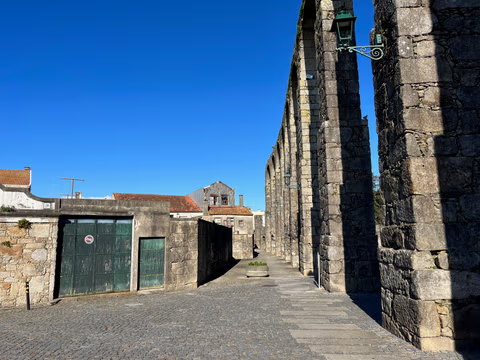
Aqueduct Trail – A path running along the Vila do Conde Aqueduct
From the Coastal Trail to the Camino Central: 12.9 km along the aqueduct from Vila do Conde to São Pedro de Rates. Route, stage, hostels, costs—explained honestly.
Read
