

Luzernerweg
The Luzernerweg runs 124.2 kilometers from Lucerne on Lake Lucerne past the pilgrimage monastery of Werthenstein, through Willisau, Huttwil and Burgdorf to Bern, then climbs on to Rüeggisberg. There, at the ruins of the first Cluniac monastery in the German-speaking world, it joins the Via Jacobi toward Fribourg and Geneva. Seven stages, 3,857 meters of ascent, high point 980 meters just before the finish. Along the way you cross from the Catholic Lucerne hinterland into the Protestant Emmental—walking, in reverse, the route a statue of the Virgin took in 1528.
- 01At a Glance
- 02Overview
- 03Other Names
- 04Who It's Ideal For—and Who It's Not So Ideal For
- 05Route & Landscape
- 06Stages, Terrain, and Difficulty
- 07The Madonna Who Fled Bern
- 08Highlights Along the Way
- 09Rüeggisberg: The First Cluny in the German-Speaking World
- 10How Pilgrims Find Their Way onto This Path
- 11Continue the pilgrimage?
- 12Preparation & Practical Information
- 13What the journey will cost you
- 14Getting Here
At a Glance
- Start / Finish: Lucerne on Lake Lucerne / Rüeggisberg priory ruins in the Gantrisch foothills; the Camino Ninja map ends just past the village
- Length: 124.2 km
- Duration: 7 stages, avg. just under 18 km; 5 to 6 days if you're fit and fast
- Elevation: ↗ 3,857 m / ↘ 3,364 m
- Highest point: 980 m at km 121.5, in the Tannwald forest between Hermiswil and Rüeggisberg
- Landscape: Reuss valley and Kleine Emme, the Lucerne hinterland with its hills and scattered farms, the ridges and gullies of the Emmental, the Aare valley at Bern, and finally a view of the Bernese Alps
- Waymarking: yellow hiking signposts with the Camino logo, volunteer route descriptions on camino-europe.eu
- Traces of St. James: at the finish, the Cluniac priory, founded between 1072 and 1076 by the order that helped build up the Camino in the Middle Ages; pilgrim apartment at Werthenstein Monastery; in Protestant Bernese territory, hardly any images of saints since 1528
- Accommodation: Werthenstein pilgrim apartment, inns and B&Bs, youth hostels in Lucerne, Burgdorf and Bern, group lodging in Rüeggisberg
- Connecting routes: Via Jacobi from Rüeggisberg, Baslerweg in Bern, Verbindungsweg Mariastein – Willisau between Ufhusen and Huttwil
- Best time: April to October; walkable in winter too, but with snow on the heights above 800 m
Overview
The Luzernerweg is the feeder route from Central Switzerland onto the great western axis of the Swiss Camino routes. Starting in Lucerne, it skips the Brünig Pass and the Bernese Oberland and heads straight west: through the Lucerne hinterland, over the hills of the Emmental and through the federal city of Bern to Rüeggisberg, where the Via Jacobi passes through from Thun. It's not a mountain trail, but it's not flat either: 3,857 meters of climbing over 124 kilometers means you're almost always going a little up or a little down.
The trail links two spiritual sites with opposite histories. In Werthenstein, a Marian pilgrimage has flourished since around 1500, drawing tens of thousands of pilgrims a year in its heyday. In Rüeggisberg only a ruin remains: the priory a Bernese nobleman gave to the Abbey of Cluny around 1072, which went under with the Reformation in 1541. Between them runs the border between Catholic Lucerne and Protestant Bern—just past Ufhusen. A Madonna once came the other way down this very trail—only almost 500 years earlier.
Other Names
The association and the route descriptions call it the Luzernerweg, also Luzerner Weg, with the tag Luzern – Rüeggisberg. Older stage lists give the first section as Brunnen – Werthenstein: pilgrims from Einsiedeln came via Brunnen and by boat across Lake Lucerne to Lucerne. In French you'll see Chemin de Lucerne, in English Lucerne Way. It is not the same as the national hiking route Via Jacobi, but a branch of its own that flows into it.
Who It's Ideal For—and Who It's Not So Ideal For
Ideal if you have a week and want a Swiss Camino with no mountain passes that still has character: farmhouses with deep hipped roofs, the gullies and ridges of the Emmental, two old towns with castles, a capital, and a finish that's more stillness than museum. Ideal, too, if you want rail access: except for the heights past Krauchthal and before Rüeggisberg, you're almost always within an hour of a train station.
Honestly, though, it's not for you if you're expecting pilgrim hostels in the Spanish sense. Real pilgrim beds exist only in Werthenstein; otherwise you sleep in inns, B&Bs or youth hostels, and in Switzerland that costs money. Not for you if you hate asphalt: the volunteers describe almost every stage as a mix of pavement and natural paths, and between Ostermundigen and Kehrsatz you're simply walking through the city. And not for you if you need a mountain panorama from day one—you only really see the Alps at the very end, from the heights before Rüeggisberg.
Route & Landscape
Lucerne to Willisau (km 0–33.3): From the Reuss in Lucerne—434 meters, the lowest point of the route—you head west out of the city, via Littau (km 4.2) to Blatten (km 7.9) with its Jost Chapel, then follow the Kleine Emme for a long stretch past Schachen (km 14.8). Kriens (km 3.4) and Malters (km 11.5) lie 1.5 and 0.7 kilometers off the trail respectively. At kilometer 19.2 you reach Werthenstein, where monastery and church perch on a rocky spur above the river. Wolhusen and Menznau stay off to the side; the trail climbs into the hills to the Galgenbergwald and, via Buholz with its Baroque Chapel of St. Gallus and Erasmus, reaches the small town of Willisau (km 33.3).
Willisau to Rüeggisberg (km 33.3–124.2): Heading north and west through forest and pasture, you go via Ufhusen (km 43.9) to Huttwil (km 47.4)—now you're in the canton of Bern. The Emmental shows itself via Dürrenroth (km 55.0), Häusernmoos (km 59.7) and the Lueg area, with a farm on every hill, before you descend to Burgdorf (km 71.7) and its castle. Past Krauchthal (km 82.9) and Thorberg Castle comes the long ridge at Tannen (844 m, km 86.6), then it's down via Boll (km 92.1) and Ostermundigen (km 99.0) to Bern (km 103.2). Finally the trail climbs out of the Aare valley via Kehrsatz (km 109.8), Niedermuhlern (km 116.4) and Hermiswil (km 120.3) to the 980-meter high point and ends in Rüeggisberg (km 123.7).
Stages, Terrain, and Difficulty
We show the route in 7 stages; the distances come from the Camino Ninja map, calibrated exactly to 124.2 km. The association's route descriptions count six sections and treat Burgdorf–Bern as a single day of nearly 30 kilometers—we split it at Boll.
- Lucerne → Werthenstein (19.2 km) — out of the city and along the Kleine Emme to the pilgrimage monastery; flat, lots of riverside path.
- Werthenstein → Willisau (14.1 km) — a short hill day via Buholz and the Galgenbergwald into the medieval little town.
- Willisau → Huttwil (14.1 km) — via Ufhusen and across the cantonal border into Bernese country; leaves room for an afternoon in Willisau.
- Huttwil → Burgdorf (24.3 km) — the heart of the Emmental via Dürrenroth and Häusernmoos; the association rates it as difficult.
- Burgdorf → Boll (20.4 km) — via Krauchthal and Thorberg onto the ridge at Tannen, 844 m; few places to stop for food along the way.
- Boll → Bern (11.1 km) — a half day via Ostermundigen into the Old Town, with time for the Minster and the Bear Park.
- Bern → Rüeggisberg (21.0 km) — along the Aare to Kehrsatz, then the long climb via Niedermuhlern to the high point and down to the priory ruins.
None of it is technically difficult; good hiking boots are enough. What's demanding is the constant up and down in the Emmental and the final climb: from Bern at 502 meters to 980 meters, you gain almost 500 meters net over the last 18 kilometers. If you'd rather walk less, you can go from Willisau via Huttwil to Dürrenroth in one day (21.7 km) and save a day.
The Madonna Who Fled Bern
Around 1500, as the monastery tells it, a gold panner from the Netherlands saw an apparition of the Virgin on the Kleine Emme and hung a picture on a fir tree at the spot. Healings followed, and in 1520 the Bishop of Konstanz consecrated a first chapel. Then, in 1528, came the Bernese Reformation: on January 27, 1528, the Bern council ordered all masses stopped, and images were cleared out of the churches across its entire territory. That same year, the faithful carried a carved Pietà from Fribach in Bernese territory across the border to safety in Werthenstein. It is still the miraculous image today.
That made Werthenstein a Catholic bulwark on the confessional border. The Lucerne government had a larger church built, consecrated in 1616 after eight years of construction; Louis XIII of France donated a new rood altar in 1621. In 1634 Franciscans moved into the new monastery, and that same year the spring of the Gnadenbrunnen (the "fountain of grace") was found. The Franciscans recorded over 400 miracles. In 1808 the vault collapsed, burying the rood altar and the Pietà, and in 1838 the liberal canton of Lucerne dissolved the monastery. From 1909 the Missionaries of the Holy Family moved in, and in 1974 the last major restoration was completed.
And so the Luzernerweg goes: you start in Catholic Lucerne, sleep in Werthenstein beside the Pietà, and then walk straight into the land it fled from. From Huttwil on, the churches stand without images, Bern Minster has been Protestant since 1528, and at the finish in Rüeggisberg waits a monastery that did not survive the Reformation: abandoned after a fire in 1532, dissolved in 1541, then a quarry for the local farmers. Honestly, that's the real appeal of this trail—it tells the story of Switzerland's religious divide one step at a time.
In practical terms: plan your first night in the pilgrim apartment at Werthenstein Monastery. It's for pilgrims only, costs 40 CHF (approx. 42 €) with breakfast (as of October 2026), one night, with a small shared kitchen; you need to register with the monastery in advance.
Highlights Along the Way
- Chapel Bridge, Lucerne (start) — covered wooden bridge from the 14th century with the older Water Tower, rebuilt after the fire of August 1993 and reopened in April 1994; of Hans Heinrich Wägmann's 158 gable paintings, only 30 have been restored.
- Hofkirche St. Leodegar (Lucerne) — collegiate church, rebuilt after the fire of 1633 through 1639 in the late Renaissance style; a monastery is documented on this site around 750.
- Werthenstein Monastery (km 19.2) — pilgrimage church from 1616 with the Pietà from Bernese territory, the Gnadenbrunnen fountain, an arcaded courtyard high above the Kleine Emme, pilgrim apartment.
- Willisau (km 33.3) — founded in 1302/03 by the brothers of Hasenburg as a fortified little town, burned down in 1375, 1386, 1471 and 1704; the Heilig-Blut-Kapelle (Chapel of the Holy Blood) recalls the legend of July 7, 1392, when a card player named Ueli Schröter cursed Christ and five drops of blood fell onto the table.
- Huttwil (km 47.4) — on May 14, 1653, rebel peasants from Lucerne, Bern, Basel and Solothurn formed the Huttwiler Bund (League of Huttwil) here and chose Niklaus Leuenberger as their leader; on September 6, 1653, he was executed in Bern. Today's little town was built after the fire of June 8–9, 1834.
- Burgdorf Castle (km 71.7) — a Zähringen castle, mentioned in 1080 as "castellum Bertoldi ducis," "the castle of Duke Berthold," sold to Bern on April 5, 1384, for 37,800 guilders; around 1800 Johann Heinrich Pestalozzi taught here. Today a museum and youth hostel.
- Thorberg (near Krauchthal, km 82.9) — castle of the lords of Thorberg, documented in 1175; Peter von Thorberg bequeathed it to the Carthusians in 1397, and since 1893 it has been a prison. The charterhouse did not survive the Reformation of 1528, but its walls still stand.
- Bern Minster (km 103.2) — cornerstone laid on March 11, 1421, under Matthäus Ensinger, tower completed only in 1893; at 100.6 meters, the tallest church tower in Switzerland; Erhard Küng's Last Judgment portal is among the most complete late Gothic sculptural cycles in Europe.
- Rüeggisberg Priory Ruins (km 123.7) — transept and walls of the Romanesque church, built roughly 1100 to 1185; excavated from 1938 to 1947, with a small museum; behind it, the view of the Bernese Alps.
Rüeggisberg: The First Cluny in the German-Speaking World
Between 1072 and 1076, Lütold von Rümligen gave his property on the hill to the Abbey of Cluny in Burgundy. In 1075 the place appears in a source for the first time, as "mons Richeri," Richer's hill—which became "Ruogersperg" in 1224 and eventually Rüeggisberg. The first cells were built by two monks whose names carry weight in the order's history: Ulrich of Zell and Cuno of Siegburg. That made Rüeggisberg the first Cluniac house in the German-speaking world—decades before Cluny's reform movement reached the great monasteries of the Empire.
For pilgrims, the name Cluny is no coincidence. In the 11th and 12th centuries the Cluniacs promoted the pilgrimage to Santiago like hardly any other order, with monasteries and hospices along the French routes. A priory on the heights above the Gürbe valley, on the road from Bern into Fribourg territory, fits right into that network. Today you'll meet pilgrims here on the Via Jacobi, coming in from Amsoldingen and Thun.
How Pilgrims Find Their Way onto This Path
Most simply start in Lucerne, by train from Zurich, Basel or Bern. Coming from the north, take the Verbindungsweg Mariastein – Willisau: it leads from the Benedictine monastery of Mariastein near Basel and shares the trail with the Luzernerweg between Ufhusen and Huttwil; from there you can continue west toward Burgdorf.
In Bern the Baslerweg joins, for anyone who set out from Basel; coming from there, you can switch onto the Luzernerweg in Bern and tack on the last stage up to Rüeggisberg. And if you're on the Via Jacobi from eastern Switzerland, you can join in Lucerne as a stopover instead of going over the Brünig.
Continue the pilgrimage?
Yes—that's the whole point of the trail. In Rüeggisberg the Luzernerweg flows into the Via Jacobi, the main axis of the Swiss Camino routes: on via Schwarzenburg and the Sense river to Fribourg, via Romont and Moudon to Lausanne on Lake Geneva, and finally to Geneva. From there the French routes lead via Le Puy-en-Velay to Santiago.
If you only want to reach Fribourg, allow about two days from Rüeggisberg; Geneva is a good two weeks away. If you've had enough, take the PostBus from Rüeggisberg back toward Bern.
Preparation & Practical Information
Pilgrim passport and app. As on all Swiss Camino routes, you'll need a pilgrim passport (credencial) to stay in the pilgrim apartment and document your journey; if you later walk all the way to Santiago, you'll be collecting your stamps for the Compostela from here on. It's best to order it online in advance so it reaches you in time for the start of your trip—from the association Verein Jakobsweg Schweiz – Compostelle Suisse it costs 12 CHF (approx. 13 €) (as of October 2026). You'll find stamps at parish offices and churches—in Willisau, for instance, at the parish office or as a sticker stamp at the church's literature stand. With the Camino Ninja App you have the map and track offline; the easiest way to plan the route is right in the app, where you put together your stages and plan suitable accommodation as you go.
Accommodation. Apart from Werthenstein, there are no actual pilgrim hostels. Book inns and B&Bs in advance—options are thin especially in Ufhusen, Dürrenroth and Boll. Rüeggisberg has only a few beds; many take the PostBus to Bern in the evening or walk straight on the next day to Schwarzenburg, which has several B&Bs.
Season. April to October is ideal; in high summer the Emmental hills offer little shade. In winter the trail is walkable, but there may be snow on the ridge at Tannen and before Rüeggisberg.
What the journey will cost you
Switzerland is expensive, and this trail lacks cheap pilgrim beds. The Werthenstein pilgrim apartment costs 40 CHF (approx. 42 €) with breakfast, the Pilgerhaus Maria Theresia in Brunnen 45 CHF (approx. 47 €). Backpacker beds in Lucerne and simple inns like those in Willisau run 30–50 CHF (approx. 32–53 €), B&Bs in Willisau and Huttwil 50–80 CHF (approx. 53–84 €), hotels such as in Dürrenroth from 80 CHF (approx. 84 €); the group lodging in Rüeggisberg is 30–50 CHF (approx. 32–53 €) (all as of October 2026, per the association's accommodation list).
Budget 90–150 CHF (approx. 95–160 €) per day for bed, breakfast and dinner; with a picnic from the village shop and youth hostel beds, it's a bit cheaper. The pilgrim passport costs 12 CHF (approx. 13 €).
Getting Here
To the start. Lucerne is a rail hub with direct trains from Zurich (about 45 minutes), Basel and Bern. From the station it's five minutes to the Reuss and the Chapel Bridge; the association's route description begins at the boat landing.
From the finish. From Rüeggisberg the PostBus runs toward Bern, and from there SBB trains go in every direction. Along the way, Werthenstein, Willisau, Huttwil, Burgdorf and Bern are all on the rail network, so cutting a stage short is easy.
- Rail: sbb.ch — timetables and tickets for Lucerne, Bern and all points in between
- Route and accommodation: jakobswegschweiz-compostellesuisse.ch — association, pilgrim passport, route booklets
- Werthenstein: kloster-werthenstein.ch — monastery and pilgrim apartment
Partners
Partner for Luzernerweg
Camino Ninja is cooperating with official partners. For this camino the partner is:


Get your pilgrim credential and shell
Everything you need for the Luzernerweg, shipped to your door.
Visit Camino Shop
Other Caminos
 Appenzeller Weg
Appenzeller Weg
52.6 km from Rankweil across the Rhine to St. Peterzell: St. James Chapel (1464), 163 Years of the Wedding Trail, connection to the Via Jacobi. Stages, costs, how to get there.
Read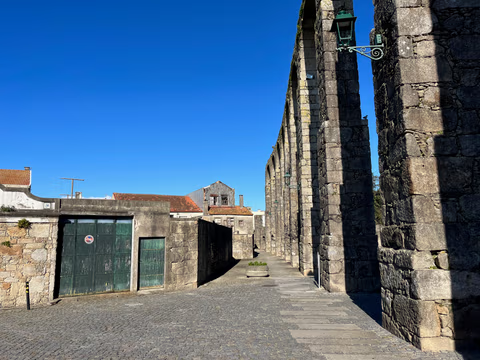
Aqueduct Trail – A path running along the Vila do Conde Aqueduct
From the Coastal Trail to the Camino Central: 12.9 km along the aqueduct from Vila do Conde to São Pedro de Rates. Route, stage, hostels, costs—explained honestly.
Read
Augsburg Way of St. James
The Augsburg Way of St. James runs 231.7 km in 11 stages from Oettingen in the Ries via Donauwörth, Augsburg, Bad Wörishofen and Ottobeuren to Ermengerst in the Allgäu — the Fuggerei, the Jakobervorstadt, a pilgrim of 1446 and Mozart's organ duel. Stages, hostels, costs.
Read

