

Jakobsweg Nijmegen–Maastricht
From the oldest city in the Netherlands to the country’s oldest church: The Nijmegen–Maastricht Way of St. James—known as the Jacobspad Limburg and organized by the Stichting Pelgrimswegen naar St. Jacob—covers approximately 217 kilometers and 11 stages through three countries: through the Reichswald, past the Marian shrine at Kevelaer, and up the Meuse River. Halfway along the route, in Roermond, lies the forearm of the Apostle James; at the destination awaits the tomb of St. Servatius—and beyond it begins the Via Mosana.
- 01At a Glance
- 02Overview
- 03In 1602, the arm was added; in 1786, the brotherhood was dissolved; in 2013, the chapel was rebuilt
- 04Other Names
- 05Who it's ideal for—and who it's not so ideal for
- 06Route & Landscape
- 07Stages, Terrain & Difficulty
- 08Highlights Along the Way
- 09How Pilgrims Find Their Way onto This Path
- 10Continue the pilgrimage?
- 11Preparation & Practical Information
- 12What the journey will cost you
- 13Getting Here
At a Glance
- Start / Finish: Nijmegen (St. Stephen’s Church / St. James’ Chapel) → Maastricht (St. Servatius Basilica)
- Length: approx. 217 km
- Elevation gain: approx. 630 m of ascent, 590 m of descent (GPS track of the route)
- Stages: 11 (10 if you add the 9-km Walbeck–Straelen leg)
- Duration: 10–11 days
- Countries: The Netherlands, Germany, and Belgium—Three Countries on the Same Path
- Waymarking: A yellow scallop shell on a blue background; in South Limburg, it also appears on wooden signposts
- Best time: April through October
- Organisation: Stichting Pelgrimswegen naar St. Jacob (Roermond, since 1996); German section together with the Landschaftsverband Rheinland
- Connection: From Maastricht on the Via Mosana via Visé and Liège to Namur
Overview
The Jakobsweg Nijmegen–Maastricht — at the organization, it's called Jacobspad Limburg — connects the oldest city in the Netherlands with the country's oldest church: approximately 217 Kilometers in 11 stages, starting at the Sint-Jacob Chapel in Nijmegen through the Reichswald and the Niersland to the Marian pilgrimage site Kevelaer, to the Maas near Venlo, through the episcopal city Roermond and finally through the Heuvelland—the only hilly region in the Netherlands—to Maastricht To the tomb of Saint Servatius. Three countries, one river, and a stop along the way that no other route of this width offers: In Roermond, you’ll pass by a forearm of the apostle, whose tomb you’re on your way to visit.
The path is supported by the Stichting Pelgrimswegen naar St. Jacob, founded 1996 in Roermond, which established the German section in collaboration with the Rhineland Regional Council; it is marked with a yellow seashell on a blue background and documented with a hiking guide, a booklet of maps, GPS tracks, and its own stamp card — twelve stamps make up the certificate of completion. And the historical foundation is older than the young foundation might suggest: In Nijmegen, there was 1438 a St. James pilgrim house; in Roermond, he said his prayers 1357 A St. James Brotherhood; in Maastricht, the inn and the brotherhood are 1429 Documented. The thread was never lost. It just wasn't labeled for a long time.
In 1602, the arm was added; in 1786, the brotherhood was dissolved; in 2013, the chapel was rebuilt
Right in the middle of this path, in the St. James Chapel of the Cathedral of Roermond, there is a forearm of the Apostle James—according to the local brotherhood, “de grootste Jacobusreliek die zich buiten het graf van St. Jacobus in Santiago bevindt” the largest relic of St. James outside the tomb of St. James in Santiago. Its chain of provenance reads like a history of European diplomacy: from the Pope Gregory IV donated to a monastery in the 9th century, 1596 in the collection of relics at El Escorial, 1602 presented to the city of Roermond by Archduke Albrecht of Austria, 1876 Certified by Bishop Paredis. The punchline is obvious: You’re going to Santiago to visit the Apostle’s tomb—and on the way, you pass by his arm. From the Sint Jacob suburb of Roermond, it’s still 2,285 Kilometers.
There is a complete chain of documentation surrounding this relic. Starting with 1357 In Roermond, there is evidence of the Confraternitas Sancti Jacobi Maioris—motto “PAX IUSTITIAE FRUCTUS”—comprising about ten members from the wealthy merchant class, who had either been to Santiago themselves or supported pilgrims, including by providing rye bread for the poor. Then the break, with two dates: Around 1580 The war destroyed St. James' Chapel, after which an entire neighborhood is named, and 1786 Emperor Joseph II dissolved the brotherhood—the remaining balance of 865 guilders went to the state. Incidentally, the cathedral archives contain a Compostela from 1604, the certificate of a pilgrim who made it all the way to Santiago. Only his name has been lost. The evidence remains, but the person is gone—an archive cannot tell the story of time any more honestly than this.
The revival came in waves, and it came from right here: 1994 Roermond once again became an official stop on the route to Santiago, 1996 The Stichting Pelgrimswegen was founded, which mapped out this route, 2000 the brotherhood returned — and 2013 She built a new chapel on the site of the destroyed one: brick with sandstone ornaments, a scallop shell on the ridge, and stained-glass windows featuring bridges, stars, and footprints. At the start of the path stands its counterpart: the “suncte Jacobs gasthuys tot Nymeegen geleegen in die Heesellstraat” 1438 Donated by the priest Hendrick van Hovelwick, it served as a glassblowing workshop, a school, a hayloft, and finally a cowshed after the Reformation—since 2004 It is officially known once again as the Sint-Jacobskapel, with a pilgrim service held on the second Sunday of the month. A path at both ends of which pilgrim houses have once again become pilgrim houses: That is no coincidence; it is part of a plan.
Other Names
In Dutch, this path is called Jacobspad Limburg — that's what its operator in Roermond calls it. The German section of the same route is operated by the Rhineland Regional Council as Jakobsweg Rhein-Maas, and on the overview maps published by the Dutch St. James Association, you’ll find it listed as Route 5: “Jacobspad Limburg — Millingen via Maastricht to Eijsden.” Three names, one trail. It’s worth clearing up two points of confusion: The Nieumeghen St. James’ Way is not a competitor, but rather its “big brother”—512 kilometers from St. Jacobiparochie in Friesland to Eijsden, which are identical to this route south of Nijmegen; north of the city, the same path simply goes by a different name. And the Pelgrimspad (LAW 7) Here's another route: Amsterdam–Den Bosch–Maastricht, marked in white and red, maintained by Wandelnet — Nijmegen is not on this route. The organizer itself has left one detail open: The official start is Nijmegen or Millingen on the Rhine. If you start in Nijmegen, you're off to a great start.
Who it's ideal for—and who it's not so ideal for
Ideal if you have ten or eleven days off and are looking for a Way of St. James that you can reach with a train ticket: flat, close to rail lines, well-connected—and richer in cultural and historical significance than its 217 kilometers might suggest. A pilgrim chapel from 1438 at the start, a Marian shrine from 1642 on the third day, the “Apostle’s Arm” in Roermond, and, at the end, the tomb of Saint Servatius. Three countries, without ever needing anything more than a good pair of shoes.
To be honest, though, this route isn’t for you if you’re looking for mountains: Between Nijmegen and Sittard, there’s almost no elevation gain; it’s only during the last two days in the Heuvelland that you’ll find sunken paths and real climbs. It’s also not for you if you can’t stand paved roads—in the north, you’ll be walking on dead-straight farm roads in some sections, and the beautiful stretches through the Reichswald are the exception, not the rule. Amenities are sparse in the German section; one pilgrim dryly noted about a village between Goch and Kevelaer: “geen café, geen markt op maandagmorgen, niente nada.” And the otherwise reliable trail markings have gaps in some forest sections—download the GPX track from the route map in advance, not while you’re on the trail.
Route & Landscape
You'll start in Nijmegen, the oldest city in the Netherlands, past the Stevenskerk and Sint-Jacobskapel—and after 17 kilometers, you'll be in Germany: in Kranenburg, where people have been making pilgrimages to the Miraculous Holy Cross since the 14th century. Next comes the Reichswald, the largest forested area in the Lower Rhine region, with the Niers, which is the route via Goch until Kevelaer Next—for two days, you'll run right through the heart of the largest Marian pilgrimage center in Northwestern Europe. Over Walbeck and the Garden City Straelen You can reach us at Steyl the Maas: the river that defines the second half.
From Steyl on, it's a river journey—dikes, floodplains, gravel lakes, ferry docks. In Roermond Cross the Roer and walk through the Voorstad Sint Jacob neighborhood; then the Maasplassen, a lake district formed from old gravel pits, across the border to Kessenich in Belgium and back to Sittard. Only then does the landscape change: Between Sittard and Meerssen That's where it begins South Limburg Hills — Sunken paths, which a pilgrim compared to the Galician “corredoiras,” orchards dotted among the fields, stone-walled farmsteads, and wayside crosses. In Meerssen, the Aachen branch splits off; you continue straight ahead, down into the Geul Valley and across the Meuse to Maastricht. The organizer does not publish the elevation gain, but the breakdown is clear: nine flat days, two with hills.
Stages, Terrain & Difficulty
The organization divides the route into stages ranging from 8 to 27 kilometers—the distance to Maastricht is eleven days, with the short stage from Walbeck to Straelen usually added on the previous day: that makes for ten days with a 30-kilometer block starting from Kevelaer. Technically, there are no difficult sections: no mountain passes, and hardly any elevation gain north of Sittard. The long days 9 and 10 are challenging, as is the trail surface—asphalt in the north, washed-out sunken paths in the south that become slippery after rain. Twelve stamps complete the hiker’s trail certificate; Kranenburg, Graefenthal Abbey, Kevelaer, Roermond, and Maastricht are guaranteed stops—in between, you’ll have to ask for directions. Stage distances come from the Camino Ninja map, calibrated exactly to 217.2 km.
- Nijmegen → Kranenburg (17.0 km) — A short start from the oldest city in the Netherlands across the border; the destination is the late-Gothic collegiate and pilgrimage church of St. Peter and Paul, home to the Miraculous Holy Cross and the first German stamp.
- Kranenburg → Goch (23.4 km) — first a dead-straight paved road between fields, then into the Reichswald, followed by a walk upstream along the Niers; along the way, Graefenthal Monastery with a stamp; at the end, the parish church of St. Mary Magdalene.
- Goch → Kevelaer (21.0 km) — The Lower Rhine at its finest: fields, tree-lined avenues, little chapels. At the end of the route lies the largest Marian pilgrimage site in Northwestern Europe, featuring a chapel of grace dating from 1654; lodging is traditionally provided in the rectory.
- Kevelaer → Walbeck (19.3 km) — through the Niers Lowlands and the Walbecker Forest, one of the quieter stages; villages known for their asparagus, swamp forest, hardly any inclines.
- Walbeck → Straelen (10.7 km) — the shortest leg after the final day, ideal as a half-day hike or as an extension of Leg 4; Straelen is a town known for its flowers and gardening, located on the Dutch border.
- Straelen → Steyl (18.3 km) — Cross the border back into the Netherlands and head down to the Meuse; Steyl is a monastic village home to St. Michael’s Mission House, and Tegelen lies along the way before reaching it.
- Steyl → Roermond (26.8 km) — along the banks of the Meuse through Swalmen to the heart of the route: the bishop’s seat, featuring the Munsterkerk (built in 1218), the cathedral housing the relic of St. James’s arm, and the Voorstad Sint Jacob.
- Roermond → Kessenich (21.0 km) — through the Maasplassen lake district and across the border into Belgium; water, dikes, sweeping views, little shade.
- Kessenich → Sittard (24.2 km) — along the Belgian Meuse loop back to Limburg; a long, flat stage that transitions from riverland to hilly terrain.
- Sittard → Meerssen (27.2 km) — This is where the Heuvelland begins: sunken paths, orchards with scattered fruit trees, and stone-walled farmsteads. In Meerssen, the Aachen branch of the trail branches off.
- Meerssen → Maastricht (8.3 km) — a short final day along the Geul Valley and across the Meuse into the city; the destination is the Sint-Servaasbasiliek, located above the tomb of Saint Servatius.
The official alternate start time is at Millingen aan de Rijn, about 20 kilometers downstream along the Rhine—convenient for anyone coming from the Rhine railway line. And the carrier path itself continues past Maastricht all the way to Eijsden continues to the Belgian border; there, the Via Mosana takes over for good.
Highlights Along the Way
- Sint-Jacobskapel, Nijmegen — Remains of the pilgrims’ hospice founded by Priest Hendrick van Hovelwick in 1438 as the “suncte Jacobs gasthuys tot Nymeegen.” After 1591: a glassblowing workshop, a school, a hayloft, and a cowshed—since 2004, once again the St. James Chapel, with a pilgrim service on the second Sunday of the month.
- Grote of Sint-Stevenskerk, Nijmegen — Consecrated by Albertus Magnus in 1272, converted to Protestantism in 1591, damaged by a falling spire in 1944, and reopened in 1969.
- St. Peter and Paul, Kranenburg — Pilgrimage church dedicated to the Miraculous Holy Cross, dating from 1406: In 1280, a shepherd is said to have thrown a host into a hollow tree—28 years later, a crucifix was discovered when the tree was cut down.
- Chapel of Mercy in Kevelaer — In 1641, the merchant Hendrick Busman heard three times, “In this place, you shall build me a little chapel!”; on May 31, 1642, the miraculous image was enshrined, and in 1654, the hexagonal chapel was built around it. Busman’s name is still inscribed on the base today.
- The Monastery Village of Steyl — an entire village of monasteries along the Meuse River, including the St. Michael Mission House; just ahead lies Venlo with the Sint-Martinus Basilica, which Pope Francis elevated to the status of basilica in 2019 — all rooted in a thousand years of church history.
- Sint-Christoffelkathedraal, Roermond — Here lies the forearm of the Apostle James; according to the Brotherhood, it is the most significant relic of James outside the tomb of Santiago: donated by Archduke Albrecht in 1602–03, documented in 1876.
- Voorstad Sint Jacob, Roermond — a neighborhood named after a St. James Chapel that was destroyed by gunfire around 1580; in 2013, the reestablished brotherhood built a new one with shell stone on the roof. Still 2,285 kilometers to Santiago.
- South Limburg Hills — The last two days: sunken paths, orchards with scattered trees, quarried-stone farmsteads; in Houthem-Sint Gerlach, a pilgrim refuge from April through October.
- Sint-Servaasbasiliek, Maastricht — the oldest surviving church in the Netherlands, built over the tomb of Saint Servatius (d. 384). The new church was consecrated in 1039 in the presence of Emperor Henry III and twelve bishops; every seven years, the Heiligdomsvaart procession displays the relics—first documented in 1391, most recently in 2025.
How Pilgrims Find Their Way onto This Path
Most people arrive by train—Nijmegen is just a few hours from Germany, and the route begins within walking distance of the train station. Those who have been on the road for a while arrive on foot from the north: via the Jacobsweg Nieumeghen, which runs from St. Jacobiparochie in Friesland through Zwolle to Nijmegen and, south of the city, follows the same route. Nijmegen is not a stop along this route, but rather a fork in the road: southward to Maastricht—or westward via Den Bosch to Antwerp. So those coming from the northern Netherlands do not change routes here, only the name of the route.
The second access option is the official alternate launch site in Millingen aan de Rijn; and anyone traveling from North Rhine-Westphalia can simply hop on along the way—the German section between Kranenburg and Straelen follows the same route that the Rhineland Regional Council operates as Jakobsweg Rhein-Maas leads to. Goch and Kevelaer have train stations; you can visit the northern part later.
Continue the pilgrimage?
This route does not end in Maastricht; it continues on: This is exactly where the Dutch section of the Via Mosana, which runs through the Sint-Pietersberg and Visé into the Meuse Valley, joins the Aachen branch in Liège, and continues across the Condroz Plateau to Namur leads. In practical terms, this means that the day after you arrive, you simply continue on your way—using the same pilgrim passport and following the same direction along the river. The Meuse, which you’ve been following since Steyl, continues to accompany you southward.
There are even two routes to choose from: If you like taking the long way around, turn off as early as Meerssen heads toward the Aachen Arm, passes the Aachen Cathedral and St. Jakob's Church, and continues from there along the Via Mosana DE to Liège, where the two branches meet. From Namur, the route continues as Via Mosana 2 to Rocroi, then via the Via Campaniensis to Vézelay and the Via Lemovicensis to the Pyrenees, where in Saint-Jean-Pied-de-Port the Camino Francés takes over. From the Sint Jacob suburb in Roermond, it’s still 2,285 kilometers to Santiago—this route has covered a good hundred of them.
Preparation & Practical Information
The best time is between April and October. The trail is accessible year-round—flat, at low elevation, with no risk of snow—but the refugios are open seasonally, and the sunken paths in the Heuvelland can be tough to navigate after weeks of rain. Expect typical Dutch weather: wind and rain without warning, but hardly any heat. The official hiking guide“Jacobspad Limburg” Published in Dutch in 2004 and in German in 2008, with an added map booklet; the organizer provides updated PDF stage descriptions and GPX-Tracks Available. In German, there is also the outdoor guidebook *Jakobsweg Rhein-Maas-Weg* (by Conrad Stein).
You should book your lodging in advance, especially on the German section: Traditional pilgrim hostels are the exception—there are refugios in Roermond and Houthem-Sint Gerlach, the Priest's House in Kevelaer, as well as monasteries, guesthouses, small hotels, and campgrounds. The Pilgrim's Passport (Credencial) Order it online in advance so it arrives in time for the start. In addition, there's the Time card From the issuer: Twelve stamps constitute the travel certificate.
And download the GPX tracks before you set out—the Muschel provides reliable guidance, but there are gaps in some wooded areas. With the Camino Ninja App You're in good hands—it has the entire route stored, and you can put together your own itinerary and plan suitable accommodations right away.
What the journey will cost you
Three countries, but the same price level: Expect about 50 to 80 euros per day for lodging with breakfast, one hot meal, and food on the go (estimate as of August 2026—the organizer does not publish fixed prices). It’s cheaper in areas with refugios and monastery lodgings—especially south of Roermond; it’s more expensive in the heart of Maastricht if you book your arrival day early. There are two additional small expenses: a hiking guide with a map booklet and the stamp card, plus the train ride back at the end. You can save money on lunch—bakeries and supermarkets are located almost everywhere along the route, except in the Reichswald and between Goch and Kevelaer: there, self-catering is a must, and early on Mondays, literally nothing is open in some villages. You shouldn’t skimp on booking in advance—if you arrive in the German section without a reservation, you’ll end up paying more for a taxi than for a room.
Getting Here
To begin with: Nijmegen Centraal is located along the Dutch Intercity routes and is usually accessible from Germany via Arnhem; from the station, it’s about a 15-minute walk to the Stevenskerk and the Sint-Jacobskapel. For the alternative starting point in Millingen aan de Rijn, take the bus from Nijmegen.
From the finish line: Maastricht has excellent transportation links—NS Intercity trains run via Eindhoven and Utrecht to Amsterdam, to Aachen is served by the Arriva RE 18 line, and to Liège The Belgian S 43 train line takes you through Visé—that is, exactly along the Via Mosana route you would take on foot. If you need to cut the trip short along the way, Venlo, Roermond, and Sittard all have train stations right along the route.
- Getting to the starting point: Train to Nijmegen Centraal (from Germany via Arnhem); schedules are available at [bahn.de](https://www.bahn.de) and [ns.nl](https://www.ns.nl).
- Getting on/off while the vehicle is moving: Train stations in Goch, Kevelaer, Venlo, Roermond, and Sittard—the route breaks down neatly into weekend segments.
- Return trip: From Maastricht via NS Intercity, to Aachen on the RE 18, to Liège on the S 43; Belgian tickets are available at [belgiantrain.be](https://www.belgiantrain.be).
- Airports: Düsseldorf and Eindhoven are the starting points; Maastricht-Aachen and Liège are the destinations.

Get your pilgrim credential and shell
Everything you need for the Jakobsweg Nijmegen–Maastricht, shipped to your door.
Visit Camino Shop
Other Caminos
 Appenzeller Weg
Appenzeller Weg
52.6 km from Rankweil across the Rhine to St. Peterzell: St. James Chapel (1464), 163 Years of the Wedding Trail, connection to the Via Jacobi. Stages, costs, how to get there.
Read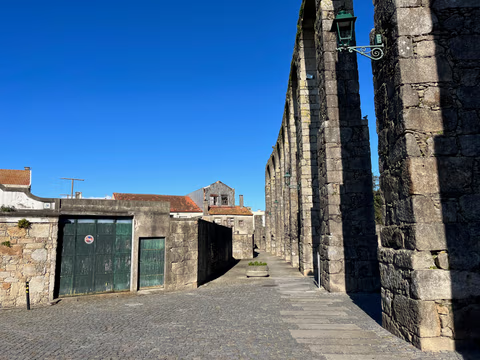
Aqueduct Trail – A path running along the Vila do Conde Aqueduct
From the Coastal Trail to the Camino Central: 12.9 km along the aqueduct from Vila do Conde to São Pedro de Rates. Route, stage, hostels, costs—explained honestly.
Read
Augsburg Way of St. James
The Augsburg Way of St. James runs 231.7 km in 11 stages from Oettingen in the Ries via Donauwörth, Augsburg, Bad Wörishofen and Ottobeuren to Ermengerst in the Allgäu — the Fuggerei, the Jakobervorstadt, a pilgrim of 1446 and Mozart's organ duel. Stages, hostels, costs.
Read

