

Pilgrimsrute Vestsjælland
119.9 kilometres, 6 stages, highest point 94 metres: the Pilgrimsrute Vestsjælland is the western section of the Danske Pilgrimsrute through the middle of Zealand — from the royal crypt in Roskilde cathedral via the lakes of Lejre into the forest of Haraldsted, where Knud Lavard was slain in 1131, to the royal necropolis of Ringsted, where the Danish network splits, south around the Sorø Sø through the Tystrup-Bavelse basin past the primeval forest of Suserup, over the Hvilehøj of Hellig Anders to Slagelse and past the Viking ring fortress of Trelleborg from 980 to the Great Belt. Operator: Foreningen af Danske Santiagopilgrimme, sections "Roskilde – Ringsted" and "Ringsted – Korsør". Frankly: the name is our Camino Ninja system, Sorø lies beside the route, not on it, no St James church on the way — and at the end the Great Belt Bridge is closed on foot.
- 01At a Glance
- 02Overview
- 03Other Names
- 04Ideal For – and Less So For
- 05Route & Landscape
- 06Stages, Terrain & Difficulty
- 07The Branching Point Lies in a Royal Crypt
- 08Highlights Along the Way
- 09How Pilgrims Reach This Route
- 10Continuing the Pilgrimage?
- 11Preparation & Practicalities
- 12What the Route Costs
- 13Getting There
At a Glance
- Start / Finish: Roskilde (Domkirke, Sankt Ibs Kirke) / Halsskov near Korsør (bridgehead of the Storebælt crossing)
- Length: 119.9 km
- Duration: 6 stages (Camino Ninja division), 5–8 days
- Elevation: ↗ 680 m / ↘ 720 m — glacial moraines, no mountains
- Highest point: 94 m at km 27.9 between Skov Hastrup and Valsølille
- Stages: 6 — Camino Ninja system on our waypoints; the operator cuts Roskilde–Ringsted 11+15+17 and Ringsted–Korsør 29+21+22 km
- Landscape: Roskilde Fjord, lake and moraine country of Lejre, forest of Haraldsted, farmland around Ringsted, Tystrup-Bavelse basin with the primeval forest of Suserup, hills of Slots Bjergby, Great Belt
- Operator: Foreningen af Danske Santiagopilgrimme (founded November 1999, over 5,100 members), waymarking checked at least twice a year. The name "Pilgrimsrute Vestsjælland" is Camino Ninja system; we bundle two operator sections
- Waymarking: yellow scallop shell on blue, square plaques on existing hiking trail posts; sparser than in Spain, GPX recommended
- Traces of St James: no St James church on the route — the Sankt Ibs Kirke stands at the start; the saints of this stretch are Knud Lavard, Hellig Anders and Mary
- Accommodation: beds reliably in Roskilde, Ringsted, Slagelse and Korsør; in between villages, shelters and Kongskilde on the Tystrup Sø; few pilgrim hostels, mostly June to August
- Junction and connection: in Ringsted (km 48.7) the Pilgrimsrute Sydsjælland – Lolland-Falster branches off south; from Korsør by train across the Storebælt to the Pilgrimsrute Fyn in Nyborg
- Best time: May to September
Overview
The branching point of this route lies in a royal crypt. In Ringsted, kilometre 48.7, stands the Sankt Bendts Kirke, in which Danish kings were buried for 150 years, from Valdemar the Great to Erik Menved — and exactly here the Danish pilgrim network splits: straight on to Funen and Jutland, left to the south to the ferry to Germany. The route there begins at the cathedral of Roskilde, the royal crypt with World Heritage status, and at the Sankt Ibs Kirke, Ib being Danish for James, leads via Svogerslev into the lakes of Lejre and through the forest of Haraldsted, in which Knud Lavard was slain on 7 January 1131 — chapel, holy spring, the oldest post-Reformation pilgrimage destination in Denmark. Beyond Ringsted Zealand becomes as mountainous as it can: the Tystrup-Bavelse basin, glacial meltwater valleys, the primeval forest of Suserup, 19 hectares untouched since 1920, then the hills of Slots Bjergby, where according to legend the priest Hellig Anders woke up after a ride from Jerusalem, Slagelse, the Viking ring fortress of Trelleborg from 980 — and the Great Belt at Halsskov.
Frankly: the name is our Camino Ninja system, the operator lists two sections, "Roskilde – Ringsted" and "Ringsted – Korsør", which we bundle into one week. Sorø with its abbey church is not on the route but four kilometres north — the marked route stays south of the lake. No St James church between start and finish, no Santiago pilgrim documented by name, the shell finds of the mappers of 2007 have no named find site, tarmac roads through farmland are part of it, pilgrim hostels are rare, and at the end the Great Belt Bridge is closed to pedestrians — to Funen you ride. What there is instead: two royal tombs, a murder forest with a holy spring, a primeval forest, a saint who was back from Jerusalem faster than his ship, and a ring fortress whose timber was felled in autumn 980. One saint went to Jerusalem and was back the same day. The other never got away from four kilometres from home.
Other Names
Pilgrimsrute Vestsjælland is Camino Ninja system: we have named the Danish routes by region so that you see at a glance where you are walking. The operating society, the Foreningen af Danske Santiagopilgrimme, works with pairs of towns and lists exactly this stretch as two sections of its Den Danske Pilgrimsrute: "Roskilde – Ringsted" (43 km, stages 11 + 15 + 17) and "Ringsted – Korsør (mod Fyn)" (72 km, stages 29 + 21 + 22). We have combined both into one week because in practice they are walked in one go; our 119.9 kilometres are the kilometrage of our route data, the operator arrives at 115.
On Danish portals you find the stretch as "Den Danske Pilgrimsrute Sjælland" with numbered stages and in stage reports as "Ringsted – Kongskilde" and "Kongskilde – Slagelse" — Kongskilde is the overnight point on the Tystrup Sø. The sub-name you find with us mentions Sorø; that is the area, not the waypoint: the trace runs south around the Sorø Sø, you see the abbey church if you walk up. Two more names you meet on the way: the Knud Lavard Pilgrimsruten, the short Catholic pilgrimage from Ringsted to Haraldsted, and the European long-distance path E6, whose posts the route shares in places. All the same route, the same shell.
Ideal For – and Less So For
Ideal if you want to read Danish history in buildings rather than hike through it: you start at a World Heritage cathedral, walk through the forest in which a king's son was slain in 1131, stand after two days in the royal necropolis of Ringsted, brush past a primeval forest and end at a Viking fortress that has been World Heritage since 2023. Ideal for weekend pilgrims: six stages, no real mountains, railway stations in Roskilde, Ringsted, Slagelse and Korsør — the route can be broken into two weekends. Ideal if you want to make the decision of the Danish network consciously: in Ringsted you stand at the only true fork between Funen and Germany. And ideal for landscape pilgrims with realistic expectations: the Tystrup-Bavelse basin is the most mountainous thing Zealand has to offer.
Frankly, though, it is not for you if you expect Spanish hostel density: between Roskilde and Korsør there are very few real pilgrim hostels, many houses open only from June to August, and Skov Hastrup, Vester Broby and Bøstrup are villages — gaps like that are planned away beforehand, not on the way. Not for you if tarmac bothers you: one pilgrim report explicitly names the roads through farmland as the weak point. Not for you if you want to rely on signs: the waymarking is "sparsommere end i Spanien", because every sign in the forest needs a permit, and without a GPX track you get lost at least once. And not for purists: the route ends at the water, the Great Belt Bridge is closed on foot, to Nyborg you ride.
Route & Landscape
Roskilde – Ringsted: The route begins on the Roskilde Fjord, at the cathedral and the Sankt Ibs Kirke, and works its way via Svogerslev into the lake and moraine landscape of Lejre — gentle humps, hedges, sunken lanes, between them the white village churches. At Skov Hastrup and Valsølille it gets more wooded, here lies the highest point of the route at 94 metres, and at Haraldsted you walk through the crime scene of Danish history: here Knud Lavard fell, here stands his chapel, here the holy spring bubbles, here stand the four crucifixes of 1921. In Ringsted you reach the middle of Zealand — flat, wide, farmland, and in the middle of it the massive brick church of the kings, at which the route branches off south.
Ringsted – Korsør: South-west of Ringsted it gets really beautiful once more. Via Høm, Alsted and Vester Broby the route draws into the basin of the lakes Tystrup and Bavelse, glacial meltwater valleys with steep slopes; at Suserup you brush past Denmark's most famous primeval forest, and Sorø with its abbey church lies four kilometres north across the lake. Then it flattens out: Lynge-Eskilstrup, Lorup, Bøstrup, the farmland around Rosted and Harrested, then the group of hills at Slots Bjergby with the cross of Hellig Anders on the Hvilehøj, from where you already see the Great Belt. Slagelse with Sankt Peders and Sankt Mikkels Kirke, the monastery grounds of Antvorskov on the edge of town, then Trelleborg and the spit of Frølunde Fed — and the route ends at the water in Halsskov, where the bridge begins that you may not walk. Surface: field tracks, forest paths, sunken lanes in the lake basin, longer tarmac sections through farmland; there is no measured share.
Stages, Terrain & Difficulty
We divide the 119.9 kilometres into six stages averaging 20.0 kilometres — Camino Ninja system; the operator cuts Roskilde–Ringsted into 11 + 15 + 17 and Ringsted–Korsør into 29 + 21 + 22 kilometres and arrives at 115. Every stage boundary below is a waypoint of our route data, every kilometre figure the difference between two points, the total exactly the 119.9 kilometres of our route. If you have seven days, split the long second stage at Valsølille (32.9) or Haraldsted (39.9).
- Roskilde – Skov Hastrup (22.8 km) — from cathedral and Sankt Ibs Kirke via Svogerslev into the lake landscape of Lejre.
- Skov Hastrup – Ringsted (25.9 km) — the longest stage: highest point (94 m), Valsølille, murder forest and holy spring of Haraldsted, arrival at the Sankt Bendts Kirke.
- Ringsted – Vester Broby (19.4 km) — via Høm and Alsted into the hills and sunken lanes of the Tystrup-Bavelse basin.
- Vester Broby – Bøstrup (15.7 km) — past the primeval forest of Suserup, detour to Sorø possible (4–5 km), on via Lynge-Eskilstrup and Lorup.
- Bøstrup – Slagelse (14.9 km) — Rosted, Harrested, Slots Bjergby with Hellig Anders' cross on the Hvilehøj, down to Slagelse.
- Slagelse – Halsskov (21.2 km) — Antvorskov on the edge of town, Trelleborg, Frølunde Fed, Svenstrup; finish on the Great Belt.
Nothing is technically difficult: field tracks, forest paths, tarmac. The 680 metres of ascent are spread over 120 kilometres — here the calf is trained, not the lungs. What is demanding is something else: the 25.9 kilometres of the second day, the tarmac stretches through farmland, and the search for lodgings in the villages between the towns. Beds are reliably available in Roskilde, Ringsted, Slagelse and Korsør, plus Kongskilde Friluftsgård on the Tystrup Sø; waterproof shoes are more important here than light ones, the meadows are wet.
The Branching Point Lies in a Royal Crypt
In Ringsted, kilometre 48.7, you stand in front of the Sankt Bendts Kirke, a brick building of around 1200 that counts as one of the high points of Romanesque brick architecture in Denmark — and in front of the only true fork of the Danish pilgrim network. Straight on it goes to Korsør, Funen and Jutland, left the route branches off south to the ferry to Germany. That the decision falls here has a reason from 1131: on 7 January of that year Knud Lavard, Duke of Schleswig and king's son, was slain in the forest of Haraldsted, nine kilometres before Ringsted, by his cousin Magnus. He was buried in Ringsted, in 1135 the monastery arose, in 1169 the pope canonised him, in 1170 the coronation of his grandson Knud VI as co-king was celebrated with a great church festival — and for 150 years, from Valdemar the Great to Erik Menved, the Danish kings had themselves buried here. A frieze of around a hundred noble coats of arms from around 1300 runs along the walls. In Haraldsted stand Knud Lavard's chapel and the holy spring, and the Knud Lavard Pilgrimsruten there is Denmark's oldest post-Reformation pilgrimage: marked by four crucifixes erected in 1921 — the wayside cross on the Holbækvej, four metres high, carved in Oberammergau, was the first wayside cross in Denmark for over 400 years. The fork of this pilgrim network is a grave. And the route there is a pilgrimage that was permitted again in 1921.
Two saints, two directions. Knud never came back from Haraldsted; the other saint of this route came back faster than his ship. Hellig Anders, priest at the Sankt Peders Kirke in Slagelse around 1200, never canonised but venerated, falls asleep according to legend — written down around 1250 — on the shore in Jerusalem, "i søvne oplever han, at en rytter byder ham sidde op hos sig", a rider lets him mount, and he wakes up on the Hvilehøj near Slots Bjergby, kilometre 92, in time to sing vespers in his own church the same day. His cross on the hill was renewed in 1952, and from there you see the Great Belt for the first time. That is the only long-distance pilgrim biography this route has, and it goes to Jerusalem, not to Santiago — we say it as it is. What Slagelse otherwise had disappeared in 1533: on Palm Sunday of that year the only documented Danish iconoclasm outside Copenhagen took place in the Sankt Mikkels Kirke, which is why almost all the medieval furnishings are missing. And on the edge of town lies Antvorskov, "Nordens ældste johanniterkloster", founded in the mid-1160s after Archbishop Eskil had brought the Knights Hospitaller to Denmark — a house whose purpose was to send a large part of its income every year to the headquarters in the Holy Land, and in which Hans Tausen preached Lutheran doctrine for the first time in 1524. Today the E20 motorway cuts through the grounds.
And then the route itself, which leaves Sorø to the left — and that is no oversight. Beyond Ringsted the trace runs via Alsted and Vester Broby south around the Sorø Sø into the basin of the lakes Tystrup and Bavelse; the overnight point of the pilgrim portals is called Kongskilde, not Sorø. The Sorø Klosterkirke, occupied in 1161 by Absalon with Cistercians from Esrum, built 1161 to 1201 in red brick, then a new material, burial place of Absalon and three kings, is a detour of four to five kilometres. Instead the route brushes past Suserup Skov: 19 hectares, untouched since 1920, "enestående for det nordvesteuropæiske lavland", entry only on trodden paths and at your own risk, dead wood and trees that nobody fells. The marked route chooses the primeval forest over the abbey church — and Absalon, who built Roskilde and Sorø, lies four kilometres beside it. At the end Trelleborg: timber felled in autumn 980, built in spring 981, 137 metres in diameter, five-metre rampart, 16 longhouses in four squares, fully excavated 1934 to 1942 as the only ring fortress, World Heritage since 2023 in the same inscription as Aggersborg on the Jutland northern branch. A route without a St James church, with two royal tombs, a primeval forest and a ring fortress — and a bridge at the end that you may not walk. That is Vestsjælland: it lets you ride where walking is no longer possible, and shows you beforehand why the walking was worth it.
Highlights Along the Way
- Roskilde Domkirke — construction begun in the 1170s under Absalon, "Nordens første gotiske teglstenskirke", UNESCO World Heritage since 1995, main burial place of the Danish kings.
- Sankt Ibs Kirke, Roskilde — Ib is Danish for James: first documented 1291, stone building around 1100–1150, hospital for Spanish soldiers in 1808, restored 1922; here the route begins.
- Svogerslev and the lakes of Lejre — moraine country with sunken lanes, hedges and white village churches.
- Haraldsted — the forest in which Knud Lavard was slain on 7 January 1131; chapel remains, holy spring and four crucifixes of 1921, including Denmark's first wayside cross for over 400 years.
- Sankt Bendts Kirke, Ringsted — brick building around 1200, royal burial place from Valdemar the Great to Erik Menved, frieze with around 100 noble coats of arms around 1300; here the Danish network splits.
- Tystrup-Bavelse basin — glacial meltwater valleys with steep slopes; Kongskilde Friluftsgård on the lake.
- Suserup Skov — 19 hectares of primeval forest, untouched since 1920, "enestående for det nordvesteuropæiske lavland"; only on trodden paths, at your own risk.
- Sorø Klosterkirke — detour 4–5 km: occupied in 1161 by Absalon with Cistercians from Esrum, church 1161–1201 in red brick; burial place of Absalon, Christoffer II, Valdemar Atterdag and Oluf II.
- Hellig Anders' Kors on the Hvilehøj — near Slots Bjergby the spot where the Slagelse priest, according to legend, woke up after his ride from Jerusalem; cross renewed 1952; first view of the Great Belt.
- Sankt Mikkels Kirke, Slagelse — Gothic brick church, vaults 1333; on Palm Sunday 1533 scene of the only documented Danish iconoclasm outside Copenhagen.
- Antvorskov — "Nordens ældste johanniterkloster", founded in the mid-1160s; in 1524 Hans Tausen preached Lutheran doctrine here for the first time; today cut through by the E20.
- Trelleborg — Viking ring fortress, timber felled in autumn 980, 137 m in diameter, 16 longhouses, fully excavated 1934–1942, museum since 1995, UNESCO World Heritage since 2023.
- Halsskov and Korsør — bridgehead of the Storebælt crossing; Korsør Fæstning around 1300, town charter 1425, bridge to Halsskov 1847.
How Pilgrims Reach This Route
Roskilde is the best-connected starting point of the Danish network, and two Camino Ninja routes end here. The Pilgrimsrute Nordsjælland comes in 104.4 kilometres from the ferry in Helsingør via Gurre, Esrum, Hillerød and Ballerup — the route with the densest St James trail in Denmark and the Albergue Ballerup. The Pilgrimsrute København – Roskilde brings you in 51.4 kilometres directly from Kastrup airport, which sounds unusual but is the operator's logic: the society itself lists the stage "Kastrup – Ishøj". If you come from Sweden, take the ferry to Helsingør or the train to Kastrup — the Danish network expressly understands itself as the extension of the route "fra Vadstena i Sverige til Santiago de Compostela".
If you only want to walk this section, get off the train in Roskilde: from Copenhagen Central around 25 minutes, from the airport with through trains. And if you only want the more beautiful second part, start in Ringsted, a good 30 minutes from Copenhagen on the high-speed line — there you also stand at the fork where the Pilgrimsrute Sydsjælland – Lolland-Falster heads south. You get your pilgrim passport from the society, which has sold it exclusively in Denmark since 1999: 25 DKK for members, 50 DKK for non-members (as of September 2026), 13 pages, room for 78 stamps.
Continuing the Pilgrimage?
The route ends at a break, and that needs saying frankly: the Great Belt Bridge is closed to pedestrians and cyclists. From Halsskov you only get across the Great Belt to Nyborg on Funen by train or bus, 15 minutes — that is exactly why the operator cuts its section here, "Ringsted – Korsør, mod Fyn". In Nyborg the Pilgrimsrute Fyn begins and leads in 161.6 kilometres via Odense, Middelfart and Kolding to Vejen. There the route meets the Hærvejen, the old ox road, and goes with it to Padborg on the German border, where the Via Jutlandica takes over.
The second possibility already lies behind you: in Ringsted, kilometre 48.7, the Pilgrimsrute Sydsjælland – Lolland-Falster branches off and leads in 149.0 kilometres via Næstved, Vordingborg, Falster and Maribo to Rødbyhavn, to the ferry to Puttgarden — there the Via Scandinavica to Lübeck begins. If you want Germany, turn off at the Sankt Bendts Kirke and need not see Korsør. Both strands find their way into the European network via the Via Baltica; in Saint-Jean-Pied-de-Port the Camino Francés begins. From Roskilde to the apostle's tomb is around 3,200 kilometres. The first 119.9 you will then have behind you.
Preparation & Practicalities
Best time: May to September. Technically the route works all year, but the few pilgrim hostels mostly open only from June to August, and in the Danish winter it is dark by 4 p.m. Expect wind from the Belt and wet meadows — waterproof shoes are more important here than light ones. Waymarking and navigation: yellow scallop shell on blue, square plaques on the posts of existing hiking trails, checked by the society at least twice a year, but "sparsommere end i Spanien", because every sign in the forest needs a permit; where there is no sign, you go straight on. Download the GPX track and plan stages and lodgings most easily directly in the Camino Ninja app. Pilgrim passport: Pilgrimspas from the society (exclusive right since 1999), 25 DKK for members, 50 DKK for non-members, 78 stamp fields; stamps in churches and hostels. Language: Danish, English everywhere. Water: at churches and cemeteries — the route is deliberately laid from church to church.
Accommodation: Beds are reliably available in Roskilde, Ringsted, Slagelse and Korsør — Danhostels, B&Bs, hotels; in between it is thin: Skov Hastrup, Vester Broby and Bøstrup are villages, Kongskilde Friluftsgård on the Tystrup Sø is the overnight point of the portals, and primitive campsites and shelters you find via udinaturen.dk, many free. Outside the Hærvejen section there are only two official pilgrim hostels on the whole Danish route, none of them here — book beforehand, do not hope on the way. Supplies: no problem, supermarkets in Roskilde, Ringsted, Slagelse and Korsør, the route leads through or close to many places. Packing list: waterproof shoes, rain layer, offline maps, power bank, sleeping bag for shelters.
What the Route Costs
You pay in Danish kroner, and frankly this route is cheaper than its country if you stick to the simple beds. The figures are providers' figures and general Danish orders of magnitude (as of September 2026). Pilgrim hostels 80–125 DKK (11–17 €) in a dormitory with self-catering, Vandrerhjem 100–200 DKK (13–27 €) per person, Danhostel room from about 600 DKK (80 €), hotel and B&B in Roskilde, Slagelse and Korsør on average 580 DKK for two (78 €) and more; shelters mostly free or a few kroner. Admission: churches free, Roskilde Domkirke and Trelleborg museum charge, Suserup Skov and Haraldsted free. Train Korsør–Nyborg across the Storebælt at regional fare.
Realistic daily budget: 200–350 DKK (27–47 €) frugal with shelter or hostel and self-catering; 500–750 DKK (67–101 €) mid-range with B&B or Danhostel and a warm meal; 900–1,300 DKK (121–174 €) comfortable with hotels in Roskilde, Ringsted, Slagelse and Korsør. For six stages that is roughly 1,200–2,100 DKK (160–280 €) frugal on the ground, plus pilgrim passport, train across the Belt and travel. Two ways to save: cook — supermarkets lie in every town on the route — and the shelters in the Tystrup-Bavelse basin, where lodgings are scarce anyway.
Getting There
To the start (Roskilde): You reach Roskilde from Copenhagen Central in around 25 minutes on DSB regional and InterCity trains, from Kastrup airport with through trains; from Germany via Hamburg–Copenhagen or via Fredericia. If you want to walk the feeder, walk the 51.4 kilometres from the airport on the Pilgrimsrute København – Roskilde.
On the way and from the finish (Korsør): Ringsted lies on the high-speed line København–Ringsted, a good 30 minutes from Copenhagen — the most practical point to walk the second half separately; Slagelse has an InterCity stop. Halsskov lies on the northern edge of Korsør, to Korsør station it is a few kilometres; from there trains run to Copenhagen (around an hour) and across the Great Belt to Nyborg and Odense — on foot across the bridge is not possible. Natural dividing point: Ringsted — Roskilde–Ringsted 48.7 kilometres, Ringsted–Halsskov 71.2.
- Rail Denmark: dsb.dk — Roskilde, Ringsted, Slagelse, Korsør, Korsør–Nyborg across the Storebælt
- Journey planner train and bus: rejseplanen.dk — nationwide
- Rail from Germany: bahn.de — Hamburg–Copenhagen
- Operator, stages, GPS, pilgrim passport: santiagopilgrimme.dk — Foreningen af Danske Santiagopilgrimme
- Shelters and campsites: udinaturen.dk — state portal, map and booking
- Trelleborg: visitdenmark.com — Viking fortress and museum

Get your pilgrim credential and shell
Everything you need for the Pilgrimsrute Vestsjælland, shipped to your door.
Visit Camino Shop
Other Caminos
 Appenzeller Weg
Appenzeller Weg
52.6 km from Rankweil across the Rhine to St. Peterzell: St. James Chapel (1464), 163 Years of the Wedding Trail, connection to the Via Jacobi. Stages, costs, how to get there.
Read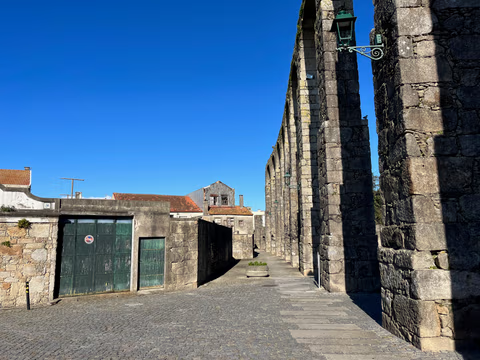
Aqueduct Trail – A path running along the Vila do Conde Aqueduct
From the Coastal Trail to the Camino Central: 12.9 km along the aqueduct from Vila do Conde to São Pedro de Rates. Route, stage, hostels, costs—explained honestly.
Read
Augsburg Way of St. James
The Augsburg Way of St. James runs 231.7 km in 11 stages from Oettingen in the Ries via Donauwörth, Augsburg, Bad Wörishofen and Ottobeuren to Ermengerst in the Allgäu — the Fuggerei, the Jakobervorstadt, a pilgrim of 1446 and Mozart's organ duel. Stages, hostels, costs.
Read

